|
|
October 5th, 2009
 We interviewed Chris Hodgdon of Hodgdon Powder Co. and learned some important information about the IMR’s new 8208 XBR powder. First Chris confirmed that ADI (Australian Defense Industries Ltd.) is the manufacturer. The powder is a very small extruded powder, similar to H322 in kernel size. That means it packs densely in a case and meters well in manual powder measures. As to burn rate, Chris stated that IMR 8208 XBR is “a tad slower than H4895.” Chris confirmed that the powder’s distinctive qualities are temp stability in an ultra-wide temperature range and a very broad accuracy window. Chris said: “Jim Carmichael found he could go up and down [significantly] in his charge weight and the group size didn’t vary.” We interviewed Chris Hodgdon of Hodgdon Powder Co. and learned some important information about the IMR’s new 8208 XBR powder. First Chris confirmed that ADI (Australian Defense Industries Ltd.) is the manufacturer. The powder is a very small extruded powder, similar to H322 in kernel size. That means it packs densely in a case and meters well in manual powder measures. As to burn rate, Chris stated that IMR 8208 XBR is “a tad slower than H4895.” Chris confirmed that the powder’s distinctive qualities are temp stability in an ultra-wide temperature range and a very broad accuracy window. Chris said: “Jim Carmichael found he could go up and down [significantly] in his charge weight and the group size didn’t vary.”
Hodgdon has already begun shipping IMR 8208 XBR to “OEM manufacturers” according to Chris, who said a major manufacturer will be loading the powder into .308 Win ammo and possibly other cartridges. Chris hopes to send AccurateShooter.com some of the new 8208 XBR powder for testing within two weeks. When will the powder be available to the general public? Chris couldn’t give a firm answer, but he stated “we hope to start shipping in January, 2010, prior to SHOT Show.”
IMR 8208 XBR Load Data Now Online
The Hodgdon Reloading Center site has been updated to include IMR 8208 XBR load data for 41 cartridges. Go to www.data.hodgdon.com and select “Cartridge Loads”. Then you’ll need to input the rifle cartridge of your choice. We quickly found IMR 8208 XBR loads for the .223 Rem, 22 PPC, 22-250, 6 PPC, 6mm BR, 6.5 Grendel, and .308 Win, and many other cartridges. NOTE: For most of these cartridges, the stated “max load” velocities were NOT particularly impressive. So, be aware, that this initial load data is pretty conservative.

October 5th, 2009
One of our readers, Rafal Walczowski, revealed that programmers from Poland have developed ballistics software for cell phones. The new program, KABAL, should be able to operate in over 90% of programmable mobile phones. Rafal tells us: “Our idea was to develop software which could be used on the most common devices people carry all the time — mobile phones.” Current mobile ballistics programs require a separate device (such as a Windows PDA), or are limited to a single type of phone (e.g. the KAC program for the I-Phone). The Polish developers came up with a handier, more universal application: “We made software that should work on every device with JAVA MIDP.2.0. That should work for about 90-95% of the phones on the market. And, later, we will make a KABAL version that runs with older versions of JAVA.”

Rafal reports the KABAL Ballistics program for mobile phones has worked well in field tests: “The algorithm for our calculator was field-tested for 18 months at ranges up to 1076 meters. Many different calibers, rifles, and bullets were employed during testing. We are pleased with the results, even when compared to QuickTarget and Exbal programs. Our KABAL program often proved more accurate, especially for long-range calculations, whereas QuickTarget and Exbal could be too optimistic.”
English Version Coming Soon — and Free BETA Version Online
Rafal reports: “Several weeks ago we finished the Polish version of KABAL and we are selling it for mobile phones. We are now are working on an English-language version, which is currently in beta testing.” There is a free English test version that works in a PC browser. This includes a BC database, a bullet stability calculator, plus tooltips describing each field. You can try out the free online beta version by clicking the link below. Rabal adds: “We would highly appreciate any opinions/feedback about our software”.
CLICK HERE for Beta Version of English KABAL Ballistics Software (Web use only)
October 3rd, 2009
 Hodgdon Powder Co. has unveiled a brand new powder, IMR 8208 XBR. From early reports, this is an exceptional new propellant that may change the way the game is played in short-range benchrest. According to Hodgdon, “IMR 8208 XBR is a remarkably advanced technology propellant” formulated for popular match, varmint and sniper rounds, including 223 Rem, 308 Win, 6mm PPC, 204 Ruger, 6mm BR, 22-250 Remington and similar calibers. We’re told the powder is being produced by ADI in Australia. Hodgdon Powder Co. has unveiled a brand new powder, IMR 8208 XBR. From early reports, this is an exceptional new propellant that may change the way the game is played in short-range benchrest. According to Hodgdon, “IMR 8208 XBR is a remarkably advanced technology propellant” formulated for popular match, varmint and sniper rounds, including 223 Rem, 308 Win, 6mm PPC, 204 Ruger, 6mm BR, 22-250 Remington and similar calibers. We’re told the powder is being produced by ADI in Australia.
IMR 8208 XBR is Consistent in All Conditions
This short grain extruded rifle powder exhibits exceptional stability with virtually no change in velocity at temperatures ranging from -40 degrees F to 165+ degrees F. Lou Murdica, who helped develop this new powder, confirms that it is not temp-sensitive. Lou told us: “I have been shooting IMR 8208 XBR for over a year and I have done a lot of winning shooting it. One of the great things about this particular powder is, I always shoot the same load whether I shoot it in Florida or Phoenix AZ. I have never had to adjust for temperature or humidity.” That’s big news in the short-range BR game. Currently, most competitors must tailor their load to suit conditions.
IMR 8208 XBR is Already Winning Matches
Lou Murdica, one of the nation’s top BR shooters, won numerous matches with 8208 XBR in 2009, including the Heavy Varmint Grand Agg at the Cactus Classic. In August 2009, Jim Carmichel won the Heavy Varmint Grand Agg at the IBS Group Nationals. What is significant here is that Jim shot the exact same load of IMR 8208 XBR both days to win the event. That’s right–this powder requires far less “tuning” than most other powders currently used in short-range benchrest.
Product Development and Performance
Lou Murdica revealed some interesting facts about IMR 8208 XBR. Lou explained that the development team was initially trying to produce a propellant that would match the desireable characteristics of the “classic” T32 powder from the 1960s. In the process of developing a T-Powder clone, Lou says that the Hodgdon/IMR powder wizards came up with something even better: “We were originally pursuing a formula like T-Powder, but we came up with something a bit different. It was so good, and shot so well, that we didn’t want to lose it. It turned out that this stuff shot as well or better than the earlier T-clone mixtures and was incredibly stable.”
 Lou continued: “I’ve shot a lot of T-Powder and it is sensitive in certain way. I feel this new powder is equal to, if not better than, a T-Powder clone because 8208 XBR is not sensitive. I can shoot the same load, at any location, in any temperature or humidity. Additionally, and this is very important — the new powder is very forgiving. It has a very broad accuracy window. If you’re shooting 30.0 grains in a 6 PPC successfully, we found you could go down to 29.8, or up to 30.2 and the accuracy was still there. You won’t see a change in group size. It has a very wide and forgiving load window.” Lou continued: “I’ve shot a lot of T-Powder and it is sensitive in certain way. I feel this new powder is equal to, if not better than, a T-Powder clone because 8208 XBR is not sensitive. I can shoot the same load, at any location, in any temperature or humidity. Additionally, and this is very important — the new powder is very forgiving. It has a very broad accuracy window. If you’re shooting 30.0 grains in a 6 PPC successfully, we found you could go down to 29.8, or up to 30.2 and the accuracy was still there. You won’t see a change in group size. It has a very wide and forgiving load window.”
[CAUTION: These charge weights may be excessive with your rifle and your bullets. Always start 10% low and work up.]
The new powder is versatile and has plenty of energy. Lou tells us “8208 XBR is a great powder. With a 6 PPC shooting 68-grainers, I can get up into the 3500 fps range. And the powder will work with larger cases too. I’ve tried it with success in a 6BR with 105s and I think it will work in a Dasher or 6 BRX. I also shot it in a 22BR successfully.”
Lou predicts that IMR 8208 XBR will have a big impact on the Benchrest game once it is widely available: “Once this powder gets in people’s hands I think you’re going to see GREAT things. It’s not finicky. It meters really well out of normal powder measures. It’s really stable. There are plusses all around. We’ll know within a year whether it becomes the powder to beat.”
Lou is no longer involved in the sale or distribution of IMR 8208 XBR: “I’m not in it any more. I have to buy my powder like everyone else.” But he encourages all BR shooters to give it a try: “The powder is fantastic. I have been telling everyone to go to your powder dealers and order it. Buy a jug and shoot it.”
Lou has high praise for the folks at Hodgdon: “You can’t say enough good things about Chris Hodgdon and Hodgdon’s willingness to develop this new powder. They’ve finally given us something we’ve really wanted and really needed. What they have done is great.”
Product Availability — IMR 8208 XBR in Short Supply until 2010
IMR 8208 XBR will be available in 1-lb canisters and 8-lb kegs in 2010. Hodgdon has produced limited quantities already, and you may be able to find some 8208 XBR at popular vendors, such as Powder Valley, in early January, 2010. You’ll need to call around to see who has it.
For more information or complete data visit imrpowder.com, phone IMR at (913) 362-9455 or write to 6231 Robinson, Shawnee Mission, KS 66202.
September 30th, 2009
 The 7th Long-Range World Muzzle-Loading Championships were held September 24-27 at Camp Butner, North Carolina. Shooters from seven nations competed at distances between 300 and 1,000 yards. Competitors employed percussion target rifles of 19th-century design (though many were modern reproductions). Typically between .40 and .50 caliber and weighing around fifteen pounds, these rifles represent the apogee of mid-1800s firearm technology. The 7th Long-Range World Muzzle-Loading Championships were held September 24-27 at Camp Butner, North Carolina. Shooters from seven nations competed at distances between 300 and 1,000 yards. Competitors employed percussion target rifles of 19th-century design (though many were modern reproductions). Typically between .40 and .50 caliber and weighing around fifteen pounds, these rifles represent the apogee of mid-1800s firearm technology.
The World Muzzle-Loading Championships, held since 1972, is the highest level of target shooting with muzzle-loading arms. Guns used range from Japanese matchlock muskets, through the flintlocks of the American Revolution, to the percussion arms of the Civil War era. Individual competitions are held in eight rifle, four pistol, and two shotgun events. Original antique arms and modern replicas compete in separate classes.

CLICK HERE for complete match results. American competitors excelled in the original-arms division of the matches. Firing 150-year-old antiques, Karl Kuehn took gold in the 1,000-yard match and silver in the 900-yard match, carrying him to triumph in the overall long-range aggregate and earning a bronze medal in the Grand Aggregate. Nor was Kuehn the only medalist. Al Roberts won the original division of the 600-yard match, while Mon Yee took bronze at 300 and 500 yards — scores which earned him bronze in the mid-range Agg as well.
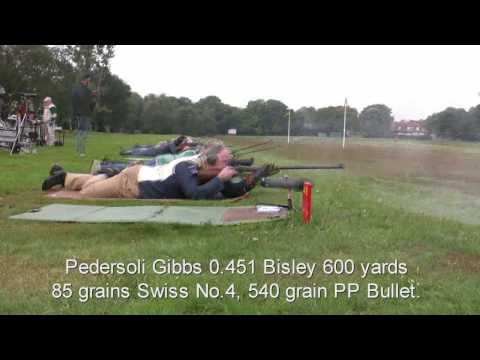
The Long-Range Muzzle-Loading World Championship was held under the auspices of the Muzzle-Loading Associations International Committee (MLAIC), the world governing body for black powder competition. The 8th World Long-Range Championship will be held in 2011, at the famed Bisley range in Great Britain. Shown below is a Pedersoli Gibbs target rifle at Bisley during the UK National Championships. Repro rifles like this won 10 gold medals at the 2007 World LR muzzle loading championships in South Africa.
More information on long-range muzzle-loading is available at www.lrml.org and www.usimlt.org (USA Team website).
September 20th, 2009
 After scanning the equipment list for the recent 600-yard IBS Nationals, one of our readers noted how the 6mm Dasher dominated the Top 10 list in both Light Gun and Heavy Gun Classes. But Sam Hall won the Grand Agg with a straight 6BR, Mike Davis won the Heavy Gun Agg with a 6BRX, and Richard Schatz won the Light Gun Agg with a 6mm Dasher. So which cartridge should you pick? What’s the best for the 600-yard game — 6BR or Dasher or BRX? After scanning the equipment list for the recent 600-yard IBS Nationals, one of our readers noted how the 6mm Dasher dominated the Top 10 list in both Light Gun and Heavy Gun Classes. But Sam Hall won the Grand Agg with a straight 6BR, Mike Davis won the Heavy Gun Agg with a 6BRX, and Richard Schatz won the Light Gun Agg with a 6mm Dasher. So which cartridge should you pick? What’s the best for the 600-yard game — 6BR or Dasher or BRX?
Sam Hall, 2008 IBS 600-yard Shooter of the Year and back-to-back 2009/2008 IBS 600-yard National Champion, offers this advice:
“I shot a Dasher most of this year at IBS 600-yard matches and shot a no-turn BRX in a couple of shoots. I even tried a BRDX (40° improved with a longer neck than Dasher) in a practice barrel. By looking at the results on my target, I would never have been able to tell the difference between any of them if I did not already know what cartridge I was shooting. The 6BR or an improved version are just downright inherently accurate. They are all easy to load for and tune. I do believe the 6-6.5×47 Lapua is harder to get tuned than the 6BR. There are always the exceptions though. I have been beaten a few times this year by one exceptionally good shooting 6-6.5×47.
My next step is to try a no-neck-turn 6BR. I have been beaten by some a few times. I am now wondering if neck-turning is worth the time. A lot of the top BRX and Dasher shooters are not turning their necks and doing extremely well.

In my opinion pick your favoite BR or improved version, learn it well, practice, and don’t deviate. If someone you know shoots a BRX (or Dasher) and has a lot of experience with it — that is a good head start for loads. You can then compare what shoots good and what does not. I sure did not learn everthing on my own. I got some good load info here on this website (AccurateShooter.com) and I used to hound Terry Brady to death for loads to find out what he was winning with. Don’t be afraid to ask questions! I still do! Good luck and have fun.”
– Samuel Hall
September 16th, 2009
Readers often ask: “What priming tool should I use?” There is no simple, clear-cut answer. Different tools have different advantages and disadvantages. Many short-range benchresters like the Sinclair one-at-a-time priming tool. They believe this unit has the best “feel” for seating primers.
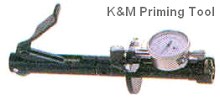 Others prefer the K&M tool, another “single-loader”, because it can be fitted with a seating depth gauge, for the ultimate in precision. On the other hand, one top shooter with a couple National Championships under his belt favors the modest $19.00 Lee Autoprime tool: “It’s simple, efficient and has served me well for years–I’m not convinced the fancy, expensive tools do a better job.” Others prefer the K&M tool, another “single-loader”, because it can be fitted with a seating depth gauge, for the ultimate in precision. On the other hand, one top shooter with a couple National Championships under his belt favors the modest $19.00 Lee Autoprime tool: “It’s simple, efficient and has served me well for years–I’m not convinced the fancy, expensive tools do a better job.”
This editor has tried all of these tools, and personally I favor the RCBS APS hand priming tool. It has two important advantages. Number one, primers are held in color-coded plastic strips so you never have to touch the primers. If you buy the pre-loaded strips, there is no chance of getting an upside-down primer, and you never have to fool with flipping primers in a tray. Second, the APS tool has a “universal” shell-holder. This employs spring-loaded jaws so it can fit any size cartridge, from a 17 Fireball to large magnums. The unit has a comfortable grip and plenty of leverage. Each time you seat a primer, the strip automatically advances. (NOTE: If you like the universal shell holder but don’t like strips, RCBS offers a new m90201 Universal Hand Priming Tool with a universal shell-holder that uses a conventional primer tray.)
 
Currently, only CCI primers can be purchased pre-loaded into strips. But there is an inexpensive tool that allows you to load Federal, Winchester, or Wolf primers into the strips. The strips come in a variety of colors (Red, White, Blue, Orange, Yellow, and Black), so you can sort your primers by color.

The RCBS APS hand primer is ideal when doing primer comparison testing. You can slide one strip of 25 primers in the tool, seat 5 or 10, then easily remove the strip with the remaining primers, and slide in a second strip with another primer type. You can slip the first strip back in a storage box and the primers remain ready to use.
As contained in the strips, primers can also be used in an RCBS 2000 progressive press, a bench-mounted priming unit, and a special device that fits into the top of a Rockchucker or similar press. I have loaded over 20,000 pistol rounds with an RCBS progressive press and I have had not a single flipped primer. Not one. The strip-priming system also makes it easy to switch from small to large primers on the progressive–this can literally be done in under 20 seconds.

The bench-mounted unit is ideal for priming large quantities of cases. The long handle provides plenty of leverage, and you can work fast, as the primers automatically feed through the system. When I load large quantities of varmint rounds, I use the bench-mounted APS system. The only gripe I have concerns the small plastic bushing that guides the primer seating rod. This bushing breaks easily and is easy to lose.
September 13th, 2009
Here’s a nice do-it-yourself project for the winter. Simpson, maker of Strong-Tie fasteners, offers FREE Workbench Plans for a sturdy, 48″-wide bench with a pegboard backing and both upper and lower shelves. A complete list of fasteners and cut lengths is provided. For use as a loading bench with mounted presses, you can double-up the bench-top for extra ridigity. Without much difficulty, the plans can be adapted to build a wider bench if you prefer.

The same downloadable document also contains plans for an 80″-high 6-shelf unit, a 72″-high heavy-duty shelving unit (with 4 shelves), and a 48″-wide heavy-duty table.
September 12th, 2009
Our current “Cover Story” for the website is about the 6XC Cartridge. German Salazar, a top prone shooter who has won the Arizona NRA Long-Range Championship using the 6XC, reveals how to get the most accuracy out of the cartridge. German discusses brass options, recommended bullets for long-range competition, and German also discusses the pros and cons of various 6XC dies.
CLICK HERE for 6XC Cartridge Review by German Salazar.
The 6XC cartridge was developed by David Tubb, and it has captured multiple Camp Perry Championships. Now that Norma brass is available, the 6XC is an outstanding choice for shooters looking for an ultra-accurate, easy-recoiling cartridge that offers more “horsepower” than the 6BR or 6BR Improved. Team Norma, shooting factory-loaded 6XC ammo, captured the 2007 300m world championship. This was the first time in many years that a cartridge other than the 6BR has won “all the marbles” in international 300m competition. And just last week, the Swedish Team of Anders Brolund, Johan Gustafsson, and Mikael Larsson won the 2009 European 300m Championship shooting the Norma 6XC.


Forum members and 6XC shooters Mudcat and German Salazar are both very happy with their choice of chamberings. German tells us:
“The 6XC is a great long-range cartridge, it needs no excuses and can hold its own against any other LR cartridge. I prefer to use Norma 6XC brass, but 22-250 brass can be used by running through a 6XC full-length die and then fire-forming. It will look pretty nasty at first, but it will shoot just fine even fire-forming.
 I principally use the 6XC for 1000-yard prone shooting (sometimes at 600). The main bullet I use is the Berger 115 VLD (in a 30″ Krieger with 1:7.5″ twist). The best powder I’ve found for the Berger 115 in the 6XC is H4831sc. Velocity is in the 3000 fps range. I principally use the 6XC for 1000-yard prone shooting (sometimes at 600). The main bullet I use is the Berger 115 VLD (in a 30″ Krieger with 1:7.5″ twist). The best powder I’ve found for the Berger 115 in the 6XC is H4831sc. Velocity is in the 3000 fps range.
Whether the 6XC is ideal for any given person depends on a lot of factors. I tend to shoot fast and keep the rifle in my shoulder. Accordingly, a low-recoil cartridge suits me because it doesn’t require any repositioning of the rifle or rebuilding of position during a 22-shot string. I know how to read wind, so whether a cartridge drifts a few inches more or less than another isn’t really a concern to me, I learn the cartridge’s behaviour and work with what I’ve got. The 6XC shines because it is ACCURATE at 1000 yards and without that, you’ve got nothing. Accuracy, low recoil, reasonable wind drift, good component availability, decent barrel life, what else is there to want in a long-range cartridge?”


Mudcat concurs that the 6XC is a great cartridge for High Power Competition:
“I am not sure there really are ‘downsides’ for the 6XC. Well, maybe barrel life, if you are used to shooting a 223 or 308. I have fired about 15,000 rounds of 6XC over the last couple of years and havent really found a negative. My 6XC barrels get an easy 2,000 rounds. In fact, most get upwards of 3,000 before I move them to strictly off-hand and rapid-fire use. (I am a High Power shooter, not a Benchrester.)
Propellant — Powder choices are excellent. However, contrary to what German has found, I can’t get H4831sc to get me the velocity that the H4350 can. I have found only two powders that deliver more speed than H4350.
Cases — Just use Winchester 22-250 cases as they last 20+ firings and you never have to trim them. I use Winchester 22-250 brass rather than any of the Tubb or Norma offerings — they are just too soft for my liking. With the Winchester, I know what I am dealing with and know I will get at least 20 firings out of it, on average. And, I never have to trim it. While I have a Giraud power trimmer, I would just as soon not do it.
Bullets — Well, 6mm bullets are out there for about anything you want to shoot.
Velocity — The 6XC offers plenty of speed. Is 3000+ fps with a 115 enough for you? I certainly hope so.
Accuracy — I can’t out shoot the 6XC round. About any decent load will work just fine. Shoot, all my 300-yard and less ammo is loaded on a Dillon 650! Overall, I agree with German, the 6XC will definitely hold its own and I am not sure that my 6.5×284 running 142s at 2950 fps actually drifts much less than the 115 VLDs.”
September 12th, 2009
We recommend Ballistol as a near-ideal case lube for basic full-length sizing. It’s extremely slick, and goes on very thin when applied with the aerosol version. Ballistol is this Editor’s favorite case lube for regular resizing, and I’ve tried all the popular brands including RCBS, Hornady One-shot, and Lee lube. Unlike many other case lubes, with Ballistol you won’t need to use a solvent or tumble the brass afterwards to remove the lube. All you need is a very thin layer of Ballistol, and this easily wipes off with a paper towel. The Ballistol will also remove the carbon on the outside of fired case-necks, so you can clean and lube your cases at the same time. (For case-forming and neck expansion, we recommend a thicker lube such as Imperial Die Wax or Mobil 1.)
Unfortunately, many folks have told us that they can’t find Ballistol at local shops, or they want to combine it with a reloading supply order to cut down on shipping costs. Here are sources for Ballistol, including Brownell’s and MidwayUSA. For convenience, we recommend the aerosol version, but the liquid version can be diluted and used also.
 Brownell’s Brownell’s
6.0 oz. Aerosol $7.58 982-000-002
MidwayUSA
6.0 oz. Aerosol $7.49 831231
16 oz. Liquid $7.49 164428
BULK ORDER SOURCES:
Ballistol USA
PACKAGE 1: BALLISTOL-LUBE
Four – 6 oz. Aerosol Cans
$ 24.00 + 10.00 s&h = $ 34.00
FireHawktech.com
Combo Pack
Two – 6 oz. Aerosol Cans
One – 16 oz. Liquid Can
Total $24.95
Aerosol Full Case (12 cans)
Twelve – 6 oz. Aerosol Cans
Total $81.00 (just $6.75/can)
Ballistol Frequently Asked Questions
Q: Is the “Ballistol Lube” with the white label the same as the Ballistol “Sportsman’s Oil” with the green label.
A: Yes. Same product, just different labels. But remember there are both aerosol and liquid versions. The aerosol comes out very thin — like water. The liquid is thick — like motor oil.

Q: The liquid version is more economical by weight, but can I dilute it down?
A: Yes, Ballistol liquid can be diluted with water, up to a 10:1 ratio and it will remain slick. We recommend about a 6:1 ratio for use as a general case cleaner and lubricant — but you should experiment yourself.
Q: If Ballistol oil can be diluted with water, does that mean it will promote corrosion?
A: No. Ballistol emulsifies in water. The resulting product will displace H20 like WD40, and then leaves a thin, protective oil. Ballistol is also mildly alkaline (pH between 8.5 and 9.5), so it neutralizes mild acidic residues such as hand sweat or residues from black powder (which are acidic).
Q: What’s Ballistol made from — it smells funny?
A: Ballistol is made from medical grade mineral oil, alkaline salts of oleic acid, several alcohols, Benzyl Acetate and oil from vegetable seeds. The smell comes from medicinal Anethole oil, which is derived from the Anise plant. Ballistol is biodegradable and non-toxic. CLICK HERE for the Material Data Safety Sheet
For more information on Ballistol, contact Ballistol USA, (800) 253 2460, (252) 261 0408 (fax).
September 8th, 2009
Guns & Gear is a new television series produced by respected shooting sports journalist Jim Shepherd and Gun Talk Radio host Tom Gresham. Forum members who watched the debut episode of Guns & Gear gave it high marks, saying it was informative and well-made.
This week’s episode of Guns & Gear should interest our readers. The show features reloading tools from Sinclair International, the AR platform M&P 15 rifle from Smith & Wesson, and Nosler Accubond bullet penetration tests. Guns & Gear airs on the Versus Cable Network at the following times: Tuesdays at 3:00pm EST, Wednesdays at 8:30am EST, and Thursdays at 8:30am EST. For other time zones, check your local listings.

You can view segments from previous episodes and learn more about featured products by visiting www.gunsandgeartv.com.
|


