This video from the U.S. Army Marksmanship Unit focuses on two key fundamentals of marksmanship: 1) Sight Alignment; and 2) Trigger Squeeze. This video can assist any Service Rifle or metallic sights shooter. The USAMU instructor explains: “You’ve probably heard a lot about fundamentals — Breathe, Relax, Aim, Squeeze… Well that gives a shooter a lot to think about. Here we teach two main firing tasks: 1) align the sights, and 2) squeeze the trigger without moving the rifle. This allows the shooter a much more simplified format.”
The following tips are transcribed from the video:
Task One: Sight Alignment
Sight alignment is the process of putting the tip of the front sight post, the rear aperture, and the shooter’s eyeball all on the same plane. It’s very important to maintain the tip of the front sight post centered in the rear aperture. Just .002″ of deviation can cause a miss at 300 meters. Allow your eye to do its job. While firing, the focus should remain on the tip of the front sight.
Task Two: Trigger Control
Your second firing task is [to] fire the rifle without moving it. This is done through proper trigger control. You’ve probably heard a lot of words about trigger control — “surprise break”, “snatch”, “pull”, “squeeze”… well we teach one thing here: “smooth”. No matter the speed at which I engage the trigger, it’s always going to be smooth. Imagine trying to pull the trigger straight through the rear of the buttstock, holding it to the rear while the gun recoils. It’s important to constantly engage the trigger, never letting your trigger finger disengage from the trigger while firing. This is achieved through natural trigger finger placement.
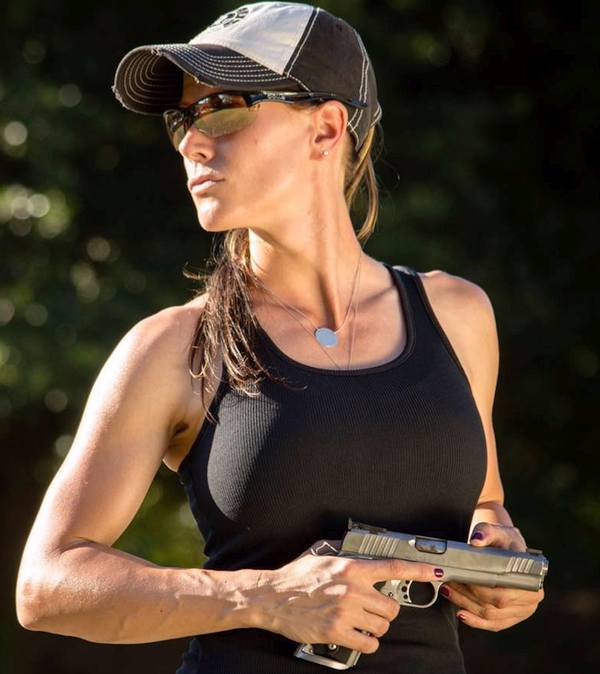
Jessie Harrison is arguably the best female action pistol shooter in history. Numero uno among all lady handgun competitors. No other lady has amassed as many championships or set so many speed-shooting records. Over the past two decades Jessie Harrison (who has also competed with with married names Jessie Duff and Jessie Abbate) has earned dozens of major titles including twenty-two U.S. Practical Shooting Association (USPSA) Ladies Championships.
Jessie is the first female shooter to obtain Grand Master status in the U.S. Practical Shooting Association. Competing in five different shooting disciplines, Jessie has won both world and national championship titles, including the prestigious Bianchi Cup, Steel Challenge World Speed Shooting Championships, and numerous USPSA National Championships. Most recently she was the Lady’s Open Champion at the 2024 World Speed Shooting Championships.
This Saturday at the Movies feature showcases Jessie Harrison shooting in competition as well as Jessie offering shooting and firearms safety tips. You can see dozens more action pistol videos featuring Jessie on the Jessie Harrison YouTube Channel.
Blast From the Past — Young Jessie in Cowboy Action Mode
Early in her shooting career, Jessie enjoyed Cowboy Action Shooting. She honed her skills shooting revolvers and lever guns “on the clock” with steel targets. For this Single Action Shooting Society (SASS) sport, all competitors use an official “alias” at matches. Jessie’s SASS alias was “Jasmine Jessie”. Watch this video from 2009 to see a young Jessie in action with a slick shotgun-loading trick.
Jessie Harrison, Successful Huntress
Jessie also enjoys hunting. Back in 2019, the chance to bag a Muley buck drew action-shooting ace Jessie Harrison out to Wyoming’s Bighorn Mountains region. Jessie, who is probably the best lady action pistol shooter on the planet, had a successful hunt with Big Horn Outfitters. Jessie, Shooting Team Captain for Taurus USA, really enjoyed getting out into the Wyoming wilderness. And she got her buck!
Bryan Litz and The Science of Accuracy Academy delivered a notable Podcast with vital information for all handloaders. This Podcast examines the effects of humidity variances on powder. Bryan notes: “If you want to know how much this can matter, we’re talking up to 200 fps difference for the same load of H4350 in 6.5 Creedmoor” at opposite extremes of humidity.
Bryan adds that “Most shooters don’t realize what a big deal this can be — it overshadows many of our efforts to make consistent velocity and hit targets. This can happen in loaded rounds not just for hand loading where you expose powder to ambient humidity. This is especially important for hunters considering the range of environments hunting ammo goes through.”
CLICK the above graphic to access first half of Podcast for free.
BONUS — Four More Science of Accuracy Podcasts
Here are four more of our favorite Podcasts from Bryan Litz’s Science of Accuracy Academy. Click on each item to hear the first half of each podcast for free.
Want More? Subscribe to The Science of Accuracy Academy
If you’d like to benefit from hearing ALL the full-length Science of Accuracy Academy Podcasts you can get a subscription to the Academy for just $9.95 per month. This grants you access to all Podcasts, exclusive videos, learning resources, and bullet data sheets.
Shooting Sports USA (SSUSA) offers a wide selection of informative articles on marksmanship techniques. If you shoot prone, “hard-holding”, you know how important proper positioning and technique can be. There is a SSUSA article that every prone shooter should read — whether you shoot air rifle, smallbore, or High Power. Compiled wtih the help of some of the country’s best prone marksmen, this article, How to Master Prone Shooting, provides a step-by-step guide to perfecting your prone position technique.
How to Master Prone Shooting — SSUSA by NRA Staff
The prone position is the most precise of the rifle shooting positions. It is used in many different shooting events at distances as close as 5 meters and as far away as 1,000 yards, and beyond that in long-range disciplines such as PRS and NRL. Prone shooting is very popular among shooters whose training time is limited, because it does not require as much practice. Age has little effect on a shooter’s ability to do well in prone; many older shooters are able to continue competing successfully in prone matches.
Here is a sample, listing STEP ONE, the basics of the prone position:
Step One: Study the Position
The prone position is steady because it is low, which gives a wide base of support to help keep the rifle still. Below are the key features of the prone position.
1. Straight line form left hand through left arm, side and leg.
2. Head tipped down comfortably.
3. Right hand grips rifle lightly.
4. Body lies behind rifle. Angle to rifle is 10 to 20 degrees.
5. Right knee bent slightly, toe pointing out.
6. Rifle lies on heel of left hand, fingers relaxed.
7. Left elbow rests to left of rifle.
8. Sling (if present) supports weight of rifle. Left arm relaxed.
9. Body rests slightly more on left side.
10. Left leg straight, toe pointing inward or straight back.
There are FIVE MORE STEPS described in detail with specific actions to perform, in the FULL Article. For example, in STEP FOUR (Sling Adjustment), the article explains: “Put the sling high on the arm and tighten the sling keeper. Wrap the arm around the sling so that the sling comes across the left hand and forearm.”
Today we share some smart tips from a past F-Class and Sling Champion who is both a great shooter AND a ballistics wizard. Founder of Applied Ballistics LLC, Bryan Litz is the author of multiple books and creator of advanced Ballistics Software.
Bryan is also a highly skilled competitor. In 2015, Bryan Litz won the F-TR Mid-Range AND Long-Range National Championships hosted at Ben Avery. And at the 2014 Berger SW Nationals (SWN), Bryan took top honors among all sling shooters. If you only know Bryan Litz from his Applied Ballistics Books and DVDs, you may not realize that this guy is a also great marksman along with being an actual rocket scientist!
Given his impressive track record in both F-Class and Palma (Fullbore) out to 1000 yards, we asked Bryan if he had any advice for other long-range competitors.
First Bryan provided three tips concerning Ballistics, his special area of expertise. Next Bryan offered three more general tips about long-range competition — how to analyze your shooting, how to choose your ‘wind strategy’, and how to avoid the most costly mistakes, i.e. how to avoid the “train-wrecks”.
Bryan Litz won the 2015 F-TR Mid-Range and Long-Range Championships with this sleek rig:
Litz Ballistics Tips
Ballistics TIP ONE. If you’re having trouble getting your ballistic software to match actual drops, you need to look at a number of possible reasons. Here are some common issues that can cause problems.
Click Values Are Not Exact. Scopes and iron sights don’t always produce accurate adjustments. In other words, if your ballistics program predicts 30 MOA of drop, and you dial 30 MOA but hit low, it might be that your sight actually only moved 28 MOA (for example). To see if your sight is adjusting accurately, shoot a tall target at 100 yards and measure group separation when dialing your sight.
Barometric vs. Station Pressure. This is a commonly misunderstood input to ballistics programs. You can avoid this pitfall by remembering the following: station pressure is the actual measured pressure at your location, and you don’t need to tell the program your altitude when using station pressure. Barometric pressure is corrected for sea level. If you’re using barometric pressure, you also have to input your altitude.
Muzzle Velocity. Chronographs are not always as accurate as shooters think they are — your true MV may be off by 10-20 fps (or more). If your drop is different than predicted at long range, it might be because your muzzle velocity input is wrong.
Mixing Up BC (G1 vs. G7). Knowledgeable long range shooters know that the G7 standard is a more representative standard for modern LR bullets. However, using G7 BCs isn’t just a matter of clicking the ‘G7′ option in the program. The numeric value of the BC is different for G1 and G7. For example, the G1 BC of the Berger 155.5 grain Fullbore bullet is .464 but the G7 BC is .237. If you were to enter .464 but click on G7, the results would be way off.
Ballistics TIP TWO. A properly installed level is absolutely essential for long range shooting. Without a good level reference, your long range wind zero will be off due to minor canting of the rifle from side to side. You can verify that your level is installed correctly on a 100-yard ‘tall target’. Draw a plumb line straight up the target and verify that your groups track straight up this line as you go up in elevation.
Ballistics TIP THREE. If your long range ballistic predictions aren’t tracking, always come back and verify your 100-yard zero. Sometimes a simple zero shift can be misconstrued as errors in long range ballistics predictions.
Litz Competition Shooting Tips
Competition TIP ONE. Improving your scores in long range competition is a constant process of self-assessment. After each match, carefully analyze how you lost points and make a plan to improve. Beginning shooters will lose a lot of points to fundamental things like sight alignment and trigger control. Veteran shooters will lose far fewer points to a smaller list of mistakes. At every step along the way, always ask yourself why you’re losing points and address the issues. Sometimes the weak links that you need to work on aren’t your favorite thing to do, and success will take work in these areas as well.
Competition TIP TWO. Select your wind shooting strategy carefully. For beginners and veterans, most points are typically lost to wind. Successful shooters put a lot of thought into their approach to wind shooting. Sometimes it’s best to shoot fast and minimize the changes you’ll have to navigate. Other times it’s best to wait out a condition which may take several minutes. Develop a comfortable rest position so you have an easier time waiting when you should be waiting.
Competition TIP THREE. Actively avoid major train wrecks. Sounds obvious but it happens a lot. Select equipment that is reliable, get comfortable with it and have back-ups for important things. Don’t load on the verge of max pressure, don’t go to an important match with a barrel that’s near shot out, physically check tightness of all important screws prior to shooting each string. Observe what train wrecks you and others experience, and put measures in place to avoid them.
Looking down-range with F-TR rifle at Ben Avery Shooting Facility in Phoenix, Arizona.
Bullet Stability and Twist Rates
In this video, Bryan Litz talks about bullet in-flight stability and how to calculate barrel twist-rate requirements for long-range bullets. Bryan explains that bullet stability (for conventional projectiles) is basically provided by the spinning of the bullet. But this spin rate is a function of BOTH the nominal twist rate of the barrel AND the velocity of the projectile. Thus, when shooting the same bullet, a very high-speed cartridge may work with a slower barrel twist rate than is required for a lower-speed (less powerful) cartridge. For match bullets, shot at ranges to 1000 yards and beyond, Bryan recommends a twist rate that offers good stability.
You’ll find more expert information on long-range shooting and ballistics on the Applied Ballistics website and the Bryan Litz Ballistics Facebook page. Bryan’s most recent Facebook post talks about the Coriolis effect — the apparent drift of a rifle trajectory due to the rotation of the earth.
To learn more, we recommend you subscribe to the Applied Ballistics Science of Accuracy — with in-depth articles, brilliant podcasts, exclusive videos and more.
As we release this story, the New Year — 2025 — is just 18 hours away (East Coast Time). Perhaps you’ve been eagerly awaiting for the big event, getting champagne (and sparklers) to celebrate the New Year. Hopefully 2025 will be much better than 2024, with a new President committed to Second Amendments rights, border security, and reducing inflation. To mark the dawning of 2025, with hope for a much better year, we expect many folks will open a bottle of champagne. You could pop the cork the traditional way, or read on and learn how to release the celebratory champagne with a rifle shot, as demonstrated by the talented Kirsten Joy Weiss. Click on the above video to see Kirsten release champagne with a rimfire rifle.
Recently at Thorton Winery in Temecula, California, a champagne vintner, we were shown the best way to open a champagne bottle. We were told you should hold the bottle nose up at an angle then rotate the BOTTLE slowly while holding the cork. That works great… but it’s not as stunning as the way sharpshooter Kirsten Joy Weiss opens a bottle of bubbly.
A former competitive smallbore rifle shooter, ace trigger-puller Kirsten Joy Weiss tried a special New Year’s trick shot a few seasons back. In keeping with the festive New Year’s spirit, Kirsten attempted to shoot the cork off a champagne bottle. After a few unsuccessful tries, she managed to hit the cork with at least two shots. But alas the cork did not fly. She actually hit the cork, but it did not release. That was surprising…
Undaunted, Kirsten changed her strategy, aiming for the neck of the bottle. This duplicates the process of “sabering” a champagne bottle — a method of liberating the bubbly by slashing off the end of the neck with a blade. Aiming for the neck of the bottle, Kirsten successfully blew off the top of the bottle. (Apparently, when “sabering” it is actually the pressure within the champagne bottle which does most of the work).
Today marks a New Year. 2020 is behind us (thank goodness!). We should start “Having Fun in 2021″. With that spirit, here are five “fun and games” targets. While each requires good conventional marksmanship skills — hitting a small aiming point — there are other strategies involved, such as playing darts or “making change” by hitting the right combination of coins. Most of us started shooting as kids, just plinking for fun. Here’s an opportunity to be like a kid again — to spend a day at the range just having fun with friends and family members.
Dartboard Target with Colored Rings
This printable Dartboard Shooting Target has the numbers inside the outer dartboard ring to allow a larger target. With this target you can shoot for the center bull, or actually play pub-style dart games, aiming for numbers and particular rings. If you don’t know how to play traditional dart games, visit NiceDarts.com for complete darts rules. One popular game is “Around The World”. The object is to hit the numbered zones, starting with number 1. Then you try for 2, 3, and so on. After hitting all the numbers 1 through 20, then hit the bullseye to win. CLICK HERE for Other Dart Board Color combinations.
American Coins Target — Make Change
This unique American Coin Target features actual-sized Eisenhower Dollars, Susan B. Anthony Dollars, and Kennedy Half Dollars in the top row. Below are rows of Quarters, Dimes, Nickels, and Pennies in descending order. NOTE: A U.S. Quarter has a diameter of approximately 1 inch, so it’s One MOA at 100 Yards. NOTE: When printing, select “100%” value and landscape mode — NOT “fit to page”! That will keep the dimensions of the coins accurate. Combining math with marksmanship, this target lets kids practice their math skills while having fun. Choose a money amount (such as $2.57 or $3.73), and “make change” by shooting a combination of coins.
NSSF Billiards Table Target
This Billiards Table Target offers 15 brightly-colored numbered balls with the cue ball at the bottom. Aim for the numbers, shooting 1-15 in sequence, or alternate between stripes and solids. You can also draw an “X” on the white cue ball (or attach a paster), and use that to set your zero. This target is fun for shooting outdoors with rifles at 50 or 100 yards or indoors with pistols.
This billiards target is part of a set of 12 Fun Targets from the NSSF. These were issued a couple seasons back for National Shooting Sports Month, held in August of each year. The other free targets include Golf Links, Bowling Pins, Fireworks, Baseball Diamond, Dutch Windmill, Water Balloons, Light Bulbs, Dartboard, and three Bullseye targets.
Flies in Circles Target
Now you can boast to your buddies that you hit a fly on your target — 16 times. On this target, 16 flies with bright red eyes are arranged in a inside circles, 16 to a page. There are various ways to use the fly targets. Some shoot to hit the head only — so aim for those red eyes. There are 11 other variations of this Fly Target available on the Targets.WS website.
Tic-Tac-Toe Fun Game Target
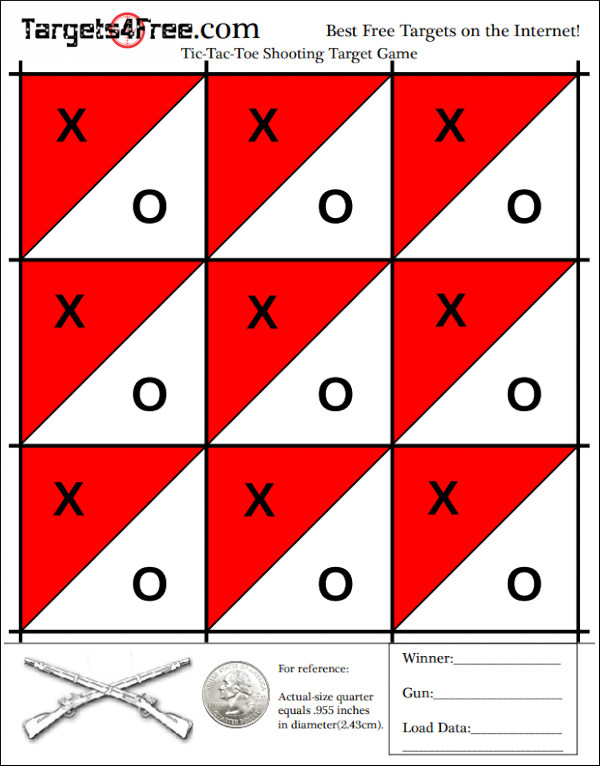
This Tic-Tac-Toe Shooting Game Target lets you challenge your shooting buddies at the range. One player can shoot the red triangles, while the other shoots the white zones, taking turns. You proceed just like a regular Tic-Tac-Toe game, alternating shots, with the goal of getting three of the same color in a row. This is a fun game for a parent and a young family member. You’ll find other fun targets on Targets4free.com.
Special BONUS — AccurateShooter.com Load Development Target
Our Load Development Target has been used by tens of thousands of shooters. It has proven very popular, since all your load data fits neatly in the boxes under each target. In fact this target is being employed by both rifle-makers (Bergara) and barrel-makers (including Criterion) to test their products. The target was designed for aiming efficiency. The red diamonds have 1/2″ sides and you can align your cross-hairs on the horizontal and vertical lines. It is a clean design that is easy to see even at 200 yards with a 20X scope. NOTE: When we test, we usually crank in a little elevation, setting the point-of-impact higher, so our shots fall in the gray circles. That way you leave the red diamonds intact for precise aiming.
The NRA has produced a good video on general principles of gun safety. New shooters should definitely watch this video, which provides many important reminders for long-time gun owners as well. This video and other safety principles are featured in a Shooting Sports USA article.
While at the range, shooters should practice Three Basic Rules:
1) Always keep the gun pointed in a safe direction.
2) Always keep your finger OFF the trigger until ready to shoot.
3) Always keep the gun UNLOADED until ready to use.
In addition, whenever you are shooting, indoors or outdoors, know what is behind your target and never shoot if there is not a safe backstop. With a centerfire rifle at an outdoor range, just a few degrees of elevation can cause a shot to impact more than a mile away.
Store Guns Safely When Not in Use
After your range sessions or hunts, is vital to store all guns safely. We recommend storing all firearms (pistols, rifles, shotguns) in a sturdy gun safe with thick steel walls. Use a GoldenRod or other device to control humidity inside the safe. We also like to use Bore-Stores or other treated gun sacks to help protect against corrosion.
Rimfire Benchrest can be fun and rewarding. It can also be frustrating because sourcing superior lots of ammo is a never-ending challenge. Still we like rimfire benchrest because you don’t need to load at the range. Plus rimfire barrels last a very long time (our friend Joe Friedrich set an ARA Benchrest record with a 100,000+ round-count barrel). Here’s a great video from the National Rimfire Benchrest Association of Ireland (NRBAI). Production quality is excellent! We highly recommend you watch this video, which does a great job illustrating both the fun and challenge of rimfire benchrest competition.
If you’ve never seen 50m Rimfire Benchrest competition, this video is well worth watching:
“If you need to get your mind away from everything… then look down a scope, concentrate, and be disciplined.”
“Comradery is one of our organization’s key traits… there are no barriers of gender, age or mobility. Just a very diverse, bunch of good people enjoying a sport together.”
“The skill, in brief, is having the ability to hit the equivalent of the top of a pinhead at 50 meters, in all conditions with a .22 round. Not easy, especially when you have to do it 50 times to get a maximum score of 500 [points], 250 per sheet.”
Back in the USA — The National 50 Benchrest League
If this article has motivated you to try rimfire benchrest competition back here in the good ol’ USA, there is a great organization that can help. Launched just a few years ago, the National 50 Benchrest League (N50) has easy-to-understand rules, and offers competition with a wide variety of rifles, even including air rifles. The whole idea was to make competition more affordable and get more shooters on the firing line. There are three classes — Pellet, Sportsman, and PRO. One can be very competitive in the Sportsman Class with a basic factory .22 LR rig or Air Rifle.
N50 competition is unique in allowing air rifle shooters to compete side-by-side with rimfire shooters. This allows folks to compete without the cost of expensive “top-dollar” rimfire ammo. Pellets are relatively inexpensive, and yes air is still free!
About N50 — The National 50 Benchrest League
Commentary by Joe Friedrich, Open Grove Benchrest
The National 50 Benchrest League (N50) offers a unique shooting experience. We shoot air rifles with pellets and slugs alongside .22 LR Rimfire shooters. We currently have sanctioned clubs throughout the USA offering competition and good fellowship.
N50 has three Classes: Pellet, Sportsman, and PRO. The first Pellet Class is strictly for pellet airguns ranging in calibers from .177-.30 using Diabolo-style pellets from various manufacturers.
The second class is the Sportsman Slug/Rimfire. This combined class allows any factory air rifle shooting commercially-made slugs in calibers from .177-.30 to compete against any factory rimfire that utilizes a factory-barreled action with no attachments to barrel. Pellet air rifles may also compete in this class.
The third class is the PRO Class, and no you do not have to have some magic card that says “Professional” to compete. This class allows purpose-built air rifles, and what we call “unlimited” rimfire rifles to compete. Three types of loads are allowed in PRO Class: .177 slug air-driven, .22 slug air-driven, and any .22 LR ammunition.
Another point — in N50, competitors are allowed to move up in class — you aren’t restricted to a “lower” division. For example, Pellet Class shooters can also move up to shoot in Sportsman and Pro. In addition, Factory rimfires are allowed in Pro Class. This way shooters with the less-expensive rifles can shoot more relays and also see how they compete with the unlimited rigs. It’s all about having fun.
We wanted to make N50 as simple as we could combining air rifles with rimfire so folks who have a factory rimfire can participate and have fun. We also did not want a lot of classes, so combining the two gun types would be simpler. To be honest we were worried that the rimfires will outpace the air rifles, but that was not the case at this year’s Nationals.
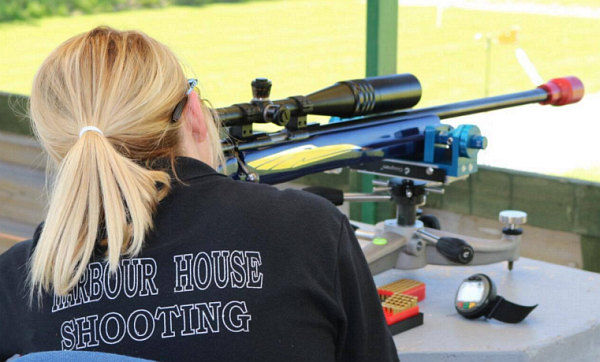
Air Rifle on beautifully crafted, plated Pappas Rest.
National 50 Benchrest League Rules and Course of Fire
The official N50 website, National50.net, lists N50 rules, classes, courses of fire, and membership requirements. There are currently 16 affiliated clubs nationwide, with more coming soon.
General Rules — Here are some of the more notable N50 General Rules that apply to N50 matches:
Target Distance: 50 yards
Match Times: 20 minutes per target
Targets: Official targets produced and distributed by N50
Aggregate Score: Cumulative score of 3 targets shot in sequence on same day
Scoring: No competitor shall score their own target
As far as hardware, N50 is pretty open. For all 3 classes, any scope is allowed and any trigger is allowed. For all 3 classes, stocks are unrestricted, stocks may be bedded, and rifle weight is unlimited. However, the Sportsman Class must retain factory barrel and action. N50 competitors in all classes may use 1-piece rests, 2-piece rests, bags, or bipods — whatever they prefer.
CLICK HERE for a free, printable version of the N50 practice target shown above. After clicking, SCROLL DOWN the page and you will see the left and right target sections that will print on 8.5×11″ paper. You can also purchase the Official N50 11″ x 17″ printed Match Targets for $25 per 100 plus shipping.
Credit Boyd Allen for finding this NRBAI Benchrest Video
With snow on the ground and sub-freezing temperatures in much of the country, we hope our readers are staying warn indoors with family members this Christmas week. To provide a bit of entertainment here are two videos that combine a holiday theme with the shooting sports.
In this fun video, YouTube host 22plinkster plays a holiday tune on steel plates. Using a Henry Golden Boy .22 LR lever gun, 22plinkster performs a plate-by-plate musical rendition of Jingle Bells. To hit each tuned plate in the right order takes considerable skill and concentration. But we thank 22plinkster for offering this special holiday shooting range concert.
Here we have 22plinkster once again. He wanted to see how many Christmas ornaments could be penetrated by one .22 LR round. To answer that burning question, he lined up 40 plastic Xmas bulbs in a row and then fired a single round of CCI .22 LR Velocitor ammo through the bunch, using his Henry Golden Boy lever action rifle. Did the bullet penetrate a dozen ornaments? Two dozen? What do you think? Watch the video to find out the surprising answer.




 A former competitive smallbore rifle shooter, ace trigger-puller Kirsten Joy Weiss tried a special New Year’s trick shot a few seasons back. In keeping with the festive New Year’s spirit, Kirsten attempted to shoot the cork off a champagne bottle. After a few unsuccessful tries, she managed to hit the cork with at least two shots. But alas the cork did not fly. She actually hit the cork, but it did not release. That was surprising…






 If this article has motivated you to try rimfire benchrest competition back here in the good ol’ USA, there is a great organization that can help. Launched just a few years ago, the


