Guest Article By Michelle Gallagher, Berger Bullets
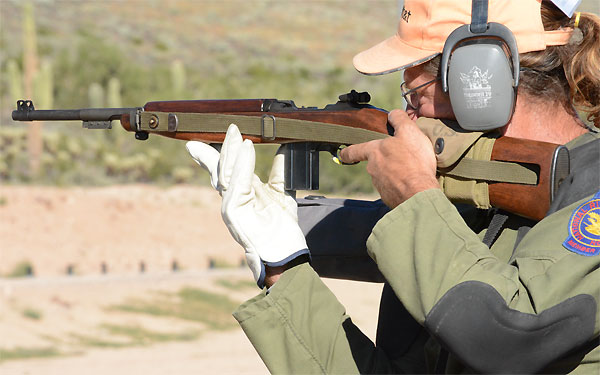
Let’s face it. In the world of firearms, there is something for everyone. Do you like to compete? Are you a hunter? Are you more of a shotgun shooter or rifle shooter? Do you enjoy running around between stages of a timed course, or does the thought of shooting one-hole groups appeal to you more? Even though many of us shoot several different firearms and disciplines, chances are very good that we all have a favorite. Are we spreading ourselves too thin by shooting different disciplines, or is it actually beneficial? I have found that participating in multiple disciplines can actually improve your performance. Every style of shooting is different; therefore, they each develop different skills that benefit each other.
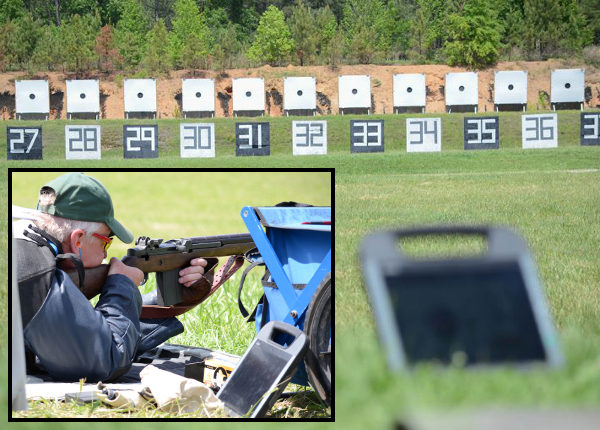
How can cross-training in other disciplines help you? For example, I am most familiar with long-range prone shooting, so let’s start there. To be a successful long-range shooter, you must have a stable position, accurate ammunition, and good wind-reading skills. You can improve all of these areas through time and effort, but there are other ways to improve more efficiently. Spend some time practicing smallbore. Smallbore rifles and targets are much less forgiving when it comes to position and shot execution. Long-range targets are very large, so you can get away with accepting less than perfect shots. Shooting smallbore will make you focus more on shooting perfectly center shots every time. Another way to do this with your High Power rifle is to shoot on reduced targets at long ranges. This will also force you to accept nothing less than perfect. Shoot at an F-Class target with your iron sights. At 1000 yards, the X-Ring on a long range target is 10 inches; it is 5 inches on an F-Class target. Because of this, you will have to focus harder on sight alignment to hit a center shot. When you go back to the conventional target, you will be amazed at how large the ten ring looks.
Also, most prone rifles can be fitted with a bipod. Put a bipod and scope on your rifle, and shoot F-TR. Shooting with a scope and bipod eliminates position and eyesight factors, and will allow you to concentrate on learning how to more accurately read the wind. The smaller target will force you to be more aggressive on your wind calls. It will also help encourage you to use better loading techniques. Nothing is more frustrating than making a correct wind call on that tiny target, only to lose the point out the top or bottom due to inferior ammunition. If you put in the effort to shoot good scores on the F-Class target, you will be amazed how much easier the long-range target looks when you return to your sling and iron sights. By the same token, F-Class shooters sometimes prefer to shoot fast and chase the spotter. Shooting prone can help teach patience in choosing a wind condition to shoot in, and waiting for that condition to return if it changes.
Benchrest shooters are arguably among the most knowledgeable about reloading. If you want to learn better techniques about loading ammunition, you might want to spend some time at benchrest matches. You might not be in contention to win, but you will certainly learn a lot about reloading and gun handling. Shooting F-Open can also teach you these skills, as it is closely related to benchrest. Benchrest shooters may learn new wind-reading techniques by shooting mid- or long-range F-Class matches.
Position shooters can also improve their skills by shooting different disciplines. High Power Across-the-Course shooters benefit from shooting smallbore and air rifle. Again, these targets are very small, which will encourage competitors to be more critical of their shot placement. Hunters may benefit from shooting silhouette matches, which will give them practice when shooting standing with a scoped rifle. Tactical matches may also be good, as tactical matches involve improvising shots from various positions and distances. [Editor: Many tactical matches also involve hiking or moving from position to position — this can motivate a shooter to maintain a good level of general fitness.]
These are just a few ways that you can benefit from branching out into other shooting disciplines. Talk to the other shooters. There is a wealth of knowledge in every discipline, and the other shooters will be more than happy to share what they have learned. Try something new. You may be surprised what you get out of it. You will certainly learn new skills and improve the ones you already have. You might develop a deeper appreciation for the discipline you started off with, or you may just discover a new passion.
This article originally appeared in the Berger Blog. The Berger Blog contains the latest info on Berger products, along with informative articles on target shooting and hunting.
For decades, Shooting USA has been a leading video resource for the shooting sports and hunting. This popular cable TV show covers shooting matches, and provides expert information on precision shooting, gun maintenance, optics, and defensive firearms use. Here are five interesting videos all worth watching. Learn about wind-reading, gun maintenance, and optics.
1. Reading the Wind — SGT Sherri Jo Gallagher of USAMU
Sergeant Sherri Jo Gallagher formerly of the U.S. Army Marksmanship Unit (USAMU) shows us how to read the wind in given conditions, and how to apply your wind assessment when aiming down-range. During her time with the USAMU, Sherri won the National High Power Championship, and was the first woman in history to earn the U.S. Army “Soldier of the Year” honors. Sherri comes from a legendary family of shooters — she was raised by Ace Marksman Mid Tompkins and mother Nancy Tompkins, the first female to win the NRA National High Power Championship.
2. Field-Stripping and Cleaning AR-Platform Rifles
Let’s face it — Black Rifles run dirty. On AR-platform rifles, the gas system blows carbon and powder residues back into the action and bolt carrier group. Accordingly, you need to clean ARs early and often, and you should fully disassemble the bolt carrier to access parts and recesses which accumulate greasy lube and hard carbon. This helpful video shows how to field-strip and clean AR-platform rifles. If you own an AR, this is definitely worth viewing. With over 2.7 million views, this is the second most-watched video on Shooting USA’s YouTube Channel.
2. MOA Defined — Jim Scoutten Explains Minute of Angle
Minute of Angle (MOA) — this is the most common measurement of group size, and hence rifle accuracy. You hear about shooters hoping to shoot 1 MOA or “half-MOA”, but many folks could not give you a precise definition. In fact MOA is an angular measurement that equates to one-sixtieth of one degree of Arc. In this video, host John Scoutten defines MOA. He then demonstrates how MOA translates to accuracy on target. He demonstrates one-half-MOA accuracy with a Les Baer Custom rifle. This company offers a three-shot, half-MOA guarantee for its rifles.
4. How to Adjust for Parallax
Most precision rifle scopes have parallax adjustment, typically a knob on the left side of the scope. but what exactly is “Parallax” and why do you need to adjust optics to ensure the parallax setting is optimal? In this Shooting USA video, John Paul of JP Rifles defines parallax and explains why you need to set parallax correctly for the distance to your target. The video then shows how to adjust parallax correctly, a process which should start with the scope’s ocular focus.
5. How to Mount a Riflescope
When mounting a scope you want to use quality rings, and ensure that the scope is leveled properly. In addition, you need to adjust the fore/aft position of the scope so that eye relief is correct. Ideal scope position may be different when shooting from the bench vs. shooting prone. In this Shooting USA video John Paul of JP Rifles reviews scope mounting basics.
Here’s a handy training option for F-Class shooters. Forum member SleepyGator is an F-Class competitor, but there are no long-distance ranges close to his home. Accordingly, he wanted some “reduced-distance” targets he could use at 300 yards for practice. There IS an official reduced-distanced standard for 300-yard F-Class matches. This utilizes the NRA No. MR-63FC – F-Class Target Center which is pasted over the MR-63 target. It provides a 1.42″ X-Ring, 2.85″ 10-Ring, and 5.85″ Nine-Ring. We offer some free targets you can print out for use at 300 yards. The dimensions of F-Class targets are found in the NRA High Power Rules, Sec. 22, part 4, page 70-71 — see sample below.
To duplicate the 300-yard target, SleepyGator made a printable version of the MR-63FC Target Center, along with a pair of training targets with two bulls and five bulls. The two-bull and five-bull targets mirror the scoring rings on the MR-63FC, but they display only the innermost three rings and two rings respectively. All three targets are Adobe PDF files that can be easily printed.
NOTE: You may need to adjust the scale (sizing) on your printer to get the dimensions exactly correct. As noted above, when printed, the 10-Ring on all three targets should measure 2.85″. This should provide some handy practice targets you can use between matches. Thanks to SleepyGator for providing these targets. You can download all three as a .Zip archive. After downloading the .Zip file, just click on the .Zip archive to extract the individual targets.
Team Berger shooter John Whidden of Whidden Gunworks topped the field to win this year’s Civilian Marksmanship Program (CMP) Smallbore Prone National Championship at Camp Perry. Whidden, who hails from Nashville, Georgia, was named the Prone 6400 Aggregate Champion after firing a score of 6379-449X. During his route to the Aggregate win, Whidden also earned third overall in the Iron (Metallic) Sight Championship and second in the Any Sight match.
The National Prone Championships featured two days of both Iron Sight and Any Sight events (four days overall) for adults and juniors. Each day included four stages of fire at 50 yards, 50 meters, and 100 yards.
The 2022 CMP National Smallbore Matches were held at prestigious Camp Perry National Guard training facility on the shores of Lake Erie near Port Clinton, Ohio. The matches started July 19th with a Small Arms Firing School for new competitors, and concluded after eight days of competition from July 20-27. These Smallbore disciplines were fired over the eight days of competition:
July 20 – Three Position Iron Sight Championship
July 21 – Three Position Any Sight Championship
July 22 – Junior Team Match, Three Position Team Championship
July 23 – Prone Metallic Sight Championship Day 1
July 24 – Prone Metallic Sight Championship Day 2
July 25 – Prone Elimination Final & Prone Team Championship
July 26 – Prone Any Sight Championship Day 1
July 27 – Prone Any Sight Championship Day 2
The Smallbore Prone National Championship is decided over four days of firing 160 rounds per day for a possible 6,400 score. Whidden finished first with a 6,379-449X, followed by Antonio Gross in 2nd scoring a 6,371-412X, and Larry Parker medaling 3rd with 6,362-413X.
Whidden stated, “The CMP ran a great match as they always do. The wind and the elements were enough to keep us on our toes. I was really pleased with the performance of the Lapua Midas+ rimfire ammunition throughout the match!”
About Lapua Ammunition and Berger Bullets
Lapua manufactures high-quality rimfire ammunition and Berger manufactures precision projectiles and match-grade ammunition for Target, Hunting and Tactical applications. Berger is part of the Capstone Precision Group, the exclusive U.S. distributor for Berger, Lapua, Vihtavuori and SK-Rimfire products. For more information, visit Bergerbullets.com.
Rimfire Benchrest can be fun and rewarding. It can also be frustrating because sourcing superior lots of ammo is a never-ending challenge. Still we like rimfire benchrest because you don’t need to load at the range. Plus rimfire barrels last a very long time (our friend Joe Friedrich set an ARA Benchrest record with a 100,000+ round-count barrel). Here’s a great video from the National Rimfire Benchrest Association of Ireland (NRBAI). Production quality is excellent! We highly recommend you watch this video, which does a great job illustrating both the fun and challenge of rimfire benchrest competition.
If you’ve never seen 50m Rimfire Benchrest competition, this video is well worth watching:
“If you need to get your mind away from everything… then look down a scope, concentrate, and be disciplined.”
“Comradery is one of our organization’s key traits… there are no barriers of gender, age or mobility. Just a very diverse, bunch of good people enjoying a sport together.”
“The skill, in brief, is having the ability to hit the equivalent of the top of a pinhead at 50 meters, in all conditions with a .22 round. Not easy, especially when you have to do it 50 times to get a maximum score of 500 [points], 250 per sheet.”
Back in the USA — The New National 50 Benchrest League
If this article has motivated you to try rimfire benchrest competition back here in the good ol’ USA, there is a new organization that can help. Launched just a couple seasons ago, the National 50 Benchrest League has easy-to-understand rules, and offers competition with a wide variety of rifles, even including air rifles. The whole idea was to make competition more affordable and get more shooters on the firing line. There are three classes — Pellet, Sportsman, and PRO. One can be very competitive in the Sportsman Class with a basic factory .22 LR rig or Air Rifle.
N50 competition is unique in allowing air rifle shooters to compete side-by-side with rimfire shooters. This allows folks to compete without the cost of expensive “top-dollar” rimfire ammo. Pellets are relatively inexpensive, and yes air is still free!
About N50 — The National 50 Benchrest League
Commentary by Joe Friedrich, Open Grove Benchrest
The new National 50 Benchrest League (N50) is a unique shooting experience. We shoot air rifles with pellets and slugs alongside .22 LR Rimfire shooters. We currently have sanctioned clubs throughout the USA offering competition and good fellowship.
N50 has three Classes: Pellet, Sportsman, and PRO. The first Pellet Class is strictly for pellet airguns ranging in calibers from .177-.30 using Diabolo-style pellets from various manufacturers.
The second class is the Sportsman Slug/Rimfire. This combined class allows any factory air rifle shooting commercially-made slugs in calibers from .177-.30 to compete against any factory rimfire that utilizes a factory-barreled action with no attachments to barrel. Pellet air rifles may also compete in this class.
The third class is the PRO Class, and no you do not have to have some magic card that says “Professional” to compete. This class allows purpose-built air rifles, and what we call “unlimited” rimfire rifles to compete. Three types of loads are allowed in PRO Class: .177 slug air-driven, .22 slug air-driven, and any .22 LR ammunition.
Another point — in N50, competitors are allowed to move up in class — you aren’t restricted to a “lower” division. For example, Pellet Class shooters can also move up to shoot in Sportsman and Pro. In addition, Factory rimfires are allowed in Pro Class. This way shooters with the less-expensive rifles can shoot more relays and also see how they compete with the unlimited rigs. It’s all about having fun.
We wanted to make N50 as simple as we could combining air rifles with rimfire so folks who have a factory rimfire can participate and have fun. We also did not want a lot of classes, so combining the two gun types would be simpler. To be honest we were worried that the rimfires will outpace the air rifles, but that was not the case at this year’s Nationals.
Air Rifle on beautifully crafted, plated Pappas Rest.
National 50 Benchrest League Rules and Course of Fire
The official N50 website, National50.net, lists N50 rules, classes, courses of fire, and membership requirements. There are currently 16 affiliated clubs nationwide, with more coming soon.
And the 2022 N50 National Championship is coming up soon. The event, for rimfire rifles and air rifles, will be held August 26-28, 2022 at the Whittington Center in Raton, New Mexico
General Rules — Here are some of the more notable N50 General Rules that apply to N50 matches:
Target Distance: 50 yards
Match Times: 20 minutes per target
Targets: Official targets produced and distributed by N50
Aggregate Score: Cumulative score of 3 targets shot in sequence on same day
Scoring: No competitor shall score their own target
As far as hardware, N50 is pretty open. For all 3 classes, any scope is allowed and any trigger is allowed. For all 3 classes, stocks are unrestricted, stocks may be bedded, and rifle weight is unlimited. However, the Sportsman Class must retain factory barrel and action. N50 competitors in all classes may use 1-piece rests, 2-piece rests, bags, or bipods — whatever they prefer.
CLICK HERE for a free, printable version of the N50 practice target shown above. After clicking, SCROLL DOWN the page and you will see the left and right target sections that will print on 8.5×11″ paper. You can also purchase the Official N50 11″ x 17″ printed Match Targets for $25 per 100 plus shipping.
Credit Boyd Allen for finding this NRBAI Benchrest Video
Report based on story by Ashley Dugan, CMP Staff Writer
CAMP PERRY, Ohio – SSG Amanda Elsenboss, 33, of the Army National Guard, has made history – Amanda is the first-ever female to be the overall winner of the President’s Rifle Match, a notable marksmanship event first held in 1894.
The 2022 President’s Rifle Match (aka “President’s 100″) took place August 1st as part of the Civilian Marksmanship Program’s (CMP) National Rifle Matches at Camp Perry. The top 100 scoring competitors are dubbed the President’s One Hundred.
“This has been a longtime coming – everybody thinks of the President’s Hundred Match”, Elsenboss said, looking back on her own career. Amanda has been a recognizable force on the firing line for years, first as a junior shooter and then as a member of the USAMU rifle team. Amanda joined the Army in 2009 and was assigned to the U.S. Army Marksmanship Unit (USAMU). There, she collected several titles, including national wins in service and long range rifle. At the 2021 National Matches, Amanda set a new national record score and was the overall individual competitor of the National Trophy Team (NTT) event – netting a near unbeatable score of 500-34X.
Last year’s National Matches was also her first as a member of the National Guard All Guard Marksmanship Team, which she joined in 2019. While on the team, she has experienced many big challenges on the firing line, and the 2022 President’s Rifle Match was no exception.
SSG Amanda Elsenboss receives awards from CMP Director Emeritus Gary Anderson.
Challenging Wind Conditions at 2022 President’s Match
This year’s President’s Match was tough. Winds were strong yet switchy throughout the day with tough, changing conditions. Yet Elsenboss managed a preliminary score of 297-9X – dropping only one point each in standing and prone positions.
“I shocked myself by shooting 99s everywhere, and I owe it to my teammates and the other competitors on the line who let me ask them what wind [calls] they were using,” she said. “The camaraderie between all of the competitors is so large that no one’s going to try to hurt you. Everyone’s looking out for you. And that makes a difference.”
Next came the President’s Match 20-person Shootoff – fired after the qualifying round from the day’s course of fire. Elsenboss had participated in the shootoff multiple times before, in 20th place and higher, but this year was her first starting in the lead position on the line. “Coming into the Shootoff with a three-point lead felt like enough of a buffer,” Elsenboss said.
As the Shootoff began, the conditions became even more challenging, with the strongest wind gusts of the day. Still, Elsenboss was confident. She put her rifle on three minutes, right where she thought it needed to be for her first record shot, and fired – a 7, to the right. “That’s not going to work”, she thought. Her next shots brought a 9 on the left and a 9 on the right. “I said to myself, ‘You’ve got it bracketed. Stop, and just put it right in the middle’”. She shot well, with her last shot a 10, for a 391-12X Shootoff Aggregate.
That score proved to be good for the Shootoff victory. SFC Brandon Green, her former USAMU teammate and 2018 President’s Match winner, came up to the firing line and told her, “Congrats, Champ!”. That was notable said Amanda: “I’ve known Brandon for almost as long as I’ve been shooting, and it means something that he would do that”.
Elsenboss finished the shootoff just above her teammate SGT Jonathan Wood and added the third consecutive President’s Rifle Match win for the Army National Guard team. The team also had the most members in the Shootoff of any service team.
After her win, fellow shooters and spectators congratulated her. Among her fans were young female competitors. Parents also thanked her for being a great example for the next generation. “I try my best to be an ambassador, being a female in a sport that’s a male dominant sport — knowing that juniors or other females in general maybe be intimidated and want to figure out shooting,” Elsenboss said.
Elsenboss remembers looking up to other lady shooters, such as Julia Watson (now Carlson) who was won national and international titles. Carlson was also the first female to win the National Matches National Trophy Individual (NTI) event back in 1998. “I was a junior, and that meant something to me,” Elsenboss said of Carlson and other influential women in the sport. “I thought, If they can do that, I can do that.”
Julia Carlson (in red) congratulates Amanda on her President’s Match victory.
From now on, no matter what she does or where she goes — Elsenboss will always be a fixture in the legacy of marksmanship and will undoubtedly carry on inspiring others. “Let’s continue this and see what we can do,” she said.
The 2022 Lapua Monarch Cup kicked off in Pennsylvania this week. The first leg of the Lapua Monarch Cup was held August 8-9, 2022 in conjunction with the NRA Smallbore Rifle Silhouette Championship at the Ridgway Rifle Club in Ridgway, PA.
In its inaugural year, the Lapua Monarch Cup is a series of smallbore silhouette shooting matches hosted in two different countries: United States and Mexico. Competitors earn points from each match within their respective classification (Master, AAA, AA, & A), giving all shooters an opportunity for over $100,000 in cash and prizes. Lapua’s Monarch Cup is recognized as the must-attend event of the silhouette shooting world — the premiere Silhouette series. For more information visit lapuamonarchcup.com.
Smallbore silhouette shooting is a fun and challenging shooting discipline that has competitors taking aim at a variety of steel chickens, pigs, turkeys and rams. Shooters, standing and unsupported, take aim at four banks of silhouettes at increasing distances, shooting 40 targets in all. For every silhouette knocked down, the competitors earn one point. Smallbore shooters are shooting at distances of 40, 60, 77 and 100 meters, and High Power at 200, 300, 385 and 500 meters.
About Lapua Lapua produces the highest quality small caliber cartridges and components for civilian and professional use. Lapua is a part of the Capstone Precision Group, exclusive U.S. distributor for Berger, Lapua, Vihtavuori and SK-Rimfire products. For more information, visit Lapua.com.
August is National Shooting Sports Month. The National Shooting Sports Foundation (NSSF), encourages every avid shooter to take one new person to a shooting range this month. Let that newcomer experience the fun of pistol, rifle, or shotgun shooting. The NSSF states: “One trip to the range can be all it takes to create a new recreational shooter. Share your passion and invite a friend on your next trip to the range.”
The +One Movement is intended to expand the number of participants in the shooting sports — something we need if we want to preserve our rights, which are under attack now from politicians in Washington.
Find Shooting Sports Events Near You
The NSSF’s ShootingSportsMonth.org website offers a comprehensive, searchable database. This lets you search by state, to find ranges, events, and sales promotions near you. Visit the NSSF online database of NSSM shooting events to find matches, clinics, training sessions, special sales — and much more.
Jeff Hansen of Utah now holds Distinguished Rifleman Badge #2561. Jeff’s journey to Distinguished status began with a box filled with his grandfather’s old shooting medals, which led him to the Camp Perry National Matches in Ohio.
Though he had no intention of shooting competitively, only arriving to see the ghosts of his grandfather and uncles, he was so moved by the ambiance of Perry that he began his own marksmanship career — eventually leading him to a prestigious Distinguished Badge.
At the 2022 National Matches, Jeff fired his best scores yet. In the National Trophy Individual (NTI) Match, he reached an overall score of 487-9X for 52nd overall out of nearly 790 competitors. And at the 600-yard line he shot an outstanding 199-5X out of a 200 possible.
“He was on the range with me shooting that 199″, Jeff said of his grandfather. “I felt like he was right there when I finished up. I just hope other people see this and see what I’ve tried to do – if I can do this, they can do this”, he said. “Chase that dream”.
Left to Right: Alvin Hansen, Ray Hansen, and Jeff’s Grandfather Lou Hansen at Camp Perry.
Inspired by My Grandfather to Become a Distinguished Marksman
Jeff Hansen earned his Distinguished Rifleman Badge in 2022 – a journey which began with his Grandpa’s own marksmanship tales from the 1920s and 1930s.
As early as I can remember, my grandfather, Lou, was a huge influence in my life. He was a great marksman. My dad, Ed Hansen, would tell me about the hunting trips they would go on and how Grandpa would make incredibly long shots to get an amazing bull elk or mule deer, only taking one shot to do so. He was always taking me hunting and fishing and shooting – lots of sleepovers where I didn’t actually sleep much, if any, because I would be so excited for the adventures that were going to happen with him the next day.
Whether it was hunting ducks, pheasants, chukars or just shooting, it didn’t matter. It was always an awesome experience with him. Life was great. Then, we got some tough news – my grandfather had leukemia. He fought a courageous battle with it for a couple of years, then in 1978, when I was 8, he passed away. Needless to say, I was devastated.
Inspired by Grandfather’s Shooting Medals
Not too long after he passed away, my dad brought home a box from Grandpa’s. It was full of medals. He carefully removed them and told me they were from when my grandfather competed in rifle matches with his brothers (Alvin Hansen, a U.S. Army veteran of World War I in France, Ray Hansen, and Oscar Hansen) at Camp Perry, Ohio, in the late 1920s to 1937.
Shooting medals from 1920s and 1930s with picture of Lou Hansen and his brothers.
My Grandpa was really humble – never said much about his trips to Camp Perry or his accomplishments there. Seeing the contents of the box, my grandfather became an even bigger hero to me. The medals he earned that impressed me the most were the three President’s Hundred brassards from 1935, 1936 and 1937 – along with many others.
I grew up looking at those medals thinking I wish I could do that maybe, someday. My life moved forward. My dad, a U.S Air Force veteran, and I both loved hunting, fishing, and shooting and still went as often as we could. Later, I got married and now have three daughters and one son. As my family grew up, we also enjoyed hunting, fishing, and shooting together.
Then, life threw some blows. My dad passed away suddenly in November 2014, and my mom fought a fierce battle with cancer for a few years before passing away in March 2018. Not long after she passed away, I found myself hanging [my grandpa’s] medals on the wall in my own home. Seeing them there got me thinking about how awesome it would be to go to Ohio and watch the President’s Match – not shoot, just watch.
In July 2018, I went. I’ve got to admit there were a few tears in my eyes driving between the two iconic lighthouses at the entrance to Camp Perry. I loved it.
The year I came happened to be the year SFC Brandon Green of the U.S. Army Marksmanship Unit cleaned the President’s Match — a record that still holds today. I got to talking to one of the Army Reserve team guys, asking him questions about competing, and he couldn’t believe I was there just to watch. I showed him some pictures of my grandfather’s medals, scorebook, and of Camp Perry in the 1930s. Matt Goad and Jon Arcularius of the Army Reserve team came over to look at them.
They said, “Hey, you can’t come all the way out here with a family history like that and not shoot here!”
They offered to sign me up for the NTI match the following day and even said they would get a rifle, ammo, and anything else I would need. That was so awesome, but I couldn’t make it work – I was flying back home the next day. Although I didn’t shoot, they did get me all the information I needed to get started.
I loved every minute of my first Camp Perry trip. It was because of the people there, showing me such kindness and taking me under their wings, that I thought, “I’ve shot all my life and hunted, and I’ve always liked marksmanship. This is something I can do.”
When I got home, I ordered a White Oak upper and started changing parts on my AR-15 to make it ready for matches. I was ready in the spring of 2019 and started shooting mostly small matches.
Grandpa Lou was humble and never talked about his achievements at Camp Perry.
At first, all I wanted to do with my rifling career was get a President’s Medal — following in my Grandpa’s footsteps. I didn’t know what “going Distinguished” was all about. I got a Silver Achievement Medal in the first match I went to, then started to go to more matches. Through that, I caught wind that winning President’s is one thing, but you’ll get to President’s if you excel your skills and go Distinguished. So, that became the new goal.
By summer, I was traveling to EIC matches and earned my first points at Nampa, Idaho, on July 21, 2019. After that, it was time to head back to Perry for the President’s and the NTI.
I didn’t do as well as I wanted, but it was an amazing experience to be competing where my grandfather had. I struggled the rest of the year and didn’t earn any more points until 2020. It was tough trying to find matches during COVID, but I ended up earning 12 more points by the end of the year. I missed a hard leg at Twentynine Palms, California, by X-Count, and things got tough after that.
I figured I needed to step up the way I was practicing, so I got a Shot Marker electronic target system and some wind flags so I could practice full distance. I’m very lucky that I can practice 30 minutes from home any time I want on public land.
At the 2022 National Matches, Jeff fired a superb 199-5X at the 600-yard line.
Starting in the first part of December, I had some extremely hard things going on in my personal life, and I didn’t feel like practicing. I didn’t even pick up my rifle for two months. I missed the first EIC in Phoenix in January, and before I knew it, February was half gone. Then, one of my friends talked me into going to the Western CMP Games in Phoenix in March.
Practice was tough, and sometimes I wondered why I was even trying. Tons of things were going wrong, and I was about DONE. I wanted to quit, many times. [But then] Western Games was fun, and I did well, but gained no points.
Navy Matches were coming around at the end of April, so I practiced as much as I could and made the trip. With several friends going, it would be great getting together after the matches and have a good time. I shot well the first day as well as on that Saturday. I even shot my personal best National Match Course score. Then Sunday, May 1, was the real test – the EIC match.
I struggled in standing and dropped a few more points than usual. Sitting was the same – rapid prone was good. Slow prone went well. The wind had some fairly big changes, but I worked through it and ended up with 477-11X. I figured there’s no way I’m making the cut for a hard leg this time and headed to the pits to finish out the match. We finished and waited for the results.
When the results were posted, I couldn’t believe it – I FINALLY GOT THAT HARD LEG! I did it. On top of earning my goal at last, it’s awesome to have my friend Jeff Lovat (#2383) be the one to present me with my Distinguished pin. (That President’s Hundred medal is still out there – maybe next year!)
The Honor of Earning the Distinguished Marksman Badge
Though I certainly enjoy earning my Distinguished Badge, the greatest thing I have gained from accomplishing this is without a doubt all the friends and people I have gotten to know along the way. To all my shooting friends, thanks for not letting me quit – part of this accomplishment is yours too.
To all of you that are working toward that goal, don’t ever quit. Keep practicing, and your day will come. Never quit until you reach your goals.
No matter what, I do know one thing. When I walk that stage at Perry at the 2022 National Matches and get my Distinguished Badge officially presented to me — well my father, my grandfather and his brothers will be walking it with me.
About the Distinguished Badge Program
To earn a Distinguished Badge, a competitor must earn 30 Excellence-In-Competition (EIC) points or more in a qualifying competition. Individuals earn the 6, 8 or 10 “leg” points based on score and a percentage of match participation, with at least one “hard” leg, worth 8 or 10 points. Currently, the CMP administers Distinguished Badges for:
Service Rifle
Service Pistol
.22 Rimfire Pistol
Junior Air Rifle
Smallbore Rifle
International Shooter
Distinguished Marksman Badge
Distinguished Air Rifle and Air Pistol
Distinguished Service Revolver Badge
Are you a do-it-yourself kind of guy with a creative eye? Then you’ll love the FREE Target Generator from the folks at ShooterShed.com. This free, interactive webpage allows you to design a variety of fun targets, including grids, benchrest-type Score Shooting targets, sight-in targets, and even playing card targets. Choose the paper size and orientation (vertical or horizontal), then select the number of target elements on the page. For example, you could have four (4) bulls or 52 playing cards. Then click the Style TAB to choose your target style. Use the OPTIONS TAB to overlay a grid on the target, choose squares or diamonds, or include load information blocks. For bullseye targets, you can control the number, color, and spacing (diameter) of the rings. LINK to TARGET GENERATOR.
Click the TARGET STYLE TAB to select one of many target styles, including NBRSA Benchrest targets and 20+ types of NRA bullseye targets, scaled to distance:
Benchrest
Bullseye
Shapes
NRA High Power
NRA Pistol
NRA Rimfire
Images
Playing Cards
Load Test Blocks
Creating new targets is fast and easy. No computer graphics skills required! We created this green diamonds grid target in just five minutes using the ShooterShed Target Generator:
And here is a handy target with short-range range Benchrest competition-style box/circle aiming points, along with fields for entry of gun/load data:
The program provides a preview of each target you generate. There are controls to choose border and fill colors. If you like a particular design, save the file, and then print as many targets as you want. Check it out, this program is fun and handy to use. Here are four (4) targets your Editor created just for this article. With a bit of practice, you can be generating your own custom targets in minutes.
About the Creator of the Target Generator
The Target Generator program was created by Rod Brown of Sheridan, Wyoming. Rod tells us: “I build custom rifles and coach shooters. I’ve got a 100-yard range out my back door. I shoot short- and long-range benchrest competitively around the country. I’m a full-time software development consultant and an FFL holder. When I’m not developing custom software for my clients, I’m usually fiddling in the shop, building a custom benchrest rifle, traveling to a match, chambering a barrel, or reloading some ammunition.
Story tip from Boyd Allen. We welcome reader submissions.