Shooting Industry (SI) magazine is often the first media source to reveal new firearms and gun-related products. And once again, in SI’s just-released April 2021 edition, we got our first glimpse of dozens of cool new guns and hardware. CLICK HERE to see all new featured products (best for mobile platforms) or CLICK HERE for magazine-style layout.
The current Shooting Industry issue spotlights 28 new products. We’ve select a half-dozen notables for our readers. There is an interesting WOOX Hybrid stock, new Lapua products, an impressive big-bore revolver from Taurus, the new Mark 7 Apex 10 progressive press, a rugged AR-friendly shooting rest, plus a handy totable cleaning kit from Otis.
Here Are Six Standouts from Shooting Industry April 2021:
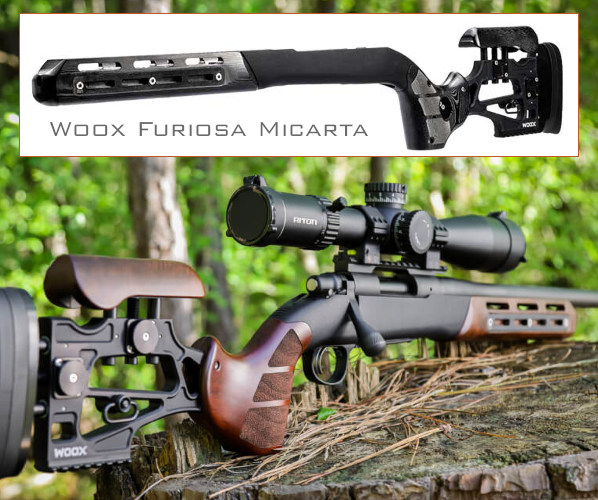
WOOX Advanced Furiosa Micarta Rifle Chassis
The new Furiosa Micarta Rifle chassis combines the best of both worlds — aircraft grade aluminum chassis strength with human-friendly ergonomics and a weather-resistant finish. The Furiosa Micarta’s outer shell casts off moisture as well as oils and solvents. The manufacturer claims the hybrid stock absorb vibrations, effectively providing harmonic dampening (as you would get with conventional wood or fiberglass stocks). The Woox Furiosa Micarta chassis is available for Remington 700, Howa 1500, Weatherby Vanguard, Sauer 100, and Tikka T3 actions.
Birchwood Casey — Alpha Shooting Rest (AR Optimized)
Birchwood Casey’s new Alpha Shooting Rest features a tubular steel frame with non-slip rubber stock rest. Weighing in at a stout 35 pounds, with integrated weighted front, this Alpha Rest should be stable. It features adjustable leveling feet with bulls-eye bubble level, ambidextrous controls, and oversized adjustment knobs. Notably this Alpha Rest will accommodate ARs with 30-rd magazines. The front of the shooting rest maneuvers 2″ for windage, 3.5″ for elevation and 4.25″ to accommodate various rifle sizes.
Lapua — New Brass and Loaded Ammunition
Lapua now offers loaded match ammunition in 6.5 Creedmoor and .260 Remington plus loaded hunting ammunition in .223 Remington and 6.5 Creedmoor. Plus NEW BRASS — Lapua has added 6.5 PRC, .284 Win, .300 Win Mag, and 300 PRC cartridge cases to its 2021 product line. Cases are sold in boxes of 100. Errki Seikkula, Lapua Sales Manager, states: “Our new Lapua cartridge case offerings for 2021 display our continued commitment to the precision shooting disciplines which are popular in the USA and globally.” The .223 Rem hunting ammo features Lapua 50 Grain Naturalis bullets, while the new 6.5 Creedmoor hunting ammunition is loaded Lapua’s 156 Grain MEGA Soft Point.
Taurus Raging Hunter Revolver in .460 S&W
For 2021 Taurus introduces a new Raging Hunter Revolver chambered in .460 S&W. This beefy wheelgun features sleeved barrel construction, and factory porting to reduce muzzle rise. A Picatinny rail on the barrel shroud makes it easy to mount optics (to complement the adjustable rear iron sight). To help manage recoil (and provide a secure hold), the Raging Hunter features an ergonomic grooved grip with cushioned inserts. Taurus CEO Bret Vorhees states: “The Taurus Raging Hunter was a hit among … handgun hunters when we introduced it in 2019. We [now offer more] downrange performance with the new Raging Hunter in .460 S&W.” This revolver is offered in three barrel lengths: 5.12″ (top photo), 6.75″, and 8.37″ (second photo).
Mark 7 Apex 10 Professional-Grade Progressive Press
TEN Stations in 2021! Mark 7, a Lyman brand, has introduced the new Apex 10, a 10-station progressive press compatible with the Mark 7 Autodrive, Mark 7 Primer Xpress, and all Mark 7 sensors. Apex 10 features include a 10 station tool head, Mark 7 mechanical powder measure, 11″ case feeder with speed adjustments, reverse setting, transparent trap door, metal construction, and case sensor activation technology. The Apex 10 also features shuttle disk priming system and double guide rod support. The new cast toolhead is designed to reduce flex under pressure.
OTIS Technology — Professional Pistol Cleaning Kit in Pouch
Otis Technology’s new Professional Pistol Cleaning Kit is optimized to clean and maintain 9mm, .40 Cal and .45 ACP Glock pistols. But of course it can be used for other handguns as well. The kit includes three bronze and three nylon bore brushes, Memory-Flex cables and three caliber-specific ripcords. A steel pistol loop rod and Otis’s 8-in-1 Pistol T-Tool for pushing and resetting pins and front site adjustment are also included. The kit even comes with a magazine plate removal tool.
In response to the growing number of first-time gun buyers during the Coronavirus outbreak, the NRA’s Education & Training Division is offering four new Online Gun Safety Courses that can be done online at home. The six NRA Online Gun Safety Courses ARE:
Each course, lasting from one to eight hours, is available online at NRAInstructors.org. To Access the 0nline training options, first CLICK HERE. Then under the Heading “DISTANCE LEARNING”, you will see options. CLICK the small gray box at the left of the title to select the course. IMPORTANT — Next you MUST SCROLL to the bottom of the NRA webpage to SEARCH. Select your state or Zip code, then you will get a list of the moderated online courses in your area.
Here is the Procedure to Follow:
1. CLICK HERE to Access ALL Course Listings
2. Select a “Distance Learning” Course.
3. Scroll Down and SEARCH for your State or Zip Code.
4. Review Course Dates and Times.
For example, here are the listed NRA online safety courses for California only. Elsewhere (in other states), YOUR list will be different!
NRA ONLINE Training Courses Sample List
“These courses will provide an option for first-time gun owners who don’t have the ability to take an NRA certified instructor-led class at their local shooting range at this time,” said Joe DeBergalis, Exec. Dir. of NRA General Operations. “While there is no replacement for in-person, instructor-led training, our new online classes do provide the basics of firearm safety training for those self-isolating at home.”
Though range time is an important part of the classes, there is still a wealth of knowledge available in the online programs. “The NRA recommends that all new gun owners seek professional training at the range, but that doesn’t mean you can’t get a head start on learning the basics of firearm safety at home. Taking one of these classes moderated by a certified NRA instructor, can only make you safer…” DeBergalis added.
This Armalite AR-50A1 .50 BMG rifle was modified by G.A. Precision.
If you’re a fan of big boomers, and love shooting steel, then definitely watch this Wide Open Magazine video. This covers a .50 BMG build by our friends at G.A. Precision (GAP). The rifle started as an Armalite AR-50A1 ($3359.00 MSRP). Then GAP fluted the barrel and swapped the factory muzzle brake with a more compact brake from American Precision Arms*. Then, as modified, the entire rig was given a rugged Cerakote finish.
The video has nice background music, great aerial drone footage, and of course some serious firepower. Using Hornady .50 BMG ammo, GA Precision’s George Gardner and his Wide Open friends shoot the big Fifty from the bench as well as prone. Enjoy!
About the .50 BMG Cartridge
The .50 Browning Machine Gun (.50 BMG, aka 12.7×99mm NATO or 50 Browning) is a cartridge developed for the Browning .50 caliber machine gun in the late 1910s, entering official service in 1921. Under STANAG 4383, it is a standard cartridge for NATO forces as well as many non-NATO countries.
John Browning had the idea for this round during World War I in response to a need for an anti-aircraft weapon, based on a scaled-up .30-06 Springfield design, used in a machine gun based on a scaled-up M1919/M1917 design that Browning had initially developed around 1900. According to the American Rifleman: “The Browning .50 originated in the Great War. American interest in an armor-piercing cartridge was influenced by the marginal French 11 mm design, prompting U.S. Army Ordnance officers to consult Browning. They wanted a heavy projectile at 2700 FPS, but the ammunition did not exist. Browning pondered the situation and, according to his son John, replied, ‘Well, the cartridge sounds pretty good to start. You make up some cartridges and we’ll do some shooting’.”
* In the video, George mistakenly says “American Patriot Arms”, but the brake is made by Georgia-based American Precision Arms.
Palmetto State Armory (PSA) is running a St. Patrick’s Day Sale, with some impressive bargains on handguns, rifles, and AR components (uppers, lowers, stocks, grips, bolt sets). Hundreds of items are on sale. Most are AR-related, but there are also many pistols and optics on sale, along with stocks, triggers, and more. Here are eight great deals that turned our heads this St. Patty’s Day:
St. Patrick’s Day Sale Great Deals
St. Patrick’s Day Shooting Coat Sale
Here is a special St. Patrick’s Day Sale Item from Creedmoor Sports. This Green Coat is certainly appropriate today, when “wearing the green” is a part of the tradition. A wide range of sizes, from 30 to 58 is available. For a few dollars more you can add a Sling Harness section or a Terry Cloth Collar piece.
It didn’t take long. Democratic Party politicians in Washington are moving to ban semi-auto, modern sporting rifles. During his campaign, Joe Biden promised to ban so-called “assault rifles” and now Democratic U.S. Senator Dianne Feinstein (CA) has introduced legislation to do just that. Feinstein’s New Senate bill, introduced as the Assault Weapons Ban of 2021, is Feinstein’s latest attempt to block gun purchases and scuttle the Second Amendment of the U.S. Constitution. An identical bill has been introduced in the House of Representatives by Congressman David N. Cicilline (D-R.I.).
God forbid Feinstein should craft legislation to actually deal with the crime, drug abuse, homelessness, and crumbling infrastructure in her home turf of San Francisco, California. No, she doesn’t care about that. That’s because she has no answers, and she knows that Democratic-party policies have fostered ALL those problems. So she wants to target guns once again, though there is zero evidence that past semi-auto gun bans have had a measurable effect on overall, national violent crime rates.
• Bans the sale, manufacture, transfer and importation of 205 military-style assault weapons by name. Owners may keep existing weapons.
• Bans any assault weapon with the capacity to utilize a magazine that is not a fixed ammunition magazine and has one or more military characteristics including a pistol grip, a forward grip, a barrel shroud, a threaded barrel or a folding or telescoping stock. Owners may keep existing weapons.
• Bans magazines and other ammunition feeding devices that hold more than 10 rounds of ammunition, which allow shooters to quickly fire many rounds without needing to reload. Owners may keep existing magazines.
• Requires a background check on any future sale, trade, or gifting of an assault weapon covered by the bill.
• Requires that grandfathered assault weapons are stored using a secure gun storage or safety device like a trigger lock.
• Prohibits the transfer of high-capacity ammunition magazines.
• Bans bump-fire stocks and other devices that allow semi-automatic weapons to fire at fully automatic rates.
Senator Feinstein declared: “We’re now seeing a rise in domestic terrorism, and military-style assault weapons are increasingly becoming the guns of choice for these dangerous groups. I’m hopeful that with the new administration and Democratic control of the Senate, we can finally … remove these deadly weapons from our communities.” NOTE: This is disingenuous to say the least. If Feinstein was really concerned about “domestic terrorism” she would be doing something about Antifa and BLM rioters.
In the Senate, the Assault Weapons Ban is cosponsored by Senators Chris Murphy (D-Conn.), Richard Blumenthal (D-Conn.), Charles E. Schumer (D-N.Y.), Dick Durbin (D-Ill.), Edward J. Markey (D-Mass.), Brian Schatz (D-Hawaii), Bob Menendez (D-N.J.), Tom Carper (D-Del.), Sherrod Brown (D-Ohio), Maggie Hassan (D-N.H.), Jeff Merkley (D-Ore.), Sheldon Whitehouse (D-R.I.), Bernie Sanders (I-Vt.), Elizabeth Warren (D-Mass.), Bob Casey (D-Pa.), Tim Kaine (D-Va.), Jack Reed (D-R.I.), Mark R. Warner (D-Va.), Mazie K. Hirono (D-Hawaii), Ron Wyden (D-Ore.), Ben Cardin (D-Md.), Chris Coons (D-Del.), Tina Smith (D-Minn.), Cory Booker (D-N.J.), Chris Van Hollen (D-Md.), Jacky Rosen (D-Nev.), Tammy Duckworth (D-Ill.), Amy Klobuchar (D-Minn.), Ben Ray Luján (D-N.M.), Alex Padilla (D-Calif.), Patty Murray (D-Wash.), Kirsten Gillibrand (D-N.Y.), Jeanne Shaheen (D-N.H.) and Debbie Stabenow (D-Mich.).
Read those names. Notice that there is not ONE Republican on the list. This anti-gun legislation is pure partisan politics folks, pushed by a biased, career politician and supported by a Democratic Party President who is suffering from dementia. While Feinstein and Nancy Pelosi and Chuck Schumer hide behind fences and razor wire, with thousands of armed National Guard troops serving as their “palace guards”, they seek to destroy your right to armed self-defense as guaranteed by the Second Amendment. Without question, after these corrupt politicians ban all mag-fed semi-autos, they will come after other guns, until their mission of disarming America is accomplished.
* There are certain “carve-outs” in the legislation. The bill exempts by name more than 2,200 guns for hunting, household defense, or recreational purposes. The bill also includes a grandfather clause that exempts all weapons lawfully possessed at the date of enactment.
Zombies are preparing to invade once again for the Zombies in the Heartland 3-Gun Match on June 4-6, 2021 at the Heartland Public Shooting Park in Grand Island, Nebraska. After canceling the match due to COVID-19 in 2020, Hornady will host the popular event again this year. For complete event information, visit the official Zombies in the Heartland website, or follow the Zombies in the Heartland Facebook page. Hornady posted: “We are already half full, so sign up fast! We look forward to having you this year!”
ZOMBIES MATCH REGISTRATION: Early registration for past competitors opened on February 24th. Returning competitors were emailed with registration links. General registration opened on 3/2/2021, so you can register now online via Practiscore (you’ll need to set up a free Practiscore Account):
LODGING INFO: Hotel rooms can be reserved at the Boarders Inn and Suites, 3333 Ramada Road, Grand Island, NE. Mention Zombies in the Heartland for reduced rates.
About the Zombies in the Heartland Match
The very popular Zombies in the Heartland event, one of the biggest three-gun shoots in the nation, will take place June 4-6, 2021 at the Heartland Public Shooting Park in Grand Island, Nebraska. The “Zombie Pandemic” match traditionally has a rich prize table worth over $150,000. Prizes include pistols, rifles, shotguns, scopes, AR uppers, gun parts, and gear of all kinds.
The Zombie Match is a veritable theme park for shootists, with many fun stages and innovative targets. Many unique, reactive zombie targets have been developed specifically for this match. The use of paper targets has been minimized — so it’s mostly “bang and clang”.
In recent years there have been TEN multi-gun stages. Rifles, pistols and shotguns are used on most stages, which feature handgun targets from 1-15 yards, shotgun targets from 10-20 yards, and rifle targets from 1-200 yards. There were also side matches with full-auto demo firearms, exploding targets, and specialty targets.
Zombies in the Heartland Highlights Video. This well-made 2017 video is worth watching! This video offers Shooter’s POV views of many stages including full auto:
ABOUT the RANGE FACILITY: Operated by the Grand Island Parks and Recreation Department, the Heartland Public Shooting Park is the largest and most complete public shooting facility in the Midwest. The facility hosts regional and national events, drawing shooters from around the world.
Good news for folks in the middle of the country — Vortex, the optics-maker, has built a very impressive new training facility in Wisconsin. This new 55,000 square-foot Vortex EDGE facility boasts indoor and outdoor ranges, with shooting outdoors to 1000 yards. The modern EDGE 100-yard range is one of only a few 100-yard indoor ranges in the country, and the only one in the Midwest. The impressive new Vortex EDGE training center is part of the Vortex campus located in Barneveld, Wisconsin. The EDGE buildings are “just across the parking lot from the Vortex HQ” in Barneveld.
Vortex has just released a video “sneak preview” showing the new EDGE facility, with the multiple indoor ranges, “shoot rooms”, and simulator training center. Check it out below:
VIDEO – Behind the Scenes of Vortex EDGE – First Look!
Vortex posted: “If you can’t travel to our campus, you can still experience Vortex EDGE. We’ll be regularly releasing videos and content, and we’ll be active on social media celebrating all things firearms training.”
The 100-yard Indoor Range is ideal for load development and accuracy testing. Three-time F-TR National Champion Ian Klemm, who works for Vortex, told us: “If someone asked me to describe my dream job, I’d probably depict some magical place where I could do serious 100-yard indoor load development and rifle tuning whenever I wanted. Well, for the last three years while the Vortex EDGE facility was being completed, that’s exactly what it’s been like and we’re all excited to finally be able to share it with the rest of the Vortex Nation. I’m extremely grateful to work for the kind of company that would want to build this facility in order to share it with our customers. Come visit us and I bet you’ll at least leave with the best ‘no wind zero’ you’ve ever had on your rifle!”
There is a 1000-yard outdoor range, plus multiple indoor facilities including a 100-yard range, 50-yard indoor “tactical” range, 25-yard tactical range, a LEO/Military “Shoot House”, and even a simulator room with VirTra 300® interactive video.
Along with the training areas, the EDGE center includes a classroom, cleaning/locker area, and a commercial showroom. Go to VortexEdge.com to learn more about the facility and class offerings. On that website, you’ll also find EDGE Instructor Bios.
We have always liked Tikka actions, and now there is a great re-barreling option for Tikka T3 owners. Criterion Barrels Inc. (CBI), makers of “pre-fit” barrels for Savage, Remington, and Rem-clone actions, also produces Tikka pre-fits. These pre-chambered barrels for Tikka T3 actions will be headspaced with a barrel nut, just like a Savage.
Click image for full-screen version
Criterion’s Tikka T3 pre-fit barrels are currently sold through Solid Accuracy, a respected Texas-based outfit that sells high-end scopes, stocks, barrels and other rifle components. Solid Accuracy states: “Each Solid Accuracy/Criterion pre-fit barrel features a hand-lapped bore and meets extreme quality control standards. Utilizing a proven barrel nut design, these barrels can be swapped in just a few minutes using only a barrel nut wrench and the appropriate headspace gauge set. Solid Accuracy offers finished lengths up to 30″ with multiple contour options.”
These Tikka pre-fits were first introduced in 2017, and the accuracy results were impressive. Solid Accuracy’s initial test rifle featured a Tikka T3 action mounted in a KRG X-Ray chassis, with Criterion barrel chambered in 6.5 Creedmoor. The group below was shot with a stout load of H4350 and Sierra 140 grain MatchKings seated .009″ in the lands.
Criterion is proud of how well the Tikka pre-fit project turned out. These barrels work great in the Tikka platform. One of Criterion’s staffers was so impressed with the initial test results that he is built his own Tikka T3 rifle, with a Criterion pre-fit of course…
At the request of our readers, we provide select “Deals of the Week”. Every Sunday afternoon or Monday morning we offer our Best Bargain selections. Here are some of the best deals on firearms, hardware, reloading components, optics, and shooting accessories. Be aware that sale prices are subject to change, and once clearance inventory is sold, it’s gone for good. You snooze you lose.
1. MidwayUSA — Crimson Trace 5-Series Tactical Scope Sale
⏺ Very good value — superb FFP optics for PRS/NRL applications
Here are great deals on high-quality First Focal Plane MilRad optics, ideal for PRS/NRL tactical applications. These high-tech Crimson Trace scopes are HALF OFF now. Grab the 3-24x56mm for $889.50 (50% OFF) or the 3-18x50mm for $799.48 (49% OFF). Both feature 34mm main tubes, tons of elevation, and advanced MR1-MIL Advanced illuminated reticles. We’ve looked through these optics and they have good glass and nice controls. These scopes feature EZ Mount Leveling Indicators for quick, precise mounting. All Crimson Trace scopes come with FREE Batteries For Life and a Lifetime Protection Warranty.
This year the Pacific NW and Texas were hit with major, once-in-50-year ice storms that caused massive power outages. (In fact the Editor’s brother was without power for 9 straight days in Oregon.) If keeping the lights on, being able to charge devices, and staying warm is important to you then you NEED a generator. Check out the WEN 56380i 3800-Watt RV-Ready Portable Inverter Generator with fuel shut-Off and electric start. Assembled in the USA, WEN generators boast critical shut-off features to prevent damage, along with important fuel/load gauges. Order one before the next storm catches you off-guard.
3. Creedmoor Sports — Lapua Cartridge Brass In Stock
⏺ Get top-quality Lapua brass now without back-orders
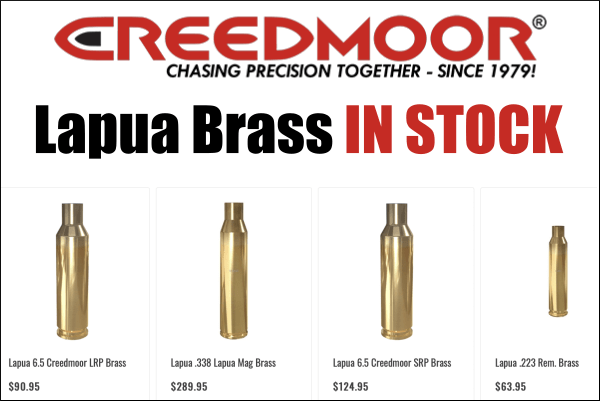
Quality reloading components continue to be tough to find, especially for popular calibers. But if you need cases, visit Creedmoor Sport for premium Lapua Rifle Brass . Creedmoor Sports currently has a very wide selection of cartridge types in stock and ready to ship. As of 3/1/2021, you’ll find Lapua brass in the popular .223 Rem, 6mmBR, 6mm Creedmoor, 6.5 Creedmoor, 6.5×284, .260 Rem, .308 Win and more, at reasonable prices.
4. Midsouth — Lock-N-Load Case Prep Duo, $54.14
⏺ Very handy, versatile unit performs multiple tasks
This Hornady Lock-N-Load Case Prep Duo lets you accomplish case deburring, chamfering, and primer pocket cleaning all with one affordable power tool. This cordless unit features has a unique twin spindle head that runs the deburrer and chamferer at the same time — that’s handy. And HERE’s a big bonus — you can take off the dual head, swivel the grip, and convert the tool into a handy single-shaft driver you can use for multiple tasks, such as running the 21st Century neck lathe. Check out this review that showcases everything this versatile Hornady Tool can do.
5. EuroOptic — Vortex Spitfire HD Scope Sale, Save up to $200
⏺ Great choice for action shooting and defense rifles — fast reticle design
Wish you could have the best of a red dot scope and a magnified optic all in one? Take a look at the Vortex Spitfire HD Red Prism Scopes. These quality scopes feature 3X or 5X magnification, and illuminated reticles with hold-overs. The clutter-free reticle allows FAST target acquisition, making these great for both 3-Gun games and defensive use. And the night illumination is great for hunting use. The 5X model is discounted $200 from $649.99 to $499.00, while the 3X model is $150 off, discounted from $599.99 to $349.99.
NOTE: If you want the widest field of view with no magnification (for short-range disciplines), Vortex also offers the 1X-AR Prism scope for $249.99, $100 off.
6. Sportsmans Warehouse — Savage B22 FV-SR 22LR, $319.99
⏺ Patriotic Stars and Stripes version — nice features for the price
Looking for an accurate .22 LR bolt-action rifle at a good price? Check out the Savage B22 FV-SR 22LR Special Edition a Sportsman’s Warehouse exclusive. The B22 FV-SR has an ergonomically-designed stock, with a high comb more vertical grip. This allows shooters to hold the rifle in a more natural position that puts less pressure on the wrist. The B22 FV-SR features a heavy-contour, suppressor-ready barrel, Picatinny scope rail, and adjustable AccuTrigger.
⏺ Affordable padded mat rolls up for easy transport
Being comfortable when shooting prone is really important for good results. So you’ll want a good mat that offers some padding along with plenty of room for your gear. If you need an inexpensive mat that checks all the boxes, check out the Redneck Convent Shooters Mat Padded Roll Up Mat . Measuring 64 inches by 21 inches it boasts plenty of room and features 1/2″ padding top to bottom. This mat rolls up for easy storage/transport (Rolled size is 21″x8″) with handy built-in rolling straps. This is also available in Black for $31.99 or Green for $39.99.
8. Amazon — Twod Front and Rear Sandbag Set, $12.99
⏺ Very low cost bag set for basic rifle or pistol support
Do you need a simple sandbag support for hunting or sighting-in rifles? Or perhaps you want to try NRL22 but don’t way to spend much on fancy bags. This Twod Shooting Rest Combo offers front and rear bags for just $12.99. These user-fillable bags are made from heavy material. The guns rest on a soft leather top section. There is also a Camo Version of this Twod twin-bag set for $14.99 on Amazon.
⏺ Decent lens, nice molded exterior, weighs just 2.9 ounces
If you want a simple, lightweight easy-to-carry optic, you may want to consider a monocular. This unit will fit in a coat pocket and is very inexpensive. With its compact form factor, 10X magnification, and durable coating, the Roxant Viper 10x25mm Pocket Scope offers good function for the $22.95 price. With minimal 2.9 oz. carry weight and a compact size, this can be a very handy optic for hunters and hikers. This 10X scope has 65% 5-star and 15% 4-star purchaser ratings. However, a few buyers experienced problems with a cloudy lens. If you purchase, inspect the unit carefully during the eligible return period.
The U.S. Army Marksmanship Unit (USAMU) has produced an excellent series of videos covering the Basic Rifleman’s Course. If you are getting started in High Power shooting, or want to improve your position shooting skills, this series is well worth watching. And these videos are not just for service rifle shooters — even bench shooters can benefit from these videos, particularly Part 5, which explains how to estimate wind speed and direction. The lead instructor for these videos is SFC Brandon Green, three-time National High Power Champion, and 2017 Service Rifle Champion. When SFC Green talks, you should listen.
SFC Brandon Green is a shooting superstar. Green won his third NRA National High Power Rifle Championship in 2018 at Camp Atterbury, Indiana. He dominated the HP Championship cycle, finishing eight points and ten Xs ahead of his nearest competitor. Brandon also won High Power National Championships in 2015 and 2013. One of the greatest marksmen in the nation’s history, SFC Green excels at all positions, both rapid-fire and slow-fire.
Part 5 — Wind and Weather Estimation (Very Useful for All Shooters)
Note: This video includes a hit location “target analysis” in the first 6 minutes.
Part 4 — Minute of Angle Explained
Part 3 — Ballistics and Zeroing
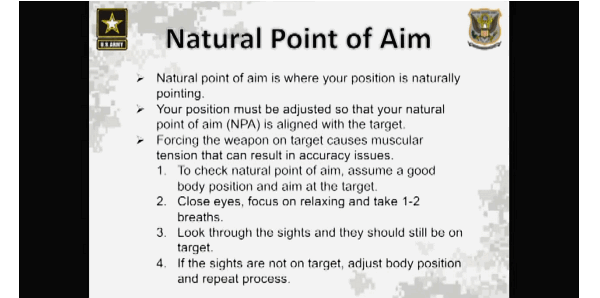
Part 2 — Positions, Sight Alignment, and Natural Point of Aim (Very Useful)
Part 1 — Aiming and Sight Picture
SFC Brandon Green (left above) has set multiple National Records at Camp Perry.







 About the Zombies in the Heartland Match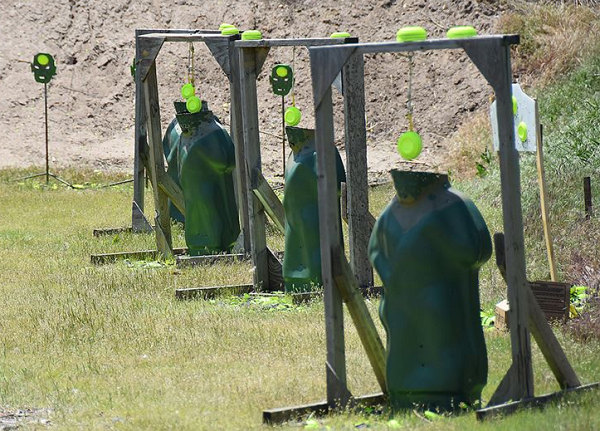







 Wish you could have the best of a red dot scope and a magnified optic all in one? Take a look at the


 Do you need a simple sandbag support for hunting or sighting-in rifles? Or perhaps you want to try NRL22 but don’t way to spend much on fancy bags. This