Lyman has just released an expanded, updated Second Edition of its AR Reloading Handbook. The original handbook was the first reloading manual dedicated exclusively to the most popular semi-auto rifle in the USA. The Second Edition of this comprehensive Lyman AR Reloading Handbook has been updated to include more cartridge types and significantly more load data. This provides AR shooters with reloading info for the vast majority of popular chamberings used in AR-platform firearms. GET BOOK HERE.
Reloaders will appreciate the extensive pressure-tested data covering a very wide selection of bullet types and powder types. The Second Edition provided data for newer cartridges such as the .224 Valkyrie, .22 Nosler, .24 Nosler, 350 Legend, as well as sub-sonic data. In addition, articles by well-known authorities are included, covering topics such as “Building An AR” and “AR15 Gas System Lengths”. This book is available right now direct from Lyman and will soon be avialable through Amazon.
Features of Lyman AR Reloading Handbook (Second Edition)
— Reloading data for popular AR-platform cartridge types, including the .223 Rem, .224 Valkyrie, 6.8 Rem, .300 AAC, 7.62×39, 350 Legend, 450 Bushmaster, .50 Beowulf and more.
— Many informative articles on specialty topics such as Reloading for Suppressors and Building ARs.
— Load Data covers all major brands of bullets and powders.
— Load Data for cast bullet data and sub-sonic loads.
AR-Platform Insights — Operation and Maintenance Tips
Here are two helpful videos for AR owners. The first uses 3D computer animation to show how AR-platform rifles work — from the inside. The Cutaway views show the operation of the gas system and bolt while cycling. The second video, by legendary competitive shooter Jerry Miculek, provide helpful guidance on AR disassembly and maintenance.
Book publishing tip from EdLongRange. We welcome reader submissions.
If you buy one book about Long Range Shooting, this should be it. Based on sophisticated testing and research, this 356-page hardcover from Applied Ballistics offers important insights you won’t find anywhere else. Modern Advancements in Long Range Shooting – Volume II, the latest treatise from Bryan Litz, is chock full of information, much of it derived through sophisticated field testing. As Chief Ballistician for Berger Bullets (and a trained rocket scientist), author Bryan Litz is uniquely qualified. Bryan is also an ace sling shooter and a past F-TR National Champion. Moreover, Bryan’s company, Applied Ballistics, has been a leader in the Extreme Long Range (ELR) discipline.
AUDIO FILE: Bryan Litz Talks about Modern Advancements in Long Range Shooting, Volume 2. (Sound file loads when you click button).
Volume II of Modern Advancements in Long Range Shooting ($39.95) contains all-new content derived from research by Applied Ballistics. Author Bryan Litz along with contributing authors Nick Vitalbo and Cal Zant use the scientific method and careful testing to answer important questions faced by long range shooters. In particular, this volume explores the subject of bullet dispersion including group convergence. Advanced hand-loading subjects are covered such as: bullet pointing and trimming, powder measurement, flash hole deburring, neck tension, and fill ratio. Each topic is explored with extensive live fire testing, and the resulting information helps to guide hand loaders in a deliberate path to success. The current bullet library of measured G1 and G7 ballistic coefficients is included as an appendix. This library currently has data on 533 bullets in common use by long range shooters.
Bryan tells us that one purpose of this book is to dispel myths and correct commonly-held misconceptions: “Modern Advancements in Long Range Shooting aims to end the misinformation which is so prevalent in long range shooting. By applying the scientific method and taking a Myth Buster approach, the state of the art is advanced….”
Bullet Dispersion and Group Convergence
Part 1 of this Volume is focused on the details of rifle bullet dispersion. Chapter 1 builds a discussion of dispersion and precision that every shooter will benefit from in terms of understanding how it impacts their particular shooting application. How many shots should you shoot in a group? What kind of 5-shot 100 yard groups correlate to average or winning precision levels in 1000 yard F-Class shooting?
Chapter 2 presents a very detailed investigation of the mysterious concept of group convergence, which is the common idea that some guns can shoot smaller (MOA) groups at longer ranges. This concept is thoroughly tested with extensive live fire, and the results answer a very important question that has baffled shooters for many generations.
Part 2 of this Volume is focused on various aspects of advanced hand-loading. Modern Advancements (Vol. II) employs live fire testing to answer the important questions that precision hand loaders are asking. What are the best ways to achieve MVs with low ES and SD? Do flash hole deburring, neck tension, primer selection, and fill ratio and powder scales sensitivity make a difference and how much? All of these questions are explored in detail with a clear explanation of test results.
One of the important chapters of Part 2 examines bullet pointing and trimming. Applied Ballistics tested 39 different bullet types from .224 through .338 caliber. Ten samples of each bullet were tested for BC in each of the following configurations: original out of the box, pointed, trimmed, pointed and trimmed. The effect on the average BC as well as the uniformity in BC was measured and tabulated, revealing what works best.
Part 3 covers a variety of general research topics. Contributing author Nick Vitalbo, a laser technology expert, tested 22 different laser rangefinders. Nick’s material on rangefinder performance is a landmark piece of work. Nick shows how shooters can determine the performance of a rangefinder under various lighting conditions, target sizes, and reflectivities.
Chapter 9 is a thorough analysis of rimfire ammunition. Ballistic Performance of Rifle Bullets, 2nd Edition presented live fire data on 95 different types of .22 rimfire ammunition, each tested in five different barrels having various lengths and twist rates. Where that book just presented the data, Chapter 9 of this book offers detailed analysis of all the test results and shows what properties of rimfire ammunition are favorable, and how the BCs, muzzle velocities and consistency of the ammo are affected by the different barrels.
Chapter 10 is a discussion of aerodynamic drag as it relates to ballistic trajectory modeling. You will learn from the ground up: what an aerodynamic drag model is, how it’s measure and used to predict trajectories. Analysis is presented which shows how the best trajectory models compare to actual measured drop in the real world.
Finally, contributing author Cal Zant of the Precision Rifle Blog presents a study of modern carbon fiber-wrapped barrels in Chapter 11. The science and technology of these modern rifle barrels is discussed, and then everything from point of impact shift to group sizes are compared for several samples of each type of barrel including standard steel barrels.
Many of our readers are thinking of trying out PRS-type competition. Tactical matches are becoming more popular every season. Along with F-Class, tactical/practical disciplines are the fastest-growing forms of competitive rifle shooting. Rich Emmons, one of the founders of the Precision Rifle Series (PRS), has written an insightful article about getting started in the tactical game. This will help PRS novices pick the right equipment and understand the game. Here are highlights from Emmon’s “PRS — Intro to Competition” article, originally published on the PRS website. You may also want to read the current PRS FAQ Page.
Precision Rifle Series — Intro to Competition
by Rich Emmons, PRS President
Tactical Shooting with a precision rifle is not like other disciplines, there is no set course of fire or format. That is what makes it so fun!
First, you have to ask yourself what do you want to accomplish. When I was introduced to long range shooting, immediately a light turned on for me, once I saw how easy it was to hit 300–600 yard targets. What I quickly learned from my first competition and the many that followed was there is so much to learn and shooting in competition put everything you thought you knew to the test. So back to the question: “What do YOU want to accomplish?”. The reality is you may not know yet, you just think it is cool to have a bad ass rifle and scope that can make almost any shot. Now if you’ve got that rifle and scope, it’s time to take it to the next level.
Watch PRS 2016 Championship
Getting Started — What to Expect
If you’re reading this, you have probably already have been bitten by the long range shooting bug. It can seem quite intimidating to just jump in with a new bunch of shooters you don’t know and shooting lingo you don’t quite understand yet. But here is the key — show up and shoot! I guarantee you if you show up to a match as a new shooter, other experienced shooters will guide you along and give you help on anything you need.
AUDIO: Click Button to hear Rich Emmons Talk about the Precision Rifle Series.
Now, a couple things you should just expect. You’re not as good as you think you are. Don’t expect to come into your first match and beat all the veterans. That just doesn’t happen unless you have had some really good coaching or other shooting competition experience to get you ready for this type of competition. If possible, find a local rifle club that has monthly long range matches, or any type of match will help prepare you for a larger PRS event. Getting involved with a rifle club and starting out shooting monthly matches is definitely the way to jump into competition shooting.
The Gear You Need
The first question that many ask is: “What kind of rifle/caliber/scope do I need?” The easiest answer to this is, the best you can afford. It’s no secret the gear is expensive. It took me several years of buying sub-par gear and eventually trading up to figure this out. Now, a guy can get a real sense of pride of doing it on the cheap, or with a factory rifle. I’ve seen many old Savage 10FPs take down custom rigs that cost 10 times as much. And if that’s all you can afford, then eventually you will learn the limitations of yourself or your gear. As for choice of cartridge/caliber, the respected Precision Rifle Blog has analyzed five years worth of match results from the best tactical shooters in the nation. CLICK HERE to read a PRB article that reveals what cartridge types the “top guns” use.
Craig Arnzen of Area 419 has created a useful article reviewing the gear PRS shooters need, including support bags, hearing protection, and other key accessories such as muzzle brakes. This helpful article also covers factory ammunition options.
Making Good Ammo
Producing quality reloads is something you have to master. It’s not hard at all, you just have to pay attention to detail, and eventually you are going to do something stupid like mis-priming your brass, or skip a row of brass when dumping your powder. Everybody has their own horror story of some reloading failure that cost them a stage or even a match. So load to perfection, work with your rifle to find what load it likes the best, then start your practice.
Practice Makes Perfect
You want to become ONE with your rifle, learning everything you can about its functionality. Getting comfortable with the operation of your rifle is key. Learn the feel of your trigger, dry-firing until you wear the paint off your bolt handle. Learn how the rifle works best — pay attention to little things like the sound and feel of the bolt feeding a round from the mag (or when it doesn’t). Learn how to remove a jammed round quickly, learn how to reload a magazine quickly. Learn to scan across a field and find targets in a quick manner, seeing the targets with your eye and coming into the scope on target. These are some of the basic practices that separate the new shooters from the seasoned ones.
Will you be traveling to other states this winter? Are you concerned about the laws that might apply when you are transporting firearms across state lines? Or are you puzzled about the requirements for obtaining a carry permit in your own state? If you have any of these questions, you should definitely get expert guidance on State statutes and regulations controlling firearms. To do that, you can purchase Attorney Bryan Ciyou’s Gun Laws by State reference book. This is worth the money, and the $20 cost also includes access to an online legal database and other services.
Free State Law Summaries Online
If you don’t want to spend the twenty bucks, there is a FREE alternative. There’s a very helpful set of State Law Summaries on the web, presented by PewPewTactical.com. Despite the silly name, the PewPewTactical website has an abundance of information that is particularly beneficial for pistol shooters and CCW holders.
One of the best features of PewPewTactical.com is the Gun Laws by State online reference guide. We looked through four of these State Law Summaries and were impressed by the depth of the coverage. But we caution — if you have specific legal questions, particularly with recently-enacted statutes, you should consult a licensed attorney for your state (or the state to which you will travel). In addition, many of the State Law Summaries have not been updated for a year or two. But they are still a good place to start. Below are links to state law articles from PewPewTactical.com. To access any State summary, simply click the State name below:
Election Day is just 52 days away. On November 3, 2020, Americans will head to the polls. For gun owners, this may be the most significant Presidential election in a generation. The Democratic Party, as stated in the DNC platform and Democrat-sponsored Bills now in Congress, intends to severely restrict gun rights, require a federal license for gun ownership, ban online ammo sales, and ban whole classes of firearms.
Nearly 5 million Americans are first-time gun buyers. We hope they, along with ALL gun owners, will vote on November 3rd, and remember which candidates support the Second Amendment. As the National Shooting Sports Foundation (NSSF) states: “Current events across the United States demonstrate why the Founding Fathers 230 years ago had the foresight to recognize why the right to keep and bear arms would still be vital today.”
Target shooters, hunters, and gun owners must work together to defend their Constitutional rights. On Election Day 2020, vote to protect America’s firearms freedoms: #GUNVOTE.
Hornady Contributes $500,000 to 2020 #GUNVOTE Effort
#GUNVOTE is a vital NSSF campaign to encourage America’s gun owners to register to vote and vote for candidates who support the Second Amendment and gun rights. Go to Action.gunvote.org to learn how to register to vote in your state, and find your polling place.
Hornady Manufacturing, maker of ammunition, tools, and reloading components, has contributed $500,000 to the NSSF’s #GUNVOTE voter registration and education campaign.
“A historic number of Americans have jumped off the fence to purchase firearms so far this year, and it’s critical for gun owners old and new to be educated and vote in November,” said Steve Hornady, President of Hornady Manufacturing. “The Second Amendment has never faced a threat like it does today. It is crystal clear why our right to keep and bear arms is now more important than ever. Making this contribution to NSSF’s #GUNVOTE campaign will ensure the firearm and ammunition industry has the resources needed to educate gun owners, target shooters and hunters about what is at stake in this election. Hornady Manufacturing is proud to support this critical voter registration, education and mobilization campaign.”
SIG Sauer Contributes $250,000 to 2020 #GUNVOTE Effort
SIG Sauer, a world-leading firearms maker, has contributed $250,000 to NSSF’s #GUNVOTE voter registration and education campaign. This campaign seeks ensure that America’s gun owners exercise their right to vote so they can protect the Second Amendment.
“SIG Sauer believes it is imperative for all gun owners to be registered to vote and to know where the candidates at all levels of government stand on the Second Amendment so that on election day they can make informed choices to protect their rights”, said SIG Sauer CEO Ron Cohen. “Our contribution to the #GUNVOTE campaign represents SIG Sauer’s wholehearted belief in the NSSF #GUNVOTE effort”.
With the Presidential election looming, the stakes have never been higher. Joe Biden and his VP candidate Kamala Harris have pledged to enact new laws that could result in rifle confiscation, criminalization of private sales, and banning of online guns and ammo purchases. In addition, Biden and Harris have called for new gun taxes, while Harris has advocated banning guns by Executive Action — rule by fiat, bypassing the legislative process.
“Science tells us that exposure to continuous noise of 85 dB for eight hours is enough to cause permanent hearing loss, and worse, spikes of 130 dB and more can result in permanent hearing damage instantly.” Source: NRA Blog.
The Risk of Hearing Loss
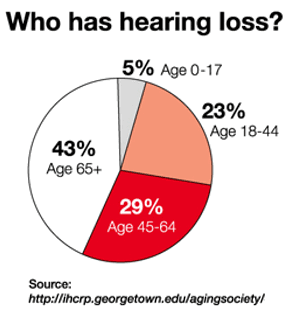
Hearing loss can be progressive and irreversible. If you are a shooter, this is serious business. As the NRA Blog cautions: “You may not even realize you’re harming your hearing. Hearing loss occurs gradually, and can go effectively unnoticed until symptoms become severe. By then, the damage is done.”Effective hearing protection is a must whenever you are shooting firearms or when you are in the vicinity of gun-shots. For ultimate protection, we recommend a good set of tapered foam earplugs, topped by ear-muffs. However, there are situations when you may prefer lighter-weight hearing protection that can be quickly removed. For example, if you are standing well behind the firing line as an observer, or if you are working as a rangemaster or waddie some distance away from the shooters.
Sound Levels for Common Noises:
9mm Luger pistol: 160 dB
Jet aircraft engine (near): 140 dB
.22 LR pistol: 134 dB
Normal human pain threshold: 120 dB
Noisy Nightclub: 110 db
Riding Motorcycle at 65 mph: 103 db
Power Lawnmower: 95 dB
Hearing damage possible: 85 dB (sustained for 8+ hours)
Hearing bands are inexpensive, lightweight, and are handy for special situations, such using hedgetrimmers and noisy power tools, when you may need to frequently remove the protection. These banded products are a also a very good form of hearing protection for hunters. You can keep them handy around the neck while spotting game, and then insert the plugs before shooting. We have tried two types of banded hearing protection, the Howard Leight Quiet Band (shown above) (25 dB NRR), and the Radians Rad-Band (23 dB NRR). The Leight Quiet Band is quite durable and the plugs can be replaced.
Radians Rad-bad is very light-weight, with Jelli™ Plugs that are comfortable, washable, and reusable. Peltor also offers Sport Banded Earplugs but we think those are a bit flimsy and the NRR seems exaggerated.
2. Ear Muffs — Max Protection and Compact Options
The highest current USA Noise Reduction Rating is 34 dB NRR. To get that kind of protection, you need pretty big muffs, but thankfully, you don’t have to spend big bucks. For under $15.00 you can buy quality ANSI-approved muffs with a 34dB Noise Reduction Rating. Chose the G&F Pro Muffs at $13.08 (Amazon’s Choice), or the dark green Walker EXT Range Muffs for $14.99. Both products have padded head-bands which retract.
Many hunters and competitive shooters prefer low-profile ear muffs. As these typically have a lower Noise Reduction Rating, perhaps NRR 22-24, we recommend running earplugs under muffs, particularly when you are at a busy range or shooting a match. If you use low-profile electronic muffs, such as Howard Leight Impact Sport Muffs, you should still be able to hear range commands even with plugs underneath.
3. Earplugs — Small, Inexpensive, but Essential
20 Pairs
50 Pairs
These Howard Leight NRR33 Max plugs are your Editor’s favorite foam earplugs. Between shooting, motorcycling and mowing lawns, I probably have Max plugs in my ears 3-4 days a week. These Leight Max plugs are very effective, easy to insert/remove (with the flared ends), and they seem to be less abrasive in the ear canal than some other brands. Right now you can get 50 pairs of these NRR33 Leight Max plugs for just $8.40 (with free shipping).
Note, if you prefer thin, light-weight earmuffs, we recommend running earplugs underneath for double protection while shooting firearms (or when you’re on the firing line). Sound experts tell us that running plugs and muffs together can effectively improve your effective noise reduction by 4-7 db NRR.
Believe it or not, here is a cartridge that makes a .338 Lapua Magnum look like a toy. The 14.5x114mm cartridge was designed as a MG and rifle-fired anti-materiel round. To translate from the metric system to caliber and inches, the round is a mammoth .57 caliber which measures 4.49 inches to the case mouth, and 6.13 inches overall. That jumbo-sized case holds a whopping 655 grains of powder. Commonly-loaded projectiles weigh 920-1030 grains. The 993gr armor-piercing projectile has a muzzle velocity of approximately 1006 meters per second (3300 fps) and can penetrate 30-32 millimeters of RHA steel at a range of 500 meters.
The top photo comes from Elardus De Lang, a Forum member who works at the Truvelo Manufacturers Armoury in South Africa. Elardus also provided an impressive video showing the massive 14.5x114mm being shot from prone with a Truvelo-built bolt-action rifle. Elardus tells us: “Here is a video, with a slow-motion ending, of our 14.5x114mm anti-materiel rifle being fired in our indoor testing facility. This caliber is a true beast! It propels a 993gr Armor-Piercing Incendiary bullet to 3300 fps, burning 480 grains of powder in the process. [This shows] that rifles of that power level can actually be shootable. The concussion indoors is something to experience……every shot feels like you are being punched in the face, and the heat from the muzzle flash actually hits you like a wave!”
14.5x114mm Cartridge Design and Dimensions
The 14.5×114mm has 42.53 ml (655 grains H2O) cartridge case capacity. The exterior shape of the case was designed to promote reliable case feeding and extraction in bolt action rifles and machine guns alike, under extreme conditions. Cartridges typically use lacquered steel cases, but some countries also use brass cases for the 14.5x115mm.
All dimensions are in millimeters (mm). Americans would define the shoulder angle at alpha/2, or 22.5 degrees. The common rifling twist rate for this cartridge is 455 mm (1:17.91″) with eight lands/grooves. According to official guidelines, the 14.5×114mm can handle up to 360 MPa (52,213 psi) piezo pressure.
14.5x114mm Cartridge History
The 14.5×114mm (.57 Cal) is a heavy machine gun and anti-materiel rifle cartridge used by the Soviet Union, the former Warsaw Pact, modern Russia, and other countries. It was originally developed for the PTRS and PTRD anti-tank rifles, but was later used as the basis for the KPV heavy machine gun that formed the basis of the ZPU series anti-aircraft guns that is also the main armament of the BTR series of armoured personnel carriers from the BTR-60 to the BTR-80 and for heavy anti-material sniper rifles. The cartridge was designed in 1939 and first issued in 1941.
In these trying times, with violence in our cities, and the Democratic Presidential candidate calling for the outright banning of mag-fed, semi-auto rifles, we know that many readers are seeking to purchase defensive firearms (while a citizen still can). If you are looking for a black rifle and/or a defensive pistol, check out Palmetto State Armory (PSA). This company, one of American’s largest Black Rifle retailers, maintains a large inventory of complete ARs, AR lowers, AR uppers, and handguns — all at very competitive prices. PSA also sells triggers and optics. And yes, PSA has ammunition in stock at fair prices.
Right now PSA is running a big Labor Day Sale. The sale has started, so you can enjoy significant savings for the next few days.
Black Rifles and Rifle Components on Sale
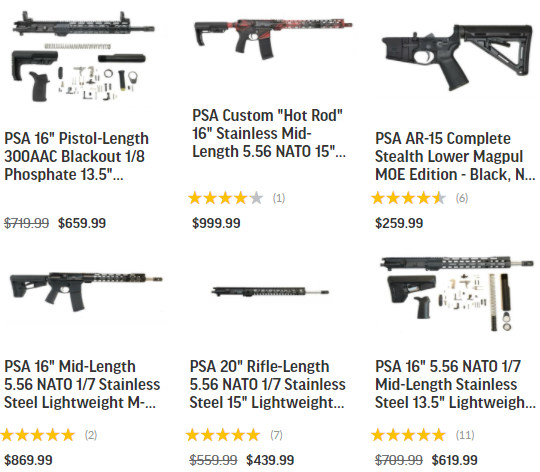
Whether you want a complete AR-platform rifle, a complete upper, or components for uppers and lowers, PSA has what you need. PSA also carries aftermarket triggers, sights, magazines, and other Black Rifle accessories. Here are some of the complete rifles, uppers, and lowers currently on sale at PSA. CLICK HERE for AR-Platform rifles, components, and accessories
Handguns on SALE at PSA
With the record-breaking volume of gun sales in recent months, many smaller gunshops have very limited inventory of handguns, particulary compact pistols suitable for CCW. However, PSA has a large supply of pistols, including popular carry guns from S&W, Ruger, Springfield Armory and other leading brands. Here’s a small sample of handguns in stock today at PSA.
PSA Ammunition on SALE
This is a small sample of the ammunition available now. This is in-stock now, ready to ship. Go to PSA’s Ammo Page to find other cartridge types on sale, including .40 SW, .357 Magnum, .308 Win, and .22 LR.
With the 2020 Presidential election just 65 days away, and more riots in the streets, it may be time to think about getting that AR-platform rifle. Getting it while you still can. Democratic Party nominee Joe Biden and his VP candidate Kamala Harris both support banning of AR-type rifles. And Biden and Harris have praised Canada’s sweeping semi-auto gun ban carried out by Prime Minister Trudeau through dictatorial executive action (without parliamentary approval). The official Democratic Party Platform includes these provisions:
— Banning the manufacture and sale of ARs and modern sporting rifles
— Halting and criminalizing online firearm and ammunition sales
— Forcing states to require licenses for owning any firearms
— Instituting delay processes for background checks
— Criminalizing private firearm transfers
And during her Presidential campaign (before she was selected as Biden’s VP), Kamala Harris declared: “Upon being elected … I will give the United States Congress 100 days to get their [sic] act together and have the courage to pass reasonable gun safety laws. And if they fail to do it, then I will take Executive Action”. That’s a chilling threat…
Got the message? The Dems want your guns. And the first guns they want to take away are the “evil” black rifles. As Robert “Beto” O’Rourke said famously: “Hell yes we’re going to take your AR15″.
AR Purchase Option — Lower Receiver
The restricted part of an AR15 is the lower receiver. This is the section that must be purchased through an FFL, with a background check. You can later add an upper (or multiple uppers), which can be purchased directly from a supplier. But the lower is what you need. If you’re short on cash, but want to get an AR, grab a lower and then add a complete upper receiver later.
One leading vendor of AR lowers is Palmetto State Armory (PSA). PSA has plenty of stripped lowers and complete lower receivers in stock right now at attractive prices. Here are two offers on 8/29/2020:
Complete AR15 Lower Receiver — $209.99
This complete Palmetto State Armory lower receiver is fully assembled and ready for your complete Upper. This unit is machined from 7075-T6 Aluminum Forgings, hardcoat anodized. The lower comes with M4 Stock and Standard Carbine Buffer. The bolt and carrier fit .223 Rem/5.56×45 case heads.
Stripped AR15 Lower Receiver — $74.99
This PSA Stripped Lower Receiver is machined from 7075-T6 Aluminum Forgings, hardcoat anodized. It does NOT include trigger group and pins for operation. You must purchase those items separately. This is just the bare lower receiver.
Sniper’s Hide offers a training class for novice shooters getting started in the PRS/NRL precision rifle game. This Precision Rifle Fundamentals course covers equipment selection, using shooting supports, rifle handling, SFP scope basics, and much more. The Precision Rifle Network video below covers a Sniper’s Hide class offered at the Sure Shot Range, near Vinton, Iowa. This video covers the class both in the field and in the classroom, and has interviews with participants.
One participant praised the course: “As a novice shooter, this [Sniper’s Hide Class] was probably the best money I have spent. It helped me learn all my equipment, how to use rear bags, how to figure out dope… and for the dollar, it’s the best money I’ve spent so far.”
Another student concurred: “I’ve been through all kinds of training, including the military and law enforcement, and I have to say the is one of the best, if not THE best class I’ve ever been in.”
Joel from the Precision Rifle Network stated: “At the end of four days, from two back-to-back precision rifle courses, we sent approximately 4500 rounds down-range. All in all, I would say this is some of the finest precision rifle training you can find ANYwhere.”
Another Video from Frank Galli of Sniper’s Hide
Frank Galli, aka “Lowlight”, is the head honcho of Sniper’s Hide. In the video below, Galli offers a series of shooting tips he calls the “Long Range Shooting W.T.F”. No that’s not what you think it is — no cuss words are involved. “W.T.F.” stands for Wind, Trajectory, and Fundamentals of Marksmanship. To shoot well, Frank says, you first must gauge the wind correctly. Second, you must know the trajectory of your load in your rifle — i.e. know your ballistics. If you want to hit a target at long range, you must start with a rock-solid zero, determine an accurate muzzle velocity, and know the Ballistic Coefficient of the bullet. Plug all that into a good ballistic program (along with elevation, temp, and air pressure) and you should have your point of impact (within a click or two) out to 1000 yards.
Watch Video for Tips about Wind-Reading, Ballistics, and Shooting Fundamentals:
The third element of “W.T.F” is “F” for “Fundamentals of Marksmanship”. This actually involves multiple factors — body position (relative to the rifle), finding your natural point of aim, proper head alignment behind the scope, pre-loading the bipod, breathing modulation, trigger control, follow through, recoil management and more. Frank addresses all these “fundamentals” in the second half of the video, starting at the 3:40 time-mark.
Books for Precision Rifle Training
Along with the Videos above, here are two recommended print publications. These both offer a wealth of useful information for PRS competitors and those interested in tactical/practical style shooting. In addition these books will also benefit hunters. They provide good tips on shooting positions, ranging, supports (bipod, tripod, bags) and more.
Practical Shooter’s Guide
Thinking of getting started in the Practical/Tactical shooting game? Looking for ways to be more stable when shooting from unconventional positions? Then you may want to read Marcus Blanchard’s Practical Shooter’s Guide (A How-To Approach for Unconventional Firing Positions and Training). Unlike almost every “how to shoot” book on the market, Blanchard’s work focuses on the shooting skills and positions you need to succeed in PRS matches and similar tactical competitions. Blanchard provides clear advice on shooting from barricades, from roof-tops, from steep angles. Blanchard says you need to train for these types of challenges: “I believe the largest factor in the improvement of the average shooter isn’t necessarily the gear; it’s the way the shooter approaches obstacles and how they properly train for them.”
Long Range Shooting Handbook
Ryan Cleckner’s Long Range Shooting Handbook is the best-selling modern book on practical rifle skills. A former U.S. Army sniper instructor, Cleckner is knowledgeable, and his text is well-organized and chock full of good information. You can view Sample Chapters on Amazon.com.
Ryan Cleckner’s highly-regarded Long Range Shooting Handbook is designed as an intro to important fundamental concepts such as MOA vs. Mils, External Ballistics, and Environmental Effects. Included are personal tips and advice based on Cleckner’s years of experience as a sniper instructor and special operations sniper.
The Long Range Shooting Handbook is divided into three main categories: What It Is/How It Works, Fundamentals, and How to Use It. “What It Is/How It Works” covers equipment, terminology, and basic principles. “Fundamentals” covers the theory of long range shooting. “How to Use It” gives practical advice on implementing what you’ve learned, so you can progress as a skilled, long range shooter. This book will benefit any long-range shooter, not just PRS/NRL competitors.


 Part 2 of this Volume is focused on various aspects of advanced hand-loading. Modern Advancements (Vol. II) employs live fire testing to answer the important questions that precision hand loaders are asking. What are the best ways to achieve MVs with low ES and SD? Do flash hole deburring, neck tension, primer selection, and fill ratio and powder scales sensitivity make a difference and how much? All of these questions are explored in detail with a clear explanation of test results.


 The Risk of Hearing Loss