An American shooter has hit a 40″ square steel target at a distance of 5000 yards (2.84 miles). This has been hailed as a New Long Range World Record. That’s quite a feat… except that it took thirty-seven (37) shots to put one .408-caliber bullet on the steel target (by a whisker). Is that really good shooting — or just a lucky impact? (The 37th shot just barely hit the right side of the 40″ x 40″ steel plate). This purported “Long Range World Record” was shot on September 30, 2017.
Should we acknowledge this as a meaningful record? Is this a noteworthy achievement or just a stupid stunt? Watch this video and decide for yourself:
ELR at 5000 Yards — World Record or Just a Lucky Shot?
The Firearm Blog explained: “After shooting through three [10-round] batches unsuccessfully, Charlie Melton connected on target with his 7th shot in the fourth batch; round number 37. According to some number crunching … the bullet that finally connected on target was likely in flight for 12.816 seconds!”
Can this lucky shot really be claimed as some kind of meaningful record? Our friend Dennis Santiago, a Service Rifle competitor, and very brainy guy, observed: “Ha! 37th shot works out to a 2.7% probability of hit single-shot. That figure … fails the test of operational viability. Any hits are incidental within the beaten zone. It’s a gimmick.”
And William W., a retired military ordnance specialist, stated: “Dispersion and random Circular Error Probable (CEP) says if you fire enough shots, you will eventually hit what you are aiming at. It could have taken one shot or one hundred or more. Do the math for a radial error of .05 MOA at 15,000 feet and see what comes up. This is what we call ‘hardstand dispersion’ which only accounts for the gun and ammunition bias. Add environmental factors and CEP gets much bigger. A true test is a series of shots that strike the target, not a holy poke.”
Shot Made with Armalite AR-30 Fitted with 31″ Barrel Chambered for .408 Tejas
The lucky shot (37th attempt) was made by former SEAL Charlie Melton of Charlie Mike Precision. He was shooting an Armalite AR30 rifle with 31″ Pac-Nor barrel chambered for the .408 Tejas, a 50° wildcat based on the .408 Cheytac cartridge. The bullets were 420 grain solids launched at 3065 FPS.
Rifle: Armalite AR-30, with 6 oz. Jewell trigger
Barrel: 31″ Pac-Nor chamber for .408 Tejas
Bullet: 420 Grain Monolithic (solid) Bullets – 3,065 FPS
Bi-Pod: Shots Gunsmithing Bipod for Armalite AR-X
Optic: Nightforce NXS 12-45x56mm fitted with Charlie TARAC Prism (see below)
Rings: Ivey Adjustable Scope Rings
Photo by Brad Stair of Performance Guns
Innovative Elevation Booster — Charlie TARAC Prism System
The Charlie TARAC Prism from TACOMHQ helps ELR Shooters hit very distant targets, by elevating the actual target image, effectively augmenting the scope’s internal elevation adjustment. The latest TARAC is an adjustable unit that adds up to 120 MIL of elevation to any scope. Current high-end scopes typically offer around 30 MIL of vertical. With the Charlie TARAC fitted to the scope’s front objective, you can add +120 MIL elevation.
There are some interesting firearms featured this week on Guns & Gear, a syndicated TV show by the creators of Gun Talk Radio. This week, the Guns & Gear team tests a Smith and Wesson M&P 10 chambered in 6.5 Creedmoor. This 6.5 CM version of S&W’s AR10-platform rifle is a leading choice for the PRS Gas Gun Division. The rifle shows good build quality and good accuracy with factory 6.5 Creedmoor ammo. If you’re a fan of the 6.5 Creedmoor cartridge and want to see how it works in a gas gun, the M&P 10 is a smart option. S&W offers good customer service and a rock-solid warranty.
Along with Smith & Wesson’s 6.5 Creedmoor semi-auto rifle, Guns & Gear’s crew tests the new Ruger 8-Shot Redhawk revolver in .357 Magnum. That short-nosed wheelgun is one ugly beast, but greater ammo capacity is probably a good thing. Then the crew samples Springfield Armory’s XD handguns. There is also a fun feature on Crimson Trace Master Series Lasergrips. It’s cool to watch the laser beams track from gun to target (see below).
Here is a sneak preview of this week’s Guns & Gear Episode:
Why We Love Wheelguns
We were intrigued by the 8-shot Ruger Redhawk, being avid revolver fans. When we go out plinking with handguns, a classic revolver is often our first choice. This Editor’s S&W model 617 ten-shot .22 LR revolver probably has more rounds through it than all my other handguns. And I have a S&W Performance Center .44 Magnum that has shot 1″ groups at 50 yards (off a rest). I like full-sized revolvers for long sight radius and inherent accuracy of the fixed barrel, combined with the superb trigger break in single-action mode.
Guns & Gear Showtimes
Guns & Gear airs year-round on the Sportsman Channel on Wednesdays at 2:00 PM Eastern, Thursdays at 8:30 PM and 11:30 PM EST, Fridays at 2:30 PM EST, and Sundays at 4:00 AM EST. Find the Sportsman Channel at DirectTV Ch. 605, DISH Network Ch. 395, AT&T U-Verse Ch. 642, Spectrum Ch. 315, and your local cable provider. Watch past Guns & Gear episodes on Gun Talk Media’s YouTube Channel, or visit www.GunTalk.com.
We like Howa 1500-series rifles. The major attractions are the smooth-running action (feels almost like a custom), a very good two-stage trigger (way better than most domestic factory triggers), pretty decent barrels, and excellent fit and finish. Howa also offers a “mini” action that’s nearly an inch shorter than a conventional short action. The only negative is that the Howa actions have metric barrel threads. That complicates the re-barreling task for some gunsmiths who don’t have the right equipment. All-in-all the Howa 1500 series is still a fine value, offering excellent “bang for the buck”. If we were choosing a new varmint or hunting rifle, the Howa would be one of our first choices.
Given our positive outlook towards Howa rifles, we were pleased to see that American Rifleman just named the Howa 1500 HCR rifle (with scope package) as the NRA Gun of the Week. Check it out:
Designed for PRS “factory class” competition and tactical applications, the Howa HCR offers the smooth-running 1500 action with HACT 2-Stage trigger in a fully-adjustable aluminum chassis. The Howa’s MSRP is $1299.00, with “street price” around $990.00 in black or $1180 with Camo finish so the HCR is directly competitive with the Ruger Precision Rifle (RPR). Available chamberings are: .223 Remington, .243 Winchester, 6.5 Creedmoor, and .308 Winchester.
Mounted on an AR-style buffer tube system, the Howa HCR utilizes the fully adjustable LUTH-AR MBA-3 stock. Length of Pull is adjustable from 12.5″ to 16.75″. Comb height is also adjustable to fine tune for scope height-over-bore. Weight with a 24″ barrel is 10.2 pounds (before optics), so this Howa HCR is lighter than many similar rifles on the market.
Trigger images from PrimaryArms.com, which sells all the triggers reviewed here: Geissele, Elftmann, Timney, and ALG Defense.
Are you thinking of upgrading the trigger system for your AR-platform rifle? There are dozens of options available, from $45 up to $300. Thankfully, Brownells has created video reviews of some of the more popular AR trigger options from Timney, Geissele, and ALG Defense. And we included a video review of the highly-regarded Elftmann Match Trigger. If you want the best solution for Service Rifle competition, you might favor the Geisselle. For ease of installation, it’s hard to beat the Timney, a “drop-in” module. Like the Timney, the super-smooth Elftman is a drop-in module. At $249.00 it’s pricey, but it is one of the best AR triggers out there. If you’re on a tight budget, the best “bang for your buck” may be the “Perfected Mil-Spec” ALG which starts at around $45.00.
Geissele Enhanced Two-Stage Trigger
Geissele makes a variety of quality AR trigger sets both single-stage and two-stage. Many High Power competitors like the two-stage Geissele trigger. This delivers a repeatable, controlled pull through the first stage with a very clean break in the second stage. The Super Dynamic Enhanced Trigger, shown above, features a distinctive, trigger blade. Reviewer Thomas Conroy says: “The flat surface is very easy to press against. Both stages are light and very distinct.”
Elftmann Drop-In Match Trigger
Though pricey ($249.00 at PrimaryArms.com), we really like the Elftmann AR trigger. It combines the best of both worlds — the precision and smoothness of the Geissele with the Timney’s ease of installation. This single stage trigger is user-adjustable from 2.75 to 4 pounds pull weight. It is offered with either straight or curved trigger blade. Primary Arms says: “The amazingly short take-up, glass-rod crisp break and [near-zero] over-travel can be compared to the finest custom 1911 triggers.”
Timney Drop-In Trigger Module
This trigger module is available for both the AR15 and the AR10 platform (as covered in the above video). Timney triggers are easy to install and come with multiple pin size and pull-weight options. Reviewer Thomas Conroy confirms that the single-stage Timney “breaks cleanly and crisply. This trigger is modular, meaning that the trigger, sear, hammer, and spring are all encased in a bright, shiny yellow aluminum housing.”
ALG Defense Trigger — Higher-Quality Basic AR Trigger
According to Thomas Conroy, ALG triggers “are the perfected version of the standard, non-adjustable mil-spec original trigger. They have the same geometry, but are made to higher quality standards, and come with … hardened and smoothed-out sear contact surface to eliminate all grittiness.” These are also offered in a nickle-boron coated version. Available for under $45.00, the ALG is a well-made, low-cost option for shooters who want a better factory-type trigger system.
For More Information about These Triggers
Learn more about Geissele, Timney and ALG triggers, plus two more AR trigger options (CMMG and Rock River Arms) in a Trigger Comparison Review by Thomas Conroy on Ammoland.com.
Hornady has introduced a new Short Magnum cartridge, the 6.5 PRC (Precision Rifle Cartridge). This will be offered as factory ammo in both a “Match” version (with 147gr ELD) and a “Precision Hunter” version (with 143gr ELD-X bullet). Presumably, in the future, Hornady will offer 6.5 PRC brass separately for hand-loaders, but Hornady has no time-line for brass availability. However, you can get 6.5 PRC brass right now from GA Precision at $86.00 per 100 cases. GA Precision’s George Gardner, who helped develop this cartridge, has posted: “It’s a non-rebated short mag based on a short RCM [Ruger Compact Magnum] case. It has 3-4 grains less capacity than the 6.5 SAUM which nets about 30-50 fps deficit to the SAUM.”
The 6.5 PRC Match seems to be aimed at the PRS crowd and long-range tactical shooters. The product launch photo shows a tactical rifle and steel plate. Hornady says the 6.5 PRC was “designed to achieve the highest levels of accuracy, flat trajectory, and extended range performance in a sensibly-designed compact package. Utilizing moderate powder charges that result in repeatable accuracy, low recoil, and reasonable barrel life, the 6.5 PRC produces high velocities for target shooting with performance well beyond 1000 yards.”
“High Velocities”? Wait a minute — here’s the ballistics chart from Hornady’s 6.5 PRC page. It shows a muzzle velocity of 2910 FPS. That’s not much better than a 6.5 Creedmoor (which can push 140s over 2800 fps), so we wonder about this. You have to ask — what is the point? Is there anything this 6.5 PRC can do that the venerable 6.5-284 can’t do just as well or better — with a standard bolt face?
New 6.5 PRC Is a Short Magnum Requiring Magnum Bolt Face
Dubbed the “big brother” to the 6.5 Creedmoor, the 6.5 PRC fits in short or medium actions with a standard magnum bolt face (.532”). The case geometry features a long cartridge case neck and 30-degree case shoulder. It sort of looks like a 6.5 Creedmoor on steroids. For its loaded 6.5 PRC Match Ammo, Hornady is showing a 2910 fps Muzzle Velocity with the 147gr ELD Match bullet. That’s not very impressive. Why go to the trouble?
Comment — Does This New 6.5 PRC Cartridge Fill a Need?
Honestly, we don’t get this. If you need more speed than a 6.5 Creedmoor and want to stick with a .264-diameter bullet, then shoot a .260 Rem or 6.5-284 using a standard bolt. This requires a magnum bolt face. The 6.5-284 is a barrel burner; the 6.5 PRC promises to be likewise. On the other hand it may work better than a 6.5-284 in a short-action magazine — that may be what Hornady is thinking…
The 6.5 PRC clearly seems to be targeted at the PRS crowd. But we see many top PRS competitors moving DOWN in cartridge size, rather than up. Many PRS guys have stepped down from the 6.5 Creedmoor to the 6mm Creedmoor, or even a 6mm Dasher. The benefit is less recoil, and cheaper bullets. Are there really many PRS shooters clamoring for a short magnum? We don’t think so.
We’ll see if this new 6.5 PRC cartridge catches on — maybe some PRS guys will want this for long-range side matches. Rifle makers currently chambering the 6.5 PRC include GA Precision, Gunwerks, PROOF Research, Stuteville Precision and Seekins Precision.
6.5 PRC Ammunition for Hunters — Also New for 2018
Hornady will also sell a version of 6.5 PRC ammo design for hunters. The Precision Hunter version, shown below, is loaded with the 143-grain ELD-X Bullet. Again, however, we really don’t know why any hunter would want to shoot this cartridge, when you already have so many good choices, such as the 6.5x55mm Swede, and the original .284 Winchester, both of which can use a standard bolt face.
If you have a hunting rifle with a magnum-size bolt, why not shoot the 7mm RSAUM or 7mm WSM? Barrel life is not really an issue for hunters, so the smaller case capacity of the 6.5 PRC is not really an advantage. Perhaps the veteran hunters among our readers can enlighten us, using the comments section. Would you build a hunting rifle chambered for the 6.5 PRC?
Thinking of trying out the Precision Rifle Series, starting off with a gas gun? Well Gavin Gear of UltimateReloader.com did just that, competing in his first-ever PRS match up in Washington State. With its timed stages (some just 90 seconds long), Gavin learned that PRS is about speed as well as accuracy. As a PRS newbie, Gavin found the competition fun but challenging. Gavin’s account of his experiences, set forth in two articles with accompanying videos, will help other novice PRS competitors prepare for PRS-type matches and assemble the right equipment.
What PRS is All About
PRS is all about pushing your rifle skills to edge. You may have to hit targets at four different distances in 90 seconds- and dial in your dope between each shot. These kinds of challenges are super-difficult, but with enough experience and practice, it’s amazing what you can do. I saw guys that were so smooth, steady, fast, and accurate, it was mind blowing! It doesn’t come easy, and the guys at the top of the heap are super-dedicated. — Gavin Gear
This video has cool Aerial Drone footage, and in-depth explanation of stages:
Gavin’s First PRS Match: The Experience
By: Ultimate Reloader
Gavin told us that he’s wanted to try out the PRS game: “For a long time I’ve talked with friends about trying out a PRS-style match. Life has been busy, but when the right opportunity came, I decided to give it a try. My friend and shooting partner Jim Findlay offered to help me prepare, and told me it would be ‘fun to shoot gas guns together’. I decided I would shoot an AR-15, and thought that would be an ideal opportunity to try something new — the 22 Nosler. I wasn’t sure exactly what I was getting myself into, but that’s typically the way things happen when you’re really trying something new. It was a great experience, and it taught me a lot about shooting. I also made some great connections and friends during the match. If you are at all interested in PRS (Precision Rifle Series, or just Precision Rifle in general) I would suggest you enter and compete in a match. You most likely won’t regret it.”
Gavin enjoyed his first match: “Overall, the match was more fun and more laid back than I thought it would be. The guys in our squad were all really helpful, and even loaned me gear to try out when they noticed my gear wasn’t right for a particular shooting activity. One such case was when Ken Gustafson (of KYL Gear) offered to loan me one of the bags he had made. Below you can see me shooting off the infamous unstable tippy tank trap with a KYL Gear bag, and I’ll have to say [the bag] was amazing. It helped me lock down my rifle and get on target. What a great feeling!”
Gavin did experience issues with his “stout” 22 Nosler loads: “I did run into some trouble — I had loaded my 22 Nosler rounds to max charge weight with Varget powder and experienced some failure-to-feed issues during the match. Initially I thought my bolt needed more lubrication, but [it was] between 96 – 100°F during the hottest part of the Match day.” With the ultra-high ambient temperatures, Gavin experienced over-pressure. Word to the wise — “Test everything you plan to use on match day, and take into account things like weather conditions as well”.
Gear Choices and Selection
Gavin tells us: “In order to be successful in a PRS match, you need a rifle that is accurate enough, extremely reliable, has great ergonomics, handles well, and fits your budget.”
22 Nosler AR-15 rifle used by Gavin in the PRS match
18″ 1:8-twist 22 Nosler Upper
Two Stage Match Trigger – .154″ Hi-Speed DMR (GEISSELE AUTOMATICS)
Hogue AR-15 rubber grip
Magpul PRS stock
Harris S-BRM 6-9″ bipod
Vortex Viper HS-T 6-24x50mm scope
Action Type — Bolt vs. Semi: While most PRS competitors use bolt-action rifles, there are classes of competition that specifically call for semi-automatic actions to be used. Even so, in Open Class where you can pick which action type you’d like to use, there’s a split between the two for various reasons. I used an AR-15 in my first match, and for comparison, I think I’ll use a bolt-action rifle in my next match!
Support — Bipods and Bags: I think the first thing I said when trying to shoot from a barricade was: ‘You have to be kidding’. For someone used to prone shots from a bipod (when shooting long-range) this new challenge seemed impossible. My reticle was literally all over the place trying to shoot a target at 400 yards. But over time things improved drastically! Part of this improvement came from practice and technique, and part came from using the right support systems, such as the Game Changer Bag from Armaggedon Gear:
Photo Courtesy Accurate Ordnance.
All the Gear Items You Need — Bags, Bipods, Optics and More
UltimateReloader.com’s PRS Gear Summary covers Rifle Choice (gas gun vs. bolt-action), chambering options, optics, support systems (bipods and bags), dope cards, accessories and much more. Both novice and experienced PRS competitors will find this article well worth reading.
Christensen Arms just unveiled a new rifle for PRS competitions and tactical applications. Christensen’s innovative Modern Precision Rifle features an all-new, proprietary chassis system and weighs less than seven pounds (for the 16″-bbl .308 Win version). The Modern Precision Rifle sports high-tech features, such as carbon fiber handguards/fore-end and cheek-piece, and black nitride-coated bolt, receiver, and muzzle brake. The rifle comes complete with a +20 MOA scope rail and a true folding stock with magnetic closure. The Christensen MPR carries a $2295.00 MSRP. That’s a grand more than a Ruger Precision Rifle, but the Christensen MPR’s action runs smoother and the gun is much, much lighter. The fore-end also feel better in the hand and the Christensen Arms rifle balances better than the Ruger.
The Christensen MPR is made from top-quality materials throughout. The chassis is machined from 7075 billet aluminum and features V-block bedding to promote superior accuracy. Other features include an adjustable folding stock with a locking hinge mechanism, and oversized, fluted bolt knob. The Modern Precision Rifle is built with a carbon fiber-wrapped barrel, free-floating handguard, and adjustable comb. The rifle is guaranteed to shoot sub-MOA.
Initial chamberings include 6.5 Creedmoor and .308 Winchester in a variety of barrel lengths. Additional calibers, including long-action offerings, are expected in 2018. The Modern Precision Rifle will hit dealers’ shelves within the next 6-8 weeks with an MSRP of $2295.00.
Carbon Components Keep Weight Down
Visit the Christensen Arms website for full specifications, technical drawings, and more photos.
British Lee-Enfield Model SHT’22/IV Rifle, courtesy www.iCollector.com.
Our friend Dennis Santiago was a technical advisor for History Channel’s Top SHOT TV show. One of the notable Top Shot episodes involved the “Mad Minute”, a marksmanship drill practiced by the British Army in the decades preceding World War I. Dennis observed that the Top Shot competitors didn’t fare too well in their “Mad Minute” attempts, not scoring many hits in the alloted one-minute time period. That prompted Dennis to give it a try himself — seeing how many hits he could score in one minute with an authentic Lee-Enfield rifle. So, a while back, Dennis ran the drill at a range in California.
Dennis, an active high power rifle competitor and instructor, enjoyed his “Mad Minute” exercise, though he assures us that this takes practice to perfect. Dennis tells us: “Here is a ‘Mad Minute’ drill, done using a period correct Lee-Enfield (SMLE) No.1 Mk III rifle and Mk VII ammo. I got to the Queen’s Regulations (15 hits in one minute) on the second run and put a good group on the target at 200 yards. This is ‘jolly good fun’ to do every once in a while. This is ‘living history’ — experiencing a skill from a time when the sun never set on the British Empire.”
“Mad Minute” was a pre-World War I term used by British Army riflemen during training at the Hythe School of Musketry to describe scoring a minimum of 15 hits onto a 12″ round target at 300 yards within one minute using a bolt-action rifle (usually a Lee-Enfield or Lee-Metford rifle). It was not uncommon during the First World War for riflemen to greatly exceed this score. The record, set in 1914 by Sergeant Instructor Alfred Snoxall, was 38 hits. (From WikiPedia.)
Want to See More “Mad Minute” Action with a Modern Tubegun?
In 2012, Gary Eliseo ran a “Mad Minute” exercise using a modern, .308 Win Eliseo RTM Tubegun of his own making. Gary ended up with 24 hits on a bull target set at 300 yards. (Gary actually had 25 hits in 25 rounds fired, but the last round hit just after the 60-second time period expired.) Note how Gary pulls the trigger with the middle finger of his right hand. This allows him to work the bolt faster, using his thumb and index finger. CLICK HERE for Eliseo Tubegun Mad Minute story.
Watch Gary Elesio Shoot the ‘Mad Minute’ (Starts at 4:47 on Video)
NOTE: In an interesting coincidence, Dennis Santiago was actually in the pits pulling targets for Gary during Eliseo’s 2012 “Mad Minute” exercise.
History of the Mad Minute Commentary by Laurie Holland
The original military requirement of the “Mad Minute” saw the soldier ready to fire with a round in the chamber, nine in the magazine, safety on. This course of fire is still followed by the GB Historic Breechloading Arms Association and other bodies in their recreated “Mad Minute” competitions.
The first 10 would go quickly, but reloads were critical, this not done by a magazine change as Gary did with the RTM or in a modern tactical or semi-auto rifle, but through slick use of ‘chargers’. It is this aspect which fouls so many of my colleagues up as it is very easy to cause a jam and a large part of 60 seconds can go in sorting it out!
Charger clips were selected for those that just held the rounds firmly enough to stop then falling out, were sand-papered and polished with a stove / fireplace polish called ‘Zebrite’ so that the rimmed rounds would slip through the clips like corn through a goose.
If you’re unfamiliar with the cock-on-closing Enfield action, it seems clumsy. With intensive practice it is very smooth and can be operated incredibly quickly. The trick is to whip the bolt back onto its stop and initiate a rebound movement that takes it and the cartridge well into the chamber thereby reducing the effort required to close the bolt and chamber the round.
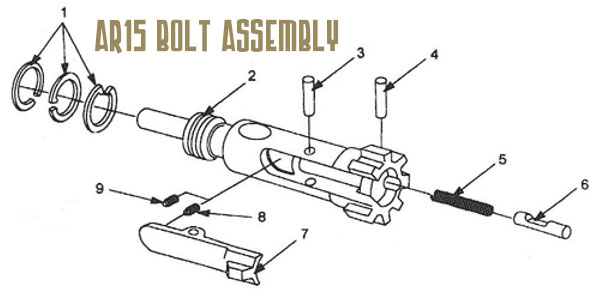
We call them “black rifles”, but that shouldn’t refer to all the carbon and gunk on the inside. AR-platform rifles can be maintenance-intensive beasts. But some AR owners make the situation worse by not regularly cleaning important small parts, or by using too much oily/greasy lubricants in the wrong places. A properly maintained and lubricated AR15 can shoot hundreds of rounds (between cleanings) without a problem. If you learn where (and where not) to apply lubricant, you’ll find that your AR will run more reliably and the task of cleaning the bolt and bolt carrier will be less of a burden.
Here is a good video that explains AR-15 Cleaning and Maintenance. In this 30-minute NSSF video, Gunsite Academy instructor and gunsmith Cory Trapp discusses the proper way to clean and maintain the AR-15 carbine. Very knowledgeable, Trapp provides rock-solid advice for AR owners. Along with cleaning producedures, this video explains how to inspect key components and how to function-test your AR before each shooting session.
Popular YouTube Channel Smarter Every Day recently released a fascinating video featuring rifle suppressors with see-through acrylic sleeves. The team filmed shots through the suppressors using ultra-high-speed (110,000 frame per second) cameras. When played back in super-slow-motion, you can see the flame propagate through the suppressor and the bullet move through each baffle before it exists the muzzle. Notably, you can see different internal flame effects depending on the baffle design. Watch the results in the video below — it’s mesmerizing:
See Through Suppressor in Super Slow Motion (110,000 fps) — Click Arrow to Watch:
The high speed transparent silencer video is pretty neat. It certainly demonstrates, to some extent, the violence that happens inside centerfire rifle suppressor when firing.
At Thunder Beast Arms Corp. we have carefully studied the forces/pressures operating inside suppressors. The “uncorking” pressure when the bullet exits the muzzle is typically in the 8,000 to 15,000 psi range, but some combinations of cartridge and barrel length can extend this up to the 25,000 psi range. Job #1 of a suppressor designer is to build a suppressor that won’t explode. Job #2 is to build one that quiets down the muzzle report significantly. Doing that well, with the minimum amount of material, is the tricky part.
Suppressor design is both art and science, and we approach our R&D from three sides: experience, experimental testing, and computation.
There are a lot of opinions about how to design a quiet suppressor. Many of these are based on preconceived notions of how suppression “should work”. These theories may or may not work when built and tested in the real world. Where the rubber hits the road is experimental testing. I would say that a majority of knowledge about “How to design a quiet suppressor” comes from building hundreds or thousands of prototypes and testing them with good equipment in a cogent experimental process. Some of those theories pan out, but many of them do not.
Thunder Beast Arms Tests its Suppressors in the Lab and in the Field.
Scientific Software Aids Design
We have also made a large investment in computation fluid dynamics (CFD) and finite-element analysis (FEA) software and use it in addition to other computer-model analysis to look at the physics that occurs inside the suppressor. This type of analysis gives information about material effects that is pretty much impossible to get any other way. Even so, the computer cannot tell you how to design a
suppressor, and the results must always be checked and compared to reality.
Thunder Beast Arms Corporation was started ten years ago with the goal of producing the best precision rifle suppressors. Our current ULTRA series in .223, 6.5 mm, .308, and .338 calibers provides industry-leading suppression performance with very light weight.


 The Firearm Blog explained: “After shooting through three [10-round] batches unsuccessfully, Charlie Melton connected on target with his 7th shot in the fourth batch; round number 37. According to some number crunching … the bullet that finally connected on target was likely in flight for 12.816 seconds!”

 Along with Smith & Wesson’s 6.5 Creedmoor semi-auto rifle, Guns & Gear’s crew tests the new Ruger 8-Shot Redhawk revolver in .357 Magnum. That short-nosed wheelgun is one ugly beast, but greater ammo capacity is probably a good thing. Then the crew samples Springfield Armory’s XD handguns. There is also a fun feature on Crimson Trace Master Series Lasergrips. It’s cool to watch the laser beams track from gun to target (see below).

 Trigger images from


 Lee-Enfield No. 4 Rifle (1943), courtesy



 The high speed transparent silencer video is pretty neat. It certainly demonstrates, to some extent, the violence that happens inside centerfire rifle suppressor when firing.


