When we first ran this story a couple years ago, it proved immensely popular with our readers. In case you missed it the first time around, check out what can be done with a factory Savage 110 BA at extreme long range — 1760 yards (one mile). Shooter Mark Dalzell did a great job with the video, which features multiple camera views so you can see the shooter and the target at the same time. Enjoy!
This video by Mark Dalzell demonstrates the long-range capabilities of the Savage 110 BA chambered in .338 Lapua Magnum. Mark took his “BadAss” rig out to the southwest Nevada desert just north of Jean Dry Lakes. He placed a 2’x3′ target way, way out there — a full mile (1760 yards) away. At that range, flight time to target was 3.75 seconds! Sighting with a Nightforce 5-22x50mm NXS scope, Mark needed a few shots to get on target, but eventually made multiple hits, using 67 MOA of elevation and 2.25 MOA left windage. You can view the hits starting at 1:56 time-mark on the video. (Mark had a second camera set up closer to the target — this displays frame in frame in the video, and if you watch carefully you can see the strikes.) The ammo was HSM 250gr HPBT match with a 3.600″ COAL. The shooting was done at 8:13 in the morning, with clear conditions, very light winds. Temp was 57°, humidity 24.5, Density Altitude 3666. Video soundtrack is La Grange by ZZ Top.
PLAY BUTTON
LISTEN TO MARK TALK about One Mile Shooting:
CLICK Play Button to hear Mark Dalzell TALK about his .338 LM Savage 110 BA and how he scored hits at 1760 yards.
Good Shooting Mark. That’s darn good for a factory rifle. You also had the elevation dialed in real close before the firing started! That shows a good knowledge of your ammo’s long-range ballistics. We also noticed how effective that muzzle brake was. Recoil looked about the same as an un-braked .308 Win.
If you thought Mark’s 1760-yard shooting was impressive, Mark has produced another video that shows a session at even greater distances — out to 2300 yards. Watch Mark Dalzell Shoot at 2300 Yards.
PrecisionRifleBlog.com recently reviewed several video-based rifle training DVD sets. While instructional DVDs will never replace live “hands-on” training, they can be cost-effective ways to sharpen your skills. Watched periodically, these training DVDs can help reinforce the fundamentals.
PRB’s Editor Cal Zant has purchased several rifle training DVDs over the years. His recent Precision Rifle Blog DVD review looks at four different options:
Long Range Made Easy, Two-Volume Set, from Accuracy 1st The Art Of The Precision Rifle, with Todd Hodnett (Magpul Dynamics) Putting Rounds On Target, with Bryan Litz (Applied Ballistics) Rifles Only — Precision Rifle Instructional DVDs, with Jacob Bynum
Cal reports that each of these four titles offers a slightly different approach, with each instructor displaying his own focus, based on his background and expertise.
Accuracy 1st’s Long Range Made Easy Two-Volume Set seemed to win PRB’s Editor’s Choice Award. The tagline on the DVD is: “Go from basic to advanced with the guy that has trained our best military snipers for the past 10 years.” That’s a pretty good description. Todd Hodnett is the primary instructor, and Bryan Litz joins him in several segments.
It’s the best of both worlds. Todd Hodnett’s pragmatic “the-bullet-cannot-lie” approach (field-proven by hundreds of the world’s best snipers), is combined with Bryan Litz’s engineering approach and vast knowledge of external ballistics verified with carefully recorded live-fire experiments. The two styles complement each other well, and provide an extremely well-rounded and comprehensive overview.
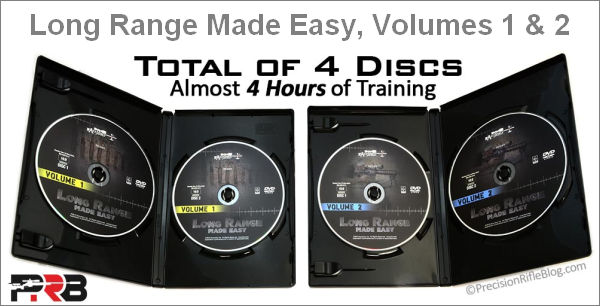
The DVD set is split into two volumes, each of which includes two discs. All together there are almost four hours of instruction from the most respected guys in the industry. And they cover a lot of ground — you’d never be able to cover this much in a one- or two-day live class. Plus with the DVD you can easily repeat an important point, and watch the whole program more than once.
Cal paid $76.95 out-of-pocket for the Long Range Made Easy, Vol. 1 & 2 Bundle, so his review wasn’t a paid advertisement. He thought this set provides a ton of value, and could help a lot of shooters. Here are key topics covered in Long Range Made Easy:
■ Advice for Gear Purchases
■ Optimal Gun Setup
■ Technique for Position
■ Simple & Quick Wind Formula
■ Using the Applied Ballistics Kestrel
■ Truing Ballistic Algorithms, Drag Scale Factoring, and Custom Drag Models
■ WEZ Analysis
■ Wind Course
If you’re new to the long range game, or you’ve been doing it for a few years and want to learn directly from some of the most sought-after instructors in the world, then check out Cal’s write-up over at PrecisionRifleBlog.com. CLICK HERE for PRB Review of Training DVDs.
Bryan Litz, 2016 F-TR National Mid-Range Champion, tried his hand at a new discipline recently — tactical shooting. Bryan competed in the Guardian Match, a PRS-type competition hosted by the Marksmanship Training Center in Lake City, Michigan. Though the course of fire was new to Bryan, he did very well indeed, finishing second overall in his first-ever Tactical Match.
Bryan said PRS-type tactical shooting is “totally different” than F-TR competition: “I think the biggest difference (from F-TR) are the time constraints. The time pressure’s totally different. We had just 25 seconds to do one short-range stage, and other stages are 90 seconds, 120 seconds….”
Bryan added: “You’ve got to know your dope for the first shot — no sighters. F-TR is more deliberate, precision-based. This [tactical game] is about accuracy to be sure, but there’s even athleticism — if you’re not flexible, you’re just straight up not going to be able to aim at some of these targets.”
Bryan, who first achieved great success in sling-shooting disciplines, said that tactical matches, with their multiple “on the clock” stages, offer new challenges: “This was a way different experience than I’m used to, mostly due to time pressure and awkward shooting positions. But I enjoyed the problem- solving element. Fellow shooters were very helpful and generous with advice.” Posting on Facebook, former USAMU coach Emil Praslick offered this sarcastic advice: “You need more Velcro and camouflage. That is what is preventing you from winning.”
During his match Brian shot in multiple locations, with a variety of target types, including steel and IPSC movers. There were some unusual challenges including a “Tree-Stand Hunter” stage, and a stage that required moving “Around, Over, and Under a Vehicle” as you can see…
Before the match, Bryan practiced from a tripod, but he wasn’t sure about the best technique: “Seriously, what kind of groups are considered ‘good’ from a position like this? Does 2 MOA suck?” Here’s the recommended technique (from Gunny N.): “Anchor the sling to the front of the rifle but not the back. Wrap sling around leg or center post of the tripod. Place your off hand on the wrap and twist it to tighten up. That will apply down pressure on the forearm. Your shoulder will apply down pressure on butt stock. You’ll tighten groups 25-50%.”
Weatherby has a new modular rifle for PRS comps and other tactical disciplines. Called the Vanguard® Modular Chassis (VMC), this rifle features a Modular Driven Technologies (MDT) aluminum stock, Luth AR MBA-1 buttstock, and 22″ heavy barrel. The Weatherby Vanguard action is fitted with an adjustable 2-stage trigger. Priced at $1519.00 MSRP, this rifle can be campaigned in the PRS “Production Class”, which limits complete rifles to $2000.00 without optics. The rifle is offered in three chamberings: .223 Rem, 6.5 Creedmoor, and .308 Winchester.
Weatherby says its Vanguard Modular Chassis tactical rifle is very accurate. To back that claim, Weatherby offers a SUB-MOA accuracy guarantee — Weatherby guarantees the rifle will shoot .99” or smaller 3-shot groups at 100 yards when used with Weatherby® factory or premium ammunition.
Near Half-MOA Accuracy with Factory Ammo
It turns out Weatherby’s accuracy claims are conservative. This tactical rifle is closer to a half-MOA rig than a 1-MOA gun. American Rifleman recently tested a .308 Win version of this rifle and recorded really stellar accuracy — close to half-MOA. What’s more, this rifle is not fussy — with a 1:10″-twist barrel it proved very accurate with six different types of factory ammo.
In fact, the rifle delivered near-half-inch 5-shot groups with two types of Hornady factory ammo, and the worst group (of six ammo types) was 0.76″, still very impressive for factory fodder. With good hand-loads this gun could go well under half-MOA (for five shots).
Vanguard Modular Chassis FIVE-SHOT Test Groups with Factory Ammo:
0.53 inches | Hornady 168gr Match BTHP (2718 fps)
0.55 inches | Hornady 155gr Steel Match (2612 fps)
0.57 inches | Black Hills 168gr BTHP (2608 fps)
0.66 inches | Federal Premium 168gr MatchKing BTHP (2659 fps)
0.70 inches | Hornady 155gr American Gunner (2697 fps)
0.76 inches | Black Hills 175gr BTHP (2603 fps)
NOTE: Group sizes are for 5-shot groups shot from bench at 100 yards with Caldwell pedestal rest and rear sandbag. Pentax Lightseeker 6-24x50mm scope. Velocities in FPS from PACT Chronograph.
The accuracy testing was done by gunwriter Mike Detty, who notes: “My single best group was fired with Hornady’s Match 168-gr. BTHP ammunition. Five shots measured just slightly more than a half-inch. Hornady’s 155-gr. Steel Match ammo wasn’t far behind with a group of .55″. Also accounting for the small groups is the VMC’s wonderful trigger. It is a two-stage affair and the first stage has about 3/8” take up with about a pound of pressure until it reaches the second stage where another 1 ¾ lbs. was required to break the shot.”
PRS Production Class Cost Limits
Production Division combined rifle and scope MSRP as listed on the company’s website shall not exceed $3,000 USD, the rifle shall not exceed $2,000 USD and the optic not exceed $2,000 USD. [Editor: For example, you could have a $2,000 rifle with a $1000.00 scope or vice-versa. The total system cannot exceed $3000. Rifle alone cannot exceed $2000.00 retail sale price.]
Production Division rifles are not permitted to be altered or improved in any way from the original factory configuration.
For a prone shooter, particularly on dusty, dirty or sandy ground, muzzle blast is a major bummer. Muzzle blast can be very disturbing — not just for the trigger-puller but for persons on either side of the gun as well. Some muzzle brakes send a huge shockwave back towards the shooter, and others send blast towards the ground, kicking dirt and debris into the prone shooter’s face. If there was a way to illustrate those factors — shockwave and debris — that might help shooters select one brake design over another.
Cal Zant at PrecisionRifleBlog.com applied a unique blend of creativity and resourcefulness to try to answer that question for 20+ muzzle brakes. Using high-speed photography and household products, he captured the blast pattern of 20+ different brake designs for easy side-by-side comparison. Can you figure out how Cal managed to show muzzle brake blasts so clearly? His “hi-viz” solution, revealed in the article, is very clever. See the eye-opening results for 20+ brakes, with illustrative photos, by visiting the Precision Rifle Blog Muzzle Brake Ground Signature Test Page.
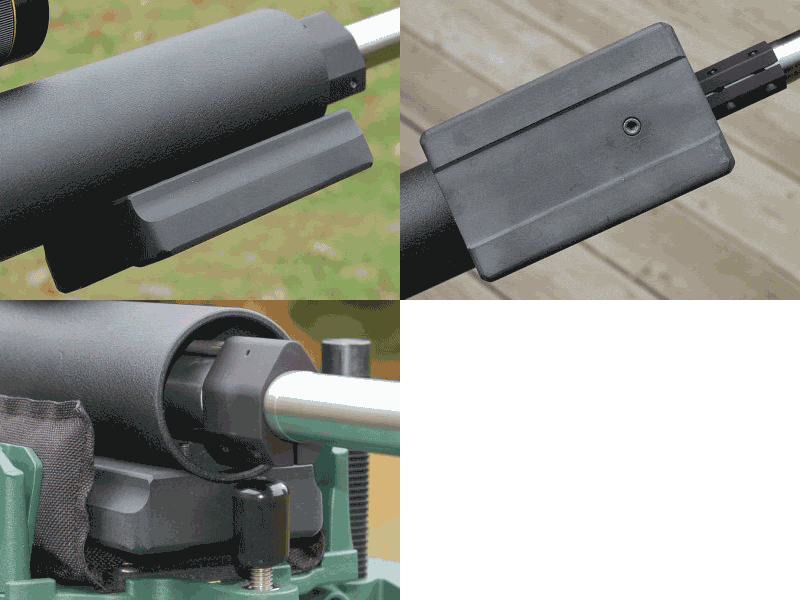
When doing load development for any rifle, it’s nice to be able to shoot from the bench with a stable front pedestal rest. Unfortunately, rifles with narrow fore-ends and ARs with tubular handguards can be somewhat wobbly on front bags. The solution is to attach a forward bag-rider to your rifle. This provides a nice, wide and flat base that sits securely in a benchrest-style front sandbag. A wide bag-rider helps prevent the gun from rocking, steadies your aim, and improves tracking. If you’re handy with tools, you can craft your own bag-rider from metal, wood, or Delrin, but there’s an easier option. Whidden Gunworks offers a nicely-engineered “bolt-on” front plate that will enhance the bench-rested accuracy of any rifle with an accessory rail on the forearm.
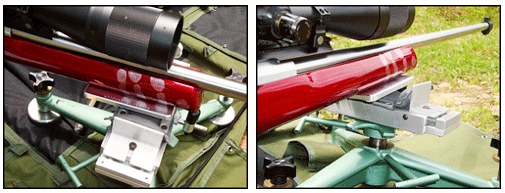
The Whidden Track Plate fits securely in the forearm accessory rail on prone, cross-the-course, and Palma rifles. These guns typically have a narrow and/or rounded fore-end so they rock and wobble when used with a front pedestal rest. The TrackPlate cures that. Once installed it provides a rock-solid, 2.9″-wide platform that mates perfectly with a benchrest-type front sandbag. This gives sling-shooters maximum stability when testing loads or zeroing their sights or scope. Plus you can now shoot F-Class competitively with a prone gun.
The Track Plate is light-weight, has catamaran-style runners to aid tracking and prevent rocking, and can be easily stowed in a range bag. The machined aluminum Track Plate fits BOTH Anschutz-style and American-style recessed forearm rails.
The Track Plate is available from Whidden Gunworks for $40.99 or from Champion’s Choice for $40.00 (item W29P). Plate designer (and National LR Rifle Champion) John Whidden says: “The Plate is great for any rifle with a rail whether it ís smallbore, centerfire, or an air gun. Now you can try F-Class with your favorite prone rifle: the Plate has a perfect low-drag finish for riding a rest or sandbags and is competition legal in all dimensions.”
Front Bag-Rider for AR-15s from EGW
Similar to the Whidden Track Plate is a 3″-wide Delrin bag-rider from Evolution Gun Works (EGW). This was developed expressly to fit the fore-ends of AR15-type rifles with round float tubes. The EGW front bag-rider attaches to a front sling swivel stud anchor. That allows it to mount as easily as a Harris bipod — no rail needed! Just unscrew the swivel stud, put the front bag-rider in place and attach one hex-head machine screw. The front bag-rider is contoured to match the handguard profile so it fits securely with no wobble. Overall, it is a slick system. Front and rear bag-riders can be attached in a couple of minutes. The Delrin blocks slide easily in the bags and make the gun ultra-stable. The gun tracks straight back. The front bag-rider comes in two (2) variants, a $39.99 radiused version (item 32141) that attaches via swivel stud, and a $49.99 version (item 32143) that mounts via a Picatinny-style rail.
EGW AR Front Bag-Rider System
EGW Picatinny Rail-Attached Front Bag-Rider
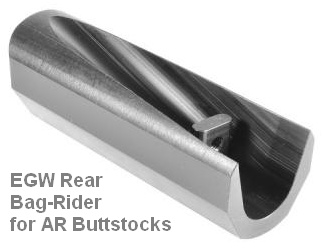
EGW Rear Bag-Rider for AR Buttstocks
EGW also offers a REAR bag-rider that attaches via the sling swivel anchor. The EGW AR Rear Bag-Rider accessory (item 32142), designed to work with A2-style buttstocks, sells separately for $39.99. This rear bag-rider provides a longer, straight “keel” that works very well in rear sandbags, giving the rifle more stability, and improving the tracking.
There’s a new long-range precision tactical rifle from Ritter & Stark (R&S) of Austria. The new SX-1 Modular Tactical Rifle (MTR) is designed to allow rapid barrel changes for three chamberings: .308 Winchester, .300 Winchester Magnum, and .338 Lapua Magnum.
Notably, the scope rail is mounted on the barrel itself, and the bolt locks directly into the barrel. This patented system allows scope, rail, and barrel to be swapped out as one integrated assembly, which should definitely help maintain zero when barrels are exchanged.
Ritter & Stark explains: “The MIL-STD 1913 Picatinny rail is installed directly on the barrel, allowing barrel interchangeability with pre-set scopes for no shift of impact when changing calibers. Easily and quickly done in the field, the patented caliber conversion system allows the barrel to be precisely positioned in the machined aluminum receiver with a greater area of contact allowing for more stability. The bolt is locked directly into the barrel breech[.]”
Video Shows Barrel Swap System, and Bolt Locking in Barrel Breech:
CNC-Controlled Rifling Process
Ritter & Stark states: “The rifling is processed in a CNC-controlled electrochemical machine. This avoids the transmission of thermal effects and mechanical stress to the material. Furthermore, this process allows us to produce barrels with unique uniformity and within tolerance zones that were not possible in a serial production before.” This is very interesting technology, and we’d like to learn more about it.
Accuracy Guarantee and Barrel Life Guarantee
Apparently the CNC-controlled rifling process works well as Ritter & Stark guarantees that its barrels maintain accuracy for a long time. The Austrian company states: “Our barrels are guaranteed to at least 5,000 rounds for .308 Win and .338 LM, and 2,000 rounds for .300 WM before noticing any degradation in accuracy.” That kind of claim certainly invites a long-term test. Who’s got enough ammo? Ritter & Stark also claims that “every rifle we manufacture can achieve 0.5 MOA 3-round groups or better with factory match-grade ammunition.”
The Ritter & Stark SX-1 MTR is designed for adaptability. It will accept third-party Rem 700-compatible triggers as well as a variety of AR-type grips. In addition, the SX-1, in standard configuration, will accept other manufacturers’ AI, SR25, or AR10 magazines. The rifle can also accept other buttstock assemblies compatible with Ritter & Stark’s folding mechanism which, interestingly, can be set to fold to either side.
Product Tip from EdLongrange. We welcome reader submissions.
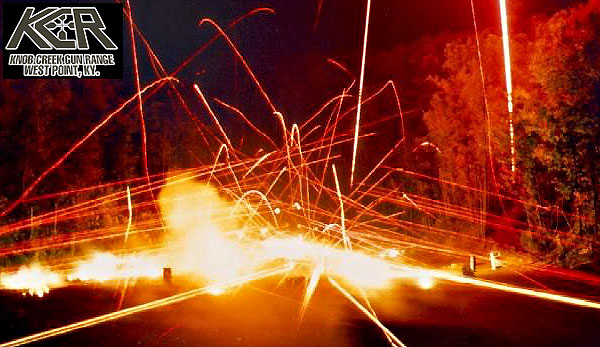
Twice a year, select-fire fans head to the Knob Creek Gun Range in West Point, Kentucky, for the nation’s largest Machine Gun Shoot. A bi-annual event, the Machine Gun Shoot is typically held on the second weekend of April and October. The next Machine Gun Shoot is coming up in one month. This year, the popular fall Shoot will be held October 14th through 16th. The highlight of every Machine Gun Shoot is the Saturday Night event, where scores of guns send regular and tracer bullets down-range. An estimated 1.25 million rounds will be expended during this year’s October 15th Night Shoot.
Click Triangle to Watch Knob Creek Machine Gun Shoot Video (Warning: Very Loud Audio)
Back in 2013, Top Shot Season 4 Champ Chris Cheng was on hand to record the firepower. Chris wrote: “About an hour before dark, folks are out on the range setting up all sorts of explosives while a crowd builds, anxiously awaiting what we all know is coming. The lights go out, and the next thing you know machine guns are going off for almost 20 straight minutes. This year’s October 2013 edition did not disappoint. Check out the video below — other than the beginning, my favorite part is at the 5:50 mark [when a Mini-Gun opens fire from the right].”
Clear skies and calm winds welcomed 85 of the nation’s best Precision Rifle Series (PRS) shooters to the PRSID Shootout at the Snake River Sportsmen range in Vale, Oregon. Held on August 27-28, this sold-out event was hosted by the Precision Rifle Shooters of Idaho (PRSID). Finishing first was Jake Vibbert of Washington state with a 163.500 score, followed by Oregonian Jon Pynch with 156.500. In third place was Ben Cleland of Georgia with 152.500.
Over the two-day event, competitors shot 20 challenging stages such as ‘MGM Spin Cycle’, ‘Run through the Rocks’, and ‘MGM Spinner Chicken Dinner’. The course of fire featured many reactive targets. The “instant feedback” offered by reactive targets is a major “fun factor” contributing to the rapid growth of PRS shooting. Shooters engaged MGM targets on 19 of the 20 stages at distances from 300 yards to 1160 yards with MGM Flash Targets on all engagements past 300 yards. The Flash Target Systems made impacts easy to see for both shooters and spotters.
Light React LED Hit Sensors were also used to help confirm hits on the two long-range stages with engagements out to 1160 yards. In the past couple of years the PRS has emerged as a very popular competitive shooting discipline. PRS specializes in tactical-style target shooting “on the clock” with challenging scenarios and targets placed at distances out to 1200 yards. More typical, however, are PRS stages with targets placed from 200 to 500 yards.
Event organizers commented afterward: “A big thanks to Travis Gibson and MGM Targets for backing our club and for making targets that show clear impacts, it made it easy on the spotters. [The] Max light react system ran flawlessly on the long range in combination with MGM flashers. There was never any guessing whether you had an impact or not.”
Can a budget-priced Savage shoot like a Sako TRG 22? Well, adding a custom “pre-fit” barrel and a state-of-the-art chassis system can transform a “Plain Jane” Savage into a serious tactical rifle. And now Kinetic Research Group (KRG) offers a new fully-adjustable chassis that’s just the ticket for a Savage tactical conversion. Just get a used Savage action, spin on a Criterion, Pac-Nor, or Shilen pre-fit barrel, and add the new 180-Alpha Chassis from KRG.
KRG offers 180-Alpha Chassis for Savage rifles. This fully-adjustable, light-weight (3.5 lbs) chassis fits Savage short action rifles with 4.4″ action bolt spacing. The 180-Alpha features tool-less cheek-piece height adjustment, spacer Length-of-Pull (LOP) adjustment, buttpad height adjustment, and plenty of accessory mounting positions. Suggested retail price for the 180-Alpha starts at $768.00 for the side bolt-release version. A bottom-release model is slightly more.
Compare KRG’s 180-Alpha Chassis to the hardware on the real deal — a Sako TRG 22 with adjustable, folding stock (model JRSM416, shown below). This SAKO TRG22 rifle in .308 Winchester retails for $5,198.00. With KRG’s 180-Alpha chassis you can put together an ergonomically-similar tactical rifle for thousands less.
Using the KRG Chassis, a take-off Savage action, and a premium pre-fit barrel, you can build a similar system for around $1540.00. Here’s how we get that figure: $370.00 for Criterion pre-fit barrel, $400.00 for action (YMMV), and $768.00 for stock (Total $1538.00).
KRG produces other adjustable, modular chassis systems for bolt-action rifles. KRG’s popular Whiskey 3 Chassis system fits the Tikka T3, Remington® 700™, Sako M995, Badger M2008, and 700 Long Action. The KRG X-RAY Chassis fits the Rem 700 Short Action, and Tikka T3, and the 180 X-RAY fits the CZ-455, Howa 1500, and Weatherby Vanguard platforms.
Product Tip by EdLongrange. We welcome reader submissions.






 The Whidden