Before SHOT … there was Sin City. The weekend before SHOT Show many of the nation’s best tactical riflemen came to Nevada for the 2015 Vegas Precision Rifle Challenge. This event, sponsored by Kelbly’s and hosted by the Sin City Precisision Shooters, offered plenty of challenges for competitors. George Gardner of G.A. Precision reports: “These guys put on a heck of a match. Lots of courses of fire with varying positional stuff [and] long-range out to 1400 yards. Hats off to these guys, they did a hell of a job. I can’t believe they secured this awesome place on the Air Force base to train and shoot on….”
Here’s a Sin City match highlight video that’s well worth watching. (Note: loud sound-track). The film-makers did a great job capturing the feel of shooting in Nevada’s high desert. You can almost smell the gun powder and feel the sting of blowing sand …
This looks like a lot more fun than sitting in a smokey Vegas Casino dueling one-armed bandits. For more information on this excellent tactical competition, visit SinCityPrecision.com.
Tripods aren’t just for cameras and spotting scopes — they can be used as shooting supports as well. In this video, our friends Ed and Steve, aka The 6.5 Guys, take a look at a variety of tripod options for shooters. Steve and Ed provide a brief overview of some of the techniques they use to shoot off a tripod support from kneeling, seated, and standing positions. They also demonstrate how slings can be used to control elevation and stabilize a rifle.
Ed and Steve employ different techniques — one uses a ball head while the other doesn’t. In the video, they explain why they have adopted their respective techniques. They explain why you may want to try a variety of tripod set-ups, depending on the shooting scenario (and your personal preferences). The 6.5 Guys also discuss the differences between two popular tripod accessories — the Hog Saddle and the lower-cost Pig Saddle.
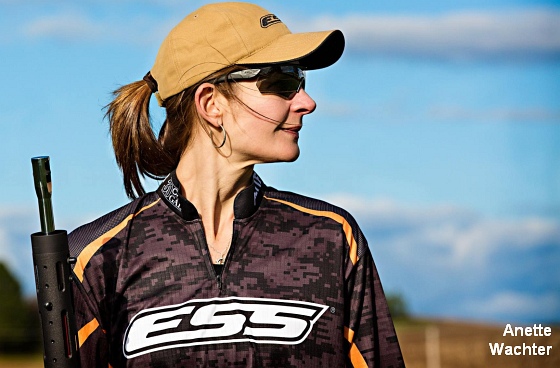
Tripod Use in the Precision Rifle Series (Anette Wachter)
I have noticed in the last year of precision rifle competitions that the tripod is a valuable asset to have. Most of the time when a stage calls for the offhand position, unless otherwise stated, people can use a tripod. Easy enough but you realize quickly that not all tripods are alike. You need to think of weight since you are carrying everything with you for 10 hours a day. And of course stability is your number one importance.This is different than a photographer’s tripod. Think of it as a tactical tripod. — Anette Wachter, The 30 Cal Gal.
Our friends Ed and Steve, aka the 6.5 Guys, were prolific last week in Las Vegas, visiting dozens of vendors at SHOT Show. Here are Ed and Steve’s video reports for Ashbury Precision Ordnance (APO), Vortex Optics, and Thunderbeast Arms. (If you’re thinking about buying a suppressor definitely check out the new Ultra series from Thunderbeast, featured in the third video below). You can see more SHOT Show videos by Ed and Steve at 6.5Guys.com.
Ashbury Precision Ordnance
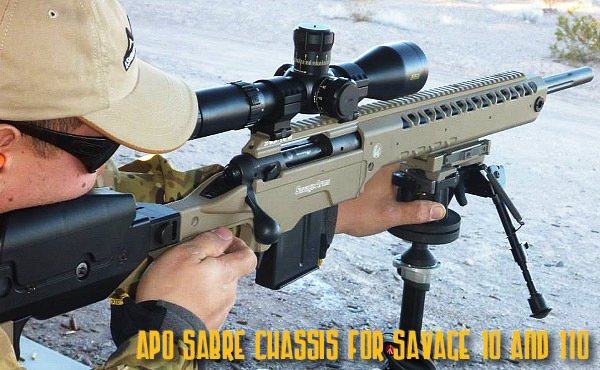
Here Precision Rifle Series (PRS) Competitor Melissa Gilliland talks about the modular chassis systems offered by Ashbury Precision Ordnance (APO). With adjustable buttplate, cheekpiece, and grip, these systems can be adapted for a variety of shooting disciplines. APO even offers a modular chassis for Savage barreled actions. Melissa shoots a tricked-out 6.5 Creedmoor rig with a Titanium APO action.
New Precision Rifle from APO
SABRE Chassis System for Savage Actions
Vortex Optics
Vortex continues to grab a larger share of the tactical and long-range hunting markets. This video features the Vortex Razor HD Gen II 4.5-27x56mm and 3-18x50mm scopes. These Gen II Razors feature apochromatic objective lenses, rugged 34mm single-piece aluminum main tubes, and versatile 6X zoom range. Both MOA-based and Milrad-based reticles are offered. Vortex scopes have large, user-friendly controls, and a good feature set for the price.
Thunder Beast Arms
Thunder Beast Arms’s suppressors, built by shooters for shooters, are tough yet light. Thunder Beast developed a strong following for its titanium cans that offered excellent performance with light weight. In this video, Thunder Beast unveils its new “Ultra” series of suppressors. Compared to Thunder Beast’s previous CB-series suppressors (of like size), these Ultras are 4 to 5 ounces lighter, yet provide 4 to 5 decibels of additional noise reduction. That represents a major gain in suppressor performance.
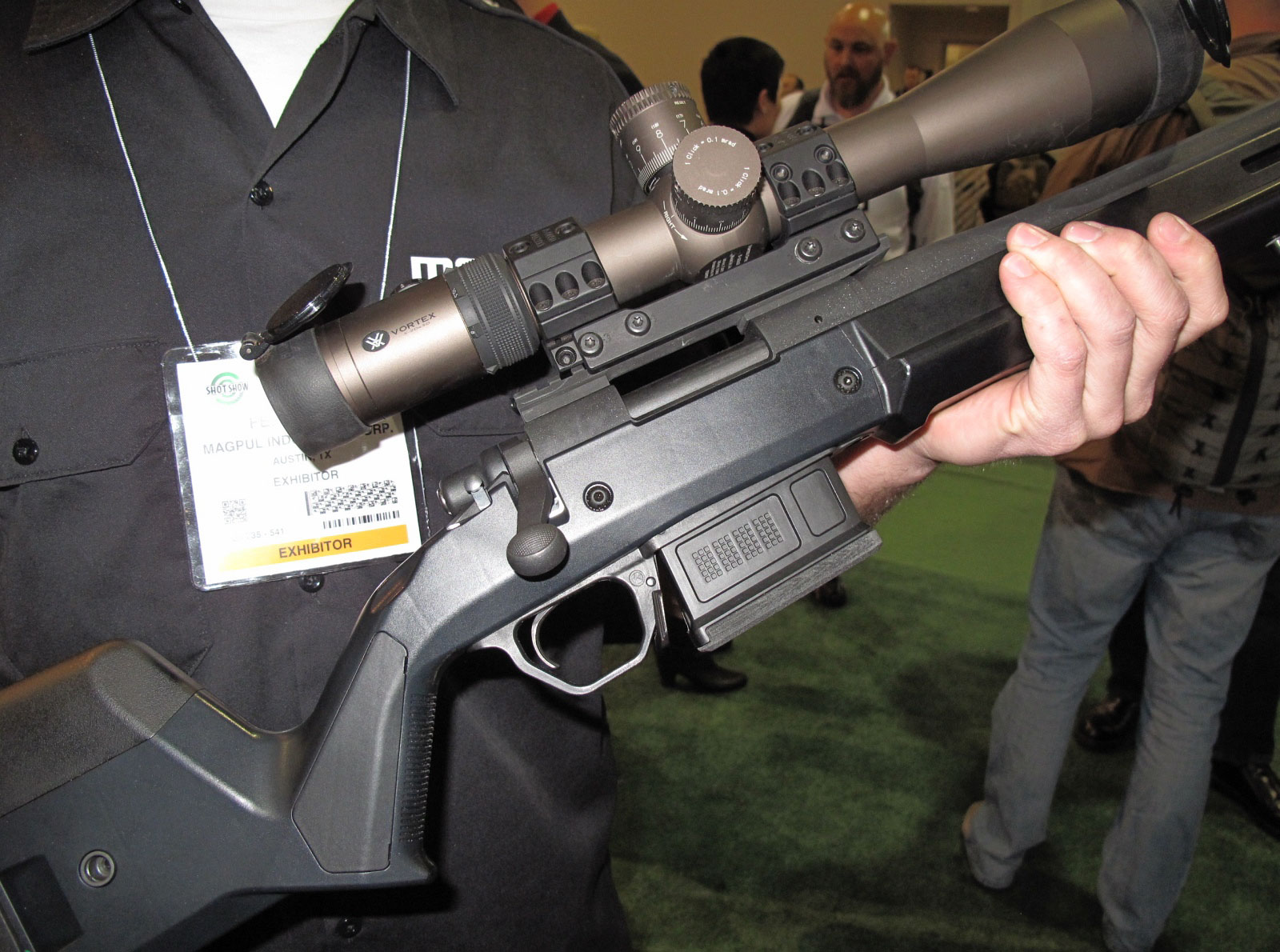
Our readers wanted more information on the $259.95 Magpul Hunter 700 stock, so here it is. We got our hands on the new product. The polymer shell is strong and stiff — not like the “Tupperware” plastic stocks you’ll find on some factory offerings. The stock comes standard with a flush bottom plate. However, for $70 more you can get a polymer magwell unit that allows use of new MagPul 5-round and 10-round magazines. The stock features an anodized aluminum V-block that allows easy installation of a Rem 700-footprint action.
CLICK Photo to See Full-Screen Image:
But perhaps the most important element of this stock can’t be shown in photos. INSIDE the stock is a metal “skeleton” that extends from the middle of the fore-end back into the grip. This skeleton, an important design innovation, gives the stock great strength and rigidity. It is sort of like a race car with a tube chassis under the body work. We suspect Magpul is working on a patent.
Can you fill a 30-round AR15 magazine in the blink of an eye — less than half a second? Well watch this video to see how it’s done, using the Israeli-designed Maglula Range BenchLoader™. In fairness, it takes about 20 seconds to fill the cleverly-designed device with thirty 5.56x45mm cartridges, but once they’re in place, a quick swipe of the hand is all it takes. Thirty rounds are zipped into the mag in 0.3 seconds (by our stopwatch). Don’t believe us? Watch the video. The magic happens at 0:42 and again at 1:17. Don’t blink — you’ll miss it.
Maglula Benchloaders are rugged CNC-machined tools designed to load 5.56/.223 Rem magazines in a single hand stroke. In the video below, a manufacturer’s rep demonstrates the speedloader, along with the “Lula” lever-action plastic loader/unloader.
Frankly, we prefer using the original straight 10-round and 20-round magazines in our ARs since they extract easier and feed flawlessly. But, if you use 30-round mags for 3-Gun matches or other tactical disciplines, these Benchloaders look like they can really speed up the loading process.
Gear Report by Kip Staton Magpul jumped feet-first into the bolt-action precision rifle market by dropping a teaser video of their Hunter 700 chassis/stock system. Feast your eyes on this video that shows Magpul’s new chassis system in action:
The Hunter 700 (MSRP $259.95) is built around a ruggedly anodized aluminum bedding block, and utilizes a standard Magpul SGA cheek riser and spacers (from the shotgun line). It also features forward M-LOK slots, as well as multiple points to mount swivel studs and QD sockets. Weight is a svelte 2.9 pounds, and the system is compatible with factory Remington 700 bottom metal. And that’s not all.
By removing a spacer in the stock, end-users can convert the rifle to feed from the company’s new steel/polymer Bolt Action Magazine Well, which accepts standard AICS pattern magazines. MSRP for the conversion is an impressive $69.95, and that price even includes a mag. But — hold on — it gets even better (look at the photo carefully).
Yup. It feeds from PMAGs. New, AICS-compatible PMAGs. The PMAG-5 7.62 AC is a fully-featured polymer magazine, with an anti-tilt follower and MSRP of $34.95. Interestingly, the magazine holds five (5) rounds to comply with hunting regulations, but the follower features a trimmable, pre-scored stop that allows users to increase capacity by a single round for other purposes.
Magpul promises that this is just the beginning for their precision rifle accessory line, hinting at a larger-capacity PMAG-10 7.62 AC in the future, as well as other calibers. Anybody running AICS pattern mags (and that’s quite a few serious precision rifle guys) should be stoked about these new products.
About the Writer
Kip Staton is a freelance gun writer based in North Texas, and loves to blog about news within the firearms industry and his perceptions on marksmanship at KipStaton.com. He served as the weekend range manager of the North Texas Shooter’s Association from 2010-2012, at which point he began performing sales consultations for a major online firearms retailer. Currently, Kip is a content marketer, copywriter and digital strategist for an award-winning Dallas marketing agency.
To read more gear reviews by Kip, visit KipStaton.com.
Here’s an item for the tactical operators out there. On the new SnipersHide Forum you’ll find a thread titled AX AICS: The New Hotness. This is a very thorough Owner’s Review of the Accuracy International AX Chassis by “TriggerMonkey”. With eight large, detailed photos, this “show-all, tell-all” thread does a great job of describing and illustrating the AX chassis system. Here’s a short sample:
2014 AX AICS Chassis
A couple of years ago I took a chance and purchased my first Accuracy International chassis, specifically the AX AICS, for my Remington 700. I say I took a chance because there was the possibility that I wouldn’t like it, I’ve never really considered myself a chassis system type of guy beforehand but it had features that appealed to me. I had nothing to worry about as it turns out because I got great accuracy out of the rifle without having to bed it and the adjustability of the stock made it very comfortable to shoot. When I saw that Accuracy International was rolling a new version of the AX AICS last year I knew that I had to have one for an upcoming build. Well now that I have one in hand I can see that the differences go far beyond just the addition of a right-hand folding stock. Nearly every part has been revised from the previous generation so let’s go through some of them.
The 2014 AX AICS comes in a pretty non-descript cardboard box in two pieces, neatly packaged in closed cell foam to protect of dings and such in transit. I would say this is a step up from my first AX AICS where the packaging was sufficient but not nearly as nice.
It’s much easier to see bullet holes “in the white” than in the black center of a High Power or F-Class Target. That’s why some shooters use “negative” black-to-white targets for practice sessions. Also, even those who compete at 800-1000 yards find it useful to practice at 300 yards. At that shorter distance, you can, on most days, see bullet holes with a good spotting scope. (Forget trying to see bullet holes at 1000 yards with any spotting scope, no matter how expensive).
The only problem with practicing at 300 yards is finding a correctly “shrunken” version of the target actually used in long range competition. Well guys, you’re in luck. One of our Forum members, Sleepygator, has produced “reduced-distance” targets (with black ring-lines on white background) for practice use at 300 yards. Only the center 10 and X rings are black, so you can see bullet holes easily “in the white” on most of the target (and this uses less ink when printing). There is an official reduced-distanced standard for 300-yard F-Class matches. This utilizes the NRA No. MR-63FC – F-Class Target Center which is pasted over the MR-63 target. It provides a 1.42″ X-Ring, 2.85″ 10-Ring, and 5.85″ Nine-Ring. (The dimensions of F-Class targets are found in the NRA High Power Rules, Sec. 22, part 4.)
To duplicate the 300-yard target, Forum member SleepyGator has prepared a printable version of the MR-63FC Target Center, along with a pair of training targets with two bulls and five bulls. The two-bull and five-bull targets mirror the scoring rings on the MR-63FC, but they display only the innermost three rings and two rings respectively. All three targets are Adobe Acrobat files that can be easily printed. You may need to adjust the scale (sizing) on your printer to get the dimensions exactly correct. As noted above, when printed, the 10-Ring on all three targets should measure 2.85″. This should provide some handy practice targets you can use between matches. Thanks to SleepyGator for providing these targets. You can download all three as a .Zip archive. After downloading the .Zip file, just click on the .Zip archive to extract the individual targets.
Many of us would like to outfit one (or more) of our rifles with a suppressor, but the cost and red tape involved can be daunting. Some states prohibit private individuals from owning suppressors. However, most U.S. states DO allow suppressor ownership. That’s the good news. On the other hand, suppressors are not inexpensive and the process of obtaining governmental approval is time-consuming. Then there is the cost of the tax stamp itself — $200.00 for each silencer you own.
Nonetheless, suppressors are fun, and they serve an important function. Along with protecting your hearing, suppressors can tame recoil and dramatically reduce muzzle flash. Noise reduction of up to 35 decibels is possible with a .223 Rem. When shooting any firearm, you should still wear hearing protection of course, but suppressors can help reduce the risk of permanent hearing damage.
Benefits of a Suppressor — Why Suppressors Make Sense:
Is It Legal For You To Own A Silencer?
The vast majority of the 50 states permit citizens to own silencers. Currently, the following states allow private ownership of suppressors: AL, AR, AK, AZ, CO, CT, FL, GA, ID, IN, KS, KY, LA, ME, MD, MI, MO, MS, MT, ND, NE, NV, NH, NM, NC, OH, OK, OR, PA, SC, SD, TN, TX, UT, VA, WA, WI, WV, and WY. Even if you live in one of these states, you should verify that owning a suppressor is legal in your city/county.
If you live in a state where suppressor ownership is legal, and you can legally own a firearm, then you can buy a suppressor. However, you need to obtain ATF permission and pay a tax.
If you are interested in getting a suppressor, thankfully there is a source that can help you select the right product, and fill out all the paperwork required. The Silencer Shop specializes in sound moderators for pistols, rimfire rifles, centerfire rifles, and yes, even shotguns. The Silencer Shop maintains a large selection of suppressors for sale, and the shop can guide you through the NFA permitting process from start to finish.
How to Buy a Silencer, Part One:
Based on hundreds of successful applications for its customers, the Silencer Shop has streamlined the National Firearms Act (NFA) Registration process for suppressor ownership. Having submitted more silencer NFA Forms than any other dealer, these guys know the ropes: “We’re at the leading edge of making the NFA process as fast and easy as possible. From our famous ‘Black Packets’ to the latest electronic submissions and Silencer Shop Direct, we have a history of innovation in this area”. The Silencer Shop also works with knowledgeable attorneys who can help you set up an NFA trust to own suppressors and other NFA items. CLICK HERE to Learn How to Register a Suppressor to a Trust.
G.A. Precision (G.A.P.) has announced a new three-lug action, the Tempest. This unit features a large bolt knob with extended, curved bolt handle (similar to the bolt handle on the Accuracy International AX). Up front the Tempest boasts an integral recoil lug with extended front tenon section — for better support of heavy barrels. The Tempest’s distinctive feature is its three-lug bolt. Compared to a two-lug bolt, a three-lugger allows a short, 60° bolt lift (fewer degrees of lift to release). Like the G.A.P. Templar action, the new Tempest sports a Rem 700 footprint, though stock inletting would have to be altered slightly for the integral lug/tenon design.
Sorry guys, G.A.P. has not yet announced a retail price or delivery date (we did ask, but the folks at G.A.P. don’t even have a wholesale price from the 3rd-party manufacturer yet). Whatever it costs, the Tempest action will be popular. It has already inspired nearly 300 likes on the G.A.P. Facebook page.







 About the Writer

 It’s much easier to see bullet holes “in the white” than in the black center of a High Power or F-Class Target. That’s why some shooters use “negative”


