|
|
January 3rd, 2015
Many of us would like to outfit one (or more) of our rifles with a suppressor, but the cost and red tape involved can be daunting. Some states prohibit private individuals from owning suppressors. However, most U.S. states DO allow suppressor ownership. That’s the good news. On the other hand, suppressors are not inexpensive and the process of obtaining governmental approval is time-consuming. Then there is the cost of the tax stamp itself — $200.00 for each silencer you own.
Nonetheless, suppressors are fun, and they serve an important function. Along with protecting your hearing, suppressors can tame recoil and dramatically reduce muzzle flash. Noise reduction of up to 35 decibels is possible with a .223 Rem. When shooting any firearm, you should still wear hearing protection of course, but suppressors can help reduce the risk of permanent hearing damage.
Benefits of a Suppressor — Why Suppressors Make Sense:
Is It Legal For You To Own A Silencer?
The vast majority of the 50 states permit citizens to own silencers. Currently, the following states allow private ownership of suppressors: AL, AR, AK, AZ, CO, CT, FL, GA, ID, IN, KS, KY, LA, ME, MD, MI, MO, MS, MT, ND, NE, NV, NH, NM, NC, OH, OK, OR, PA, SC, SD, TN, TX, UT, VA, WA, WI, WV, and WY. Even if you live in one of these states, you should verify that owning a suppressor is legal in your city/county.
If you live in a state where suppressor ownership is legal, and you can legally own a firearm, then you can buy a suppressor. However, you need to obtain ATF permission and pay a tax.
If you are interested in getting a suppressor, thankfully there is a source that can help you select the right product, and fill out all the paperwork required. The Silencer Shop specializes in sound moderators for pistols, rimfire rifles, centerfire rifles, and yes, even shotguns. The Silencer Shop maintains a large selection of suppressors for sale, and the shop can guide you through the NFA permitting process from start to finish.
How to Buy a Silencer, Part One:
Based on hundreds of successful applications for its customers, the Silencer Shop has streamlined the National Firearms Act (NFA) Registration process for suppressor ownership. Having submitted more silencer NFA Forms than any other dealer, these guys know the ropes: “We’re at the leading edge of making the NFA process as fast and easy as possible. From our famous ‘Black Packets’ to the latest electronic submissions and Silencer Shop Direct, we have a history of innovation in this area”. The Silencer Shop also works with knowledgeable attorneys who can help you set up an NFA trust to own suppressors and other NFA items. CLICK HERE to Learn How to Register a Suppressor to a Trust.

December 31st, 2014
G.A. Precision (G.A.P.) has announced a new three-lug action, the Tempest. This unit features a large bolt knob with extended, curved bolt handle (similar to the bolt handle on the Accuracy International AX). Up front the Tempest boasts an integral recoil lug with extended front tenon section — for better support of heavy barrels. The Tempest’s distinctive feature is its three-lug bolt. Compared to a two-lug bolt, a three-lugger allows a short, 60° bolt lift (fewer degrees of lift to release). Like the G.A.P. Templar action, the new Tempest sports a Rem 700 footprint, though stock inletting would have to be altered slightly for the integral lug/tenon design.

Sorry guys, G.A.P. has not yet announced a retail price or delivery date (we did ask, but the folks at G.A.P. don’t even have a wholesale price from the 3rd-party manufacturer yet). Whatever it costs, the Tempest action will be popular. It has already inspired nearly 300 likes on the G.A.P. Facebook page.


December 30th, 2014
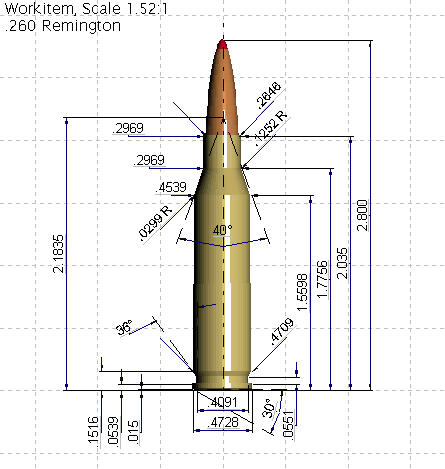
The AR-10 was designed to handle the 7.62×51/.308 Winchester and other .308 “family” cartridges such as the .243 Win and .260 Remington. Our friend Dennis Santiago recently put together an AR-10 to shoot the accurate .260 Rem cartridge. Here is his initial report:
AR-10 Platform Chambered for .260 Remington by Dennis Santiago
I was very curious to see how the .260 works in the AR-10 compared to a .308. I’ve always thought about chambering a bolt gun in .260 but before doing so I thought it’d be good to try it using a less expensive entry point. With an AR platform’s easy interchanging of barrels, it seem like the best way to test out the .260 Rem chambering. So far, it’s most impressive.
DPMS LR-308 in .260 Remington getting function cycle tuned and zeroed

I took the AR-10-type .260 Rem a step closer to being ready for matches yesterday. The first order of business was to confirm which buffer spring to use with both the 123 grain and 140 grain bullet loads. My .260 Rem loads, on average, are using 4-5 grains less powder than the .308 loads. In a semi-automatic action that means less gas/energy to work the mechanics. The solution in an AR-10 platform is to either cut coils in the .308 spring or use a weaker AR-15 buffer spring; yup they are not the same. In this case, a CS flat spring for the AR-15 did the trick.
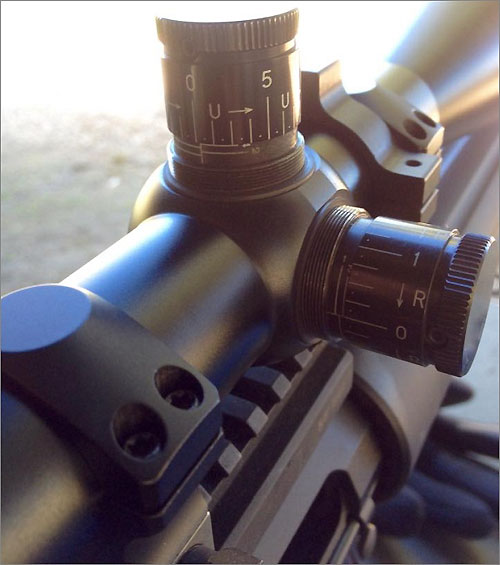
I also put a very nice NightForce Benchrest 12-42x56mm scope that came via friend Mark Gravitt on it and got zeros. This scope’s 1/8th MOA clicks are nice. The AR-10 had previously mounted a NightForce F1, a more “field tactical” 3-15X system. This 12-42X scope now sets this gun up as more of a target cannon. Field of view is limited when your minimum magnification is twelve. Maybe I’ll put an auxiliary red dot on it just to find the target.
Pet Loads: H4350 and Lapua 123gr Scenars
Comment by Daily Bulletin Editor
Over a two-year period, this Editor put a lot of rounds through a .260 Remington. I did a ton of load testing with that Savage-actioned rifle (before it was rebarreled as a 6mmBR Norma). I tried two dozen load recipes with five different powders and bullets ranging from 100 grains to 142 grains. Hodgdon H4350 was my “go-to” powder. As many 260 Rem shooters have discovered, H4350 is a winner in the .260 Rem. This propellant delivered the lowest ES in my rifle and nothing beat H4350 for consistent accuracy with bullets in the 120-140 grain range. My most accurate load was with Lapua 123gr Scenars, pushed by H4350 and CCI 250 primers. The 123gr Scenars worked well jumped as well as seated into the lands. Best accuracy, in my 24″-barreled .260 Rem, was right about 2950 fps. Other powders work well, but H4350 is a very good choice for the .260 Remington (as well as the smaller 6.5×47 Lapua cartridge).
December 20th, 2014
Tactical matches are becoming more and more popular every season. Along with F-Class, the tactical discipline is one of the fastest-growing forms of competitive rifle shooting. Rich Emmons, one of the founders of the Precision Rifle Series (PRS), has written an insightful article about getting started in the tactical game. Here are highlights from Emmon’s PRS — Intro to Competition article.

Precision Rifle Series — Intro to Competition
by Rich Emmons, PRS President
Tactical Shooting with a precision rifle is not like other disciplines, there is no set course of fire or format. That is what makes it so fun!

First, you have to ask yourself what do you want to accomplish. When I was introduced to long range shooting, immediately a light turned on for me, once I saw how easy it was to hit 300–600 yard targets. What I quickly learned from my first competition and the many that followed was there is so much to learn and shooting in competition put everything you thought you knew to the test. So back to the question: “What do YOU want to accomplish?”. The reality is you may not know yet, you just think it is cool to have a bad ass rifle and scope that can make almost any shot. Now if you’ve got that rifle and scope, it’s time to take it to the next level.
Watch PRS 2012 Championship (Click arrows icon to view full-screen version.)
Getting Started — What to Expect
If you’re reading this, you have probably already have been bitten by the long range shooting bug. It can seem quite intimidating to just jump in with a new bunch of shooters you don’t know and shooting lingo you don’t quite understand yet. But here is the key — show up and shoot! I guarantee you if you show up to a match as a new shooter, other experienced shooters will guide you along and give you help on anything you need.
|
AUDIO: Click Button to hear Rich Emmons Talk about the Precision Rifle Series. |
Now, a couple things you should just expect. You’re not as good as you think you are. Don’t expect to come into your first match and beat all the veterans. That just doesn’t happen unless you have had some really good coaching or other shooting competition experience to get you ready for this type of competition. If possible, find a local rifle club that has monthly long range matches, or any type of match will help prepare you for a larger PRS event. Getting involved with a rifle club and starting out shooting monthly matches is definitely the way to jump into competition shooting.
The Gear You Need
The first question that many ask is: “What kind of rifle/caliber/scope do I need?” The easiest answer to this is, the best you can afford. It’s no secret the gear is expensive. It took me several years of buying sub-par gear and eventually trading up to figure this out. Now, a guy can get a real sense of pride of doing it on the cheap, or with a factory rifle. I’ve seen many old Savage 10FPs take down custom rigs that cost 10 times as much. And if that’s all you can afford, then eventually you will learn the limitations of yourself or your gear. As for choice of cartridge/caliber, the Precision Rifle Blog has analyzed three years worth of match results from the best tactical shooters in the nation. CLICK HERE to read an article that reveals what the “top guns” use.

Making Good Ammo
Producing quality reloads is something you have to master. It’s not hard at all, you just have to pay attention to detail, and eventually you are going to do something stupid like mis-priming your brass, or skip a row of brass when dumping your powder. Everybody has their own horror story of some reloading failure that cost them a stage or even a match. So load to perfection, work with your rifle to find what load it likes the best, then start your practice.

Practice Makes Perfect
You want to become ONE with your rifle, learning everything you can about its functionality. Getting comfortable with the operation of your rifle is key. Learn the feel of your trigger, dry-firing until you wear the paint off your bolt handle. Learn how the rifle works best — pay attention to little things like the sound and feel of the bolt feeding a round from the mag (or when it doesn’t). Learn how to remove a jammed round quickly, learn how to reload a magazine quickly. Learn to scan across a field and find targets in a quick manner, seeing the targets with your eye and coming into the scope on target. These are some of the basic practices that separate the new shooters from the seasoned ones.


December 3rd, 2014
If you want to build your arsenal of tactical rifles, here’s the Deal of the Decade. If you buy one large-caliber Armalite Rifle (.50, .416, .338, or .308 cal) you can get one FREE .223-cal AR-type carbine. That’s right, buy one rifle, and get one free. In fact, as a special added bonus, if you purchase the Armalite AR-50A1 .50 BMG National Match Rifle, you get TWO AR carbines. Buy one, get two free.
These spectacular deals are being offered through Eurooptic.com, via phone-in orders only. You won’t find these offers on the Armalite or Eurooptic websites. You need to call (570) 368-3920 (and ask for Jason). NOTE: this offer is limited to supplies on hand. You snooze, you lose.
Option One: Purchase AR-50A1 National Match, receive TWO 223-caliber AR rifles for free: LEC15A4CBK and 15A4CB (optical sights NOT included). Yes — you get three (3) rifles total.
Option Two: Purchase qualifying rifle and receive EITHER one LEC15A4CBK OR 15A4CB (optical sights NOT included). You get two (2) rifles total. Qualifying primary rifle purchase: 50A1B-416, 50A1B, 10SBF, 10SCBF, A10SBF, A10SCBF, 30A1B338, 30A1BT338, 31BT308, 31BTC308, 30A1B300, or 30A1BT300.

Get TWO more rifles with purchase of AR-50A1 National Match

Sale Tip from EdLongrange. We welcome reader submissions.
November 29th, 2014
Can a budget-priced Savage shoot like a Sako TRG 22? Well, adding a custom “pre-fit” barrel and a state-of-the-art chassis system can transform a “Plain Jane” Savage into a serious tactical rifle. And now Kinetic Research Group (KRG) offers a new fully-adjustable chassis that’s just the ticket for a Savage tactical conversion. Just get a used Savage action, spin on a Criterion, Pac-Nor, or Shilen pre-fit barrel, and add the new 180-Alpha Chassis from KRG.

In 2015 KRG will introduce the NEW 180-Alpha Chassis for Savage rifles. This fully-adjustable, light-weight (3.4 lbs) chassis fits Savage short action rifles with 4.4″ action bolt spacing. If you like user-configurable stocks, you’ll love the 180-Alpha. It features tool-less cheek-piece height adjustment, spacer Length-of-Pull (LOP) adjustment, buttpad height adjustment, and plenty of accessory mounting positions. Suggested retail price for the 180-Alpha is $770.00 in either bottom bolt-release or side bolt-release action configuration.
CLICK HERE for Specifications of KRG 180-Alpha Stock for Savages.
Compare KRG’s 180-Alpha Chassis to the hardware on the real deal — a Sako TRG 22 with adjustable, folding stock (model JRSM416, shown below). This SAKO TRG22 rifle in .308 Winchester retails for $5,198.00. With KRG’s 180-Alpha chassis you can put together an ergonomically-similar tactical rifle for thousands less.

Using the KRG Chassis, a take-off Savage action, and a premium pre-fit barrel, you can build a similar system for under $1600.00. Here’s how we get that figure: $370.00 for Criterion pre-fit barrel, $400.00 for action (YMMV), and $770.00 for stock (Total $1540.00).
KRG produces other adjustable, modular chassis systems for bolt-action rifles. KRG’s popular Whiskey 3 Chassis system fits the Tikka T3, Remington® 700™, Sako M995, Badger M2008, and 700 Long Action. The value-priced KRG X-RAY Chassis fits the Rem 700 Short Action, and Tikka T3.

New Product Tip by EdLongrange. We welcome reader submissions.
November 14th, 2014
Got Bipod? If you’re in need of an adjustable two-legged friend for the front of your favorite rifle(s), Midsouth has you covered. Right now Midsouth Shooters Supply has a wide selection of Harris Bipods in stock at attractive prices. For example, the Harris 6″-9″ BR model with leg notch is just $69.68. That’s ten bucks cheaper than we’ve found elsewhere. From small to tall, Midsouth carries Harris bipods for your intended applications. Midsouth also sells a variety of authentic Harris mounting adapters, including rail adapters, and flat fore-end adapters.


October 23rd, 2014
Got fifty bucks? Well that’ll buy you an AR Lower this week. Quite simply, this is the best AR deal we’ve seen this year, and one of the best values on a firearm receiver we can remember. Right now, while supplies last, Brownells.com is offering Bushmaster-brand AR-15 stripped lower receivers for just $49.99. You read that right — you can get a major manufacturer AR lower for under fifty bucks. That’s a savings of $120.00 off the normal price. Get them while you can.

NOTE: Stripped lowers are considered the firearm, so this must be delivered to an FFL-holder. It is fairly easy to complete the lower with readily available parts and the trigger group of your choice.

Bushmaster Stripped Lower Receiver Product Description
Receiver is a rigid 7075 T6 aluminum forging with extra metal in the right places for added strength without unnecessary bulk. Features a beefy, M16A2-pattern reinforced area around the front pivot pin, a strengthening ridge over the receiver extension threads, and a ridge around the mag release button to guard against accidental magazine drop by preventing unintentional button activation. Bead blasted after machining to ensure a uniform, non-reflective surface before application of lusterless black military hardcoat A8625, Type III, Class 2 anodized finish that adds surface strength and resists abrasion. A final, nickel acetate seal coat provides extra protection against corrosion. Stripped lower is the perfect companion for Bushmaster Lower Receiver Parts Kit, available separately
October 18th, 2014
Frank Galli (aka “Lowlight”), the head honcho of Sniper’s Hide, has created a good 15-minute wind-reading video for the Scout web network. This video, a segment from the Sniper’s Hide Day One DVD, covers many of the important basics of wind reading. It’s a helpful introduction for those getting started in long-range rifle shooting.
Click Image to Go to Video Playback Page:

Quote 1: “On the range, people describe the wind as the Great Equalizer. Next to your drop, drift from wind is the second most important consideration for the long range precision rifle shooter. Unlike drop, which is predictable, the wind is a constantly changing factor.”
Quote 2: “Wind is like water. It’s important to understand how terrain will effect the wind, how it will change the direction, velocity and consistency. It’s responsible for turbulence, it’s responsible for unseen changes that will throw our shot off. Wind will ebb and flow just like waves crashing on the beach. We need to understand the frequency and velocity of each wave.”
CLICK HERE to Watch Wind-Reading Video.
October 7th, 2014
MIL or MOA — which angular measuring system is better for target ranging (and hold-offs)? In a recent article on his PrecisionRifleBlog.com website, Cal Zant tackles that question. Analyzing the pros and cons of each, Zant concludes that both systems work well, provided you have compatible click values on your scope. Zant does note that a 1/4 MOA division is “slightly more precise” than 1/10th mil, but that’s really not a big deal: “Technically, 1/4 MOA clicks provide a little finer adjustments than 1/10 MIL. This difference is very slight… it only equates to 0.1″ difference in adjustments at 100 yards or 1″ at 1,000 yards[.]” Zant adds that, in practical terms, both 1/4-MOA clicks and 1/10th-MIL clicks work well in the field: “Most shooters agree that 1/4 MOA or 1/10 MIL are both right around that sweet spot.”

READ MIL vs. MOA Cal Zant Article.
Zant does note that a whopping 94% of shooters in the Precision Rifle Series (PRS) used a mil-based reticle. However, Zant says: “This does NOT mean MIL is better. It just means MIL-based scopes are more popular.” Zant agrees with Bryan Litz’s take on the subject: “You can’t really go wrong with either (MIL or MOA). They’re both equally effective, it comes down to how well you know the system. If you’re comfortable with MOA, I wouldn’t recommend switching to MIL. I have a few MIL scopes but primarily because they’re on rifles used for military evaluation projects, and that community is now mostly converted to MILS, so when in Rome….”
We recommend you read Zant’s complete article which is very thorough and is illustrated with helpful graphics. Here are the key points Zant makes in his MIL vs. MOA analysis:
MIL vs. MOA — Key Points
There are a handful of minor differences/trade-offs between MIL & MOA, but there are no inherent advantage to either system. Most people blow the small differences WAY out of proportion….Here are the biggest differences and things to keep in mind:
- Whatever you decide, go with matching turret/reticle (i.e. MIL/MIL or MOA/MOA)
- 1/4 MOA adjustments are slightly more precise than 1/10 MIL.
- MIL values are slightly easier to communicate.
- If you think in yards/inches the math for range estimation is easier with MOA. If you think in meters/cm the math is easier with MIL.
- When your shooting partners are using one system, there can be some advantage to having the same system.
- Around 90% of the PRS competitors use MIL.
- There are more product options (with ranging reticles) in MIL.
Range Card Print-Outs
Zant makes an interesting practical point regarding range card print-outs. He suggests the MIL System may be easier to read: “You can see in the range card examples below, 1/4 MOA adjustments take up more room and are a little harder to read than 1/10 MIL adjustments.”

|


