Close-up view of a sectioned case. This one here was “fixin’ to pop”, says Glen Zediker.
Here are highlights from an article Glen Zediker wrote for the Midsouth Blog. In this article Glen focuses on cartridge brass. Glen discusses the most common failures that appear with brass that has been shot multiple times, or which has been fired at excessive pressures. Glen explains some simple ways to check your cartridge brass to detect “early warning signs” of case failure, particularly case head separation, which can be dangerous.
How Cases Degrade with Multiple Firings By Glen Zediker
This article explains when, and then how, to check after the progress of changes commencing with the firing on a new case. It’s the “progress of degeneration,” in a way of looking at it because the concern is getting a handle on when enough change in the brass has come about to require attention. Or abandonment. As said then, for me that’s 4 firings. That, as said last time, is when I might see changes that need attention. Also as said, that figure didn’t come out of a hat, but from my own notes in running my competition NRA High Power Rifle loads. [Editor’s Note: With Lapua brass, using moderate loads, in bolt-action rifles, we typically get about 10 good (match-worthy) firings. But if you anneal your Lapua brass, and run modest pressures, Lapua brass can perform well for 20 or more load cycles.]
The areas most affected are the case neck and case head area. Case neck walls get thicker [but] the case head area body walls get thinner. Primer pockets get shallower and larger diameter.
This case shows a cracked neck AND a crack (separation) above the case head. Zediker says it is “rare to see one case with both of the most common failures. [This case] was attacked by an M14.”
Case Head — Causes of Separation and Cracking
When a case is under pressure during firing, the brass, like water, flows where it can, where it’s more free to move. Of course, the chamber steel limits the amount it can expand. The case shoulder blows fully forward and the case base is slammed back against the bolt face. There is, therefore and in effect, a tug on both ends — it gets stretched. The shoulder area is relatively free to expand to conform to the chamber, but the other end, the case head area, is not. Since that’s the area of the case with the thickest walls, it doesn’t expand “out” much at all. What it does is stretch. The “case head area,” as I refer to it here, is the portion of the case above the web, which is just above the taper that leads in to the extractor groove. The “area” extends approximately an eighth-inch up the case body.
Here’s a “pressure ring.” You’ll see this after firing, if you see it. And, if you see it, that case is done. The bright ring indicates excessive stretching, which indicates excessive thinning. If you see a ring circling the case, noticeable because it’s lighter color than the case body, and it’s in this area, I’d say that case is done. And that’s right where a “head separation” occurs. It can crack and also blow slap in two, and that’s the “separation” part of case head separation.
Photo courtesy GS Arizona.
This is a spot to keep close watch on as cases age. It is also the area that is more “protected” by sizing with less case shoulder set-back. That is, pretty much, where the freedom for the stretching movement in this area comes from (the case shoulder creates a gap). If you’re seeing a sign that a head separation [might happen with relatively few firings], chances are the shoulder set-back is excessive, and also… the load pressure level.
Bent Paper Clip Case-Wall Gauge
Editor: You can use a bent paper clip to detect potential case wall problems. Slide the paper clip inside your case to check for thin spots. GS Arizona explains: “This simple little tool (bent paper clip) will let you check the inside of cases before you reload them. The thin spot will be immediately apparent as you run the clip up the inside of the case. If you’re seeing a shiny line on the outside and the clip is really hitting a thin spot inside, it’s time to retire the case.” Photo by GS Arizona.
Monitor Primer Pocket Dimensional Changes
Another case-head-area and pressure-related check is the primer pocket. As said, the primer pocket will get larger in diameter and shallower in depth each firing. As with many such things, the questions are “when” and “how much,” and the main thing, “how much?”
If the pocket gets excessively shallow, and that’s judged by a primer that seats fully but isn’t at least a tick below flush with the case base, there could be function issues. There’s a risk of a “slam-fire” with a semi-auto that uses a floating firing pin, and, if there is actual protrusion, that has the same effect as insufficient headspace. A primer pocket uniformer can reset the depth of a shallowed primer pocket to what it should be, but the real test for me is how easily the next primer seats into it. If it’s significantly less resistance, I’ll say that case is done. Shallower can be refurbished. That’s a primary function of a primer pocket uniformer. Larger diameter, though, can’t be fixed. I’ve mentioned in another article or two that, any more at least, my main gauge of load pressure has become how much primer pocket expansion there’s been.
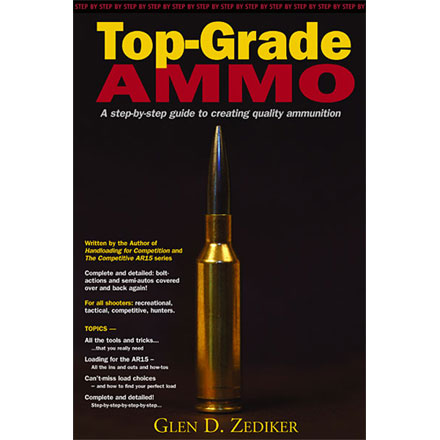
Glen’s books, Handloading For Competition and Top-Grade Ammo, are available at Midsouth HERE. For more information about other books by Glen, visit ZedikerPublishing.com
Smith & Wesson has issued a CONSUMER SAFETY ALERT for the M&P 15-22, a semi-auto .22LR rimfire rifle with ergonomics like the centerfire AR15. If you own an M&P 15-22, you need to inspect the bolt. A manufacturing problem with the bolt could allow the gun to fire when the bolt closes, even without pulling the trigger. This inspection process is described in this video.
Smith & Wesson states: “The bolt from your M&P 15-22 must be inspected to determine whether it exhibits the condition identified in this notice. To determine whether your firearm is affected by this condition, please inspect your firearm by following the inspection instructions provided here. We are asking consumers of all M&P 15-22 firearms manufactured before February 1, 2019 to inspect their bolt for this condition.”
Smith & Wesson Notice:
M&P 15-22 CONSUMER SAFETY ALERT
AND INSPECTION PROCEDURE
PRODUCT AFFECTED: ALL models of M&P15-22 rifles and pistols manufactured before February 1, 2019.
STOP USING YOUR M&P 15-22 UNTIL IT HAS BEEN INSPECTED AND YOUR BOLT REPLACED (IF NECESSARY).
Smith & Wesson has identified two M&P 15-22 firearms from recent production on which the breech face counter bore depth was not within manufacturing specification. In those firearms, the lack of depth may allow the bolt, upon closing, to crush the rim of the case, causing the round to fire, cycling the bolt, and potentially resulting in multiple discharges without depressing the trigger. This issue can occur in the following two scenarios:
1) With a loaded magazine in the firearm and the bolt locked to the rear, depressing the bolt release to allow the bolt to drop freely may ignite the round as the bolt closes without engaging the trigger and with the safety selector in either the safe or the fire position, and may also result in multiple discharges.
2) With a loaded magazine in the firearm, bolt in the closed position and a round in the chamber and the safety selector in the fire position, depressing the trigger will cause the round to fire normally, however as the bolt cycles, the next round may be ignited by the bolt crushing the rim of the case as it closes, causing multiple discharges.
We believe that these are isolated incidents, however, any unintended discharge of a firearm has the potential to cause injury. Therefore, we have developed this inspection procedure to ensure that all products in the field are safe to use. We are asking customers to perform the following procedure and to refrain from using their M&P15-22 until the bolt has been inspected and replaced as necessary.
REMEDY/ACTION TO BE TAKEN: The bolt from your M&P15-22 must be inspected to determine whether it exhibits the condition identified in this notice. To determine whether your firearm is affected by this condition, please inspect your firearm by following the inspection instructions provided here.
Safety Alert Tip from EdLongrange. We welcome reader submissions.
This is good news for gun-owners. Sportsman’s Warehouse (SW), which operates 92 retail stores in 23 states, now offers gunsmithing. Gun enthusiasts can get complete firearms gunsmithing services at the new Sportsman’s Warehouse Gunsmith Center in Utah. You can ship your rifles, pistols, or shotguns to the SW Gunsmith Center, or simply drop off your firearm at ANY Sportsman’s Warehouse store. The SW Gunsmith Center, equipped with mills and lathes, offers complete repair, refinishing, threading, metal, and stock work. For more info, visit: www.Sportsmans.com/gunsmith.
“Customers can quickly and easily drop off their firearms directly at our new Gunsmith Service Center in Utah, take them to any Sportsman’s Warehouse store, or ship them in for service,” states Jon Barker, Sportsman’s Warehouse President/CEO. “Expanding from the Utah market, we now offer this unique service to customers nationwide, including our 92 store locations.” SW has a loyalty program — each dollar spent at the Gunsmith Center gives members a point towards earning SW gift cards.
Fees Are Reasonable — $200 for Barrel Chambering
There is a $45 minimum charge for guns left overnight, and a $68/hour labor rate. A barrel chambering/fitting job costs $200. Threading a muzzle costs $100.00. Fitting an aftermarket AR trigger is $45. Blue-printing a bolt-action receiver costs $175.00. Glass-bedding an action costs $90-$175. CLICK HERE for Gunsmithing Fee Schedule.
The new Sportsman’s Warehouse gunsmith shop is located in SW’s Salt Lake City Distribution Center. The workspace features four stations for gunsmiths to work on rifles, shotguns, pistols, and muzzleloaders. They also have added a full production lathe that is designed for 24-hour-a-day operation, as well as a large end mill for a variety of metal working operations.
Finish tanks, a spray booth and oven for Cerakote, along with other pieces of equipment that will allow them to perform almost any gun service or customization are being installed.
“The only thing we won’t offer is custom wood stock building,” said Bill Sturtevant, Head Gunsmith. “The time necessary for that service takes too much time and pulls our gunsmiths off of other projects for too long. But just about anything else, including refinishing stocks, is on the table.”
Sportsman’s Warehouse will offer 1-year and 3-Year Firearm Service Plans supported by the company’s gunsmiths. Plans include: mounting and bore sighting, field cleaning, factory-service augmentation, free shipping to the factory for repair, and discounts on Gunsmith Service Center work.
Story Tip from EdLongrange. We welcome reader submissions.
A team of Texas engineers uses the principle of convolution to plot shot impacts. By triangulating data from multiple accelerometers, each shot’s exact point of impact can be plotted with great precision.
Waterloo Labs is a group of engineers from National Instruments and other self-declared “nerds” from Austin, Texas. These folks conducted an interesting demonstration using electronic accelerometers to plot bullet impacts from a suppressed Ruger MKIII .22LR pistol. The accelerometers respond to vibrations caused when the bullets hit a drywall target backer. By triangulating data from multiple accelerometers, each shot’s exact point of impact can be plotted with great precision. These point-of-impact coordinates are then fed into a computer and super-imposed into a Flash version of the Half-Life video game (which is projected on the drywall board). The end result is being able to “play” a video game with a real firearm.
Do-It-Yourself Electronic Target System?
Now, we are NOT particularly interested in shooting Zombies in a video game. However, the technology has interesting potential applications for real shooters. Waterloo Labs has published the computer code, used to triangulate bullet impacts from multiple accelerometers. Potentially, a system like this could be built to provide display and scoring of long-range targets. Sophisticated electronic target systems already exist, but they use proprietary hardware and software, and they are very expensive. The Waterloo Labs experiment shows that shooters with some computer and electronic skills could build their own electronic scoring system, one that can be adapted to a variety of target sizes and materials.
In addition, we imagine this system could be utilized for military and law enforcement training. The walls of structures used for “live-fire” room-clearing exercises could be fitted with accelerometers so the bullet impacts could be plotted and studied. Then, later, the impact plots could be combined with a computer simulation so that trainees could “replay” their live-fire sessions, viewing the actual location of their hits (and misses).
This is one amazing .50-caliber rifle. Along with the lever-actuated falling block, it has a massive swing-out breech block like you’d find on a field artillery piece. The action is so wide that the sights and scope are offset. You’ve heard of the “Beauty and the Beast”? Well here the Beast IS a Beauty….
View looking down at the action from above. Note the hinged Breech-Block.
This extraordinary example of gunsmithing art was crafted by the late J.T. (Jack) Smith of Sudbury, Massachusetts. This unique .50-caliber rifle features an aircraft machine gun barrel cut down to 38-1/4″, and turned octagon to round (in the style of Schuetzen rifles). The round portion of the barrel is tapered with a heavy boss at the muzzle. The barrel is inlaid in gold on both left and right side top flats. Custom scope bases are fitted to the receiver and to the top of the barrel. These hold an externally adjusting Unertl 15X target scope in offset scope mounts.
Huge Falling Block Receiver
The massive receiver (8″ long x 2-3/4″ wide x 3″ deep) is remarkable in design and construction. Machined from solid steel, the action incorporates several unique features. Note the hinged Howitzer-style breech block which swings to the right and mortises into the back of the receiver in the loading slot, providing a back-up for the falling block. We’ve never seen anything like that on any rifle. The one-piece floorplate/lever incorporates a Ruger No. 1-style latch which locks into the bottom of the trigger guard. The entire floorplate and lever retract downward. Firing is accomplished by means of a striker mounted in the hinged (swing-out) breech block. This is manually cocked with another lever on top of the breech block. Dropping the falling block activates the extractor which removes the spent case.
Offset Sights
This rifle features a custom-built, windage-adjustable offset front sight plus a custom-built vernier tang sight with aperture offset to the left side. The sights are offset to the left for a right-handed shooter, to correct for the extreme width of the receiver, allowing a more comfortable head position.
Have you recently purchased a new scope? Then you should verify the actual click value of the turrets before you use the optic in competition (or on a long-range hunt). While a scope may have listed click values of 1/4-MOA, 1/8-MOA or 0.1 Mils, the reality may be slightly different. Many scopes have actual click values that are slightly higher or lower than the value claimed by the manufacturer. The small variance adds up when you click through a wide range of elevation.
In this video, Bryan Litz of Applied Ballistics shows how to verify your true click values using a “Tall Target Test”. The idea is to start at the bottom end of a vertical line, and then click up 30 MOA or so. Multiply the number of clicked MOA by 1.047 to get the claimed value in inches. For example, at 100 yards, 30 MOA is exactly 31.41 inches. Then measure the difference in your actual point of impact. If, for example, your point of impact is 33 inches, then you are getting more than the stated MOA with each click (assuming the target is positioned at exactly 100 yards).
How to Perform the Tall Target Test
The objective of the tall target test is to insure that your scope is giving you the proper amount of adjustment. For example, when you dial 30 MOA, are you really getting 30 MOA, or are you getting 28.5 or 31.2 MOA? The only way to be sure is to verify, don’t take it for granted! Knowing your scopes true click values insures that you can accurately apply a ballistic solution. In fact, many perceived inaccuracies of long range ballistics solutions are actually caused by the scopes not applying the intended adjustment. In order to verify your scope’s true movement and calculate a correction factor, follow the steps in the Tall Target Worksheet. This worksheet takes you thru the ‘calibration process’ including measuring true range to target and actual POI shift for a given scope adjustment. The goal is to calculate a correction factor that you can apply to a ballistic solution which accounts for the tracking error of your scope. For example, if you find your scope moves 7% more than it should, then you have to apply 7% less than the ballistic solution calls for to hit your target.
NOTE: When doing this test, don’t go for the maximum possible elevation. You don’t want to max out the elevation knob, running it to the top stop. Bryan Litz explains: “It’s good to avoid the extremes of adjustment when doing the tall target test.I don’t know how much different the clicks would be at the edges, but they’re not the same.”
Should You Perform a WIDE Target Test Too?
What about testing your windage clicks the same way, with a WIDE target test? Bryan Litz says that’s not really necessary: “The wide target test isn’t as important for a couple reasons. First, you typically don’t dial nearly as much wind as you do elevation. Second, your dialed windage is a guess to begin with; a moving average that’s different for every shot. Whereas you stand to gain a lot by nailing vertical down to the click, the same is not true of windage. If there’s a 5% error in your scope’s windage tracking, you’d never know it.”
Verifying Scope Level With Tall Target Test
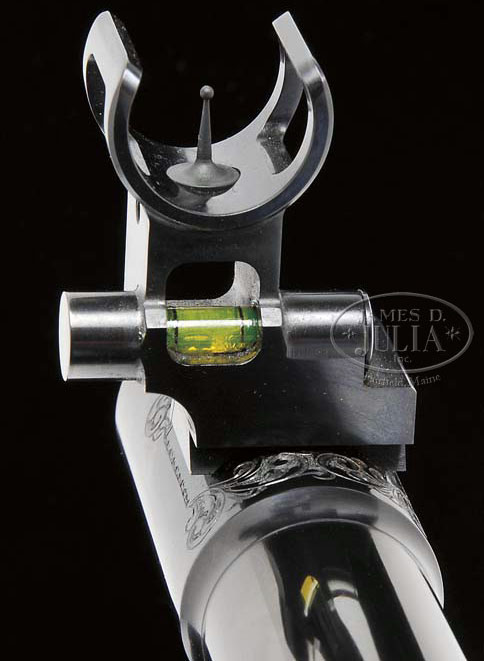
Bryan says: “While setting up your Tall Target Test, you should also verify that your scope level is mounted and aligned properly. This is critical to insuring that you’ll have a long range horizontal zero when you dial on a bunch of elevation for long range shots. This is a requirement for all kinds of long range shooting. Without a properly-mounted scope level (verified on a Tall Target), you really can’t guarantee your horizontal zero at long range.”
NOTE: For ‘known-distance’ competition, this is the only mandatory part of the tall target test, since slight variations in elevation click-values are not that important once you’re centered “on target” at a known distance.
Our friend Dennis Santiago was recently conducting training for a Southern California Police Department. During a training session one of the unit’s AR15s stopped functioning. The problem — the bolt in the AR rifle broke in half. Dennis states: “They ran the gun dry, broke for lunch, shot it again. They don’t like that. I personally like to flood the bolt wet with lube on training days. It prevents stuff like this. Given that, it’s a simple remove-and-replace fix.”
Here are some of the more interesting comments about this parts failure — an AR bolt that literally sheared in half:
“If I was a betting man [the steel] wasn’t made by Carpenter Steel. They are one of the few companies that use the correct [milspec-steel, C-158] called out on the drawing which they coincidentally developed. Most of the other companies that make [AR Bolts] use different steel with the same heat treat specification as what is called out which gives them the potential of being a little on the brittle side at the upper end of the tolerance. When it comes to the AR platform, bolts are probably the only part of the entire gun where I must admit to being a little bit of a brand snob.” David O’N.
[Editor’s Note: Actually Carpenter Steel does not make AR bolts. They are a steel supplier, and yes Carpenter did develop the original C-158 steel for AR bolts. Here is a contrary view, claiming that AISI 9310 Steel is actually stronger than milspec Carpenter C-158: 9310 Steel for AR Bolts.]
“Dry bolt and carrier shouldn’t cause that. Looks like a big pressure spike. What kind of ammo…?” Guy G.
Reply from Dennis: “55gr factory ammo.Piles of it.”
“Is that the new two-piece bolt everyone’s been talking about LOL?” — Darren R.
“Let me guess…the PD called you in cause they didn’t know why it stopped going ‘pew pew’?” — Jim O.
Reply from Dennis: “I was there today for qualifications. It broke during the rifle phase. Simple enough to fish the bolt parts out of the action. The training didn’t miss a beat. I have an armory full of the things.”
CCI and Federal Premium are both brands of Vista Outdoor. Most CCI rimfire is produced in Idaho, while other Federal-branded rimfire ammo is produced in Federal’s Anoka, Minnesota facilities. Here we feature videos from both CCI and Federal ammo plants. Watch and learn how rimfire ammo is made.
Field & Stream Tours Federal Ammo Plant in Minnesota
A reporter for Field & Stream recently got a chance to tour the Federal ammunition production facility in Anoka, Minnesota. This large plant produces both rimfire and centerfire ammunition. While touring the plant, the reporter was allowed to capture video showing the creation of .22 LR rounds from start to finish. This is a fascinating video, well worth watching.
Note to Viewers — After Starting Video, Click Speaker Icon to HEAR audio!
This revealing video shows all phases of .22 LR ammo production including cupping, drawing, annealing, washing, drying, head-stamping, priming, powder charging, bullet seating, crimping, waxing, inspection, and final packaging. We recommend you watch the video from start to finish. You’ll definitely learn some new things about rimfire ammo.
.22 LR Ammo Production in Idaho
Back in 2016, YouTuber 22Plinkster was able to tour the CCI Ammo plant in Lewiston, Idado. Here is the rimfire production video he produced.
The Manufacturing Process for .22 LR Rimfire Ammunition Shooting Sports USA explains: “Rimfire cartridge cases are the oldest self-contained cartridge in existence, having been in continuous production since the mid-1850s. Rimfire cases are drawn from a thin piece of brass and formed with a hollow rim. A priming compound is then forced into the case using centrifugal force, where it is charged with powder and a bullet is seated in the mouth of the case. The case is then crimped around the bullet to ensure sufficient push and pull when the round is fired. When the firing pin strikes the thin brass rim of the case, the hollow rim is crushed and the primer is ignited.” Source: SSUSA.org 9/2/2017.
Why You CANNOT Rely on the MV Printed on the Ammo Box!
When figuring out your come-ups with a ballistics solver or drop chart it’s “mission critical” to have an accurate muzzle velocity (MV). When shooting factory ammo, it’s tempting to use the manufacturer-provided MV which may be printed on the package. That’s not such a great idea says Bryan Litz of Applied Ballistics. Don’t rely on the MV on the box, Bryan advises — you should take out your chrono and run your own velocity tests. There are a number of reasons why the MV values on ammo packaging may be inaccurate. Below is a discussion of factory ammo MV from the Applied Ballistics Facebook Page.
Five Reasons You Cannot Trust the Velocity on a Box of Ammo:
1. You have no idea about the rifle used for the MV test.
2. You have no idea what atmospheric conditions were during testing, and yes it matters a lot.
3. You have no idea of the SD for the factory ammo, and how the manufacturer derived the MV from that SD. (Marketing plays a role here).
4. You have no idea of the precision and quality of chronograph(s) used for velocity testing.
5. You have no idea if the manufacturer used the raw velocity, or back-calculated the MV. The BC used to back track that data is also unknown.
1. The factory test rifle and your rifle are not the same. Aside from having a different chamber, and possibly barrel length some other things are important too like the barrel twist rate, and how much wear was in the barrel. Was it just recently cleaned, has it ever been cleaned? You simply don’t know anything about the rifle used in testing.
2. Temperature and Humidity conditions may be quite different (than during testing). Temperature has a physical effect on powder, which changes how it burns. Couple this with the fact that different powders can vary in temp-stability quite a bit. You just don’t know what the conditions at the time of testing were. Also a lot of factory ammunition is loaded with powder that is meter friendly. Meter friendly can often times be ball powder, which is less temperature stable than stick powder often times.
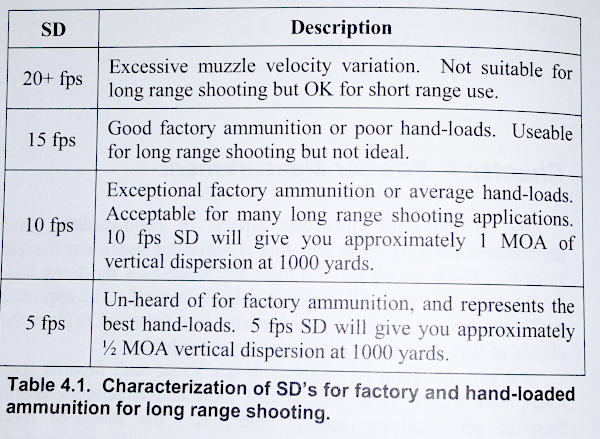
3. The ammo’s Standard Deviation (SD) is unknown. You will often notice that while MV is often listed on ammo packages, Standard Deviation (normally) is not. It is not uncommon for factory ammunition to have an SD of 18 or higher. Sometimes as high as 40+. As such is the nature of metering powder. With marketing in mind, did they pick the high, low, or average end of the SD? We really don’t know. You won’t either until you test it for yourself. For hand-loaded ammo, to be considered around 10 fps or less. Having a high SD is often the nature of metered powder and factory loads. The image below is from Modern Advancements in Long Range Shooting: Volume II.
4. You don’t know how MV was measured. What chronograph system did the manufacturer use, and how did they back track to a muzzle velocity? A chronograph does not measure true velocity at the muzzle; it simply measures velocity at the location it is sitting. So you need to back-calculate the distance from the chrono to the end of the barrel. This calculation requires a semi-accurate BC. So whose BC was used to back track to the muzzle or did the manufacturer even do that? Did they simply print the numbers displayed by the chronograph? What kind of chronograph setup did they use? We know from our Lab Testing that not all chronographs are created equal. Without knowing what chronograph was used, you have no idea the quality of the measurement. See: Applied Ballistics Chronograph Chapter Excerpt.
5. The MV data may not be current. Does the manufacturer update that data for every lot? Or is it the same data from years ago? Some manufacturers rarely if ever re-test and update information. Some update it every lot (ABM Ammo is actually tested every single lot for 1% consistency). Without knowing this information, you could be using data for years ago.
CONCLUSION: Never use the printed MV off a box of ammo as anything more than a starting point, there are too many factors to account for. You must always either test for the MV with a chronograph, or use carefully obtained, live fire data. When you are using a Ballistic Solver such as the AB Apps or Devices integrated with AB, you need to know the MV to an accuracy down to 5 fps. The more reliable the MV number, the better your ballistics solutions.
We know you guys like taking photos of your rifles at the range. And, if you’re selling a rifle, scope, front rest, or rear bag, you need good photos to post in our Forum classifieds. Here’s a basic photography tip that can help you produce dramatically better photos. Use your camera’s ability to add “fill flash” even in daylight.
There’s plenty of light on a bright day. But bright light also means strong shadows. The shadows can leave parts of your subject literally in the dark. Daylight flash will help fill in those dark spots. In addition, if you are on a covered firing area, and want to include the range in your photo, you can benefit from using flash. This will prevent the foreground subject from being too dark while the downrange background is much too bright.
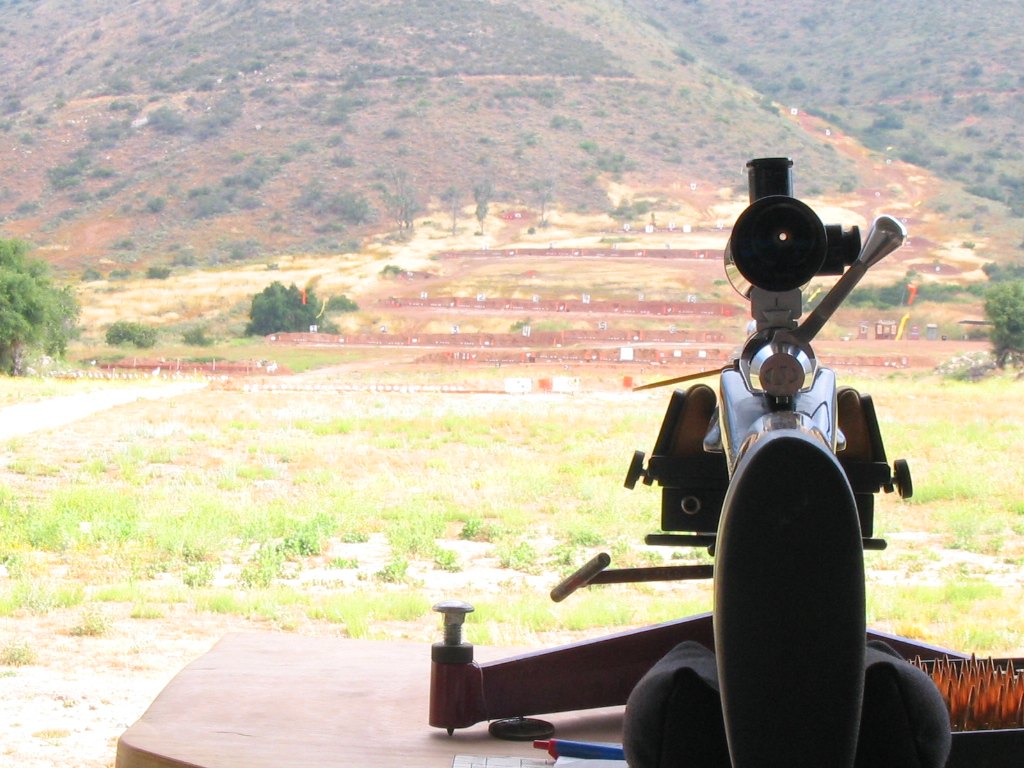
Photo without Flash
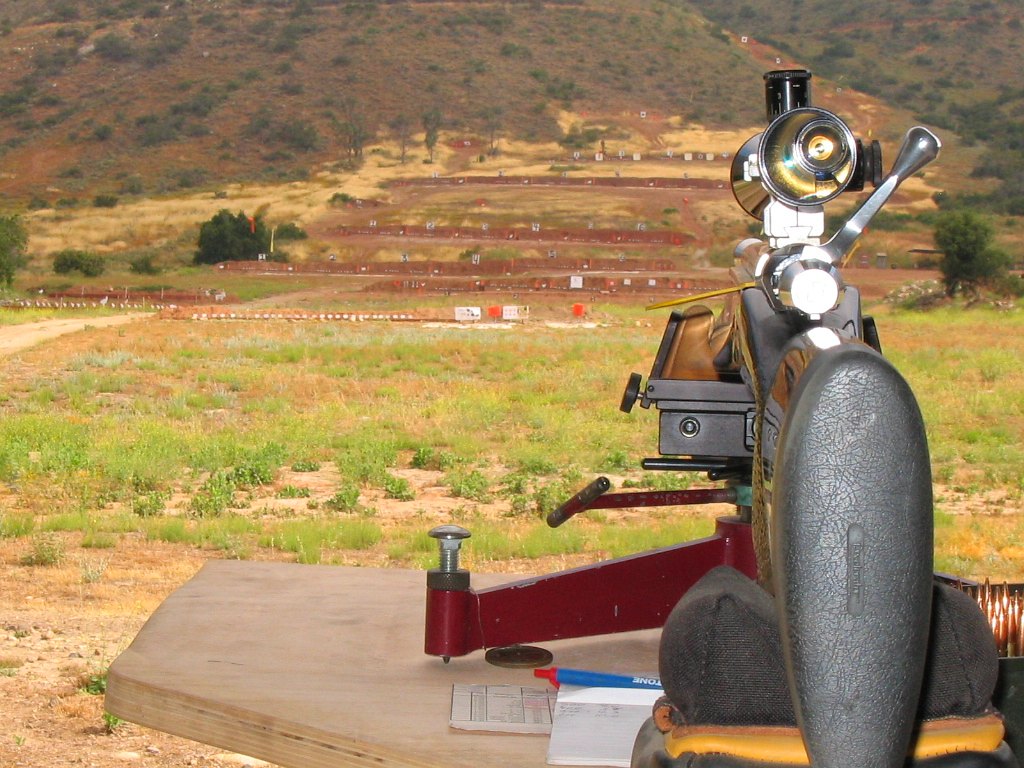
The photo above was taken without flash. As you can see, the rifle is too dark so details are lost. At the same time, the background (downrange) is over-exposed and washed out. The second photo below is taken with daylight flash. The difference is dramatic. Now you can see details of the rifle, while the background is exposed properly. Note how much easier it is to see the the targets downrange and the colors of the front rest. NOTE: these two photos were taken at the same time — just seconds apart.
Photo with Daylight “Fill-Flash”
Be sure to click on the larger versions of each photo.
How to Activate Daylight Flash
Most digital cameras have daylight flash capability. Some cameras have a separate setting for “auto fill flash”. On other cameras, you’ll have to set the camera to aperture priority and stop down the aperture to force the flash to fire. Read your camera’s manual. On many Canons, a menu that lets you set the “flash output”. For “fill flash” we like to set the flash at 30% to 50% output. This fills in the shadows sufficiently without “killing contrast” or creating too much reflection on shiny metal. Below is a photo taken with 30% flash output. Note the rich colors and how the exposure is balanced between foreground and background. Without flash the sky and target area would be “washed out”.
Here’s another tip for Canon owners. If you like deep, rich colors, use the “Vivid” setting in the effects menu. This punches up saturation and contrast.






 Glen’s books, Handloading For Competition and Top-Grade Ammo, are available at Midsouth HERE. For more information about other books by Glen, visit ZedikerPublishing.com


 The new Sportsman’s Warehouse gunsmith shop is located in SW’s Salt Lake City Distribution Center. The workspace features four stations for gunsmiths to work on rifles, shotguns, pistols, and muzzleloaders. They also have added a full production lathe that is designed for 24-hour-a-day operation, as well as a large end mill for a variety of metal working operations.
 Do-It-Yourself Electronic Target System?




 Verifying Scope Level With Tall Target Test



 We know you guys like taking photos of your rifles at the range. And, if you’re selling a rifle, scope, front rest, or rear bag, you need good photos to post in our Forum classifieds. Here’s a basic photography tip that can help you produce dramatically better photos. Use your camera’s ability to add “fill flash” even in daylight.