Forest of Windflags at World Benchrest Championships in France in 2011
There’s a simple, inexpensive “miracle device” that can cut your groups in half. If you’re not using this device, you’re giving away accuracy. The “miracle device” to which we refer is a simple wind indicator aka “windflag”. Using windflags may actually improve your accuracy on target much more than weighing charges to the kernel, or spending your life savings on the “latest and greatest” hardware.
Remarkably, many shooters who spend $3000.00 or more on a precision rifle never bother to set up windflags, or even simple wood stakes with some ribbon to show the wind. Whether you’re a competitive shooter, a varminter, or someone who just likes to punch small groups, you should always take a set of windflags (or some kind of wind indicators) when you head to the range or the prairie dog fields. And yes, if you pay attention to your windflags, you can easily cut your group sizes in half. Here’s proof…
Miss a 5 mph Shift and You Could DOUBLE Your Group Size
The table below records the effect of a 5 mph crosswind at 100, 200, and 300 yards. You may be thinking, “well, I’d never miss a 5 mph let-off.” Consider this — if a gentle 2.5 mph breeze switches from 3 o’clock (R to L) to 9 o’clock (L to R), you’ve just missed a 5 mph net change. What will that do to your group? Look at the table to find out.
Values from Point Blank Ballistics software for 500′ elevation and 70° temperature.
Imagine you have a 6mm rifle that shoots half-MOA consistently in no-wind conditions. What happens if you miss a 5 mph shift (the equivalent of a full reversal of a 2.5 mph crosswind)? Well, if you’re shooting a 68gr flatbase bullet, your shot is going to move about 0.49″ at 100 yards, nearly doubling your group size. With a 105gr VLD, the bullet moves 0.28″ … not as much to be sure, but still enough to ruin a nice small group. What about an AR15, shooting 55-grainers at 3300 fps? Well, if you miss that same 5 mph shift, your low-BC bullet moves 0.68″. That pushes a half-inch group well past an inch. If you had a half-MOA capable AR, now it’s shooting worse than 1 MOA. And, as you might expect, the wind effects at 200 and 300 yards are even more dramatic. If you miss a 5 mph, full-value wind change, your 300-yard group could easily expand by 2.5″ or more.
If you’ve already invested in an accurate rifle with a good barrel, you are “throwing away” accuracy if you shoot without wind flags. You can spend a ton of money on fancy shooting accessories (such as expensive front rests and spotting scopes) but, dollar for dollar, nothing will potentially improve your shooting as much as a good set of windflags, used religiously.
Windflags Sources and Options
Which Windflag to buy? There are many vendors selling windflags of various types, some with daisy wheels others without. You may want to go to a match and see what types works best for you. CLICK HERE for the Benchrest Central Classifieds with multiple windflag types and accessories for sale. Here is a sample:
Most of us own a .223 Rem rifle. Now, thanks to our friends at Rifleshooter.com we can assess exactly how velocity changes with barrel length for this popular cartridge.
Rifleshooter.com performed an interesting test, cutting the barrel of a .223 Rem rifle from 26″ all the way down to 16.5″. The cuts were made in one-inch intervals with a rotary saw. At each cut length, velocity was measured with a Magnetospeed chronograph. To make the test even more interesting, four different types of .223 Rem/5.56 ammo were chron’d at each barrel length. The Rifleshooter.com team that conducts these tests has a full-service gun shop, 782 Custom Gunworks — visit 782guns.com.
Test Barrel Lost 25.34 FPS Per Inch (.223 Rem Chambering)
How much velocity do you think was lost, on average, for each 1″ reduction in barrel length? The answer may surprise you. The average speed loss of the four types of .223/5.56 ammo, with a 9.5″ shortening of barrel length, was 240.75 fps total (from start to finish). That works out to an average loss of 25.34 fps per inch.
5.56/.223 Barrel Cut-Down Speed Test 26″ to 16.5″
Start FPS at 26″
End FPS at 16.5″
Total Loss
Average Loss Per Inch
UMC .223 55gr
3182*
2968
214
22.5 FPS
Federal M193 55gr
3431
3187
244
25.7 FPS
Win m855 62gr
3280
2992
288
30.3 FPS
Blk Hills .223 68gr
2849
2632
217
22.8 FPS
*There may have been an error. The 25″ velocity was higher at 3221 fps.
Rifleshooter.com observed: “Cutting the barrel from 26″ to 16.5″ resulted in a velocity reduction of 214 ft/sec with the UMC 223 55-grain cartridge, 244 ft/sec with the Federal M-193 cartridge, 288 ft/sec with the Winchester M855 cartridge and 217 ft/sec with the Back Hills 223 68-grain match cartridge.”
How the Test Was Done
The testers described their procedure as follows: “Ballistic data was gathered using a Magnetospeed barrel-mounted ballistic chronograph. At each barrel length, the rifle was fired from a front rest with rear bags, with five rounds of each type of ammunition. Average velocity and standard deviation were logged for each round. Once data was gathered for each cartridge at a given barrel length, the rifle was cleared and the bolt was removed. The barrel was cut off using a cold saw. The test protocol was repeated for the next length. Temperature was 45.7° F.”
See More Barrel Cut-Down Tests on Rifleshooter.com
Rifleshooter.com has performed barrel cut-down tests for many other calibers/chamberings including 6mm Creedmoor, .308 Winchester, and .338 Lapua Magnum. See these test results at Rifleshooter.com.
Much Different Results with 6mmBR and a Longer Barrel
The results from Rifleshooter.com’s .223/5.56 test are quite different than the results we recorded some years ago with a barrel chambered for the 6mmBR cartridge. When we cut our 6mmBR barrel down from 33″ to 28″ we only lost about 8 FPS per inch. Obviously this is a different cartridge type, but also our 6mmBR barrel end length was longer than Rifleshooter.com’s .223 Rem start length. Velocity loss may be more extreme with shorter barrel lengths. And, of course, different cartridge types and powder/bullet combinations will yield different results.
The Civilian Marksmanship Program (CMP) has issued an ammunition safety advisory to all users of M1 Garands, M1903s, and M1903A3 rifles. Ammunition that is loaded beyond 50,000 Copper Units of Pressure (CUP) and using bullets weighing more than 172 grains should be limited to modern rifles, and NOT USED in old military rifles aged 70+ years.
After this warning was issued by the CMP, the California Rifle and Pistol Association (CRPA) provided further safety recommendations for owners or older firearms:
CRPA Ammunition and Older Firearms Guidelines
Many of us have either purchased or inherited firearms in excess of 25 years of age. The issue … noted as an example by the Civilian Marksmanship Program in regards to certain ammunition leads as they apply to the M1 Garand is not isolated to that particular firearm. The CRPA… has seen similar issues exposed with other [older] firearms when using modern loads. We strongly advise you to check with the manufacturer for recommended load limitations before purchasing modern ammunition for an older firearm.
CRPA also recommends these safety procedures:
— Have a gunsmith check your older firearm for safety prior to using it.
— Take a reloading class to help develop a safe load for your older firearm.
— Inspect older ammunition for defects such as a green patina or rust build up on the cases or crystallization on the projectiles. If defects are observed, the CRPA suggests disassembling the ammo into components for proper recycling and disposal.
Storage of Ammo for Older Rifles
The CRPA also cautioned that you should be cautious about older ammo that may be decades old, including old milsurp ammunition. The CRPA advises:
1. Store ammunition in a cool, dry, location where little temperature fluctuation occurs.
2. If storing ammunition in an air/watertight ammo can, utilize water absorbent silica packs and place packs in the can with the ammunition.
3. Conduct periodic checks every 12-24 months and replace the silica packs as needed.
We created this custom target in 5 minutes using PrintTargets.net. If you like it, DOWNLOAD HERE.
AccurateShooter.com has a HUGE collection of FREE downloadable PDF targets. We offer a very wide range of target designs: Load Development Grids, NRA Bullseye targets, Official-Size BR targets, Realistic Varmint Targets, Silhouette Shapes, Fun Plinking Targets, and even specialized tactical training targets. If our collection of free targets isn’t enough, or if you want to create a new kind of target — you’re in luck. The Australian-based interactive website, PrintTargets.net, allows you to create your own customized, printable PDF targets. Shown below are just a few of the target designs you can create in minutes:
CLICK Graphic to Create Your Own Targets.
Just follow the step-by-step instructions to set paper size, layout, bullseye color, line thickness, number of rings and diameter. You can even add Score Numbers to your target rings. PrintTargets.net is easy and fun to use. It’s much faster to create targets this way than to try to draw a series of circles with PowerPoint or MS Paint.
Power-User Tip: PrintTargets.net even offers a handy diamond-grid calibration diagram that you can add to your custom target designs. You’ll find the calibration grid as option #15 when you design your target — just scroll all the way down the PrintTargets.com home page.
Lapua, renowned producer of high-quality components and ammunition, has hired Shane Barnhart as the new Manager of the Lapua Rimfire Performance Center located in Marengo, Ohio. As Manager, Shane will supervise rimfire ammo lot testing in Lapua’s state-of-the art indoor tunnel in Marengo.
Patterned after the world-renowned Lapua Test Center in Germany, both the Marengo, OH and Mesa, AZ Lapua Rimfire Performance Centers provide shooters the opportunity to test multiple lots of ammunition under tightly controlled conditions. Each of the Lapua Rimfire Performance Centers offer the ability to test ammunition at both 50 and 100 meters, simultaneously. By comparing the results of various lots fired at both distances, the best performing lots can provide a distinct competitive advantage. This allows for higher scores and more hits on target for a customer’s chosen discipline. To learn more about the Lapua Rimfire Performance Centers or to schedule an appointment, visit rimfiretest.com.
Shane Barnhart at Camp Perry in 2014, shooting with the USAMU Team.
Barnhart Has Won Multiple National Shooting Championships and Served with USAMU
Barnhart is an accomplished competitive shooter. Shane won 8 National Smallbore Championships, a Service Rifle National Championship, a Civilian Marksmanship Long Range National Championship, and more. Over the past 20 years, Barnhart served with the U.S. Army Marksmanship Unit (USAMU), where he was a competitive marksman and head coach. With the USAMU, Shane gained years of experience testing smallbore ammunition at the USAMU’s range. Barnhart will commence managing the day-to-day test operations in Ohio beginning in late February 2022.
“I’m excited for the opportunity to continue being part of the shooting community and to work with such a great brand while doing so,” said Barnhart. “I’ve seen how this kind of testing can make a major difference for a competitive shooter, and I am excited to help [shooters] realize their competitive dreams.”
About Lapua — Lapua produces outstanding rimfire and centerfire cartridges and components for civilian and professional use. Lapua is a part of the Capstone Precision Group, exclusive U.S. distributor for Berger, Lapua, Vihtavuori and SK-Rimfire products. For more information, visit Lapua.com.
Applied Ballistics (AB) has announced the deployment schedule for the Applied Ballistics Mobile Laboratory during the 2022 shooting season. The Applied Ballistics Crew will be driving the Mobile Lab Truck and Trailer to a number of important shooting events in 2022. At these events you can get a Personal Drag Model (PDM) for your rifle/load based on Doppler Radar testing. The first deployment will be at the Bomber Run match in Indiana on February 18, 2022, just two weeks away. Here is the overall 2022 schedule:
The Applied Ballistics Mobile Lab trailer carries a vast array of equipment including computers, sensors, and advanced Doppler Radar equipment. The Doppler Radar is employed to create custom ballistic profiles (aka “Personal Drag Models”) for shooters at major matches.
Personal Drag Models (PDMs) provide shooters with exact, precise ballistics data for their preferred ammo as fired in their match rifles. This is especially important for rimfire ammo which may start supersonic, then go transonic, and finish well subsonic during much of its flight. Bryan Litz explains: “The Doppler Radar system allows us to track the bullet’s velocity as it flies down-range. As the bullet’s velocity decays, that’s what tells you the ballistic coefficient, the drag, and [other factors].”
About the Applied Ballistics Mobile Lab
Q: What is the basic purpose of the Applied Ballistics Mobile Lab?
Mitchell Fitzpatrick: The Mobile Lab allows us to effectively carry out ballistics testing in the field and at events. It has most of the capabilities of our normal lab, but on wheels.
Q: What hardware and electronics are carried in the Mobile Lab? What are its capabilities?
Bryan Litz: The Mobile Lab will transport most everything that’s in the main lab including the Doppler radar. This rig is new and we haven’t fully outfitted it yet. The load-outs will be somewhat flexible depending on the venue we are supporting.
Wouldn’t it be cool if your rifle scope had a built-in laser rangefinder, plus a weather sensor, a ballistics calculator, compass, and even wireless communication? Yes that would be very cool indeed, and that is why the Pentagon is spending at least $20 million on an amazing new “smart optic” from Vortex.
Vortex Optics has been awarded the contract for the U.S. military’s “Next Generation Squad Weapon–Fire Control” (NGSW-FC) optic. Under this contract, Vortex will provide up to 250,000 XM157 NGSW-FC optics over 10 years. These XM157 optics include an amazing set of features: variable magnification optic, backup etched reticle, laser rangefinder, ballistic calculator, atmospheric sensor suite, compass, Intra-Soldier Wireless, visible and infrared aiming lasers, and a digital display overlay.
The new XM157 smart optic is described as a “computer atop the weapon” since it can calculate range, ballistics, atmospherics, directional information, and digital overlay. The fire control system will replace the close combat optic, rifle combat optic, and machine gun optic used by U.S. Special Operations units, Marine Corps, and Army infantry units.
The XM157 is a Low Powered Variable Optic (LPVO) with a display overlay, Laser Rangefinder (LRF), ballistic solver, environmental sensors, aiming lasers, digital compass, and wireless communication to provide for seamless connectivity on the battlefield. The XM157 is based on a 1-8x30mm LPVO with glass-etched reticle on USA-made lenses. The XM157 weighs less than the combined weight of traditional LPVOs plus weapon-mounted Laser Rangefinders.
Vortex Contract Worth at Least $20 Million… And Potentially $2.7 Billion!
With a starting price of $20 million, the NGSW-FC Optic contract stipulates that Vortex will receive at least $20 million from the Pentagon. This will cover the XM157 advanced optics as well as supporting accessories, spare parts, repairs, and engineering services. The Vortex subsidiary Sheltered Wings will fulfill the contract.
As reported in Guns.com: “The 10-year contract… covers the production and delivery of up to 250,000 XM157 Next Generation Squad Weapons-Fire Control systems. The NGSW-FC will be the common sight for the Army’s new NGSW-Rifle, set to replace the M4 Carbine in front line service, and the NGSW-Automatic Rifle, the intended replacement for the M249 Squad Automatic Weapon. The contract minimum is set at $20 million, with a fantastic $2.7 billion maximum mentioned if all options are taken, pointing to a unit price for each NGSW-FC optic as being in the neighborhood of $10,800. However, it should be noted that, going past the sights themselves, the contract includes supporting accessories, contractor support, spare parts, repairs, and engineering efforts, likely pointing to a significantly lower per-unit cost than the basic math would imply.”
Vortex Nation Podcast About NGSW Fire Control Optic
The Pentagon chose Vortex to provide its Next Generation Squad Weapon – Fire Control Optic (NGSW-FC). But what is an NGSW-FC? What is Vortex’s new scope replacing? What weapons will it ultimately sit on? What features/capabilities does it have? What is Active Reticle? What is Intra-Soldier Wireless? How do the features work? How was it tested? Is it easy to use? Vortex Rep Alexander Lewis answers these questions and more in the 49-minute Podcast linked below.
Vortex Podcast Answers Key Questions about new XM157 Smart Optic
Podcast Highlights about NSGW-FC Optic:
00:00 – NGSW-FC Intro
08:44 – A Traditional LPVO at its Core
16:22 – Smart Scope Technology
19:43 – The “Active Reticle” (Rendering)
23:40 – Smart Scope Technology
29:07 – Size/Weight
33:08 – Laser Rangefinder and Interfaces
42:53 – Battery and Power
Next Generation Squad Weapons Program
Launched in 2017, the Next Generation Squad Weapons (NGSW) program is a U.S. military initiative to develop operationally relevant squad-level lethality against various threats. Three defense firms have been selected to provide weapons and ammunition prototypes for the program: SIG Sauer, General Dynamics, and Textron Systems. The weapon system also provides soldiers with significant range and signature management capability improvements.
Do you own a LabRadar chronograph, or perhaps you are planning to add one to your range gear this season? With a LabRadar, you don’t have to go downrange to set up the chrono on a tripod and fuss with bore-sighting. LabRadars are excellent chronographs, particularly when paired with an inertial trigger.
Here is an excellent accessory that can be easily fitted to LabRadars. This Edelkrone StandONE all-terrain foldable camera stand can provide a stable base when shooting from a bench or the ground. It can quickly and easily adjust to uneven ground so that your LabRadar sits properly vertical and square to the horizon. The versatile Edelkrone StandONE sells for $119.20 at B&H Camera.
Note how the StandONE can adapt to uneven ground through the multiple hinges on the legs.
Forum member X-47B found this stand and he says it works great with his LabRadar. He is a commercial photographer, so he is familiar with the latest and greatest camera stands. In our Shooters’ Forum he posted: “Working in commercial photography and video I come across all different equipment. When I got this Edelkrone StandONE folding base, I realized it is the perfect base for a LagRadar. Works on friction, no ball-head needed. It works on any terrain and folds up tiny, so it’s perfect for prone or the bench.” Stated load capacity is 15 pounds, and this is made to hold expensive camera gear, so there’s no problem placing a LabRadar unit on top.
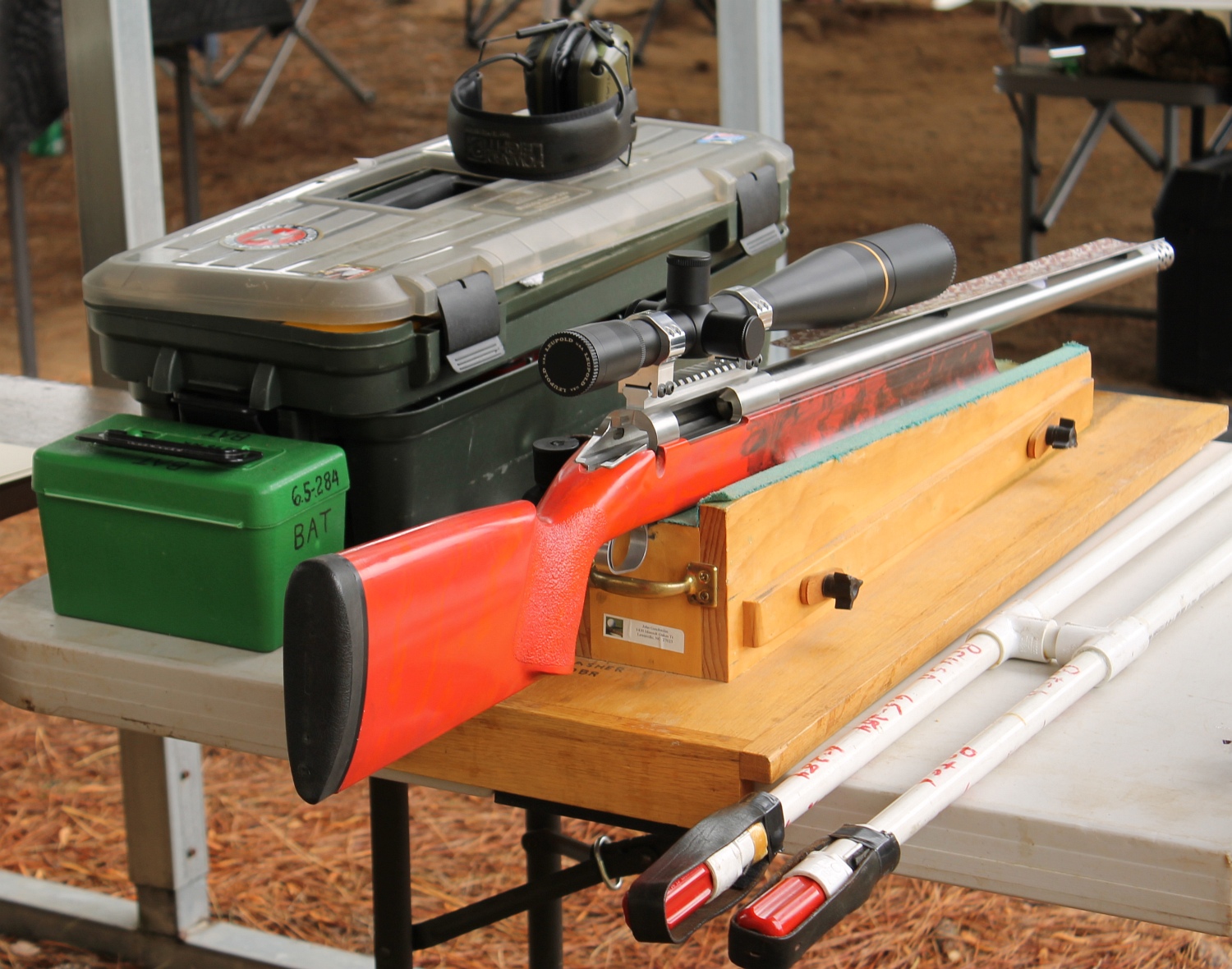
We saw some interesting gear at a 600-yard IBS match at the Piedmont Gun Club (Rutherfordton, NC) a few seasons back. On display were a variety of hand-made wood cleaning cradles designed to fit on table tops. These typically employ a box-style design, with layer of cloth or other padding to cushion the underside of the stock. On display were both single-rifle cleaning cradle/boxes and dual-rifle rigs. This is a good do-it-yourself project that can be built with simple tools.
Click Photos to View Large Versions
Notice that these cradle-boxes feature an extended lower section in the rear. This lower “lip” butts up against the edge of the table so the whole assembly stays in place. In the photo above it appears that the lower section may actually be cut from a rubber block, but we’re not sure.
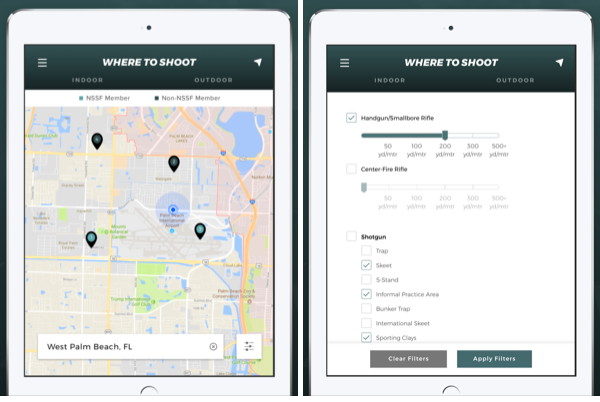
The Where To Shoot Mobile App quickly locates shooting ranges near you, drawing on North America’s most comprehensive directory of shooting ranges. Users can search by current location, state, or zip code. Once you locate a range, you can view activities offered along with a summary of range facilities. You can even get driving directions.
The app is modeled after NSSF’s popular WhereToShoot.org® website and is updated frequently with range information for every U.S. state and Canadian province. Once you’ve located a place to shoot, the App can provide directions to the range. The App also includes video tips for shooters, news, and firearm-safety information.


 There’s a simple, inexpensive “miracle device” that can cut your groups in half. If you’re not using this device, you’re giving away accuracy. The “miracle device” to which we refer is a simple wind indicator aka “windflag”. Using windflags may actually improve your accuracy on target much more than weighing charges to the kernel, or spending your life savings on the “latest and greatest” hardware.