|
|
January 15th, 2014
 It’s a rare thing when you can talk with a living legend about the sport he loves. We had just that opportunity yesterday at SHOT Show when we chatted with Carl Bernosky, TEN-TIME National High Power Champion. We covered a lot of ground in the interview, discussing the future of the High Power game and the changes in hardware Carl has seen during his storied career. Carl also offers some “rock solid” advice for younger High Power shooters hoping to improve their skill sets. We also talked about Carl’s plans for 2014 and his epic battle with SSG Brandon Green at the 2013 High Power Championships at Camp Perry. Carl and Brandon battled to the last shot of the last relay of the last day. After four complete days of shooting, the two men remained tied on points and tied on X-count. Apply a tie-breaker rule based on X-count at long-range, Green was named the 2013 Champion, with Carl named runner-up. That 2013 event was a true “Battle of the Titans” between two immensely talented marksmen. It’s a rare thing when you can talk with a living legend about the sport he loves. We had just that opportunity yesterday at SHOT Show when we chatted with Carl Bernosky, TEN-TIME National High Power Champion. We covered a lot of ground in the interview, discussing the future of the High Power game and the changes in hardware Carl has seen during his storied career. Carl also offers some “rock solid” advice for younger High Power shooters hoping to improve their skill sets. We also talked about Carl’s plans for 2014 and his epic battle with SSG Brandon Green at the 2013 High Power Championships at Camp Perry. Carl and Brandon battled to the last shot of the last relay of the last day. After four complete days of shooting, the two men remained tied on points and tied on X-count. Apply a tie-breaker rule based on X-count at long-range, Green was named the 2013 Champion, with Carl named runner-up. That 2013 event was a true “Battle of the Titans” between two immensely talented marksmen.
We asked Carl about trends in the High Power game. He said that more and more shooters are moving to the AR15 platform. The accuracy is there, and there are advantages to the self-loading actions particularly during rapid-fire. Carl also felt that it takes more training time to master cycling a bolt while shooting in the standing position. Because he does not have to manipulate a bolt, Carl says his self-feeding AR helps him when standing (Carl is considered one of the best standing shooters ever).
Watch Interview with Carl Bernosky, 10-Time National High Power Champion
Though most readers will recognize Carl from reports of his many National Championships, you may not realize that Carl is also a very skilled stock-maker. Carl produces high quality laminated-wood stocks at his shop in Pennsylvania. He offers a full range of stocks for Prone, Palma, F-TR, F-Open, Long Range Benchrest competition, and he also builds fine tactical stocks and hunting stocks. You can see examples of Carl’s stocks at CarlBernosky.com. Carl recently acquired a CNC machine for inletting. This can create ultra-precise inlets for a wide variety of actions.
January 15th, 2014
Norma makes good stuff. And now, you can save 10% on all Norma products, thanks to Bullets.com. As a special way of saying “thanks” to AccurateShooter.com readers and Forum members, Bullets.com will knock 10% off the price of all Norma brass, ammunition, and other Norma products now through the end of January. To qualify for the discount, use Discount Code 14ACC10JAN (the first character is the digit “1”). FYI, Bullets.com does have Norma .22 LR ammo in stock. (Click here for Norma Tac .22 LR Ammo at $5.95 per box.) You may want to grab some rimfire ammo (as well as centerfire ammo and/or Norma brass) and take advantage of this January Promo.

January 14th, 2014

It’s official. No more “vaporware”. In 2014, Leupold will sell a 7-42x56mm VX-6 scope for approximately $1800.00. This scope will be “coming out this summer”. This is a very impressive optic that will give other premium high-magnification competition scopes a run for their money. The new 7-42 features a 34mm main tube. That large diameter tube helps the scope deliver an estimated 70 minutes of elevation (final specs subject to change). There is a side parallax control, and target turrets with 1/8th-MOA click values and built-in zero stop. We were pleased to see that the scope features a “fast-focus” eyepiece with plus/minus diopter adjustment. Initially the scope will be offered with two (2) reticles, the TMOA and TMOA Plus. These feature MOA-based hash marks, with a small gap in the very center with a target dot at the aiming point.
We did get a chance to test the scope. Jason successful engaged targets at 960 yards using a .308 Win Colt modular rifle fitted with the new 7-42x56mm Leupold. Jason reports that the clicks are tactile and positive. The scope is sharp and bright all the way out to the edges of the viewing circle, even at max 42 power. We liked this optic, and can’t wait to get our hands on a final production version.
Leupold 7-42x56mm VX-6 ($1800.00 MSRP, mid-2014 release)
- Magnification Range: 7X to 42X
- Front Objective: 56mm
- Elevation Range: 70 MOA (estimated) with Zero Stop
- Main Tube Diameter: 34mm
- Warranty: Full lifetime Leupold Gold Ring Warranty
Watch Video Showing Features of Leupold 7-42x56mm VX-6 Riflescope

January 14th, 2014
There were many big tactical rifles on display at Media Day, none bigger than the .50 BMG Barrett m107a1. This beast also sported the largest suppressor we’ve ever seen, a “can” the size of a motorcycle exhaust. Called the “QDL” for “Quick Detach Large”, this suppressor fits over the regular muzzle brake. It is capable of reducing the m107a1’s report from 175 db to 158 db. We learned that the m107a1 has been made “leaner and meaner” for 2014, with a six-pound weight savings. That’s important to soldiers charged with carrying the big rig in the field. Watch the last half of the video below to learn about the upgraded m107a1 and the big new QDL suppressor.


Along with the m107a1, Barrett showed us the new MRAD (Multi-Role Adaptive Design), a modular rifle that can shoot .308 Win (7.62×51), .300 Win Magnum, and .338 Lapua Magnum. The MRAD’s design allows the operator to swap barrels and change bolt-heads quickly and easily with simple tools. In fact, you can even remove the trigger group in less than a minute, just by flipping up the MRAD’s hinged upper and pushing out the safety cross-pin (3:00 minute mark in video). The MRAD dis-assembly procedure is shown in the video below. The MRAD is a very well-thought-out design, and it shot very well when Jason tested it. At least in .308 Win configuration, the braked MRAD has good manners on bipod. It doesn’t hop or roll, but recoils straight back, making it very easy to get back on target.


January 13th, 2014
 More and more people are reading books on tablet computers and eReader devices such as the Kindle and Nook. Recognizing the demand for digital resource works, Applied Ballistics has just releases of its first eBook — a digital version of Accuracy and Precision for Long Range Shooting. This work (which has sold 5000 hard copy versions), is now available in electronic format for both Kindle and Nook eReaders. iPad users can use the Kindle app to access the eBook. More and more people are reading books on tablet computers and eReader devices such as the Kindle and Nook. Recognizing the demand for digital resource works, Applied Ballistics has just releases of its first eBook — a digital version of Accuracy and Precision for Long Range Shooting. This work (which has sold 5000 hard copy versions), is now available in electronic format for both Kindle and Nook eReaders. iPad users can use the Kindle app to access the eBook.
This book discusses how to evaluate multiple variables to improve your hit percentage. It explains how to correct the trajectories for drop, wind deflection, etc. through the use of Weapon Employment Zone (WEZ) analysis. WEZ is applied throughout the book, showing readers how to get more rounds on targets, more reliably. Case studies (with live fire verification for many scenarios) show what things affect your hit probability at long range.
All formats of the eBook are sold for $27.99 (hardcopy is $34.99). The Kindle book is available directly from Amazon.com, while the Nook version can be purchased from BarnesandNoble.com.
Free eReader Content on Applied Ballistics Website
If you have a Kindle, Nook, or iPad, you should visit the Ballistics website. You’ll find many free technical articles you can download as PDF files or in Kindle format or Nook format. To access these FREE articles, select the “Recreational” or “Professional” tabs on the top of the Applied Ballistics home page, then choose the “Articles” link from the pull-down menu. Bryan Litz tells us: “We recently updated our website and we’ve included a number of free articles about bullet design, long-range ballistics, and aspects of WEZ analysis. You don’t need an eReader for these — just download the PDF versions.”
January 13th, 2014
A while back, Werner Mehl of Kurzzeit.com produced a 10-minute video for the 2010 SHOT Show. On the eve of another SHOT Show, we thought you’d like another view of a stunning video that became a huge hit on YouTube. This video has has been watched over 8.2 million times, making it one of the most popular shooting-related videos in history. Employing cameras recording at up to 1,000,000 (one million) frames per second, Mehl’s bullet flight video has been called “astounding”, “mesmerizing”, and a “work of art.” If you haven’t seen it yet, sit back and enjoy!

LINK: Kurzzeit.com Video System and PVM-21 Chronograph
Click the link above to learn more about Werner Mehl and his super-sophisticated camera systems that can record at 1,000,000 frames per second. On the same linked page you can learn about the advanced PVM-21 chronograph (now sold as the PVM-2008 or PVM-08) designed by Werner. Operating “all-infrared, all the time”, the PVM-21 is the best optical chronograph we have tested for very low light conditions, or very tricky light conditions.
January 13th, 2014
 On January 10, the National Shooting Sports Foundation (NSSF) and the Sporting Arms and Ammunition Manufacturers’ Institute (SAAMI) filed a lawsuit on behalf of their members against the State of California in Fresno Superior Court challenging the state’s microstamping law. NSSF and SAAMI seek to invalidate and enjoin enforcement of provisions of California state law enacted in 2007, but not made effective until May 2013. These newly “activated” provisions of California law will effectively require that ALL future models of semi-auto pistols be microstamp-capable. Note — semi-auto handguns that are currently on California’s “approved” handgun roster will not be banned from sale. But guns introduced in the future cannot be sold in California unless they have microstamping technology. If gun makers cannot include such features in their future designs, the next generation of handguns will effectively be banned from sale in California. On January 10, the National Shooting Sports Foundation (NSSF) and the Sporting Arms and Ammunition Manufacturers’ Institute (SAAMI) filed a lawsuit on behalf of their members against the State of California in Fresno Superior Court challenging the state’s microstamping law. NSSF and SAAMI seek to invalidate and enjoin enforcement of provisions of California state law enacted in 2007, but not made effective until May 2013. These newly “activated” provisions of California law will effectively require that ALL future models of semi-auto pistols be microstamp-capable. Note — semi-auto handguns that are currently on California’s “approved” handgun roster will not be banned from sale. But guns introduced in the future cannot be sold in California unless they have microstamping technology. If gun makers cannot include such features in their future designs, the next generation of handguns will effectively be banned from sale in California.
Under California law, firearms manufacturers would have to micro laser-engrave a gun’s make, model and serial number on two distinct parts of each gun, including the firing pin so that, in theory, this information would be imprinted on the cartridge casing when the pistol is fired. “There is no existing microstamping technology that will reliably, consistently and legibly imprint the required identifying information by a semiautomatic handgun on the ammunition it fires. The holder of the patent for this technology himself has written that there are problems with it and that further study is warranted before it is mandated. A National Academy of Science review, forensic firearms examiners and a University of California at Davis study reached the same conclusion and the technical experts in the firearms industry agree,” said Lawrence G. Keane, NSSF senior vice president and general counsel. “Manufacturers can not comply with a law the provisions of which are invalid, that cannot be enforced and that will not contribute to improving public safety. As a result, we are seeking both declaratory and injunctive relief against this back-door attempt to prevent the sale of new semiautomatic handguns to law-abiding citizens in California.”
In 2007, California Assembly Bill 1471 was passed and signed into law requiring microstamping on internal parts of new semiautomatic pistols. The legislation provided that this requirement would only became effective if the California Department of Justice certified that the microstamping technology is available to more than one manufacturer unencumbered by patent restrictions. On May 17, 2013, Attorney General Kamala D. Harris provided such certification. The DOJ’s certification notice has been attacked on the grounds that it is scientifically unsound, founded on little more than “wishful thinking”.
January 12th, 2014
 After Colorado banned full-capacity magazines, Magpul Industries began looking for a more gun-friendly location. After considering various options, Magpul Industries has decided to move its manufacturing, distribution, and shipping operations to Cheyenne, Wyoming. The company said it plans to lease a 58,000-square-foot manufacturing and distribution facility while a new 100,000-square-foot facility is being completed in Cheyenne. Magpul also plans to move its corporate headquarters to Texas. Magpul Industries currently employs over 200 people in Colorado, contributing over $80 million annually to Colorado’s economy. Colorado can kiss that $80 million goodbye, as Magpul plans to move virtually all operations to Wyoming or Texas. After Colorado banned full-capacity magazines, Magpul Industries began looking for a more gun-friendly location. After considering various options, Magpul Industries has decided to move its manufacturing, distribution, and shipping operations to Cheyenne, Wyoming. The company said it plans to lease a 58,000-square-foot manufacturing and distribution facility while a new 100,000-square-foot facility is being completed in Cheyenne. Magpul also plans to move its corporate headquarters to Texas. Magpul Industries currently employs over 200 people in Colorado, contributing over $80 million annually to Colorado’s economy. Colorado can kiss that $80 million goodbye, as Magpul plans to move virtually all operations to Wyoming or Texas.
Richard Fitzpatrick, Founder, President, and CEO of Magpul Industries, said that Magpul had no choice but to leave when Colorado outlawed Magpul’s “core products”. The company began a nationwide search for a new base of operations after legislation was enacted in Colorado that restricted the sale of firearms accessories — the core of Magpul’s business.
Magpul plans to transition 92% of its current workforce outside of Colorado within 12-16 months and will maintain only limited operations in Colorado. “Moving operations to states that support our culture of individual liberties and personal responsibility is important,” explained Fitzpatrick, who added: “This relocation will also improve business operations and logistics as we utilize the strengths of Texas and Wyoming in our expansion.”
January 12th, 2014
Next time you have a barrel fitted, consider having your gunsmith create a “stub gauge” from a left-over piece of barrel steel (ideally taken from your new barrel blank). The outside diameter isn’t important — the key thing is that the stub gauge is created with the same reamer used to chamber your current barrel, and the stub must have the same bore diameter, with the same land/groove configuration, as the barrel on your rifle. When properly made, a stub gauge gives you an accurate three-dimensional model of the upper section of your chamber and throat. This comes in handy when you need to bump your case shoulders. Just slide a fired case (with spent primer removed) in the stub gauge and measure from base of case to the end of the gauge. Then, after bumping, re-measure to confirm how much you’ve moved the shoulder.
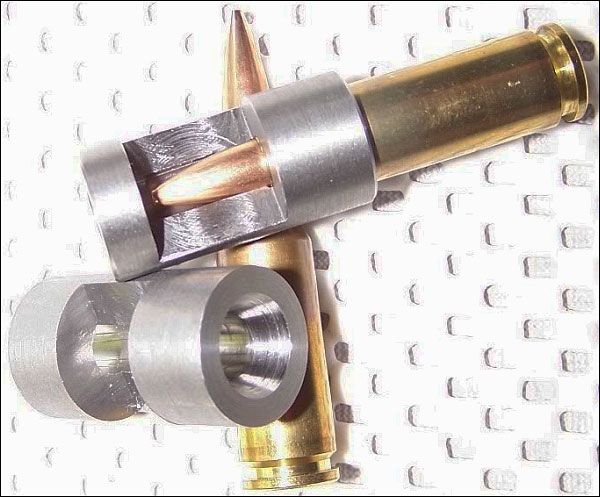
In addition, the stub gauge lets you measure the original length to lands and freebore when your barrel was new. This gives you a baseline to accurately assess how far your throat erodes with use. Of course, as the throat wears, to get true length-to-lands dimension, you need take your measurement using your actual barrel. The barrel stub gauge helps you set the initial bullet seating depth. Seating depth is then adjusted accordingly, based on observed throat erosion, or your preferred seating depth.
Forum member RussT explains: “My gunsmith [makes a stub gauge] for me on every barrel now. I order a barrel an inch longer and that gives him enough material when he cuts off the end to give me a nice case gauge. Though I don’t have him cut that nice-looking window in the side (as shown in photos). That’s a neat option. You can tell how much throat erosion you are getting from when it was new as well. For measuring initial seating depths, this is the most useful item on my loading bench next to calipers. Everyone should have a case gauge made by there smith if you have a new barrel put on.”
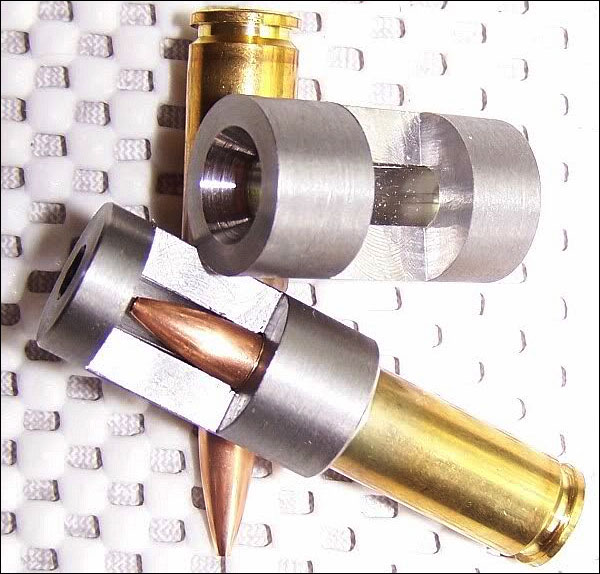
Forum member Lawrence H. has stub gauges made with his chamber reamers for each new barrel. He has his smith cut a port in the stub steel so Lawrence can actually see how the bullet engages the rifling in a newly-cut chamber. With this “view port”, one can also see how the case-neck fits in the chamber. Lawrence tells us: “My stub gauges are made from my barrels and cut with my chamber reamers. With them I can measure where my bullets are ‘touching the lands’ and shoulder bump dimensions. This is a very simple tool that provides accurate information.” To learn more about stub gauges, read this Forum Thread. The photos above and below show Lawrence’s stub gauges:
January 12th, 2014
 Redding is now offering Micro-Adjusting Taper Crimp Dies for the .223 Remington (5.56×45) and .308 Winchester (7.62×51), the two most popular cartridges used in competitive rifle shooting. New for 2014, these top-adjusting, micrometer-style dies, you can adjust crimp precisely without having to back-out the die and reposition the lock ring. Redding is now offering Micro-Adjusting Taper Crimp Dies for the .223 Remington (5.56×45) and .308 Winchester (7.62×51), the two most popular cartridges used in competitive rifle shooting. New for 2014, these top-adjusting, micrometer-style dies, you can adjust crimp precisely without having to back-out the die and reposition the lock ring.
The process of traditional taper crimp die adjustment is generally both time consuming and imprecise due to the 1:14″ thread pitch coupled with the need to reposition the lock ring after each adjustment. The new Redding Micro-Adjusting Taper Crimp Dies for .223 Rem and .308 Win use a knurled, micrometer-type head situated to provide approximately +/- 0.100″ of adjustment after initial die set-up. The actual crimp is applied with a hardened steel “free floating” internal sleeve.
To Taper Crimp or Not to Crimp?
That Depends…
Do you actually need a taper crimp on .223 Rem or .308 Win cartridges? If you are shooting a precision bolt gun, the answer is “probably not”. However, if you are hand-loading ammo for a semi-automatic rifle, there are reasons you may want to apply a taper crimp on the cartridge. And high-volume .223 Rem shooters may want to apply a taper crimp, particularly when loading mixed headstamp brass using a progressive press. The new Redding dies allow you to control the amount of crimp easily and more efficiently. Redding claims that: “Down time and loss of production due to adjustment of the crimp are virtually eliminated, dramatically increasing the rounds per hour rates of all progressive and turret-style presses.”
High-volume hand-loaders often struggle with the realities of case variation and the resulting difficulties in obtaining a uniform crimp. Redding notes: “Case length is not the only variable, as case neck-wall thickness also impacts where the case intersects the die’s tapered crimping surface.”
|


