|
|
July 4th, 2008
On this nation’s Independence Day, we should remember the “shot heard ’round the world”. It is quite possible that there would be no United States of America (in the form we now know it), but for the courage of a small band of ordinary citizens, armed with hunting rifles. The militias of Concord and Lexington, Massachusetts were the first colonists to provide organized, armed opposition to British rule in the Americas. It is their fighting spirit that we celebrate today.

The Battles of Lexington and Concord
Having learned about arms stockpiled in Concord, on April 19, 1775, British General Gage ordered an estimated 700-800 regulars to march to Concord to seize arms, gunpowder, and cannons. (Gage also wanted to arrest John Hancock and Sam Adams, reported to be in Lexington.) Learning of the planned British action, Paul Revere rode to Lexington to alert the militia. Hancock and Adams went into hiding and the Lexington militia (120 or so men) formed up under Captain John Parker. When the British reached Lexington, they arrayed in battle formation on the Lexington Green. Parker told his men: “Stand your ground! Don’t fire unless fired upon! But if they want to have a war, let it begin here!” The British then advanced. A shot was heard, and the British regulars charged and attacked Parker’s force. When the smoke had cleared, the British suffered only one man wounded. However, eight Minutemen died, including Captain Parker’s cousin, Jonus, killed by bayonet.
The British then continued to the Concord arsenal. After securing the roads leading into Concord, the British troops proceeded to destroy powder and weapons. In the process the Concord courthouse was accidentally set on fire. The Minutemen, formed up on the hills outside Concord, saw smoke and thought the British were burning the town. The Concord Minutemen then attacked the British at Concord’s North Bridge. By most reports the Militia fire was much more accurate than the British volleys. Two Redcoat officers were killed, along with many enlisted men. Surprised by this, the British broke ranks and retreated. The Minutemen chased after them and captured the North Bridge. The British then abandoned Concord and marched back to Boston. The Minutemen hounded the Redcoats in retreat, peppering the Brits with sniper fire all the way back into Boston. John Parker lead his Lexington Militia in one ambush of the retreating British, known as “Parker’s Revenge”. Concord/Lexington Battle Map.

Who Were the Minutemen?
As early as 1645 in the Massachusetts Bay Colony, some men were selected from the general ranks of town-based “training bands” for rapid deployment. Men so selected were designated as Minutemen. The Minutemen were often 25 years old or younger, and they were chosen for their enthusiasm, political reliability, and strength. They were the first armed militia to arrive or await a battle. Officers, as in the rest of the militia, were elected by popular vote.
Most Colonial militia units were provided neither arms nor uniforms and had to equip themselves. Many simply wore their own farmers’ or workmans’ clothes, while others had buckskin hunting outfits. Some added Indian-style touches to intimidate the enemy, even including war-paint. Most used hunting rifles, which did not have bayonets but were accurate at long range. The rifled musket used by most Minutemen was also well suited to this role. The rifling gave it a much greater range than the smoothbore musket, although it took longer to load. When performing as skirmishers, the Minutemen could fire and fall back behind cover before the British could get into range. There is a popular notion that most Minutemen were “crack shots”. In reality, some (with hunting experience) were fine marksmen, while others were poorly trained. (Source: Wikipedia.org.)
July 3rd, 2008
Here’s a hot deal that will probably sell out quickly. Midsouth Shooters Supply is selling Federal 5.56×45 M193 ball ammo with Lake City headstamp for just $7.85 per 20-rd box. That’s $39.25 per hundred rounds — just about the best deal you can find right now for quality, reloadable domestic 5.56×45 ammo with brass casings.

According to U.S. military specs, M193 Ball ammo delivers a 55gr FMJ boat-tail bullet at 3,250 fps from a 20″ test barrel measured 15 feet from the muzzle. This mil-spec ammo should work well in ARs and most .223 Remington bolt guns. However, you should read our .223 Rem Cartridge Guide to understand the distinctions between .223 Rem SAAMI specs and 5.56×45 Military specs:
.223 Remington vs. 5.56×45
There ARE differences between the .223 Remington as shot in civilian rifles and the 5.56×45 in military use. While the external cartridge dimensions are essentially the same, the .223 Remington is built to SAAMI specs, rated to 50,000 CUP max pressure, and normally has a shorter throat. The 5.56×45 is built to NATO specs, rated to 60,000 CUP max pressure, and has a longer throat, optimized to shoot long bullets. Should you be worried about shooting 5.56×45 milspec ammo in a .223 Remington? The answer really depends on your chamber. 5.56×45 ammo is intended for chambers with longer throats. If you shoot hot 5.56×45 ammo in short-throated SAAMI-spec chambers you can encounter pressure issues. The new long-throated ‘Wylde’ chamber allows safe use of military ammo.
Is It Time to Purchase Large Quantities of Ammo?
Many shooters are stocking up on loaded ammo out of concern with the anticipated results of the next Presidential election. Are they being smart, or paranoid? Given the threat of restrictive new legislation, perhaps it’s not a bad idea to lay in a supply of 5.56×45 before prices go up again. On the other hand, this XM193 is 1.25 MOA ammo at best — so it won’t be useful for match purposes and it’s not particularly well-suited for varminting. We question the logic of stashing away thousands of rounds of ammo that’s not going to be used anytime soon. Still, ammo has proven to be a better investment in recent years than the stock market. As noted above, Midsouth’s price (a July Special) is about as good as it gets, and we expect this Federal XM193 to sell out quickly.
July 2nd, 2008
Last summer we featured the Optical Booster from Gene Davis that magnifies the image viewed with Benchrest scopes. Since then, we’ve received dozens of questions about the product. Gene’s Boosters have proven very popular, and over the past year he’s brought out new models, including a slip-on version that fits most 1″ or 30mm scopes. You can now see all the offerings on Gene’s website, BulzEyePro.com.

Boosters Now Offered for Leupold, March, Nightforce, Sightron, and Weaver
Gene now sells Screw-in Boosters for Leupold Comp Series scopes (made after 2003), March scopes, NightForce BR scopes, Sightron BR scopes, and Weaver T-Series scopes. These screw-in, threaded 3X boosters cost $100.00 including shipping and insurance.

The original Gene Davis Optical Booster #1 is a Zeiss-made lens with threaded ring that simply screws on to your scope behind the eyepiece, using the threads provided for lens caps (consider it an eyepiece extension). This is now offered in a 3X version that boosts the viewed image roughly 30%, with with optimum boost on targets 20 to 200 yards away. Hence, on a 36X scope, Davis’ 3X Optical Booster creates the equivalent of a 46X power scope. Many long-range BR shooters using this product have reported that it does aid precise aiming. However, there is a price for the extra magnification — the reticle will appear slightly larger, and the image will appear somewhat darker. But, according to Gene: “the image darkening is almost imperceptible during prime daylight hours.”
 We think Gene’s invention is a winner–a great way to get more magnification at a low cost — $100.00. We also like the fact that, unlike an internal boosting job, you can simply remove the booster if you want to return to the original magnification level. Installing the Optical Booster #1 requires no modification to your scope. However, Gene explains: “You may need to screw in the scope’s eyepiece (ocular lens) a bit to maintain the sharpness of the cross-hairs”.
New Slip-On Models Offer Interchangeable Lenses
For greater versatility, Davis now offers a Slip-On Optical Booster #2 with a rubber housing that fits any scope with an eyepiece diameter of 1.45″-1.75″. This allows you to easily move the Booster from one scope to another. In addition, a variety of lenses can be inserted in the flexible rubber housing. You can switch from a 3X Lens to Gene’s latest lens, the 4X-Multicoat Extreme Long-Range 50-to-Infinity.

Gene is developing other specialized lenses for hunting and long-range Benchrest that you can swap into the Slip-On Booster housing. As Gene explains: “We offer a range of lenses that will change in and out of the same housing that will fit on all of your 1 inch and 30 mm scopes in just a few seconds. Do a 50-yard bench rest shoot with our 3X Ultra Brite Lens in the morning and a 1000-yard bench rest with our 4X Multi-Coat Extreme Long Range Lens in the afternoon. Then, on the way home pop in one of our 2.5X hunting model lenses and put a little fresh meat on the table.”

The Slip-On Booster Model #2 currently costs $95.00 with 3X lens or $125.00 with 4X Long-Range Multi-Coat lens.
Gene reports: “The Optical Boosters do a fantastic job for old or poor eyes. We now have screw-in models to fit Leupold, March, Nightforce, Sightron, and Weaver Scopes. The Boosters require no internal modification and will not alter the factory warranty. To purchase, contact Gene Davis at (740) 503-4486 or visit www.BulzEyePro.com.
July 2nd, 2008
Torx Head screws are superior to other fastener designs for attaching scope rings and bases. The patented Torx design can be tightened very firmly with much less chance of stripping. Torx-head screws are available in a variety of sizes and thread pitches to fit your particular rings and the scope base holes tapped in your receiver.

Now through July 31, 2008, MidwayUSA is offering a complete kit of genuine Leupold Torx-head screws with 80 base screws and 70 ring screws for just $30.00. That’s 25% off the regular $39.99 price. Every gunsmith should have this kit, and regular shooters might want to purchase the kit as well. When you’re mounting a new scope base or ring set, it’s great to have exactly the right Torx screw you need. The Leupold Torx screw kit, MidwayUSA item 235284, contains a 50/50 mix of black and silver color screws so you can match them to both black- and silver-finish scopes.
July 1st, 2008
Kurt Stone of LV Steel Targets has developed a new series of Steel Silhouette targets that offer multiple options for the shooter. The new design features a central, circular “target within a target.” Shown in the photo below, the green center circle (either 7.5″ or 6″ in diameter) will swing back when hit, then reset itself. Kurt also offers silhouettes with a black paddle plate at the top right or left. This can be used to simulate “hostage” scenarios.

We like the model 19C, a 25″ x 15″ silhouette plate with 6″-diameter center circle target. The silhouette plate is large enough to allow you to get zeroed at 500-700 yards, and then you can shoot at the center circle for a more challenging test of accuracy. At 600 yards the center circle (painted green in the photos) is 1 MOA. That’s a nice size that rewards a good shooter (and accurate rifle) at long range. The model 19C ranges in price from $205.00 to $270.00 depending on steel thickness (3/8″ to 5/8″). This same design is offered in model 18C with a 7.5″ center on a 30″ x 18″ steel silhouette.

LV Steel Targets offers a wide variety of other hardened steel targets including spring-loaded silhouettes and “poppers”, plus gongs and swingers of all sizes.
July 1st, 2008
 This week, Shooting USA features the U.S. Shooting Team. These world-class competitors will represent the United States this summer in the 2008 Beijing Olympics. Shooting USA will broadcast a full hour covering Team USA shooters, including Gold Medalists Matt Emmons (Smallbore Rifle), and Kim Rhodes (Shotgun). The show will feature ALL the Olympic shooting disciplines, including air pistol, air rifle, smallbore rifle, and trap/skeet.

We highly recommend this episode of Shooting USA. Here are the showtimes on the Outdoor Channel:
Eastern Time 4:30 PM, 8:30 PM + 2:00 AM (Thursday)
Central Time 3:30 PM, 7:30 PM + 1:00 AM (Thursday)
Mountain Time 2:30 PM, 6:30 PM, Midnight
Pacific Time 1:30 PM, 5:30 PM, 11:00 PM
CLICK HERE or visit USAShooting.com for more information about the USA Shooting Team. You can make a tax deductible donation by sending a check or money order to:
USA Shooting/Donations
1 Olympic Plaza
Colorado Springs, CO 80909
June 30th, 2008
AccurateShooter.com has been testing one of the new Sightron SIII 8-32×56 target scopes. In Part One of our Sightron Test, Jason Baney reviewed the optical qualities and characteristics of the scope — what you see through the lens.


Sightron Test PART TWO — Mechanical Tracking
Now, in Part Two of our test, Jason took the scope to the range to test how well it tracks, and how repeatable the clicks are. Jason did a variety of tests, including a “box test” at 100 yards, and multi-cycle elevation tracking tests at both 100 yards and 300 yards.
In the box text, Jason zeroed his gun, a 6.5×47 Lapua, then put two shots in the lower left corner of a large sheet of paper. He then clicked up 72 clicks (18 MOA) and fired two more shots. Then he added 60 clicks (15 MOA) right, and fired two shots. Next he went back down 72 clicks (18 MOA) and fired two shots in the right corner. Finally he went back 60 clicks left (15 MOA), and fired two shots in the lower left.


Box test results were impressive. The last set of shots were virtually in the same place horizontally as the first two, just slightly over one bullet diameter below the “start” group. Jason noted: “The ‘last corner of the box’ vertical could easily be mirage, barrel heating, or my hold.” Jason noted that both the left and right vertical legs of the box, measured from group center to center, were exactly 19.8″. The top horizontal side of the box measured 16.375″ while the bottom horizontal was 16.25″. Jason notes: “The horizontal legs were within 0.125″. That difference could have easily been wind.”
Jason made 264 total clicks during the box test. His final two shots were just slightly below the first two — close enough that mirage could explain the difference. Jason concluded: “I think the Sightron showed excellent tracking. I noted that the vertical ‘side leg’ measurements were exactly the same. I didn’t end up in exactly the same spot, but it was really close. The slight shift in elevation could be caused by mirage or barrel heating.”
UP/DOWN Tracking Cycle Tests
To further test the vertical tracking repeatability, Jason shot a five-round group at 100 yards. Before EVERY shot he cranked in 120 clicks (30 MOA) of vertical, then cranked back down 120 clicks (30 MOA). As you can see from the target, the Sightron tracked beautifully. Though there is some horizontal (from wind), the total vertical spread for all five shots is about 0.1″, and that’s as tight (or tighter) than Jason’s rifle can normally shoot, as we explain below. Jason notes: “The group at 100 yards shows about 0.1″ vertical…can’t ask any better than that. So, the scope’s adjustments were obviously not adding any vertical component to the group.”

Test Gun: 6.5×47 Lapua, 123 Scenar, Reloder 15
Test Conditions: 100 yards, 90° F, 50% RH, 0-3 mph wind
Test done with 1/3 MOA Rifle
Jason conducted the test with a 6.5×47 rifle. This is a very accurate gun, and Jason is a great trigger-puller, but this is no rail gun. Repeatable group size for this rifle is typically mid-threes. The Sightron exhibited tracking repeatability inside the normal group vertical spread of this rifle (when no elevation clicks are made). We can conclude then, that the actual vertical tracking shift (after five 30 MOA up/30 MOA down cycles) is negligible.
 300-Yard UP/DOWN Tracking Test
To supplement our findings at 100 yards, Jason repeated the 30 MOA up/30 MOA down cycle test with five (5) shots at 300 yards. He ended up with 5 shots with a total vertical of 1.5″ or 1/2 MOA. Again, given the limitations of the rifle and its typical vertical spread at 300 yards, this was very good. Note that three of the five shots went into about 1/2″ of vertical. Jason believes the shot low left was “driver error” or mirage. If that shot is excluded, the total vertical was 0.734″ or 0.234 MOA — which is about as tight as this gun can shoot at 300 yards. Jason concluded: “If you exclude the low left shot, which was probably me or mirage, we have a quarter-MOA vertical group. I’m not sure the gun can do better. In fact, 1/3 MOA is more typical. If scope tracking error was inducing vertical I would have expected the vertical spread to have been much larger. Here’s a situation where we can’t really overcome the gun (and shooter’s) inherent precision limits. I’ll give the Sightron a thumbs up here. If it was even two clicks off after all that cycling, the group would have shifted 1/2 MOA (about 1.5″) up or down, and that didn’t happen.”

Working the Turrets–Mechanical Feel
Jason said the turrets offer a good feel: “The effort needed to rotate the turrets is minimal, but the clicks are very smooth and positive. Overall, the feel is very good for both horizontal and vertical controls. The feel of the side-focus parallax is also good, and the side-focus did not display any lash or focus problems that we’ve observed on some other brands of optics.”
June 30th, 2008
David Tubb’s latest DVD, “The Art & Technique of the Modern Match Rifle”, is a great resource for any position shooter. This 2-disc DVD provides over 4.5 hours of instruction and shooting demonstrations.
David has included highlights from that DVD in a shorter promo video. While the shorter video is a sales tool, it’s very informative in its own right. Watch the video and you’ll learn a great deal just by watching how David shoulders his rifle, and how he adjusts and maintains his shooting position. David shows examples of prone, sitting, and standing positions. In the short “trailer” David also provides helpful tips on adjusting sights, and placing the spotting scope.

CLICK HERE to View David Tubb VIDEO.
 If you shoot Service Rifle, High Power, or prone, you can benefit from watching this short sampler video. The full 2-disc DVD is available for $49.95 from Creedmoor Sports or Superior Shooting Systems. With over 4.5 hours of content, the DVD covers all the across-the-course positions, the set-up and use of aperture sights and diopters, High Power and long range targets, the approach method in offhand, proper placement and use of spotting scopes. The DVD includes bonus footage of David shooting strings in all of the across-the-course positions.
June 29th, 2008
The 2008 IBS 600-yard Nationals concluded Saturday at Oak Ridge, TN. Many of the nation’s top shooters were there, including multiple world record-holders. Sam Hall was the big winner at the match. He took the Two-Gun Grand Agg, while winning Heavy Gun (HG) group Agg., HG score Agg., and Light Gun (LG) Score Agg. As Greg Seigmund said, Sam “tore the place down.” Glen Sterling shot well to finish second in the Two-Gun Grand. Richard Schatz compiled an impressive 2.242″ average to win Light Gun Group Aggregate. Richard’s Dasher really performed — three of his eight LG targets were mid-inch: 1.395″, 1.473″, and 1.736″. Joel Kendrick shot the small LG group of the match, an 0.984″, but Sam Hall wasn’t far behind, with a 1.089″ on his third target.
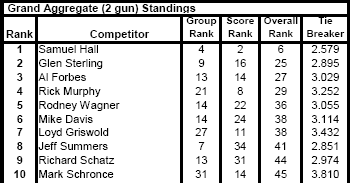
CLICK HERE for Complete Match Results (438kb .pdf file). Equipment lists are found on pp. 9-11.
Hammerin’ Hall Talks About the Nationals
After the match, Sam gave us the details of his impressive win: “First off, I would like to thank Larry Sparks, Dave Tooley, Greg Seigmund, Larry Isenhour, Steve Shelp and everyone else that helped out to put on the match. They all did a great job. It was run very well and smoothly. Everyone I talked to said they had a really great time. I really enjoyed meeting all the guys from other states I had heard about and read about. Everyone I talked to was humble and top-notch.”
Q: How did it feel to win the Championship?
Sam: It is just starting to sink in that I won after I have got home. But, I still can’t believe I won. As they say, I was floating around on cloud nine after the win. It really meant the most to me when I got home and got to show and tell my two young boys and my wife what I had done.

Q: What were the conditions like?
Sam: We started with Light Gun each day. Every morning was pretty calm, but by mid-morning the mirage and breezes started. They were very switchy at times. We also had some pretty severe thunderstorms on the first two afternoons that “ate some peoples’ lunch”.
Q: Tell us about your equipment.
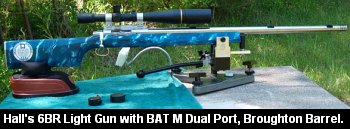
Sam: Both my Light Gun (LG) and Heavy Gun (HG) are straight 6BRs, with .268 necks. In LG I shot my Blue/White Shehane-stocked ST-1000 with 103 Spencer VLDs. The blue gun, smithed by BAT’s Tom Dixon, features a BAT M dual port, Broughton Barrel (1800 rounds), and Leupold 45X Competition scope. (Note: the equipment list is incorrect, I did not shot my Leonard-stocked gun in LG). In HG I shot another Shehane ST-1000 (orange/ white) but with Berger 105 VLDs. The orange rifle (smithed by Leonard Baity) weighs 28 lbs. (lots of lead in the stock). It has a Lilja 31″ straight-fluted barrel (800 rounds), BAT MB dual port, March 50x scope.
Q: What loads were you running?
Sam: I have been shooting the same loads in these two rifles for two years: Alliant Reloder 15, CCI BR-4 primers, Lapua brass, with 103 Spencers in my LG and 105 Berger VLDs in my HG. Both are barely in the rifling so my bolt is easy to close and I won’t pull a bullet out if I have to eject a live round (which I did have to do). My LG brass is the original 100 with about 18 reloadings. My bolt lift was getting a little sticky at the top in the middle of the day, so I put ice packs around my ammo in the heat of the day to keep pressure down. I certainly don’t recommend this to anyone! I just know this load and its limits.
Q: What was the key to victory for you?
Sam: I had the mindset when I went into the match that I was going to actually take more time shooting, remember my fundamentals, follow through each shot, and be as careful I could shooting. I figured if I did not get in a hurry, and thought through each shot, I was more likely not to have a big group that would kill me. Richard Schatz said the same thing at the end of the match. Richard tells people you don’t have to shoot little bitty groups at the Nationals to win, you just can’t shoot any really big ones.
Q: What are your plans for the rest of the season?
Sam: As far as anything new, I am actually thinking of an improved BR next year for the wind. Hoping I can get the velocity at a lower pressure. I might put these two barrels in semi-retirement and try to get another couple of barrels going. If I can’t get anything shooting better than my old barrels, I will put them back on when the stakes get high again. These two rifles and loads are like old gloves, I am used to them and trust them. They can sit unused for weeks, but when I pull them out, they perform as well as before.
The DQ Problem
Many top shooters experienced DQs during the match. In some cases the DQs were wind-related. However, a number of shooters DQ’d by shooting a record round on the sighter target which remained in place during record fire. After the match many shooters asked “Why don’t they just take down the sighter targets when record fire commences?” That would eliminate this potential problem. Alternatively, a large orange sticker could be placed over the sighter center, warning shooters not to fire at that target. In short-range benchrest, in the case of certain errant shots, there is a rule providing a 1-MOA penalty rather than a DQ. That’s worth considering for the 600-yard game.
June 29th, 2008
 In Sierra Bullets’ X-Ring Quarterly Newsletter, you’ll find lots of useful info on ballistics and reloading. Among our favorite regular X-Ring features are the “Short Shots” offered by Sierra Technician Carrol Pilant. Here are some of Carrol’s tips.
General Reloading Advice
● When using a collet style case trimmer, try to tighten the collet down equally each time to keep lengths uniform. If you tighten it down hard, the case will be longer than one you tighten down lightly.
● A little lube on the pilot and cutter on a case trimmer every few cases will help keep it from trying to gall in the case mouth and helps keep the blades sharp and cutting smoothly. It makes trimming an easier task.
● When charging cases from a powder measure, use smooth uniform movement being sure to give powder time to fall into the powder drum chamber. Also be sure to give it time to fall into the case.
● When using mixed cases or cases that have been fired a different number of times, don’t be surprised to get erratic velocities and performance.
● Just because two bullets weigh the same doesn’t mean they can be loaded the same. The amount of bearing surface can vary drastically.

Photo by M. Dunlap
Handgun Reloading Tips
● In revolver cases, rather than try to seat and crimp in one stage, seat in one stage and crimp separately. You won’t have the bulge at the base of the crimp you often get when trying to do it in one stage.
● When roll crimping, if your cases are erratic lengths, your crimps will be erratic also. Cases should be trimmed to the same length.
|


