|
|
June 13th, 2008
Put the same load in a variety of barrels (with the same length and chamberings) and you’ll see a wide variance in muzzle velocity. In fact, it’s not unusual to see up to 100 fps difference from one barrel to the next. We demonstrated this with a comparison test of Lapua factory ammo.
Chron Testing Lapua Factory Ammo
We recently chronographed Lapua 105gr 6mmBR factory ammo in three different 8-twist barrels of similar length. The results were fascinating. Lapua specs this ammo at 2790 fps, based on Lapua’s testing with its own 26″ test barrel. We observed a speed variance of 67 fps based on tests with three aftermarket barrels.

Brand ‘S’ and Brand ‘PN’ were pre-fit barrels shot on Savage actions. Brand ‘K’ was fitted to a custom action. All test barrels were throated for the 100-108 grain bullets, though there may have been some slight variances in barrel freebore. With a COAL of 2.330″, the rounds were “jumping” to the rifling in all barrels. Among the four barrels, Brand ‘PN’ was the fastest at 2824 fps average — 67 fps faster than the slowest barrel. Roughly 10 fps can be attributed to the slightly longer length (27″ vs. 26″), but otherwise this particular barrel was simply faster than the rest.
Results Are Barrel-Specific, Not Brand-Specific
These tests demonstrate that the exact same load can perform very differently in different barrels. We aren’t publishing the barrel-makers’ names, because it would be wrong to assume that ‘Brand X’ is always going to be faster than ‘Brand Y’ based on test results from a single barrel. In fact, velocities can vary up to 100 fps with two identical-spec barrels from the SAME manufacturer. That’s right, you can have two 8-twist, 26″ barrels, with the same land-groove configuration and contour, from the same manufacturer, and one can be much faster than another.
Don’t Demand More Than Your Barrel Can Deliver
We often hear guys lament, “I don’t get it… how can you guys get 2900 fps with your 6BRs and I can only get 2840?” The answer may simply be that the barrel is slower than average. If you have a slow barrel, you can try using more powder, but there is a good chance it may never run as fast as an inherently fast barrel. You shouldn’t knock yourself out (and over-stress your brass) trying to duplicate the velocities someone else may be getting. You need to work within the limits of your barrel.
 Factory Ammo Provides a Benchmark
If you have a .223 Rem, 6BR, .243 Win, 6.5×47 Lapua, 6.5×55, .308 Win, 30-06, or 300 WM Rifle, we recommend you buy a box of Lapua factory-loaded ammo. This stuff will shoot great (typically around half-MOA), and it can give you a baseline to determine how your barrel stacks up speedwise. When you complete a new 6BR rifle, it’s wise to get a box of the factory ammo and chronograph it. That will immediately give you a good idea whether you have a slow, average, or fast barrel. Then you can set your velocity goals accordingly. For example, if the factory 6BR ammo runs about 2780-2790 fps in your gun, it has an average barrel. If it runs 2820+ in a 26″ barrel (or 2835 fps in a 28″), you’ve got a fast tube.

June 13th, 2008
Erik Stecker of Berger Bullets confirmed that his company will be producing a new, high-BC 20-Caliber bullet this fall. The new bullet features a conventional, non-VLD tangent-ogive design for greater seating flexibility and, hopefully, increased precision. The new bullet should be the highest-BC bullet available to 20-Cal shooters from a major bullet-maker. Although production dies aren’t ready yet, Berger has set a 0.400 Ballistic Coefficient design goal for the bullet. That would be a significant step up from Berger’s current 50gr, 20-caliber bullet, which has a published BC of 0.295.
We expect the new 55-grainer to require an 1:8″ or faster twist barrel, but the exact twist required will depend on the final bullet dimensions when it is put into production. Expected ship date for the new 55gr bullet is “late August to early September”, according to Stecker. With the correct-twist barrel, the new bullet should work well in most popular 20-caliber chamberings, including 20 VarTarg, 20-223, 20 PPC, 20 BR, and .204 Ruger.

June 12th, 2008
High-magnification scopes allow shooters to aim more precisely and to see their targets better at long ranges. Recent years have seen an “optics arms race” in benchrest shooting. It used to be thought that 36-power was plenty for 100- and 200-yard BR matches. Now, top shooters are running 40- or 45-power optics, and some competitors are even using 50X and 60X scopes.

Perils of Too Much Magnification
Extra magnification comes with a price, however. With equal-sized front objective lenses, the view through a 50-power scope will appear darker than the view through a 35-power optic, and the 50X will have a much smaller exit pupil. The exit pupils on some scopes are under 1mm. An exit pupil that tiny makes your head position ultra-critical — move your head very slightly and you’ll lose the circle of light entirely. Small exit pupils are more fatiguing, causing more eye strain. Higher magnification can, in some conditions, also make it more difficult to cope with mirage. Many shooters prefer a zoom scope so they can dial down the magnification when the mirage is extreme.
Advantages of Variable-Power Scopes
So how much magnification do you really need? That comes down to your personal preferences and your budget. Since a good zoom scope, such as the Nightforce BR 12-42×56 or the new Sightron SIII 8-32×56, lets you “back off” your power, there’s really no reason NOT to go with a high-power scope on a target rifle, provided you can make weight.

A Formula for Scope Resolving Ability
From an optics standpoint, how much power do you need to resolve a bullet hole at a given distance? There is a handy online Scope Resolution Calculator that lets you do this. Just type in the bullet diameter and distance, and the calculator will tell you how much magnification you need, at a MINIMUM, to resolve that particular size bullet hole. This calculator assumes perfect viewing conditions and the highest grade lenses. In reality, as viewing conditions get bad, all bets are off. A bullet hole that could be resolved at 30-power in perfect viewing conditions, might not be resolved even at 80-power when conditions are bad. Nonetheless, it’s fun to play with the calculator, created by Twin City Rod & Gun:
CLICK HERE for Bullet Hole Resolution Calculator

June 12th, 2008
 Readers often ask for a good, authoritative resource on doping the wind and reading mirage. Many Forum members recommended M.Sgt. Jim Owens’ Wind-Reading guide. This is now offered on CD, with 22 sets of wind charts. Owens’ Reading the Wind and Coaching Techniques clearly explains how to gauge wind speeds and angles. Owens, a well-known High Power coach (and creator of Jarheadtop.com), offers a simple system for coming up with wind value based on speed and angle. The CD also explains how to read mirage — a vital skill for long-range shooters. In many situations, reading the mirage may be just as important as watching the wind flags. Owens’ $9.95 CD provides wind-reading strategies that can be applied by coaches as well as individual shooters.
 Shooters’ Log Books
M. Sgt. Owens also offers excellent log books for High Power shooters. The Owens Data Book features an updated design with “amended” grid lines and twin plotting bulls for rapid fire. Much more than just a shot log, Owens’ books offers eight sets of wind charts, a wind speed estimating guide, a “gun round count page”, a scoring system chart, an equipment check list, and a guide for normal come-ups from 100 to 1,000 yards in 100 yard increments. There is also a special Long-Range Data Book with 54 two-sided pages for the 600-yard stage, 54 two-sided pages for the 800/900/1,000 yard target, 14 sets of wind charts, and larger plotting areas. Price for either the standard Owens Data Book, or the Long-Range Data book, is $14.95 plus $1.50 S&H.

June 11th, 2008
While shooting at the Pala Varmint Silhouette Match recently, we had a chance to test drive John Adams’ Pentax PF-80ED Spotting Scope. It’s a great scope, fitted with outstanding lenses. We tried both the 20-60 power zoom and the superb Pentax XW-10 wide angle/extended eye relief lens, which provides a fixed 52X image. The XW-10 is the most user-friendly spotting scope eyepiece I’ve ever tried–ultra-bright, with nearly an inch of eye relief.

One thing that made the Pentax such a pleasure to use was the mounting set-up. John has his PF-80ED set on a sturdy Manfrotto tripod with a special geared tripod head, the Manfrotto model 410. The geared head allows you to make very fine, precise movements in vertical or horizontal planes. You don’t have to unscrew a clamp, fiddle around to re-position the scope, and then struggle to lock it in place again without altering the position. This unique, compact head offers precise gear movement in three directions: pan (horizontal movement left to right), elevation, and angular rotation around TDC (horizon tilt).
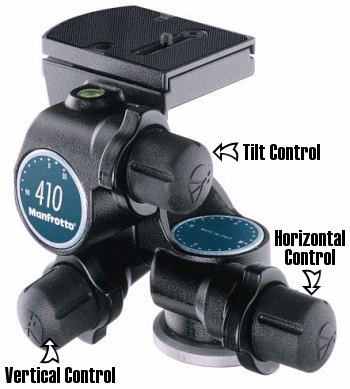
The Manfrotto 410 geared head was superb. While spotting at 600 yards, I could easily move up or down a few inches on the target with just a quick twist of a knob. If I wanted to move down the line to a sighter plate, it was just as easy to pan a few feet horizontally, without disturbing my vertical setting at all. I don’t know how Manfrotto does it (the gearing system is patented), but very little effort is required to turn the knobs in any direction, and there is plenty of travel.

If you want to make large adjustments, as when moving your view from a 1000-yard target bay back to the 100-yard line, you can disengage the gear drives and manually move the entire head. The Manfrotto 410 incorporates a unique feature that allows you to instantly disengage the gears and rough position the camera by hand, then instantly reengage them for precise final alignment. The model 410 head supports up to 5 kg (11 pounds), and is also suitable for 35mm SLR and medium format cameras. The head incorporates a quick release camera plate system.
So what does this superior technology cost? The Manfrotto model 410 costs about $210.00 at large camera outlets, but you can sometimes find one for about $180.00 on sale. Is it worth it? If you’re on a very tight budget–spend your money on a barrel first. But, if you have an $800+ scope that’s used quite often, the geared head is worth the investment. Others seem to agree — three other Pala shooters added geared heads to their tripods after trying John Adams’ rig. The gearing makes it much, much easier to move the scope in very small increments while spotting at extreme ranges. But what about resale? These geared heads are also extremely popular with commercial photographers, so they hold their value well.
The Manfrotto 410 was previously sold as a “Bogen-Manfrotto 3275/410″ and you may still find older versions listed that way. Manfrotto also makes two other geared heads, the model 400 ($680.00, 22 lb. rating) and 405 ($385.00, 16 lb. rating), but these are much more expensive, and designed for very heavy cameras.
Pipe and Post Level
To get the best results from any tripod when using a spotting scope (or chronograph), you need to make sure the base for your scope is set level to the horizon. Deluxe heads, such as the Manfrotto geared heads, have built-in bubble levels, which make it easy to level the scope. If you don’t have a level on your tripod, but it has a telescoping center shaft, you can use a simple, inexpensive Pipe and Post Level. These attach with an elastic band around the vertical shaft and provide bubble levels in both horizontal and vertical planes. You can purchase these levels for under $5.00 at hardware stores and home supply outlets.

Good, Inexpensive Tripod
If you want for a good, solid tripod that will hold a heavy 80+ mm spotting scope at a bargain price, look for a used Davidson Star-D on eBay, or one of the optics forums.
 The Davidson Star-D tripod is a solid, all-metal rig that is sturdy enough to be used for movie cameras. Star-Ds feature convenient rotary cam (collet) leg height adjustments and all-metal tilt and pan controls that lock solidly. The center post is clamped with a big locking ring that adjusts for tension. The rugged, machined-aluminum Star-D tripods are no longer in production but you can find good “previously-owned” models for sale on eBay. This tripod is ideal for use with a chronograph or spotting scope (for viewing in sitting or standing positions). You’ll see a variety of Star-Ds on eBay. What you want are the newer Star-Ds with all-silver heads and cam-locked legs. You can often pick them up for under $25.00. Look for the latest versions, as shown in the picture.
June 11th, 2008
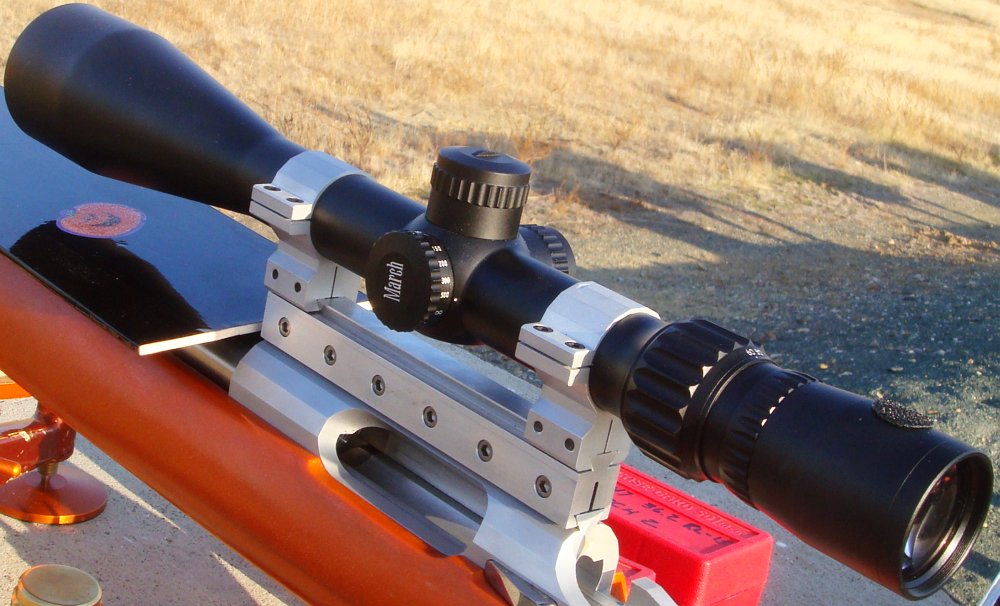
Right now the March line of scopes represent the “state of the art” in high-magnification Benchrest scopes. They are unexcelled for brightness, sharpness, and perhaps most importantly, shot-to-shot reliability. Many top short-range benchrest shooters, who can’t tolerate even a tiny shift in the scope’s reticle moving the point of impact a few hundreths of an inch, are using the March 40X, 50X, and 60X, and now the new 10-60X Zoom.
CLICK HERE for complete MARCH SPECIFICATIONS


March scopes are made in Japan by DEON. In the USA they are sold exclusively by Kelbly’s. Jim Kelbly reports: “Some 40s and 50s are in stock now. The 10-60X zooms will be in stock in about two months unless the back order list gets longer as it is everyday. If you want a March scope you should not wait till they are in stock. We have a waiting list and you should get on it if you would like one in next two months.”
Current March Scope pricing:
40×52, 50×52, and 60×52 fixed focal length: $2100.00
10-60×52 Zoom: $2400.00


June 10th, 2008
Bruno Shooters Supply is currently offering great pricing on Shilen rifle barrels. All 1.250″ or smaller diameter barrels are just $236.40. This applies to barrels 28″ in length or shorter. Bruno’s 22 Rimfire, .224, 6mm, 6.5mm, 7mm, and 30 caliber barrels are offered in a variety of twist rates from 1:8″ to 1:17″ (twist rates are dependent on caliber).
CLICK HERE for Bruno’s Shilen barrel inventory.

June 10th, 2008
We now know for certain the two candidates for President of the United States — Obama and John McCain. The views of these two men on gun issues could not be more different. McCain has supported Second Amendment rights and opposed more restrictive gun laws at the Federal level. Obama supports bans on all semi-automatic weapons, approves strict local restrictions on handguns, and he co-sponsored a bill in 2000 limiting handgun sales to one per month. Make no mistake about it, Barrack Obama is no friend of hunters or firearms enthusiasts.

By contrast, John McCain re-affirmed his commitment to gun rights in a recent Interview with the NRA. The complete text of the interview is available online. Here are some highlights:
Q: Senator, throughout your career you have opposed waiting periods on firearm purchases, bans on commonly owned ammunition, and efforts to register and license gun owners. What are your reasons for those positions?
McCain: I have consistently opposed these measures, because they are arbitrary restrictions on the constitutional rights of law-abiding citizens. Gun bans, waiting periods, ammunition bans, registration and licensing of gun owners — each of these has a common theme: They only affect law-abiding citizens. And they have another common theme: They don’t work as crime-fighting tools.
Q:Senator, why should gun owners support you in November?
While [the NRA and I] have disagreed at times on some issues, I have never tried to hide my positions, or to say one thing and do another. And the fact is that we have always agreed on the vast majority of issues—as evidenced by my opposition to gun bans, ammunition bans, waiting periods, registration and licensing, and other arbitrary restrictions on law-abiding gun owners during my entire career. As I mentioned earlier, of the three presidential candidates who had an opportunity to sign the historic and bipartisan amicus brief in the Heller case—strongly arguing that the Second Amendment guarantees an individual Right to Keep and Bear Arms and that Washington, D.C.’s ban on handguns and operable firearms in the home is unconstitutional—I was the only one who did.
Text and photo copyright © 2008 National Rifle Assn., All Rights Reserved.
June 10th, 2008
The gun industry is growing, at least based on the increased Federal excise taxe collections. Sales of ammunition and firearms rose 10.8 percent in the fourth quarter of 2007, led by a 23.6 percent increase in ammunition sales, a 5.9 percent rise in handgun sales and a 4 percent increase in long gun sales. These figures are based on excise taxes collected on wholesale receipts–so the rises can represent higher prices for guns and ammo, or higher quantities sold, or both. The statistics are taken from the latest Pittman-Robertson federal excise tax collection report.

Excise taxes are calculated as a percentage of wholesale receipts, paid quarterly by firearm and ammunition manufacturers, and earmarked for state wildlife conservation and habitat restoration programs. During the quarter, $74.8 million was collected, compared to $67.4 million in the same period in 2006. From October through December, $16.2 million was collected for pistols and revolvers, $31.4 million for long guns and $27.1 million for ammunition. The latest tax collections suggest overall sales of $694.4 million, not including retail markup or final retail sales. For the entire calendar year, a total of $303.2 million was collected in excise taxes, up 21.2 percent from the $250.1 million in 2006.
June 9th, 2008
Competing at the NRA Long-Range Regionals this weekend, Charles Ballard of North Carolina shot a new, pending F-Class Open record of 200-13X at 1000 yards. Charles also won the Regionals. Charles was shooting a straight .284 Winchester with 180gr Bergers and H4831sc powder. His rifle was smithed by Ray Bowman of Precision Rifle & Tool.

Charles told us: “It was about 103 degrees when I shot the 200-13x. The wind was running left to right, with 3-4 mph let-offs. But the velocity changes were pretty easy to read from the mirage. I dialed down the scope to 25-power and really locked into the mirage. Then, I got in a zone. I had a lot of confidence in what the mirage was telling me and I never took my head up and looked around at the flags. As soon as the spotter came up and it looked right, I broke the next shot — no hesitation. I probably shot the whole string in under 9 minutes. At about round 15, I started thinking that this might be a record and my heart really started pounding.”
The .284 Win for F-Class
Charles reports: “This rifle project began several years ago. I wanted a cartridge that would launch the high-BC, 180gr 7mm bullets with barrel life superior to that of a short mag. I read the article on this site about Jerry Tierney’s .284 and the cogs began to turn. After speaking with Mr. Tierney at the 2006 F-Class Nationals I decided this was the caliber I was going with, despite several shooters telling me I would not be able to obtain the desired velocities.


The action of choice was the 1.55″ round BAT MB. The MB model’s extended front end (allowing more barrel support and more bedding surface) was also a determining factor. The barrel is a 32″, 1.250″ straight contour Broughton 5C. As my gunsmith Ray Bowman says, “the Broughtons just shoot”. The chamber was cut with a reamer made for Lapua 6.5-284 necked up, throated for the 180s. The laminated stock is Precision Rifle & Tool’s F-Class. This low-profile stock has full adjustment and an extended, super-stiff fore-end. It rides the bags better than any stock I have ever shot.
Berger 180s at 2900 FPS, with Single-Digit ES
Ballard’s match load, 54.5 grains of H4831sc with Berger 180s, runs 2900 fps with an ES of 7 and SD of 2. Charles noted: “It took a lot of development work to get to that ideal load, but the velocity consistency really helps at 1000 yards.”
Charles noted that his gun likes to shoot well-fouled. “This Broughton barrel seems to shoot best at 50-150 rounds after it’s been cleaned. The vertical tightens up. Since the last cleaning, I had about 60 rounds through the barrel when I shot the record string. I credit Jerry Tierney for giving me the idea to go shoot an entire match without cleaning.”
|