Based on its external appearance, a modern riflescope may seem simple. It’s just a tube with two or three knobs on the outside right? Well, looks can be deceiving. Modern variable focal-length optics are complex systems with lots of internal parts. Modern scopes, even ‘budget’ optics, use multiple lens elements to allow variable magnification levels and parallax adjustment.
A few seasons back, we had a chance to look inside a riflescope thanks to a product display from ATK, parent of Alliant Powder, CCI, Federal, RCBS, Speer, Weaver Optics. ATK sliced open a Weaver Super Slam scope so you can see the internal lens elements plus the elevation and windage controls. We thought readers would like to see the “inner workings” of a typical modern rifle scope, so we snapped some pictures. The sectioned Super Slam scope was mounted inside a Plexiglas case, making it a bit hard to get super-sharp images, but you can still see the multiple lenses and the complex windage and elevation controls.
Want to see the details?CLICK HERE to view full-screen photo.
Check out those five targets. The Aggregate (average) of all five targets is a tiny 0.0840 inches! These were shot by Gary Ocock at 100 yards in a California benchrest match on August 6, 2017. Though Gary’s 0.0840 Agg beats existing records, this was not a “sanctioned” match, so Gary’s killer Agg will NOT be submitted for IBS or NBRSA records. So, sadly, the Agg won’t appear in the record books, but this remains a spectacular, verified feat of rifle accuracy, accomplished in competition.
Gary’s red railgun is arguably the Most Accurate Gun Ever Built. As far as we can determine, no one has ever shot a smaller 5-target Agg anywhere, at any time. FYI, the NBRSA Unlimited Class 5×5 Aggregate World Record is 0.1242″ shot by Jerry Lahr in 2012. Gary’s 0.0840″ Agg is much smaller.
The Unlimited Benchrest Record That Will Never Be (Official)
Report by Boyd Allen
Gary Ocock’s stunning unlimited Aggregate is beyond amazing. That’s an average of five, 5-shot groups of .0840. Shot under sanctioned match rules, but at an unsanctioned 100-yard fun match, this Aggregate is well under the current 100-yard official records of the IBS (.1386), and the NBRSA (.1242). The fourth of the five groups measured a minuscule .018, less than half the size of the existing NBRSA Unlimited record of .049 (also shot by Gary). Check it out:
When the top 15 shooters all post teen Aggs, conditions must be pretty favorable. However there were some light switchy winds — Gary said that he shot better in the left to right condition.
GUN SPECIFICATIONS
Ocock’s red Jay Young Unlimited Railgun features one major difference from Young’s typical Railgun designs. The bottom of the barrel block is integral with the top (moving part), of the gun. The barrel is Ocock’s usual 1:13.5″-twist Krieger chambered for the 6 PPC. The BAT Neuvo action* is unusual in that its lugs are horizontal at lock-up instead of the usual vertical. With horizontal lugs, both lugs maintain contact with their abutments when the action is cocked. In the more normal configuration when cocked the top lug is forced off of its seat by a combination of the angle of the trigger cocking piece interface, the pressure of the striker spring, and bolt clearance at the rear of the action.
LOAD SPECIFICATIONS
Gary shot this remarkable Agg with well-used brass, Vihtavuori N133 powder, and self-made 66gr BT bullets** seated at “jam”. This amazing Agg was shot on the second day of a 2-day Unlimited Benchrest match. On Day 1 Gary had experimented with various loads using both surplus IMR 8208 and Vihtavuori N133, but was not satisfied with the results. For his first group on Day 2, Gary tried a light load of N133. After seeing the result, however, he decided to go to the other extreme — a super stout N133 load — with the same powder. As you can see, Gary’s willingness to experiment paid off.
Notably, Gary used light neck tension. Ocock found that for these bullets and this barrel, light neck tension worked best (contrary to “normal” N133 benchrest practice). Ocock used a bushing that only produces .001″ difference between the diameters of sized and loaded case necks.
This video shows a line-up of Rail-Guns. One of Gary Ocock’s Rails appears at the 0:35 time-mark.
Comment on Ocock’s Achievement
Congratulations to Gary Ocock for superb shooting (and smart loading). Even though the match was not sanctioned (so the Agg will never be a record), Ocock has raised the bar very high, and given us a new standard of ultimate accuracy.
Though this 0.0840 Aggregate and 0.018 group will never go into the record group, they are still noteworthy. There’s virtually no doubt that they would have survived inspection by any record committee. Except for the lack of fixed backers, an IBS requirement (for detecting cross-fires), all other conditions were met for an officially-sanctioned match.
Ocock Did Set Single-Group IBS World Record with Red Railgun
Photo credit: Ben Zentner
Here is Gary with his Red Railgun at a Visalia event in October 2017. Ocock let the event’s youngest competitor, 12-year-old Gavin Lichtenwalter, shoot Gary’s new Railgun for the last three matches on Sunday afternoon. The day before, 10/21/17, Gary shot an IBS Heavy Benchrest World Record putting five shots in just 0.045 inches, as certified by the IBS record committee. Here is that group, as first measured at the range at 0.039 inches.
*The new BAT Neuvo actions are the result of a collaboration between Dwight Scott, and Bruce Thom, featuring Dwight’s ideas and BAT’s proven manufacturing expertise.
** Ocock shot his own, boat-tail match bullets, made with George Ulrich-crafted dies using Hood cores. Although he said that it had been a while since he had weighed any, his best guess was that they weigh something around 66.5 grains.
Most competitive shooters are pretty good about bore cleaning (some may even clean their bores too aggressively). However, we’ve found that many shooters neglect the chamber area and the bolt lug recesses. It’s too easy to clean the bore, slip out the guide rod and say “I’m done.” Sinclair Int’l explains why it’s important to clean the action interior: “Shooters use a lot of grease and oil on their bolts to reduce friction and to prevent wear[.] Unfortunately, both of these compounds attract grit, powder and primer residues. Cleaning your receiver is especially critical [with] custom actions where the fit between the action and bolt is held to very tight tolerances. Routine cleaning of the action will prevent unnecessary wear on the bolt body, locking lugs, and the action raceways/guide rails. Frequent action cleaning is also essential to keeping the trigger area free of debris which can cause trigger hang-ups and failures.”
Cleaning the Chamber
Combustion by-products, lubricants, and solvent residues can collect in your chamber. Severe build-up of grease and carbon can interfere with chambering. Also some solvents will promote corrosion. You need to keep your chambers clean.
1) Install a clean cotton mop of the correct size on the end of a chamber rod and insert the mop into the chamber. Rotate the mop several times to remove any brush bristles left behind and any excess solvent that was between the rod guide snout and the end of the chamber. Make sure the chamber is dry. Prior to storing a rifle you can oil the chamber but make sure the oil is removed prior to firing the rifle.
2) Alternatively, install an old bore brush on a chamber rod, overlap a couple of patches on the brush bristles, and wrap them around the brush completely. Then insert the patch-covered brush into the chamber while rotating it to remove the excess solvent and debris. Push it firmly into the neck area of the chamber. A similar method is to pierce a large patch on the end of the brush loop and insert it into the action, again rotating the brush as you push the patch up against the breech.
Cleaning the Lug Recess Area
The action lug recess area is one of the dirtiest places on a bolt-action rifle. To properly clean this area, always use a tool designed for the task, such as the $26.99 Sinclair Action Cleaning Tool (part # ACT1) which is part of the full Sinclair Action Cleaning Tool Kit ($45.99, part #ACT2).
1) Insert a cotton roll or cleaning felt into your lug recess cleaning tool and wet both ends and the face of the cotton roll/felt with solvent.
2) Insert the tool into the action and push it forward until it is positioned fully in the lug recess area and rotate the tool head several times. Then reverse the rotation for another few turns. While rotating the tool move it slightly in and out to cover the entire recess area and to also clean the breech face.
3) Remove the tool from the action and inspect the surface of the felt or cotton roll. If there is quite a bit of residue on both sides of the felt/roll, then repeat with another wet felt/roll.
4) When you feel the recess area is completely clean, insert a dry cotton roll into the tool and rotate the tool head to remove any remaining solvent and debris. If necessary, use a second dry cotton roll.
5) You can follow this step up with another pass of a mop or patches into the chamber to get any debris or solvent that pushed forward out of the lug recess area.
Bullet sorting station — quilted Maple with marble tile inlay, created by JVW2008.
We have a master woodworker in our Shooters’ Forum, Jerry from Colorado (aka JVW2008). In a Shooters’ Forum thread, Jerry showcases multiple examples of his handiwork — various wood projects for the reloading room. Beautifully made, these one-of-a-kind custom cabinets and tool stands deserve to be on display in a museum.
Jerry’s creations exhibit exquisite craftsmanship and some very clever design features. What is your favorite item among the Jerry’s wood wonders shown here? You can reveal your favorites in the comment section below.
Throne for a Sartorius Analytical Balance
Jerry built this “Throne” for his ultra-precise Sartorius Entris force restoration scale, which is linked to a V2 Auto-Trickler. This is a true state-of-the-art powder measuring system on a beautiful base unit.
Cabinet for Balance Beam Scale
Here is an oak balance beam scale cabinet and weighing surface. Note the mulitiple tiers, side wings, and other smart design features.
Custom Arbor Press Base
Below is a handsome, well-designed base for K&M Arbor Press and Wilson dies. Look at the fitted recesses for the hand dies — very nice!
Jumbo Walnut/Maple Loading Block
And here is a beautiful 100-cartridge reloading block, crafted from Walnut over Maple. It’s impressive to see 100 cartridges all lined up like that!
To see more impressive wood projects by our Shooters’ Forum members, visit the Wood Working Ideas Forum Thread. Along with Jerry’s reloading toom wonders, you’ll see cleaning cradles, shooting benches, transport boxes, and much more. Check out this amazing inlaid rifle case crafted by Forum member Nando-AS for his son.
Rimfire Varmint Adventure
Can you shoot prairie dogs with a .22 LR Rifle? The answer is yes, if you have an accurate rifle, know your drops, and keep your targets within a reasonable distance (inside 240 yards). While the .17 HMR and .17 WSM are much more potent, flat-shooting, and effective P-dog slayers, a talented marksman CAN get good results with a .22 LR rimfire rifle, as ace PRS shooter and gunsmith Jim See recently proved.
Posting on his Facebook Page on 7/9/2020, Jim wrote: “Took out the .22 LR for some LR prairie poodles, there were not many in this town, but it gave me a chance to get some impressive hits. Norma TAC-22 ammo put the smack down on a first-round hit, called head shots at 189 yards. The body-shot dog was a first-round kill at 240 yards. I had one more head shot with a second round hit at 163. The nice part about using the .22 Long Rifle ammo is the [critters] don’t spook too bad, so a follow-up shot with a correction is usually available to get a better wind hold.” Even unsuppressed, a .22 LR rimfire shot makes much less noise than a centerfire round.
NOTE: The Norma TAC-22 .22 LR ammo used by Jim See offers great bang for the buck. It is quite affordable — a 50rd box is just $4.41 at Midsouth Shooters. Some lots have show outstanding accuracy. These target photos (below) come from Champion Shooters Supply which may have gotten an exceptional lot. This vendor tells us: “We have found this to run very well in Ruger rifles, handguns, and target pistols. These are 5-shot groups at 50 yards with an Anschutz 1913 rifle. This is an incredible value.” Jim says the TAC-22 delivers 1″ groups at 100 yards in his rifle.
Free Sierra Varmint Target — Prairie Enemy
Sierra Bullets has introduced a new line of loaded centerfire varmint ammunition, the Prairie Enemy series of cartridges. Sierra currently offers Prairie Enemy ammo for six cartridge types: .204 Ruger, .223 Rem, .224 Valkyrie, .22-250 Rem, .243 Win, and 6.5 Creedmoor. To celebrate this new ammo line, Sierra created a colorful Prairie Enemy P-Dog target. Click the image below to download the PDF target.
“The pessimist complains about the wind; the optimist expects it to change; the realist adjusts the sails.” — William Arthur Ward
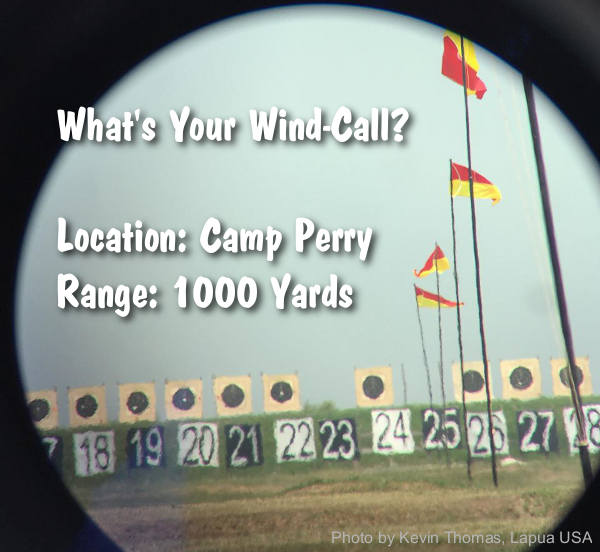
Readers often ask us: “Is there a decent, easy-to-comprehend book that can help my wind-reading?” Many of our Forum members have recommended The Wind Book for Rifle Shooters by Linda Miller and Keith Cunningham.
New Edition Released in May 2020
A NEW hardback edition of The Wind Book was released May 26, 2020. This 144-page book, first published in 2007, is a great resource. But you don’t have to take our word for it. If you click this link, you can read book excerpts and decide for yourself. When the Amazon page opens, click the book cover (labeled “Look Inside”) and another screen will appear. This lets you preview the first few chapters, and see some illustrations. Along with the new hardback edition ($22.99), Amazon offers a Kindle (eBook) edition for $14.99.
Other books cover wind reading in a broader discussion of ballistics or long-range shooting, such as Applied Ballistics for Long-Range Shooting by Bryan Litz. But the Miller & Cunningham book is ALL about wind reading from cover to cover, and that is its strength. The book focuses on real world skills that can help you accurately gauge wind angle, wind velocity, and wind cycles.
All other factors being equal, it is your ability to read the wind that will make the most difference in your shooting accuracy. The better you understand the behavior of the wind, the better you will understand the behavior of your bullet. — Wind Book for Rifle Shooters
The Wind Book for Rifle Shooters covers techniques and tactics used by expert wind-readers. There are numerous charts and illustrations. The authors show you how to put together a simple wind-reading “toolbox” for calculating wind speed, direction, deflection and drift. Then they explain how to use these tools to read flags and mirage, record and interpret your observations, and time your shots to compensate for wind. Here are two reviews from actual book buyers:
I believe this is a must-have book if you are a long-range sport shooter. I compete in F-Class Open and when I first purchased this book and read it from cover to cover, it helped me understand wind reading and making accurate scope corrections. Buy this book, read it, put into practice what it tells you, you will not be disappointed. — P. Janzso
If you have one book for wind reading, this should be it. Whether you’re a novice or experienced wind shooter this book has something for you. It covers how to get wind speed and direction from flags, mirage, and natural phenomenon. In my opinion this is the best book for learning to read wind speed and direction. — Muddler
As ranges are starting to open up again, folks are enjoying the opportunity to shoot at long range. But if you like to shoot paper out beyond 400 yards or so, you’ll find that it can be difficult to see bullet holes on paper, even with premium high-magnification spotting scopes. That’s why it’s great to have a high-quality wireless target camera. The systems we like are produced by Longshot Target Camera (aka Targetvision).
With a Longshot camera system, you receive a live WiFi feed from a camera. This comes back to your shooting station on the firing line and you can view the image with a laptop or mobile device. No separate tall antennas or routers are required, and you don’t need internet coverage. Simply place the camera unit next to your target and the receiver unit close to your rifle or bench. (Or, with the 300-yard-rated Marksman you get the WiFi signal directly from the camera — there’s no separate receiver). The Longshot system is completely self-contained. Longshot produces a variety of cameras starting at just $399.00 for the LongShot Marksman. We recommend the $799.00 LR-3 unit which is rated to a whopping two miles.
This Video shows how the Longshot Marksman Wireless Target Camera Works:
Longshot camera systems are excellent. They provide VERY sharp images and the WiFi signal is strong and stable, without the fuzziness you find with lesser systems. And, importantly, Longshot cameras come with integrated shot-marking software that works with your mobile device (phone or tablet). The Longshot mobile Apps can mark all the shots in your group (and you can select colors). In addition you can make your last-fired shot blink on the screen. And, as you’d expect, you can take a screen-shot at any time to record your shot impacts for future review. This kind of functionality makes the Longshot camera system much more sophisticated than any conventional optical spotting scope.
Longshot CEO Clay Rhoden explains: “Longshot target camera systems provide shooters with the opportunity to see their long range impacts as they occur. Acting as your spotting scope downrange you are able to see each impact with clarity. Our wireless target camera systems and camera spotting scopes provide double the resolution and double the possible distance available elsewhere.”
If you purchase a Longshot camera system, we recommend getting the optional “Bulletproof Warranty” for $39.00. This will cover most replacements if you accidentally shoot the camera system placed down-range. That $39.00 buys a lot of peace of mind. If you start with a $399.00 Marksman unit, you can also later upgrade to a full 2 mile-rated LR-3 system.
OK guys — check your powder stashes. Here’s an important notice regarding Accurate 2520 powder. There is one lot of Accurate 2520 that is dangerous, so you should not load with it. If you have some of this powder from Lot 0913192116, stop using it, and contact Western Powders at 406-234-0422. Western Powders issued this notice on 7/1/2020:
ACCURATE 2520 RECALL — 2520 Powder — LOT 0913192116
Western Powders is issuing a recall of Accurate 2520 1 lb. bottles with lot number 0913192116. The lot number is stamped on the back of the bottle. This is a limited recall and ONLY applies to this lot number of Accurate 2520. USE OF THIS POWDER MAY RESULT IN HIGH PRESSURE LOADS AND SUBSEQUENT GUN DAMAGE OR SERIOUS PERSONAL INJURY. If you are in possession of this propellant, please discontinue use immediately and contact Western Powders at 406-234-0422. We will replace your powder and instruct you how to dispose of this powder.
Product innovation is all about “building a better mousetrap”, or in this case, building a better bore-cleaning patch. A real smart guy, Shane Smith, has invented a triangular patch that earned a patent. The U.S. Patent Office has awarded a utility patent for BoreSmith’s Triangle Patch™. This unique cleaning patch was designed by Shane Smith, a mathematician/physicist who employed his scientific and firearms knowledge to create innovative bore-cleaning products.
BoreSmith’s clever Triangle Patch™ (aka Pyramid Patch) presents more cleaning surface area to the bore wall than does a conventional square or round patch (of equivalent size). At the same time, the unique geometry makes Triangle Patches much less likely to jam in the barrel. This is because the notches in the sides of the triangle allow the patch to sit more uniformly on the jag (without bunching up). In addition, the Pyramid patch is must less likely to jam due to pleating. One reason conventional patches get stuck is unwanted 5-layer pleating. The special notches in the Pyramid patch remove all or most 5-layer pleating. As a result the patch does not bunch up and this also reduces rod bowing. SEE Triangle Patches HERE.
Triangle Patch Function and Geometry Explained (See 1:18 time-mark):
NOTE: Despite what you may see in this video, you should ALWAYS insert brushes and patches from the chamber end first, using a fitted cleaning rod bore guide. With bolt-action rifles, NEVER insert a cleaning rod (with brush or jag) in through the muzzle. This may damage the delicate crown of your barrel.
The Triangle Patches work great with Boresmith’s patented dual-diameter bore brushes:
With the COVID-19 Pandemic, many shooting ranges remain closed or severely restricted. And in some cities there are still stay-at-home orders in place. If you’re an avid rifleman who enjoys shooting regularly, the Pandemic lock-down can bring withdrawal pains. The closure of outdoor ranges can mean months of forced inactivity, unless you have indoor shooting solution — such as this indoor airgun target backer system from Creedmoor Sports.
If you cannot practice at a nearby public range, Creedmoor Sports offers a great solution for those who want to shoot indoors — even in your own basement or garage.
Creedmoor’s patented 10m Air Gun Range provides a target holder and a curtain-type backstop capable of stopping pellets with a muzzle velocity up to 600 fps. The target boxes can be positioned at various heights for prone, kneeling, and standing. Creedmoor says the hardened steel target boxes provide 100% containment for any pellet passing through the target.
Creedmoor’s Air Gun Range is a proven, heavy duty product — the only Air Rifle target system ever tested and approved by the U.S. Military. This system is now being used in more than 800 schools nationwide, as well as the CMP shooting facility in Alabama. The 3-station range easily dis-assembles for transport and storage, fitting inside a 34″ x 10″ x 8″ carry duffle. The one-station range measures 84″ high x 30″ wide when assembled.
The Portable Air Gun Range comes with a durable curtain/ backstop that sets up quickly and easily. Velcro edging allows multiple curtains to be joined together. The curtain provides ample stopping power for air pellets. However, this is NEVER to be used with rimfire or centerfire rounds, or even high-energy pneumatic hunting rifles. This is for standard airguns only. That could be a $100 Crosman, or a $3600.00 Model 9003 S2 Anschutz:


 Check out those five targets. The Aggregate (average) of all five targets is a tiny 0.0840 inches! These were shot by Gary Ocock at 100 yards in a California benchrest match on August 6, 2017. Though Gary’s 0.0840 Agg beats existing records, this was not a “sanctioned” match, so Gary’s killer Agg will NOT be submitted for IBS or NBRSA records. So, sadly, the Agg won’t appear in the record books, but this remains a spectacular, verified feat of rifle accuracy, accomplished in competition.



 Rimfire Varmint Adventure




 With the COVID-19 Pandemic, many shooting ranges remain closed or severely restricted. And in some cities there are still stay-at-home orders in place. If you’re an avid rifleman who enjoys shooting regularly, the Pandemic lock-down can bring withdrawal pains. The closure of outdoor ranges can mean months of forced inactivity, unless you have indoor shooting solution — such as this indoor airgun target backer system from Creedmoor Sports.


