To understand the heart and mind of a champion, watch this video profiling Jessie Harrison. This talented lady is arguably the best female action pistol shooter in history. No other woman has amassed as many championships or set so many speed-shooting records. Over the past two decades Jessie Harrison (who has also competed with with married names Jessie Duff and Jessie Abbate) has earned dozens of major titles including twenty-two U.S. Practical Shooting Association (USPSA) Ladies Championships. Jessie won her 22nd USPSA title at the 2021 USPSA Race Gun Nationals in Alabama.
Jessie is one of the hardest-working athletes in the shooting game. Jessie is America’s “leading lady” — perhaps the winningest female pistol shooter in the game today. The drive and dedication that has made Jessie a success are revealed in this video from Weatherby.
Jessie Harrison’s Will to Win
Jessie explains how hard work brings titles: “To prepare for a championship, I’m on the range constantly.
My office is the gun range — that’s where I do my work.
I travel the country pullin’ the trigger, makin’ brass, smelling gunsmoke. I have to make sure that I’m in control because… there is no other person on the line with me, helping pull the trigger.
I have to pay attention to my foot placements, my set-ups, my positions, gettin’ the gun clean out of the holster, my reloads. I can’t think about it when I’m shooting. I can’t think about these small things. I have to focus on the sights and pulling the trigger. It’s just me and the gun.
[When] I step out on to the range, I simply have to be perfect — I have to be the best… I won’t settle for anything less.”
First-Ever Female Grand Master
Jessie Duff is the first woman in history to earn the title of USPSA Grand Master (GM), the highest rating conferred by the U.S. Practical Shooting Association (USPSA). To earn this prestigious ranking, Duff had to maintain an average above 95% in shooting classification courses, something never before achieved by a lady shooter. Jessie finished 2013 with a 95.39% average.
Over the years, the U.S. Army Marksmanship Unit (USAMU) published a series of reloading articles on its Facebook Page. In this article, the second in a 3-part series, the USAMU covers the process of loading competition pistol ammunition. The authors focus on two key elements — the taper crimp and the quality/uniformity of the original brass. If you shoot pistol competitively, or just want to maximize the accuracy of your handguns, read this article. The taper crimp tips are very important.
Loading Accurate Competition Pistol Ammunition — Part 2 of 3
One often-overlooked aspect of handloading highly-accurate pistol ammunition is the amount of taper crimp used, and its effect on accuracy. (NOTE: this article pertains to loading for semi-autos — revolver crimp techniques involve some quite different issues.) Briefly, different amounts of taper crimp are used with various handloads to obtain best accuracy. The amount is based on bullet weight, powder burn rate and charge, plus other factors such as case neck tension. During machine-rest testing of experimental Service Pistol ammunition, many variables are examined. Among these, our Shop often varies a load’s crimp in degrees of 0.001″ when re-testing for finest accuracy.
How to Measure Taper Crimp on Pistol Cartridges
One question that often arises is, “How do I measure the taper crimp I’m putting on my cartridges?” Using the narrow part of one’s dial caliper jaws, carefully measure the case diameter at the exact edge of the case mouth on a loaded cartridge. It’s important to take several measurements to ensure consistency. Also, be sure to measure at several places around the case mouth, as case wall thickness can vary. After measuring 2-3 cartridges with a given crimp setting, one can be confident of the true dimension and that it can be repeated later, if needed.
However, for good results, one must use brass from one maker due to variances in case wall thickness. For example, the same degree of crimp that imparts a measurement of 0.471″ with Brand X brass may result in 0.469″ with Brand Y. Thus, for best accuracy, using brass from the same manufacturer is important — particularly for 50-yard Slow Fire. In a perfect world, it is better still to use brass from one lot number if possible. With the popularity of progressive presses using interchangeable tool heads, keeping separate tool heads adjusted for each load helps maximize uniformity between ammunition lots.
Brass Uniformity and Accuracy
Brass is important to pistol accuracy. While accurate ammunition can be loaded using brass of mixed parentage, that is not conducive to finest results, particularly at 50 yards. It is important for the serious competitor to pay attention to his brass – even if only for the 50-yard “Slow Fire” portions of “Bullseye” matches and practice. By segregating brass as described above, and additionally keeping track of the number of times a given batch of cases has been fired, one can ensure case neck tension and case length are at their most uniform.
Given the large volumes of ammunition consumed by active pistol competitors, using inexpensive, mixed surplus brass for practice, particularly at the “short line” (25 yards), is understandable. In NRA Outdoor Pistol (“Bullseye”), the 10-ring is relatively generous — especially for a well-trained shooter with an accurate pistol and load. However, for the “long line” (50 yards), purchasing and segregating a lot of high-quality brass to be used strictly for slow-fire is a wise idea. To keep track of your brass on the line, use a unique headstamp marking with 1 or 2 colors of marking pen ink.
Uniform Cartridge Overall Length is Important
Cartridge case Overall Length (OAL) uniformity as it comes from the factory is important to achieving utmost accuracy. More uniform case lengths (best measured after sizing) contribute to greater consistency of crimp, neck tension, ignition/burn of powder charge, headspace (rimless cartridges), etc. Cartridge case-length consistency varies noticeably by maker and, with lesser manufacturers, also from lot to lot. Some manufacturers are more consistent in their dimensions than others, and also in the hardness/ductility of their brass. Similarly, pay attention to primer brands, powder lot numbers, etc.
Consider Using a Lock-Out Die with Progressive Presses
When reloading pistol ammo with a Progressive press, we strongly recommend the use of a lock-out die, or other system that can detect double charges or low charges. If your progressive is manually advanced, the possibility of a double charge is very real — and that can have disastrous consequences.
On UltimateReloader.com website you’ll find an excellent two-part series on the function and set-up of the RCBS Lock-Out Die. This die prevents loading if a high or low powder charge is detected. The video below shows setup of the RCBS Lock-Out Die on the Dillon XL-650 progressive press.
Here’a useful article by Sierra Bullets Media Relations Manager Carroll Pilant. This story, which originally appeared in the Sierra Bullets Blog, covers some of the more common ammo problems that afflict hand-loaders. Some of those issues are: excessive OAL, high primers, and improperly-sized cases. Here Mr. Pilant explains how to avoid these common problems that lead to “headaches at the range.
I had some gentlemen at my house last fall getting rifle zeros for an upcoming elk hunt. One was using one of the .300 short mags and every 3rd or 4th round would not chamber. Examination of the case showed a bulge right at the body/shoulder junction. These were new cases he had loaded for this trip. The seating die had been screwed down until it just touched the shoulder and then backed up just slightly. Some of the cases were apparently slightly longer from the base to the datum line and the shoulder was hitting inside the seating die and putting the bulge on the shoulder. I got to thinking about all the gun malfunctions that I see each week at matches and the biggest percentage stem from improper handloading techniques.
One: Check Your Cases with a Chamber Gage
Since I shoot a lot of 3-gun matches, I see a lot of AR problems which result in the shooter banging the butt stock on the ground or nearest solid object while pulling on the charging handle at the same time. I like my rifles too well to treat them that way (I cringe every time I see someone doing that). When I ask them if they ran the ammo through a chamber gage, I usually get the answer, “No, but I need to get one” or “I didn’t have time to do it” or other excuses. The few minutes it takes to check your ammo can mean the difference between a nightmare and a smooth running firearm.
A Chamber Gauge Quickly Reveals Long or Short Cases
Size Your Cases Properly
Another problem is caused sizing the case itself. If you will lube the inside of the neck, the expander ball will come out a lot easier. If you hear a squeak as the expander ball comes out of a case neck, that expander ball is trying to pull the case neck/shoulder up (sometimes several thousandths). That is enough that if you don’t put a bulge on the shoulder when seating the bullet … it can still jam into the chamber like a big cork. If the rifle is set up correctly, the gun will not go into battery and won’t fire but the round is jammed into the chamber where it won’t extract and they are back to banging it on the ground again (with a loaded round stuck in the chamber). A chamber gage would have caught this also.
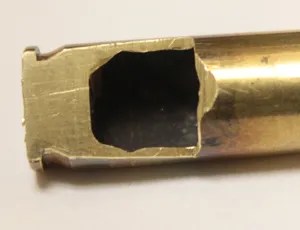
Oversizing cases also causes problems because the firing pin doesn’t have the length to reach the primer solid enough to ignite it 100% of the time. When you have one that is oversized, you usually have a bunch, since you usually do several cases at a time on that die setting. If the die isn’t readjusted, the problem will continue on the next batch of cases also. They will either not fire at all or you will have a lot of misfires. In a bolt action, a lot of time the extractor will hold the case against the face of the breech enough that it will fire. The case gets driven forward and the thinner part of the brass expands, holding to the chamber wall and the thicker part of the case doesn’t expand as much and stretches back to the bolt face. If it doesn’t separate that time, it will the next time. When it does separate, it leaves the front portion of the case in the chamber and pulls the case head off. Then when it tries to chamber the next round, you have a nasty jam. Quite often range brass is the culprit of this because you never know how many times it has been fired/sized and in what firearm. Back to beating it on the ground again till you figure out that you have to get the forward part of the case out.
Just a quick tip — To extract the partial case, an oversized brush on a cleaning rod [inserted] and then pulled backward will often remove the case. The bristles when pushed forward and then pulled back act like barbs inside the case. If you have a bunch of oversized case that have been fired, I would dispose of them to keep from having future problems. There are a few tricks you can use to salvage them if they haven’t been fired though. Once again, a case gage would have helped.
Two: Double Check Your Primers
Another thing I see fairly often is a high primer, backwards primer, or no primer at all. The high primers are bad because you can have either a slam fire or a misfire from the firing pin seating the primer but using up its energy doing so. So, as a precaution to make sure my rifle ammo will work 100% of the time, I check it in a case gage, then put it in an ammo box with the primer up and when the box is full, I run my finger across all the primers to make sure they are all seated to the correct depth and you can visually check to make sure none are in backwards or missing.
Three: Check Your Overall Cartridge Length
Trying to load the ammo as long as possible can cause problems also. Be sure to leave yourself enough clearance between the tip of the bullet and the front of the magazine where the rounds will feed up 100%. Several times over the years, I have heard of hunters getting their rifle ready for a hunt. When they would go to the range to sight in, they loaded each round single shot without putting any ammo in the magazine. On getting to elk or deer camp, they find out the ammo is to long to fit in the magazine. At least they have a single shot, it could be worse. I have had hunters that their buddies loaded the ammo for them and then met them in hunting camp only to find out the ammo wouldn’t chamber from either the bullet seated to long or the case sized improperly, then they just have a club.
Four: Confirm All Cases Contain Powder
No powder in the case doesn’t seem to happen as much in rifle cartridges as in handgun cartridges. This is probably due to more handgun ammo being loaded on progressive presses and usually in larger quantities. There are probably more rifle cartridges that don’t have powder in them than you realize though. Since the pistol case is so much smaller internal capacity, when you try to fire it without powder, it usually dislodges the bullet just enough to stick in the barrel. On a rifle, you have more internal capacity and usually a better grip on the bullet, since it is smaller diameter and longer bearing surface. Like on a .223, often a case without powder won’t dislodge the bullet out of the case and just gets ejected from the rifle, thinking it was a bad primer or some little quirk.
For rifle cases loaded on a single stage press, I put them in a reloading block and always dump my powder in a certain order. Then I do a visual inspection and any case that the powder doesn’t look the same level as the rest, I pull it and the one I charged before and the one I charged after it. I inspect the one case to see if there is anything visual inside. Then I recharge all 3 cases. That way if a case had powder hang up and dump in the next case, you have corrected the problem.
On progressive presses, I try to use a powder that fills the case up to about the base of the bullet. That way you can usually see the powder as the shell rotates and if you might have dumped a partial or double charge, you will notice as you start to seat the bullet if not before. On a progressive, if I don’t load a cartridge in one smooth stroke (say a bullet tipped over sideways and I raised the ram slightly to reset it) Some presses actually back the charge back adding more powder if it has already dumped some so you have a full charge plus a partial charge. When I don’t complete the procedure with one stroke, I pull the case that just had powder dumped into it and check the powder charge or just dump the powder back into the measure and run the case through later.
This 12″ Bullseye Pistol Diagnostic Target helps improve handgun marksmanship. The target diagnoses common problems with one-handed shooting based on shot impact zones. While this target is designed for righties, left-handed shooters can use the target too. Just observe the opposite tips.
Do you know someone who wants to get started in pistol shooting? Here’s a helpful resource. The NRA now offers its Basics of Pistol Shooting Course in an online format. That makes it easy to cover the “classroom” phase of the course on your own time. The $60.00 online course includes 11 step-by-step lessons (to be followed by live range training). CLICK HERE to enroll in online Pistol Training Course.
Train Online, Then Register for a Range Session
For the NRA Basics of Pistol Shooting course, Phase 1 is conducted in an online environment, completed on your own time (cost is $60.00, non-refundable). After successfully completing the online exam, students can register for Phase 2, the instructor-led training session. Phase 2 is conducted at your local range with an NRA-Certified Instructor. NOTE: There will normally be an additional fee for Phase 2. You must successfully complete BOTH Phase 1 and Phase 2 in order to receive your NRA Basics of Pistol Shooting course certificate.
Designed and developed by experts to accommodate busy schedules, the web-based course takes a blended learning approach to firearms training with both online and physical components. Students have 90 days to work through 11 online lessons before registering for Phase 2, the NRA Certified Instructor-led phase at a local range.
“Thanks to our online courses and network of more than 125,000 NRA Certified Instructors, it has never been easier to learn basic firearm skills,” said Kyle Weaver, NRA General Operations Exec. Director. The NRA offers other online training courses at Onlinetraining.nra.org. Along with pistol course, these offerings include Rifle Training, Shotgun Training, a Range Safety Office (RSO) course, and a Range Development and Operations course.
Know someone getting started with handguns? Here is a useful video focusing on safety:
We’ve been fans of the Howa Mini Action rifles since they were introduced a decade ago. With actions that are nearly an inch shorter than typical “short actions”, these Mini Action rigs work great as a compact “truck gun” or carry-around varminter. Current chamberings are: 22 ARC, .223 Rem, 6MM ARC, 6.5 Grendel, 7.62x39mm, 350 Legend. These feature a 20″ barrel with a 16.5″ option for the 350 Legend.
6.5 Guy Ed Mobley Tests the 7.62×39 Howa Mini Action Rifle
The Howa Mini Action rifles come with the excellent HACT 2-stage trigger and a 5-round or 10-round, synthetic detachable box mag (depending on caliber). The Mini Action’s bolt is 13% shorter than on regular short actions, providing a shorter, faster bolt throw. Weight is also reduced. This makes for a nice, compact (and very shootable) package.
6.5 Guys Test Howa Mini Actions in 6.5 Grendel and 7.62×39
The 6.5 Guys recently secured a pair of Howa Mini Actions, one chambered in 6.5 Grendel and the other in 7.62×39 Russian: “After trying out the Howa Mini Action rifles at SHOT Show 2017, we got a couple of loaners in 6.5 Grendel and 7.62×39 courtesy of Legacy Sports. These rifles are known for their smooth cycling and lightweight actions, as well as some unique chamberings for bolt rifles (6.5 Grendel, 7.62×39). Long story short, we really enjoyed them.” In fact Steve liked his 6.5 Grendel enough that he plans to purchase the gun. Get the full scoop in this VIDEO REVIEW:
The folks at Legacy Sports also conducted extensive accuracy tests of commercial ammunition in 6.5 Grendel and 7.62×39. The most accurate 6.5 Grendel ammo, with a stunning 0.29″ group, was Alexander Arms with Lapua 123gr Scenar; second best (0.56″ group) was Hornady with 123gr A-Max bullet. The most accurate 7.62×39 ammo was Hornady 123gr SST with a 0.62″ group in the 20″ Heavy Barrel version. View Howa’s Test Reports with these links:
At the request of our readers, we provide select “Deals of the Week”. Every Sunday afternoon or Monday morning we offer our Best Bargain selections. Here are some of the best deals on firearms, hardware, reloading components, optics, and shooting accessories. Be aware that sale prices are subject to change, and once clearance inventory is sold, it’s gone for good. You snooze you lose.
NOTE: All listed products are for sale to persons 18 years of age or older. No products are intended for use by minors.
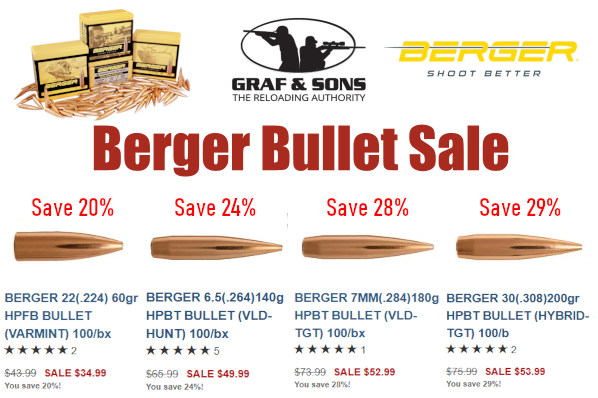
Graf & Sons — Berger Bullet Sale
⏺️ » Good 20-29% savings on Berger match and hunting bullets, many calibers
When it comes to competition components, Berger Bullets produces some of the best bullets you can buy. And Berger offers a wide selection of calibers, bullet weights, and bullet profiles (standard, VLD, hybrid). With savings up to 29%, now is the time to stock up for this year’s matches and take advantage of these big Berger bullet discounts at Grafs.com.
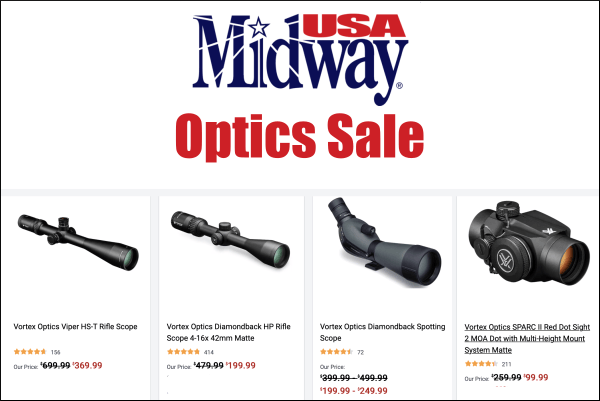
MidwayUSA — Major Discounts on All Types of Optics
⏺️ » Big Optics Sale with major savings, plus FREE Shipping offers
If you’re looking to grab a new scope or other type of optic, check out the optics sale at MidwayUSA. You’ll find riflescopes, spotting scopes, binoculars, thermal monoculars, rangefinders and Red Dots at crazy low prices. For example the Burris 5-20x50mm Eliminator rangefinder scope has been discounted $800, a huge 40% savings. Plus many orders over $100 will qualify for FREE Shipping this week.
As an Amazon affiliate, this site can earn revenues through sales commissions.
When a rifle isn’t shooting up to it’s potential, we need to ask: “Is it the gun or the shooter?” Having multiple shooters test the same rifle in the same conditions with the same load can be very revealing…
When developing a load for a new rifle, one can easily get consumed by all the potential variables — charge weight, seating depth, neck tension, primer options, neck lube, and so on. When you’re fully focused on loading variables, and the results on the target are disappointing, you may quickly assume you need to change your load. But we learned that sometimes the load is just fine — the problem is the trigger puller, or the set-up on the bench.
Here’s an example. A while back we tested two new Savage F-Class rifles, both chambered in 6mmBR. Initial results were promising, but not great — one gun’s owner was getting round groups with shots distributed at 10 o’clock, 2 o’clock, 5 o’clock, 8 o’clock, and none were touching. We could have concluded that the load was no good. But then another shooter sat down behind the rifle and put the next two shots, identical load, through the same hole. Shooter #2 eventually produced a 6-shot group that was a vertical line, with 2 shots in each hole but at three different points of impact. OK, now we can conclude the load needs to be tuned to get rid of the vertical. Right? Wrong. Shooter #3 sat down behind the gun and produced a group that strung horizontally but had almost no vertical.
Hmmm… what gives?
Shooting Styles Created Vertical or Horizontal Dispersion
What was the problem? Well, each of the three shooters had a different way of holding the gun and adjusting the rear bag. Shooter #1, the gun’s owner, used a wrap-around hold with hand and cheek pressure, and he was squeezing the bag. All that contact was moving the shot up, down, left and right. The wrap-around hold produced erratic results.
Shooter #2 was using no cheek pressure, and very slight thumb pressure behind the tang, but he was experimenting with different amounts of bag “squeeze”. His hold eliminated the side push, but variances in squeeze technique and down pressure caused the vertical string. When he kept things constant, the gun put successive shots through the same hole.
Shooter #3 was using heavy cheek pressure. This settled the gun down vertically, but it also side-loaded the rifle. The result was almost no vertical, but this shooting style produced too much horizontal.
A “Second Opinion” Is Always Useful
Conclusion? Before you spend all day fiddling with a load, you might want to adjust your shooting style and see if that affects the group size and shape on the target. Additionally, it is nearly always useful to have another experienced shooter try your rifle. In our test session, each time we changed “drivers”, the way the shots grouped on the target changed significantly. We went from a big round group, to vertical string, to horizontal string.
Interestingly, all three shooters were able to diagnose problems in their shooting styles, and then refine their gun-handling. As a result, in a second session, we all shot that gun better, and the average group size dropped from 0.5-0.6 inches into the threes — with NO changes to the load.
That’s right, we cut group size in half, and we didn’t alter the load one bit. Switching shooters demonstrated that the load was good and the gun was good. The skill of the trigger-puller(s) proved to be the limiting factor in terms of group size.
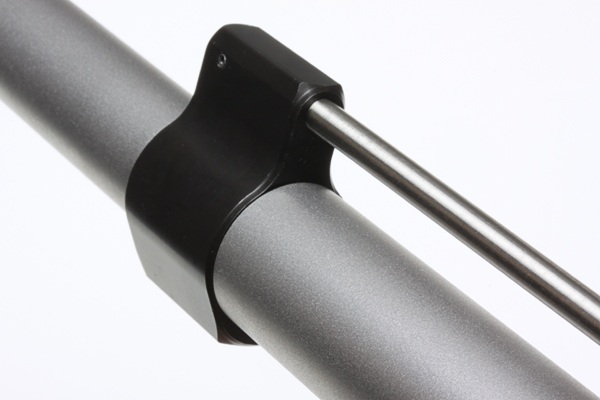
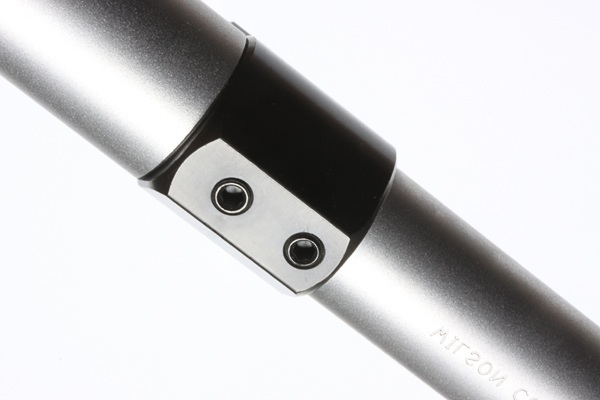
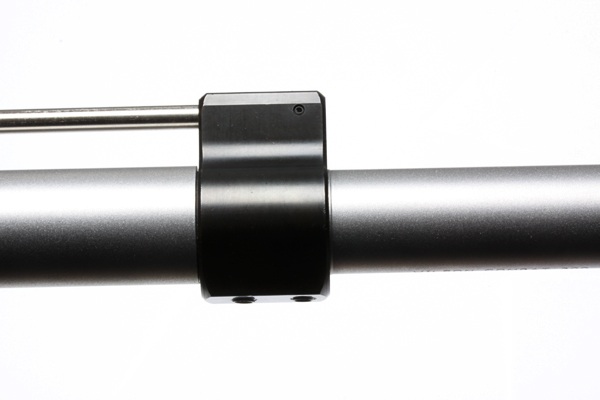
Wouldn’t it be cool if you could adjust the bolt cycling energy on your AR-platform rifle? Turn down the cycling rate for slow fire at the bench or varmint hunting. Crank up the energy for 3-Gun matches and rapid-fire disciplines. This IS possible with a handy accessory that fits on your barrel. Wilson Combat offers an Adjustable Lo-Profile AR Gas Block for direct gas impingement AR-type rifles. Wilson Combat’s adjustable gas block replaces a standard AR gas block and allows you to tune your AR’s gas system for smoother cycling and enhanced reliability. Wilson Combat explains: “Adjusting your rifle’s gas port will lower or increase your bolt’’s cyclic rate. This tailors your rifle’s performance to your unique needs.”
A simple adjustment of the hex screw at the front of the block modulates the gas volume allowing you to tune your rifle’s function to your favorite loads. This is very handy when shooting non-standard AR calibers, unusual hand-loads, or suppressed rifles. Adjustable Gas Block systems are sold as complete kits starting at $61.07. Wilson Combat offers two diameters (.750″, .875″) so you can select the right dimensions for your rifle configuration and barrel diameter. The blocks are Chromoly steel with a black Melonited finish.
Package Includes:
Adjustable Gas Block (Melonite Finish)
Adjustment Set Screw (Installed)
Straight Gas Tube (Installed, Gas Tube Pin Installed)
Editor: This story by Tommy C. (aka “dc.fireman”) comes from our Shooters’ Forum. It’s fascinating to see how a relatively inexpensive Savage M12 BVSS varmint rig was transformed into a sophisticated 300M match rifle with a modern chassis, Shilen barrel, and top-of-line sights. With some ingenuity, and careful parts selection, Tommy created a rifle that can compete with match rifles costing many thousands of dollars more. American ingenuity at work!
Savage Reborn — Old BVSS Transformed into 300M Match Rifle
by Tommy C. (aka “dc.fireman”)
So, I began the project of building a 300M International competition gun, about a year ago, intending to compete at the 300M Nationals this year in Minnesota at the Minneapolis Rifle Club. Realistically, I didn’t want to pay the price-tag demanded of the Bleikers, Grunig & Elmigers, Hammerlis, or Tanners that (infrequently) pop-up for sale from time to time. So I decided to build my own 300M Match rifle with an American action, barrel, chassis, and trigger.
Here is Tommy’s completed 300M Match rifle with Savage action in PDC Custom chassis.
I had decided on the .260 Remington (aka 6.5-08) as the caliber choice. This beat out 6.5×47 Lapua simply due to the cost/availability of brass. The .260 Rem cartridge is based on the .308 Win parent. I made my first batch of brass by necking down some Federal .308, and it worked great. [Editor: We do recommend Lapua .260 Remington brass for match purposes for those who don’t have a supply of good .308 Win brass.]
I had an older Savage M12 stagger-feed action, originally from an old .22-250 BVSS. I contacted James at Northland Shooter Supply, and he walked me through the game plan and equipment I needed: Shilen Select Match 26″ barrel, NSS Stainless recoil lug and nut, a set of Forster headspace gauges, and the NSS action wrench.
Catalog photo of current Savage M12 BVSS in .22-250 Rem.
A few months later, I replaced the original Accu-trigger with a Rifle Basix SAV-II trigger, and immediately wondered why I waited so long to do that. The Rifle Basix is perfect for my application. Mind you the he safety DOES NOT work now, but, I don’t need it for my application.
Another member on the AccurateShooter Forum sold me a BVSS stock that has been re-worked by Alex Sitman of Masterclass Stocks, and it served as a placeholder, until I could find a maker who could nearly replicate my Feinwerkbau 2700 Alu stock in my smallbore match gun.
After scouring the AccurateShooter Forum, and multiple internet searches, I found PDC Custom in Michigan. I spoke with Craig Kierstadt a few times, before finally deciding to pull the proverbial trigger on his chassis. He had a few of the older chassis stocks with spacing for the Savage stagger-feed action. He machined an Anschutz rail into the fore-end for my hand stop and sling. Then he powder-coated the chassis black, and sent it to me sans grip and butt plate.
Photo of action/chassis. Tommy says: “It locks up really tightly, and you can tell Craig spent some time on the CNC work need to make this all fit.”
There are a few minor issues with the PDC chassis, but overall, I would rate this a 9.5 out of a possible 10. The price, and the features built into it, plus the ease of which everything fit together, far outweigh any minor issues. And two of the issues I quickly corrected with Teflon tape. I will need to make a walnut cheek piece — a curved one isn’t conducive to aperture iron sight shooting.
Savage Action .260 Rem 300M Match Rifle Components:
Action, Barrel, Stock, Grip
Savage M12 stagger-feed action, 4.27″ spacing
Shilen Select Match Barrel, 26″
Rifle Basix SAV-II Trigger
PDC Custom Chassis — tool-less adjustments
Bobsled SLED for single loading (required)
MEC Contact III Butt plate (German)
MEC handstop/sling swivel (German)
Walnut Target grip for AR-15 (eBay sourced)
Sight Components and Hardware
MEC Spy Long rear sight (German)
Centra front sight tunnel (German)
Centra adjustable aperture (German)
Medesha sight extension tube + collar
Champion’s Choice front sight base
Champion’s Choice mirage band
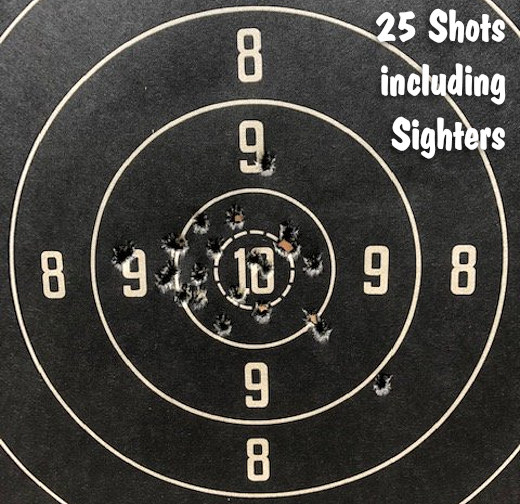
For his practice load, Tommy shot 123gr Hornady ELD-M bullets with H4831 powder and CCI BR2 primers. This load performed well — Tommy posted: “My 25-shot initial prone test today shows promise. There are five sighter shots, and 20 record shots. One of the 9s at 9 o’clock is my first sighter, the other one I own. The 8 out at 4 O’clock was a round that was difficult to chamber. My initial scoring puts me somewhere in the vicinity of 193-7X.”
The target used is the NRA C2, “300M International Rifle Target, reduced for 200 yards”. The 10 Ring is 2.40″ in diameter, while the Inner 10 (X-Ring) is 1.24″.
Match Load — Varget and Nosler Bullets
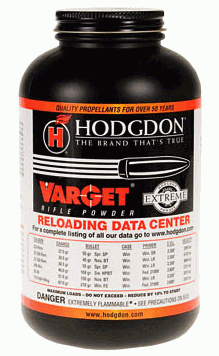
For his match load, Tommy switched to Varget and Nosler bullets: “My match load uses 37.9 grains Hodgdon Varget with a Nosler 123gr bullet. This was a recommendation by a gentleman with a lot of experience in 300M shooting.”
Tommy adds: “The amount of knowledge gained via the AccurateShooter Forum has made this all a reality, instead of just a passing thought.”
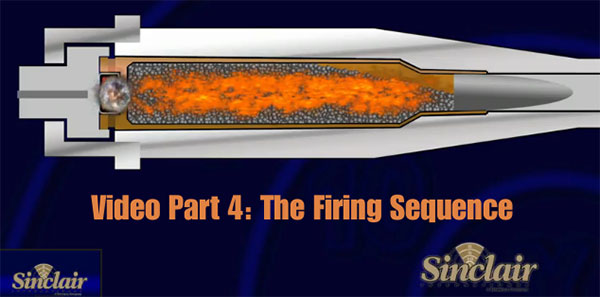
Sinclair International has created a series of instructional videos illustrating the basics of metallic cartridge reloading. The 8-Part series starts with reloading basics and provides step-by-step, how-to instructions that will help new reloaders get started. Detailed, animated illustrations show you what happens inside the chamber when shooting, and inside the dies during each step of reloading. The videos can be viewed on Sinclair International’s YouTube channel. Shown below is the first video in the series:
Each of the Sinclair videos is hosted by then Sinclair Int’l President Bill Gravatt (now with Creedmoor Sports). Bill doesn’t just show you “how”, he tells you “why”. The how-to segments cover case inspection, proper die set up, case sizing, primer installation, powder measuring, bullet seating, crimping, and even goes into the record keeping needed for the handloader. “We wanted to give shooters who haven’t reloaded a look at all the advantages of creating your own ammo and how easy it is to get started,” said Gravatt, “without telling them they had to have any certain brand or type of equipment to do the job.”
The Eight Video Topics Are:
Part 1 — Intro to Video Series
Part 2 — Intro to Reloading Safety
Part 3 — Metallic Cartridge Components
Part 4 — The Firing Sequence
Part 5 — Tools for Reloading
Part 6 — Loading Bottle-Neck Cartridges (2 videos)
Part 7 — Loading Straight Wall Cartridges
Part 8 — Reloading Series Conclusion
Reloading Tools
Shown below is Part 5 of the video series, covering the tools used for precision reloading.
We also strongly recommend the Part 4 Video to readers who are getting started in reloading. This “How Things Work” segment covers the sequence of events inside the chamber (and barrel) when the cartridge is fired. The video includes helpful graphics that show what happens to the primer, powder, cartridge, and bullet when the round is fired. The video also illustrates “headspace” and explains how this can change after firing. We think this video answers many common questions and will help reloaders understand the forces at work on their brass during the firing process.


 Jessie Harrison’s Will to Win





 Oversizing cases also causes problems because the firing pin doesn’t have the length to reach the primer solid enough to ignite it 100% of the time. When you have one that is oversized, you usually have a bunch, since you usually do several cases at a time on that die setting. If the die isn’t readjusted, the problem will continue on the next batch of cases also. They will either not fire at all or you will have a lot of misfires. In a bolt action, a lot of time the extractor will hold the case against the face of the breech enough that it will fire. The case gets driven forward and the thinner part of the brass expands, holding to the chamber wall and the thicker part of the case doesn’t expand as much and stretches back to the bolt face. If it doesn’t separate that time, it will the next time. When it does separate, it leaves the front portion of the case in the chamber and pulls the case head off. Then when it tries to chamber the next round, you have a nasty jam. Quite often range brass is the culprit of this because you never know how many times it has been fired/sized and in what firearm. Back to beating it on the ground again till you figure out that you have to get the forward part of the case out.










 Match Load — Varget and Nosler Bullets