Have you ever wondered how Olympic-class position shooters hold their aim so steady? Those bulky shooting coats help, but there is a lot of bio-mechanics involved also. Top shooters employ their body structure to help support the weight of their rifles, and to steady their aim. This interesting video, produced by GOnra Media, demonstrates rifle hold and body alignment for prone, standing, sitting, and kneeling positions. Olympic Gold Medalist Jamie Corkish (formerly Jamie Gray) demonstrates the proper stance and position of arms and legs for each of the positions.
Ideally, in all of the shooting positions, the shooter takes advantage of skeletal support. The shooter should align the bones of his/her arms and legs to provide a solid foundation. A shooter’s legs and arms form vertical planes helping the body remain stable in the shooting position.
Jamie Corkish, London 2012 Gold Medalist in Women’s 3 X 20, has retired from top-level competitive shooting. However, Jamie remains involved in the shooting sports as a Public Relations/Marketing representative for ELEY, a leading maker of rimfire ammunition. Jamie also works with shooting clubs and educational institutions to promote smallbore target shooting.
Images are stills from GOnraMedia video linked above.
Sako, and its subsidiary Tikka, make some of the finest hunting rifles you can buy. These offer smooth actions, and very good out-of-the-box accuracy for factory rifles. In addition, Sako and Tikka now offer high-tech carbon fiber stocks, along with Sako’s handsome wood stocks. With the three videos showcased today, you get a virtual tour of the Sako/Tikka production facilities in Finland.
Tour of Finland SAKO/Tikka Factory — 22-Minute Video
In this informative video, the Canada in the Rough team tours the Sako/Tikka factory in Riihimäki, Finland. All aspects of the production process are covered — crafting actions, barrel-making, stock fitting and more. It was interesting to see the hammer-forging process for barrels, and the exacting measurements that are performed on the actions and bolt assemblies. If you have an interest in rifle production and the type of modern, computer-controlled machinery now being used, definitely watch this video.
SPECIAL REPORT: NEW Tikka T3x Ace Target Rifle for PRS/NRL
Tikka is best known for its rugged and accurate hunting rifles. But recently Tikka has introduced an impressive new line of T3x Ace Target chassis rifles. These 10.6-lb rigs have impressive alloy chassis stocks, with modular M-LOK and Arca-Swiss compatible fore-ends, and interchangeable magwells. Optimized for PRS/NRL competition, the Tikka T3x Ace Target has a fine 2-stage adjustable trigger, plus a rear stock section with adjustable cheek-piece and nicely-designed attached lower bag rider. Available chamberings are .223 Rem, 6.5 Creedmoor, and .308 Winchester with prices starting at $1749.00. NOTE: Tikka also offers the rimfire .22 LR Tikka T1x Ace Target rifle for practice and competition. This is cool because NRL-22 Matches are now very popular.
Visit to SAKO/Tikka Carbon Fiber Stock Factory
This Sako-produced video shows how the company’s modern carbon-fiber stocks are produced. The stock production process is highly automated, to ensure that the finished stocks have very precise dimensions. These carbon Sakos are some of the nicest carbon-fiber stocks we’ve ever seen.
SAKO Factory Tour in Riihimäki, Finland
In this segment, huntress and outdoor video host Mia Anstine tours the Sako manufacturing facility in Riihimäki, Finland. This video covers both firearms production and ammunition manufacturing. In a follow-up video posted below, Mia tests Sako rifles and Sako ammunition at a Finland range. Mia also reported on her Sako factory tour in the Beretta Blog. She notes: “Sako built its original manufacturing facility during World War I. To this day they still utilize the original buildings but have also grown over the years to include larger production areas and updated equipment.”
Canada in the Rough Video Tip from Boyd Allen — we welcome reader submissions
Be prepared to have your mind blown by Max Michel. This guy is FAST. In this video he puts 18 shots on three targets with two (2) reloads, in a total of 4.79 seconds. That’s right, drawing from holster, he sends 18 rounds in under five seconds, with two mag changes in the process. That works out to a rate of fire of 225 rounds per minute. Consider this — Max shoots faster than a 19th-century Gatling Gun (which had a rate of fire of roughly 200 rounds per minute). And Max is accurate as well as speedy — 16 of Max’s 18 shots were in the targets’ A-Zones, with the other two just barely outside.
Click Speaker Icon to hear sound (audio) — it’s even more impressive with sound!
Max Michel is a legend within the world of competitive shooting. He is the SIG Sauer Team captain with an unrivaled record of major pistol titles. Max is a 7-time World Speed Shooting Champion, 7-time U.S. Steel National Champion, 13-time USPSA National Champion, and 20-time U.S National Champion. He is also a Guinness Record holder and past IPSC World Champion. Michel also owns multiple World Speed Shooting records as well as being the first Action Shooter to win all USPSA Area Championships in the same season. Born and raised in New Orleans, Louisiana, Max began shooting when he was just five years old. In 1999 Max joined the USAMU’s Action Pistol Team and served in the U.S. Army for 10 years as an Army shooter and trainer. Today, Max is recognized worldwide as a top-tier athlete and instructor.
We’ve found ten great discount/rebate programs. These specials can save you big bucks on pistols, shotguns, ammo, or bullets. Some of these rebates are worth big bucks. For example you can Save 10% on a new Browning rifle, save $50 on a new Stoeger pistol, save $75 on a new Beretta pistol, or save $300 on a new Beretta shotgun. And with the Smith & Wesson and Springfield Armory promotions you get a free reflex optic with a pistol purchase. Note: most of these promos are good through the end of April or May, but some expire on April 15th — so check the dates.
The shooting season is now in full swing. When you head to the range you’ll want to be prepared. That means collecting all the gear you’ll need at the range. It’s easy to forget small, critical items, so we’ve provided a checklist of the small “extras” you should pack before you head out to the range. In addition to rifle, rests, ammo, targets, and cleaning gear, here are a dozen essentials you should include in your range bag.
• Shell-Holder — If you don’t have calipers, you can use a shell-holder to check for excessive case expansion from hot loads. If a fired case doesn’t slip into the shell-holder easily, your load is definitely TOO HOT.
• Extra Earplugs — Always use ear protection when shooting. We bring a 35mm film canister with extra sets of foam earplugs.
• Hex Wrench or Screwdriver for action screws — Action screws can work loose with time. Always bring the appropriate hex wrench or screwdriver whenever you go to the range.
• Small Wrench for Scope Rings — Check the tension of your scope base and ring fasteners before you go. Bring along a small Torx wrench for the ring screws (or other tool that fits your fasteners).
• Normal and Under-sized Jags — It is often wise to use one-caliber undersize jags when applying solvent with cotton patches. You should have a couple sizes in your range kit.
• Extra Batteries — Bring extra batteries for all your electronic gear — which can include chronograph, windmeter, digital camera, GPS etc.
• Small Notebook and Pen or Pencil — Use the notebook to record chron data, log group sizes, and make notes about wind and weather conditions.
• Adhesive dots — Bring a few sheets of adhesive dots (sold at office supply stores). Use small white or black dots as target pasters. Use larger red or orange dots as aiming points (target centers).
• Folding Chair or Camp Stool — This comes in handy if you’re spotting for another shooter, or if you reload away from the firing line.
• Water Bottle — You can’t shoot well if you’re dehydrated. Bring at least two quarts of water with you and keep a bottle at the bench.
• Surveyors’ Tape and Wood Stakes — You can make inexpensive wind indicators using surveyors’ tape attached to the top of wood stakes.
• Small Plastic Ruler — Use this to measure your group sizes. A transparent (see-through) ruler works best. Rulers are also useful for drawing lines on targets.
This list is not intended to be exclusive. There are many other items you may wish to include. Obviously bring safety glasses, and Sharpie-type pens are always handy to mark targets. We invite our readers to add other “essentials” to the list. The important thing is to plan ahead, packing your key items before you drive to the range.
Most of us assume that if we weigh our powder carefully (down to the tenth of a grain or less) we can achieve a uniform powder fill from case to case in our handloads. Weighing does ensure that the weight of the propellant in each case is the same, but is the column of powder the same by volume each time? “Not necessarily” is the answer. An interesting experiment by our friend Boyd Allen demonstrates that the manner in which you place kernels in the case can make a significant difference in the height of the powder column within the brass case.
Using a Gempro 250 scale, Boyd measured exactly 30.6 grains of Vihtavuori N-133 powder. He then inserted this powder in the same cartridge case multiple times. (The case has a fired primer in place.) But here is the key — Boyd used various filling techniques. He did a slow fill, and a fast fill, and he also experimented with tapping and drop tubes. What Boyd discovered was that you can start with the exact same weight of powder (in fact the very same set of kernels), yet end up with vary different fill heights, depending on how you drop the kernels into the case. Look at the photos. Despite variations in lighting, the photos show the same 30.6 grains of powder, placed in the same cartridge, with four different methods.
Using funnels with long drop tubes packs kernels more tightly, creating a shorter powder column. That allows you to get more propellant (by weight) into the case.
Boyd Explains the Procedure Used for his Experiment.
EDITOR’s NOTE: So there is no misunderstanding, Boyd started with a weighed 30.6 grain charge. This identical charge was used for ALL four fills. After a fill the powder was dumped from the case into a pan which was then used for the next fill technique to be tried. So, the powder weight was constant. Indeed the exact same kernels (of constant weight and number) were used for each fill.
Boyd writes: “I used the same powder for all fills, 30.6 gr. on a GemPro 250 checked more than once. All fills employed the same RCBS green transparent plastic funnel. The fast drop with the funnel only overflowed when it was removed from the case neck, and 15 granules of powder fell on the white paper that the case was sitting on. The fast-funnel-only drop with tapping, was done with the funnel in place and the case and funnel in one hand, while tapping the case body with the index finger hard, many times (about 20 fast double taps). My idea here was to “max out” the potential of this tapping technique.
The slow drop with the funnel and 10″-long .22 cal. Harrell’s Precision drop tube, was done by holding the scale pan over the funnel and tapping the spout of the pan repeatedly on the inside of the funnel about 1/3 down from the top, with the scale pan tilted just enough so that the powder will just flow. Many taps were involved, again, to max out the technique.
Again, to be clear, after each case filling, the powder was poured from the case back into the scale pan carefully. You may notice the similarity between the fast drop with the drop tube, and the funnel only with tapping. Although I did not photograph it, fast tube drop and tapping (combined) improved on tapping alone, but only to about half as far down the neck as the slow with drop tube. Due to the endless possible permutations, I picked four and left it at that.
I believe that I can make the rough judgment that the scale pan funnel and drop tube technique, which involved a longer drop period, and probably less velocity at the top of the tube, left more room in the top of the case neck than the slow drop from the measure with the same drop tube. You have both pictures, so you can make the comparison.” — Boyd
Does Powder Column Height Variance Make a Difference?
Boyd’s experiment proves pretty conclusively that the method of dropping a given weight of powder can affect the height of the powder column in the case and the degree of powder compression (when a bullet is seated). He showed this to be true even when the exact same set of kernels (of constant weight) was used in repetitive loadings. This raises some interesting questions:
1. Will subsequent cartridge transport and handling cause the powder to settle so the variances in powder column height are diminished?
2. If significant inconsistencies in powder column height remain at time of firing, will the difference in fill level hurt accuracy, or result in a higher extreme spread in velocity?
3. Is there any advantage (beyond increased effective case capacity) for a tight (low level) fill vs. a loose (high level) fill?
We don’t know the answer to these follow up questions. This Editor guesses that, if we tested low-fill-height rounds vs. high-fill-height rounds (all with same true fill quantity by weight), we might see meaningful differences in average velocity. I would also guess that if you fired 10 rounds that exhibited quite a difference in powder column heights, you might see a higher ES/SD than if you shot 10 rounds loaded with a very consistent powder column height (either high or low). But further testing is needed to determine if these predictions are true.
This month USA Shooting celebrates 30 years as the American Governing Body for shooting sports within the U.S. Olympic and Paralympic Committee. USA Shooting will commemorate its anniversary throughout 2025 with special events, social media giveaways, and initiatives designed to further expand participation in competitive shooting sports. To learn more about USA Shooting’s 30th Anniversary programs, visit USAShooting.org and follow @USAShooting on Facebook, X, and Instagram.
“These three decades represent not just organizational longevity, but a remarkable journey of athletic excellence… and competitive innovation,” said Kelly Reisdorf, CEO of USA Shooting. Since its founding in 1995, USA Shooting has guided American marksmen and markswomen to 36 Olympic and Paralympic medals, developing world-class talent across all shooting disciplines.
“The trajectory of American competitive shooting has been defined by both winning at the highest levels and developing tomorrow’s champions,” said Tim Rupli, Chairman of USA Shooting. “We’ve cultivated American talent while championing the values of precision, discipline, and patriotic excellence[.]”
A Legacy of Champions
For three decades USA Shooting has produced shooting sports legends, including Kimberly Rhode, a 6-time Olympic medalist, and Vincent Hancock, the first shooter to win four gold medals in the same event. Most recently, USA Shooting athletes excelled at the Paris 2024 Olympic and Paralympic Games, securing six medals — including gold for Hancock in Men’s Skeet, silver medals for Sagen Maddalena in Women’s 50m Rifle 3 Positions, Conner Prince in Men’s Skeet, Austen Smith and Hancock in Mixed Skeet Team.
The legacy extends to stellar coaches like Lloyd Woodhouse, whose 23-year leadership of the U.S. shotgun team produced 10 Olympic medals across four Games and earned him recognition as the 2003 U.S. Olympic and Paralympic Committee Coach of the Year.
From Amateur Act to Global Force
USA Shooting traces back to the Amateur Sports Act of 1978, which established the National Rifle Association of America as the governing body for shooting sports. The mid-1980s saw the establishment of the U.S. Olympic Shooting Center and Olympic Shooting Park in Colorado Springs, creating a permanent home for the U.S. Shooting Team.
Looking Ahead: The 2028 Olympics in Los Angeles
As the organization celebrates its past, USA Shooting remains focused on the future — particularly the Los Angeles 2028 Olympic and Paralympic Games, which will mark the first Summer Olympics on American soil in over three decades. “Having the summer Games return to the United States presents an unprecedented opportunity to showcase our sport and athletes to a home audience,” Reisdorf added. “We’re positioning USA Shooting for its most successful Olympic cycle in our history.”
Sightron offers an excellent 1-4.5x24mm optic expressly designed for service rifle competition with the 4.5X power limit. Sightron’s S-TAC 1-4.5×24 SR1 Service Scope is designed and engineered for CMP Service Rifle and NRA High Power Rifle competition. The Second Focal Plane (SFP) S-TAC 1-4.5×24 SR1 boasts high-quality optical glass with MC-333 lens multi-coatings. This provides great light transmission while reducing flare.
Sightron’s S-TAC 1-4.5×24 SR1 boasts an impressive 100 MOA elevation travel and 60 MOA of windage travel with 1/4-MOA clicks. The tube is 30mm aircraft aluminum, nitrogen charged for waterproofing. Sightron’s exclusive ExacTrack erector tube system provides consistent and repeatable adjustments. Testers confirm the turrets have very positive, audible clicks while the elevation and windage numbers are easy to read.
The scope’s SR1 reticle provides a clean sight picture with a 9 MOA circle surrounding a 1/2 MOA aiming dot (see photo below). One MOA stadia lines on the horizontal and lower vertical areas help draw the eye to the center of the reticle. This scope is current on sale for $374.99 at Creedmoor Sports.
SIGHTRON S-TAC 1-4.5×24 SR1 Scope Features:
Second Focal Plane LPVO designed for CMP Service Rifle and NRA High Power Rifle Competition
Tactical turrets with solid, tactile audible clicks and easy to read numbers
ExacTrack Windage and Elevation System
Sightron Lifetime Performance Guarantee
Length: 10.3″ Weight: 20.8 oz.
A while back, we featured a portable reloading bench built on a Black & Decker Workmate. That proved a VERY popular do-it-yourself project so we’re showing it again, in case you missed it the first time.
Texan Robert Lewis made himself a great portable reloading bench from plywood mounted to a Black & Decker Workmate 225. The bench, roughly 22″ x 19″ on top, folds up to fit easily in your car’s trunk or behind the seats in a pick-up truck cab. Four recessed bolts hold the wood top section to the collapsible B&D Workmate. The sides and back of the unit are attached to the base with small nails. There is a small shelf (also nailed in place) which can be used to clamp a powder measure or hold a scale. Shown in the photo is a Harrell’s Benchrest measure and Harrell’s single-stage “C” press.
Originally, the whole unit could be built for about $65.00 with pine, or $80.00 with oak (as shown). Robert explained: “The Workmate was $40. If someone bought a 2’x4′ sheet of 3/4″ oak plywood, I think it is around $30. Using pine plywood would be about half that. Fasteners were $3. Spar Urethane would be $5.” [Editor: We have seen major inflation — the Workmate is now about $80 and you’ll be spending more for the wood, so figure the whole project might be $150.00.]
Robert told us: “I used a couple ideas I found on the web. The Larry Willis website gave me the idea to use the Black and Decker Workmate as a base. I found the Workmate on sale for $40 and the top is made from oak plywood I had in my shop. I sealed the wood with three coats of Spar Urethane. The whole thing folds into a nice package for transportation to and from the range.”
NOTE: Since we first ran this story, the price of a Black & Decker Workmate WM225 has increased substantially. But good news — Amazon is currently selling WM225-A Workmates for $74.99, a decent price, particularly for Prime members who get FREE shipping. And for $79.34 at Home Depot, you can get the Workmate WM225 with Local Store Pickup or home delivery (in most states).
In the past the U.S. Army Marksmanship Unit published a series of reloading “how-to” articles on its USAMU Facebook page. One “Handloading Hump Day” article covered two basic case prep chores — uniforming primer pockets and deburring flash-holes. Visit the USAMU Facebook page for other tips.
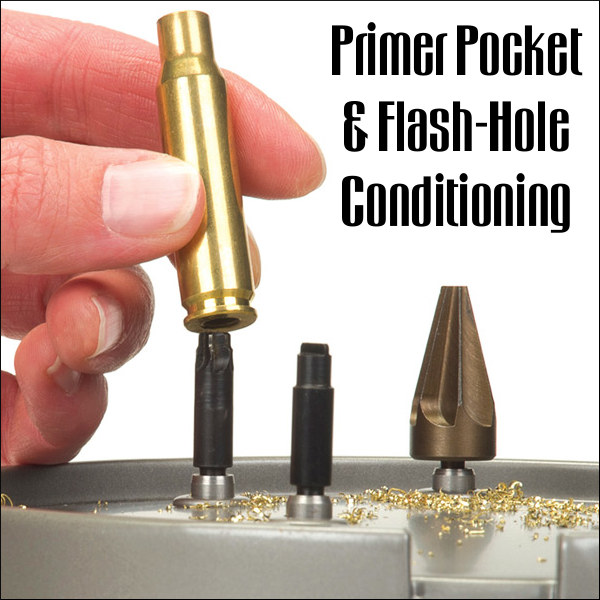
Primer Pocket & Flash-Hole Conditioning
This week, we’ll address a question that frequently arises: “Do you uniform primer pockets and deburr flash-holes?” As we tailor our handloading methods to the specific needs of each instance, the answer, not surprisingly, is “Sometimes!” However, don’t flip that dial just yet, as what determines our approach may be helpful in deciding how to address one’s own techniques. Moreover, we have a buried “Easter Egg” morsel that may bring a chuckle, as well as useful safety information!
Generally, the USAMU Handloading Shop does not uniform primer pockets (PP) or deburr flash holes (FH) of our rifle brass. We’re certainly not against it… Rather, this reflects the very high volume of ammunition we load, the fact that very few cases are ever re-loaded for a second firing, and the types of brass we use. However, as a need is perceived, we DO deburr flash holes. Of interest, we have fired many very small, 1000-yard test groups and aggregates using weight-selected, domestic brass that had not had PPs uniformed or FHs deburred.
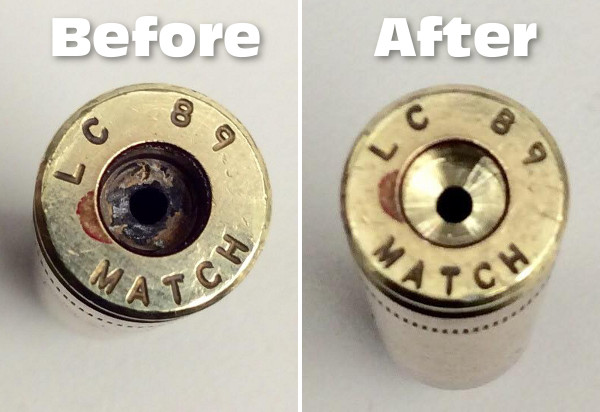
Before and After — On the left is a fired, deprimed 7.62×51 case with primer residue intact. On the right the primer pocket has been uniformed to SAAMI specs. Note the shiny finish at the bottom of the pocket — evidence of the the removal of metal when uniforming the primer pocket.
As to the type cases we use, many thousands of our long-range 5.56mm cases come to us from the arsenal with the primer of our choice pre-installed and staked-in, per usual practice. Obviously, we cannot uniform either FHs or PPs on this live, primed brass. However, after careful sorting, inspection and preparation, we do obtain match-winning results with it.
Shooters who reload their brass several times may decide to uniform PPs and deburr FHs, especially on their “300-yard and beyond” brass. Here, they will use the cases many times, while the uniforming is performed only once. Also, most handloaders only process moderate amounts of brass, compared to our multi-thousand round lots.
Having high quality Long Range (LR) brass helps. Many of the better brass manufacturers [make] their flash holes so that no burrs are created. Still, it does pay to inspect even THESE manufacturer’s products, as occasional slips are inevitable. Very rarely, some of the best makers will have a significant burr in, say, 1 per 1000 or 2000 cases, and it’s worth catching those.
Exceptions can always be found. Recently, we began processing a large lot of match brass from a premier manufacturer. We were startled to find that every case had a significant burr in the FH — something we’d never before seen from this maker. We then broke out the FH deburring tools and went to work.
Some observers have noted that it can be difficult to truly verify the contribution to accuracy of these procedures — particularly when firing from the shoulder, in conditions. Members of this staff, as individual rifle competitors, do often perform these operations on their privately-owned LR rifle brass. One could ascribe this to the old High Power Rifle maxim that “if you think it helps, then it helps.”
However, a World Champion and Olympic Gold/Silver medalist here commented on his own handloading (for International competition, which demands VERY fine accuracy). He noted that he did seem to see a decline in accuracy whenever he did not uniform FHs, deburr FHs and clean primer pockets before each reloading. (One might be tempted to counter that only a truly World Class shooter could reliably detect the difference.) However, with the wisdom of decades experience, our Champion also remarked that “It could have been that I just wasn’t shooting as well that day.”
For those who do opt for these procedures, note that various tool models may have adjustable depth-stops; pay attention to the instructions. Some FH-deburring tools (which enter the case mouth, not the primer pocket) are dependent upon uniform case length for best results.
Above is a flash-hole deburring tool on an RCBS powered case-prep unit. These case prep machines can save a lot of pain and misery, helping one perform various functions quickly and efficiently.


 The shooting season is now in full swing. When you head to the range you’ll want to be prepared. That means collecting all the gear you’ll need at the range. It’s easy to forget small, critical items, so we’ve provided a checklist of the small “extras” you should pack before you head out to the range. In addition to rifle, rests, ammo, targets, and cleaning gear, here are a dozen essentials you should include in your range bag.
 • Shell-Holder — If you don’t have calipers, you can use a shell-holder to check for excessive case expansion from hot loads. If a fired case doesn’t slip into the shell-holder easily, your load is definitely TOO HOT.
 • Hex Wrench or Screwdriver for action screws — Action screws can work loose with time. Always bring the appropriate hex wrench or screwdriver whenever you go to the range.
 • Extra Batteries — Bring extra batteries for all your electronic gear — which can include chronograph, windmeter, digital camera, GPS etc.
 • Folding Chair or Camp Stool — This comes in handy if you’re spotting for another shooter, or if you reload away from the firing line.
 • Small Plastic Ruler — Use this to measure your group sizes. A transparent (see-through) ruler works best. Rulers are also useful for drawing lines on targets.


 A while back, we featured a portable reloading bench built on a Black & Decker Workmate. That proved a VERY popular do-it-yourself project so we’re showing it again, in case you missed it the first time.