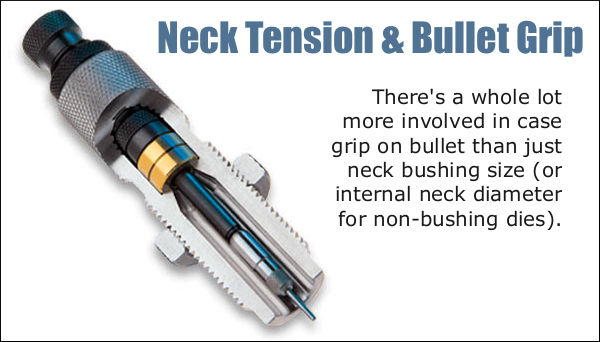
Many novice hand-loaders believe that neck bushing Inside Diameter (ID) size is the only important factor in neck tension. In fact, many different things will influence the grip on your bullet and its ability to release from the case neck. To learn the ins and outs of neck tension, take some time and read this article carefully.
Neck Tension (i.e. Grip on Bullets) Is a Complex Phenomenon
While we certainly have considerable control over neck tension by using tighter or looser bushings (with smaller or bigger Inside Diameters), bushing size is only one factor at work. It’s important to understand the multiple factors that can increase or decrease the resistance to bullet release. Think in terms of overall brass-on-bullet “grip” instead of just bushing size (or the internal neck diameter in non-bushing FL dies).
Bullet grip is affected by many things, such as:
1. Neck-wall thickness.
2. Amount of bullet bearing surface (shank) in the neck.
3. Surface condition inside of neck (residual carbon can act as a lubricant; ultrasonic cleaning makes necks “grabby”).
4. Length of neck (e.g. 6mmBR neck vs. 6mm Dasher).
5. Whether or not the bullets have an anti-friction coating.
6.The springiness of the brass (which is related to degree of work-hardening; number of firings etc.)
7. The bullet jacket material.
8. The outside diameter of the bullet and whether it has a pressure ridge.
9. Time duration between bullet seating and firing (necks can stiffen with time).
10. How often the brass is annealed.
11. Amount (length) of neck sized (e.g. you can size only half the neck).
12. Interior diameter of bushing, or neck section of non-bushing die.
— and there are others…
One needs to understand that bushing size isn’t the beginning and end of neck tension questions, because, even if bushing size is held constant, the amount of bullet “grip” can change dramatically as the condition of your brass changes. Bullet “grip” can also change if you alter your seating depth, and it can even change if you ultrasonically clean your cases.
In our Shooters’ Forum a reader recently asked: “How much neck tension should I use?” This prompted a Forum discussion in which other Forum members recommended a specific number based on their experience, such as .001″, .002″, or .003″. These numbers, as commonly used, correspond to the difference between case-neck OD after sizing and the neck OD of a loaded round, with bullet in place. In other words, the numbers refer to the nominal amount of interference fit (after sizing).
While these commonly-used “tension numbers” (of .001″, .002″ etc.) can be useful as starting points, neck tension is actually a fairly complex subject. The actual amount of “grip” on the bullet is a function of many factors, of which neck-OD reduction during sizing is just one. Understanding these many factors will help you maintain consistent neck tension as your brass “evolves” over the course of multiple reloadings.
Seating Depth Changes Can Increase or Decrease Grip on Bullet
You can do this simple experiment. Seat a boat-tail bullet in your sized neck with .150″ of bearing surface (shank) in the neck. Now remove the bullet with an impact hammer. Next, take another identical bullet and seat it with .300″ of bearing surface in another sized case (same bushing size/same nominal tension). You’ll find the deeper-seated bullet is gripped much harder.
Neck-Wall Thickness is Important Too
I have also found that thinner necks, particularly the very thin necks used by many PPC shooters, require more sizing to give equivalent “grip”. Again, do your own experiment. Seat a bullet in a case turned to .008″ neckwall thickness and sized down .003″. Now compare that to a case with .014″ neckwall thickness and sized down .0015″. You may find that the bullet in the thin necks actually pulls out easier, though it supposedly has more “neck tension”, if one were to consider bushing size alone.
In practical terms, because thick necks are less elastic than very thin necks, when you turn necks you may need to run tighter bushings to maintain the same amount of actual grip on the bullets (as compared to no-turn brass). Consequently, I suspect the guys using .0015″ “tension” on no-turn brass may be a lot closer to the guys using .003″ “tension” on turned necks than either group may realize.
Toward a Better Definition of Neck Tension
As a convenient short-cut, we tend to describe neck tension by bushing size alone. When a guy says, “I run .002 neck tension”, that normally means he is using a die/bushing that sizes the necks .002″ smaller than a loaded round. Well we know something about his post-sizing neck OD, but do we really have a reliable idea about how much force is required to release his bullets? Maybe not… This use of the term “neck tension” when we are really only describing the amount of neck diameter reduction with a die/bushing is really kind of incomplete.
My point here is that it is overly simplistic to ask, “should I load with .001 tension or .003?” In reality, an .001″ reduction (after springback) on a thick neck might provide MORE “grip” on a deep-seated bullet than an .003″ reduction on a very thin-walled neck holding a bullet with minimal bearing surface in the neck. Bushing ID is something we can easily measure and verify. We use bushing size as a descriptor of neck tension because it is convenient and because the other important factors are hard to quantify. But those factors shouldn’t be ignored if you want to maintain consistent neck tension for optimal accuracy.
Consistency and accuracy — that’s really what this all about isn’t it? We want to find the best neck tension for accuracy, and then maintain that amount of grip-on-bullet over time. To do that you need to look not only at your bushing size, but also at how your brass has changed (work-hardened) with time, and whether other variables (such as the amount of carbon in the neck) have changed. Ultimately, optimal neck tension must be ascertained experimentally. You have to go out and test empirically to see what works, in YOUR rifle, with YOUR bullets and YOUR brass. And you may have to change the nominal tension setting (i.e. bushing size) as your brass work-hardens or IF YOU CHANGE SEATING DEPTHS.
Remember that bushing size alone does not tell us all we need to know about the neck’s true “holding power” on a bullet, or the energy required for bullet release. True bullet grip is a more complicated phenomenon, one that is affected by numerous factors, some of which are very hard to quantify.
Everyone should own a rifle chambered for the 17 HMR. This is an inherently accurate cartridge, with minimal recoil. The 17 HMR, loaded with 17- or 20-grain bullets, is effective on small varmints well past 150 yards. The ballistics are way better than the .22 LR and .22 WMR. There are also a variety of good factory rifles available, including Savage’s innovative A17, now available in a nice, thumbhole laminated stock. And most importantly, the ammo is becoming more affordable. You can now get good 17 HMR ammo for under twenty cents per round.
The laminated thumbhole stock version of the Savage A17 is a great carry-around varminter.
There are great deals to be had right now on 17 HMR — you can pick up a 50-round box for under $9.00. A couple seasons back you might have to pay $12-$15 for the same stuff. The best deal we’ve found is at Midsouth Shooters Supply, which has Hornady 17 HMR ammo loaded with 17-grain V-Max bullets, for just $8.69 (17.4 cents/round).
Here are other current good deals, as found with the WikiArms.com ammo search engine:
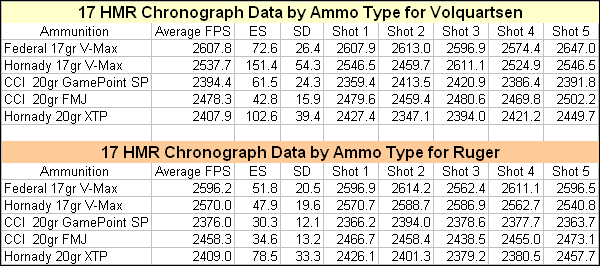
A while back we tested a variety of 17 HMR ammo types in a pair of 17 HMR rifles, a Ruger 77/17 and a Volquartsen (above), chronographing the ammo samples in both guns. Here are our chrono test results.
Dustin Ellermann (past Top Shot Champion) has tested both normal and subsonic 17 HMR ammo in another Volquartsen rifle. He got the best accuracy with the CCI-brand A17 ammo, which is optimized for the Savage A17 rifle. This impressive 100-yard group was shot with A17 ammo:
We like air rifles both for fun shooting and for competition. However, so many options are now available that is easy to get over-whelmed with the choices. Thankfully, there is a good book that helps air rifle shooters make informed decisions about air guns and gear. Steve Markwith’s new title, Air Rifles: A Buyer’s and Shooter’s Guide offers a wealth of useful information. This 154-page paperback book is now available for $12.95. The book is also offered as a FREE Kindle download for Amazon Prime and Kindle Unlimited members. Check it out — you may be able to get the book for free.
“This is a very informative book explaining the ins and outs of air rifles, their capabilities and limitations. I highly recommend this book to anyone considering purchasing an air rifle for marksmanship practice or small game hunting.” – L. Stanek, Verified Amazon Reviewer
Read Free Sample Chapters Online
If you go to Amazon.com and click on the cover of this book, you can view a FREE preview with extensive samples from many chapters. The book covers all the most important types of air rifle systems, both pre-charged pneumatics and other self-charging guns. Markwith reviews the wide variety of pellets available, offering suggestions for particular applications. You’ll also find a useful discussion of Airgun Power, Range, and Accuracy. This will help you pick the right air rifle for your application.
Markwith explains the many attractions of airguns. They are not considered firearms (in most jurisdictions) so they can be purchased at local shops or mail-order outlets without FFL fees or background checks. You’ll find a huge online selection of airguns at PyramydAir.com that can ship direct to you — no FFL required. Air rifles are also quiet and very inexpensive to shoot. While .177 and .22 caliber air rifles are most common, there are also larger-caliber airguns offered for hunting or special applications.
New Creedmoor “Scope Kennel” Padded Rifle Scope Protector
Creedmoor Sports has developed a deluxe scope protector that looks good. Made with thick padding and heavy webbing, this can definitely help shield expensive optics from impact damage or scrapes, protecting your investment.
The new Creedmoor Scope Kennel padded rifle scope protector fits any scope shorter than 13 inches, and protects your rifle scope while you’re on the range, stowing your rifle in a gun safe, or working on/cleaning your rifle. As you can see, the cover allows the use of an Empty Chamber Indicator.
The Scope Kennel is securely held in place by two heavy-duty adjustable straps, and is available with either Velcro closures or buckle closures. Made from tough 1000-dernier Cordura (with a soft, lined interior), this cover is offered in your choice of 24 different colors (e.g. tan, camo, red, blue, green) for $59.95. Made in the USA by Creedmoor’s own fabric wizards, the Scope Kennel can be customized with your name embroidered on the sides. The Scope Kennel was designed specifically for AR-platform rifles, but you can call 800-273-3366 to order for other types of rifles.
To demonstrate the strength of the Scope Kennel, Creedmoor GM Dennis DeMille did a pull-up with a red Scope Kennel hooked on a fork-lift blade.
More and more folks are using Burris Signature Rings these days. These unique rings feature polymer inserts. That allows you to pre-load some elevation in your scope set-up, or you can center-up the windage. Additionally, the polymer inserts hold your scope securely without leaving marks on the tube. Lastly, some folks believe that Signature rings may offer advantages for benchrest competition. Rodney Wagner shot the best 600-yard group in history using Burris Signature Zee Rings (“Zee” denotes the Weaver-rail model). James O’Hara set multiple IBS 1000-yard records using Burris Signature Zee Rings. James will tell you he thinks “all his guns seem to shoot best with these rings”.
Records Have Been Set with Signature Zee Rings
Are Signature Zees good enough for competition? Absolutely. Some folks scoff at these Burris rings, given their low price. A set of 1″-diameter Sig Zees cost just $38.79 at Grafs.com. But consider this, Rodney Wagner shot the smallest 600-yard group in history, a 0.336″ 5-shot stunner, using Signature Zee Rings on his IBS Light Gun. Here’s a photo of Rodney showing the record-setting rifle, outfitted with affordable Signature Zee 30mm rings.
Vendors Have Burris Signature Rings in Stock Now
A quick search of webstores shows that various models of Burris Signature Rings are available from many vendors. NOTE: You may have to check with more than one seller to get the exact size, height, and model you prefer. But right now these vendors have pretty good selections of Signature Zees, including the hard-to-find 30mm High and Extra High models. If you check all three sellers, you’ll probably find what you need.
A while back, RifleShooter online magazine published a list of the purported Ten Best Bolt-Action Rifles of All Time. Ten classic rifle designs (including the Remington 700 and Winchester Model 70) were featured with a paragraph or two explaining their notable features.
“Best” Lists Stir Controversy…
These Top 10 lists are always controversial. While most readers might approve of half the entries, there are always some items on the Top 10 list that some readers would challenge. Here is RifleShooter’s Top 10 list. What do you think? Are there some other bolt-actions that are more deserving?
1. Springfield M1903
2. Mauser 98
3. Winchester Model 70
4. Remington Model 700
5. Weatherby V
6. Sako L61/AV
7. Savage Model 110
8. Ruger M77
9. Tikka T3
10. Mannlicher-Schonauer
Here is the original Sierra manufacturing facility in Whittier, CA.
On August 22, 2017 it was announced that Sierra Bullets has been sold to Clarus Corporation (NASDAQ: CLAR), a Utah-based holding company that also owns Black Diamond Equipment Ltd., makers of ski and mountain gear/apparel. Given the importance of this acquisition, we thought our readers might want to learn more about Sierra’s history, and how it makes its bullets…
Sierra Bullets — How It Got Started
Report Based on Story by Carroll Pilant, Sierra Bullets Media Relations Manager
What became Sierra Bullets started in the late 1940s in a Quonset hut in California. In 1947, three aircraft machinists, Frank Snow, Jim Spivey, and Loren Harbor, rented machine space to produce rivets for the aircraft industry along with fishing rod guides and rifle front sight ramps. In the post-WWII years, sport shooting was becoming hugely popular, but quality ammunition was in short supply. For shooting enthusiasts, reloading was the solution to the ammo supply shortage. Snow, Spivey, and Harbor recognized this, creating Sierra Bullets to help fill the void. Before long, they were selling a 53-grain match bullet to the Hollywood Gun Shop. These bullets are still in production today as the Sierra #1400 53-grain MatchKing.
A few years later, an accomplished competitive shooter named Martin Hull joined Sierra. Hull helped develop new bullet types and served as manager of Sierra’s ballistics laboratory for nearly 20 years. With Hull’s help, Sierra’s output grew rapidly. The California company outgrew several locations before it moved to a large facility in Santa Fe Springs, CA, in 1963.
New Owners and New President in the Late Sixties
In 1968, the Leisure Group bought Sierra Bullets. Other Leisure Group companies included Lyman Reloading, High Standard Manufacturing Company, Yard Man, Thompson Sprinkler Systems, Flexible Flyer Sleds, and Dodge Trophies (Which made the Oscar and Rose Bowl Game trophies).
Soon after purchasing Sierra, the Leisure Group hired Robert Hayden as President and General Manager. Hayden was a mechanical engineer who had worked for Remington Arms. Hayden remained the president of Sierra for 42 years, retiring in 2012 when Pat Daly became president.
Sierra Moves to Missouri
In 1990, Sierra relocated to Sedalia, Missouri, where the company remains today. Sierra Bullets now employs over 100 people including five full-time ballistic technicians who answer daily reloading and firearms questions by both phone and e-mail.
The Making of MatchKings — How Sierra Produces SMKs
All Sierra bullets begin life as a strip of gilding metal, an alloy consisting of 95% copper and 5% zinc. To meet Sierra’s strict quality requirements, the gilding metal requires three times more dimensional and quality control standards than is considered standard in the copper manufacturing industry.
A blanking press stamps out a uniform disc and forms the cup that will be drawn into the MatchKing jacket. The cup is then polished and sent to a draw press to be drawn into a jacket that is longer than needed for the future MatchKing, thus allowing for the trim process. Press operators constantly check concentricity to make sure we have only quality jackets. The jackets then go to a trimmer where they are visually inspected again.
After being polished a second time, the jacket travels to the bullet press. In the meantime, 80-pound lead billets are being extruded into lead wire for the cores where great care is taken so that the core wire is not stretched. The core wire is lightly oiled before continuing to the bullet press to be swaged.
The lead core wire and trimmed jacket meet at the bullet press where the first stage forms a boattail on the jacket. The lead core is then formed on top of the bullet press and fed down into the jacket. In one stroke of the press, the MatchKing is formed.
Quality control technicians pull samples from each lot of MatchKings to make sure they meet Sierra’s stringent standards. Samples are then sent to Sierra’s 300-meter underground test range (shown below) to be shot for accuracy on mechanical mounts referred to as “unrestricted return to battery rests” that Sierra designed and built in-house.
After inspection, the bullets are placed in the familiar green box along with reloading labels. They are then shrink-wrapped and shipped all over the world.
If you like accurate rifles and reactive targets, you’ll enjoy this episode of Shooting USA TV, which features long-range varmint silhouette competition in Texas, the Lone Star State. We have participated in these kind of matches on the West Coast — they are definitely a ton of fun. The sport combines the pure accuracy of benchrest competition with the fun of knocking down critter targets. These are smaller than standard silhouettes, so it’s quite a challenge to hit them at 300 yards and beyond. In this episode, host John Scoutten competes with his 6.5 Creedmoor PRS rifle. He found that 1-MOA Coyotes offered plenty of challenge at 385 meters! Most shooters use benchrest-grade rifles with premium front rests.
EDITOR: We strongly recommend you take the time to watch this Shooting USA feature — it shows some top-flight benchrest rifles, and also covers the origins of benchrest varmint silhouette in Pennsylvania. There are even some AccurateShooter Forum members on screen. John Scoutten also does nice job explaining the challenges of shooting this discipline with a PRS rig. We think any benchrest or tactical shooter will really enjoy watching this video.
Full 48-Minute Episode of Shooting USA featuring TX Varmint Silhouette:
Travis Frazier of Field & Cave Outfitters says shooters love the reactive targets: “The most exciting thing is seeing your hits — these [targets] really go airborne”. Yep, that’s the best thing about Varmint Silhouette matches — hits deliver instant gratification. Travis designs and produces these steel targets.
This Texas match features multiple target shapes, 10 at each distance: Tiny Prairie Dogs at 200m, 3″x3″ Armadillos at 300m; 3″x5″ Coyotes at 385m; 5″x4″ Hogs at 500m; Chickens (on swingers) at 600 yards; and Pigs (on Swingers) at 750 yards. Competitors are allowed 10 rounds and 10 minutes to hit each set of targets.
BONUS Features in this Shooting USA Episode
Rimfire Challenge World Championship
This episode also includes the Rimfire Challenge World Championship in Alabama (starting at 33:25). This event attracts hundreds of shooters who ring steel with .22 LR rifles and pistols. This may be the ultimate fun match for the whole family. Many of the top shooters are juniors, who can run the all-steel stages in three seconds. The 16 stages each have 5 to 8 steel targets that can be shot in any order, but the last round must go on the red-marked “Stop Plate”.
History of the Gun: Remington 700
This week’s gun history segment of Shooting USA features the Remington 700, one of the most successful bolt-action rifles ever, with over 5 million produced. The Rem 700 has served hunters, military marksmen, and Rem 700 actions have been used for countless competition rifles.
Sierra Bullets has been acquired by Clarus Corporation (NASDAQ: CLAR) for the sum of $79,000,000, “subject to a post-closing working capital adjustment”. Sierra is one of the world’s leading producers of bullets for hunters, sportsmen, and target shooters. With revenues topping $30,000,000 per year, Sierra has long been a major force in the firearms world. Clarus, formerly Black Diamond Inc., is a Utah-based holding company which “seeks opportunities to acquire and grow businesses that can generate attractive shareholder returns”. Clarus also owns Black Diamond Equipment, Ltd., maker of outdoor equipment/clothing for the climbing, skiing and mountain sports markets.
StreetInsider.com reports: “The transaction is expected to be immediately accretive to Clarus’ earnings per share. For the unaudited 12 months ended June 30, 2017, Sierra’s total revenues were approximately $32 million with EBITDA of approximately $12.5 million, representing a purchase price multiple of approximately 6.3x EBITDA. Sierra has a strong cash flow profile, generating free cash flow conversion of approximately 95% with limited ongoing capex requirements.”
“The team at Sierra has continued building on a 70-year legacy dedicated to the highest-level of precision in design, world-class manufacturing and quality control,” said Warren B. Kanders, executive chairman of Clarus. “These attributes have cultivated a diverse customer base of enthusiasts and industry OEMs that drive high recurring revenue and strong cash flow, which we expect to maximize through the utilization of our net operating loss carry forwards.”
Sierra’s President Pat Daly commented: “Our team takes great pride in developing and manufacturing the most precise and accurate bullets in the world. This is supported by our deep institutional knowledge of highly-specialized manufacturing processes that have produced leading products and created a significant competitive advantage. As the only pure-play bullet brand, it was important for us to partner with a team that shares our values and commitment to excellence, and we are excited to join the Clarus family. I look forward to staying on to continue driving our brand growth.” All senior management are expected to remain with Sierra under Clarus’ ownership.
About Sierra Bullets
Founded in 1947 in California, Sierra Bullets is an American manufacturer of bullets. Based in Sedalia, Missouri since 1990, Sierra manufactures a wide range of bullets for both rifles and pistols. Sierra’s product line, recognized by iconic “green box” packaging, includes popular brands such as MatchKing, GameKing, and BlitzKing. Sierra bullets are used for precision target shooting, hunting, and defense purposes. For more information, visit SierraBullets.com.
News Tip from Boyd Allen. We welcome reader submissions.
Burris Signature Rings with polymer inserts are an excellent product. The inserts allow you to clamp your scope securely without ring marks. Moreover, using the matched offset inserts you can “pre-load” your scope to add additional elevation. This helps keep the scope centered in its elevation range while shooting at long range. Additionally, with a -20 insert set in the front and a +20 insert set in the rear, you may be able to zero at very long ranges without using an angled scope base — and that can save money. (To move your point of impact upwards, you lower the front of the scope relative to the bore axis, while raising the rear of the scope.)
Insert Elevation Values and Ring Spacing
People are sometimes confused when they employ the Burris inserts. The inset numbers (-10, +10, -20, +20 etc.) refer to hundredths of inch shim values, rather than to MOA. And you need the correct, matched top/bottom pair of inserts to give you the marked thousandth value. Importantly, the actual amount of elevation you get with Burris inserts will depend BOTH on the insert value AND the spacing between ring centers.
Forum member Gunamonth has explained this in our Shooters’ Forum:
Working with Burris Signature Rings
Burris inserts are [marked] in thousandths of an inch, not MOA. To know how many MOA you gain you also need to know the ring spacing. For example, with a -20 thou insert set in the front and a +20 thou insert set in the rear, if the ring spacing is 6″, the elevation change will be approximately +24 MOA upwards.
Here’s how we calculate that. If you have a 2 X 0.020″ “lift” over a distance of 6 inches (i.e. 0.040″ total offset at 0.5 feet) that’s equivalent to 0.080″ “lift” over 12 inches (one foot). There are 300 feet in 100 yards so we multiply 0.080″ X 300 and get 24″ for the total elevation increase at 100 yard. (Note: One inch at 100 yards isn’t exactly a MOA but it’s fairly close.)
Here’s a formula, with all units in inches:
Total Ring Offset
——————– X 3600 = Change @ 100 yards
Ring Spacing
(.020 + .020)
—————– X 3600 = 24 inches at 100 yards
6
NOTE: Using the above formula, the only time the marked insert offset will equal the actual MOA shift is when the center to center ring spacing is 3.60″. Of course, you are not required to use 3.60″ spacing, but if you have a different spacing your elevation “lift” will be more or less than the values on the inserts.


 In our Shooters’ Forum a reader recently asked: “How much neck tension should I use?” This prompted a Forum discussion in which other Forum members recommended a specific number based on their experience, such as .001″, .002″, or .003″. These numbers, as commonly used, correspond to the difference between case-neck OD after sizing and the neck OD of a loaded round, with bullet in place. In other words, the numbers refer to the nominal amount of interference fit (after sizing).
 Neck-Wall Thickness is Important Too






 More and more folks are using Burris Signature Rings these days. These unique rings feature polymer inserts. That allows you to pre-load some elevation in your scope set-up, or you can center-up the windage. Additionally, the polymer inserts hold your scope securely without leaving marks on the tube. Lastly, some folks believe that Signature rings may offer advantages for benchrest competition. Rodney Wagner shot the best 600-yard group in history using Burris Signature Zee Rings (“Zee” denotes the Weaver-rail model). James O’Hara set multiple IBS 1000-yard records using Burris Signature Zee Rings. James will tell you he thinks “all his guns seem to shoot best with these rings”.


 .
. 


