Editor: This story by Tommy C. (aka “dc.fireman”) comes from our Shooters’ Forum. It’s fascinating to see how a relatively inexpensive Savage M12 BVSS varmint rig was transformed into a sophisticated 300M match rifle with a modern chassis, Shilen barrel, and top-of-line sights. With some ingenuity, and careful parts selection, Tommy created a rifle that can compete with match rifles costing many thousands of dollars more. American ingenuity at work!
Savage Reborn — Old BVSS Transformed into 300M Match Rifle
by Tommy C. (aka “dc.fireman”)
So, I began the project of building a 300M International competition gun, about a year ago, intending to compete at the 300M Nationals this year in Minnesota at the Minneapolis Rifle Club. Realistically, I didn’t want to pay the price-tag demanded of the Bleikers, Grunig & Elmigers, Hammerlis, or Tanners that (infrequently) pop-up for sale from time to time. So I decided to build my own 300M Match rifle with an American action, barrel, chassis, and trigger.
Here is Tommy’s completed 300M Match rifle with Savage action in PDC Custom chassis.
I had decided on the .260 Remington (aka 6.5-08) as the caliber choice. This beat out 6.5×47 Lapua simply due to the cost/availability of brass. The .260 Rem cartridge is based on the .308 Win parent. I made my first batch of brass by necking down some Federal .308, and it worked great. [Editor: We do recommend Lapua .260 Remington brass for match purposes for those who don’t have a supply of good .308 Win brass.]
I had an older Savage M12 stagger-feed action, originally from an old .22-250 BVSS. I contacted James at Northland Shooter Supply, and he walked me through the game plan and equipment I needed: Shilen Select Match 26″ barrel, NSS Stainless recoil lug and nut, a set of Forster headspace gauges, and the NSS action wrench.
Catalog photo of current Savage M12 BVSS in .22-250 Rem.
A few months later, I replaced the original Accu-trigger with a Rifle Basix SAV-II trigger, and immediately wondered why I waited so long to do that. The Rifle Basix is perfect for my application. Mind you the he safety DOES NOT work now, but, I don’t need it for my application.
Another member on the AccurateShooter Forum sold me a BVSS stock that has been re-worked by Alex Sitman of Masterclass Stocks, and it served as a placeholder, until I could find a maker who could nearly replicate my Feinwerkbau 2700 Alu stock in my smallbore match gun.
After scouring the AccurateShooter Forum, and multiple internet searches, I found PDC Custom in Michigan. I spoke with Craig Kierstadt a few times, before finally deciding to pull the proverbial trigger on his chassis. He had a few of the older chassis stocks with spacing for the Savage stagger-feed action. He machined an Anschutz rail into the fore-end for my hand stop and sling. Then he powder-coated the chassis black, and sent it to me sans grip and butt plate.
Photo of action/chassis. Tommy says: “It locks up really tightly, and you can tell Craig spent some time on the CNC work need to make this all fit.”
There are a few minor issues with the PDC chassis, but overall, I would rate this a 9.5 out of a possible 10. The price, and the features built into it, plus the ease of which everything fit together, far outweigh any minor issues. And two of the issues I quickly corrected with Teflon tape. I will need to make a walnut cheek piece — a curved one isn’t conducive to aperture iron sight shooting.
Savage Action .260 Rem 300M Match Rifle Components:
Action, Barrel, Stock, Grip
Savage M12 stagger-feed action, 4.27″ spacing
Shilen Select Match Barrel, 26″
Rifle Basix SAV-II Trigger
PDC Custom Chassis — tool-less adjustments
Bobsled SLED for single loading (required)
MEC Contact III Butt plate (German)
MEC handstop/sling swivel (German)
Walnut Target grip for AR-15 (eBay sourced)
Sight Components and Hardware
MEC Spy Long rear sight (German)
Centra front sight tunnel (German)
Centra adjustable aperture (German)
Medesha sight extension tube + collar
Champion’s Choice front sight base
Champion’s Choice mirage band
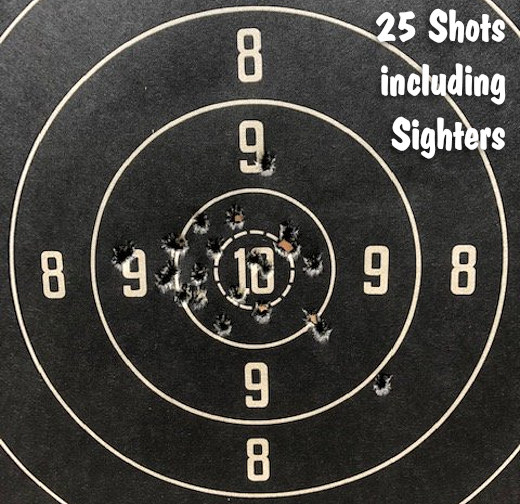
For his practice load, Tommy shot 123gr Hornady ELD-M bullets with H4831 powder and CCI BR2 primers. This load performed well — Tommy posted: “My 25-shot initial prone test today shows promise. There are five sighter shots, and 20 record shots. One of the 9s at 9 o’clock is my first sighter, the other one I own. The 8 out at 4 O’clock was a round that was difficult to chamber. My initial scoring puts me somewhere in the vicinity of 193-7X.”
The target used is the NRA C2, “300M International Rifle Target, reduced for 200 yards”. The 10 Ring is 2.40″ in diameter, while the Inner 10 (X-Ring) is 1.24″.
Match Load — Varget and Nosler Bullets
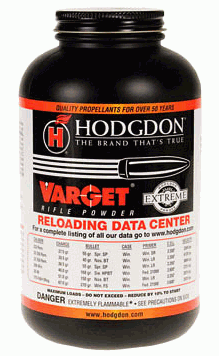
For his match load, Tommy switched to Varget and Nosler bullets: “My match load uses 37.9 grains Hodgdon Varget with a Nosler 123gr bullet. This was a recommendation by a gentleman with a lot of experience in 300M shooting.”
Tommy adds: “The amount of knowledge gained via the AccurateShooter Forum has made this all a reality, instead of just a passing thought.”
This impressive 15-round group was shot by Jim See of Elite Accuracy.
Different Shooting Disciplines Demand Different Levels of Precision/Accuracy
In the rapid-fire 3-Gun game, you could probably “clean” most stages with a 2-MOA rifle. By contrast, in the short-range group benchrest game, to compete with the best, you’ll need a rifle that shoots in the “ones” (i.e. 0.1-0.19 MOA) in perfect conditions. In 1000-yard F-Class competition, the top shooters want a rifle that will hold one-third-MOA of vertical at that distance.
What is your standard of accuracy? How good is “good enough”. Jim See, a skilled gunsmith and successful PRS competitor, recently answered that question for his tactical discipline. For the kind of matches Jim shoots, he likes to have a rifle that will hold half-MOA for five (5) shots, 3/4-MOA for 15 shots, and 1 MOA for twenty shots. Remarkably, Jim’s rifle can do that with factory ammo. Above is an impressive 15-shot group shot with .260 Remington Federal Premium Ammo.
“I say it all the time, my loads need to print 5 under 1/2″, 10 under 3/4″, and 20 under 1″. It’s simple, if a hot barrel will keep 20 rounds fired in succession under my standard it will be a good barrel and load for Precision Match Shooting. Federal Premium Gold Metal Match .260 with Sierra bullets made the cut for me today. 15 consecutive shots under 3/4 MOA.” –Jim See
It’s said that you “can never have too much accuracy”, but there are acceptable standards for each discipline, and they’re not the same. A 100/200 yard Benchrest shooter will be sorely disappointed with a rifle/ammo set-up that can only deliver half-MOA. On the other hand, a PRS competitor like Jim See can achieve great success with a lesser degree of precision. This means you can save time and money. You can run your barrels longer between cleanings, and you don’t have to go “full OCD” when loading your ammo. The PRS shooter does not need to weigh-sort primers, or load powder to single-kernel standards. Proof is the performance. Jim See has been a podium finisher at many PRS and tactical events. Learn more about Jim’s gunsmithing and training operations at Jim’s Facebook Page.
Download This Load Development Target
Jim’s target seemed a bit familiar. AccurateShooter.com created this Diamond and Dot Target a few years back. On each aiming point, there are high-contrast black horizontal and vertical lines for aligning your cross-hairs. The gray circle lets you see the bullet impacts above, without obliterating the red diamond, which is quite useful for precise aiming (we put fine cross-hairs on the points of the diamond). This target sheet includes data entry tables below each of the three aim points. There are many other free targets out there, but this format is very popular. We’re pleased to see Jim using it. You can download this and dozens of other FREE Targets from the AccurateShooter.com Target Page.
Brownells is a well-known retailer of guns, gun parts, tools, accessories, ammo, and pretty much everything gun related. Brownells has a very active video production department that releases new “how-to” and product information videos every week. These videos offer helpful advice on gun cleaning/maintenance, reloading, as well as selecting/assembling components for various kinds of rifles. There now over 1000 videos on the Brownells YouTube Channel, this really is a remarkable resource.
One of our favorite regular Brownells video features are the Quick Tip Cartridge Comparisons. Brownells tech staffers look at a pair of cartridge types and reveal the noteworthy differences. Here are three recent Cartridge Comparison videos from Brownells.
6.5 Creedmoor vs. .260 Remington
Brownells Gun Tech Caleb Savant compares and contrasts the 6.5 Creedmoor rifle cartridge with the older .260 Remington. Both cartridges are often loaded to nearly the same overall length (OAL), but with more of the bullet inside the neck for the .260 Rem. The .260 Remington is basically a .308 Winchester necked down to 6.5mm (.264″). The 6.5 Creedmoor has a shorter case, with a more modern 30-degree shoulder angle. With the same cartridge OAL, that can make it possible to load longer-ogive, higher-BC bullets. However, with a long-freebore chamber, the .260 Rem can certainly run any high-BC 6.5mm bullet made.
The .260 Remington can, theoretically, generate a bit more velocity at the muzzle because its longer case holds a bit more powder. However, with high-quality Lapua brass, in the real world, the 6.5 Creedmoor comes pretty darn close to .260 Rem performance with any given bullet weight. Moreover, the 6.5 Creedmoor is available with small primer pocket brass from Lapua. This brass may give a higher number of reloading cycles before case-head expansion becomes a problem. For the hunter, both choices are good, but the older .260 Rem may feed a bit better from a magazine, given the .260’s case taper and longer body. Overall, we favor the 6.5 Creedmoor for its versatility and efficiency, but the .260 Rem is a good cartridge too.
6.8 SPC vs. 6.5 Grendel
Brownells Gun Tech Caleb Savant compares two medium-caliber cartridges that can work in AR15-platform rifles: the 6.5 Grendel and the 6.8 SPC (aka 6.8mm Remington “Special Purpose Cartridge”). The 6.5 Grendel is typically loaded with a high-BC .264″ bullet, while the 6.8 SPC has a larger-diameter .277″ bullet. Both have the same 2.26″ OAL as the AR-15’s standard .223 Remington / 5.56 NATO round. The big difference is the 6.5 Grendel’s faster velocity and flatter trajectory. With the same bullet weight, Brownells says the 6.5 Grendel will be about 100 fps faster than the 6.8 SPC. Given a 100-yard zero, the 6.5 Grendel will drop about 8.5″ at 300 yards, while the 6.8 SPC will drop 10.5″ at the same range. The 6.5 Grendel is probably a better choice for long-range targets, at least when loaded with a higher-BC bullet. A big difference is brass. You can get superb Lapua brass for the 6.5 Grendel. Not so for the 6.8 SPC, which really has never developed into a widely popular accuracy round.
7.62×51 NATO vs. .308 Winchester (Subtle differences)
Brownells Technician Caleb Savant talks about the .308 Winchester and 7.62x51mm NATO. Most shooters know that both rounds have the same external dimensions. In fact, the military 7.62×51 was developed from the civilian .308 Winchester. So… can they be used interchangeably? The 7.62×51 cartridge normally can be fired from any rifle chambered in .308 Winchester because the 7.62 is spec’d for a lower pressure than SAAMI max in the .308 Win. However, we have encountered some British and Austrian 7.62×51 NATO milsurp ammo that was VERY hot — more than a typical commercial .308 Win Load. Accordingly you should always be careful when shooting new 7.62×51 ammo in your rifles. Likewise you should be careful about shooting higher-pressure .308 Win in some 7.62 NATO rifles. The 7.62×51 NATO chamber is slightly longer, and the cartridge’s case is typically a bit thicker, so it will “flow” and expand into the extra space. NOTE: Some newer rifles with 7.62×51 NATO chambers ARE made to handle .308 Win ammo. Check the owner’s manual or contact your rifle’s manufacturer to find out for sure.
.44 Magnum vs. .45 Long Colt — Great Wheelgun Cartridges
Brownells Gun Tech Steve Ostrem does a quick compare-and-contrast of the .44 Magnum and .45 Long Colt — two of the most popular revolver cartridges. The .45 LC debuted in the 1870s, when the steel used in revolvers was much weaker than modern steel, so it’s typically loaded as a low-pressure cartridge. The .44 Magnum was developed in the 1950s specifically for hunting, and stronger modern gun steels meant revolvers could be built to handle its much greater pressures. Full-power commercial .44 Magnum ammunition tends to be easier to find. The .45 Colt you find at the gun store is loaded mildly so folks don’t blow up their vintage revolvers! BOTH cartridges are great for handloading because they have straight-wall cases and can handle a wide variety of powders and bullet weights. Dies, brass, and bullets are readily available for both. If you don’t handload but want a hunting revolver, .44 Magnum is the better choice, as there’s more FULL-power factory ammo available.
If this article has got you thinking about loading for a new cartridge type or perhaps getting a new gun, head over to Brownells and enjoy the HoliDeals sale event going on right now. You can save from 10-50% on popular products including scopes, reloading presses, AR uppers and lowers, and many other items.
This impressive 15-round group was shot by Jim See of Elite Accuracy.
Different Shooting Disciplines Demand Different Levels of Precision/Accuracy
In the rapid-fire 3-Gun game, you could probably “clean” most stages with a 2-MOA rifle. By contrast, in the short-range group benchrest game, to compete with the best, you’ll need a rifle that shoots in the “ones” (i.e. 0.1-0.19 MOA) in perfect conditions. In 1000-yard F-Class competition, the top shooters want a rifle that will hold one-third-MOA of vertical at that distance.
What is your standard of accuracy? How good is “good enough”. Jim See, a skilled gunsmith and successful PRS competitor, recently answered that question for his tactical discipline. For the kind of matches Jim shoots, he likes to have a rifle that will hold half-MOA for five (5) shots, 3/4-MOA for 15 shots, and 1 MOA for twenty shots. Remarkably, Jim’s rifle can do that with factory ammo. Above is an impressive 15-shot group shot with .260 Remington Federal Premium Ammo.
“I say it all the time, my loads need to print 5 under 1/2″, 10 under 3/4″, and 20 under 1″. It’s simple, if a hot barrel will keep 20 rounds fired in succession under my standard it will be a good barrel and load for Precision Match Shooting. Federal Premium Gold Metal Match .260 with Sierra bullets made the cut for me today. 15 consecutive shots under 3/4 MOA.” –Jim See
It’s said that you “can never have too much accuracy”, but there are acceptable standards for each discipline, and they’re not the same. A 100/200 yard Benchrest shooter will be sorely disappointed with a rifle/ammo set-up that can only deliver half-MOA. On the other hand, a PRS competitor like Jim See can achieve great success with a lesser degree of precision. This means you can save time and money. You can run your barrels longer between cleanings, and you don’t have to go “full OCD” when loading your ammo. The PRS shooter does not need to weigh-sort primers, or load powder to single-kernel standards. Proof is the performance. Jim See recently took third place at the Spearpoint Shootout, and he has been a podium finisher at other events. Learn more about Jim’s gunsmithing and training operations at EliteAccuracy.com.
Download This Load Development Target
Jim’s target seemed a bit familiar. AccurateShooter.com created this Diamond and Dot Target a few years back. On each aiming point, there are high-contrast black horizontal and vertical lines for aligning your cross-hairs. The gray circle lets you see the bullet impacts above, without obliterating the red diamond, which is quite useful for precise aiming (we put fine cross-hairs on the points of the diamond). This target sheet includes data entry tables below each of the three aim points. There are many other free targets out there, but this format is very popular. We’re pleased to see Jim using it. You can download this and dozens of other FREE Targets from the AccurateShooter.com Target Page.
Brownells is a well-known retailer of guns, gun parts, tools, accessories, ammo, and pretty much everything gun related. Brownells has a very active video production department that releases new “how-to” and product information videos every week. These videos offer helpful advice on gun cleaning/maintenance, reloading, as well as selecting/assembling components for various kinds of rifles. There now over 1000 videos on the Brownells YouTube Channel, this really is a remarkable resource.
One of our favorite regular Brownells video features are the Quick Tip Cartridge Comparisons. Brownells tech staffers look at a pair of cartridge types and reveal the noteworthy differences. Here are three recent Cartridge Comparison videos from Brownells.
6.5 Creedmoor vs. .260 Remington
Brownells Gun Tech Caleb Savant compares and contrasts the 6.5 Creedmoor rifle cartridge with the older .260 Remington. Both cartridges are often loaded to nearly the same overall length (OAL), but with more of the bullet inside the neck for the .260 Rem. The .260 Remington is basically a .308 Winchester necked down to 6.5mm (.264″). The 6.5 Creedmoor has a shorter case, with a more modern 30-degree shoulder angle. With the same cartridge OAL, that can make it possible to load longer-ogive, higher-BC bullets. However, with a long-freebore chamber, the .260 Rem can certainly run any high-BC 6.5mm bullet made.
The .260 Remington can, theoretically, generate a bit more velocity at the muzzle because its longer case holds a bit more powder. However, with high-quality Lapua brass, in the real world, the 6.5 Creedmoor comes pretty darn close to .260 Rem performance with any given bullet weight. Moreover, the 6.5 Creedmoor is available with small primer pocket brass from Lapua. This brass may give a higher number of reloading cycles before case-head expansion becomes a problem. For the hunter, both choices are good, but the older .260 Rem may feed a bit better from a magazine, given the .260’s case taper and longer body. Overall, we favor the 6.5 Creedmoor for its versatility and efficiency, but the .260 Rem is a good cartridge too.
6.8 SPC vs. 6.5 Grendel
Brownells Gun Tech Caleb Savant compares two medium-caliber cartridges that can work in AR15-platform rifles: the 6.5 Grendel and the 6.8 SPC (aka 6.8mm Remington “Special Purpose Cartridge”). The 6.5 Grendel is typically loaded with a high-BC .264″ bullet, while the 6.8 SPC has a larger-diameter .277″ bullet. Both have the same 2.26″ OAL as the AR-15’s standard .223 Remington / 5.56 NATO round. The big difference is the 6.5 Grendel’s faster velocity and flatter trajectory. With the same bullet weight, Brownells says the 6.5 Grendel will be about 100 fps faster than the 6.8 SPC. Given a 100-yard zero, the 6.5 Grendel will drop about 8.5″ at 300 yards, while the 6.8 SPC will drop 10.5″ at the same range. The 6.5 Grendel is probably a better choice for long-range targets, at least when loaded with a higher-BC bullet. A big difference is brass. You can get superb Lapua brass for the 6.5 Grendel. Not so for the 6.8 SPC, which really has never developed into a widely popular accuracy round.
7.62×51 NATO vs. .308 Winchester (Subtle differences)
Brownells Technician Caleb Savant talks about the .308 Winchester and 7.62x51mm NATO. Most shooters know that both rounds have the same external dimensions. In fact, the military 7.62×51 was developed from the civilian .308 Winchester. So… can they be used interchangeably? The 7.62×51 cartridge normally can be fired from any rifle chambered in .308 Winchester because the 7.62 is spec’d for a lower pressure than SAAMI max in the .308 Win. However, we have encountered some British and Austrian 7.62×51 NATO milsurp ammo that was VERY hot — more than a typical commercial .308 Win Load. Accordingly you should always be careful when shooting new 7.62×51 ammo in your rifles. Likewise you should be careful about shooting higher-pressure .308 Win in some 7.62 NATO rifles. The 7.62×51 NATO chamber is slightly longer, and the cartridge’s case is typically a bit thicker, so it will “flow” and expand into the extra space. NOTE: Some newer rifles with 7.62×51 NATO chambers ARE made to handle .308 Win ammo. Check the owner’s manual or contact your rifle’s manufacturer to find out for sure.
.44 Magnum vs. .45 Long Colt — Great Wheelgun Cartridges
Brownells Gun Tech Steve Ostrem does a quick compare-and-contrast of the .44 Magnum and .45 Long Colt — two of the most popular revolver cartriges. The .45 LC debuted in the 1870s, when the steel used in revolvers was much weaker than modern steel, so it’s typically loaded as a low-pressure cartridge. The .44 Magnum was developed in the 1950s specifically for hunting, and stronger modern gun steels meant revolvers could be built to handle its much greater pressures. Full-power commercial .44 Magnum ammunition tends to be easier to find. The .45 Colt you find at the gun store is loaded mildly so folks don’t blow up their vintage revolvers! BOTH cartridges are great for handloading because they have straight-wall cases and can handle a wide variety of powders and bullet weights. Dies, brass, and bullets are readily available for both. If you don’t handload but want a hunting revolver, .44 Magnum is the better choice, as there’s more FULL-power factory ammo available.
This impressive 15-round group was shot by Jim See of Elite Accuracy.
Different Shooting Disciplines Demand Different Levels of Precision/Accuracy
In the rapid-fire 3-Gun game, you could probably “clean” most stages with a 2-MOA rifle. By contrast, in the short-range group benchrest game, to compete with the best, you’ll need a rifle that shoots in the “ones” (i.e. 0.1-0.19 MOA) in perfect conditions. In 1000-yard F-Class competition, the top shooters want a rifle that will hold one-third-MOA of vertical at that distance.
What is your standard of accuracy? How good is “good enough”. Jim See, a skilled gunsmith and successful PRS competitor, recently answered that question for his tactical discipline. For the kind of matches Jim shoots, he likes to have a rifle that will hold half-MOA for five (5) shots, 3/4-MOA for 15 shots, and 1 MOA for twenty shots. Remarkably, Jim’s rifle can do that with factory ammo. Above is an impressive 15-shot group shot with .260 Remington Federal Premium Ammo.
“I say it all the time, my loads need to print 5 under 1/2″, 10 under 3/4″, and 20 under 1″. It’s simple, if a hot barrel will keep 20 rounds fired in succession under my standard it will be a good barrel and load for Precision Match Shooting. Federal Premium Gold Metal Match .260 with Sierra bullets made the cut for me today. 15 consecutive shots under 3/4 MOA.” –Jim See
It’s said that you “can never have too much accuracy”, but there are acceptable standards for each discipline, and they’re not the same. A 100/200 yard Benchrest shooter will be sorely disappointed with a rifle/ammo set-up that can only deliver half-MOA. On the other hand, a PRS competitor like Jim See can achieve great success with a lesser degree of precision. This means you can save time and money. You can run your barrels longer between cleanings, and you don’t have to go “full OCD” when loading your ammo. The PRS shooter does not need to weigh-sort primers, or load powder to single-kernel standards. Proof is the performance. Jim See recently took third place at the Spearpoint Shootout, and he has been a podium finisher at other events. Learn more about Jim’s gunsmithing and training operations at EliteAccuracy.com.
Download This Load Development Target
Jim’s target seemed a bit familiar. AccurateShooter.com created this Diamond and Dot Target a few years back. On each aiming point, there are high-contrast black horizontal and vertical lines for aligning your cross-hairs. The gray circle lets you see the bullet impacts above, without obliterating the red diamond, which is quite useful for precise aiming (we put fine cross-hairs on the points of the diamond). This target sheet includes data entry tables below each of the three aim points. There are many other free targets out there, but this format is very popular. We’re pleased to see Jim using it. You can download this and dozens of other FREE Targets from the AccurateShooter.com Target Page.
The .260 Remington and the 6.5×55 Swedish (aka 6,5x55mm SE) are both very popular cartridges with hunters and target shooters. The 6.5×55 has a long military heritage and a great record as a hunting round. The .260 Rem, essentially a .308 Win necked down to .264 caliber, is a more recent cartridge, but it grows in popularity every year, being one of the top cartridges for tactical/practical competitions. It offers better ballistics and less recoil than the parent .308 Win cartridge. In our Shooter’s Forum, respected UK gun writer Laurie Holland provided a good summary of the differences between the two chamberings. Laurie writes:
The 6.5×55 case has 6 or 7% more capacity than the .260s, even more in practice when both are loaded to standard COALs with heavy bullets, which sees them having to seated very deep in the .260 Rem using up quite a lot of powder capacity. So loaded up for reasonable pressures in modern actions, the 6.5×55 will give a bit more performance.
The issue for many is what action length is available or wanted, the 6.5×55 requiring a long action. So sniper rifle / tactical rifle competitors will go for the .260 Rem with the option of the many good short-bolt-throw designs around with detachable box magazines (DBMs). If a bit more performance is needed, the .260 AI (photo right) can yield another 100-150 fps velocity, depending on bullet weight.
According to Military Times, the U.S. Special Operations Command (SOCOM) is considering replacing the 7.62×51 NATO in semi-auto sniper rifles with a mid-size 6.5 mm cartridge. The two leading candidates are the 6.5 Creedmoor and the .260 Remington. These 6.5 cartridges would deliver a flatter trajectory, better long-range ballistics, and reduced recoil compared to the 7.62×51 NATO (aka .308 Winchester). While the .260 Rem enjoys a case capacity edge over the 6.5 Creedmoor, in the real world, performance is similar — both cartridge types can push a 130gr bullet to velocities around 2900 fps. (See Sierra 6.5 CM Load Data.)
“Major Aron Hauquitz told Military Times Tuesday that SOCOM is in the preliminary stages of exploring a sniper rifle chambered in the 6.5 mm caliber. The two commercially available rounds being evaluated are the .260 Remington and the 6.5 mm Creedmoor.
Research shows that both rounds will ‘stay supersonic longer, have less wind drift and better terminal performance than 7.62 mm ammunition’, SOCOM officials said.
‘We’re purely in the exploratory phase’. Hauquitz said. ‘We’re trying to see if we can take a weapon that is 7.62 and give it greater range, accuracy and lethality.'”
The SOCOM representative indicated that test rifles in 6.5 Creedmoor and/or .260 Remington might be issued to test teams later this year, but there was no issue date in place yet. Hauquitz said the 6.5 mm exploration came out of preliminary results of the Small Arms Ammunition Configuration study, which assesses commercially available ammunition and new ammo technologies.
SOCOM Also Considering Polymer Cartridges
The Military Times report also revealed that SOCOM is considering polymer-cased rifle ammunition, with the goal of reducing load weight. SOCOM’s research shows that a polymer-cased mid-sized 6.5 mm cartridge could be one-third lighter than conventional brass-cased 7.62×51 ammo. That means the next-generation 6.5 mm ammo could “come in at 5.56×45 mm weight ranges”. While SOCOM is seriously looking at this new option, polymer-cased ammo will NOT be required for SOCOM’s new semi-auto rifle. In other words, if the polymer ammo is not ready, that “would not delay potential fielding of a 6.5 mm rifle” according to Maj. Hauquitz.
Are you a fan of 6.5mm rifle cartridges? Then you should visit TargetShooter Magazine and read Laurie Holland’s latest “magnum opus”. Laurie recounts the development of 6.5mm rifle cartridges and examines a host of “six-fives” including the well-known 6.5×55 Swede and more esoteric cartridges such as the 6.5×58 Vergueiro. Laurie looks at a variety of military 6.5mm cartridges, including Japan’s 6.5×50 Arisaka, as well as some big 6.5mm Magnums. This Editor shot a .260 Remington (essentially a necked down .308 Win) for quite a while. I was pleased to see that Laurie discusses the .260 Rem, along with its bigger brother, the 6.5-06.
Part One of a four-part series, this is a LONG article, which runs over 4000 words. There are more than a dozen photographs, showing both cartridge types and bullet types. In addition, cartridge specs are presented in two detailed tables. Here is a list of the notable 6.5mm cartridges Laurie references (and we may have missed a few):
The 6.5×55 Swedish Mauser and Other Early Designs
Thanks to the 6.5X55mm and its common name of ‘Swedish Mauser’ (it was a joint Swedish / Norwegian military development truth to tell), not forgetting first rate Lapua, Norma, and Sako ammunition and components, many associate the 6.5s with Scandinavian countries. However, the two Nordic nations weren’t alone in adopting 6.5mm designs during the back end of the 19th century, moreover Germany and Austria did as much to popularize the caliber. The Netherlands, Italy, Japan, Romania, Portugal and Greece took the small caliber military route too, although some later decided to convert at least partially to larger bores.
However, once armies started to adopt lighter, pointed bullets at improved velocities in the .30-class designs starting with the German 7.92mm 153gr bulleted S-Patrone of 1905 which produced the then astonishing MV of 2900 fps in the G98 rifle, the 6.5s lost out as contemporary propellants couldn’t handle smaller calibers as efficiently. It’s significant that while some early users moved to larger caliber service rifles, no country [other than Japan] has adopted 6.5mm in the last 110 years although there have been some unsuccessful initiatives recently.
Prior to WW2, there had only been a single American attempt to produce a 6.5, the brilliant cartridge designer and riflemaker Charles Newton with his eponymous 256 design of 1913 which used a shortened and necked-down 30-06 case. The Western Cartridge Company loaded ammunition for Newton, a 129gr expanding bullet at a claimed 2760 fps MV and obtained in a longer barrel than those fitted to production rifles.
RWS introduced the powerful 6.5X68mm in 1939 and it is still in use in Europe.
Many tactical shooters have adopted the .260 Remington as an alternative to the heavier-recoiling .308 Winchester. The .260 Rem has also performed well in the hands of long-range High Power shooters such as SSG Sherri Jo Gallagher, past National High Power Champion. The .260 Remington is basically the .308 Win necked down to .264 (6.5 mm) caliber. It can launch very high-BC 130-142 grain projectiles at impressive velocities. The ballistics of the .260 Rem allow it to shoot flatter, with less wind drift, than typical .308 Win loads.
For fans of the .260 Remington, very high-quality factory ammo is now available. ABM Ammo, a division of Berger Bullets just announced that it will produce two varieties of .260 Remington ammo.
ABM’s 260 Remington 140gr Berger Match Hybrid Target ammo is designed for class-leading ballistic and superior accuracy. Using the highest-BC 6.5 mm caliber bullet offered by Berger, the 140gr Hybrid, this load features less wind deflection and more energy on target than the competition. ABM claims that this Match Hybrid ammo is “unrivaled as a long-range 260 Remington factory ammo option.” Since it pushes a higher-BC bullet than other .260 Rem factory ammo, we’d have to agree with that statement.
Performance based on a 26″ barrel and sea level conditions.
Mission Ready .260 Rem OTM Tactical Load for Mag-Fed Rifles
ABM Ammo also offers .260 Rem factory ammo loaded with the NEW 130gr AR Hybrid bullet. The .260 Rem 130gr Berger Match AR Hybrid OTM Tactical load is optimized for the AR-10 platform or any magazine-fed rifle. Berger’s 130gr AR Hybrid bullet offers a 0.290 G7 BC. That’s very close to the 0.317 BC of the longer 140gr Hybrid. This, combined with a 2847 FPS muzzle velocity, provides excellent performance in a shorter COAL that feeds perfectly from box magazines.
In fact, if you run the ballistics (using JBM) using ABM’s published MVs, you’ll find that you give up nothing with the shorter bullet. At 600 yards, the 130gr “Mission Ready” load has 78.8″ (12.5 MOA) of drop. By comparison, the “Match Ready” load with 140-grainers has 80.3″ (12.8) MOA of drop at 600 Yards (That’s not a mistake — the smaller bullet has LESS drop because it has a higher MV to start.) At 1000 yards, the “Mission Ready” load is virtually identical to the “Match Ready” load: The 130gr ammo has 304.6″ (29.1 MOA) of drop at 1000 vs 303.4″ (29.0 MOA) for the 140gr ammo at the same distance. (These calculations are based on standard conditions at sea level, with ABM supplied MVs.)
Because the ballistics are so close, you may want to try both loads in your .260 Rem rifle, even if you single-load and are not restricted by mag length. Some barrels may have a preference for one bullet over the other.
Product Tip from EdLongRange. We welcome reader submissions.


 Match Load — Varget and Nosler Bullets


 The 6.5×55 case has 6 or 7% more capacity than the .260s, even more in practice when both are loaded to standard COALs with heavy bullets, which sees them having to seated very deep in the .260 Rem using up quite a lot of powder capacity. So loaded up for reasonable pressures in modern actions, the 6.5×55 will give a bit more performance.


