|
|
January 13th, 2015
Forum member Erik Cortina recently launched his own YouTube Channel dedicated to precision reloading and accurizing. Erik’s videos demonstrate the proper use of specialized reloading tools and provide helpful hints. Erik’s latest video is about the “mother of all brass trimmers”, the Giraud powered case trimmer. Erik says: “It you do volume reloading… this is the only trimmer to get. It not only trims to length but it also chamfers your case mouth inside and out.” In his video, Erik offers some very clever and useful tips that will help you get the most from your Giraud.
The Giraud trimmer is very precise. When set up correctly, it can trim brass with amazing consistency. In the video, Erik trims 5 pieces of brass in 15 seconds (6:32 mark). He then measures all five with precision calipers (7:00-8:08). All lengths are exact within .0005 (half a thousandth). Erik notes that the Giraud trimmer indexes off the case shoulder. As long as you have fire-formed brass with consistent base-to-shoulder dimensions, you should get very consistent trim lengths.
The secret to the system is a 3-way cutting head. This cutter can be swapped in and out in a couple minutes with wrenches provided with the kit. Erik has three different heads; one each for 6.5mm, 7mm, and .30 caliber. The video shows how to adjust the cutting heads to match caliber diameter (and to get the desired amount of inside/outside chamfer).
This is a manufacturer’s photo showing an older model.

To trim and chamfer cases, you simply insert them nose-first into the cartridge-specific case-holder. Erick offers a smart tip — He uses a die locking ring to position the cartridge holder (3:15). This can be locked in place. Erik says die locking rings work much better than the hex-nuts provided by Giraud (with the hex-nut, one must re-set cut length each time you change case-holders.)

The Giraud can be used in either horizontal or vertical modes. Erik prefers to have the trimmer aligned vertically, allowing him to push cases down on the trimmer head. But the trimming unit has twin sets of rubber feet, allowing horizontal or vertical orientation.

Improved Case-Holder Made with Chamber Reamer:
For his .284 Shehane, Erik had to create his own case-holder (Giraud does not make one for that wildcat cartridge). Erik used his chamber reamer. To his surprise, Erik found that the brass was easier to trim in the custom case holder (compared to the Giraud-made spring-loaded holders). With a perfect fit, trimming and case extraction went more smoothly and the process was easier on his hands. (See 9:00-10:00). Based on Erik’s experience, you may want to create your own custom case-holder.
Trim Bullet Meplats Also
With a special bullet-holder fitting and meplat cutter head, the Giraud power trimmer can be used to trim bullet meplats. Trimming meplats can help make the Ballistic Coefficents of a batch of bullets more consistent. Uniforming meplats is also often done as a first step in the process of “tipping” bullets to improve BC.


October 22nd, 2014
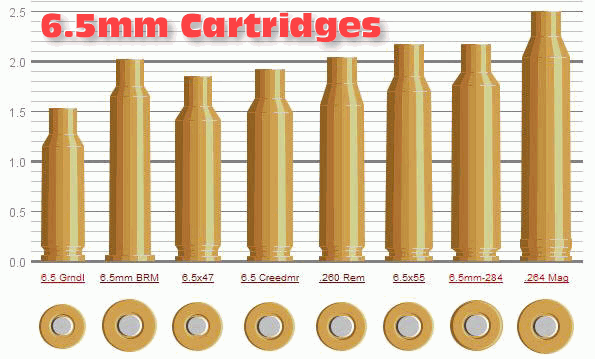
Chart created with Ammoguide’s Visual Comparison Tool. Visit Ammoguide.com to learn more.
by Eben Brown, EABCO.com, (E. Arthur Brown Co. Inc.)
The current popularity of 6.5mm cartridges in the USA has been a long time in coming. I won’t go into my opinions on why it took so long to catch on. The important thing is that it finally HAS caught on and we’re now so fortunate to have a wide selection of 6.5mm cartridges to choose from!
6.5mm Grendel – Developed by Alexander Arms for the AR15 and military M4 family of rifles. The Grendel fits the dimensional and functional requirements of these rifles while delivering better lethality and downrange performance. There are now similar cartridges from other rifle companies. We chamber for the Les Baer “264 LBC-AR”. Designed for velocities of 2400-2500 fps with 123gr bullets, it shoots the 140-grainers at about 2000 fps (for comparison purposes).
6.5mm BRM – Developed by E. Arthur Brown Company to give “Big Game Performance to Small Framed Rifles” — namely our Model 97D Rifle, TC Contender, and TC Encore. Velocities of 2400-2500 fps with 140gr bullets puts it just under the original 6.5×55 Swede performance.
6.5mm x 47 Lapua – Developed by Lapua specifically for international 300m shooting competitions (with some interest in long-range benchrest as well). Case capacity, body taper, shoulder angle, and small rifle primer are all features requested by top international shooters. You can expect velocities of 2500-2600+ with 140 gr bullets.
 6.5mm Creedmoor – Developed by Hornady and Creedmoor Sports, the 6.5mm Creedmoor is designed for efficiency and function. Its shape reaches high velocities while maintaining standard .308 Winchester pressures and its overall length fits well with .308 Win length magazines. You can expect velocities of 2600-2700+ fps with 140gr bullets. 6.5mm Creedmoor – Developed by Hornady and Creedmoor Sports, the 6.5mm Creedmoor is designed for efficiency and function. Its shape reaches high velocities while maintaining standard .308 Winchester pressures and its overall length fits well with .308 Win length magazines. You can expect velocities of 2600-2700+ fps with 140gr bullets.
.260 Remington – Developed by Remington to compete with the 6.5mmx55 Swedish Mauser that was (finally) gaining popularity in 1996. By necking down the 7mm-08 Remington to 6.5mm (.264 cal), the .260 Remington was created. It fit the same short-action [receivers] that fit .308 Win, .243 Win, 7mm-08 Rem, etc. You can expect velocities of 2600-2700 fps with 140gr bullets in the 260 .Remington.
[Editor’s Note: In the .260 Rem, try the Lapua 120gr Scenar-Ls and/or Berger 130gr VLDs for great accuracy and impressive speeds well over 2900 fps.]
6.5mm x 55 Swedish Mauser – This was the cartridge that started the 6.5mm craze in the USA. It is famous for having mild recoil, deadly lethality on even the biggest game animals, and superb accuracy potential. Original ballistics were in the 2500 fps range with 140gr bullets. Nowadays handloaders get 2600-2700+ fps.
[Editor’s Note: Tor from Scandinavia offers this bit of 6.5x55mm history: “Contrary to common belief, the 6.5×55 was not developed by Mauser, but was constructed by a joint Norwegian and Swedish military commission in 1891 and introduced as the standard military cartridge in both countries in 1894. Sweden chose to use the cartridge in a Mauser-based rifle, while Norway used the cartridge in the Krag rifles. This led to two different cartridges the 6.5×55 Krag and 6.5×55 Mauser — the only real difference being safe operating pressure.”]
6.5-284 Norma — This comes from necking the .284 Winchester down to .264 caliber. Norma standardized it for commercial ammo sales. The 6.5mm-284 was very popular for F-Class competition and High Power at 1,000 yards. However, many F-Class competitors have switched to the straight .284 Win for improved barrel life. 6.5-284 velocities run 3000-3100+ fps with 140gr bullets.
.264 Winchester Magnum – Developed by Winchester back in 1959, the .264 Win Mag never really caught on and may have delayed the ultimate acceptance of 6.5mm cartridges by US shooters (in my opinion). It missed the whole point and original advantage of 6.5 mm cartridges.
The Original 6.5mm Advantage
The special needs of long-range competition have skewed things a little. However the original advantages of 6.5mm cartridges — how deadly the 6.5mms are on game animals, how little recoil they produce, and how easy they are to shoot well — still hold true today.

March 21st, 2014
 Mid-sized 6.5mm cartridges proved themselves at the recent Shoot for the Green match in northwest Oklahoma. Four out of the top five shooters ran a rifle chambered for the 6.5×47 Lapua, with the fifth shooting the slightly larger 6.5 Creedmoor cartridge. 53 shooters from as far away as California showed up to test their skills in the stiff March winds in NW Oklahoma. The course of fire was challenging, with improvised field shooting positions and targets set as far as 1300 yards out. And there were “Troop” stages that competitors have come to expect in Oklahoma. Match winner Rick Reeves stated, “I enjoyed the troop stages more than anything else, even though I didn’t shoot them the best.” Mid-sized 6.5mm cartridges proved themselves at the recent Shoot for the Green match in northwest Oklahoma. Four out of the top five shooters ran a rifle chambered for the 6.5×47 Lapua, with the fifth shooting the slightly larger 6.5 Creedmoor cartridge. 53 shooters from as far away as California showed up to test their skills in the stiff March winds in NW Oklahoma. The course of fire was challenging, with improvised field shooting positions and targets set as far as 1300 yards out. And there were “Troop” stages that competitors have come to expect in Oklahoma. Match winner Rick Reeves stated, “I enjoyed the troop stages more than anything else, even though I didn’t shoot them the best.”

Steve Elmenhorst shooting a Troop Stage.

Rich Emmons, who steered his 6.5x47L to fourth place, has written a match report for PrecisionRifleSeries.com. Day One saw temps around 70 degrees with only light, switchy winds. But Day Two was brutal, Emmons reports: “On Sunday… 40-50 mph winds hit NW Oklahoma hard and most competitors were woken up. To say that shooting in the 15-30 mph winds with temps in the high 30s [was really tough] is an understatement. All competitors struggled a bit and scores were understandably lower on Day Two. Conditions were brutal and both the ROs and the competitors deserve a gold star for toughing it out and finishing the match.” CLICK HERE for Complete Match Results
| Top 5 Shooters Equipment List
Rick Reeves
6.5×47 Lapua, 140 Berger Hybrid, Surgeon Action, McMillan A-5 Stock, Bartlein Barrel, Rem trigger, Vortex Razor scope, Built by DMFJ, Tab Sling & bag, Harris Bipod, AAC Suppressor.
Adam Roberts
6.5 Creedmoor, Desert Tech Armory (DTA), Benchmark Barrel, 123 Lapua Scenar, H4350 powder, Silencer Tech Suppressor, S&B PMII scope w/ H2CMR reticle.
Justin Shireman
6.5×47 Lapua, Surgeon/ Parry Custom Gun, Silencer Tech Suppresor, Benchmark Barrel, McMillan Stock, Harris Bipod, Swarovski binoculars.
Rich Emmons
6.5×47 Lapua, Surgeon Rifle, Bartlein Barrel, Mcmillan Stock, Berger 140 Hybrids, Harris Bipod, S&B PM II MSR, Vortex Binoculars, MGM Switchview, 5.11 gear, JEC brake.
John Sommers
6.5×47 Lapua, Surgeon Rifle, Bartlein Barrel, Mcmillan Stock, Lapua 139, Harris Bipod, S&B PM II MSR, Vortex Binoculars, AAC Suppressor. |
October 20th, 2013
In our Shooters’ Forum, there was an interesting discussion of the 6.5×47 Lapua case necked down to .22 caliber. Forum members discuss the pros and cons of a “22×47 Lapua” wildcat versus the classic 22-250 or a 22-250 AI.
Forum member SkeetLee asked: “I am considering a 22x47L or a 22-250 AI. I like the Lapua brass and I have heard some good accuracy reports from the 6.5×47 Lapua case whether it be chambered as a 6.5mm or necked down to 6mm or even 22 caliber. I don’t know too much about the 22-250 AI except that it’s pretty popular and it’s fast…. I don’t see much offered for reloading dies for the 22x47L. I know I can use a bushing die to neck size but what about full length sizing and seating dies? Does it make better sense to just go with the 22-250 AI?”

Respected Savage Gunsmith Fred Moreo, posting as “Medicineman”, offered this interesting advice: “Why not get the best of both worlds? I built a 22×47 Improved for my coyote gun. It is easy as just running the 22-250 AI reamer in .050″ short, and trimming the same amount off the dies. It is actually a little more efficient than the 22-250 AI. My best load for coyotes is a 65gr Sierra GameKing pushed by 39.4 grains of H4350 for 3750 fps. The Lapua brass will take more pressure than any 22-250 brass available, and last four times as long. The 65 Sierra GKs hit like a sledge-hammer, and were originally designed for shooting red kangaroos — they’re pretty tough from what I hear.”
 Forum member Vic C. from Oklahoma has experience with the 22-250 AI, and has recently built a 22×47 Lapua. Comparing the 22-250 AI with the 22x47L, Vic tells us: “Accuracy should be very good from either caliber in custom barrels.” Vic continues: “I have two 22-250 AI barrels and a new 22X47 Lapua barrel that I’ve just started load testing. The 22X47 Lapua case capacity is slightly more than a standard 22-250 Rem and less than the 22-250 AI (fireformed). The advantage of the 22X47 L, of course, is the availability of Lapua brass. I have Remington, Winchester and Federal brass for the 22-250 AIs and prefer Remington which I’ve found to be quite good, but not up to Lapua standards of course. Forum member Vic C. from Oklahoma has experience with the 22-250 AI, and has recently built a 22×47 Lapua. Comparing the 22-250 AI with the 22x47L, Vic tells us: “Accuracy should be very good from either caliber in custom barrels.” Vic continues: “I have two 22-250 AI barrels and a new 22X47 Lapua barrel that I’ve just started load testing. The 22X47 Lapua case capacity is slightly more than a standard 22-250 Rem and less than the 22-250 AI (fireformed). The advantage of the 22X47 L, of course, is the availability of Lapua brass. I have Remington, Winchester and Federal brass for the 22-250 AIs and prefer Remington which I’ve found to be quite good, but not up to Lapua standards of course.
Recently I’ve been shooting some reformed Norma 6XC brass in the 22-250 AI and find it to be of excellent quality. [Editor’s Note: Lapua also now makes 22-250 brass though it is currently hard to find.] Dies for the 22-250 AI are much easier to come by than for the 22X47 Lapua. For a coyote rifle, if you’re not saving the hides, I think either caliber would be a great choice. For a PD rifle I would go with the 22-250 AI because of much less work prepping the hundreds of cases needed.”
October 1st, 2013
 The 6.5×47 Lapua necked down to 6mm is a popular wildcat. However, we’ve learned that, when necking down a 6.5×47 Lapua case to 6mm, simply running the brass into a 6-6.5×47 full-length sizer won’t give the best results. Reader “Fireball”, who has worked with both a 6-6.5×47 and a 22-6.5×47, offers this tip: “You don’t want to bring the 6.5mm case all the way down to 6mm in one step — it’s too big of a jump. First, to smooth entry, run a 6.5mm expander in the case mouth, and chamfer the outside of the case mouth — be sure to remove all burrs. Apply some lube to the neck. Then, if you have a .257 bushing, put that in a 6BR bushing neck die, and run the case up [for initial reduction].” Then, use your 6mm die for the final step. The 6.5×47 Lapua necked down to 6mm is a popular wildcat. However, we’ve learned that, when necking down a 6.5×47 Lapua case to 6mm, simply running the brass into a 6-6.5×47 full-length sizer won’t give the best results. Reader “Fireball”, who has worked with both a 6-6.5×47 and a 22-6.5×47, offers this tip: “You don’t want to bring the 6.5mm case all the way down to 6mm in one step — it’s too big of a jump. First, to smooth entry, run a 6.5mm expander in the case mouth, and chamfer the outside of the case mouth — be sure to remove all burrs. Apply some lube to the neck. Then, if you have a .257 bushing, put that in a 6BR bushing neck die, and run the case up [for initial reduction].” Then, use your 6mm die for the final step.
Alternatively, you can use a Redding 6BR body die initially. The body die will funnel the neck down about half way. Body dies are pretty inexpensive ($29.99 at Grafs.com, Item #RED75317). After running the brass through the 6BR body die, then you can run the case into the Forster 6-6.5×47 Full-length sizing die. The Forster die is excellent — it sizes a no-turn neck just about perfectly, so long as you do an intermediate step first.”
September 15th, 2012
 300m Lapua European Cup Finals are currently underway in Zagreb, Croatia. The prone events have concluded — and Lapua ammo shooters dominated the field, with the little 6mmBR topping all other cartridge types in both the mens’ and womens’ divisions. There have been challengers to the 300m crown, including Norma’s 6XC and Lapua’s own 6.5×47, but it appears that the 6mmBR cartridge is still “King of the Hill” at 300 meters. We know that Lapua’s 6mmBR factory ammo is outstanding. This factory 6mmBR ammo shot well under quarter-MOA in one Eliseo Tubegun we tested (READ 6mmBR Tubegun Story). 300m Lapua European Cup Finals are currently underway in Zagreb, Croatia. The prone events have concluded — and Lapua ammo shooters dominated the field, with the little 6mmBR topping all other cartridge types in both the mens’ and womens’ divisions. There have been challengers to the 300m crown, including Norma’s 6XC and Lapua’s own 6.5×47, but it appears that the 6mmBR cartridge is still “King of the Hill” at 300 meters. We know that Lapua’s 6mmBR factory ammo is outstanding. This factory 6mmBR ammo shot well under quarter-MOA in one Eliseo Tubegun we tested (READ 6mmBR Tubegun Story).
The European Cup Finals continue today with mens’ 3×40 and ladies’ 3×20 matches. On Sunday, the last day of the competition, the Mens’ 3×20 Standard Rifle and Super Finals are slated. Here are results from Friday’s 300m Prone matches:
| Mens’ 300m Prone Results
1. Antti Puhakka, FIN 599-34X – 6mm BR
2. Juha Rutonen, FIN 598-42X – 6mm BR
3. Josselin Henry, FRA 597-32X – 6.5×47 Lapua
4. M. Ackermann, SUI 597-32X – 6.5×47 Lapua
5. Mikhael D’Halluin, FRA 596-39X – 6mm BR
All Top 5 male shooters used Lapua
factory-loaded ammunition. |
Women’s 300m Prone Results
1. Catherine Houlmont, FRA 599-39x – 6mm BR
2. Charlotte Jakobsen, DEN 598-38x – 6mm BR
3. Eva Friedel, GER 598-32x – 6mm BR
All Top 3 female shooters used Lapua factory-loaded 6mmBR ammunition.
L to R in photo below:
Jakobsen, Houlmont, Friedel |


CLICK HERE for Complete 300m European Cup Results from Zagreb.

June 23rd, 2012
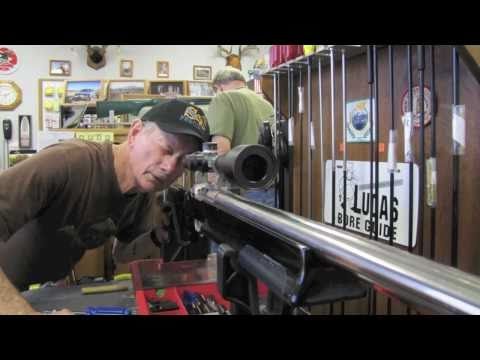
 A while back, we featured the East Texas Benchrest Shoot-out in Huntsville, TX. That match was co-sponsored by S&S Precision Rifles of Argyle, Texas. In the video below, the folks at S&S put together some tack-drivers for their customers. There are some nice glimpses of bedding work, and barrel finishing. Watch carefully — at the 40-second mark you’ll see a sub-1/4″, 10-shot group that S&S co-owner “Stick” Starks shot at 200 yards with his 6.5×47 Lapua rifle. That’s serious accuracy. Half-way through the video, Stick offers advice for shooters looking for a super-accurate fun gun for club shoots: “If you want to shoot [at] 100 and 200 yards, I’d get me a 6BR or a 30 BR. It would be the most fun gun you ever had… and the barrel will probably last three or four thousand rounds.” If you want a gun to shoot at primarily 500-600 yards, Stick recommends the 6.5×47 Lapua chambering. He told us: “Run it with the Berger 130s and Hodgdon H4350 powder. That H4350 works great with the 130 Bergers.” A while back, we featured the East Texas Benchrest Shoot-out in Huntsville, TX. That match was co-sponsored by S&S Precision Rifles of Argyle, Texas. In the video below, the folks at S&S put together some tack-drivers for their customers. There are some nice glimpses of bedding work, and barrel finishing. Watch carefully — at the 40-second mark you’ll see a sub-1/4″, 10-shot group that S&S co-owner “Stick” Starks shot at 200 yards with his 6.5×47 Lapua rifle. That’s serious accuracy. Half-way through the video, Stick offers advice for shooters looking for a super-accurate fun gun for club shoots: “If you want to shoot [at] 100 and 200 yards, I’d get me a 6BR or a 30 BR. It would be the most fun gun you ever had… and the barrel will probably last three or four thousand rounds.” If you want a gun to shoot at primarily 500-600 yards, Stick recommends the 6.5×47 Lapua chambering. He told us: “Run it with the Berger 130s and Hodgdon H4350 powder. That H4350 works great with the 130 Bergers.”
August 11th, 2010
 In international 300m competition the top shooters use high-tech rifles shooting some of our favorite cartridges: 6mmBR, 6XC, and 6.5×47 Lapua. These chamberings all possess superb inherent accuracy, allowing great scores even when shooting with iron sights. This week, both men and women have been competing in prone and three-position 300m events. The level of competition has been high — Bettina Bucher of Switzerland tied the womens’ 599 score record in winning the women’s 300m prone event, and the 600-point mens’ record score has been tied twice in prone matches, once by France’s Josselin Henry, shooting factory 6.5×47 Lapua ammo. To see Bettina Bucher and Josselin Henry in action, visit the ISSF-Sports.org website. There you’ll find complete match results, as well as photos and videos of the action. In international 300m competition the top shooters use high-tech rifles shooting some of our favorite cartridges: 6mmBR, 6XC, and 6.5×47 Lapua. These chamberings all possess superb inherent accuracy, allowing great scores even when shooting with iron sights. This week, both men and women have been competing in prone and three-position 300m events. The level of competition has been high — Bettina Bucher of Switzerland tied the womens’ 599 score record in winning the women’s 300m prone event, and the 600-point mens’ record score has been tied twice in prone matches, once by France’s Josselin Henry, shooting factory 6.5×47 Lapua ammo. To see Bettina Bucher and Josselin Henry in action, visit the ISSF-Sports.org website. There you’ll find complete match results, as well as photos and videos of the action.

Right now there are three short videos covering 300m competition. CLICK HERE to access the videos. When the page displays, go to the scrolling menu (on right) and select: “300m Rifle Prone Women”, or “300m Standard Rifle Men”, or “300m Rifle Prone Men”. The video on the 300m prone womens’ competition features Switzerland’s Bettina Bucher who tied a World Record in the event. Note, in the 300m mens Standard Rifle highlights video, the American announcer incorrectly names the winner of the 300m Standard Rifle event as “Henry Josselin”. She got it backwards.
Josselin Henry Wins 300m Standard Rifle Event, But Three Shooters DQ’d
Marco Dalla Dea of the ISSF Media team reports that France’s Josselin Henry won today’s 300m Standard Rifle event, becoming the new world champion with a total score of 587 points. The French shooter, who had equaled the 300m Rifle Prone Men world record of 600 points two days ago, had never won an ISSF medal in this event before. Tomorrow, the 28-year old shooter from Paris will compete in the 300m rifle Three-Position event.
Three competitors were disqualified in the 300m mens’ Standard Rifle Finals. There are strict rules on the geometry and features of a “Standard Rifle”, in contrast to “Free Rifle” class which is pretty much “anything goes”. One shooter was DQ’d for an illegal front sight extension, another was tossed for having an “anatomical” grip, and a third shooter was sent packing because his buttplate had too much curve. In the standing position, a hook-style buttplate extension can provide a significant advantage. This hook configuration is allowed on Free Rifles only.
April 18th, 2010
 Texan Erik Cortina (aka X3MHunter in our Forum) showcased some great marksmanship recently. Competing at Houston’s Bayou Rifle Club, Erik shot a spectacular 600-49X to break the Rifle Club’s 300-yard F-Class Open division record of 599-32X. Erik smashed the Bayou record, raising the point count to a perfect 600 with 17 more Xs than before. Erik reports: “Conditions were calm, about 65 degrees with about a 1-3 mile wind from right to left. I would say they were almost perfect conditions. I was there at the right place at the right time!” Eric’s three strings, in order, were: 200-17X, 200-16X, and 200-16X. That’s consistency! In setting the new record, Erik demonstrated how accurate the 6.5 x 47 Lapua cartridge can be. (Note: There is no official NRA 3x20x300-yard F-Open Record at this time. The NRA currently logs only an individual 20-shot 300-yard F-Open record, which was set by Shiriz Balolia, with a perfect 200-20X). Texan Erik Cortina (aka X3MHunter in our Forum) showcased some great marksmanship recently. Competing at Houston’s Bayou Rifle Club, Erik shot a spectacular 600-49X to break the Rifle Club’s 300-yard F-Class Open division record of 599-32X. Erik smashed the Bayou record, raising the point count to a perfect 600 with 17 more Xs than before. Erik reports: “Conditions were calm, about 65 degrees with about a 1-3 mile wind from right to left. I would say they were almost perfect conditions. I was there at the right place at the right time!” Eric’s three strings, in order, were: 200-17X, 200-16X, and 200-16X. That’s consistency! In setting the new record, Erik demonstrated how accurate the 6.5 x 47 Lapua cartridge can be. (Note: There is no official NRA 3x20x300-yard F-Open Record at this time. The NRA currently logs only an individual 20-shot 300-yard F-Open record, which was set by Shiriz Balolia, with a perfect 200-20X).
We know many of our readers have built, or plan to build, a 6.5×47 Lapua match rifle. The question often arises: “What powder should I shoot and what weight bullet?” We normally advise people to start with bullets in the 120-130 grain-range with a powder such as Varget or Reloder 15. However, the unique properties of Reloder 17 offers a “heavy bullet solution.” In the hands of Asst. Editor Jason Baney, our AccurateShooter.com 6.5×47 Lapua test rifle shot the 140gr Bergers very accurately using Reloder 17. In fact, Jason’s most accurate 200-yard load was with the 140s and RL17.

 Erik Cortina also found that the 6.5×47 cartridge can work superbly with 140 grain-class bullets. Erik shot the 139gr Lapua Scenar bullets (jammed .020″ in the lands) with a stout load of Reloder 17 (more than 40 grains). Erik was able to drive the 139gr Scenars well over 2900 fps with the small 6.5×47 case. Erik tells us: “I developed this load doing a ladder test at 500 yards. This might be a very hot load in most rifles but mine is throated specifically for the 139 Scenars since I didn’t plan on shooting anything else. This load does not show pressure signs on my rifle.” Erik got great accuracy with minimal brass prep: “The Lapua 6.5×47 brass is great. After uniforming the primer pockets, I tried to weight sort but only found .3 grains variance on 300 pieces of brass, so I just loaded the brass and went shooting.” Erik Cortina also found that the 6.5×47 cartridge can work superbly with 140 grain-class bullets. Erik shot the 139gr Lapua Scenar bullets (jammed .020″ in the lands) with a stout load of Reloder 17 (more than 40 grains). Erik was able to drive the 139gr Scenars well over 2900 fps with the small 6.5×47 case. Erik tells us: “I developed this load doing a ladder test at 500 yards. This might be a very hot load in most rifles but mine is throated specifically for the 139 Scenars since I didn’t plan on shooting anything else. This load does not show pressure signs on my rifle.” Erik got great accuracy with minimal brass prep: “The Lapua 6.5×47 brass is great. After uniforming the primer pockets, I tried to weight sort but only found .3 grains variance on 300 pieces of brass, so I just loaded the brass and went shooting.”
Rifle Components and Smithing
Erik’s rifle features a Lawton 7500 RBRP left-eject action, mated to a 1:8″-twist, 28″ Krieger barrel. The barrel was chambered for a no-turn 6.5×47. The stock is a Richard Franklin Low Rider made by West Custom Rifles. The rifle was smithed by Mark Pharr of Tumbleweeds Custom Rifles.
March 1st, 2010
IBS 600-yard National Champion and recent 600-yard Shooter of the Year Sam Hall has been hard to beat when he’s got his 6BR or his Dasher dialed in. Sam recently told us that he’s been experimenting with the 6.5×47 Lapua cartridge, thinking that a larger, higher-BC bullet might perform better in the wind.


Sam’s competitors are probably hoping we’ll report that Sam is struggling with the new cartridge, and can’t get his new 6.5×47 to shoot. Well, guys… no such luck. Sam recently took his 6.5×47 Heavy Gun out in some fairly windy conditions, but still returned a spectacular four-shot group at 600 yards. Sam measured the group at 0.357 inches. We measured it at 0.371″ with OnTarget software, but that was going off a photograph, which can be less precise. Either way, 4 shots in well under 0.4 inches at 600 yards is spectacular.
As Sam told us, however, “I just wish I’d shot that in competition… with a fifth shot of course.” Even though Sam’s group was shot in practice, it’s still an amazingly small group — one that suggests that the 6.5×47 Lapua may have great potential as a Benchrest cartridge. The group size, in MOA, is 0.059!

Sam’s load was 37.0 grains of Reloder 15 with 130gr Berger VLDs and CCI BR4 primers. The gun is a Bat-actioned, 47-lb “true heavy” built by Leonard Baity using a McMillan 50BMG stock. The barrel is a 29.5″ Brux, 1.25″ straight contour, with a 1:8.5″ twist. Sam reports:
The gun has a BAT MB 1.55″ round action. The reamer was a Kiff (PTG) .290 neck with .160 freebore. The loaded round is .288 at the neck. I made a mistake labeling the target. The primers were CCI BR4s, not 450s. The 130gr Bergers VLDs are lot 0225 (the early ones). They are in the rifling as far as I can get them (jam). I use a .287 Redding bushing in my Redding “type S” FL dies. I seat with a Wilson seater. The stock is a McMillian Light 50 BMG stock full of lead from McMillian. With the 40x Leupold it weighs 47 pounds. The fore-end is 3.5 inches wide. Leonard Baity did the complete rifle. I had him to put a rail (3 inches wide) on the back so I could use my adjustable rest Leonard made me a few years ago for my Shehane Maxi-Tracker stock. Even though this rifle is only 14 pounds lighter than the 61-pound aluminum stock Maxi-Tracker 6mm Dasher I shot last year, it feels like it is 25 pounds lighter. It is much, and I mean MUCH more manageable carrying this rifle around than the Maxi-Tracker. I can actually use my Farley, joy-stick rest with the rifle. I just replace the 3 inch bag with a 3.5 inch wide bag. I can make adjustments much faster with the Farley than I can twisting knobs.
The reason I built the 6.5×47 Lapua is to try to beat the wind we have here in NC in the spring. Plus, the fact I love to shoot and experiment. The 6.5 bullets are not affected as much by the wind as the 6mms. I started shooting 600-yard competiton with a 6.5-284. I could predict where the bullet was going to hit much better with it than the 6mms I shoot now. In windy conditions, the 6mms seem to “dance around” when sighting in. The heavy 6.5 seems to say on track and Point of Impact is more predictable. In 600-yard competition, score is half the game. I figured if I could get a 6.5 shooting somewhere close to a 6BR or 6BR Improved, I would be ahead of the game in the wind. So far this rifle is agging at 600 yards pretty close to my Dasher and BRX, but not better. After I found this load that shot the 0.357 inch 4-shot group, I went out and shot four more, 4-shot groups in some wind of 10-20 mph and the rifle agged 2.08 inches.
I am still haunted by a “flier” in each group. I am still trying to work that out. The 0.357 group I will say was a fluke because it is the only group I have shot that did not have a flier. The rifle sure won’t group like that every time, but that one time sure was pretty! You may ask why I shoot 4-shot groups during load development and practice. Three is not enough, but four will tell you what the rifle will do, plus I can shoot more groups before the barrel gets too warm.
Our first match is next month at Piedmont. I am going to give this rifle a try. Time will tell if I will stick with this round for serious 600-yard competition or back to the 6mms. — Samuel Hall
|


