Accurate, modular, and supremely versatile, the AR15 is America’s favorite semi-auto rifle. But let’s face it, the AR is a maintenance hog. The AR’s gas tube blows carbon and soot right into the middle of the bolt assembly where it cakes on to the metal. The AR bolt also has many tiny parts, and small recesses, which must be cleaned regularly. This author has seen numerous ARs fail simply because there was gunk (dried lube, carbon, brass shavings) in the ejector slot or extractor spring recess.
A Clean AR is a Happy AR — Whether You Run ‘Wet’ or ‘Dry’
There are various schools of thought when it comes to maintaining an AR. Some folks prefer to run their AR “dry” with minimal lube on the lugs and friction surfaces. Other shooters prefer to run their ARs “wet”, with lots of lube. But whatever your preference, you need to clean your AR regularly. And nothing is more important than the AR’s bolt/carrier assembly. Because it is involved in feeding, firing, and extracting, the AR-15 bolt/carrier assembly can be considered the most critical portion of the AR-15 from a maintenance standpoint.
Bolt Take-Down Guide on Top Quark Blog
The editor of the Top Quark Blog has created an excellent illustrated AR15 Bolt Take-Down Guide that shows how to disassemble an AR15 bolt and carrier for regular cleaning. Even if you’re an experienced AR15 shooter, you can learn something from this page (sample at right), and you may want to bookmark it for future reference. The photos are large and clear and there are helpful hints for each step of the process.
The author knows his stuff and offers some important insights. For example, he notes that “Extractor springs in most AR15 bolt assemblies are fairly weak, and this can lead to various extraction-related failures. One of the few high points about Colt assemblies is their usage of higher-strength extractor springs. You can tell the difference by looking at the inner plastic insert. ‘Normal’ springs feature a blue plastic insert, Colt strong springs have a black insert.”
There is one notable oversight on this page — the author doesn’t cover disassembly and cleaning of the ejector assembly. This is actually quite important. A few small brass shavings, combined with carbon and lube in the ejector slot, WILL cause malfunctions. In fact, when this editor is called to diagnose problem ARs, the first things I look at (after swapping magazines) are the ejector recess and the slot for the extractor. Clogged ejectors are responsible for fail-to-ejects and other jams. It is essential that you keep the ejector hole clean. Old, gooey lube residues mixed with carbon and tiny brass shavings in the ejector recess will create all sorts of problems. As shown in the diagram below, it is simple to remove the ejector (#6) and ejector spring (#5), by drifting the ejector retaining pin (#4).
It’s a rare thing when you can talk with a living legend about the sport he loves. We had just that opportunity yesterday at SHOT Show when we chatted with Carl Bernosky, TEN-TIME National High Power Champion. We covered a lot of ground in the interview, discussing the future of the High Power game and the changes in hardware Carl has seen during his storied career. Carl also offers some “rock solid” advice for younger High Power shooters hoping to improve their skill sets. We also talked about Carl’s plans for 2014 and his epic battle with SSG Brandon Green at the 2013 High Power Championships at Camp Perry. Carl and Brandon battled to the last shot of the last relay of the last day. After four complete days of shooting, the two men remained tied on points and tied on X-count. Apply a tie-breaker rule based on X-count at long-range, Green was named the 2013 Champion, with Carl named runner-up. That 2013 event was a true “Battle of the Titans” between two immensely talented marksmen.
We asked Carl about trends in the High Power game. He said that more and more shooters are moving to the AR15 platform. The accuracy is there, and there are advantages to the self-loading actions particularly during rapid-fire. Carl also felt that it takes more training time to master cycling a bolt while shooting in the standing position. Because he does not have to manipulate a bolt, Carl says his self-feeding AR helps him when standing (Carl is considered one of the best standing shooters ever).
Watch Interview with Carl Bernosky, 10-Time National High Power Champion
Though most readers will recognize Carl from reports of his many National Championships, you may not realize that Carl is also a very skilled stock-maker. Carl produces high quality laminated-wood stocks at his shop in Pennsylvania. He offers a full range of stocks for Prone, Palma, F-TR, F-Open, Long Range Benchrest competition, and he also builds fine tactical stocks and hunting stocks. You can see examples of Carl’s stocks at CarlBernosky.com. Carl recently acquired a CNC machine for inletting. This can create ultra-precise inlets for a wide variety of actions.
If you can’t get enough info on ARs, check this out. The folks who brought you the Firearms Guide, have released a new, comprehensive resource for AR-Platform rifles — of all calibers and configurations. The new AR Rifles Digital Guide presents over 1,300 semi-auto and full-auto AR-style rifles from 65 manufacturers worldwide. AR rifles in calibers from .22 LR to .458 SOCOM are covered with technical specifications, features, prices, and up to 12 high-rez, zoomable pictures for each model. This new DVD also contains a schematics library with printable and zoomable exploded views and parts lists. This is great for gunsmiths and guys working on AR projects.
This $15.99 AR resource DVD has thousands of pages of content, all easily searchable with ten different search criteria including: caliber, price, manufacturer, gun finish, barrel type, country, and more. The DVD’s search engine lets you quickly find AR rifle models, schematics, parts lists, and other information. In addition, the AR Digital Guide features a comprehensive ammo database. Choose a cartridge type and caliber. Then, with just one click, you can access information on bullet styles, bullet weights, features and ballistics of all the currently available ammunition in that chambering.
Easy to Buy, Easy to Run
You can order the AR Rifles Digital Guide DVD directly from FirearmsGuide.com for just $15.99. DVDs start shipping on December 19th — just in time for Christmas. This unique AR Rifles DVD works on Windows XP, Vista, 7 & 8. Just drop the DVD in your CD/DVD drive, and it starts automatically — no software installation is required.
For many cartridge types, Hornady Superformance ammunition provides enhanced velocity compared to some other types of factory-loaded ammo. However, Hornady has found that there may be issues when Superformance ammo is shot in gas-operated guns with barrels under 20″, or with barrels fitted with suppressors. This is because the gas returning from the barrel port may cause the bolt to begin unlocking prematurely. Hornady has published the following information concerning the uses of Superformance ammo in direct impingment and gas piston self-loading rifles.
Internal Ballistics of Superformance Ammo in Semi-Auto Guns
Superformance™ ammunition is tested and is safely within SAAMI pressure guidelines. Gas operated (direct impingement or gas piston) firearms are perfectly safe to use with Superformance ammunition. However, Hornady ballisticians have conducted testing with a variety of guns (including guns equipped with suppressors), and our findings conclude that some systems work far better with Superformance ammunition than others.
It is recommended that to get the best functioning with Superformance ammunition in gas operated/gas piston semi-automatic or select fire guns, rifle length gas systems with 20 inch or longer barrel lengths are best for reliable firing and extraction. Any other configuration — particularly shorter barrels/gas systems — are best served with the installation of an adjustable gas system, ESPECIALLY if a suppressor is to be installed.
Due to the longer duration of peak pressure produced by Superformance, the post peak/declining port pressure at common carbine and mid-length gas port locations is still higher than that produced by standard propellant. This has a tendency to flood the system with a larger volume of gas, at a higher velocity, that tries to open the bolt of the gun too fast. It’s a timing issue. The cartridge case is still swollen from the application of pressure during firing while the gun is simultaneously trying to extract the cartridge case before it has had an opportunity to settle back to its original size, or more simply: the gun is still in the process or firing while it’s trying to extract the cartridge case.
If the firearm and the ammunition are not in sync, there can be what is commonly identified as “pressure signs” on the cartridge case. This is exhibited by the movement/marring of the head of the cartridge case, cratered primers, flat primers, ripped or ruptured cartridge cases, “popped primers”, and/or any combination of these effects. If any of these “pressure signs”; are apparent, stop firing immediately. If an adjustable gas system is installed, it is advisable to reduce the amount of gas flowing through the system by closing the gas port until the gun operates correctly.
With the installation of an adjustable gas system, gas pressure can be metered to a point that enough gas is applied to open the bolt, but at a slower rate to allow the cartridge case to return to its original diameter prior to the movement of the bolt, and thus allow for proper extraction.
Pressure VS Gas Port Location
Due to the longer duration of peak pressure produced by Superformance™, the post peak/declining pressure at common carbine and mid-length gas port locations is still higher than that produced by standard propellant. However, there is very little difference in port pressure between Superformance™ and standard propellants at the rifle length port location.
Superformance and Suppressors
The use of suppressors on rifles creates yet another dynamic in firearms design that is not commonly understood or communicated. Consider the suppressor on a firearm the same as a muffler on a car. The suppressor works as a filter for the gas (noise) that is escaping the barrel during firing. As a “filter”, it takes longer for the gas to leave the confines of the firearm, and thus, it creates back pressure. This back pressure, ESPECIALLY in a gas operated firearm forces an extensive amount of gas back through the firearm’s operating system that may create too much thrust too early during the firearm’s cycle of operation.
To counteract this back pressure, the use of an adjustable gas system is advised. By metering the gas system to ensure that it will cycle the firearm correctly and not flood the system with gas/pressure, the gun will work properly and will still benefit dramatically from the increased velocity potential of Superformance ammunition.
AR-platform rifles are fun to shoot, but .223 Rem centerfire ammo can get expensive if you put a lot of rounds downrange. Dedicated .22 LR uppers let you do live-fire training with more affordable rimfire ammo while retaining the weight, balance, and feel of your AR-platform rifle. You use your regular lower, so the ergonomics and grip feel the same. Likewise, the trigger group is the same, so you don’t need to adapt to a different trigger pull. With these .22 LR upper conversions you can shoot reactive targets at relatively close range, with less noise and recoil. (But remember that rimfire bullets can ricochet, so always shoot at a safe distance and always wear eye and ear protection).
Dedicated .22 LR Rimfire Uppers for AR-Platform Rifles
A number of companies offer dedicated .22 LR rimfire uppers that work with any standard AR15-platform lower. Brownells carries dedicated .22 LR AR uppers starting at $419.99. Brownells offers flat-top AR uppers, allowing you to easily mount the aiming system (iron sights or optics) of your choice. Brownells offers a 100% satisfaction guarantee on all products it sells, including .22 LR uppers.
AR-Style .22LR Rimfire Rifles (Complete Guns)
Another option is to purchase a complete AR-style rimfire rifle chambered for the .22 LR cartridge. This option may be more affordable than you think. Right now Impact Guns is selling the Smith & Wesson M&P 15-22 with 16″ barrel for just $509.99 (marked down from $649.99). It’s a nice little rifle. The M&P 15-22 is designed and built as a true .22 LR semi-auto from the ground up, with ergonomics (and most operating controls) identical to a centerfire M&P 15 rifle. Here’s the black and tan version:
H&K offers the HK 416 D145RS, a dedicated .22 LR rimfire rifle. Engineered and built in Germany by Carl Walther, the HK 416 D145RS features a match-grade precision barrel, metal upper and lower receivers, retractable stock, and machined rail interface system with on-rail iron sights. These HK rimfire rifles (which employ a blow-back action) are accurate and reliable. Current ‘street price’ is around $660.00. One purchaser writes: “Great .22. I have had this gun a couple of months and have put about 500 rounds of 5 different brands of ammo through it. Not one FTE. I have shot other brands that can’t get through one 30-round mag without a failure. [The 416] is a little pricey compared to the competition but you get what you pay for.”
There’s a new gun game focusing on defensive rifle skills — the NRA National Defense Matches (NDM). Think of this as IDPA with ARs. The inaugural NRA National Defense Matches will be held October 12-13, 2013 at Peacemaker National Training Center, in Gerrardstown, West Virginia.
NDM programs are designed for all skill levels, with the goal of developing and exercising defensive rifle skills. There are three types of NDM matches. First, the basic-level match allows novices to shoot from a variety of positions at relatively close ranges out to 100 yards. Competitors will engage targets from standing, kneeling, prone, and ‘roll-over’ prone positions (to simulate actual defensive situations). Next is the advanced-level NDM. This type of match is held on multiple bays with targets placed at seven to 50 yards. Shooters must move quickly from one firing point to the next. The championship-level, open-terrain NDM, calls for shooters to maneuver through undulating forested terrain, engaging targets from difficult firing positions, at distances out to 500 yards. All NDM matches are conducted according to established general parameters, but the actual courses of fire can be adapted to the features of particular ranges, to suit the terrain and range lay-out. Watch the video to see how NDM matches are conducted.
National Defense Match Demonstration Video (Warning: Very Loud — turn speakers down.)
Story tip by EdLongrange. We welcome reader submissions.
Compared to bolt-action rifles, direct gas impingement AR-platform rifles tend to be filthy, maintenance-intensive beasts, requiring regular disassembly and cleaning of the innards. Op-rod style AR variants run cleaner and cooler, but they still require regular maintenance. Now there is a versatile, compact multi-tool that performs a variety of critical servicing/maintenance tasks for AR-platform rifles.
Weighing just 6 ounces, the new D-CAT from Space Age Weaponry fits in the storage compartment of a standard AR-15 fixed butt stock. Brownells says the D-CAT (“Deployable Compact Armorer’s Tool”) is the “only tool necessary to assemble the AR-15/M16 from component parts, or perform a complete disassembly”. The video below explains the feature and functions of the $149.99D-CAT.
The D-CAT is made from quality materials: 6061-T6 Aircraft Aluminum, 303 Stainless steel, and H13 Tool Steel. Bits, punches, and other small parts are located in the tool magazine, within the torque handle. Simply rotate the magazine gate to expose the individual compartments. Within the magazine you will find a 1/8″ punch, a flat blade driver, front sight adjustment tool, and a 3/16″ and 9/64″ hex driver. There is also a spare punch pocket and a Hammer/Trigger pin pocket. This is also the mode in which the D-CAT is used as a screwdriver. The driver makes use of a standard ¼” hex well so the tool can be augmented to serve as a general purpose driver for any bit you choose to carry.
Tool Tip from EdLongrange. We welcome reader submissions.
Just a “heads-up” for our AR shooters out there. Check this out. For a limited time, Brownells is selling
Magpul 30-Round Polymer AR mags for just $10.79 each. That’s right — high-quality Magpul PMAG 30s for under eleven bucks. Hard to beat that deal if you are looking for name-brand 30-rounders for your .223/5.56 AR-platform rifle. Click image below to see product info on the Brownells webstore.
In our Shooters’ Forum, one member posed the question: “What makes an AR accurate? What parts on an AR can really affect accuracy — such as free-floating handguards, barrels, bolts, bolt carriers?” He wanted an honest, well-informed answer, not just sales pitches. Robert Whitley posted a very comprehensive answer to this question, based on his experience building and testing dozens of AR-platform rifles. Robert runs AR-X Enterprises, which produces match-grade uppers for High Power competitors, tactical shooters, and varminters.
Building an Accurate AR — What is Most Important
by Robert Whitley
There are a lot of things that can be done to an AR to enhance consistent accuracy, and I use the words “consistent accuracy” because consistency is a part of it (i.e. plenty of guns will give a couple great 5-shot groups, but won’t do a very good 10- or 20-shot groups, and some guns will shoot great one day and not so good on others).
Here are things we think are important to accuracy.
1. Great Barrel: You’ll want a premium match-grade barrel, well-machined with a good crown and a match-type chambering, true to the bore and well cut. The extension threads must also be cut true to the bore, with everything true and in proper alignment.
2. Rigid Upper: A rigid, heavy-walled upper receiver aids accuracy. The typical AR upper receiver was made for a lightweight carry rifle and they stripped all the metal they could off it to make it light to carry (which is advantageous for the military). The net result are upper receivers that are so thin you can flex them with your bare hands. These flexible uppers are “strong enough” for general use, but they are not ideal for accuracy. Accuracy improves with a more rigid upper receiver.
3. True Receiver Face: We’ve found that truing the receiver face is valuable. Some may argue this point but it is always best to keep everything related to the barrel and the bore in complete alignment with the bore (i.e. barrel extension, bolt, upper receiver, carrier, etc.).
4. Barrel Extension: You should Loctite or glue the barrel extension into the upper receiver. This holds it in place all the way front to back in the upper receiver. Otherwise if there is any play (and there typically is) it just hangs on the face of the upper receiver completely dependent on the face of the upper receiver as the sole source of support for the barrel as opposed to being made more an integral part of the upper receiver by being glued-in.
5. Gas Block: You want a gas block that does not impose pointed stress on the barrel. Clamp-on types that grab all the way around the barrel are excellent. The blocks that are pinned on with tapered pins that wedge against the barrel or the slip on type of block with set screws that push up from underneath (or directly on the barrel) can deform the bore inside of the barrel and can wreck the accuracy of an otherwise great barrel.
6. Free-Float Handguard: A rigid, free-float handguard (and I emphasize the word rigid) really makes a difference. There are many types of free-float handguards and a free-float handguard is, in and of itself, a huge improvement over a non-free-float set up, but best is a rigid set-up. Some of the ones on the market are small diameter, thin and/or flexible and if you are shooting off any type of rest, bipod, front bag, etc., a rigid fore-end is best since ARs want to jump, bounce and twist when you let a shot go, as the carrier starts to begin its cycle before the bullet exits the bore.
7. Barrel Contour: You want some meat on the barrel. Between the upper receiver and the gas block don’t go real thin with a barrel (we like 1″ diameter if it’s workable weight-wise). When you touch off a round and the bullet passes the gas port, the gas system immediately starts pressuring up with a gas impulse that provides vibrations and stress on the barrel, especially between the gas block back to the receiver. A heavier barrel here dampens that. Staying a little heavier with barrel contour through the gas block area and out to the muzzle is good for the same reasons. ARs have a lot going on when you touch off a round and the gas system pressures up and the carrier starts moving (all before the bullet exits the bore) so the more things are made heavier and rigid to counteract that the better — within reason (I’m not advocating a 12-lb barrel).
8. Gas Tube Routing Clearance: You want a gas tube that runs freely through the barrel nut, through the front of the upper receiver, and through the gas key in the carrier. Ensure the gas tube is not impinged by any of them, so that it does not load the carrier in a stressed orientation. You don’t want the gas tube bound up so that when the gas tube pressures up it immediately wants to transmit more force and impulse to the barrel than would normally occur. We sometimes spend a lot of time moving the gas block with gas tube on and off new build uppers and tweaking gas tubes to get proper clearance and alignment. Most gas tubes do need a little “tweaking” to get them right — factory tubes may work OK but they typically do not function optimally without hand-fitting.
9. Gas Port Tuning: You want to avoid over-porting the gas port. Being over-gassed makes the gas system pressure up earlier and more aggressively. This causes more impulse, and increases forces and vibration affecting the top end and the barrel. Tune the gas port to give the amount of pressure needed to function properly and adequately but no more.
10. Front/Back Bolt Play: If accuracy is the game, don’t leave a lot of front/back bolt play (keep it .003″ but no more than .005″). We’ve seen factory rifles run .012″ to .015″ play, which is OK if you need to leave room for dirt and grime in a military application. However, that amount of play is not ideal for a high-accuracy AR build. A lot of front/back bolt play allows rounds to be hammered into the chamber and actually re-formed in a non-consistent way, as they are loaded into the chamber.
11. Component Quality: Use good parts from a reputable source and be wary of “gun show specials”. All parts are NOT the same. Some are good, some are not so good, and some aftermarket parts are simply bad. Don’t be afraid to use mil-spec-type carriers; by and large they are excellent for an accuracy build. Also, remember that just because a carrier says “National Match” or something else on it does not necessarily mean it’s any better. Be wary of chrome-plated parts as the chrome plating can change the parts dimensionally and can also make it hard to do hand-fitting for fit and function.
12. Upper to Lower Fit: A good upper/lower fit is helpful. For quick and dirty fit enhancement, an Accu-Wedge in the rear helps a lot. The ultimate solution is to bed the upper to a specific lower so that the upper and lower, when together, are more like one integral unit. For the upper receivers we produce, we try to get the specs as close as we can, but still fit the various lowers in the market place.
13. Muzzle Attachments: Don’t screw up the muzzle (literally). Leave as much metal on the barrel at the muzzle as you can. People like to thread the muzzle for a flash hider, suppressor, muzzle brake, or some other attachment, but if you really want accuracy, leave as much metal as you can there. And, if you have something that screws on, set it up so that it can be put on and have it stay there without putting a lot of torque and stress on it right where the bullet exits the bore. If you are going to thread the end of the barrel, make it concentric with the bore and make sure what you screw on there is as well. For all muzzle attachments, also ensure that the holes through which the bullet passes through are dead true to the bore. Many aftermarket screw-on things are not so good that way. Anything that vents gas should vent symmetrically (i.e. if it vents left, it should vent equally right, and likewise, if it vents up, it should vent down equally). Uneven venting of gas can wreck accuracy.
14. Quality Ammunition: Ammo is a whole story by itself, but loads that are too hot typically shoot poorly in an AR-15. If you want accuracy out of an AR-15, avoid overly hot loads. Shown below are test groups shot with four (4) different uppers, all with moderate loads. These four uppers all pretty much had the same features and things done to them as explained in this article, and they all shot great.
Magpul is now offering 40-round capacity PMAG GEN M3 magazines for AR-platform rifles chambered for .223 Rem/5.56×45. Just 2 1/8″ longer than a 30-round Magpul magazine, the new 40-rounder will fit and function in standard AR mag wells. Magpul claims that: “The new PMAG 40 is just as reliable, durable, and compatible as the PMAG 30.”
Magpul’s new 40-round magazines should prove popular with 3-Gun competitors. The extra 10 rounds can reduce the number of mag changes, which should allow 3-gunners to shave seconds off stage times. As with other latest-generation PMAGs, the new PMAG 40s feature an over-insertion stop catch that prevents the magazine from being slammed too far into the gun during fast changes. This stop catch prevents mag damage and lessens the chance of a malfunction. For LEO and Military personnel using select fire ARs, Magpul notes that: “The optimized magazine spring can handle feeding at cyclic rates over 1150 rounds per minute.”
Major vendors, such as Brownells, will be selling the PMAG 40s very soon. Brownells is charging $19.95 for the PMAG 40, product #100-012-633WB. We expect these things to sell like hotcakes. The editors of Guns.com note: “These magazines are going to be incredibly popular. Everyone likes extra ammo, even when it’s hard to find. And when most magazines with capacities greater than 30 run $40-$50, at these prices Magpul is going to tear through their competition.”


 A Clean AR is a Happy AR — Whether You Run ‘Wet’ or ‘Dry’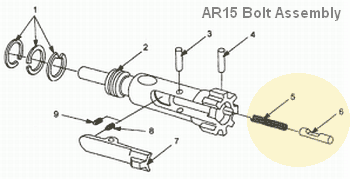
 It’s a rare thing when you can talk with a living legend about the sport he loves. We had just that opportunity yesterday at SHOT Show when we chatted with Carl Bernosky, TEN-TIME National High Power Champion. We covered a lot of ground in the interview, discussing the future of the High Power game and the changes in hardware Carl has seen during his storied career. Carl also offers some “rock solid” advice for younger High Power shooters hoping to improve their skill sets. We also talked about Carl’s plans for 2014 and his epic battle with SSG Brandon Green at the 2013 High Power Championships at Camp Perry. Carl and Brandon battled to the last shot of the last relay of the last day. After four complete days of shooting, the two men remained tied on points and tied on X-count. Apply a tie-breaker rule based on X-count at long-range, Green was named the 2013 Champion, with Carl named runner-up. That 2013 event was a true “Battle of the Titans” between two immensely talented marksmen.
 If you can’t get enough info on ARs, check this out. The folks who brought you the


 AR-platform rifles are fun to shoot, but .223 Rem centerfire ammo can get expensive if you put a lot of rounds downrange. Dedicated


 There’s a new gun game focusing on defensive rifle skills — the NRA National Defense Matches (NDM). Think of this as IDPA with ARs. The inaugural NRA National Defense Matches will be held October 12-13, 2013 at



 5. Gas Block: You want a gas block that does not impose pointed stress on the barrel. Clamp-on types that grab all the way around the barrel are excellent. The blocks that are pinned on with tapered pins that wedge against the barrel or the slip on type of block with set screws that push up from underneath (or directly on the barrel) can deform the bore inside of the barrel and can wreck the accuracy of an otherwise great barrel.

 Magpul is now offering 40-round capacity PMAG GEN M3 magazines for AR-platform rifles chambered for .223 Rem/5.56×45. Just 2 1/8″ longer than a 30-round Magpul magazine, the new 40-rounder will fit and function in standard AR mag wells. Magpul claims that: “The new PMAG 40 is just as reliable, durable, and compatible as the PMAG 30.”


