|
|
February 26th, 2010
Jeff Stover, President of the IBS (International Benchrest Shooters) just sent us the final rules and safety guidelines for AR benchrest competition under the IBS. Jeff noted: “Shooters should understand that the ranges and clubs will determine whether to allow AR rifles in their particular IBS benchrest matches.” This program is not mandatory, and each club will decide, based on its own priorities, whether ARs will be allowed to compete. When they ARE “invited”, AR-platform rifles will run in their own separate class.

Click the links below to download two .PDF files:
DOWNLOAD: IBS AR Benchrest Final Rules
DOWNLOAD: IBS AR Benchrest Safety Checklist
February 24th, 2010
After we reported that Tyler Rico of Arizona won the Nevada Regional High Power Championship (at the ripe old age of 15), some of our readers asked about Tyler’s match rifle. Tyler, who earned his Distinguished badge at age 13 (the youngest ever to do do), primarily shoots AR-platform rifles. The AR with which Tyler won the 2010 Nevada Regional featured a custom 6mmAR upper built by Robert Whitley’s AR-X Enterprises. The 6mmAR chambering, basically a 6.5 Grendel necked down to 6mm, was popularized by Robert, who is himself an avid High Power shooter.
Tyler Rico’s 6mmAR upper has an interesting history. Whitley explained: “Originally we built it up for some testing by the Marine Shooting Team and we took it down to Quantico. They liked it a lot but did not have authority or funding to buy them. When Tyler’s father called me looking for an upper for Tyler, I offered a special deal on it because we wanted to help support a junior shooter.” Built on a heavy-walled DPMS Low Pro receiver, Tyler’s upper features a 26″ Krieger 1:8″ twist barrel, and a side-positioned charging handle.

According to Whitley, “My test rifle with Tyler’s upper shot great. Above is a photo of one of the initial 10-shot, 100-yard test targets I shot with the upper at 100 yards. This gun really hammered. Remember The ‘X’ ring is the size of a dime”.
Five Shots at 300m that Could Fit under a Quarter
Robert Whitley took the photo below at the Marine’s Quantico, VA, Precision Weapons Section facility. The photo shows a target shot with Tyler’s upper at 300 meters. That’s a five-shot group the size of a quarter. Robert reports: “The Marines wouldn’t let me take the target home, because they planned to use the target to support their lobbying effort for funds to purchase new 6mmAR uppers.”

February 18th, 2010
A reliable 22LR conversion kit for an AR-platform rifle lets you train with inexpensive ammo. That’s a big advantage for 3-gun competitors who must engage multiple targets rapidly, often at relatively short distances. Multi-gun competition is a speed game, requiring plenty of practice to “run with the big dogs”. It’s not unusual for elite 3-gun shooters to put hundreds of rifle rounds down range every week. Service Rifle shooters can also benefit from cross-training with an AR equipped to shoot .22LR rimfire rounds. With a good .22LR conversion kit, Service Rifle shooters can practice their positions and gun-handling at minimal expense. In the winter, if you have a .22LR conversion for your AR, you can train at the many indoor ranges that allow rimfire rifles, but not centerfire rifles.
Complete Conversion Kit for $189.99 from CDNN
CDNN Investments in Texas is offering a good deal on the CMMG .22lr Stainless Conversion Kit for AR15-type rifles. This includes a stainless bolt and bolt carrier assembly and two (2) 25-round magazines or two (2) 10-round mags. The CMMG Kit uses your existing fire control (trigger) group and requires no internal gunsmithing. Just drop it in and shoot. While supplies last, the CMMG Conversion Kit with magazine(s) is priced at $189.99. NOTE: CDNN is offering 2 mags with this package as a “limited time offer”. (MidwayUSA also has this Kit, with one mag, for $199.99.)

CMMG .22LR Kit Is Reliable and Affordable
The CMMG conversion is widely used and has proved quite reliable, both with the 10-round and 25-round magazines. It is recommended by Brownells, though some Brownells customers have said the kits required some minor fitting or polishing. (This may be more of an issue with “off-brand” uppers — Colt AR owners reported no issues.) In the video below you see an AR15 being fired with the CMMG .22LR conversion in place. Then the CMMG bolt is exchanged for the original .223 Rem bolt assembly and the gun is shot in centerfire mode.

In the second video below you’ll see the CMMG conversion shot with two full (or nearly full) 25-round magazines, in rapid fire. There are no malfunctions.

February 11th, 2010

The First Shot, the CMP’s online magazine, features a well-written article on Prone Shooting Technique by SPC Matthew Sigrist of the U.S. Army Marksmanship Unit (USAMU). The article covers all the major points of gun hold and body position: hand position, elbow position, stock weld, buttstock placement, and sling position/tension.

SPC Matt Sigrist of the USAMU breaks down the prone position into “fundamentals” and explains how you put each element together to create a stable body position: “The fundamentals are the building blocks of a position. Much like the framework of a house, a correct application of the fundamentals ensures a solid and stable structure. Since each person’s position will depend on their particular body build and shape, there is no ‘perfect position’ that applies to everyone. Experience, practice and knowledge of the correct fundamentals will dictate the best position for you.”
SPC Sigrist also demonstrates the two basic variations of the leg position when shooting prone: open/spread legged, and bent-legged.
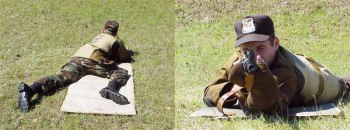

For any service rifle, highpower, cross-course, or prone shooter, this helpful article can improve your performance in the prone position.
February 4th, 2010
If you’re looking for an extremely high-quality, 100% reliable semi-auto rifle for defense, three-gun matches, or predator control, you should consider the Sig556. Based on the Sig 550-series rifles used by the Swiss Army, the Sig556 features a piston/op-rod upper for enhanced reliability. The bolt, bolt carrier, and other receiver internals stay much cleaner and cooler in the Sig556 than with a direct-impingement design such as the AR-15. The Sig556 also features ultra-reliable magazines and a true folding stock as an option.

CLICK HERE for Sig556 Rifle Rebate Details
Now through March 8, 2010, Sig Sauer is offering a $300 Rebate on all Sig556 rifles. Customers must purchase a Sig556 rifle from a Sig Sauer commercial dealer before March 8, 2010. NOTE: Rebate Forms must be received by March 22, 2010. Remember, if you wait ’til the last minute to buy, you only have two weeks to submit the Rebate Form.
January 31st, 2010
The IBS recently announced that it would allow AR-platform rifles to compete in local IBS benchrest matches in their own class. If you plan to campaign your AR in this new class, you should definitely add a 3″-wide front sled and some kind of rear bag-rider to your gun. Without a flat fore-arm “sled” and rear bag-rider, ARs tend to be very wobbly, and the standard rear stock (with sling loop in place) is terrible in a rear sandbag.

 
Robert Whitley’s AR-X Enterprises has just what you need to improve your AR’s bench behavior. AR-X sells precisely-fitted Delrin bag-riders, crafted expressly for ARs by Evolution Gun Works (EGW). The 3″-wide front bag rider (aka “sled”) features a “twin rail” design and attaches to a tubular fore-arm via a swivel stud. The rear bag-rider mates to the bottom of a standard AR stock and attaches via the rear sling swivel anchor. This provides a smooth, straight surface to ride the bags.
These Delrin EGW bag-rider units were originally designed and prototyped for AccurateShooter.com’s 20 Practical AR project rifle. We tried many different designs, and the final production versions really work — as you can see in the video above. The AR bag-riders cost $40 front and $40 rear, or $75.00 for the set of two. To order, visit 6mmAR.com, or email Robert Whitley: rcw3 [at] erols.com .
January 29th, 2010
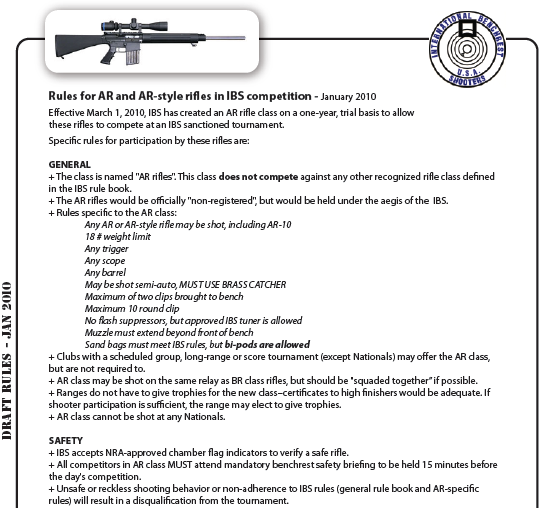
 Defying its reputation as a stodgy, conservative organization, the IBS will allow AR-style rifles to compete in their own class at IBS benchrest matches next year. Both AR15-platform and AR10-platform rifles can compete in this new, provisional class. Defying its reputation as a stodgy, conservative organization, the IBS will allow AR-style rifles to compete in their own class at IBS benchrest matches next year. Both AR15-platform and AR10-platform rifles can compete in this new, provisional class.
This will NOT displace any of the current classes (e.g. Sporter, LV, HV, Unlimited), nor change any rules for current classes. The “AR Experiment” will last for one year and then the IBS will determine whether to make the class permanent. IBS President Jeff Stover stressed three points:
1. This is an experiment for a one-year trial.
2. Clubs MAY have an AR class, but they are not required to do so.
3. The IBS Nationals are NOT affected — there will be no ARs at any Nationals
The IBS has distributed proposed draft rules, and the IBS plans to adopt final rules on March 1, 2010. Here are some of the key proposed rules:
November 25th, 2009
Writer David Fortier recently conducted an extensive torture test of AR15 magazines — both polymer and metal-bodied. Fortier’s test results, some of which may surprise you, are found in David’s article “Feeding Your AR”, published in the latest (November 20, 2009) edition of Shotgun News.
 Fortier tested a variety of popular AR mags including PMAG, Tango Down, CProducts SS, Brownells, Bravo Company, Lancer, MSAR, and Tapco. The “torture tests” included dropping the mags on their feedlips from 8.5 feet, driving a full-size army truck over the mags, jumping on the mags, and deliberately tilting the followers. The mags were also tested for fit and function with live-fire shooting. Results were a little surprising. When dropped from 8.5 feet on their feedlipgs, the Tango Down, PMAG and TAPCO all split down the spine. CLICK HERE for Test Photos. Fortier tested a variety of popular AR mags including PMAG, Tango Down, CProducts SS, Brownells, Bravo Company, Lancer, MSAR, and Tapco. The “torture tests” included dropping the mags on their feedlips from 8.5 feet, driving a full-size army truck over the mags, jumping on the mags, and deliberately tilting the followers. The mags were also tested for fit and function with live-fire shooting. Results were a little surprising. When dropped from 8.5 feet on their feedlipgs, the Tango Down, PMAG and TAPCO all split down the spine. CLICK HERE for Test Photos.
The Lancer L5 model seemed to be the toughest magazine tested, and Fortier noted how the “old-fashioned” aluminum mags did surprisingly well. Lancer L5 magazines have “see-through” translucent polymer bodies (similar to Sig 55X series magazines). In addition, the Lancers feature teflon-coated, hardened steel feed lips, and a rubber-coated “bumper bottom”. Lancer L5s are offered in 20-round, 30-round, and 48-round capacities. The 48-rounder employs a special coupler to provide super-high capacity for 3-gun comps. Below is a Lancer-produced video showing the L5s being dropped from 5 feet (on both base and feed lips) without injury.
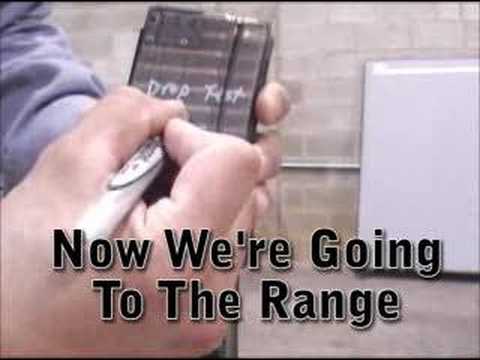
Fortier, posting on AR15.com concluded: “PMAGs are very good, but not as indestructible as some think. Aluminum mags are not as bad as some think. You should consider checking out Lancer’s mag…they surprised me. If MSARs mag dropped free they would be an interesting option. Dropping mags onto cement is A LOT tougher on them then running them over with a SUV…. but all those videos from the various mag companies sure did work wonders for advertising didn’t they?”
 Old Metal 20s — Still Best Match Mag? Old Metal 20s — Still Best Match Mag?
Editor’s NOTE: I won’t speculate as to the best 30-round magazine for field and military use. But in all the ARs I’ve owned, and most of the AR target rifles I’ve shot, the best magazine for Bench use and High Power Match use was the old 20-round straight aluminum mag with silver-colored metal follower. These 45-year-old mags seem to work perfectly, even when the gray powder-coat has worn off in spots revealing a dull brass color underneath. The silver metal follower still works better than most of the new “no-tip” polymer followers.
There may be better 20-round polymer mags today, but match shooters won’t go wrong with the original metal-bodied straight 20s with metal followers. I’ve bought, sold, and traded many AR mags over the years — and my old GI metal 20s are the only ones I’ll never sell.
November 18th, 2009
This story may seem like science fiction, but we assure you the details are real. FN Herstal has created a new electronic device, appropriately named the “Black Box”, which can record and store a rifle’s round count and firing sequences. In addition, the FN Black Box contains digital identifiers for the weapon. This means that, when coupled to a GPS, the FN Black Box can transmit the gun’s ID and location to a military command or other monitoring authority.
Black Box Technology Limited to Military… For Now
The technology is exciting, though the ramifications for gun control are chilling to say the least. At present, FN Herstal envisions its Black Box as an add-on for military or law enforcement weapons. No one has yet suggested that black boxes be fitted to civilian arms.

The FN Black Box can record multiple types of firing data: round count, burst rates, burst lengths, and firing sequences. The digital sensors can even detect stoppages due to failures to cycle. FN evisions that this information can alert armorers when weapons require maintenance. In addition, by tracking the numbers of rounds fired, military commanders can determine when ammunition resupply is required or when barrels need replacement.
The Say Uncle Blog notes that while this kind of digital recorder may seem novel for weapons, “the same concept is often applied to industrial machines”, allowing factory owners to optimize maintenance schedules.
It there a black box in your future? We don’t see much application for Benchrest or High Power events, but this kind of round counter might prove useful in speed shooting disciplines. We do worry about the potential application of “black box” technology to defensive firearms. The digital records of shots fired as well as the sequence of those shots could be used as evidence in trials of gun owners. Imagine being on trial and having your testimony “impeached” by a digital chip removed from your gun.
November 13th, 2009
A full-time lawyer, Robert Whitley is also an avid prone, Highpower, and cross-course shooter. Over the past two years, Robert has pioneered a cartridge for these disciplines (as well as long-range varminting) based on the 6.5mm Grendel necked down to 6mm. Robert calls the cartridge the “6mmAR”.

The 6mmAR cartridge has performed very well in AR-based comp guns, both with shorter bullets loaded to mag length, and 105-107gr bullets single-loaded. Robert has complete info about the 6mmAR on his website, 6mmAR.com, including recommended loads and field test results. Robert has also developed a higher capacity version, with the shoulder blown forward and a shorter neck. He calls this the 6mmAR Turbo. This round can drive 105-108gr bullets in the 2850-2900 range, and it has proven very accurate. It is one of the best options for AR-platform space-gun shooters.
Though making 6mmAR brass from 6.5 Grendel brass is quite straight-forward and simple, Robert receives many questions about forming the brass, so he recently prepared a video. The two-minute video shows how quick and easy the brass-forming process can be:
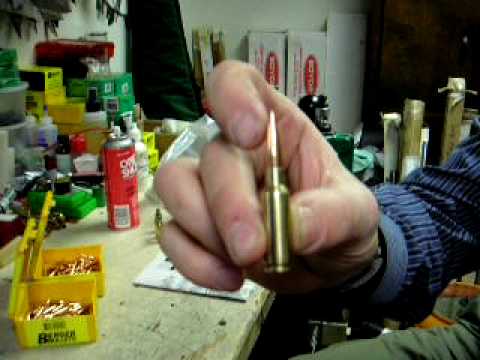
Robert also builds and sells products for across-the-course shooters, including complete AR uppers, chambered in a variety of calibers, including 6mmAR. Jerry Tierney, 2005 NBRSA 1000-yard champion, has a 6mmAR upper built by Robert and Jerry says the upper “Absolutely shoots great. I love it.” In the past few months, Jerry has broken many NRA senior records with his new 6mmAR-chambered rifle.
CLICK HERE for Feature Article on 6mmAR and Robert Whitley (many photos)
CLICK HERE for 6mmAR LOAD DATA
|


