|
|
September 21st, 2010
Here’s a word to the wise — not all full-length sizing dies are properly dimensioned to carry out the important task of “bumping” shoulders back on fired cases. With some dies the task may simply be impossible (without die or shell-holder modification). In fact, you may find that your attempt to bump the shoulder may actually INCREASE the dimension from base of case to shoulder datum!
 We recently had some four-times fired 6mmBR Lapua brass. Using a Harrell’s collar that indexes off the shoulder, we measured the length from base of case to top of collar at 1.570″ (with primer removed). We noticed a little more resistance to bolt closure compared to fresh brass, so we decided to bump the shoulders back two thousandths. As a point of reference, we measured the same dimension (base of case to top of Harrell’s collar, primer out) as 1.5675″ on once-fired Lapua 6mmBR brass. We recently had some four-times fired 6mmBR Lapua brass. Using a Harrell’s collar that indexes off the shoulder, we measured the length from base of case to top of collar at 1.570″ (with primer removed). We noticed a little more resistance to bolt closure compared to fresh brass, so we decided to bump the shoulders back two thousandths. As a point of reference, we measured the same dimension (base of case to top of Harrell’s collar, primer out) as 1.5675″ on once-fired Lapua 6mmBR brass.
 This Can’t Be Right … This Can’t Be Right …
To bump our shoulders we had an RCBS Gold Medal bushing full-length sizing die. Per the manufacturer’s instructions, we started with the die backed off 1/2 turn from contact with the shell-holder with the press ram at full height. We lubed and sized one case and then measured it. The shoulder had not moved. OK, no problem, we screwed the die down to contact the shell-holder (at full ram height) and tried again. This time the measured dimension was actually longer by a couple thousandths. The brass which measured (with collar) 01.570″ before sizing now measured 01.572″ — we were going in the wrong direction!
“Bumped” Shoulder Stretched .003″
Frustrated, we screwed the RCBS die in 1/8th turn past touching to allow “cam-over” which is necessary with some presses to actually push the shoulder back. We sized the case again, and this time the dimension had grown another .001″, to a total length of 1.573″! Wondering if there was something wrong with our calipers, we took the full-length sized brass (which previously had chambered just fine) to our 6BR rifle and tried to chamber it. Sure enough, the headspace had been lengthened by .003″ and the brass would not chamber at all.
 Die Was Too Long Inside to Bump Shoulders Properly Die Was Too Long Inside to Bump Shoulders Properly
What was going on? Here’s the explanation: the interior cavity of the die was too long so the shoulder surface inside the die was never actually making contact with the shoulder of the brass — and the die could not be screwed down any further. As the RCBS die, which was fairly tight in the bottom half, reduced the diameter of the brass, the case actually grew in length. While the brass was sized at the bottom it grew upwards because the “shoulder” section on the inside of the die was too high. As we “squeezed” the brass at the bottom it simply flowed upwards, increasing headspace.
With this RCBS die, in its current configuration, there was no way we could bump the shoulder back, even by .001″. The die would likely function effectively if we ground a few thousandths off the bottom, but we don’t think a die user should be obliged to make such a modification.
Lesson Learned: If your full-length die can’t bump your brass even when it is screwed down all the way (to cam-over if necessary), then you need a different die or you need to modify your die. As proof of this, we took out my trusty Redding 6mmBR full-length sizing die. This was set up (from experience), one-half turn off contact with the shell-holder. In that position, the Redding die easily bumped the shoulder of a fired case .002″ with no trouble whatsoever. We started at 1.570″ and ended up 1.568″ — right where we wanted to be. The task that couldn’t be done with the RCBS Gold Medal FL Die was accomplished easily with the Redding die. After lubing the case, we simply raised the ram to full height, and this moved the shoulder back .002″ as measured with the Harrell’s collar positioned on the shoulder.
August 15th, 2010
Powder Valley, a major vendor of powder, primers, brass, bullets, and loaded ammo, has received some large shipments of popular powders including Hodgdon Varget and IMR 8208 XBR. Powder Valley also has the hard-to-find Alliant Reloder 17 powder in stock, in both 1-lb and 5-lb containers.
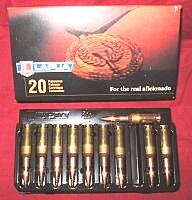 Powder Valley Now Stocks Factory-Loaded Ammo Powder Valley Now Stocks Factory-Loaded Ammo
FYI, Powder Valley is now stocking quality factory-loaded ammo from Lapua, Hornady, Nosler, Prvi Partizan, and Wolf. If you’re looking for match-grade Lapua factory ammo or the Hornady .223 Rem, 6.5 Creedmoor, and .30-06 ammo, give Powder Valley a call at 800-227-4299.
Powder Valley Inventory Updates on Facebook
Powder Valley now posts recent product arrivals on Facebook. If you have a Facebook account you can link to the Powder Valley page to get the latest updates.
August 13
IMR 8208: Finished up the backorders on 8208 8#. We received in about 200 kegs from Hodgdon last week and have filled backorders that were placed prior to June 25.
August 12
Large shipments of primers received over the last couple days. Received 2 million Winchester, 1.2 million Federal, 1.5 million Rem and 6 million Tula. Also received large shipment of Winchester brass.
August 6
Varget 8-lb jugs have arrived. We won’t update the website until Monday. Facebookers go ahead and put your order in now and you will get first dibs.
August 2
Received in about 2 million Remington primers. Also, received a large shipment of backorders from Berger. We will be receiving about 125,000 Federal Small Pistol primers later this week and about 2-2.5 million in 3-4 weeks. We will begin listing these primers on the website August 3 so you can place an order if you would like.

August 10th, 2010
 Young Entrepreneurs Launch LuckyGunner.com Young Entrepreneurs Launch LuckyGunner.com
What happens when two dedicated sport shooters, one of whom is an IT specialist, find they aren’t able to source the ammo and reloading supplies they need? Well, they start their own company! The acute ammo/component shortages of the past two years inspired the creation of LuckyGunner.com. LuckyGunner.com’s story is like most American success stories: a combination of hard work, entrepreneurial innovation, and some good fortune. The co-founders, both under age 30, successfully navigated the Obama-induced ammunition shortage, the Great Recession, and the normal challenges faced by all small-business owners to transform their idea into a shooting supplies website generating over $3,200,000 of revenue in its first twelve months.
 Among ammunition and component vendors, LuckyGunner.com is somewhat unique — it “doesn’t do back-orders”. Through an advanced “real-time” inventory system, everything that displays on the LuckyGunner.com website is guaranteed to be in stock. LuckyGunner.com also ships orders fast — normally all orders placed before 3:00 pm EST will ship that same day or on the following business day. Among ammunition and component vendors, LuckyGunner.com is somewhat unique — it “doesn’t do back-orders”. Through an advanced “real-time” inventory system, everything that displays on the LuckyGunner.com website is guaranteed to be in stock. LuckyGunner.com also ships orders fast — normally all orders placed before 3:00 pm EST will ship that same day or on the following business day.
Extensive In-Stock Ammo Inventory
Most of the loaded ammunition carried by LuckyGunner.com is for handguns, but the company is building up its selection of name-brand rifle ammo in popular calibers: .308 Win, .223 Rem, .243 Win, 30-06, 7.62×39 and more. And of course LuckyGunner.com maintains a huge supply of 22LR and 17HMR rimfire ammo in stock. Hand-loaders will be pleased to note that Luckygunner.com has plenty of primers in stock, of all flavors: CCI, Federal, Fiocchi, Remington, Winchester, Wolf.
Frustrations with Other Vendors Inspired Creation of LuckyGunner.com
Luckygunner’s founders had themselves experienced the frustration of waiting long periods for merchandise: “We were already customers of other online retailers and simply realized that all our normal sources were chronically out-of-stock.” This frustration was compounded by the common industry practice of accepting orders for out-of-stock product and then notifying frustrated customers only days later that the order could not be fulfilled for several weeks or months.
A New Business Model Based on Fast Shipping with No Back Orders
LuckyGunner.com was created to “deliver the goods” without long wait times. One of the company’s founders told us: “We are built exclusively on the twin ideas of fast-shipping and not doing back-orders — ever. The Obama-induced ammo rush prompted us to open our online doors because we just couldn’t find what we needed on a regular basis…and when we did find what we were looking for, we couldn’t be sure that the [other vendor] actually had it in stock or just hadn’t updated their website. Hence, the on-site live inventory counter next to each product listing. So far, our customers have responded really positively to this focus on fast shipping with no back-orders.”
August 3rd, 2010
 Cabelas.com is running a good promotion now through August 10, 2010. Click the link below to get a promo code good for $20.00 off any order of $150.00 or more. That $20.00 off promo comes in handy, as Cabela’s big annual Reloading Sale is underway right now. You’ll find good prices on Alliant, Hodgdon and IMR powders, CCI Primers, Barnes Bullets, and Winchester Brass. For example, a 5-lb jug of Alliant Reloder 15 has been reduced to $99.99, while Winchester .204 Ruger brass is marked down to $115.99 for 500 cases. Use your $20.00 off promo on discounted sale items for maximum savings. Cabelas.com is running a good promotion now through August 10, 2010. Click the link below to get a promo code good for $20.00 off any order of $150.00 or more. That $20.00 off promo comes in handy, as Cabela’s big annual Reloading Sale is underway right now. You’ll find good prices on Alliant, Hodgdon and IMR powders, CCI Primers, Barnes Bullets, and Winchester Brass. For example, a 5-lb jug of Alliant Reloder 15 has been reduced to $99.99, while Winchester .204 Ruger brass is marked down to $115.99 for 500 cases. Use your $20.00 off promo on discounted sale items for maximum savings.

NOTE: This promo is not good on prior purchases, it cannot be combined with other coupons or promotions, the offer can only be used once, and it is not valid on gift cards or gift certificates.
August 2nd, 2010
 MidwayUSA now offers milspec 5.56x45mm Lake City brass (item 197849) at $114.99 per 500 cases. That works out to just $23.00 per hundred. Shooters report this brass is “very uniform” and shoots great in AR-type rifles. It can also be used in rifles chambered for the .223 Remington. MidwayUSA reports: “This is true 5.56x45mm mil-spec, new, unfired, heavy duty brass with the LC 09 headstamp. It is the same brass supplied to our fighting forces in Iraq and Afghanistan. We made a special buy on a limited supply and it will not last long. Cases should be sized, neck-chamfered, and deburred before loading. With this brass, there is no primer crimp to remove.” MidwayUSA now offers milspec 5.56x45mm Lake City brass (item 197849) at $114.99 per 500 cases. That works out to just $23.00 per hundred. Shooters report this brass is “very uniform” and shoots great in AR-type rifles. It can also be used in rifles chambered for the .223 Remington. MidwayUSA reports: “This is true 5.56x45mm mil-spec, new, unfired, heavy duty brass with the LC 09 headstamp. It is the same brass supplied to our fighting forces in Iraq and Afghanistan. We made a special buy on a limited supply and it will not last long. Cases should be sized, neck-chamfered, and deburred before loading. With this brass, there is no primer crimp to remove.”
User Report: “Brand new Lake City brass made to 5.56 NATO spec, fresh annealed necks and no primer crimp. It cycles perfectly fine in my AR, loads with no fuss, and I’ve had NO issues with it.” — J.H. from Abilene, TX
July 23rd, 2010
Robert Whitley sampled a recent lot of Lapua 6mmBR brass and found that the neck-walls are marginally thinner, resulting in a very slightly smaller loaded neck diameter. Here is Robert’s report….
For the last few years the different boxes of Lapua 6mmBR Norma brass I have purchased (four different lots) have yielded brass with necks that measured around .269″ – .2695″ loaded. While this worked out very well in a variety of applications, sometimes I had to neck-turn that brass because it was a little too tight for an application or chamber I had. I recently received some of the latest “blue box” Lapua 6mm BR Norma brass (Lot # P00487801) and this latest lot of 6BR brass measures right around .268″ loaded (with popular 6mm bullet types). While some may bemoan the smaller neck diameter of this latest brass lot, for others, this can be a buying an opportunity to resolve an existing clearance issue with a “no neck turn” chamber. For example, if you have a .271″ “no neck-turn” type chamber, this may help resolve clearance issues that arose with other batches of brass. Or, for those who need to turn their necks to fit a tighter chamber, this new lot of 6mmBR brass has about .001″ – .0015″ less metal to remove, making the turning process that much easier.

 This lot of brass (Lot # P00487801) was obtained from Graf & Sons. Since the batches of Lapua 6mmBR Norma brass that come into this country typically sell out quickly, if this .268″-loaded-neck brass is of interest to you, get some soon as it may go fast. While in years past I tried to keep my neck clearance very close to the chamber neck diameter, as time passes, I am now finding that in some situations a little more neck clearance can help remedy an accuracy or consistency issue. A certain amount of clearance is clearly needed for the proper accuracy and consistency of ammunition, but in some situations a tight neck clearance is not optimum and may be more detrimental then beneficial. We tinker with everything else with our loads and rifles, why not neck clearance? — Robert Whitley This lot of brass (Lot # P00487801) was obtained from Graf & Sons. Since the batches of Lapua 6mmBR Norma brass that come into this country typically sell out quickly, if this .268″-loaded-neck brass is of interest to you, get some soon as it may go fast. While in years past I tried to keep my neck clearance very close to the chamber neck diameter, as time passes, I am now finding that in some situations a little more neck clearance can help remedy an accuracy or consistency issue. A certain amount of clearance is clearly needed for the proper accuracy and consistency of ammunition, but in some situations a tight neck clearance is not optimum and may be more detrimental then beneficial. We tinker with everything else with our loads and rifles, why not neck clearance? — Robert Whitley

Editor’s NOTE: If you need some new 6BR brass, but your existing cases have no-turn necks which are .269″+ loaded, you may want to segregate the newer .268-necked brass. Segregating the new brass will allow you to use a a slightly smaller diameter bushing to maintain the same amount of grip on the bullet (as before). Other than this minor change in neck diameter with this lot of brass, this Lapua 6mm BR Norma brass is essentially the identical product as it has been all along.
Visit Robert Whitley’s 6mmAR.com website for more information on Grendel-based cartridges, and his 6mmHOT.com site for info on the 6mmBR Improved Dasher, 6-6.5×47, and 6.5×47.
July 1st, 2010
Lapua’s new 22-250 brass has finally started to arrive on dealers’ shelves. Forum member William P. (aka “Heath”) just got two boxes of the new brass. Both boxes have the same lot number. Heath was kind enough to sort the brass and report his findings.
 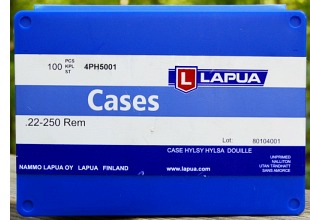
Based on Heath’s 200-count sample, we can say this new brass is very, very consistent in weight. The total weight spread (delta) for 200 cases was just 1.4 grains! And the vast majority, 83%, were within 0.7 grains in weight (160.3 – 161.0). For the varminter, sorting may be superfluous. Once again, Lapua has produced a superb new product, and we love the new, blue plastic boxes.
FYI, you 6mm shooters should know that the Lapua 22-250 brass can be made into quality 6XC brass. And it’s even easier to create a 6-250 wildcat. In May, Robert Whitley explained how he created a tack-driving 6-250 Wildcat from the new Lapua 22-250 brass.
June 17th, 2010
Hand-loaders know how to assemble bullet, brass, powder and primer into a loaded cartridge. But have you ever wondered how brass cartridge cases are formed, or how bullets are made, starting with raw materials? Federal Ammunition (a division of ATK) has created an interesting video that shows how factory-loaded ammo is created, from start to finish. The video shows how cartridge brass is cupped, drawn, sized, annealed, then finished-formed. In addition, you can see how bullets are formed then inserted in cartridges with automated machinery. This is a fascinating video, worth watching.

Bullet-Making Process at the Sierra Bullets Plant
A second video, produced for the Discovery Channel’s How Stuff Works TV show, illustrates how bullets are made at the Sierra Bullets plant. Watch 80-lb billets of lead being drawn into wire to be used as bullet cores. Then see how copper jackets are formed, lubed, sized and combined with bullet cores to create the finished product — precision bullets for hunters and match shooters.
Thanks to German Salazar for finding these two videos.
May 21st, 2010
 Tune in to Tom Gresham’s Gun Talk Radio this Sunday, May 23rd. Tom has an all-star line-up for Sunday’s broadcast, leading off with Texas Governor Rick Perry. Gov. Perry talks about guns, freedom, and using his own carry pistol to fend off a coyote attack. Tune in to Tom Gresham’s Gun Talk Radio this Sunday, May 23rd. Tom has an all-star line-up for Sunday’s broadcast, leading off with Texas Governor Rick Perry. Gov. Perry talks about guns, freedom, and using his own carry pistol to fend off a coyote attack.
Military Cartridge Brass Controversy
U.S. Congressman Brad Ellsworth of Indiana also joins Gresham to discuss an amendment added to the National Defense Authorization Bill that would prohibit the U.S. military from destroying brass cartridge cases. Some base commanders have allowed this “once-fired” brass to be sold as scrap metal, which results in less revenue for the Department of Defense. It also eliminates millions of reloadable cartridge cases which should be sold through legal channels — something that can help with the brass shortages law recreational and competitive shooters have experienced recently.
“As a gun owner myself and a former sheriff,” said Rep. Ellsworth, “I know that these cases are mostly used for marksmanship training and competition and law enforcement agencies. Authorizing the military to re-sell these casing is a win-win for hunters and marksman and the Defense Department.”
SCAR Rifle Deployment for SOCOM
Gabe Bailey, FNH USA Marketing Director for Combat Rifle and Technical Support, will also visit Gun Talk Radio this Sunday. He will discuss the SCAR weapon system, which recently received final “Milestone C” approval for deployment to U.S. SOCOM troops.

 In its 15th year of national syndication, Tom Gresham’s Gun Talk Radio runs on 94 stations, plus SIRIUS XM Satellite Radio. All Gun Talk shows can be downloaded as podcasts through Apple iTunes or at Gun Talk Archives. In its 15th year of national syndication, Tom Gresham’s Gun Talk Radio runs on 94 stations, plus SIRIUS XM Satellite Radio. All Gun Talk shows can be downloaded as podcasts through Apple iTunes or at Gun Talk Archives.
May 19th, 2010
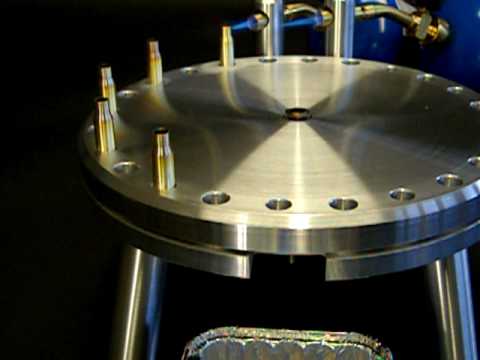
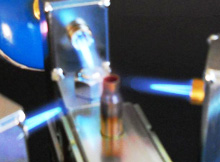 Forum member and long-range shooter Jerry Brandon has launched a new company, Ballistics Edge Mfg., which produces cartridge annealing machines for use by home reloaders. Brandon, a talented designer and fabricator, first tried annealing to maintain the quality of his own match brass. Brandon then built and tested a series of prototype annealing machines, working with a variety of brass sizes. Now Ballistics Edge Mfg. offers a full line of four annealing machines: the manually-operated Model 200 ($250), the motorized twin-torch Model 300 ($345), the motorized triple-torch Model 350 ($395), and the motorized Model 400 ($475), a beautifully-machined carousel design. Forum member and long-range shooter Jerry Brandon has launched a new company, Ballistics Edge Mfg., which produces cartridge annealing machines for use by home reloaders. Brandon, a talented designer and fabricator, first tried annealing to maintain the quality of his own match brass. Brandon then built and tested a series of prototype annealing machines, working with a variety of brass sizes. Now Ballistics Edge Mfg. offers a full line of four annealing machines: the manually-operated Model 200 ($250), the motorized twin-torch Model 300 ($345), the motorized triple-torch Model 350 ($395), and the motorized Model 400 ($475), a beautifully-machined carousel design.
Brandon’s most versatile machine, and the one he recommends for annealing both normal- and magnum-sized cases, is the Model 350. Like the Model 300, the Model 350 features all-metal construction and motorized case transport. The Model 350 uses three torches rather than the Model 300’s two. The triple-torch system does a better job heating the large-diameter necks on .338, .416 and .50-caliber cases. The triple-torch design also ensures fast, uniform heating of the case-necks on smaller cases. The video below shows the Model 350 in action, annealing jumbo-sized .50 BMG cases.

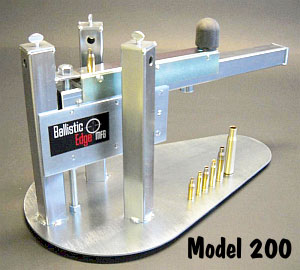 For PPC, 6mmBR, and .308-sized cases, you can use the Model 200, the Model 300, or the Model 400. The Model 200 is a simple, one-at-a-time annealer that works remarkably well using a sliding arm. Simply slide the case into the flame, then slide it out after the required dwell time. For the average reloader, the Model 200 may be more than adequate. If, however, you plan to anneal hundreds of cases a week, you may want to consider the beautifully-machined Model 400 carousel, which will anneal 100 cases in less than 15 minutes. The Model 400 features both .308-size and magnum/ultra magnum-size holes to accept both .47X and .56X diameter cases. Just choose the correct size hole and adjust the torch height to match your case. The .75″-thick shell-plate top acts as a heat-sink to protect the lower case body. View the Model 400 carousel annealer in the video below. For PPC, 6mmBR, and .308-sized cases, you can use the Model 200, the Model 300, or the Model 400. The Model 200 is a simple, one-at-a-time annealer that works remarkably well using a sliding arm. Simply slide the case into the flame, then slide it out after the required dwell time. For the average reloader, the Model 200 may be more than adequate. If, however, you plan to anneal hundreds of cases a week, you may want to consider the beautifully-machined Model 400 carousel, which will anneal 100 cases in less than 15 minutes. The Model 400 features both .308-size and magnum/ultra magnum-size holes to accept both .47X and .56X diameter cases. Just choose the correct size hole and adjust the torch height to match your case. The .75″-thick shell-plate top acts as a heat-sink to protect the lower case body. View the Model 400 carousel annealer in the video below.
Ballistics Edge Website Offers Good Technical Advice on Annealing
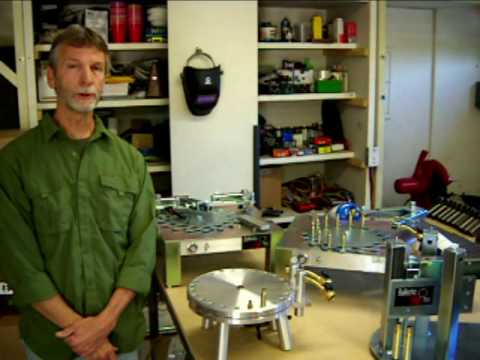
Anyone interested in learning about cartridge annealing should visit www.AnnealingMachines.com, Jerry Brandon’s website. There you’ll find a helpful, authoritative discussion of annealing, including the all-important factors of time and temperature. As Brandon observes, much MISinformation about annealing can be found. Brandon will set you straight. Read Brandon’s How to Anneal article and you can avoid making costly (and potentially dangerous) mistakes, whether you anneal manually or use an annealing machine. In the video below, Jerry Brandon reviews the features of Ballistics Edge annealing machines. He also provides some good, basic advice for shooters who are looking to try their hand at annealing for the first time.
|


