With the Berger Southwest Nationals coming up soon (Feb. 6-12), we thought we would share some tips from a past Champion who really knows the Ben Avery range in Phoenix. In 2015, Bryan won the F-TR Mid-Range AND Long-Range National Championships hosted at Ben Avery. And at the 2014 Berger SW Nationals (SWN), Bryan took top honors among all sling shooters. If you only know Bryan Litz from his Applied Ballistics Books and DVDs, you may not realize that this guy is a great marksman (along with being an actual rocket scientist). This guy can shoot.
Given his impressive track record at Ben Avery, we asked Bryan if he had any advice for other long-range competitors. First Bryan provided three tips concerning Ballistics, his special area of expertise. Next Bryan offered three more general tips about long-range competition — how to analyze your shooting, how to choose your ‘wind strategy’, and how to avoid the most costly mistakes, i.e. how to avoid the “train-wrecks”.
Here is the sleek F-TR Rig Bryan Litz used to win the 2015 F-TR Mid-Range and Long-Range Championships at Ben Avery:
Litz Ballistics Tips
Ballistics TIP ONE. If you’re having trouble getting your ballistic software to match actual drops, you need to look at a number of possible reasons. Here are some common issues that can cause problems.
Click Values Are Not Exact. Scopes and iron sights don’t always produce accurate adjustments. In other words, if your ballistics program predicts 30 MOA of drop, and you dial 30 MOA but hit low, it might be that your sight actually only moved 28 MOA (for example). To see if your sight is adjusting accurately, shoot a tall target at 100 yards and measure group separation when dialing your sight.
Barometric vs. Station Pressure. This is a commonly misunderstood input to ballistics programs. You can avoid this pitfall by remembering the following: station pressure is the actual measured pressure at your location, and you don’t need to tell the program your altitude when using station pressure. Barometric pressure is corrected for sea level. If you’re using barometric pressure, you also have to input your altitude.
Muzzle Velocity. Chronographs are not always as accurate as shooters think they are — your true MV may be off by 10-20 fps (or more). If your drop is different than predicted at long range, it might be because your muzzle velocity input is wrong.
Mixing Up BC (G1 vs. G7). Knowledgeable long range shooters know that the G7 standard is a more representative standard for modern LR bullets. However, using G7 BCs isn’t just a matter of clicking the ‘G7′ option in the program. The numeric value of the BC is different for G1 and G7. For example, the G1 BC of the Berger 155.5 grain Fullbore bullet is .464 but the G7 BC is .237. If you were to enter .464 but click on G7, the results would be way off.
Ballistics TIP TWO. A properly installed level is absolutely essential for long range shooting. Without a good level reference, your long range wind zero will be off due to minor canting of the rifle from side to side. You can verify that your level is installed correctly on a 100-yard ‘tall target’. Draw a plumb line straight up the target and verify that your groups track straight up this line as you go up in elevation.
Ballistics TIP THREE. If your long range ballistic predictions aren’t tracking, always come back and verify your 100-yard zero. Sometimes a simple zero shift can be misconstrued as errors in long range ballistics predictions.
Litz Competition Shooting Tips
Competition TIP ONE. Improving your scores in long range competition is a constant process of self-assessment. After each match, carefully analyze how you lost points and make a plan to improve. Beginning shooters will lose a lot of points to fundamental things like sight alignment and trigger control. Veteran shooters will lose far fewer points to a smaller list of mistakes. At every step along the way, always ask yourself why you’re losing points and address the issues. Sometimes the weak links that you need to work on aren’t your favorite thing to do, and success will take work in these areas as well.
Competition TIP TWO. Select your wind shooting strategy carefully. For beginners and veterans, most points are typically lost to wind. Successful shooters put a lot of thought into their approach to wind shooting. Sometimes it’s best to shoot fast and minimize the changes you’ll have to navigate. Other times it’s best to wait out a condition which may take several minutes. Develop a comfortable rest position so you have an easier time waiting when you should be waiting.
Competition TIP THREE. Actively avoid major train wrecks. Sounds obvious but it happens a lot. Select equipment that is reliable, get comfortable with it and have back-ups for important things. Don’t load on the verge of max pressure, don’t go to an important match with a barrel that’s near shot out, physically check tightness of all important screws prior to shooting each string. Observe what train wrecks you and others experience, and put measures in place to avoid them.
“Must-Watch” SWN Video has aerial view of Ben Avery plus highlights from Saturday
Christmas is coming soon. Books have always been popular holiday gifts. If you haven’t completed your holiday shopping, here are some recommended titles that should please the serious shooters and firearms enthusiasts on your shopping list. For shooting clubs, books also make great end-of-season member awards. Most of us would rather have a useful book than one more piece of wood to toss in a box in the closet.
Here Are TEN BOOKS Recommended for Serious Shooters:
Glen Zediker’s brand new book, Top-Grade Ammo, is hot off the press. Many folks believe this is Glen’s best book ever. This 314-page resource covers every aspect of the reloading process — component sorting, priming, sizing, bullet seating and more. With 430 photos, Top-Grade Ammo is a richly-illustrated, step-by-step guide to producing high-quality handloads. Unlike many reloading books, Top-Grade Ammo is truly current and up-to-date, so it covers modern practices and the latest precision reloading tools. While Zediker focuses on producing match-grade ammo for competition, this book will also help novice reloaders on a budget. It’s written for all hand-loaders — beginners through advanced. This book features a special “lay-flat” binding so it’s easy to use as a benchtop reference. To view Chapter List and sample pages visit ZedikerPublishing.com.
If you’re a serious long-range shooter, consider adding this book to your library. Relying on extensive ballistics testing, Modern Advancements contains some fascinating research results, including the effects of twist rate on muzzle velocity, BC, and precision. Other sections detail the evolution of modern rifle, bullet, and optics designs. And there is an important comparison test of chronographs. Laser rangefinders and wind measurement devices are explained in detail by contributing author Nick Vitalbo. This book is a valuable resource for anyone who wants to understand the current “state of the art” in today’s shooting world. There is a ton of “hard science” in this book — not just opinions.
This book should be on the shelf of every short-range benchrest shooter. (Shooters in other disciplines will find the book helpful as well.) Butch Lambert says Mike’s book is “far and away the best Benchrest book written. Very comprehensive, it touches on every aspect of our game.” Mike’s 368-page book is dedicated to getting the most from modern rifle accuracy equipment with an emphasis on shooting 100-200-300 yard group benchrest tournaments. This book covers the most popular hardware plus new equipment offerings are covered, including external mount scopes, actions, triggers, stocks, wind flags, and more. Also covered are rifle handling techniques, note taking, tuning, bullet selection, goals, and match strategies. Mike provides many tips that will help active competitors update their own competitive program.
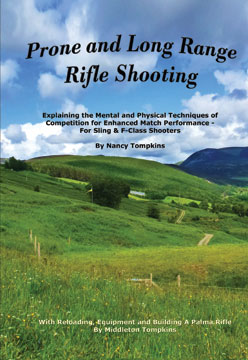
Nancy Tompkins is one of the greatest long-range shooters in American history. She has won five National Long-range Championships. Tompkins’ treatise is a must-read for serious Palma, F-Class, and High Power shooters. The revised Second edition includes F-Class equipment and techniques, and newly updated information. Color pictures. Topics include Mental & Physical training, Reading Wind & Mirage Shooting Fundamentals, International Competition, and Loading for Long Range. Nancy Tompkins is a 4-time winner of the National Long Range Championships, and has won countless other major events. Nancy has been on six Palma Teams (as both a shooter and a coach).
Ryan Cleckner is noted for his ability to explain complex topics in an easy-to-comprehend manner. Now Cleckner has authored a book, the Long Range Shooting Handbook, which expands on the topics covered in Cleckner’s popular NSSF video series. The Long Range Shooting Handbook is divided into three main categories: What It Is/How It Works, Fundamentals, and How to Use It. “What It Is/How It Works” covers equipment, terminology, and basic principles. “Fundamentals” covers the theory of long range shooting. “How to Use It” gives practical advice on implementing what you’ve learned, so you can progress as a skilled, long range shooter. You can view Sample Chapters from Ryan’s Book on Amazon.com.
Tony Boyer, the most successful shooter in the history of short-range benchrest competition, shares many of his match-winning tips in this 323-page book. The book covers all aspect of the benchrest discipline: loading, windflags, rest set-up, addressing the rifle, and match strategies. This is a high-quality publication, filled with valuable insights. Every serious benchrest shooter should read Tony’s book. Boyer has dominated registered benchrest in a fashion that will never be duplicated, having amassed 142 U.S. Benchrest Hall of Fame points. The next closest shooter, Allie Euber, has 47 Hall of Fame points. This handsome, full-color book is 323 pages long, with color photos or color illustrations on nearly every page.
This book by 11-time National High Power Champion David Tubb focuses on position shooting and High Power disciplines. Section One covers fundamentals: position points, natural point of aim, breathing, triggering mechanics and follow-through, sling selection and use, getting started, getting better, avoiding obstacles. Section Two covers mechanics of offhand, sitting, and prone positions. Section Three covers shooting skills, including wind reading and mental preparation. Section Four covers the technical side of shooting, with extensive disuctions of rifle design, load development, reloading barrel maintenance, and rifle fitting. We consider this book a “must-read” for any sling shooter, and there is plenty of good advice for F-Class shooters too.
Bullseye Mind (Mental Toughness for Sport Shooting) by Dr. Raymond Prior, $17.95 (Softcover).
Having a Bullseye Mind means thinking in ways that create confidence and consistency, even under pressure. A “must-read” for competitive shooters, Bullseye Mind is a mental training book written specifically for the shooting sports. The book is well-organized, with handy highlighted lists and key “talking points”. Each chapter concludes with examples from a world-class shooters such as: Matt Emmons, 2004 Olympic Gold Medalist; Vincent Hancock, 2-time Olympic Gold Medalist; Jamie Corkish, 2012 Olympic Gold Medalist; Petra Zublasing, 2014 World Champion/ISSF Shooter of the Year; and Nicco Campriani, 2012 Olympic Gold Medalist, 2010 World Champion. This book has earned rave reviews from competitive shooters who found it really helped their “Mental Game”. One recent purchaser states: “This book is as though you had a coach in your back pocket…”
Many of our Forum members have recommended The Wind Book for Rifle Shooters by Linda Miller and Keith Cunningham. This 146-page book, published in 2007, is a very informative resource. But you don’t have to take our word for it. If you click this link, you can read book excerpts on Amazon.com. This lets you preview the first few chapters, and see some illustrations. Other books cover wind reading in a broader discussion of ballistics or long-range shooting. But the Miller & Cunningham book is ALL about wind reading from cover to cover, and that is its strength. The book focuses on real world skills that can help you accurately gauge wind angle, wind velocity, and wind cycles.
Steven Boelter’s 352-page book is a comprehensive study of all types of rimfire ammunition (including 17s and 22 mags), with over 600 photos. In a remarkable undertaking, Steven Boelter fired every brand and sample of rimfire ammo he could acquire (including .22 LR, 17 Mach 2, 17 HMR and .22 WMR), and recorded all the results. In all, Steven tested 11 brands and 137 different rimfire rounds, firing over 32,000 test rounds.
Nosler recently introduced a new series of high-BC bullets with factory-closed meplats. Bryan Litz’s team at Applied Ballistics is now testing these new Reduced Drag Factor (RDF) projectiles to determine their performance — and specifically to see if the BCs are as high as claimed. Nosler bullet testing is underway this week and Litz hopes to bring the results to the Applied Ballistics Seminar in North Carolina later this week (November 3-4, 2016).
Applied Ballistics Seminar Fall 2016: November 3 – 4, 2016 – Caraway Conference Center
4756 Caraway Mountain Road Sophia, NC 27350; Phone: (336) 629-2374. Seminar Sign-Up.
Bryan notes: “If you live in the Southeast region, this is the last seminar for you for at least a year, possibly longer. We will most likely do the next seminars in regions not yet visited.”
Applied Ballistics Library Update
Bryan Litz is hard at work testing new projectiles: “We are currently in the middle of testing all these new offerings that have recently come out. In fact, the lab is up and running today, with some of the new Nosler RDFs going down range. Bullet measurements have been taken with our state-of-the-art digital comparator which is accurate to within 0.0001″. For example, shown below are the measured dimensions for the new Nosler RDF .308 175 grain projectile. For these new bullets, we will not only have complete BC measurements accurate to ± 1%, but we will have Custom Drag Models (CDMs) coming as well.”
New Data Coming Soon
Bryan hopes to present the new Nosler data at the Seminar this week in North Carolina. In addition, Bryan is developing information for the Hornady ELD bullets, G9 Competition Series solid bullets, some new Sierras, and some other projectiles not currently in the library: “Once we complete testing on all these new offerings, we will then compile the library for the next library update (which will be done across all platforms). We want to make sure that none of these new offerings are left out. For those who want to see some of the early results, come join us at this final seminar of 2016!”
Custom Drag Models
Applied Ballistics has been providing custom drag models for use in trajectory prediction for the past several years. Custom Drag Models (CDMs) for bullets are a more refined way of modeling drag for bullets because you’re not referencing a standard like G1 or G7, rather you’re using the actual measured drag of a specific bullet in a ballistic solver. This results in more accurate trajectory predictions, especially through transonic.
PrecisionRifleBlog.com recently reviewed several video-based rifle training DVD sets. While instructional DVDs will never replace live “hands-on” training, they can be cost-effective ways to sharpen your skills. Watched periodically, these training DVDs can help reinforce the fundamentals.
PRB’s Editor Cal Zant has purchased several rifle training DVDs over the years. His recent Precision Rifle Blog DVD review looks at four different options:
Long Range Made Easy, Two-Volume Set, from Accuracy 1st The Art Of The Precision Rifle, with Todd Hodnett (Magpul Dynamics) Putting Rounds On Target, with Bryan Litz (Applied Ballistics) Rifles Only — Precision Rifle Instructional DVDs, with Jacob Bynum
Cal reports that each of these four titles offers a slightly different approach, with each instructor displaying his own focus, based on his background and expertise.
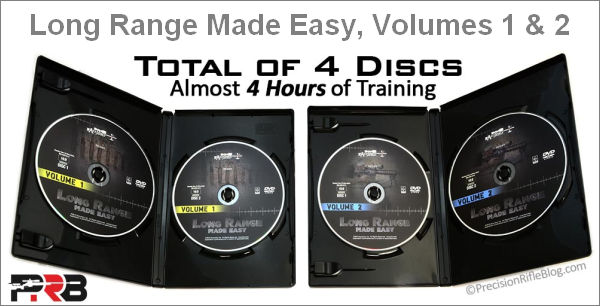
Accuracy 1st’s Long Range Made Easy Two-Volume Set seemed to win PRB’s Editor’s Choice Award. The tagline on the DVD is: “Go from basic to advanced with the guy that has trained our best military snipers for the past 10 years.” That’s a pretty good description. Todd Hodnett is the primary instructor, and Bryan Litz joins him in several segments.
It’s the best of both worlds. Todd Hodnett’s pragmatic “the-bullet-cannot-lie” approach (field-proven by hundreds of the world’s best snipers), is combined with Bryan Litz’s engineering approach and vast knowledge of external ballistics verified with carefully recorded live-fire experiments. The two styles complement each other well, and provide an extremely well-rounded and comprehensive overview.
The DVD set is split into two volumes, each of which includes two discs. All together there are almost four hours of instruction from the most respected guys in the industry. And they cover a lot of ground — you’d never be able to cover this much in a one- or two-day live class. Plus with the DVD you can easily repeat an important point, and watch the whole program more than once.
Cal paid $76.95 out-of-pocket for the Long Range Made Easy, Vol. 1 & 2 Bundle, so his review wasn’t a paid advertisement. He thought this set provides a ton of value, and could help a lot of shooters. Here are key topics covered in Long Range Made Easy:
■ Advice for Gear Purchases
■ Optimal Gun Setup
■ Technique for Position
■ Simple & Quick Wind Formula
■ Using the Applied Ballistics Kestrel
■ Truing Ballistic Algorithms, Drag Scale Factoring, and Custom Drag Models
■ WEZ Analysis
■ Wind Course
If you’re new to the long range game, or you’ve been doing it for a few years and want to learn directly from some of the most sought-after instructors in the world, then check out Cal’s write-up over at PrecisionRifleBlog.com. CLICK HERE for PRB Review of Training DVDs.
On the heels of the announcement that Berger Bullets will join the Nammo group, the following information was posted on the Long Range Hunting Forum by Doc Beech of Applied Ballistics:
I would like to emphasize a couple of things before you read on. The [acquisition of Berger Bullets by Nammo] CHANGES NOTHING. Production will remain in the same facility, by the same people, to the same quality. Berger Bullets will remain the highest-quality bullets on the market. What this merger does, is it gives these companies [the opportunity] to work together, to provide the highest-quality ammunition.
Lapua is well known for its high-quality brass, VihtaVuori makes high-quality powder, and Berger makes high-quality bullets. When you put the three together, you have the possibility of unmatched, premium … factory ammunition. To be clear, this will not affect the quality or way that Berger bullets are produced.
Q & A about Berger Bullets Joining Nammo Group
Q. What are Nammo’s plans concerning Berger Bullets?
A. Nammo plans on operating Berger Bullets as a stand-alone brand with support from the Nammo Group in a number of areas. First, they would like to help Berger improve the availability of many of their bullets that are in high demand.
Q. Are you going to eliminate any specific bullets? In other words, do they need to stock up!
A. We have no immediate plans to discontinue any of our bullets. We will continue as a part of our normal business practice to discontinue bullets that have been replaced by a superior product or those that do not have a demand sufficient to warrant allocating time in our production schedule. This is just what we have always done as part of our process.
Q. Is Bryan Litz still going to be the ballistician for Berger Bullets?
A. Yes. Bryan is an important part of the Berger Bullet team and our plans definitely include keeping Bryan on as our lead ballistician.
Q. Is Eric Stecker going to remain in charge of Berger Bullets?
A. Eric Stecker will continue as President of Berger Bullets
Q. Are the same dealers going to carry Berger Bullets?
A. Yes, we have no plans to change the way we distribute Berger Bullets to the shooting community.
Q. Does this mean ABM Ammo will have direct access to components like powder and brass?
A. Yes.
__________________
Doc Beech – Applied Ballistics
doc.beech@appliedballisticsllc.com
www.abmediaresources.com – www.appliedballisticsllc.com
Bryan Litz, 2016 F-TR National Mid-Range Champion, tried his hand at a new discipline recently — tactical shooting. Bryan competed in the Guardian Match, a PRS-type competition hosted by the Marksmanship Training Center in Lake City, Michigan. Though the course of fire was new to Bryan, he did very well indeed, finishing second overall in his first-ever Tactical Match.
Bryan said PRS-type tactical shooting is “totally different” than F-TR competition: “I think the biggest difference (from F-TR) are the time constraints. The time pressure’s totally different. We had just 25 seconds to do one short-range stage, and other stages are 90 seconds, 120 seconds….”
Bryan added: “You’ve got to know your dope for the first shot — no sighters. F-TR is more deliberate, precision-based. This [tactical game] is about accuracy to be sure, but there’s even athleticism — if you’re not flexible, you’re just straight up not going to be able to aim at some of these targets.”
Bryan, who first achieved great success in sling-shooting disciplines, said that tactical matches, with their multiple “on the clock” stages, offer new challenges: “This was a way different experience than I’m used to, mostly due to time pressure and awkward shooting positions. But I enjoyed the problem- solving element. Fellow shooters were very helpful and generous with advice.” Posting on Facebook, former USAMU coach Emil Praslick offered this sarcastic advice: “You need more Velcro and camouflage. That is what is preventing you from winning.”
During his match Brian shot in multiple locations, with a variety of target types, including steel and IPSC movers. There were some unusual challenges including a “Tree-Stand Hunter” stage, and a stage that required moving “Around, Over, and Under a Vehicle” as you can see…
Before the match, Bryan practiced from a tripod, but he wasn’t sure about the best technique: “Seriously, what kind of groups are considered ‘good’ from a position like this? Does 2 MOA suck?” Here’s the recommended technique (from Gunny N.): “Anchor the sling to the front of the rifle but not the back. Wrap sling around leg or center post of the tripod. Place your off hand on the wrap and twist it to tighten up. That will apply down pressure on the forearm. Your shoulder will apply down pressure on butt stock. You’ll tighten groups 25-50%.”
Ballistics Guru Bryan Litz needed all of his wind-reading skills in Lodi, WI. Conditions were challenging!
Bryan Litz of Applied Ballistics won his second straight Mid-Range F-TR National Championship this past weekend. Likewise the Michigan F-TR Team won its second Championship in a row. So it was a heck of a showing by the Michiganders overall. With a strong individual performance, Phil Kelley finished second with his fellow X-Men teammate James Crofts in third. The X-Men Team also garnered second-place in the F-TR Team event. Kelley told us: “It sure is fun to compete with the best in the business — to share the individual overall podium with Bryan Litz and James Crofts is an exciting honor.”
It was a bit cold in Lodi, Wisconsin, photo by K. McSparron.
F-Class Goes High-Tech with Electronic Targets
This was the first-ever F-Class National Championship that used electronic Targets. Litz offers his perspective on the new E-Targets in the Q&A section below — Bryan is mostly positive about the E-Targets but he says there are still some minor bugs to be worked out.
Bryan, a sling-shooter at heart, has really taken to this F-TR game. He won both the Mid-Range and Long Range F-TR National Championships in 2015 and now he has one 2016 title in the bag. Bryan tells us: “Many thanks go out to all those who’ve supported me in winning my second F-TR Mid-Range National Championship. My serious pursuit of F-TR shooting began the day I called John Pierce and requested: ‘John, build me one like yours’. That rifle and others built by Pierce Engineering are at the top of the game. Thanks also to my many great team-mates on the Michigan and U.S. Rifle Teams who have taught me a lot about this sport. As always the competition was stiff and mother nature gave us some drastically different looks. The challenging weather, combined with the introduction of electronic targets to this sport at the national level, required shooters to be highly adaptable. Thanks to the match organizers and technical staff who did a great job.”
John Pierce (left) and Bryan Litz with his Championship-winning Pierce-built F-TR rifle (2014 photo).
Litz Loads Vihtavuori N140 with 215gr Berger Hybrids in his .308 Win
Bryan told us: “Load data is always a common question and I keep no secrets –I’m running the same basic load I shot the past few years with the exception that I’m now burning 43.0 grains of Vihtavuori N140 instead of Hodgdon Varget in new Lapua brass with Fed 210M primers and 215 Berger Hybrids seated about 0.005″ off the riflings. This gets 2520 fps in a 28-inch barrel. I use this same load for both mid-range and long range.”
Team Competition — Michigan Wins F-TR Division with X-Men in Second
Michigan F-TR Team won its second consecutive Mid-Range National Championship. Congratulations to team-mates Al Barnhart, Doug Boyer, Bryan Litz, and John Roethlisberger. Al and Doug are experienced veterans but this is John’s first experience in a national-level event. Michigan actually fielded two teams in this event and the second squad also won a medal in one of the matches. Byran Litz noted that the Michigan F-TR Team “has been working hard to develop our shooters and many have made it onto the U.S. Rifle Team. We have many great sponsors including: Applied Ballistics, Berger Bullets, Bartlein Barrels, Marksmanship Training Center, Nightforce Optics, Pierce Engineering, and Vihtavuori Powder.” Bryan added: “I also thank Team X-Men for the spirited competition. You guys (James Crofts, Tracy Hogg, Phil Kelly, Ian Klemm, and Ken Klemm) are great and make these team matches very fun.”
Bryan Litz with Michigan F-TR team-mates Al Barnhart, John Roethlisberger, and Doug Boyer.
Q & A with the Champ — Litz Talks Targets and Match Strategies
We asked Bryan how the new Electronic Target technology used in Lodi alters the F-Class game. As the Long Range Nationals are underway now, we also asked Bryan to comment on Mid-Range vs. Long Range strategies — what does he do different at 1000 yards vs. 600 yards.
1. How did you like the electronic targets? Did this require/allow a change in your shooting style or rhythm (e.g. can competitors shoot faster now with less wait time between shots)?
LITZ: I really like the E-Targets for many reasons. Not pulling pits is the biggest one but the E-Targets also bring a level of fairness that human pullers could never achieve in the sense that everyone gets the same speed ‘service’.
For the 2016 FCNC in Lodi, WI, all the targets are programmed with a 7-second delay which is equivalent to “very good” target service. The system actually shows your shot value immediately, but doesn’t plot the location of the shot for 7 seconds. So if you want to “machine gun” a shot following an X with the same hold, you can take your chances without knowing where the X was.
The E-Targets require some adaptation from regular pit service. For those with many years of experience on traditional targets, it’s just WEIRD that the target doesn’t go up and down or have a spotter in it. All the information you need is on the tablet. This isn’t better or worse, just different. Occasionally the tablets lose signal for a few seconds and it can be frustrating, but this is not different than when a puller missed a shot and you had to “call for a mark”. I think that very soon the connectivity issues will be fully resolved and the systems will operate flawlessly. I know it would be impossible to get all the shooters through on such a small range any other way. The E-Targets have enabled a medium-sized range like Lodi to host a National Championship.
Q: How is the mid-range F-TR game different than long-range F-TR competition?
LITZ: Usually Mid-Range is about consistent precision — not having any fliers and not dropping any points. Mid-Range matches are usually decided by a narrower point spread than long range. Conditions aren’t typically big enough to move you out of the 10 ring very much at mid-range. The first couple days of the 2016 Mid-Range Nationals was just like this. I won the first two days, dropping only 3 points in total. But then the wind picked up on Day 3 and it was totally different! It became more like a Long Range match with all the points falling like rain and [conditions] very difficult to read. Many more 8s and 7s appeared at 600 yards and the field really spread out. In the end I was able to hold onto my lead and win the tournament.
Q. Why the change to Vihtavuori N140 powder? Was it more available or were you seeing lower ES/SD?
LITZ: I’m seeing the same ES/SDs with VV N140 as what I was using before (Varget) and N140 may burn a little cleaner. Also availability has been improving on the Vihtavuori powders in recent years. We (the Michigan F-TR Rifle Team) are very fortunate to have Vihtavuori as a sponsor and look forward to winning many matches with Vihtavuori products.
Editor’s Note: If any readers have results for the F-Open Mid-Range Nationals, please post in the comments section below and we will update this story.
Today is practice day for the Mid-Range F-Class Nationals, which commence bright and early tomorrow morning in Lodi, Wisconsin. In any shooting competition, you must try to avoid major screw-ups that can ruin your day (or your match). In this article, reigning F-TR National Mid-Range and Long Range Champion Bryan Litz talks about “Train Wrecks”, i.e. those big disasters (such as equipment failures) that can ruin a whole match. Bryan illustrates the types of “train wrecks” that commonly befall competitors, and he explains how to avoid these “unmitigated disasters”.
Urban Dictionary “Train Wreck” Definition: “A total @#$&! disaster … the kind that makes you want to shake your head.”
Success in long range competition depends on many things. Those who aspire to be competitive are usually detail-oriented, and focused on all the small things that might give them an edge. Unfortunately it’s common for shooters lose sight of the big picture — missing the forest for the trees, so to speak.
Consistency is one of the universal principles of successful shooting. The tournament champion is the shooter with the highest average performance over several days, often times not winning a single match. While you can win tournaments without an isolated stellar performance, you cannot win tournaments if you have a single train wreck performance. And this is why it’s important for the detail-oriented shooter to keep an eye out for potential “big picture” problems that can derail the train of success!
Train wrecks can be defined differently by shooters of various skill levels and categories. Anything from problems causing a miss, to problems causing a 3/4-MOA shift in wind zero can manifest as a train wreck, depending on the kind of shooting you’re doing.
Below is a list of common Shooting Match Train Wrecks, and suggestions for avoiding them.
1. Cross-Firing. The fastest and most common way to destroy your score (and any hopes of winning a tournament) is to cross-fire. The cure is obviously basic awareness of your target number on each shot, but you can stack the odds in your favor if you’re smart. For sling shooters, establish your Natural Point of Aim (NPA) and monitor that it doesn’t shift during your course of fire. If you’re doing this right, you’ll always come back on your target naturally, without deliberately checking each time. You should be doing this anyway, but avoiding cross-fires is another incentive for monitoring this important fundamental. In F-Class shooting, pay attention to how the rifle recoils, and where the crosshairs settle. If the crosshairs always settle to the right, either make an adjustment to your bipod, hold, or simply make sure to move back each shot. Also consider your scope. Running super high magnification can leave the number board out of the scope’s field view. That can really increase the risk of cross-firing.
2. Equipment Failure. There are a wide variety of equipment failures you may encounter at a match, from loose sight fasteners, to broken bipods, to high-round-count barrels that that suddenly “go south” (just to mention a few possibilities). Mechanical components can and do fail. The best policy is to put some thought into what the critical failure points are, monitor wear of these parts, and have spares ready. This is where an ounce of prevention can prevent a ton of train wreck. On this note, if you like running hot loads, consider whether that extra 20 fps is worth blowing up a bullet (10 points), sticking a bolt (DNF), or worse yet, causing injury to yourself or someone nearby.
[Editor’s Note: The 2016 F-Class Nationals will employ electronic targets so conventional pit duties won’t be required. However, the following advice does apply for matches with conventional targets.]
3. Scoring/Pit Malfunction. Although not related to your shooting technique, doing things to insure you get at least fair treatment from your scorer and pit puller is a good idea. Try to meet the others on your target so they can associate a face with the shooter for whom they’re pulling. If you learn your scorer is a Democrat, it’s probably best not to tell Obama jokes before you go for record. If your pit puller is elderly, it may be unwise to shoot very rapidly and risk a shot being missed (by the pit worker), or having to call for a mark. Slowing down a second or two between shots might prevent a 5-minute delay and possibly an undeserved miss.
4. Wind Issues. Tricky winds derail many trains. A lot can be written about wind strategies, but here’s a simple tip about how to take the edge off a worse case scenario. You don’t have to start blazing away on the command of “Commence fire”. If the wind is blowing like a bastard when your time starts, just wait! You’re allotted 30 minutes to fire your string in long range slow fire. With average pit service, it might take you 10 minutes if you hustle, less in F-Class. Point being, you have about three times longer than you need. So let everyone else shoot through the storm and look for a window (or windows) of time which are not so adverse. Of course this is a risk, conditions might get worse if you wait. This is where judgment comes in. Just know you have options for managing time and keep an eye on the clock. Saving rounds in a slow fire match is a costly and embarrassing train wreck.
5. Mind Your Physical Health. While traveling for shooting matches, most shooters break their normal patterns of diet, sleep, alcohol consumption, etc. These disruptions to the norm can have detrimental effects on your body and your ability to shoot and even think clearly. If you’re used to an indoor job and eating salads in air-conditioned break rooms and you travel to a week-long rifle match which keeps you on your feet all day in 90-degree heat and high humidity, while eating greasy restaurant food, drinking beer and getting little sleep, then you might as well plan on daily train wrecks. If the match is four hours away, rather than leaving at 3:00 am and drinking five cups of coffee on the morning drive, arrive the night before and get a good night’s sleep.”
Keep focused on the important stuff. You never want to lose sight of the big picture. Keep the important, common sense things in mind as well as the minutia of meplat trimming, weighing powder to the kernel, and cleaning your barrel ’til it’s squeaky clean. Remember, all the little enhancements can’t make up for one big train wreck!
Why You CANNOT Rely on the MV Printed on the Ammo Box!
When figuring out your come-ups with a ballistics solver or drop chart it’s “mission critical” to have an accurate muzzle velocity (MV). When shooting factory ammo, it’s tempting to use the manufacturer-provided MV which may be printed on the package. That’s not such a great idea says Bryan Litz of Applied Ballistics. Don’t rely on the MV on the box, Bryan advises — you should take out your chrono and run your own velocity tests. There are a number of reasons why the MV values on ammo packaging may be inaccurate. Below is a discussion of factory ammo MV from the Applied Ballistics Facebook Page.
Five Reasons You Cannot Trust the Velocity on a Box of Ammo:
1. You have no idea about the rifle used for the MV test.
2. You have no idea what atmospheric conditions were during testing, and yes it matters a lot.
3. You have no idea of the SD for the factory ammo, and how the manufacturer derived the MV from that SD. (Marketing plays a role here).
4. You have no idea of the precision and quality of chronograph(s) used for velocity testing.
5. You have no idea if the manufacturer used the raw velocity, or back-calculated the MV. The BC used to back track that data is also unknown.
1. The factory test rifle and your rifle are not the same. Aside from having a different chamber, and possibly barrel length some other things are important too like the barrel twist rate, and how much wear was in the barrel. Was it just recently cleaned, has it ever been cleaned? You simply don’t know anything about the rifle used in testing.
2. Temperature and Humidity conditions may be quite different (than during testing). Temperature has a physical effect on powder, which changes how it burns. Couple this with the fact that different powders can vary in temp-stability quite a bit. You just don’t know what the conditions at the time of testing were. Also a lot of factory ammunition is loaded with powder that is meter friendly. Meter friendly can often times be ball powder, which is less temperature stable than stick powder often times.
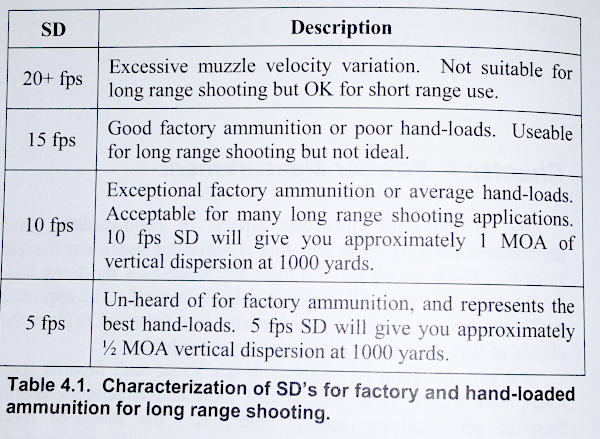
3. The ammo’s Standard Deviation (SD) is unknown. You will often notice that while MV is often listed on ammo packages, Standard Deviation (normally) is not. It is not uncommon for factory ammunition to have an SD of 18 or higher. Sometimes as high as 40+. As such is the nature of metering powder. With marketing in mind, did they pick the high, low, or average end of the SD? We really don’t know. You won’t either until you test it for yourself. For hand-loaded ammo, to be considered around 10 fps or less. Having a high SD is often the nature of metered powder and factory loads. The image below is from Modern Advancements in Long Range Shooting: Volume II.
4. You don’t know how MV was measured. What chronograph system did the manufacturer use, and how did they back track to a muzzle velocity? A chronograph does not measure true velocity at the muzzle; it simply measures velocity at the location it is sitting. So you need to back-calculate the distance from the chrono to the end of the barrel. This calculation requires a semi-accurate BC. So whose BC was used to back track to the muzzle or did the manufacturer even do that? Did they simply print the numbers displayed by the chronograph? What kind of chronograph setup did they use? We know from our Lab Testing that not all chronographs are created equal. Without knowing what chronograph was used, you have no idea the quality of the measurement. See: Applied Ballistics Chronograph Chapter Excerpt.
5. The MV data may not be current. Does the manufacturer update that data for every lot? Or is it the same data from years ago? Some manufacturers rarely if ever re-test and update information. Some update it every lot (ABM Ammo is actually tested every single lot for 1% consistency). Without knowing this information, you could be using data for years ago.
CONCLUSION: Never use the printed MV off a box of ammo as anything more than a starting point, there are too many factors to account for. You must always either test for the MV with a chronograph, or use carefully obtained, live fire data. When you are using a Ballistic Solver such as the AB Apps or Devices integrated with AB, you need to know the MV to an accuracy down to 5 fps. The more reliable the MV number, the better your ballistics solutions.
Many of the world’s best F-Class shooters have traveled to Ottawa, Ontario, Canada this week to compete at the Canadian F-Class National Championships. F-Open ace Shiraz Balolia, who won back-to-back Canadian F-Open Championships in 2015 and 2014, will pursue a “three-peat” at Canada’s Connaught Ranges. There will be plenty of F-TR talent on hand as well, including Bryan Litz, reigning U.S. Mid-Range and Long-Range F-TR Champion. The first challenge for the shooters will be the weather, which can be notoriously wet and windy at Connaught. The weather forecast looks good for today and tomorrow, but thunderstorms (and rain) are predicted for Friday and Saturday.
U.S. F-TR Rifle Team Prepares for the Canadian Championships:
Shown above is the U.S. F-TR Rifle Team, which will compete in the F-TR division. In the America Match, teams from Canada, South Africa, and the United States will battle head-to-head for national honors.
Many Companies Help Sponsor U.S. F-TR Rifle Team
It takes significant resources to field a large shooting team in international competition. The U.S. F-TR Rifle team is fortunate to have many great sponsors helping the team with equipment and financial support. The team’s top-level “Gold Medal” sponsors, are, in alphabetical order: Berger Bullets, Gemtech, Kelbly’s, McMillan Fiberglass Stocks, Nightforce Optics, Pierce Engineering, and 5.11 Tactical. CLICK HERE for a list of all sponsors.


 With the Berger Southwest Nationals coming up soon (Feb. 6-12), we thought we would share some tips from a past Champion who really knows the Ben Avery range in Phoenix. In 2015, Bryan won the F-TR Mid-Range AND Long-Range National Championships hosted at Ben Avery. And at the 2014 Berger SW Nationals (SWN), Bryan took top honors among all sling shooters. If you only know Bryan Litz from his Applied Ballistics Books and DVDs, you may not realize that this guy is a great marksman (along with being an actual rocket scientist). This guy can shoot.









 Train Wrecks (and How to Avoid Them)
 4. Wind Issues. Tricky winds derail many trains. A lot can be written about wind strategies, but here’s a simple tip about how to take the edge off a worse case scenario. You don’t have to start blazing away on the command of “Commence fire”. If the wind is blowing like a bastard when your time starts, just wait! You’re allotted 30 minutes to fire your string in long range slow fire. With average pit service, it might take you 10 minutes if you hustle, less in F-Class. Point being, you have about three times longer than you need. So let everyone else shoot through the storm and look for a window (or windows) of time which are not so adverse. Of course this is a risk, conditions might get worse if you wait. This is where judgment comes in. Just know you have options for managing time and keep an eye on the clock. Saving rounds in a slow fire match is a costly and embarrassing train wreck.