Effects Of Cartridge Over All Length (COAL) And Cartridge Base To Ogive (CBTO) – Part 1 by Bryan Litz forBerger Bullets.
Many shooters are not aware of the dramatic effects that bullet seating depth can have on the pressure and velocity generated by a rifle cartridge. Cartridge Overall Length (COAL) is also a variable that can be used to fine-tune accuracy. It’s also an important consideration for rifles that need to feed rounds through a magazine. In this article, we’ll explore the various effects of COAL, and what choices a shooter can make to maximize the effectiveness of their hand loads.
Sporting Arms and Ammunition Manufacturers’ Institute (SAAMI)
Most loading manuals (including the Berger Manual), present loading data according to SAAMI (Sporting Arms and Ammunition Manufacturers’ Institute) standards. SAAMI provides max pressure, COAL and many other specifications for commercial cartridges so that rifle makers, ammo makers, and hand loaders can standardize their products so they all work together. As we’ll see later in this article, these SAAMI standards are in many cases outdated and can dramatically restrict the performance potential of a cartridge.
Bullet seating depth is an important variable in the accuracy equation. In many cases, the SAAMI specified COAL is shorter than what a hand loader wants to load their rounds to for accuracy purposes. In the case where a hand loader seats the bullets longer than SAAMI specified COAL, there are some internal ballistic effects that take place which are important to understand.
Effects of Seating Depth / COAL on Pressure and Velocity
The primary effect of loading a cartridge long is that it leaves more internal volume inside the cartridge. This extra internal volume has a well known effect; for a given powder charge, there will be less pressure and less velocity produced because of the extra empty space. Another way to look at this is you have to use more powder to achieve the same pressure and velocity when the bullet is seated out long. In fact, the extra powder you can add to a cartridge with the bullet seated long will allow you to achieve greater velocity at the same pressure than a cartridge with a bullet seated short.
Figure 1. When the bullet is seated farther out of the case, there is more volume available for powder. This enables the cartridge to generate higher muzzle velocity with the same pressure.
When you think about it, it makes good sense. After all, when you seat the bullet out longer and leave more internal case volume for powder, you’re effectively making the cartridge into a bigger cartridge by increasing the size of the combustion chamber. Figure 1 illustrates the extra volume that’s available for powder when the bullet is seated out long.
Before concluding that it’s a good idea to start seating your bullets longer than SAAMI spec length, there are a few things to consider.
Geometry of a Chamber Throat
The chamber in a rifle will have a certain throat length which will dictate how long a bullet can be loaded. The throat is the forward portion of the chamber that has no rifling. The portion of the bullet’s bearing surface that projects out of the case occupies the throat (see Figure 2).
The length of the throat determines how much of the bullet can stick out of the case. When a cartridge is chambered and the bullet encounters the beginning of the rifling, known as the lands, it’s met with hard resistance. This COAL marks the maximum length that a bullet can be seated. When a bullet is seated out to contact the lands, its initial forward motion during ignition is immediately resisted by an engraving force.
Seating a bullet against the lands causes pressures to be elevated noticeably higher than if the bullet were seated just a few thousandths of an inch off the lands.
A very common practice in precision reloading is to establish the COAL for a bullet that’s seated to touch the lands. This is a reference length that the hand loader works from when searching for the optimal seating depth for precision. Many times, the best seating depth is with the bullet touching or very near the lands. However, in some rifles, the best seating depth might be 0.100″ or more off the lands. This is simply a variable the hand loader uses to tune the precision of a rifle.
If you’re looking for a great start for your summer, mark your calendars for May 31 through June 2, 2013 and plan to shoot the 2013 Remington-Bushmaster Long Range Regional at the Reade Range in central Pennsylvania. June in the Appalachian Mountains is a beautiful time and place. The Reade range is a first-class facility and terrific place to shoot. Since last year improvements have been made to the range to help accommodate the large number of competitors that this and other matches draw. The Regional tournament is open to conventional (sling), and F-class shooters (both F-TR and F-Open). There is still time to sign-up for the match and entries are still being accepted.
Firing will begin on Friday, May 31st with a 4-man team match that follows a morning of practice. Saturday is 3×1000 any/iron match followed by a wind clinic by Bryan Litz and a prize raffle. The match concludes on Sunday with 3×1000 any/any matches and awards presentations (with meal provided). Several teams are expected to be in attendance, pit pullers will be available for hire by competitors and Applied Ballistics will operate a hospitality tent with drinks and snacks all weekend.
CLICK “PLAY” to HEAR Bryan Litz TALK about LR Regional Match Course of Fire and PRIZES:
As if the fun of competitive shooting isn’t enticing enough, this match is heavily sponsored with some terrific prizes. Awards for the winners include: Remington rifles, Championship medals, and first place Team medals. Pluis half the entry fees will be returned to the winners as cash awards. In addition to awards, the prize table, containing donations from over 30 sponsors with a value well over $6,000, will be raffled as door prizes. Last year, every competitor was able to walk away with a prize!
Remington-Bushmaster Arms is the primary sponsor of the match. Applied Ballistics, LLC is promoting the match and you can see a full list of the match sponsors and prizes on the Applied Ballistics website. Sponsor donations are greatly appreciated. If you have a business in the firearms industry and would like to support the shooting sports by donating to this match, please contact Jennifer Litz at Jennifer.litz [at] appliedballisticsllc.com.
Editor: With Jerry Tierney steering a straight .284 Win to victory at the recent NBRSA 1000-Yard Nationals, we thought readers would appreciate a “second look” at this story. Our friend Bruce Duncan talks about the .284 Win and explains why it has proven so successful in long-range competition.
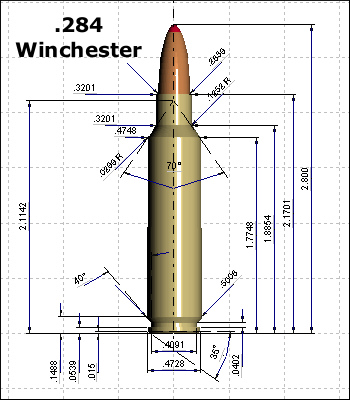
Building a Straight .284 Winchester
Sometime back–at least two years ago–Jerry Tierney confided in me that he was givng up on the 6.5s, and moving to the 7mms. “If you could only shoot one 7mm, Jerry,” I asked, “which would it be?” … “Straight 284 Win,” he answered.
So when I was thinking to rebarrel my 6.5×47 Lapua, in the fall of 2010, the .284 Win came immediately to mind. I am not about to argue the primacy of any chambering. I look at the dominance of the 6mm Dasher, at Missoula, say, or the recent NBRSA 600- and 1000-Yard Nationals and wonder.
And I’m reasonably convinced that none of us ever makes an entirely rational decision — one based purely on fact, and void of prejudice and emotion. But I knew a bunch of the U.S. F-Class guys were moving to 7mm, and decided to build one myself. This would be a NBRSA Heavy Gun, using my existing Barnard PC twin-port action, and my existing Shehane MBR Tracker stock. Going to the 7mm made sense to me — an accurate heavy bullet with a high BC, such as the Berger 7mm 180gr Hybrid, has a good chance of getting where one wants it to go. That’s particularly important when you’re shooting in tough wind conditions.
I ordered a 1:9″-twist barrel from Bartlein with 5R rifling and 1.250″ straight contour. (By the way, MT Guns has racks of Bartlein barrels if you need one right away.) I spoke at length with Ray Bowman of Precision Rifle & Tool (PR&T), who has immense experience with the .284 Win, and his fingerprints on a lot of winning rifles. Ray was supportive.
“The .284 Shehane isn’t enough bang for the buck”, Ray suggested. I sense he was telling me that I could achieve what I wanted with a standard .284 Win, without the cost of custom-run dies or the hassle of case-forming. I had David Kiff of Pacific Tool & Gauge cut me a reamer with a .313″ neck. I hadn’t decided on a bullet — I shoot Bergers exclusively — but watched the results from Phoenix in 2011, and noticed Bryan Litz did well with his .284 Win, shooting the Berger 180 Hybrid, as did Danny Biggs, shooting a 7mm RSAUM. I did some preliminary 100-yard load testing, and settled on a few loads I wanted to try (at longer range) with the Berger 180.
Shooting in good conditions on an Ojai, California morning, I tried three, five-shot groups with three different loads at 600 yards. One load in particular gave me two groups out of three at 1.8xx”. That’s pretty darn good at 600. The only surprise was that the bullets were seated to have the ogive just kiss the lands, rather than the slight jump that most were using.
It turned out that my load development wasn’t a fluke. The gun shot well, taking Third Place, 6-Target Aggregate Heavy Gun Group at the 2011 NBRSA 1000-Yard Nationals in Sacramento. Together with my 6×47 Lapua Light Gun, I took Third Place Overall. (The LG also featured a Barnard Action, Bartlein barrel, and Shehane stock.)
Great Accuracy Is Possible
So I was not surprised when Ed Docalavich, one of MT Guns clients, wrote to say how happy he was with the .284 Winchester we built for him. He attached one of the proverbial “Wallet Targets” from load testing. You can see it at right. There are five (5) shots at 100 yards, in a ragged hole you could practically cover with the Excedrin tablet in the photo. Not bad for a stout-recoiling rifle. Ed’s gun features a Barnard P action, Bartlein 5R 1:9″-twist, 1.250″-straight barrel, chambered for a no-turn neck.
Like I said, I’m not about to argue the primacy of any particular chambering, and my hat is off to the 6mms that do so well at 1000 yards. But I like the idea of a heavier bullet; the Berger 180gr Hybrid seems like magic. And as you might imagine, I don’t think it’s any coincidence at all that Ryan Pierce recently set a new 1000-Yard F-Open Record shooting the straight .284 Winchester. (READ Pierce Record Story).
At the end of this year, Berger Bullets plans to introduce a new projectile that may truly be the most revolutionary bullet design since the advent of jacketed spitzers in the late 19th Century. Berger’s new bullet is unlike anything we have ever seen before. It features concentric curved ridges, or “ripples”, on the bearing surface. Tests show that this new projectile, dubbed the “Sonic Ripple Bullet”, has signficantly less drag than conventional bullets (no matter what their ogive configuration). In addition, the Sonic Ripple design provides increased stability at all velocities (allowing barrels with slower twist rates for a given bullet weight).
So, what does all this mean in practical terms? Well, compared to conventional bullets (of similar weight/size), the Sonic Ripple Bullet will shoot a flatter trajectory, buck the wind better, retain energy longer, and remain stable for a much longer distance. That’s big news for competitive shooters, tactical shooters, and long-range hunters.
The Science of the Sonic Ripple Bullet Design
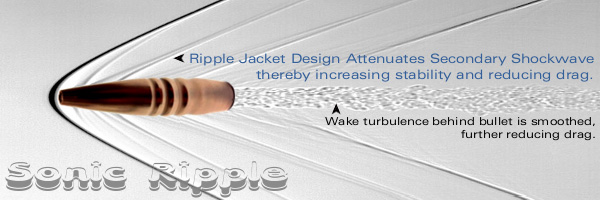
Bryan Litz, Ballistician for Berger Bullets, explains: “This radical leap forward in bullet design was made possible by advanced, new bullet-making technologies. The unusual bullet appearance is only part of the revolutionary ‘Sonic Ripple’ system. The curvilinear waves or ripples in the bullet jacket are designed to create a specific resonance when fired from a specially ‘tuned’ barrel system. The result is an optimization of the sonic wavefront created by the bullet as it travels through its trajectory. This wavefront optimization simultaneously reduces bullet drag while increasing bullet stability.”
In essence, the supersonic shock-wave is smoothed out, dramatically reducing secondary wave fronts. This is all good, as Bryan explains: “If all the internal ballistic requirements are met, the Sonic Ripple bullet exits the muzzle with a harmonically-stabilized launch dynamic. As a further benefit of the ripple design, tests show that the concentric ripples also enhance boundary layer airflow attachment on the bullet. This, in turn, dramatically reduces wake turbulence and attendant drag.”
The reduction of wake turbulence (combined with wavefront optimization) represents a “major breakthrough” which should increase projectile BC by at least 0.14 (on G7 scale), according to Bryan. But, we wondered, might the increased surface area associated with the ripples slow the bullet down in flight? Actually, no. Bryan explained: “Eddies in the boundary layer around the ripples actually lower skin friction drag which more than compensates for increased surface area, resulting in a net friction drag loss at all velocities — both supersonic and transonic.”
Sonic Ripple Bullets Available by the End of 2013
When will we see Sonic Ripple Bullets on dealers’ shelves? Maybe this year. Berger’s marketing department told us: “The Sonic Ripple technology is currently under development and is expected to mature enough for commercial application by late fall, 2013.”
Berger Bullets has released its “new and improved” Ballistics Calculator on the Berger Bullets website. Much work, and several weeks of testing, went into Berger’s new web-based ballistics calculator. But Berger is pleased to announce that the handy Balllistics Calculator is now up and running! CLICK HERE for Calculator.
How to Use Berger’s Ballistic Calculator
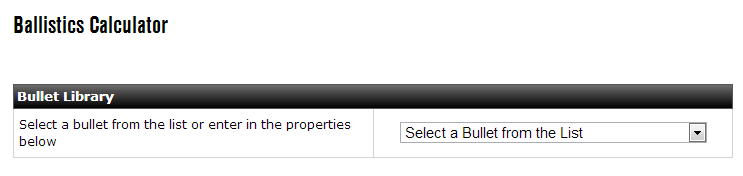
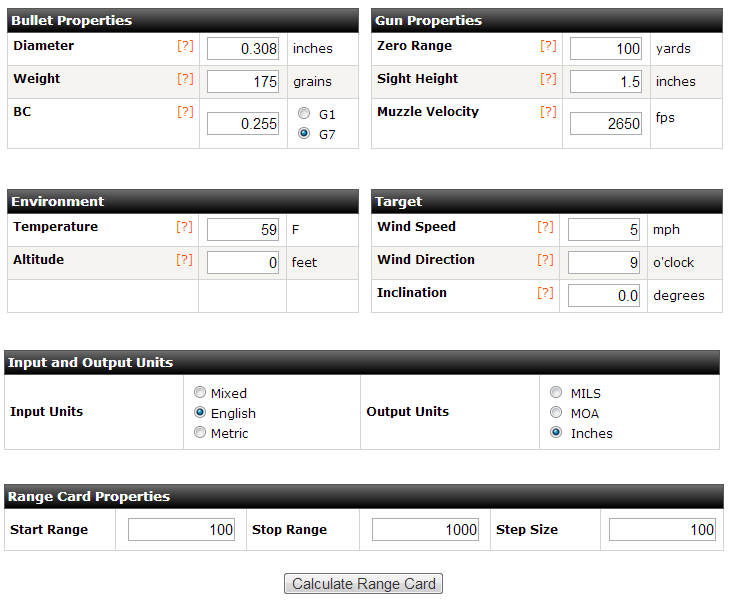
On the top of Berger’s home-page you’ll find a link that says “Ballistics”, with a drop-down menu for Berger’s Twist Rate Calculator and Ballistics Calculator. When using the Ballistics Calculator, the first element you’ll see is the bullet library. This convenient tool automatically fills in the bullet properties fields with the correct information when you select a bullet from the list.
Below, you will see the bullet properties fields are filled in with the 30 Cal 175gr VLD Berger Target Bullet information. You would then manually change the Gun Properties, Environment, Target, and the rest of the fields to correspond with the conditions you will be shooting under. After you have filled in all the variables properly, click “Calculate Range Card” to generate a ballistic solution showing your load’s trajectory, with come-up values at various distances.
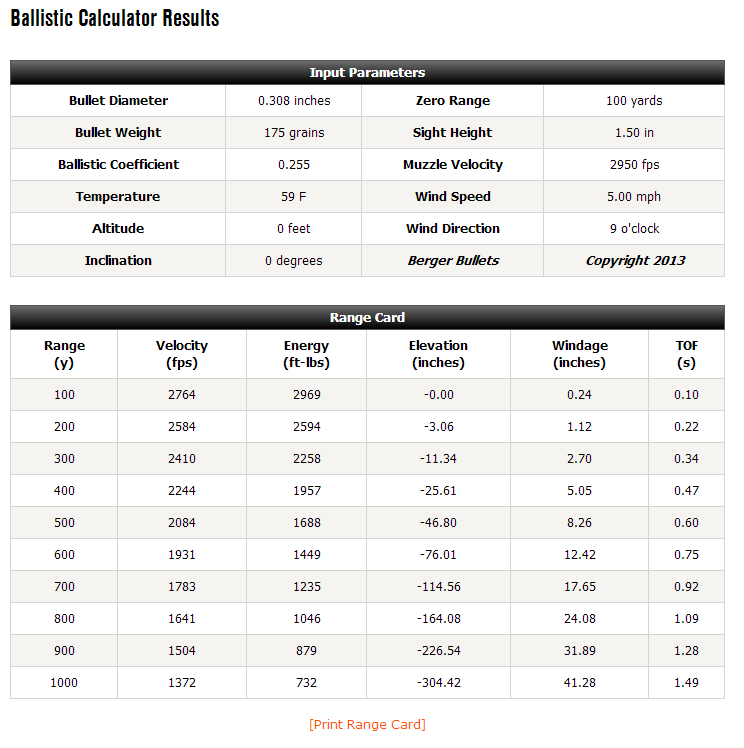
Once the Calculator Results are given, you can print them out and take them with you to the range or on your hunt. Here is an example of the calculated results:
If you have questions about the Ballistics Calculator CLICK this link or use the contact info below. Berger also plans to release a mobile version of the Ballistics Calculator in the near future. This should work well on smart-phones and tablets, so watch for it!
Berger Bullets
Marketing and Shooter Services
Phone: 714-447-5422 (option 2)
M-F 8am to 4:30pm pst
Story tip from EdLongrange. We welcome reader submissions.
Here’s a Ballistics Trivia challenge, put together by Bryan Litz of Applied Ballistics LLC. Bryan is Berger Bullets’ Ballistician and the author of Applied Ballistics for Long Range Shooting. Bryan posed the following Ballistics Question about Kinetic Energy and Aerodynamic Drag:
Consider a .30 caliber 175 grain bullet with a G7 BC of .259 (Berger 175 OTM) fired level at a muzzle velocity of 2650 fps in standard (ICAO) sea level conditions.
As this bullet flies downrange, it loses velocity due to aerodynamic drag. As the velocity of the bullet decays, so does its Kinetic Energy (in ft-lbs). The Kinetic Energy lost by the bullet in a given amount of time can be defined in terms of power.
Another way to think about this is that the aerodynamic drag on the bullet can be expressed in terms of power, calculated from the projectile’s change in Kinetic Energy over flight time.
Question: How much power (expressed in Watts) is applied to the bullet by aerodynamic drag on average over:
A) 500 yards?
B) 1000 yards?
C) 1500 yards?
Guesses are welcome, but this one can be calculated exactly.
Applied Ballistics also supports youth education. During “March is Reading” month, $1.00 from each book sold will be donated to the 100 Libraries in 100 Days campaign. This crowd-funding campaign was established to provide book donations to libraries across the country.
Applied Ballistics invites readers to enjoy a discount on these two respected shooting books, while at the same time supporting libraries which encourage young people to read good books.
Report by Bryan Litz
The 2013 Berger Southwest Nationals is in the record books. No matter how you shot, those who traveled from the east were happy to escape the brutal winter weather, at least for a while. But that’s not to say there wasn’t some fine shooting!
Sling Shooting Results
In the sling class, Nancy Tompkins was far in the lead, followed by second place Bryan Litz, and Trudie Fay (who shot a Palma rifle) in third. It’s noteworthy that, after all the smoke had cleared, Bryan, Trudie, and 4th place Angus McLeod were tied in score, with only Xs separating second through fourth place. It was an exciting finish to say the least, especially for Bryan Litz whose poor performance in the Palma course started him in 25th place on Day One. Bryan went on to win both 1000-yard days, dropping only 2 points in 4 matches to climb to 2nd place overall. Trudie, who finished third overall among all sling shooters, also deserves recognition. Shooting a .308 Win Palma rifle with aperture sights the whole match, Trudie beat all but two Any/Any shooters who were allowed to use scopes and run any cartridge type they preferred.
F-Class Results
In the F-Open Class, Shiraz Balolia finished first shooting a .300 WSM. Freddy Haltom was second and Danny Biggs took third place. In the F-TR Division, John Hayhurst topped the field, followed by Lige Harris (second), and James Crofts (third place). CLICK HERE for more info and F-Class Top 10 Lists.
Listen to Shiraz Balolia Talk about his F-Open Victory (Click PLAY to Launch Audio File)
[haiku url=”http://accurateshooter.net/Video/shirazmemo1.mp3″ title=”Shiraz Talks about F-Open”]
Profile of Winning F-TR Team from Michigan
The Michigan F-TR Team had a very successful debut, breaking the National record for the 4-man F-TR Palma team course. However, that same day Team USA Blue coached by Mid Tompkins shot two points higher to set the new official record. The Michigan F-TR team came back on the second day of team matches (4-man 1000 yards) and won by a decisive 15-point margin to win the day and the overall F-TR Team Aggregate. Coached by Bryan Litz, firing members of the Michigan F-TR team included: Al Barnhart (Captain), Doug Boyer, Bill Litz, and Dale Sunderman. Team members Charlie Hayes and Jennifer Litz (adjutant) were also present and contributed to the team’s success. In all it was a very successful and educational first tour for the Michigan team, considering it was only formed this winter and it only practiced together one time before traveling to Phoenix. One interesting technical note is that 3 out of 4 Michigan Team shooters used the new Berger 215gr Hybrid bullet. That’s a very heavy projectile for the .308 Winchester case, but the Michiganders certainly showed the potential of the heavy Hybrid in F-TR competition.
Michigan F-TR team, from left to right: Dale Sunderman, Al Barnhart, William Litz, Jennifer Litz, Doug Boyer, Bryan Litz, Charlie Hayes.
We are proud to announce that AccurateShooter.com has achieved a major milestone. We now have over 20,000 registered members in our Shooter’s FORUM! This represents a big step forward for the site, which started in September 2004, nearly eight-and-a-half years ago. We witnessed major site growth in 2012, with Forum traffic rising nearly 40% and the member ranks growing significantly.
We wish to thank all our Forum members for making our Shooter’s Forum the “go-to” place for information on precision shooting and reloading. Those members are also to be credited for the “good fellowship” one finds in our Forum. We are proud to have hit the 20,000-member mark, and we hope to reach an even greater audience of avid shooters in the months and years ahead!
20,000th Forum Member Wins Prize Package
Our 20,000th member registered last night. This lucky fellow, whom we’ll call “Mr. 20K”, is an avid shooter from Pennsylvania. As a reward for becoming our 20,000th Forum member, he will receive a great collection of prizes. First, he will receive a beautiful, all-stainless Primer Seating Tool from 21st Century Shooting (or $120 credit for other 21st Century products). Second, “Mr. 20K” will get a $50 credit on a purchase of $200.00 or more with Eurooptic.com. This can be used on Lapua brass and bullets as Eurooptic.com is now a Lapua vendor.
The prize package also includes TWO autographed books from top authors in the shooting world: Bryan Litz and Julie Golob. First, Julie Golob, Captain of Team S&W, has donated a signed copy of “SHOOT”, her hot-selling guide to action shooting. Bryan, founder of Applied Ballistics LLC, will provide a signed copy of his latest book, Accuracy and Precision for Long Range Shooting.
Bryan Litz, author of Applied Ballistics for Long-Range Shooting, told us that Kestrel will unveil a new “Shooter’s Weather Meter” this week at SHOT Show. The brand-new Kestrel Shooter’s Weather Meter will feature Bryan’s sophisticated Applied Ballistics software inside. This allows shooters to calculate very accurate trajectories while measuring up to 15 environmental parameters. This is a big step forward, according to Bryan.
When can you get your hands on one? The new Shooter’s Weather Meter will be available for pre-order for spring 2013 production. [Bryan hosted a demonstration at the Kestrel SHOT Show Booth Thursday at 2:00 pm.]
With integrated Applied Ballistics software, Kestrel users are now able to select from either G1 or G7 ballistic coefficients (BC) when calculating a trajectory. The new Ballistics Kestrel also offers the very extensive “Litz”-measured BC library of over 225 bullets. In addition to these features, users can “train” the software to match a specific rifle based on observed impacts at long range with the ballistics calibration feature. With more accurate BC data, shooters are empowered to make more precise trajectory calculations.
Watch Video about Kestrel Shooters’ Weather Meter with Applied Ballistics Software
New Kestrel Can Communicate with Remote Wind Sensors
The new Kestrel Shooter’s Weather Meter can receive data from wind sensor arrays designed and sold by Applied Ballistics. The use of remote sensors allows actual wind data from various distances down-range to be factored into the ballistics solution. Kestrel says that no other handheld weather meter has offered this kid of multi-array “remote sensing” capability before. Like all Kestrels, the Shooter’s Weather Meter is IP67 waterproof and ruggedized to MIL-STD-810F standards.
Kestrel Weather & Environmental Meters are manufactured by Nielsen-Kellerman, which has produced advanced environmental instruments for more than 15 years. Every Kestrel meter is pocket-sized, rugged, accurate, waterproof, easy-to-use, and backed by an industry-leading five-year warranty.


 Effects Of Cartridge Over All Length (COAL) And Cartridge Base To Ogive (CBTO) – Part 1


 You can visit the
 Building a Straight .284 Winchester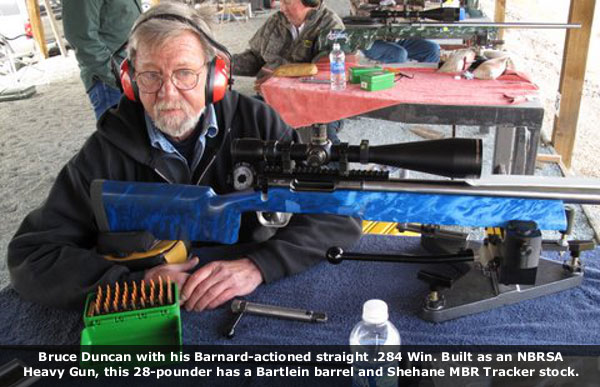
 It turned out that my load development wasn’t a fluke. The gun shot well, taking Third Place, 6-Target Aggregate Heavy Gun Group at the 2011 NBRSA 1000-Yard Nationals in Sacramento. Together with my 6×47 Lapua Light Gun, I took Third Place Overall. (The LG also featured a Barnard Action, Bartlein barrel, and Shehane stock.)
 The Science of the Sonic Ripple Bullet Design

 If you have questions about the Ballistics Calculator
  Consider a .30 caliber 175 grain bullet with a G7 BC of .259 (Berger 175 OTM) fired level at a muzzle velocity of 2650 fps in standard (ICAO) sea level conditions.


 We are proud to announce that AccurateShooter.com has achieved a major milestone. We now have over 20,000 registered members in our Shooter’s FORUM! This represents a big step forward for the site, which started in September 2004, nearly eight-and-a-half years ago. We witnessed major site growth in 2012, with Forum traffic rising nearly 40% and the member ranks growing significantly.
 Bryan Litz, author of Applied Ballistics for Long-Range Shooting, told us that Kestrel will unveil a new “Shooter’s Weather Meter” this week at SHOT Show. The brand-new Kestrel Shooter’s Weather Meter will feature Bryan’s sophisticated Applied Ballistics software inside. This allows shooters to calculate very accurate trajectories while measuring up to 15 environmental parameters. This is a big step forward, according to Bryan.


