Millions of Americans now exercise their Constitutional right to “keep and bear arms”, specifically to carry a pistol for personal protection and home defense. In response to the rapid growth of the CCW (Concealed Carry Weapon) market, numerous gun-makers have introduced compact handguns specifically designed for concealed carry. These “Carry Guns” tend to be smaller, lighter, with smoother, rounded edges on slide and frame. Today, many modern carry guns are also “Optics Ready”, meaning they have slides that can accept smaller red dot sights. And some companies are now selling handguns with the optics pre-installed.
Top Ten Best Carry Pistols for the Money
Here the Honest Outlaw Channel reviews ten semi-auto pistols. The host states these are the “10 best pistols for the money,” adding that “these handguns are reliable, accurate, durable, light weight, and cost less than most alternatives.” This video was released in December 2022, so it covers the latest generation of modern carry pistols.
Five Favorite Carry Pistols — Colion Noir’s Top Handguns
Colion Noir is a very popular gun reviewer and Second Amendment advocate. In this video, which has over 1.1 million views, Colion covers the five guns he personally carries. Why five? Colion states: “When it comes to my concealed carry guns, I practice tactical polyamory. Essentially, I don’t just carry one gun. I have a rotation of guns I carry based on what I’m wearing that day, where I’m going, and what I’m doing. I put a lot of thought into my carry rotation, which changes based on my needs. Sometimes a gun that’s better at handling the job comes out, and I’ll carry it once I’m comfortable with its reliability. That said, there are five guns I consistently carry[.]”
Five Top Choices among CCW & EDC (Everyday Carry) Handguns
The host notes: “We are going over the five best CCW firearms that I reviewed this year and ranking them from 1 to 5. We are going to save the best for the last. Some of the criteria for ranking these firearms isn’t only based on performance. We are ranking based on performance, price, reliability, and comfort.”
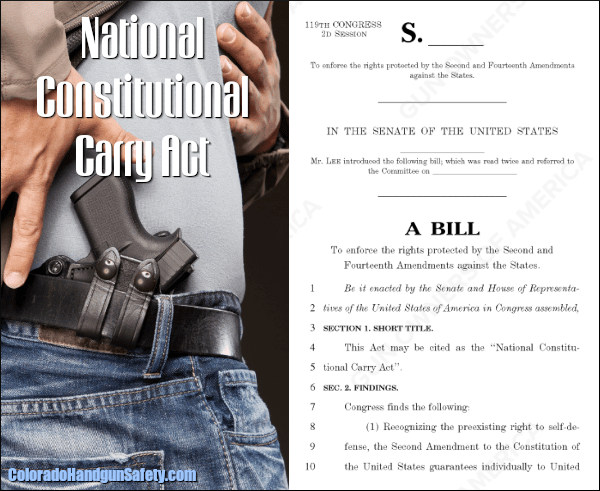
U.S. Senator Mike Lee (Utah) has introduced notable new legislation, the National Constitutional Carry Act. Senator Lee’s U.S. Senate Bill restores the right to carry firearms in ALL 50 states. This bill would ensure that law abiding American citizens are able to carry around the country without fear of antigun states arbitrarily restricting or criminalizing their chosen self-defense tool. Residents of antigun states would no longer have to endure second class Second Amendment treatment, whether through outright hardware bans or policies that indirectly discourage the exercise of Second Amendment rights.
The Gun Owners of America (GOA) endorses the National Constitutional Carry Act. Erich Pratt, GOA Senior Vice President, issued the following statement: “In a time of war, Americans cannot afford to have the right to bear arms delayed by arbitrary state permitting processes. Public safety is threatened not only by ordinary criminals, but also bad actors working for foreign adversaries, and Americans need to be armed for the security of our free state. That’s why Gun Owners of America is proud to endorse Senator Mike Lee’s National Constitutional Carry Act. Under this GOA-backed legislation, the right to carry a firearm without a government permission slip will be fully restored, and unconstitutional states regulations on firearms, ammunition, and magazine size will be preempted.”
Here is GOA’s Minuteman Moment video analysis of the proposed National Constitutional Carry Act:
If you are evaluating a firearm for self-defense use, you should consider three main factors: Reliability, Functionality (sights, trigger, ergonomics), and Effectiveness (ability to halt/neutralize threats). Regarding effectiveness, you need to consider what happens when the projectiles from your firearm reach the target. That involves penetration and terminal ballistics.
A 12ga shotgun is very effective inside 20 yards, with less risk of over-penetration* vs. a centerfire rifle.
You’ve probably heard the term “Terminal Ballistics”. But do you really know what this refers to? Fundamentally, “Terminal Ballistics” describes the behavior of a projectile as it strikes, enters, and penetrates a target. Terminal Ballistics, then, can be said to describe projectile behavior in a target including the transfer of kinetic energy. Contrast this with “External Ballistics” which, generally speaking, describes and predicts how projectiles travel in flight. One way to look at this is that External Ballistics covers bullet behavior before impact, while terminal ballistics covers bullet behavior after impact.
The study of Terminal Ballistics is important for hunters, because it can predict how pellets, bullets, and slugs can perform on game. This NRA Firearm Science video illustrates Terminal Ballistics basics, defining key terms such as Impact Crater, Temporary Cavity, and Primary Cavity.
External Ballistics, also called “exterior ballistics”, is the part of ballistics that deals with the behavior of a non-powered projectile in flight.
Terminal Ballistics, a sub-field of ballistics, is the study of the behavior and effects of a projectile when it hits its target.
*This Shooting Illustrated article discusses over-penetration risks with a variety of cartridge types. “A bullet passing through a threat and continuing with the potential to cause unintentional damage to a bystander or object is a situation commonly described as over-penetration.”
One of our Forum members asked: “Are there any good books on pistol marksmanship? I’m looking for a book that covers techniques and concepts….” Here are six recommended titles that can make you a better pistol shooter. These books run the gamut from basic handgun training to Olympic-level bullseye shooting.
Good Guidebooks for Pistol Shooters
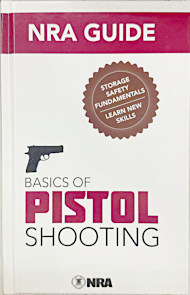
There are actually many good books which can help both novice and experienced pistol shooters improve their skills and accuracy. For new pistol shooters, we recommend the NRA Guide to the Basics of Pistol Shooting. This full-color publication is the designated student “textbook” for the NRA Basic Pistol Shooting Course.
Serious competitive pistol shooters should definitely read Pistol Shooters Treasury a compilation of articles from World and National Champions published by Gil Hebard. You could work your way through the ranks with that book alone even though it is very small. It is an excellent resource.
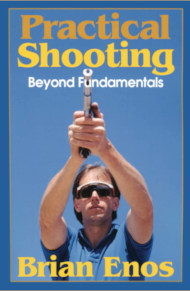
If you’re interested in bullseye shooting, you should get the USAMU’s The Advanced Pistol Marksmanship Manual. This USAMU pistol marksmanship guide has been a trusted resource since the 1960s. Action Shooters should read Practical Shooting: Beyond Fundamentals by Brian Enos, and Practical Pistol by Ben Stoeger. Brian Enos is a well-known pistol competitor with many titles. Ben Stoeger is a two-time U.S. Practical Pistol shooting champion. Last but not least, Julie Golob’s popular SHOOT book covers pistol marksmanship, along with 3-Gun competition. Julie holds multiple national pistol shooting titles.
Jessie Harrison is one of the greatest female pistol shooters on the planet. In the video below, Jessie offers smart tips on purchasing a handgun, and getting started in competition. Jessie covers caliber choice, handgun fit/ergonomics, concealability, holster options, and other key factors.
Do you often carry a concealed handgun? Then you can benefit from Beretta’s FREE 15-page e-book, Ten Essential Tips for CCW Holders. This eBook, in handy PDF format, helps gun owners select an appropriate handgun (and holster), understand legal obligations and responsibilities, and train effectively with the firearm. This short PDF eBook offers many useful tips to consider, in particular for gun owners who are contemplating the pros and cons of everyday carry for themselves.
As the Beretta CCW booklet says, “Carrying a concealed handgun requires a certain amount of confidence. You need to be confident in your knowledge of laws and regulations. You have to have confidence in your accuracy, and you need to trust that you can carry a gun effectively, securely and comfortably. If a gun is a burden for you to carry, you probably won’t.”
Surprising Facts About Actual Defensive Handgun Use
You may be surprised to learn when and how handguns are actually used for self-defense. Most defensive uses are at very short range and the incident only lasts a matter of seconds. You need to be prepared, and train to be proficient drawing and aiming your weapon. And remember, shooting is a last resort, when a safe retreat is not available.
55% of gunfights take place in 0-5 feet.
20% of gunfights take place in 5-10 feet.
20% of gunfights take place in 10-21 feet.
95% of gunfights take place in 0-21 feet. (Source: FBI)
The average man can cover 21 feet of ground in 1.5 seconds.
The average gunfight is over in 3-5 seconds.
3 to 4 shots are usually fired.
Most gunfights take place in low-light conditions.
On average, one shot in four strikes someone.
Here are two (2) sample pages from Beretta’s CCW eBook.
Do you often carry a concealed handgun? Then you should definitely read Beretta’s FREE 15-page eBook, Ten Essential Tips for CCW Holders. This eBook, in handy PDF format, helps gun owners select an appropriate handgun (and holster), understand legal obligations and responsibilities, and train effectively with the firearm. This short PDF eBook offers many useful tips to consider, in particular for gun owners who are contemplating the pros and cons of everyday carry for themselves.
As the Beretta CCW booklet says, “Carrying a concealed handgun requires a certain amount of confidence. You need to be confident in your knowledge of laws and regulations. You have to have confidence in your accuracy, and you need to trust that you can carry a gun effectively, securely and comfortably. If a gun is a burden for you to carry, you probably won’t.”
Surprising Facts About Actual Defensive Handgun Use
You may be surprised to learn when and how handguns are actually used for self-defense. Most defensive uses are at very short range and the incident only lasts a matter of seconds. You need to be prepared, and train to be proficient drawing and aiming your weapon. And remember, shooting is a last resort, when a safe retreat is not available.
55% of gunfights take place in 0-5 feet.
20% of gunfights take place in 5-10 feet.
20% of gunfights take place in 10-21 feet.
95% of gunfights take place in 0-21 feet. (Source: FBI)
The average man can cover 21 feet of ground in 1.5 seconds.
The average gunfight is over in 3-5 seconds.
3 to 4 shots are usually fired.
Most gunfights take place in low-light conditions.
On average, one shot in four strikes someone.
Here are two (2) sample pages from Beretta’s CCW eBook.
Millions of Americans now exercise their Constitutional right to “keep and bear arms”, specifically to carry a pistol for personal protection and home defense. In response to the rapid growth of the CCW (Concealed Carry Weapon) market, numerous gun-makers have introduced compact handguns specifically designed for concealed carry. These “Carry Guns” tend to be smaller, lighter, with smoother, rounded edges on slide and frame. Today, many modern carry guns are also “Optics Ready”, meaning they have slides that can accept smaller red dot sights. And some companies are now selling handguns with the optics pre-installed.
For today’s Saturday video showcase, we feature six videos covering a wide range of popular semi-automatic carry guns. You’ll see offerings from Beretta, Glock, HK, Kahr, Kimber, Ruger, Smith & Wesson, Taurus, Walther and more. In addition, we’ve included a video that covers the pros and cons of installing optics on carry pistols. Finally, as a bonus, we’ve included a video that highlights five handguns that you may want to avoid, as they have not lived up to expectations.
Top Ten Best Carry Pistols for the Money
Here the Honest Outlaw Channel reviews ten semi-auto pistols. The host states these are the “10 best pistols for the money,” adding that “these handguns are reliable, accurate, durable, light weight, and cost less than most alternatives.” This video was released in December 2022, so it covers the latest generation of modern carry pistols.
Five Favorite Carry Pistols — Colion Noir’s Top Handguns
Colion Noir is a very popular gun reviewer and Second Amendment advocate. In this video, which has over 1.1 million views, Colion covers the five guns he personally carries. Why five? Colion states: “When it comes to my concealed carry guns, I practice tactical polyamory. Essentially, I don’t just carry one gun. I have a rotation of guns I carry based on what I’m wearing that day, where I’m going, and what I’m doing. I put a lot of thought into my carry rotation, which changes based on my needs. Sometimes a gun that’s better at handling the job comes out, and I’ll carry it once I’m comfortable with its reliability. That said, there are five guns I consistently carry[.]”
Five Top Choices among CCW & EDC (Everyday Carry) Handguns
The host notes: “We are going over the five best CCW firearms that I reviewed this year and ranking them from 1 to 5. We are going to save the best for the last. Some of the criteria for ranking these firearms isn’t only based on performance. We are ranking based on performance, price, reliability, and comfort.”
Ten Modern Micro-Pistols for Concealed Carry
The reviewer states: “It’s 2023 and the world of firearms keeps evolving. One of the hottest trends in the firearms industry right now is micro pistols — small, compact handguns that are perfect for concealed carry or as backup guns. If you’re looking for the best micro pistols in 2023, you’ve come to the right place. This video reviews the latest and greatest micro pistols on the market, discussing their features, performance, and why they’re making waves in the gun community.”
Kimber’s R7 Mako pistol won a coveted Golden Bullseye Award from NRA’s Shooting Illustrated magazine, taking the trophy for the magazine’s “2022 Handgun of the Year” category. The R7 Mako is very compact, with good ergonomics, yet it offers 12-rd (11+1) capacity (and 13+1 with extended magazine). The R7 Mako showed outstanding accuracy when tested indoors (see video at 15:25 time-mark).
The R7 Mako is offered Optics Ready for $599.00 MSRP or with Crimson Trace Red Dot Optic installed for $799.00 MSRP. SEE Shooting Illustrated Review.
New Heckler & Koch CC9 Double-Stack Micro-Compact
Heckler & Koch (HK) has released its new CC9 micro-compact, striker-fired 9x19mm pistol. With great accuracy, ergonomics, and reliability, the HK CC9 should be a top choice among micro-compact pistols. Designed and produced in the USA, this is the smallest double-stack carry pistol HK has ever built. The CC9 features a modular grip with swappable backstraps. With a “Safe Take Down Feature” for disassembly, there is no need to pull the trigger during field-striping, making the CC9 safer than a Glock. The slide is optics-ready and there is a short Picatinny rail on the front of the polymer frame for mounting accessories. The micro-compact CC9 is 6.03″ long and 0.99″ wide. The barrel is 3.32″ long and the CC9 weighs 18.4 ounces without magazine. MSRP is currently $699.00.
Optics on Carry Pistols — Factors to Consider
Red Dot sights are becoming more popular than ever. Many pistols today are “Optics Ready”, and some handguns can now be purchased with optics already installed. There are both strengths and weaknesses having optics on CCW handguns. In this video, Massad Ayoob outlines the pros and cons of Red Dots on carry pistols. Along with covering the factors to consider, Ayoob provides advice on red dot zeroing, defoggers, and more.
BONUS: Five Handguns to Avoid
When shopping for a handgun, it’s helpful to know which models to avoid, because of poor reliability or other shortcomings. This Honest Outlaw video reveals five handguns that are not the best choices for concealed carry: Smith & Wesson CSX, SCCY CPX-2, Remington RP-9, Kahr CW 380, and Taurus PT 22.
Do you often carry a concealed handgun? Then you can benefit from Beretta’s FREE 15-page e-book, Ten Essential Tips for CCW Holders. This eBook, in handy PDF format, helps gun owners select an appropriate handgun (and holster), understand legal obligations and responsibilities, and train effectively with the firearm. This short PDF eBook offers many useful tips to consider, in particular for gun owners who are contemplating the pros and cons of everyday carry for themselves.
As the Beretta CCW booklet says, “Carrying a concealed handgun requires a certain amount of confidence. You need to be confident in your knowledge of laws and regulations. You have to have confidence in your accuracy, and you need to trust that you can carry a gun effectively, securely and comfortably. If a gun is a burden for you to carry, you probably won’t.”
Surprising Facts About Actual Defensive Handgun Use
You may be surprised to learn when and how handguns are actually used for self-defense. Most defensive uses are at very short range and the incident only lasts a matter of seconds. You need to be prepared, and train to be proficient drawing and aiming your weapon. And remember, shooting is a last resort, when a safe retreat is not available.
55% of gunfights take place in 0-5 feet.
20% of gunfights take place in 5-10 feet.
20% of gunfights take place in 10-21 feet.
95% of gunfights take place in 0-21 feet. (Source: FBI)
The average man can cover 21 feet of ground in 1.5 seconds.
The average gunfight is over in 3-5 seconds.
3 to 4 shots are usually fired.
Most gunfights take place in low-light conditions.
On average, one shot in four strikes someone.
Here are two (2) sample pages from Beretta’s CCW eBook.
If you are evaluating a firearm for self-defense use, you should consider three main factors: Reliability, Functionality (sights, trigger, ergonomics), and Effectiveness (ability to halt/neutralize threats). Regarding effectiveness, you need to consider what happens when the projectiles from your firearm reach the target. That involves penetration and terminal ballistics.
A 12ga shotgun is very effective inside 20 yards, with less risk of over-penetration* vs. a centerfire rifle.
You’ve probably heard the term “Terminal Ballistics”. But do you really know what this refers to? Fundamentally, “Terminal Ballistics” describes the behavior of a projectile as it strikes, enters, and penetrates a target. Terminal Ballistics, then, can be said to describe projectile behavior in a target including the transfer of kinetic energy. Contrast this with “External Ballistics” which, generally speaking, describes and predicts how projectiles travel in flight. One way to look at this is that External Ballistics covers bullet behavior before impact, while terminal ballistics covers bullet behavior after impact.
The study of Terminal Ballistics is important for hunters, because it can predict how pellets, bullets, and slugs can perform on game. This NRA Firearm Science video illustrates Terminal Ballistics basics, defining key terms such as Impact Crater, Temporary Cavity, and Primary Cavity.
External Ballistics, also called “exterior ballistics”, is the part of ballistics that deals with the behavior of a non-powered projectile in flight.
Terminal Ballistics, a sub-field of ballistics, is the study of the behavior and effects of a projectile when it hits its target.
*This Shooting Illustrated article discusses over-penetration risks with a variety of cartridge types. “A bullet passing through a threat and continuing with the potential to cause unintentional damage to a bystander or object is a situation commonly described as over-penetration.”
Gun Owners of America (GOA) and the Gun Owners Foundation (GOF) teamed up with Gun Owners of California (GOC) to file suit challenging portions of SB 2, a bill that anti-gun Governor Gavin Newsom signed into law this week. This unconstitutional legislation was passed in response to the Bruen decision (which ended the state’s draconian “may-issue” policy). As signed by Newsom, California SB 2 will:
— Create vast, restricted “sensitive locations” where concealed carrying would be prohibited, including all private property unless expressly permitted by the owner;
— Require 16 hours of training;
— Significantly increase the costs associated with securing a permit.
This lawsuit challenging SB 2 was filed in the U.S. District Court (Central District South) in Calfornia. The action, entitled May et al v. Bonta specifically goes after the “sensitive locations” provision of the law. Several other anti-gun states have enacted similar unconstitutional legislation in response to the Bruen decision, and GOA and GOF are a part of litigation in several of these cases.
Click image for a list of insurance programs for CCW holders.
Erich Pratt, GOA’s Senior Vice President, issued the following statement:
“This is just the latest assault on our rights in California. Just as concerning, Governor Gavin Newsom has already made his anti-gun intentions quite clear: he wants to effectively repeal the Second Amendment. Sadly, his acknowledgment that doing so would be the only way to enact more gun control did not dissuade him from violating his oath when he signed this law into effect, but we are fully prepared to fight back.”
Sam Paredes, on behalf of the board for GOF and in his role as the Executive Director of Gun Owners of California, added:
“Pro-gun groups in California have had success when pushing back on legislation like this –just look at our victory last week against the state’s magazine ban. And just like in that case, we are confident SB 2 will be overturned. I’ve been warning governors and legislatures across the country since the Bruen decision that these ‘response bills’ will not stand, but unfortunately, many have still been pushed through. That won’t stop us however – states should fall in line, or we will make them.”







 Good Guidebooks for Pistol Shooters