|
|
November 1st, 2014
There have been some remarkable team performances at the 2014 F-Class Nationals. With good conditions, talented shooters, and ultra-accurate rifles, three teams have “raised the bar” with record-breaking performances this week in Phoenix.
Team Long Shots Breaks Records with 800-42X Score at 1000 Yards
Congratulations to the Long Shots rifle team for breaking the 80-shot, 1000-yard, F-Open Civilian and Open Team Match National Records with a score of 800-42X. That is amazing shooting! Give credit to Michelle Gallagher, David Bailey, Ken Dickerman, David Gosnell, and Mark Walker.
Michelle Gallagher (as Snow White) on Halloween with her four team-mates.

Team Grizzly — F-Open National Champions
Shiraz Balolia reports: “Team Grizzly just won the F-Open National Team Championship. This is the third major match that Trudie Fay has coached four shooters into winning. She was also our coach when she coached us to a win at the last National Championship in Raton, and then again in February this year (2014) when we set a new National record in the Palma course in Phoenix at 800, 900, and 1000 yards. Trudie is a heck of a wind reader!” Shooters are: Kenny Adams, Shiraz Balolia (Captain), Emil Kovan, and John Myers.

Team Sinclair — Six-Time National F-TR Champions
Ray Gross Posted: “I just got home after the Team Sinclair victory dinner… teammate Derek Rodgers set a new 1000-yard national record Wednesday, then beat it for a new, higher, record Thursday. Then we won the team National Championship today and set a new National Record doing it! We are ‘stone cold’, 6-time National Champions. I’m proud to be a part.”

October 29th, 2014
UPDATE: On October 29th, at the Nationals, Derek Rodgers beat his own new record, with a 200-12X!
Congratulations to Derek Rodgers for setting a new 1000-yard National Record with a score of 200-11X at the Arizona Long Range Regional in Phoenix. A past national F-Class Champion, Derek is a member of Team Sinclair and the U.S. National F-TR team. Derek’s rifle is built on a Kelbly action, using a Bartlein barrel and a McMillan stock. It is topped with a Nightforce Optics scope. His ammo was made using Berger bullets, Lapua brass and Hodgdon Powder.

F-Class competition continues this week at the Ben Avery Shooting Facility in Phoenix Arizona this week. The 2014 F-Class National Championhip runs October 28 through November 2, 2014. The F-Class National Championship is a multi-day match comprising of all shots at 1000 yards. There will be a mix of individual and four person team matches. The competition consists of two different Divisions: F-Open and F-TR (Target Rifle). Each Division is made up of five different Categories: High Master, Master, Expert, Sharpshooter and Marksman.
October 14th, 2014
When we recently ran a story about Dennis Santiago’s new snakeskin Eliseo Tubegun, folks asked us if this kind of rifle can be competitive in F-Class competition. Here’s a detailed answer to that question by G. Salazar, who runs the Riflemans Journal Website.
A while back, G. Salazar published a three-part article on Shooting The Tubegun in F-Class. Links for all three segments are found below. The article covers some of the hardware German engineered to adapt his tubegun for long-range F-Class shooting with scope. If you’re an F-Classer, or just a fan of tubeguns, you should read German’s article, in all its parts.
READ Tubegun in F-Class Part 1
READ Tubegun in F-Class Part 2
READ Tubegun in F-Class Part 3
In the intro to his multi-part F-Class Tubegun article, German explains:
Salazar: The tubegun has truly changed the face of High Power shooting over the past five years or so. Specifically, the CSS (Gary Eliseo) tubeguns, which are made for a broad variety of actions and configurable to single-shot or repeater, have truly helped the sport to grow. That’s not just idle talk, the two principal factors that made the tubegun so important to our growth are the ease of transition for AR15 shooters moving into a bolt-action rifle and the absolutely ridiculous length of time it currently takes to get a stock from the conventional stock makers. My last conventional stock took well over two years from order to delivery (plain fiberglass). One of my friends has now been waiting four years for a simple wood stock for a smallbore rifle. By contrast, tubeguns, which are largely CNC machined, are delivered in a reasonably short time — weeks or a couple of months at most.

Notwithstanding the foregoing, the tubegun would never have attained its present success if it weren’t for one simple fact — they are brutally accurate. I have three CSS tubeguns, one chambered in .308 and two in .30-06 and they are my favorite prone rifles due to their accuracy and great ergonomics. Those factors are just as appealing to an F-Class competitor as to a prone shooter, and indeed, the tubegun is making solid inroads into F-Class. READ MORE…
READ MORE of Part 1, The Tubegun in F-Class
September 16th, 2014
Report by Vince Bottomley
For this year, the European F-Class Championships moved from its traditional November date to mid-September. England can be smitten with some dreadful weather in November and previous Championships have suffered everything from rain and mist, to sub-zero temperatures. It proved to be a wise decision and competitors enjoyed balmy, sunny weather for the whole week, with matches on September 12-14, 2014. The event was well attended with 206 individual entries and over 20 teams. With competitors from a dozen nations, this is one of the biggest F-Class events in the world.
Congratulations to Scotland’s Des Parr, the new F-Open champion (on V-count over James Finn), and congrats to Giulio Arrigucci of Italy, who won the F-TR title. Both Parr and Finn dropped only five points over the entire two-day individual competition. For more information (and full listing of match results) visit www.GBFclass.co.uk.

| F-Open Individual Results |
F-TR Individual Results |
1. Des Parr (Scotland): 470.48V (possible 475)
2. James Finn (Ireland): 470.41V
3. Marco Been (Holland): 467.49V
4. Mik Maksimovic (GB): 465.38V
5. Daniel McKenna (Ireland): 464.40V
6. Dave Lloyd (GB): 463.36V |
1. Giulio Arrigucci (Italy): 455.30V
2. Francisco Franco Mosquera (Spain): 454.30V
3. Sergii Gorbon (Ukraine): 452.36V
4. Tom Bond (GB): 449.29V
5. Valentin Pomomarenko (Ukraine): 449.29V
6. Russell Simmonds (GB): 449.29V |
Over the past few years, numbers have increased steadily and this year, over 200 shooters assembled on Bisley’s famous Stickledown range on the Friday morning for the first of two days of individual competition, followed by Team Matches on the Sunday. The four days preceding the Championships were available for practice and informal competitions.
With near-perfect conditions for the first 800-yard stage, some excellent scores were recorded. Scotsman Paul Crosbie’s F-TR score of 75.12V not only took the stage win but also set a new GB record and equaled the top F-Open score (by Italian Gian Antonio Quaglino). Maximums were also recorded at 900 yards by both classes but at 1000 yards, Scotsman Des Parr’s 74.11V was a clear winner, with Italy’s Andrea Ceron’s recording a 72.6V in F-TR.
The Famous Stickledown Range at Bisley

At the end of Day One, Des Parr was leading Open Class by a single point and Spain’s Francisco Franco Mosquera had a two point lead in F-TR. The following day, competitors tackled the same course of fire to decide the title of European Champion.
Although a little overcast for the start of Day Two, the sun soon broke through and the fact that the top 36 Open shooters didn’t drop a single point at 800 yards gives an indication of conditions. Even the top 15 F-TR shooters ‘cleaned’ the target but, some relays experienced less favorable conditions.
 At 900 yards, again the top nine Open competitors shot ‘possibles’ but, in F-TR, Ukraine’s Sergii Gorban’s excellent 74.9V was the top score. For the final 1000-yard shoot – a 2 and 20 this time, Ireland’s Kevin Clancy’s 95.5V was a great F-TR score but Dave Lloyd’s winning Open score of 99.6V was absolutely stunning. At 900 yards, again the top nine Open competitors shot ‘possibles’ but, in F-TR, Ukraine’s Sergii Gorban’s excellent 74.9V was the top score. For the final 1000-yard shoot – a 2 and 20 this time, Ireland’s Kevin Clancy’s 95.5V was a great F-TR score but Dave Lloyd’s winning Open score of 99.6V was absolutely stunning.
In the end, Scotland’s Des Parr and Ireland’s James Finn tied on points with 470 of 475 possible, but Parr took the 2014 European F-Open title based on V-bull count: 48 for Parr vs. 41 for Finn. Italy’s Giulio Arrigucci won the F-TR Championship by one point over Francisco Franco Mosquera.

We were delighted to have American shooter Francis ‘Biff’ Conlon join us – shooting a borrowed rifle in F-TR (second from left in the above photograph). Biff shot as part of one of the F-TR Teams in the pre-Championship competitions and picked up a gold medal – note the unusual trophy! Maybe a few more Americans might think it worthwhile making the trip to shoot in next year’s Europeans.
TEAM Matches
The Championships end with the Teams Matches on the Sunday. These matches are for eight-man teams so, not all countries are able to field a team but four Open Teams and five FTR teams were fielded. Ranges are 900 and 1000 yards with 15 shots at each distance. Wind coaches are permitted.
| F-Open Team Results |
F-TR Team Results |
1. Great Britain – 1161.120V
2. Italy – 1145.74V
3. Germany (BDMP) – 1129.91V |
1. Germany (BDMP) – 1106.57V
2. Italy – 1104.68V
3. Ukraine – 1101.69V |
Report from David Lloyd, current Great Britain F-Open Team Captain
I’ve just got back from the F-Class European Championships. The minor 4-man teams match was held last Thursday afternoon and was shot over 1000 yards with 2 + 20 to count. I was part of the victorious Team March (388.26V). In second place was the Midland Precision Guns Team with 383.26V.
The conditions were good and the level of competition was very high. Team March was captained by Gary Costello the UK and European importer of March scopes. The coach was Tony Marsh and he did a superb job of coaching the team to victory (he coached me to a score of 100-6Vs). The shooters were: Gary Costello, David Lloyd, Ian Boxall, Darren Stewart. Peter Walker was reserve shooter and register keeper.
August 4th, 2014

F-Class competition will be featured on this week’s episode of Shooting USA television. This week, Shooting USA takes an inside look at the rapidly-growing sport of F-Class shooting, with coverage of both F-TR and F-Open competition at 600 yards and beyond. This show will air three times on Wednesday, August 6, on the Outdoor Channel (see air times by region below). This episode will also feature the historic 1907 Winchester, a choice of gangsters in the 1920s.
 The Shooting USA Hour on Wednesdays: The Shooting USA Hour on Wednesdays:
AIR TIMES BY TIME ZONE
Eastern Time 3:30 PM, 9:00 PM, 12:00 Midnight
Central Time 2:30 PM, 8:00 PM, 11:00 AM
Mountain Time 1:30 PM, 7:00 PM, 10:00 PM
Pacific Time 12:30 PM, 6:00 PM, 9:00 PM
F-Class Basics
The ‘F’ in F-Class stands for Farquharson. Canadian George Farquharson is credited with founding the sport in the 1990s. Farquharson wanted to create a discipline for fellow older shooters whose fading eyesight made it difficult to compete in traditional iron-sight high power matches. In 2007, the United States NRA officially recognized the prone shooting disciple. Since then the sport has grown rapidly. Over 350 shooters attended the 2013 F-Class Nationals in Raton, NM.
F-Class is similar to High Power rifle shooting, with competitors taking turns in the pits, pulling and scoring targets. Unlike conventional High Power shooting with iron sights, F-Class shooters use scopes (with up to 80x max power, though the most popular scope is still probably the 12-42x56mm Nightforce Benchrest).
All F-Class competition is shot prone. Competitors are classified into two divisions, F-TR (Target Rifle) and F-Open. F-TR rifles must be shot from bipod, and must be chambered for either the .223 Rem or .308 Win cartridges. Max F-TR gun weight is approximately 18.18 pounds, including bipod. In the F-Open division, rifles can weigh up to 10 kg (22 pounds) and front rests can be used (but you may shoot from a bipod if you wish). F-Open competitors may shoot any cartridge which is .35 caliber or under.
July 29th, 2014
2014 and 2012 U.S. National F-TR Champion James Crofts is one of America’s top F-Class shooters. A member of the 2013 World Championship-winning F-TR Team USA squad, James knows a thing or two about long-range shooting, that’s for sure. But you may be surprised to learn how James sharpens his shooting skills at relatively short distances. You see, James often practices with a .22 LR rimfire rifle at distances from 50 to 200 yards. James tells us: “Shooting my F-Class rimfire trainer saves me money and improves my shot process and wind-reading abilities.”
Remington rimfire 40X barreled action in PR&T LowBoy stock with PT&G bolt.

Rimfire Training Teaches Wind-Reading Skills by James Crofts
Training with the rimfire is extremely useful and can be done from 25 yards out to 200 yards. I am lucky and can shoot 50 yards right off my back deck. That is far enough that any miscue on rifle handling will show up on the target. I use a two dry-fire to one actual shot routine for my practices. This gives me much more positive reinforcement without any negative reinforcement.
Wind reading is extremely important with a .22 LR rifle. I use a set of smallbore flags to aid my wind calls. The smallbore flags are a must and force you to look at the flags and mirage on each and every shot. If you think the flags at Camp Butner move a lot, try smallbore flags around tall pine trees.
Rimfire Training Is Cost-Effective
Rimfire ammunition is much less costly than centerfire ammo. Though .22 LR prices have risen in recent years (and rimfire ammo is harder to find), even now I can get a 500-round brick of .22 LR ammo for less than $75.00. That works out to fifteen cents a round. That’s a fraction of the cost of handloading .308 Win match ammo. Heck, you can pay 40 cents a piece for match-grade .308-cal centerfire bullets. Then you have to figure in brass, primers, and powder.

My CMP 40X Rimfire F-TR LowBoy Clone
My quest into the .22 LLR rimfire field started with an email from the Civilian Marksmanship Program (CMP) announcing Rem 40X stripped barreled actions for sale. I thought, “Hmmm… Could one of those little 40X barreled actions be turned into a F-Class training rifle?” My gunsmith Ray Bowman of Precision Rifle & Tool was brought in at this point.
After conferring with Ray, it was decided that he could indeed turn this into a F-Class training rifle. Ray contacted Dave Kiff of PT&G and ordered a new bolt for the Remington 40X rimfire action. Next was the stock decision. I decided to go with a PR&T Low Boy F-Class stock — this is an exact clone of the stock for my .308 Win F-TR competition rifle. Then a Jewell trigger was acquired to complete the components. Ray built this just like he would any custom rifle, other than using the stock barrel. The project turned out awesome. The rifle was a hammer from the beginning even with the stock barrel.

About James Crofts
This spring, James Crofts was chosen as the new Vice Captain for the USA F-TR National Team. James comes from a military background, having served 20 years in the U.S. Navy aboard fast attack submarines. James has also been a shooting member of the 8-man F-TR Team USA, and he is always one of the top shooters in any F-TR competition. James told us: “Now the work begins, but with Ray Gross as Captain I think we can handle it. It will be a tough act to follow. Darrell Buell and Mike Miller set the bar extremely high with back-to-back world championship gold medals.”

James Crofts — Photo by Kent Reeve.
July 5th, 2014
Darrell Buell, past captain of the world champion F-TR Team USA, just received an impressive new piece of kit. A custom flat sheet was created by Kent Rush for Darrell, complete with cool graphics and sponsors’ logos. As soon as we saw this on Darrell’s Facebook page, we knew this would be popular with our readers. Heck, this Editor wants one too — with “AccurateShooter.com” emblazoned on it.

Darrell loves his new shooting accessory: “Here’s the whole enchilada! Savage rifle, 2014 Nightforce Competition Scope, Berger Bullets (185 Juggernauts), Seb Lambang’s new Joy-Pod (plus “Pod-Pad” mat), a new shooting mat courtesy of Scott at Red Star Targets, and an awesome new rear-bag sheet by Kent Rush for the Edgewood bag. This new sheet allows for friction-free rear bag adjustments — Thanks Kent Rush!”


Darrell Leads North American Junior F-TR Team
Though he has stepped down from his role as Captain of F-TR Team USA, Darrell hasn’t given up his coaching duties entirely. Darrell is the coach (and adult leader) of the North American Junior F-TR Team. Darrell is lending his world-beating long-range shooting knowledge to young competitors who are making a mark for themselves already. Here is Darrell with one of his young marksmen.

April 14th, 2014
The NRA, on the recommendation of the NRA High Power Committee, has appointed Ray Gross as the new United States F-TR Team Captain, to serve through the 2017 World Championship cycle. Ray brings a wealth of experience in both national and international competition. As a member of the World Championship-winning 4-person U.S. F-TR team, and the hugely successful Team Sinclair F-TR squad, Ray is a skilled coach, a top-flight shooter, and a great guy who is respected by his peers. Ray brings a unique combination of skills to the team as its new leader.
Ray Gross (center with gray hat), with fellow Team USA F-TR Shooters at Raton, NM.

Ray has asked James Crofts to serve as US F-TR Vice Captain. James comes from a military background, having served 20 years in the US Navy aboard fast attack submarines. James has also been a shooting member of the 8-man F-TR Team USA, and he is always one of the top shooters in any F-TR competition.
James told us: “It’s official, I have been named the new Vice Captain for the USA F-T/R National Team. Now the work begins but with Ray Gross as Captain I think we can handle it. Tough act to follow, Darrell Buell and Mike Miller set the bar extremely high with back to back world championship gold medals.”
James Crofts — Photo by Kent Reeve.
April 10th, 2014
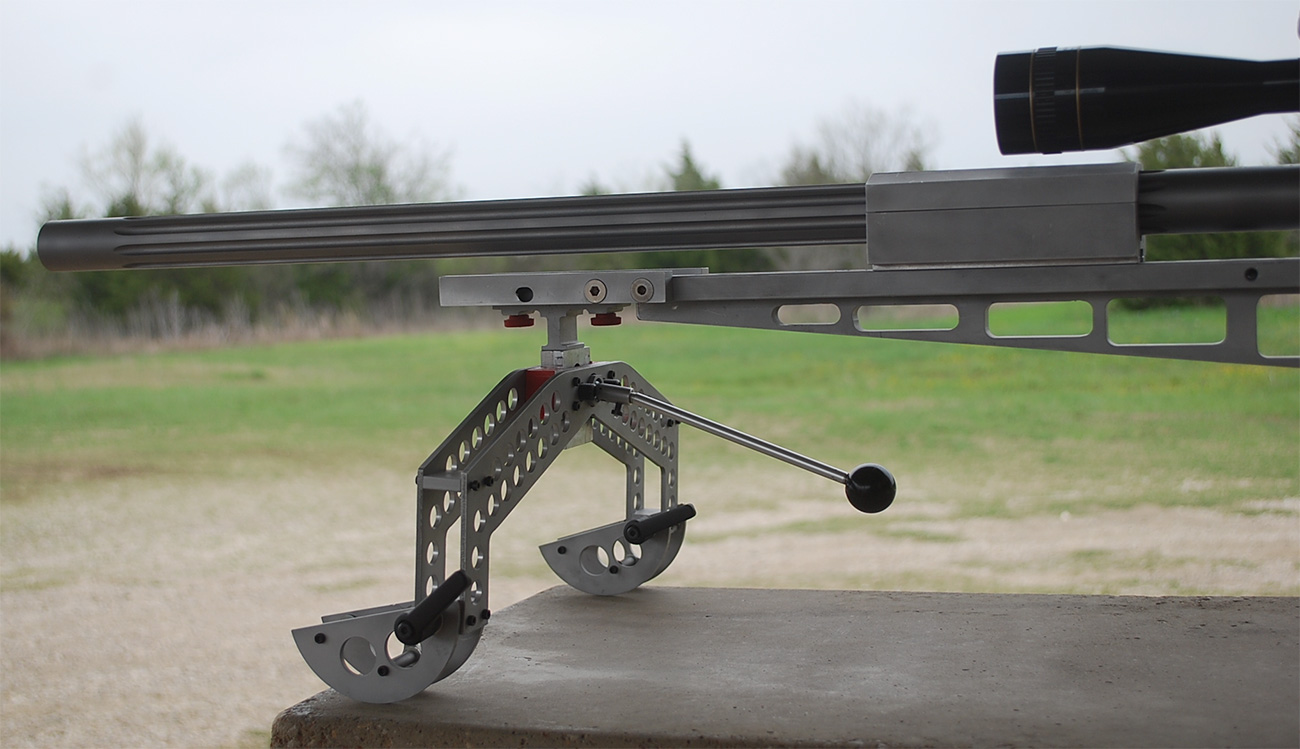
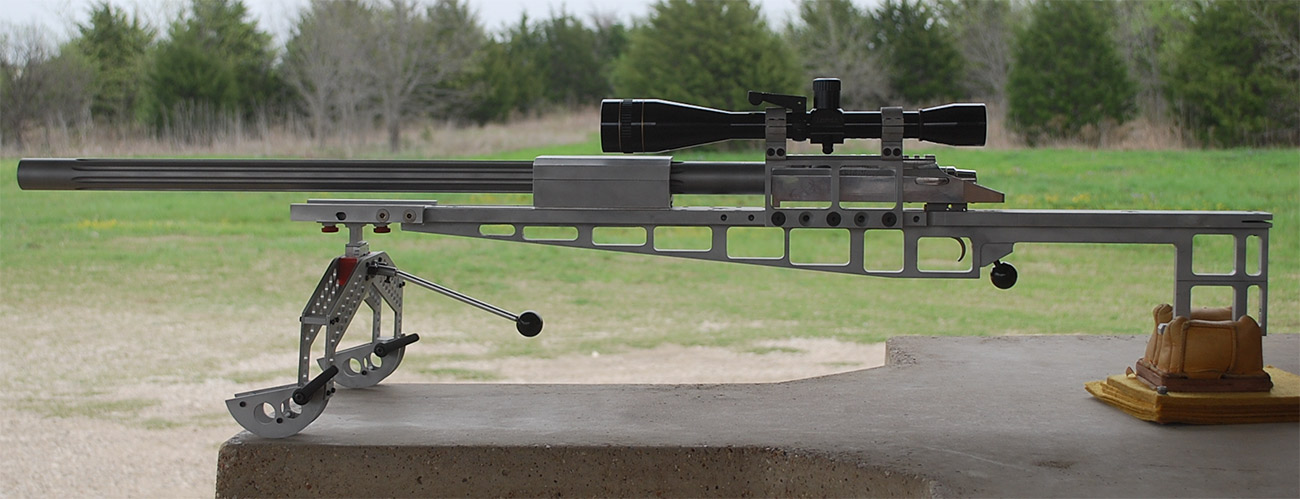
We know you guys like exotic hardware, so today we pulled something very exotic from our featured rifle archives. We doubt that you have ever seen anything quite like this before. Gun-builder Richard King says: “I thought you might like to see my latest project. This is my personal gun, built the way I wanted it. I know it’s radical and some may not care for it. But it works.”


Report by Richard King (King’s Armory, Texas; ‘Kings X’ on our Forum)
This is pretty much an all-aluminum rifle. The action is a Kelbly F-Class with a Shilen stainless steel competition trigger. The scope is a 1″-tube Leupold 36X with a Tucker Conversion set in Jewell spherical bearing rings. The .223 barrel is Pac-Nor 3-groove, 1:6.5″-twist mounted in a “V”-type barrel block. The bipod has vertical adjustment only via a dovetail slide activated by a stick handle. It works like a joy-stick, but for vertical only. I adjust for windage by moving the rear sandbag.
The 30″ barrel is 1.250″ in diameter. With the barrel block forward, the vibrations should be at a low frequency. Instead of one long rod whipping, I now have two short rods (barrel haves) being dampened. This is my fourth barrel block gun. They work, but so does a good pillar-bedded action. I just do stuff a little different.

The vertical “keel” down the bottom of the stock stops the “spring” of a flat-bar stock. There is little, if any, noticeable flex before or during recoil. The long length of the stock, the fat barrel, and the forward-mounted barrel block work together to keep the gun from rising off the ground. BUT, remember this is a .223 Rem rifle. A .308 Win version might act very differently. I may try a .308-barreled action soon, just to see what happens. But I will stick with the .223 Rem as my choice for match shooting.
 The offset scope idea came from a benchrest “rail” gun. In truth, the whole concept came from a rail gun — just adapted to being shot off a bipod. Sure it isn’t directly over the bore. It is about 1.5″ over to the left. So if you want the scope to be zeroed on the center of the target, you have to adjust for the offset. At 100 yards that is 1.5 MOA. But at 300 it is only 0.5 MOA, at 600 only a ¼-MOA, and at 1000 about 1 click on my scope. The offset scope idea came from a benchrest “rail” gun. In truth, the whole concept came from a rail gun — just adapted to being shot off a bipod. Sure it isn’t directly over the bore. It is about 1.5″ over to the left. So if you want the scope to be zeroed on the center of the target, you have to adjust for the offset. At 100 yards that is 1.5 MOA. But at 300 it is only 0.5 MOA, at 600 only a ¼-MOA, and at 1000 about 1 click on my scope.
What the offset DOES do for me is eliminate any cheek pressure. My cheek never touches the stock. Since this is only a .223 Rem, I don’t put and shoulder pressure behind it. And I don’t have a pistol grip to hang on to, but I do put my thumb behind the trigger guard and “pinch” the two-ounce trigger.
The offset scope placement could interfere with loading a dual-port action from the left. That’s not a problem for me as I set my spotting scope up on the left side very close to the rifle. I have plenty of time to reload from the right side while the target is in the pits being scored.
Again — this is my rifle. It is designed for my style of shooting. It is not meant to be a universal “fit all” for the general public. However, I will say the design is adaptable. I can easily convert the system to run in F-Open Class. I would drop a big-bore barreled action into the “V” block, slide on a heavier pre-zeroed scope and rings, add plates on the sides up front to bring the width to 3”, and maybe a recoil pad. It might be interesting to offset the wings up from to counter torque of the big bullets. But I would also have to offset the rear bag rider to get the gun to recoil straight back.
How the Gun Performs
I have had “T” to the range only twice for load development. It groups like my present barrel-blocked 223 F-TR gun. But it’s much easier to shoot and it only moves about 3/4” — straight back. I tried to build am omni-directional joy-stick bipod but I could not get all the side-to-side wiggle out of it. So I have set it up so it only moves up and down (horizontal movement is locked-out). As it works now, the joystick on the bipod lets me set elevation on the target quickly (with up/down adjustment). Then, to adjust for windage, I slide my rear bag side-to-side as needed. Once set, I just tickle the trigger and smile.
Gun Handling — Shoot It Like a Bench-Gun
I basically shoot the gun with no cheek or body contact. I don’t grip it, other than maybe a pinch on the trigger guard. The scope was offset to the left to help the shooter move off the gun and avoid the possibility of head/cheek contact with the stock.
[haiku url=”http://accurateshooter.net/Video/RichKingTalks.mp3″ Title=”Richard King Talks”]
|
VOICE FILE: Richard King Explains How He Shoots his ‘Texas-T’ Rifle: |
CLICK PHOTOS to See Big Size
February 21st, 2014
Most F-TR rifles are essentially prone rifles adapted for use with bipod and rear bags. They feature prone or tactical-style stocks designed to allow a firm grip on the gun, with cheek, hand, and shoulder contact. This has worked very well. Unquestionably, a skilled F-TR shooter can achieve outstanding scores with such a configuration — it works. However, “there’s more than one way to skin a cat”.
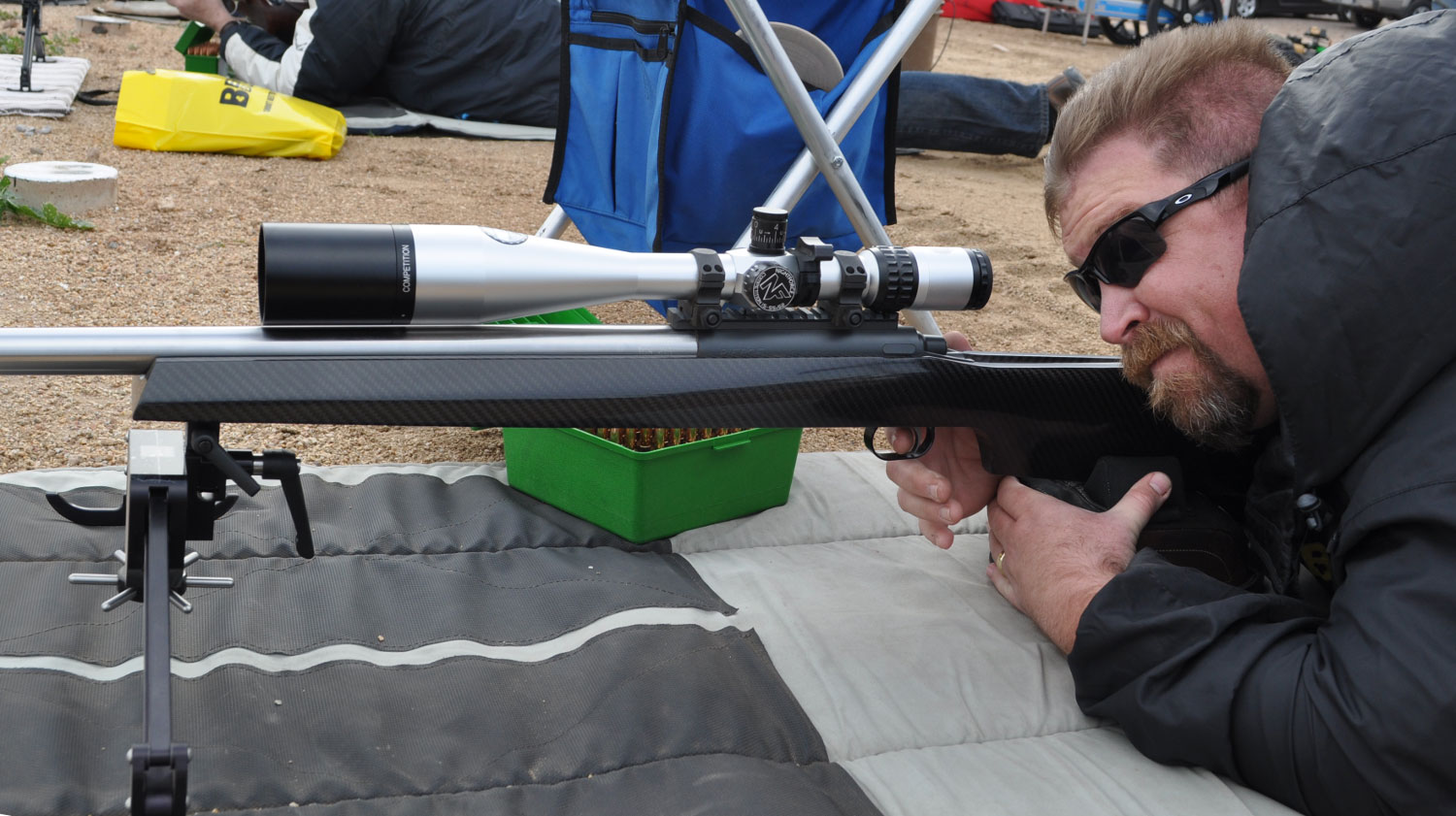
At the Berger Southwest Nationals, Eric Stecker introduced a new type of rifle, and a new type of gun-handling, to the F-TR ranks. Shooting “free-recoil” style* (i.e. with virtually no contact on his rifle) Eric managed to finished second overall in F-TR (with the highest X-count), beating some past national champions in the process. Thinking “outside the box” worked for Stecker in Phoenix. The success of Eric’s benchrest-style rifle and shooting technique definitely drew the attention of other F-TR shooters.
Click photo to zoom

|
VOICE FILE: Eric Stecker Talks About the SWN and his Radical F-TR Rifle. |
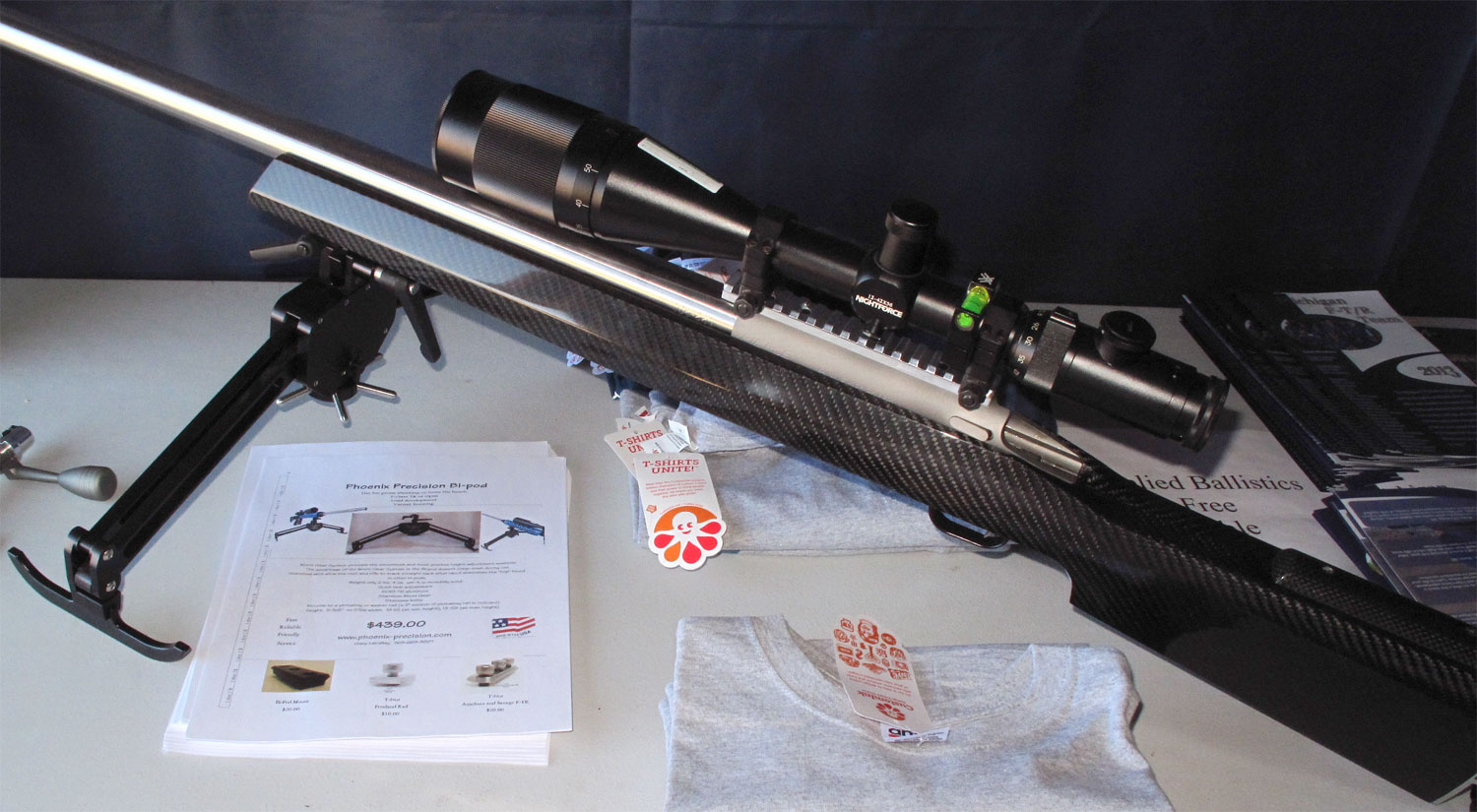
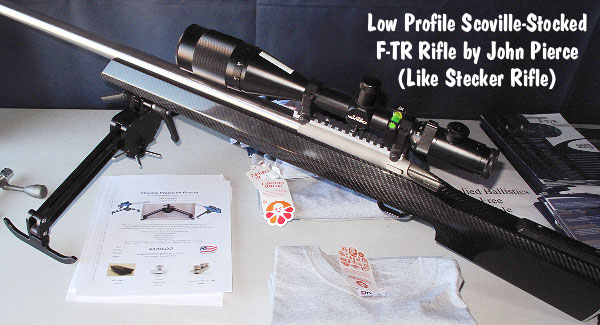
Eric’s F-TR rig was built by John Pierce using a stiff, light Scoville carbon-fiber stock. The stock is so light that Eric’s rifle came in 1.5 pounds under the F-TR maximum weight limit (8.25kg or 18.18 pounds). The gun features a Pierce action, Bartlein barrel, Jewell trigger, and a Gen 1 Nightforce 15-55X52mm Comp scope. From the get-go, Eric’s strategy was to “aim small” and shoot his rig like a bench-gun. He actually focused on shooting really small groups rather that just trying to keep shots within scoring rings and “hold waterline”. With a .308 Win that could shoot bugholes at 100 yards, this strategy paid off.
 Rifle builder John Pierce explains the thinking behind this rifle: “The stock choice was mine — I had built two prototype rifles last year based on the premise that the game is Benchrest in the prone position. I still feel very strongly regarding [this concept]. I chose Bob Scoville for obvious reasons — he is an artisan and his stocks have won so much, they just flat work. We built Eric the latest configuration along these lines, and the tool worked for him. Without a doubt, Eric is a shooter, and we were all pleased to watch him perform so well.” Rifle builder John Pierce explains the thinking behind this rifle: “The stock choice was mine — I had built two prototype rifles last year based on the premise that the game is Benchrest in the prone position. I still feel very strongly regarding [this concept]. I chose Bob Scoville for obvious reasons — he is an artisan and his stocks have won so much, they just flat work. We built Eric the latest configuration along these lines, and the tool worked for him. Without a doubt, Eric is a shooter, and we were all pleased to watch him perform so well.”
Eric sets up rifle before match. During live fire his hands do not contact the stock.

Eric employed a benchrest-style shooting technique with his F-TR rig — he shot pretty much free recoil, with no cheek pressure, no hand contact, and just a “whisper” of shoulder contact. Eric explains: “I shoot what’s called ‘free recoil’. Now the rifle is butted up against my shoulder very lightly, but no other part of my body touches the rifle except for my finger on the trigger.” Eric has even used this technique when shooting a 7mm cartridge in F-Open at other matches: “Someone suggested that this style wasn’t possible with the larger [7mm] cartridges, but I found it very successful so I continue to do it that way.”
|
VOICE FILE: Eric Stecker Talks About Shooting F-TR with Benchrest Technique. |
Eric also employed an unconventional strategy — he was focused on shooting small groups (not just holding ring values): “Since I have started shooting F-Class, I treat [the target] like a benchrest target. What I mean by that is that I regard the center as my first shot, and so my objective is to create the smallest group. So, I will hold whatever… is required to end up with the bullet ending up in the center — that’s probably true of any F-Class shooter, but I guess the perspective’s a little different when you have a benchrest background.” Eric explained that “maybe I aim a little smaller than others might”, because in the benchrest game, “the slightest miss ends up costing you quite dearly”.
Click to Zoom Photo (This is not Eric Stecker’s rifle, but a “sistership” built by John Pierce.)
Eric Talks about F-TR Trends
Will other F-TR shooters build rifles suited for free-recoil-style shooting? Eric isn’t sure: “I don’t know if this type of rifle is the future of F-TR. I shoot a lot of benchrest, so putting those kinds of components into an F-TR gun made a lot of sense to me. One thing I like about F-TR is that there are a lot of different types of approaches being tried and some of them are successful. So I think it’s still pretty wide-open[.] But I think the really great part of what we found at the Southwest Nationals is that shooting [with] a benchrest-style approach certainly doesn’t hurt you. What I mean by that is … aiming small, trying to make the group as tight as possible rather than trying to hit a particular area. I actually tried to shoot tight groups — that was a focus and that worked for me — I had quite a high X-Count.” NOTE: Eric finished with 51 Xs, 14 more than F-TR Grand Agg winner Radoslaw Czupryna (37X). James Crofts had the second highest X-Count with 48 Xs.
Even Berger’s Boss did pit duty at the Berger SW Nationals.

*”Free Recoil” style shooting has its variations. Some would say “pure free recoil” would not even allow shoulder contact. Eric Stecker lightly touches the back of the stock with his shoulder.
|