|
|
June 9th, 2016
Take a look at that unusual target below. We bet you’ve never seen one of these before. It’s a 50-Yard Sighting Target for the M1 Garand. It’s designed to allow a rifleman to confirm his zeros for multiple yardages all the way out to 1000 yards. But importantly, he can establish those zeros at a very “short” shooting facility, since the target is positioned at a mere 50 yards.

Here’s how it works. The target is placed at fifty (50) yards. You start at the bottom, aiming at the black circle. Then check your come-up table and work your way up, clicking step-by-step to the various horizontal lines set for 200, 300, 500, 600 and 1000 yards. This is NOT “spray and pray” — you need to have a pretty good idea of the clicks you need, based on your ammo’s ballistics. This target is calibrated for the U.S. Military M72 Ball Ammo. The targets are available from Champion’s Choice ($0.75 each) or from Creedmoor Sports (12 for $5.95).
Lapua’s Kevin Thomas used this target to get zeroed for the recent D-Day Anniversary Match at the Talladega Marksmanship Park. Kevin used the target for both his M1 Garand as well as his M1903A1 Springfield, both chambered for the .30-06 Springfield cartridge.

Zeroing at a Short Distance — How to Use the 50-Yard Sighting Target, by Kevin Thomas
As part of my preparation for the Garand Match at the CMP’s Talladega Marksmanship Park, I needed to zero my new M1 Garand, but I was crunched for time. I didn’t have time to get to my normal range and confirm zeros at actual yardages. But a 50-yard zero target came to the rescue. Made for M1s using the M72 National Match ammo, the target allows the shooter to establish fairly good zeros at 200, 300, 500, 600 and 1,000 yards if you’ve got access to a 50-yard range.
I have no idea when these 50-yard Sighting Targets were first developed, but they’ve been around for at least as long as I’ve been involved in this game (longer than I care to admit). It consists of a tall target, with a smallish black bullseye located at the bottom center. The bullseye is an aiming point only. Extending through the top of the target is a vertical line that runs directly up the center, to nearly the top of the paper. Across this, there are intersecting horizontal lines that are marked 200, 300, 500, 600 and 1,000.
The target was designed for the M1 rifle using then-issued M72 National Match ammunition. This ammo launched a 173gr FMJBT bullet at approximately 2,640 fps. It was a good load in its day, supersonic out to the 1,000-yard line. While that ammo is fairly scarce these days, this isn’t a problem for the handloader. My standard match load for the M1 Garand utilizes the 175gr Lapua Scenar HPBT, and delivers remarkably similar ballistic performance. Thus my normal Garand load translates nicely to this 50-yard target. Yes, this is by design. No point in reinventing the wheel when Lake City has already established what works!

In use, the shooter sets the target up at a measured 50 yards, and (this is critical) checks the vertical line with a plumb bob or a carpenter’s level, to ensure that it is absolutely vertical. Once the target is set, the rifle is fired and the group noted. From there, it is a simple matter of zeroing it normally to bring the groups into alignment with the vertical line, at the elevation needed for a particular range. Once your group is hammering the intersection of the vertical line and the horizontal line marked “200”, you have established your 200-yard zero for that rifle. Record the number of clicks, and you’re good to go. Raise the impacts up to coincide with the line marked “300” and you now have a 300-yard zero as well. And so on, right up the target. Record those settings in your data book, and you’re ready to go to the range at the full distances. If done carefully, you may be in the X-Ring, but at the very least, you’ll be well-centered and ready to get some hard dope recorded for future shoots.
The same target can also be used with an M14/M1A, at least at the shorter distances. The ballistics of the M118 and the current M118LR are similar enough that this will get you on target at the full distances, probably requiring just a half MOA or so change from the 50 yard zero you recorded. Same bullets, moving at a slightly more sedate 2,550 fps, you’ll be in the ballpark at least.
Bryan Litz has recently popularized the short-range zeroing methods once again, reintroducing it to a new generation of shooters that may not have been aware of the old M72 short-range zero target. The same principles apply, and with the advent of the myriad computer ballistics programs and chronographs on the market today, any shooter can rapidly develop his own zero targets to accomplish the same result. But in the meantime, especially with the M1’s resurgent popularity, it’s nice to know that there’s an easy way to do things without a trip to a full-length range. The modestly-priced 50-Yard Sighting Targets can be ordered through Champion’s Choice or Creedmoor Sports.
Oh, and when I arrived in Talladega, yes, my zeros were good! All’s well that ends well. Safe Shooting! — Kevin Thomas
March 21st, 2016
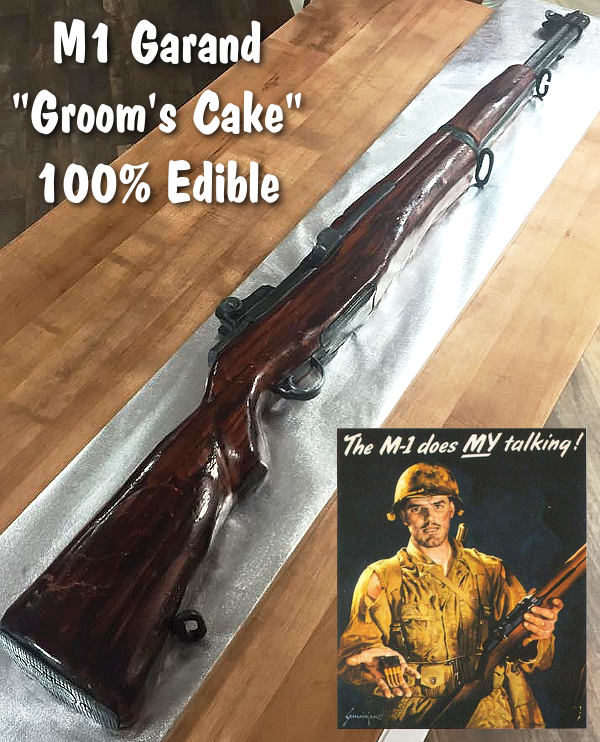
Here’s something you’ve probably never seen before — an edible M1 Garand. You heard that right. The rifle you see in these photos is actually a specialty cake, and every element of the chocolate Garand is deliciously edible, even the authentic receiver and sights. Note the remarkable detail — the grain in the wood, the sling swivels, trigger guard, and buttplate. This is truely a masterpiece of cake-making.

This is my rifle. There are many like it, but this one is edible (and delicious).
My edible rifle is my best friend. It is my life. I must master it as I must master my life.
Without me, my edible rifle is useless. Without my edible rifle, I am useless. I must eat my rifle true….
This impressive example of cake-making was created by Kentucky Wildflour Cakes. This was created as a “Groom’s cake” for a wedding reception. Below is a photo of the unique chocolate cake in the making. The fellow who commissioned this work of culinary art posted: “I begged you to knock this one out of the park for me, and by gosh you blew it out of the park! This was the main attraction at our reception last night and people are still going on and on about it. I can’t even begin to express how thankful I am for your work!”. For those doubting Thomases who can’t believe this masterpiece was actually created, layer by layer, as a cake, here is a photo of the M1 Garand cake “under construction”:

December 4th, 2015

What really happens when an M1 Garand fires the final round and the En-Bloc clip ejects with the distinctive “Ping”. Well thanks to the folks at ForgottenWeapons.com, you can see for yourself in super-slow-motion. The entire cycling process of a Garand has been captured using a high-speed camera running at 2000 frames per second (about sixty times normal rate). In this video, watch the clip eject at the 00:27 time-mark. It makes an acrobatic exit, spinning 90° counter-clockwise and then tumbling end over end. At the 1:20 time-mark you can actually see the two sides of the clip oscillating back and forth as the clip flies through the air.
2000 frame per second video shows M1 Garand ejecting spent cartridges and En-bloc clip.
November 11th, 2015

On this Veterans Day, we thought we would reprise this inspirational profile of SGT Robert Evans, a U.S. Army veteran who lost his right hand in combat in Iraq. Remarkably, despite his injury, SGT Evans obtained the Distinguished Rifleman Badge. Read on to learn more about this remarkable young soldier.
Wounded Warrior Goes Distinguished
Report based on story by Ashley Brugnone, CMP writer
At the 2013 Western CMP Games, SGT Robert Evans attained what many shooters seek their entire shooting careers — a Distinguished Rifleman’s Badge. Evans earned his DR badge with just one hand, after losing his right hand while serving in Iraq with the U.S. Army.
 SGT Robert Evans: Defying the Odds, Single-Handedly SGT Robert Evans: Defying the Odds, Single-Handedly
AFter joining the Army in 2003, SGT Robert Evans served two tours in Iraq, suffering a spinal injury on the first tour. On his second tour, his life changed forever. On May 31, 2007, Evans was commanding a Bradley Fighting Vehicle in Iraq. As the Bradley drove under an old Fedayeen guard shack, an IED on top of the guard shack detonated while Evans was reaching out of the turret. The blast amputated Robert’s right hand at the wrist.
Even as a young boy, Evans had always enjoyed shooting. He vowed to stay involved with the sport despite his injury: “I couldn’t give up shooting after I lost my hand. It’s always been too important to me,” he said. “No matter what is going on in my life, when the sights are aligned and the hammer is about to fall, nothing in the world matters at that second. It’s my nirvana.”
Evans worked his way back into the sport by starting in F-Class. The position allowed him to hold hard and pull the trigger, while also being able to use his optics. Then he got involved with J.J. O’Shea’s M1 for VETS Project. The project helps transition wounded combat veterans back into the world of shooting, with equipment arrangements, position training and mental preparations.

Working with the M1 for Vets group, Evans started shooting again. But there were challenges: “The first time I shot after my amputation, it was very frustrating,” he said. “I couldn’t hold still, and shooting left-handed was so foreign.” Being extremely right-eye dominant his entire life, the loss of his right hand caused him to relearn many things, including how to shoot. Learning how to reload and adjust for wind while slung up became a pain for Evans….

In 2008, after several months and rigorous hours of dry firing, Evans found himself crossing the threshold of Camp Perry — a dream he had waited to fulfill his entire life. He scored around 50 points standing, out of 100, on his first trip. Though not bad for someone with an amputation, that wasn’t enough for Evans. He wanted to become a Distinguished Rifleman.
SGT Evans during Team Match at 2013 CMP Western Games.

He began to realize his dream as he earned his first 10 points (towards Distinguished) at Camp Perry in 2012. It took him 15 months to LEG out. His next 6 points came at the 2013 Eastern Games in Camp Butner, NC, followed by 10 more points at the 2013 National Matches. There, hoping to “bronze out,” he managed to one-up himself to actually earn a silver medal.
Then came the 2013 Western Games at the Ben Avery Shooting Facility in Phoenix, AZ. Never giving up hope and remembering his long journey from the hospital bed to the firing line, he received his final 8 points. SGT Robert Evans had become a Distinguished Rifleman.

“There was a lot of pressure, speculation and competition as to who would be the first Combat Wounded Veteran to ‘Go Distinguished’ within M1 for VETS,” he said. “I’m very proud to have earned my badge, but more importantly, I hope that more wounded veterans will realize that it is within their grasp. It’s not an impossibility anymore. I hope it motivates everybody to train a little harder and hold a bit tighter – not just wounded veterans. If I can do it, anybody can.”
Posted Courtesy of the Civilian Marksmanship Program, www.TheCMP.org
Author: Ashley Brugnone, CMP Writer/Editor
August 6th, 2015

Victor Betzold had a Camp Perry experience for the ages. At the 2015 CMP Games, Betzold won the Garand Match, won the M1 Carbine Match (setting a new Record), and took the 3-Gun Aggregate for the second year in a row. Now that’s an impressive performance. Betzhold is no stranger to shooting – beginning in junior high and firing well into college, then taking his love for guns into the Army. After the years went on and work and family became higher priorities, he fell away from the sport he loved. But now that he’s retired at age 60, he’s had time to practice again – practice that has certainly paid off.
During his remarkable showing at the National Games Matches, Betzold won the Carbine Match with a score of 375-6X, setting a new National Record in the process. In the National Garand Match, Betzold fired a score of 290-7X to become the overall winner of a field of 1213 competitors.
“It feels great,” he said. “I’ve been working at this for a long time.” The 60-year-old Betzold was also the top senior for both the Garand Match and the Carbine Match.
With his outstanding performances in the Garand and Springfield Matches, as well as an exceptional seventh-place finish in the Vintage Military Match, Betzold claimed the 3-Gun Aggregate title for the second year in a row — with a combined score of 865-19X.
Lady Competitor at the Garand Match (file photo).

To review complete results for all CMP National Match events at Camp Perry, visit the CMP 2015 Trophy Matches and SAFS Results Page.
November 19th, 2014
Here’s a shocking video showing a massive Kaboom (KB) that literally destroyed an M1 Garand in the hands of a lady shooter. One second she has a classic .30-06 battle rifle in her arms, and the next second she has nothing but a pile of parts. She is fortunate to have survived this incident without apparent serious injury. She may have had a squib (undercharged round) in her prior shot at the 00:12 time-mark. At 00:15 it seems she may have experienced “click no bang” (we can’t tell for sure). The detonation occurs at time-mark 00:25, and is then replayed in slow-motion.
 If this Kaboom wasn’t caused by a squib, there might have been a catastrophic failure of the cartridge that failed to fire at 00:15. The shooter herself, posting as ArizonaGirl24 on YouTube, thinks the gun may have fired out of battery. What do you think? If this Kaboom wasn’t caused by a squib, there might have been a catastrophic failure of the cartridge that failed to fire at 00:15. The shooter herself, posting as ArizonaGirl24 on YouTube, thinks the gun may have fired out of battery. What do you think?
Text accompanying the posting of this video on LiveLeak, states: “A woman, her shooting partner, and their cameraperson are lucky to be alive. Her M1 Garand detonated after she failed to check the barrel for an obstruction due to an apparent squib round….
[After the shot at 00:12] she is obviously aware that something is amiss and seems to check the chamber, but does not unload the rifle to check for the presence of a barrel obstruction.
She raises the rifle and fires it again, causing a catastrophic weapon failure. Parts of the weapon fly in all directions. The video then terminates.”
What happened to the shooter? She reported: “I was very lucky with the outcome. I have lots of splinters and bruising, but nothing broken. My left hand took the brunt of the blow to my wrist and palm of my hand. Still pretty painful, but I will be fine.”
LESSON ONE: If you experience any kind of malfunction, or what appears to be a light-recoiling (or soft-sounding) shot, you should STOP shooting immediately. Clear the firearm and check for barrel obstructions.
LESSON TWO: Always wear ear and eye protection when shooting any firearm, even rimfires.
LESSON THREE: With a semi-auto gun, ensure the bolt is completely in battery after every shot.
LESSON FOUR: When hand-loading check EVERY round for powder charges prior to seating bullets, and weigh your loaded rounds before boxing them. Also check for high primers on EVERY round. If using a progressive press, use a Lock-Out Die that will alert you to any under-loaded cartridge. Be wary of commercial reloads.
Video tip from Mark LaFevers. We welcome reader submissions.
October 3rd, 2014
 Classic American battle rifles have regained popularity via M1 Garand matches, service rifle matches, the M1A Match at Camp Perry, and Vintage Sniper competitions. If you own a classic M1 Garand, or an M1A, the modern semi-auto descendant of the M14, you should enjoy the two videos presented here. With help from our friend Grant G., we managed to located two original U.S. Army training films, one for the M1 Garand, and one for the M14. Both films use clever animated drawings to show the gas guns’ internal operations and cycling processes. Classic American battle rifles have regained popularity via M1 Garand matches, service rifle matches, the M1A Match at Camp Perry, and Vintage Sniper competitions. If you own a classic M1 Garand, or an M1A, the modern semi-auto descendant of the M14, you should enjoy the two videos presented here. With help from our friend Grant G., we managed to located two original U.S. Army training films, one for the M1 Garand, and one for the M14. Both films use clever animated drawings to show the gas guns’ internal operations and cycling processes.
M1 Garand Training Film
Here is a U.S. Army training film for the M1 Garand (officially the United States Rifle, Caliber .30, M1). The M1 Garand was the first semi-automatic battle rifle to be generally issued to the infantry of a major nation, though other countries issued semi-auto rifles to special units. Gen. George S. Patton called the Garand “The greatest battle implement ever devised.”
Animated Diagrams Show M1 Garand Operational Cycle starting at 2:00-Minute Mark:
M14 Training Film
The successor to the M1 Garand was the M14. The 27-minute official U.S. Army video below demonstrates the operation of the M14. Field-stripping is shown from the 5:13 time-mark through 8:30. Cut-away drawings show the M14’s gas operation at 8:40.

The complete 8-step functioning cycle is demonstrated from the 9:25 time-mark through 22:41. These eight operations are: 1) Feeding; 2) Chambering; 3) Locking; 4) Firing; 5) Unlocking; 6) Extracting; 7) Ejecting; and 8) Cocking. This movie is fairly long, but fans of battle rifles will find it well worth their time. Every M1A owner should definitely watch this video start to finish.
Watch M14 Functioning Cycle Starting at 9:25 Mark:
July 6th, 2014
 The popular Vintage Sniper Rifle Team Match returns to Camp Perry on July 18, 2014, as part of this year’s National Matches. The Sniper Team Match was first held at Camp Perry in 2011, after being “test-fired” at the Eastern and Western CMP Games in 2010. The match tests competitors’ shooting abilities in a controlled environment and requires precise communication between teammates. Fierce competition and great camaraderie have made the Vintage Sniper Rifle Team Match a hugely popular event. The popular Vintage Sniper Rifle Team Match returns to Camp Perry on July 18, 2014, as part of this year’s National Matches. The Sniper Team Match was first held at Camp Perry in 2011, after being “test-fired” at the Eastern and Western CMP Games in 2010. The match tests competitors’ shooting abilities in a controlled environment and requires precise communication between teammates. Fierce competition and great camaraderie have made the Vintage Sniper Rifle Team Match a hugely popular event.

Two-person teams will fire 10 rounds in 20-second intervals from scoped vintage military rifles set on sand bags. One team marksman shoots from the prone position at 300 and 600 yards, while the other serves as a spotter to relay shot position. Marksman and spotter switch positions on the firing lines, allowing each teammate to play both roles. Scores are then combined for an Aggregate team total.
CLICK HERE for more info about the Vintage Sniper Match and other National Trophy Rifle Matches. These CMP Photo Gallery images are from the 2011 Vintage Sniper Rifle Team Match.

Dennis DeMille (G.M. of Creedmoor Sports) with spotter Don Rutherford.

Two M1 Garands, fitted with scopes and lace-on cheekpads.

Who can identify this rifle, with its unusual scope mount?

Here’s an old Swedish Mauser, chambered for the 6.5x55mm cartridge. These old Swedes can shoot!

Wounded Veteran participates in Vintage Sniper Rifle Team Match.

Hornady’s Dave Emary (left) with “Gunny” R. Lee Ermey (right).

A good time was had by all. This is a fun competition.

September 30th, 2013
 Over the years, many Civilian Marksmanship Program firearms purchasers have asked if the CMP would consider offering reliable, reasonably-priced and prompt maintenance, repair and upgrade of USGI-issue rifles. The CMP has responded and the answer is “YES”. Over the years, many Civilian Marksmanship Program firearms purchasers have asked if the CMP would consider offering reliable, reasonably-priced and prompt maintenance, repair and upgrade of USGI-issue rifles. The CMP has responded and the answer is “YES”.
Starting October 1, 2013, the CMP Custom Shop (Anniston, AL) opens for business, providing a wide variety of repair, upgrade and custom services for a wide range of U.S. Military rifles, specifically those issued in early eras. As well as regular repairs (and troubleshooting), the CMP Custom Shop will be able to perform virtually any normal upgrading, accurizing, customizing, and refinishing for the types of rifles the CMP sells.
CMP will work on the M1 Garand, M1 Carbine, 1903 and 1903A3 Springfield, the 1917 Enfield and the Krag. Other rifles like the Remington 40X, Mossberg 44, and H&R Model 12 can also be serviced. CMP will NOT work on shotguns, pistols, revolvers, M14/M1A, AR15-style rifles or other commercially-produced modern rifles. For a list of services (with prices) visit the CMP Custom Shop webpage.

NOTE: Before you can send a rifle to the CMP Custom Shop you must be a customer on file in the CMP system. Customers must meet the same eligibility requirements as for CMP rifle purchases. Once qualified, you can purchase a rifle from the CMP and have the CMP Custom Shop make modifications to it prior to shipping.
CMP Custom Shop Can Work on USGI Rifles Purchased from Other Sources
The CMP Custom Shop can work on rifles that may have been purchased elsewhere as long as they were made by a USGI contractor. Some examples include: Springfield Armory (not Springfield Inc.), Harrington & Richardson, Winchester, International Harvester, Remington, Rock Island, Eddystone, Inland, Underwood, Rock-Ola, Quality Hardware, National Postal meter, Standard Products, IBM, Irwin-Pederson and Saginaw. NOTE: There are many NON-USGI copies of the M1 Garand, 1903 Springfield and especially the M1 Carbine that CMP will be unable to work on.

 For more information, call (256) 835-8455, x1113, or send email to customshop [at] thecmp.org. Shipping and Correspondence address for the CMP Custom Shop is: For more information, call (256) 835-8455, x1113, or send email to customshop [at] thecmp.org. Shipping and Correspondence address for the CMP Custom Shop is:
CMP Custom Shop
1803 Coleman Rd
Anniston, AL 36207
September 11th, 2013
Yesterday (August 10th), the California Assembly, on a 44-31 vote, approved SB 374, which bans the sale (or transfer) of ALL semi-automatic centerfire rifles that can accept a detachable magazine of any kind (no matter what the capacity). Californians who possess such rifles would be required to register them with the State, for a fee, prior to January 1, 2015. Since SB 374 has already passed the California State Senate, this bill, after conforming amendments in the Senate, is expected to go to Governor Jerry Brown for signature within a few weeks.

The scope of SB 374 is sweeping. It bans all self-loading centerfire rifles capable of using a detachable magazine, regardless of magazine capacity (or placement). The operative language of SB 374 with respect to magazines is an awkward double-negative. But the intent is clear — if a semi-auto centerfire rifle can accept a detachable magazine AT ALL, it is banned:
SECTION 1. Section 30515 of the Penal Code is amended to read:
30515. (a) Notwithstanding Section 30510, “assault weapon” also means any of the following:
(1) A semiautomatic centerfire rifle that does not have a fixed magazine with the capacity to accept no more than 10 rounds.
The way we interpret this, a semi-automatic with ANY kind of detachable magazine (even a one-rounder) would be banned. This would outlaw a wide variety of commonly-used hunting rifles fitted with flush-mounted 3-, and 4-round ‘pop-out’ magazines. This would outlaw the classic Remington 750 deer rifle, for example. It would outlaw M1 Garands which have an 8-round en bloc clip. And if you already own an M1 Garand, you would have to register it with the state government. (Under other legislation in the works in Sacramento, all ‘bullet button’ ARs would also be banned.)
Other observers read SB 374 the way we do — that it bans any and all centerfire rifles that can take a detachable magazine (of any capacity). Ammoland states that SB 374 will “eliminate the future sale, purchase, manufacture, importation and possession of semi-automatic rifles that can accept detachable magazines. No more mini-14s, no more ARs, no more M1s, and say goodbye to your Remington 750 for deer hunting. [T]he goal is clear – if it is a rifle and has a detachable magazine, then forget about owning one.”
California Legislative Counsel’s Digest
SB 374, as amended, Steinberg. Firearms: assault weapons.
Existing law regulates the sale, carrying, and control of firearms, including assault weapons, and requires assault weapons to be registered with the Department of Justice. Violation of these provisions is a crime. Existing law defines a semiautomatic, centerfire rifle that has the capacity to accept a detachable magazine and other specified features and a semiautomatic weapon that has a fixed magazine with a capacity to accept 10 or more rounds as an assault weapon.
This bill would, instead, classify a semiautomatic centerfire rifle that does not have a fixed magazine with the capacity to accept no more than 10 rounds as an assault weapon. The bill would require a person who, between Jan. 1, 2001, and Dec. 31, 2013, inclusive, lawfully possessed an assault weapon that does not have a fixed magazine, including those weapons with an ammunition feeding device that can be removed readily from the firearm with the use of a tool, and who, on or after Januarry 1, 2014, possesses that firearm, to register the firearm by July 1, 2015. By expanding the definition of a crime, this bill would impose a state-mandated local program.
|
|


