Fans of Heavy Artillery should head over to the updated and enhanced Fifty Caliber Shooters Association (FCSA) Image Gallery website. There you’ll find photo collections and animated slide-shows (there also a separate Video Collection) On the photo gallery page, you’ll find a map. Click on any gray range link to see images from that venue. There are also a series of articles covering FCSA competition along with the “care and feeding” of the big 50-caliber rifles.
The FCSA will host its 1000/600 Yard World Championship July 5 through 7, 2018 at the Whittington Center in Raton, New Mexico. This will follow the 2018 King of 2 Miles Competition at Raton, which runs July 2-4, 2018. CLICK HERE to Register for FCSA 2018 Championship.
About the FCSA
Founded in 1985, the FCSA is an international organization with members in 22 countries. Headquartered in Monroe, Utah, the FCSA has a membership of approximately 4000. While the FCSA provides a service to military and law enforcement with research and instruction as well as an active liaison in both communities, the primary charter of the FCSA is the promotion of the sporting use of the 50 BMG cartridge and its wildcat derivatives. The FCSA and its members have lead the way in refining .50-caliber cartridges, rifles, and 1000-yard plus shooting know-how. Members enjoy a quarterly magazine, a suppliers directory, a very active website, and access to literally the best repository of 50 BMG information on the planet. If you are interested in Mr. John Browning’s big 50, you should seriously consider joining the FCSA.
Story tip by EdLongrange. We welcome reader submissions.
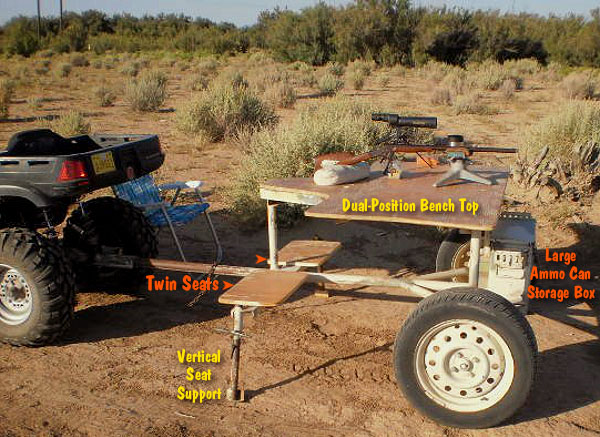
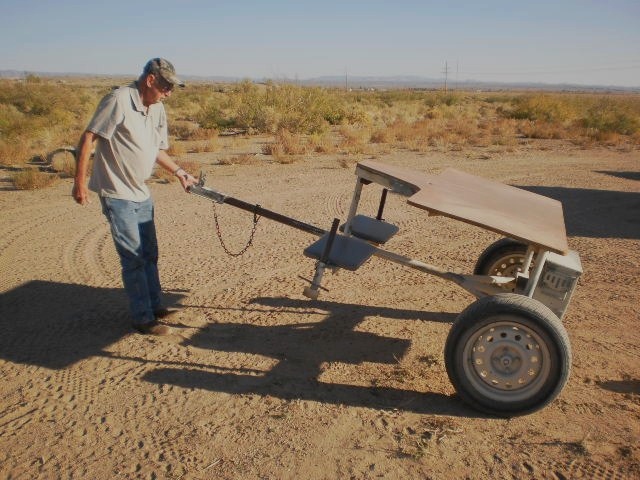
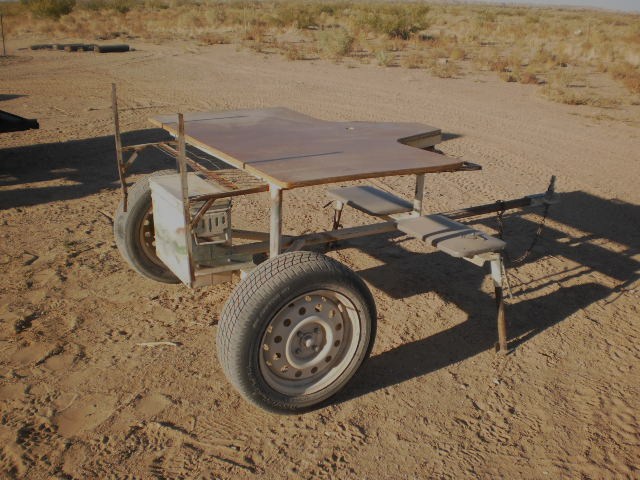
AccurateShooter Forum member John H. of New Mexico (aka “Skratch”) has created an impressive mobile shooting bench that he can haul with his ATV. This trailer-mounted, movable bench is built on a central tubular spine that also serves as the tongue for the trailer, which attaches to a standard hitch. The bench offers two (2) shooting positions so it works for both left-handed and right-handed shooters.
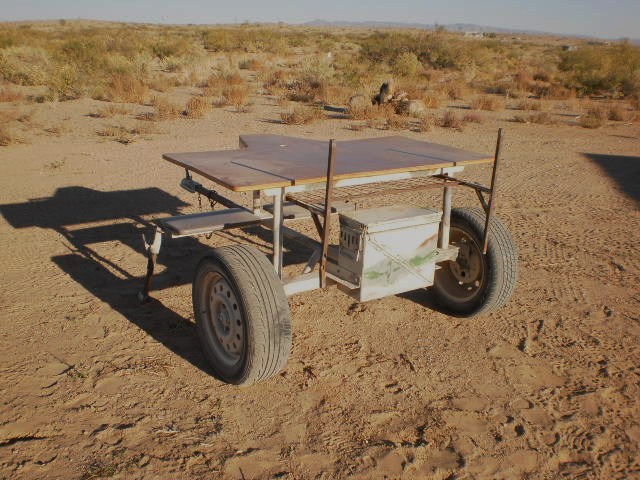
Up front, for storage, a surplus .50-Cal ammo can is secured to the trailer frame. The V-shaped middle section of the wood benchtop looks to be reinforced with a metal stiffener frame on the underside. The front section of the bench is supported by twin tubular uprights attached to the box-section axle housing. The two wooden bench-style seats (on left and right) ride on a cross-tube. At the ends of that cross-tube are adjustable legs for additional support.
Great Rig for New Mexico Varmint Hunting
There are plenty of great varmint hunting areas in Skratch’s home state of New Mexico — you’ll find some huge prairie dog fields there. But to get the best results on a varmint-hunting field session, you need a solid shooting station that can be easily hauled to new locations as needed. It looks like John (aka “Scratch”) has come up with an outstanding “War Wagon” for his New Mexico varmint safaris.
Click on image frames to see full-size photos
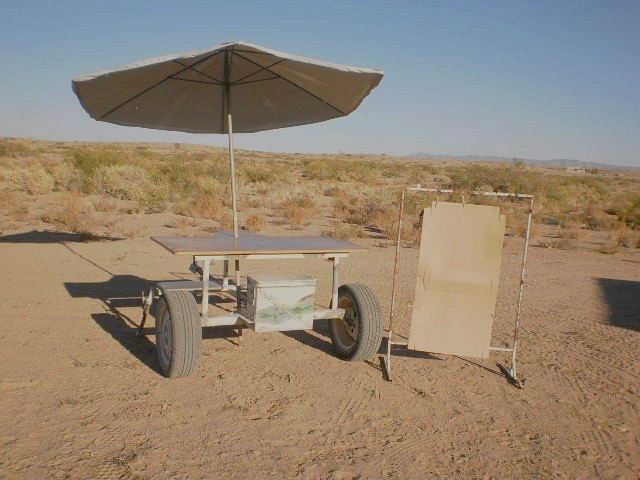
Some readers wanted to know how John’s War Wagon is positioned in the field and if it is ever detached from John’s ATV. John answers: “We do unhook the 4-wheeler for target-checking unless we have an extra along which is usually the case. That way we can level the table front to rear. We have an umbrella from a patio table to provide shade on extra warm days.”
War Wagon Construction Details
John told us: “My brother-in-law and I built this mobile bench a few years ago. The axle, wheels and tire are a tag axle from a small Chevy car, obtained from a salvage yard for about $35-$40 a decade ago. The tubular frame is drill stem, while the bench-top and seats are 3/4′” plywood. Under the plywood we fitted rails so we can slide our target stand under the benchtop for secure travel. The total cost for everything (including storage box) was about $250-$300.”
We set the bench and seat heights so that, with adults, the rifle sets straight level to the shoulder. For the smaller ‘younguns’ we just use a sofa pillow to raise them up. (Yes, adjustable seat heights would be great.) The ammo box holds our rifle rest, sand bags, spotting scope, and miscellaneous gear. Options are a couple of lawn chairs, and a cooler of brew (for after the shooting is done).
Photos by Stephen Fiorenzo, courtesy Applied Ballistics.
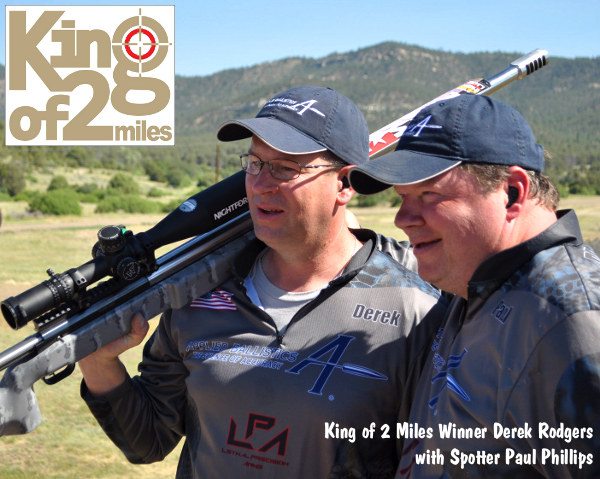
The 2017 King of 2 Miles match has concluded, and we have a new monarch. F-Class Ace Derek Rodgers is the new King of 2 Miles. Shooting with Team Applied Ballistics, Derek delivered a dominant performance, scoring nearly twice as many points as his nearest rival, Ronnie Wright. And Derek was the first KO2M marksman in history to hit the target at the maximum 3368-yard (1.91 mile) distance.
With his McMillan-stocked .375 CheyTac rifle, Derek shot brilliantly from the start. He was perfect — without a miss — at the first three yardages: 1543, 1722, and 1888. He had some misses at 1953 and 2667 yards, but then he out-shot all competitors at 3028 yards, going two for five. No other shooter managed a single hit at 3028 yards. Then it all came down to the big one — the last (and greatest) challenge, the target at 3368 yards (1.91 miles).
This would require superior shooting skills, a masterful wind call (by Emil Praslick), and nerves of steel. Derek tried four shots without success. It looked like the two-mile hit would continue to be an impossible goal. But then, on his fifth and very last shot, Derek did it — he hit the 3368-yard target.
After Derek made the (nearly) two-mile shot, cheers erupted on the firing line — what an achievement! Derek is the first (and only) shooter to make the 3368-yard shot at K02M. Watch him do it in this video:
Derek Rodgers Hits Target at 3368 Yards on his Final Shot:
Derek Rodgers K02M-Winning Hardware and Ammunition
Factory Rifle Finishes in Second Place
With so many full-custom rifles on the firing line, many were surprised to see a factory rifle finishing second overall. Ronnie Wright shot superbly with his stock Barrett M99 chambered in .416 Barrett. Ronnie’s impressive second-place performance proved the effectiveness of the .416 Barrett cartridge (and the build quality of the M99). For ammo, Ronnie used Cutting Edge 472gr MTAC projectiles loaded in Barrett-stamped .416 cases. The powder was Alliant Reloder 50 ignited by CCI #35 50 BMG primers. The rifle had a Barrett factory 32″ barrel fitted with an Accuracy 1st level.
INTERVIEW with DEREK RODGERS:
Q: What do you believe contributed to your success at this match?
Derek: This match was truly a team effort from the entire Applied Ballistics Team. Emil Praslick and Paul Phillips are world class wind-readers and spotters. They have the ability to make decisive decisions and trust that I (as the shooter) will put a bullet on target every time a command is given. We posses a dynamic team background with a lot of history and experience under our belt. Our positive team synergy is hard to find. The addition of vital tools played a huge role in our success. A few of the tools we used were the AB Kestrel and Garmin Foretrex 701 AB Elite to give absolutely crucial and accurate ballistic solutions. The new McMillan ELR Beast stock was stable and the NF ATACR scope is robust and clear. The Bartlein barrel used was top notch! However, one of the most important pieces of the ELR puzzle and the only thing that separates the target is — the bullet. We chose Cutting Edge (CE) bullets due to their high level of precision. These bullets proved to be invaluable in connecting every piece of steel at the KO2M competition. The CE 400gr Lazer Max bullet was selected and was tremendously accurate. This bullet transitioned into a sub-sonic velocity without any loss of precision at ELR distances. Our success would not be possible if the projectile did not fly correctly for 7+ seconds of flight time. CE has outstanding designs and several quality choices to choose from.
Q: How many hours would you say you practiced for this match?
Derek: It is hard to calculate practice time in hours. ELR is a program that we work on every chance we get — day and night for months prior to the event. We have an extremely strong background of team shooting and long range shooting. A lot of time has been invested on and off the range, but does not stop there. The combined range time from other disciplines really helped me to be successful in transitioning from long range to ELR. It really is a compilation of 10 years of trials and tribulations. Some would say, “the Devil is in the details”. Our team tries very hard to not overlook any small detail. Practice and training is always scrutinized for improvements. Our Applied Ballistics team has a love and passion that goes beyond measurable amounts of time. We were fortunate to get together for two days a month prior to the Ko2M event to review our program and practice as a team. Bryan Litz had a plan, and we discovered as a team we had flaws in our program. Each one of us contributed from years of experience on improving our technique until we had a winning solution.
Q: Why did you choose the .375 CheyTac cartridge?
Derek: When I was asked to join the AB Team, I needed to get an ELR rifle built in a short period of time. I was under a very tight time schedule to get the project complete. In an effort to eliminate variables, I decided to keep things standard and as simple as possible. I chose the .375 CheyTac for the ease of getting components. The larger rifles are more difficult to get components quickly and I felt like the .375 CheyTac had enough attributes to be competitive at ELR distances.
The Cutting Edge 400gr bullets are milled from solid copper bar stock on a CNC Swiss-style lathe.
New ELR Hardware and Software on Display at K02M
This marks the second straight year that Team Applied Ballistics has won the K02M event. Last year, Team AB shooter Mitchell Fitzpatrick won the coveted “King of 2 Miles” title (Fitzpatrick finished fourth this year, just off the podium). In the past year, there has been considerable evolution in Extreme Long Range hardware and software, and projectiles are constantly being improved.
Bryan Litz (center) conferring with Team AB members Emil Praslick (L) and Doc Beech (R).
We asked Bryan Litz, founder of Applied Ballistics, to summarize developments in the ELR game. Here are Bryan’s observations:
“Each year the KO2M sees advancements and shooters converging on those tools and processes that have proven effective in prior years. It’s rather apparent, for example, that spotting impacts is a crucial part of success in this match. This was improved by the match directors/organizers placing the targets in very good locations for spotting impacts. We’re seeing less set-ups with adjustable bases, and more with solid/fixed scope mounts. One of the exciting new pieces of equipment is the periscope device made by TACOMHQ (John Baker). This device provides an optical shift to the image which allows you to get more elevation for those long shots. Also, the refinement of fire control (ballistic) solutions has really played a role in getting shooters centered up for their first shots.”
“This tournament highly favors first-round impacts with the scoring system, so the approach of ‘walking the shots on’, isn’t a winning strategy. Those who employed accurate ballistics solvers were able to score more first round hits, and pile up the points. First and second place (at least) were using Applied Ballistics solvers to center their shots. We’re looking forward to even more advancements and making these ELR shots even out to two miles more commonplace in the future thru systematically applying the Science of Accuracy.”
If you’ve never visited the NRA Whittington Center outside Raton, New Mexico, it is well worth a visit. This new HD video shows the features of this unique facility where marksmen can shoot from 10 yards to two miles. Drone video footage gives you a “birds eye view” of the scenery and the ranges.
This is an excellent video. Well worth watching, with impressive aerial photography.
The Whittington Center hosts many major matches each year. Along with the training and range facilities, the Whittington Center has comfortable, modern cabins and RV camping zones for extended stays. Founded in 1973, the Center offers ranges for every kind of shooting discipline, along with a shotgun center, firearms museum, specialized firearms training, guided and unguided hunts, plus an adventure camp for younger shooters.
Next week the NRA Black Powder Target Rifle Championship will be held at the Whittington Center in Raton, NM. From July 19-24, top Black Powder Cartridge Rifle (BPCR) shooters from around the country will test their skills during a week-long event with targets set from 200 to 1000 yards. On the firing line you’ll see many handsome, custom-built BPCRs (Sharps, Ballards, Browning High Walls, Rolling Blocks) with exquisite wood, hand-checkering, and color-case-hardened receivers.
The Black Powder Championship starts with mid-range matches from 200 to 600 yards. Then competitors set their sights for long range, with 800-1000 yard Creedmoor matches at the end of the week. Interestingly, for safety reasons, there are minimum bullet weight and muzzle velocity requirements for the Creedmoor matches. These BPCR shooters launch some seriously heavy projectiles downrange:
Applied Ballistics team dominates the King of 2 Miles match: Mitchell Fitzpatrick (1st Place), Bryan Litz (2nd Place), and Paul Phillips (4th Place).
The King of 2 Miles event has come to an end, the scores have been tallied, and Team Applied Ballistics finished first, second, and fourth. That’s dominance. The “Top Gun” was young Mitchell Fitzpatrick, who blitzed the field with his impressive .375 Lethal Precision Arms LLC rifle shooting prototype solid 400gr Berger bullets. Mitchell built this rifle himself using a McMillan A5 Super Mag stock. Remarkably, Mitchell nailed first- and second-shot hits at the 2477-yard target, a full 1.4 miles away. That’s amazing shooting. The photo below illustrates the vast distance from firing line to target.
Mitchell gave credit to his team-mates: “We had the best ballistic solutions possible thanks to the work done at Applied Ballistics LLC by the one and only Bryan Litz. Bryan is also a world-class wind coach and world champion shooter. Paul Phillips, also a world-class wind coach, world champion shooter, and just an all-around class act. Paul was invaluable to making the wind calls we needed to win this match. One of the most important parts of any rifle system is the projectile… Berger’s new prototype .375-cal 400gr projectile we have been developing gave us a monumental ballistic advantage. [It was] without a doubt, a key to our success.”
Berger Ballistician Bryan Litz took second place shooting a .338 Edge (the only .338 rifle in the Finals). Durvin Wick finished third, while Paul Phillips, shooting Bryan’s rifle, placed fourth overall.
Report by Bryan Litz, Team Applied Ballistics
The 2016 King of 2 Miles event is in the books. Today the Top 10 teams engaged targets at 2011 yards, 2477 yards, and 3375 yards. All three Applied Ballistics teams had hits at 2011 yards, and two out of three of us scored first-round hits at 2477 yards! Note that no competitor (from any team) hit the two-mile (3375-yard) target, but that gives us a goal to shoot for next year. Many factors contributed to the success of the Applied Ballistics shooters in this event:
1. Teamwork. We shoot together on the U.S. Rifle Team. The standardized communication protocols between coaches and shooters was a big advantage in this timed event. We had excellent team-work, and are already discussing ways to improve and adapt our approach to ELR events.
2. Science. Applied Ballistics specializes in the science of accuracy. First round hits in this event are scored highly and you can get more first round hits if you know your ballistics. The top two shooters in this event both had first round hits at 2477 yards today which was key, and is not possible without highly accurate ballistic solutions.
3. Ballistic Performance. The performance of Mitchell Fitzpatrick’s .375 Lethal Precision Arms LLC rifle with the prototype 400 grain Berger Bullets solid is unmatched (G7 BC of 0.56 at over 3000 fps). This performance helped Mitch win the match by a sizable margin. The other two Applied Ballistics teams were shooting Bryan Litz’s .338 Edge with the Berger Bullets 300 grain Hybrid. Despite being a smaller caliber (compared to the .375s, .416s, and .50-calibers), the .338 Cal 300 grain Berger Hybrid proved to be a great performer.
There were quite a few big .50 Cals on the line, but a .375 topped the field. Sheri Judd photo.
Thanks to Eduardo Abril De Fontcuberta, Founder of the KO2M Event
We would like to thank all those who worked hard to make this event happen especially Eduardo Abril De Fontcuberta (shown below with Mitchell Fitzpatrick and Paul Phillips). Eduardo has worked hard to organize a great event that pushes the limits of ELR shooting in a fun and competitive way. We’re very grateful for the chance to participate and look forward to competing in the King of 2 Miles event next year. Also, thanks to Kelly McMillan for his support of our team. Kelly has been an awesome sponsor of our efforts here, as well as the U.S. Rifle Team, and the shooting community in general.
Edgewood makes some of the best front and rear shooting bags you can buy. And the latest Edgewood rear bag is better than ever, with a new hybrid “slick material overlay”. This combines the shape retention and stability of leather ears, with slick, low-friction material where the stock rides. This “best of both worlds” solution delivers both bag stability and improved tracking. Derek Rodgers, the only man who has won BOTH the F-Open and F-TR National Championships, is using this new rear bag, and he says it’s excellent. He says his gun tracks great with the slick material on top of leather-based ears.
You’re probably familiar with Edgewood for its high-quality shooting accessories. You may not know that Edgewood also offers a full line of quality leather holsters. And we bet you didn’t know that Edgewood got its start making tack and bridles for horse riders. Here’s a short history of Edgewood Leather, a family-run business based in Albuquerque, New Mexico.
The History of Edgewood Leather
by Jack Snyder
I’ve always enjoyed working with leather and still do to this day. Something about starting with an idea and building a useful and hopefully, beautiful piece does it for me. There’s nothing like leather to stimulate my imagination. It brings out my creativity and makes me happy.
I began doing leatherwork as a kid, 12 or 13, and the first piece I made was a pair of shoes. Got a job in a leather shop in the late ’60s and made purses and belts, wallets and sandals — many pairs of sandals. I opened a small retail shop in Estes Park, CO and made even more of the same, adding vests, halter tops, hats, mountain man gear of all sorts from skunk hats to goat fur high-top moccasins.
After a decade or so, I became restless for something new and taught myself bridle work. I discovered a niche market with English riders who were always looking for beautiful, well-fitting show bridles and over a period of about twenty years developed and produced many products for these riders — numerous types of nosebands, breastplates, martingales, girths and many different varieties of reins. At the same time I observed that for every horse and rider there were at least two dogs trotting along beside. I began making dog products which closely resembled their horse buddies bridle work. Sales were good. Leashes, leads, halters and collars showed up at dog shows around the country. My bridles were worn by many champions in every horse discipline — dressage, show ring, hunter-jumpers, and my polo gear became popular among the players. All of that was fun and I’m still proud of those products (still being made today), but it was time for a change. I sold my interest to my partner and tried to retire. Didn’t work, though.
My plan was to shoot benchrest matches, as many as I could. And I did for some time and loved every minute. I’ve made many friends among the shooters, discovering early on that these people are the most interesting, smart folks a guy could ever associate with. To the man, they’ll share what they know with you and even hand you their gun when yours malfunctions during a match, and grin and slap you on the back when you beat ‘em with it!
When I was getting started in benchrest, one aspect of the game was somewhat disappointing to me-the quality and stability of the shooting bags. It was natural with my past leather experience to make what I thought would be a better product. I cobbled up a couple of bags and went to a match in Oklahoma. All hell broke loose. Most of the shooters had to have one. By the end of the summer, I had so many orders for shooting bags, I couldn’t keep up the pace. I was improving the designs, based on the shooters telling me what worked and didn’t work. I was adding new products, experimenting with materials, processes and configurations and having a great time. Completely by accident, Edgewood Shooting Bags was born. My wife Cindy and my two kids Jackie and Aaron jumped in and we became a bag-making machine — always looking to improve and expand upon the products. Jackie’s husband Ryan joined us several years ago and together, we’ve made a pretty awesome team.
Edgewood’s New Line of Leather Holsters
Since we’re all avid shooters with many handguns among us, the next logical product to add to our catalog would be a line of high-quality leather holsters. For the last year or so, we’ve come up with what we believe to be the most comfortable, elegant holster out there. Affordably priced, these holsters are are available in many different styles and configurations, for both outside carry and concealed carry.
Latest Rear Bag Design — Leather Ears with ‘Slick Material Overlay’
Edgewood constantly strives to improve its products. Witness the new “slick material overlay” bag ears. This is a major design improvement over our regular “slick ears”. The development of the overall design all started when we noticed some shooters applying household products like talcum powder or dryer sheets to the ears of their bag in an effort to reduce friction and speed up their rifle’s return to battery. We found a material that would achieve this function without the need to raid their wife’s pantry for powders or laundry accessories and began sewing the ears up using this “microscopic glass bead impregnated” fabric. We were happy with the results. However, we soon began to realize that the slick material could have the longevity of our nylon as well as its slick properties, if we found a way to increase its thickness without causing wrinkles or inconsistencies.
First, we ended up hunting down some similar fabric with a much higher strength and thickness. It even has a fireproof backing that makes it far more durable — even if shooters aren’t planning on exposing it to temperatures higher than the Arizona desert can offer. This material was definitely superior and even more representative of the quality and durability that shooters have come to expect from products wearing the Edgewood logo. We didn’t stop there, either.
We started experimenting with a way to combine our toughest ear design, which is made from soft leather, with the slick material to create the best of both worlds. We deemed it the “slick overlay” option and many of the world’s top shooters now swear by it. There is no compromise with this ear set — shooters gain all of the advantages of the slick material, in addition to durability and consistency that exceeds even our tried and true nylon ears. Many of our original bags have been punished by shooters for over a decade and are still performing. We expect this design to last even longer.
Keeping ahead of the curve with innovations that create and help propel evolution in the sport is a signal of our commitment to retain our status into the future. Along with other new products like our second generation of concealed and open carry holsters, range bags for sighting in hunting rifles, radius front bags for AR-style rifles, camouflage color options and more — we even have a new logo for 2016. Check us out online or give us a call. We’re ready to meet the demands of shooters — from Benchrest and F-Class to concealed carry and IDPA.
Jack Snyder
President – Edgewood Shooting Bags and Gun Leather
In our Shooters’ Forum thread about Portable Shooting Benches, Forum member John H. of New Mexico (aka “Skratch”) showed off a nicely-crafted mobile shooting bench that he can haul with his ATV. This trailer-mounted, movable bench is built on a central tubular spine that also serves as the tongue for the trailer, which attaches to a standard hitch. The bench offers two (2) shooting positions so it works for both left-handed and right-handed shooters.
Up front, for storage, a surplus .50-Cal ammo can is secured to the trailer frame. The V-shaped middle section of the wood benchtop looks to be reinforced with a metal stiffener frame on the underside. The front section of the bench is supported by twin tubular uprights attached to the box-section axle housing. The two wooden bench-style seats (on left and right) ride on a cross-tube. At the ends of that cross-tube are adjustable legs for additional support.
Great Rig for New Mexico Varmint Hunting
There are plenty of great varmint hunting areas in Skratch’s home state of New Mexico — you’ll find some huge prairie dog fields there. But to get the best results on a varmint-hunting field session, you need a solid shooting station that can be easily hauled to new locations as needed. It looks like John (aka “Scratch”) has come up with an outstanding “War Wagon” for his New Mexico varmint safaris.
Is The Challenge Of Big Bore Extreme Range Shooting And Hunting Right For You? By James Patterson
Handling a 50 BMG
Is a 50 BMG caliber rifle difficult to shoot? Not at all. The relatively heavy weight of a standard rifle at 30 pounds or more combined with a very efficient muzzle brake makes it a pleasure to shoot. The typical recoil can be compared to a .243 rifle or a 12 gauge trap load. On the other hand, the burning of a typical load of 230 grains of powder combined with that muzzle brake makes the muzzle blast experience exhilarating. A first time shooter will fire, pause for a moment in awe at the muzzle blast, and then break out into what has become known as “The 50 caliber Grin”, almost impossible to wipe from ones face. My daughter started competing with the 50 BMG at 18 (115 lbs of tall skinny girl) and happily shoots 100+ rounds in the course of a match, her grin on the last round is as wide as on the first! Many members and competitors in the FCSA are women and many have distinguished themselves as excellent marksman having set world records on numerous occasions.
Cost of Big-Bore Shooting
Is owning and shooting a 50 BMG caliber rifle expensive? Relatively speaking yes, but one must put it into perspective. Rifles may run from $2500 to $7000, maybe even more for a top of the line custom rifle. A good scope will set you back $500 to $1500. And while excellent commercial ammo is available it runs from $3 to $5 a round. Most serious shooters start reloading for the rifle as soon as practical, not only for the economics of reloading but also for the ability to fine tune custom ammo for their specific rifle. It’s a very rare match that is won shooting commercial ammo. I recently compared the cost of my hobby — owning, shooting, and competing with the 50 BMG — with a friend whose hobby is snowmobiling. Factoring in the cost of equipment, licensing, gasoline, clothing, etc. it was soon obvious that my hobby was significantly less expensive than his.
Getting Started So how does one get started? You could do as I did, purchase a rifle not knowing what you were really getting into; or you could come out to a FCSA-sponsored event, shoot a number of different rifles, rub shoulders with those who have already taken the plunge, and see if this sport is right for you. While membership in the Fifty Caliber Shooters Association (FSCA) is required to compete at a FSCA event, membership is not required to come and experience first hand what is going on. If you have any inclination that you are interested in the extreme sport of long rang, big bore shooting then a year’s membership in the FCSA is only $60 ($20 for active duty military) a significant bargain if it helps you make just one well-informed equipment choice. In addition one of the primary functions of the FCSA is helping to identify active members near you who can help you understand just what is involved and help you ‘get your feet wet’ in this challenging sport.
Preview by John Gaines, President, BERC
Sponsored by the Bald Eagles Rifle Club, the 2014 Spirit of America Fullbore Rifle Prone Championship will be held at the NRA Whittington Center near Raton, New Mexico on 5-12 September. The event is open to Target Rifle, F-Open, and F-TR shooters. There will be matches at 300, 500, 600, 900 and 1000 yards. CLICK HERE for 2014 Spirit of America Match Program.
Since 2001 the Bald Eagles have hosted the Spirit of America Match and it has grown in both stature and reputation with every year of competition. It is one of the premier fullbore matches in the world, and the range at Raton is one of the most challenging in the United States.
The short ranges are fired in the mornings and the long ranges in the afternoon. Short range matches (300, 500, and 600 yards) are fired “two to the mound” while the long ranges (900 and 1000 yards) are fired “string fire”. Both individual and team matches are fired and competitors not belonging to a recognized or hometown team are encouraged to join a “make-up” team for the experience and the camaraderie of team shooting. The total round count for the week is more than 400 (counting practice and “blow-off” shots.) That’s lots of shooting on one of the best ranges in the world!
Door Prizes and More…
In addition to cash, trophies, and medals there will be a door prize table containing various merchandise from recognized companies in the shooting sports industry. Top door prize will be a Savage M12 F-Class rifle with a Nightforce Competition scope. To learn more about the 2014 Spirit of America Match visit the Bald Eagles Rifle Club website at www.baldeaglesrc.org.
The Guns and the Targets
The match is for fullbore Target rifle, F-Class (Open), and F-Class (T/R). There will be separate awards for each category.
TARGET RIFLE
Gun Specs: A rifle chambered for the unmodified 7.62×51 or commercial .308 Win cartridge, or a rifle chambered for the unmodified 5.56mm or commercial .223 Remington cartridge. Any safe trigger is acceptable.
Targets: 300 yards-MR63; 500 yards-MR65; 600 yards-MR1; 900 & 1000 yards-NRA LR
F-CLASS
Gun Rules: Rifles and rests must comply with NRA rules 3.4 & 3.4.1
Targets: 300 yards-MR63FC; 500 yards-MR65FC; 600 yards-MR1FC; 900 & 1000 yards-R-FC


 Fans of Heavy Artillery should head over to the updated and enhanced Fifty Caliber Shooters Association (FCSA) Image Gallery website. There you’ll find photo collections and animated slide-shows (there also a separate Video Collection) On the photo gallery page, you’ll find a map. Click on any gray range link to see images from that venue. There are also a series of articles covering FCSA competition along with the “care and feeding” of the big 50-caliber rifles.




 I began doing leatherwork as a kid, 12 or 13, and the first piece I made was a pair of shoes. Got a job in a leather shop in the late ’60s and made purses and belts, wallets and sandals — many pairs of sandals. I opened a small retail shop in Estes Park, CO and made even more of the same, adding vests, halter tops, hats, mountain man gear of all sorts from skunk hats to goat fur high-top moccasins.


