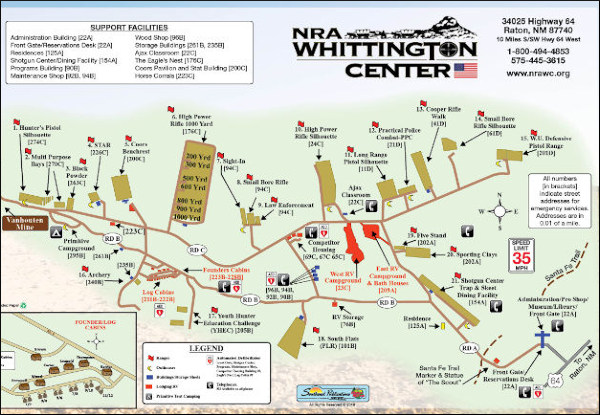
The 2026 Spirit of America NRA National Fullbore Championship is running September 11–17, 2026, at the NRA Whittington Center in Raton, New Mexico. Sponsored by the Bald Eagles Rifle Club, this individual and team championships event is open to Target Rifle (Fullbore), F-Open, and F-TR shooters. There are matches at 300, 500, 600, 900 and 1000 yards. CLICK HERE for 2026 Spirit of America Match Program.
The Spirit of America Championship is one of the flagship long-range rifle competitions at the NRA Whittington Center, offering a world-class fullbore rifle match experience on the renowned 1000-yard range. Since 2001 the Bald Eagles have hosted the Spirit of America Match and it has grown in reputation with every year of competition. It is one of the premier fullbore matches in the United States, and the range at Raton is one of the most challenging in the USA. 2026 Spirit of America Match Preview.
This video shows Day 2 of the Spirit of America individual championships. This shows the 300-yard line as the match got started. Brandon Green notes the winds were already pretty “sporty” blowing 10-12 mph and gusting a bit heavier.
This video was taken during practice. Brandon comments: “Practice Day for the Spirit of America Match. It is absolutely beautiful. This is one of the most awesome places in the world to shoot… it is gorgeous.” Brandon said some rains and “pretty big winds” were predicted. He noted it would be interesting to “see who could survive [the high winds].”
Here is a view of the 1000-yard range seen from the Founders Cabins up on the opposing hill. Raton is truly one of the most spectacular places you could ever shoot a match like this.
For today’s Sunday GunDay story we offer a short history of the legendary .50 BMG cartridge, tips on loading, and some fun photos from FCSA matches in the Western USA.
Fans of Heavy Artillery should visit Fifty Caliber Shooters Association (FCSA) website. There you’ll find range maps, photo collections and animated slide-shows On the FCSA photo gallery page, you’ll find a map. Click on any gray range link to see images from that venue. There are also a series of articles covering FCSA competition along with the “care and feeding” of the big 50-caliber rifles.
About the .50 BMG Cartridge
The .50 Browning Machine Gun (.50 BMG, aka 12.7×99mm NATO or 50 Browning) is a cartridge developed for the Browning .50 caliber machine gun in the late 1910s, entering official service in 1921. Under STANAG 4383, it is a standard cartridge for NATO forces as well as many non-NATO countries.
John Browning had the idea for this round during World War I in response to a need for an anti-aircraft weapon, based on a scaled-up .30-06 Springfield design, used in a machine gun based on a scaled-up M1919/M1917 design that Browning had initially developed around 1900. According to the American Rifleman: “The Browning .50 originated in the Great War. American interest in an armor-piercing cartridge was influenced by the marginal French 11 mm design, prompting U.S. Army Ordnance officers to consult Browning. They wanted a heavy projectile at 2700 FPS, but the ammunition did not exist. Browning pondered the situation and, according to his son John, replied, ‘Well, the cartridge sounds pretty good to start. You make up some cartridges and we’ll do some shooting’.”
Are you a died-in-the-wool .50 BMG fan? Got a hankerin’ for heavy artillery? Then visit the FCSA Photo Gallery page. There you’ll find hundreds of photos from Fifty Caliber Shooting Association (FCSA) matches and 50 Cal fun shoots in eleven states plus Australia, Switzerland, and the United Kingdom. To access the photos from the Gallery Page, start by selecting a shooting club and state with the brown buttons. After selecting the location, then click on the colored buttons for the event date.
Photo sets go all the way back to 2002, so you can see the evolution of the hardware over the years. Sample multiple archives to see the differences in terrain from one range to another — from Raton’s alpine setting to the hot, dry Nevada desert. This Gallery is really a treasure-trove of .50-Cal history. Here are a few sample images.
Reloading Powder and Special Tools for .50 BMG
Alliant’s Powder for 50-Caliber Applications
In 2009 Alliant unveiled Reloder 50, a slow-burn-rate powder designed primarily for long-range, .50-caliber rifle shooters. According to Alliant, the burn rate is “a little slower than Winchester 860″ and the powder is showing excellent lot-to-lot consistency. Load density is optimized for the 50 BMG and similar cases. Like Reloder 17, Reloder 50 employs a process which penetrates the kernels with the burn-rate-controlling chemical. This should allow a longer, flatter pressure curve, yielding more velocity than conventional powders can deliver. Alliant says that Reloder 50 offers “superior velocity and the ability to burn cleaner (with less residue)”. Reloder 50 comes in both 1-lb (#150527) and 8-lb (#150528) containers.
Forster and Lyman .50 BMG Trimmers
Big Fifty enthusiasts asked for a dedicated .50 BMG case trimmer, so Forster and Lyman created .50 Cal trimmers specifically for that cartridge. The cutter tip on the Forster .50 BMG Case Trimmer is much sharper than the cutter on the Lyman 50 Cal AccuTrimmer. However, the Forster tool is currently out of production, so it is harder to find than the Lyman .50 BMG trimmer, which is $92.93 on Amazon. Our advice is go ahead and get the Forster if you can find one — the cutter head is much sharper, and we prefer the Forster’s collet-style case-holder. The Forster gets the job done more quickly, with less effort. If you want the ultimate .50 BMG trimmer, check out the L.E. Wilson .50 BMG trimmer. But it is a hefty $268.40 at Midsouth.
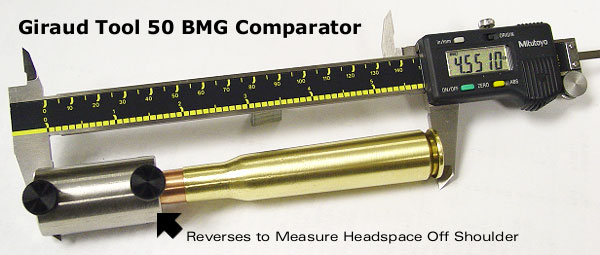
Giraud .50 BMG Case/Bullet Comparator Giraud Tool makes a comparator for 50-Cal cartridges. The double-ended comparator is quite versatile. In one orientation you can measure base-to-ogive bullet length and also measure cartridge OAL from rim to bullet ogive. When reversed, you can use the comparator to measure cartridge headspace. The $35.00 Giraud .50 BMG Comparator gauge is constructed of 303 stainless and fits most any vernier, dial, or digital caliper. CLICK HERE for more info.
Edgewood Shooting Bags makes some of the best front and rear shooting bags you can buy. And the Edgewood rear bag are offered with a modern, hybrid “slick material overlay”. This combines the shape retention and stability of leather ears, with slick, low-friction material where the stock rides. This “best of both worlds” solution delivers both bag stability and improved tracking. Derek Rodgers, the only man who has won BOTH the F-Open and F-TR National Championships, has used this bag and he says his gun tracks great with the slick material on top of leather-based ears.
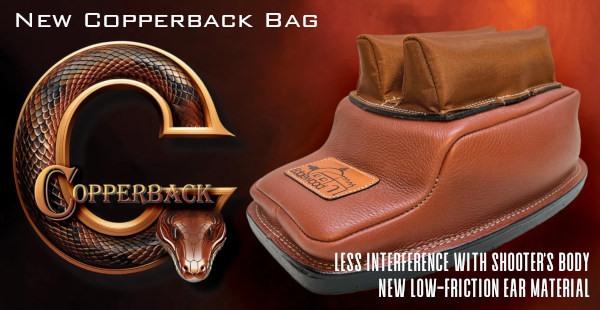
New Copperback Edgewood Rear Bags
Edgewood’s new Copperback bags boast a new bag shape and ear geometry that maximizes stability while minimizing interference with shooter’s body. The Cooperbacks also feature a new ear material specially coated to reduce friction for smooth recoil and return to battery.
Along with great front and rear bags, Edgewood also offers quality leather OWB holsters and IWB holsters. And we bet you didn’t know that Edgewood got its start making tack and bridles for horse riders. Here’s a short history of Edgewood Leather, a family-run business based in Albuquerque, New Mexico.
The History of Edgewood Leather
by Jack Snyder
I’ve always enjoyed working with leather and still do to this day. Something about starting with an idea and building a useful and hopefully, beautiful piece does it for me. There’s nothing like leather to stimulate my imagination. It brings out my creativity and makes me happy.
I began doing leatherwork as a kid, 12 or 13, and the first piece I made was a pair of shoes. Got a job in a leather shop in the late ’60s and made purses and belts, wallets and sandals — many pairs of sandals. I opened a small retail shop in Estes Park, CO and made even more of the same, adding vests, halter tops, hats, mountain man gear of all sorts from skunk hats to goat fur high-top moccasins.
After a decade or so, I became restless for something new and taught myself bridle work. I discovered a niche market with English riders who were always looking for beautiful, well-fitting show bridles and over a period of about twenty years developed and produced many products for these riders — numerous types of nosebands, breastplates, martingales, girths and many different varieties of reins. At the same time I observed that for every horse and rider there were at least two dogs trotting along beside. I began making dog products which closely resembled their horse buddies bridle work. Sales were good. Leashes, leads, halters and collars showed up at dog shows around the country. My bridles were worn by many champions in every horse discipline — dressage, show ring, hunter-jumpers, and my polo gear became popular among the players. All of that was fun and I’m still proud of those products (still being made today), but it was time for a change. I sold my interest to my partner and tried to retire. Didn’t work, though.
My plan was to shoot benchrest matches, as many as I could. And I did for some time and loved every minute. I’ve made many friends among the shooters, discovering early on that these people are the most interesting, smart folks a guy could ever associate with. To the man, they’ll share what they know with you and even hand you their gun when yours malfunctions during a match, and grin and slap you on the back when you beat ‘em with it!
When I was getting started in benchrest, one aspect of the game was somewhat disappointing to me-the quality and stability of the shooting bags. It was natural with my past leather experience to make what I thought would be a better product. I cobbled up a couple of bags and went to a match in Oklahoma. All hell broke loose. Most of the shooters had to have one. By the end of the summer, I had so many orders for shooting bags, I couldn’t keep up the pace. I was improving the designs, based on the shooters telling me what worked and didn’t work. I was adding new products, experimenting with materials, processes and configurations and having a great time. Completely by accident, Edgewood Shooting Bags was born. My wife Cindy and my two kids Jackie and Aaron jumped in and we became a bag-making machine — always looking to improve and expand upon the products. Jackie’s husband Ryan joined us several years ago and together, we’ve made a pretty awesome team.
Latest Rear Bag Design — Leather Ears with ‘Slick Material Overlay’
Edgewood constantly strives to improve its products. Witness the new “slick material overlay” bag ears. This is a major design improvement over our regular “slick ears”. The development of the overall design all started when we noticed some shooters applying household products like talcum powder or dryer sheets to the ears of their bag in an effort to reduce friction and speed up their rifle’s return to battery. We found a material that would achieve this function without the need to raid their wife’s pantry for powders or laundry accessories and began sewing the ears up using this “microscopic glass bead impregnated” fabric. We were happy with the results. However, we soon began to realize that the slick material could have the longevity of our nylon as well as its slick properties, if we found a way to increase its thickness without causing wrinkles or inconsistencies.
First, we ended up hunting down some similar fabric with a much higher strength and thickness. It even has a fireproof backing that makes it far more durable — even if shooters aren’t planning on exposing it to temperatures higher than the Arizona desert can offer. This material was definitely superior and even more representative of the quality and durability that shooters have come to expect from products wearing the Edgewood logo. We didn’t stop there, either.
We started experimenting with a way to combine our toughest ear design, which is made from soft leather, with the slick material to create the best of both worlds. We deemed it the “slick overlay” option and many of the world’s top shooters now swear by it. There is no compromise with this ear set — shooters gain all of the advantages of the slick material, in addition to durability and consistency that exceeds even our tried and true nylon ears. Many of our original bags have been punished by shooters for over a decade and are still performing. We expect this design to last even longer.
Keeping ahead of the curve with innovations that create and help propel evolution in the sport is a signal of our commitment to retain our status into the future. Along with other new products like our second generation of concealed and open carry holsters, range bags for sighting in hunting rifles, radius front bags for AR-style rifles, camouflage color options and more. Check us out online or give us a call. We’re ready to meet the demands of shooters — from Benchrest and F-Class to concealed carry and IDPA.
Jack Snyder
President – Edgewood Shooting Bags and Gun Leather
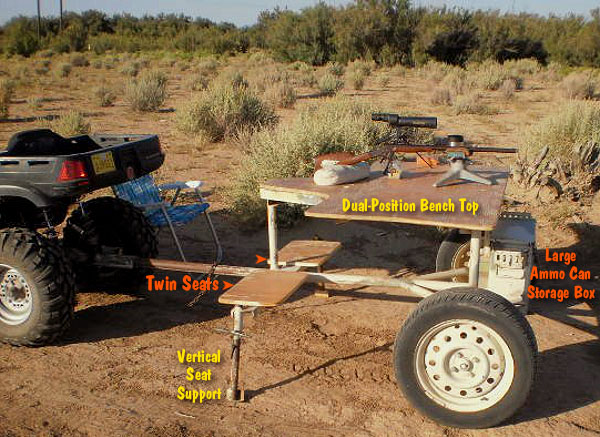
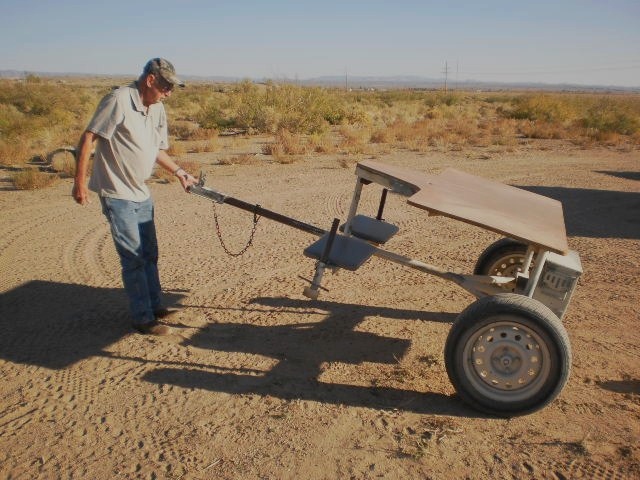
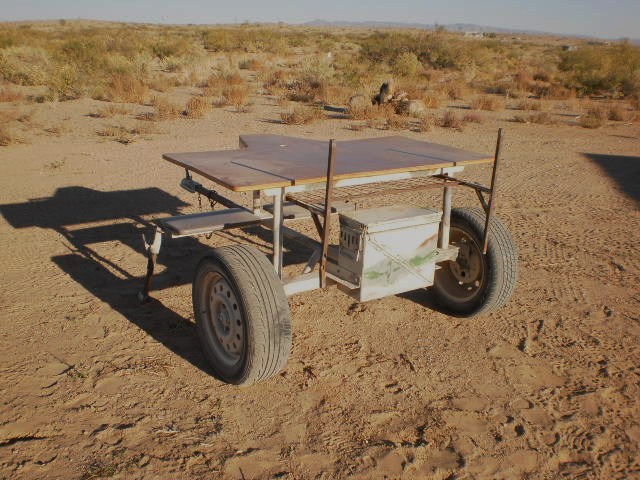
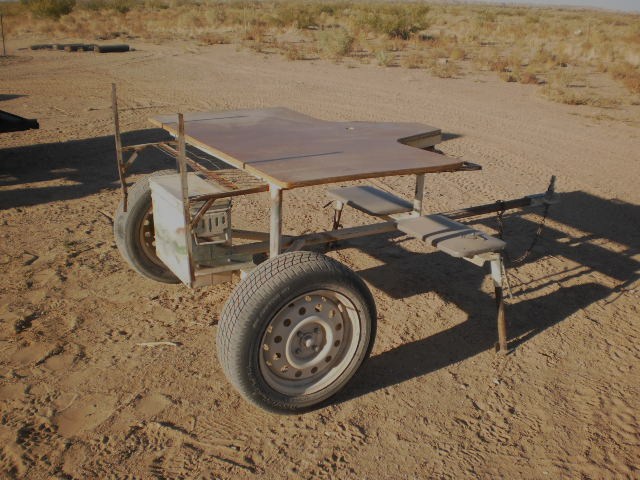
AccurateShooter Forum member John H. of New Mexico (aka “Skratch”) has created an impressive mobile shooting bench that he can haul with his ATV. This trailer-mounted, movable bench is built on a central tubular spine that also serves as the tongue for the trailer, which attaches to a standard hitch. The bench offers two (2) shooting positions so it works for both left-handed and right-handed shooters.
Up front, for storage, a surplus .50-Cal ammo can is secured to the trailer frame. The V-shaped middle section of the wood benchtop looks to be reinforced with a metal stiffener frame on the underside. The front section of the bench is supported by twin tubular uprights attached to the box-section axle housing. The two wooden bench-style seats (on left and right) ride on a cross-tube. At the ends of that cross-tube are adjustable legs for additional support.
Great Rig for New Mexico Varmint Hunting
There are plenty of great varmint hunting areas in Skratch’s home state of New Mexico — you’ll find some huge prairie dog fields there. But to get the best results on a varmint-hunting field session, you need a solid shooting station that can be easily hauled to new locations as needed. It looks like John (aka “Scratch”) has come up with an outstanding “War Wagon” for his New Mexico varmint safaris.
Click on image frames to see full-size photos
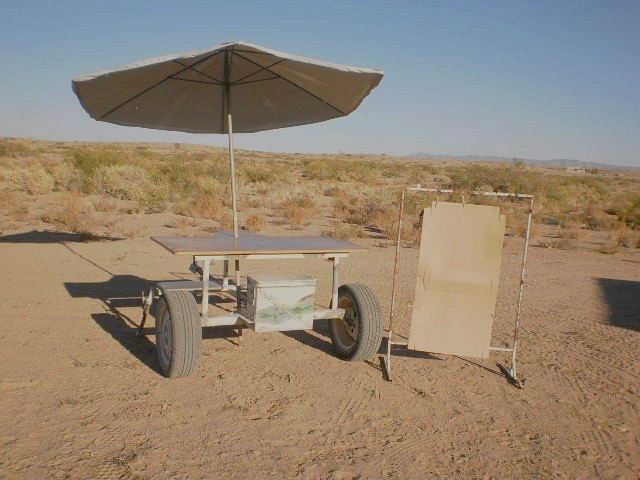
Some readers wanted to know how John’s War Wagon is positioned in the field and if it is ever detached from John’s ATV. John answers: “We do unhook the 4-wheeler for target-checking unless we have an extra along which is usually the case. That way we can level the table front to rear. We have an umbrella from a patio table to provide shade on extra warm days.”
War Wagon Construction Details
John told us: “My brother-in-law and I built this mobile bench a few years ago. The axle, wheels and tire are a tag axle from a small Chevy car, obtained from a salvage yard for about $35-$40 a decade ago. The tubular frame is drill stem, while the bench-top and seats are 3/4′” plywood. Under the plywood we fitted rails so we can slide our target stand under the benchtop for secure travel. The total cost for everything (including storage box) was about $250-$300.”
We set the bench and seat heights so that, with adults, the rifle sets straight level to the shoulder. For the smaller ‘younguns’ we just use a sofa pillow to raise them up. (Yes, adjustable seat heights would be great.) The ammo box holds our rifle rest, sand bags, spotting scope, and miscellaneous gear. Options are a couple of lawn chairs, and a cooler of brew (for after the shooting is done).
For today’s Sunday GunDay story we offer a short history of the legendary .50 BMG cartridge, tips on loading, and some fun photos from FCSA matches in the Western USA.
Fans of Heavy Artillery should visit Fifty Caliber Shooters Association (FCSA) website. There you’ll find range maps, photo collections and animated slide-shows On the FCSA photo gallery page, you’ll find a map. Click on any gray range link to see images from that venue. There are also a series of articles covering FCSA competition along with the “care and feeding” of the big 50-caliber rifles.
About the .50 BMG Cartridge
The .50 Browning Machine Gun (.50 BMG, aka 12.7×99mm NATO or 50 Browning) is a cartridge developed for the Browning .50 caliber machine gun in the late 1910s, entering official service in 1921. Under STANAG 4383, it is a standard cartridge for NATO forces as well as many non-NATO countries.
John Browning had the idea for this round during World War I in response to a need for an anti-aircraft weapon, based on a scaled-up .30-06 Springfield design, used in a machine gun based on a scaled-up M1919/M1917 design that Browning had initially developed around 1900. According to the American Rifleman: “The Browning .50 originated in the Great War. American interest in an armor-piercing cartridge was influenced by the marginal French 11 mm design, prompting U.S. Army Ordnance officers to consult Browning. They wanted a heavy projectile at 2700 FPS, but the ammunition did not exist. Browning pondered the situation and, according to his son John, replied, ‘Well, the cartridge sounds pretty good to start. You make up some cartridges and we’ll do some shooting’.”
Are you a died-in-the-wool .50 BMG fan? Got a hankerin’ for heavy artillery? Then visit the FCSA Photo Gallery page. There you’ll find hundreds of photos from Fifty Caliber Shooting Association (FCSA) matches and 50 Cal fun shoots in eleven states plus Australia, Switzerland, and the United Kingdom. To access the photos from the Gallery Page, start by selecting a shooting club and state with the brown buttons. After selecting the location, then click on the colored buttons for the event date.
Photo sets go all the way back to 2002, so you can see the evolution of the hardware over the years. Sample multiple archives to see the differences in terrain from one range to another — from Raton’s alpine setting to the hot, dry Nevada desert. This Gallery is really a treasure-trove of .50-Cal history. Here are a few sample images.
Reloading Powder and Special Tools for .50 BMG
Alliant’s Powder for 50-Caliber Applications
In 2009 Alliant unveiled Reloder 50, a slow-burn-rate powder designed primarily for long-range, .50-caliber rifle shooters. According to Alliant, the burn rate is “a little slower than Winchester 860″ and the powder is showing excellent lot-to-lot consistency. Load density is optimized for the 50 BMG and similar cases. Like Reloder 17, Reloder 50 employs a process which penetrates the kernels with the burn-rate-controlling chemical. This should allow a longer, flatter pressure curve, yielding more velocity than conventional powders can deliver. Alliant says that Reloder 50 offers “superior velocity and the ability to burn cleaner (with less residue)”. Reloder 50 comes in both 1-lb (#150527) and 8-lb (#150528) containers.
Forster and Lyman .50 BMG Trimmers
Big Fifty enthusiasts asked for a dedicated .50 BMG case trimmer, so Forster and Lyman created .50 Cal trimmers specifically for that cartridge. The cutter tip on the Forster .50 BMG Case Trimmer is much sharper than the cutter on the Lyman 50 Cal AccuTrimmer. However, with the Forster tool you will pay more for that superior cutting ability — the Forster .50 BMG trimmer is $125.18 at Precision Reloading compared to $85.21 on Amazon for the Lyman .50 BMG trimmer. Our advice is go ahead and pay the extra money for the Forster — the cutter head is much sharper, and we prefer the Forster’s collet-style case-holder. The Forster gets the job done more quickly, with less effort. NOTE: Grab the Forster while you can — we believe Forster has halted production (but it is still in stock at Precision Reloading and some other vendors).
Giraud .50 BMG Case/Bullet Comparator Giraud Tool makes a comparator for 50-Cal cartridges. The double-ended comparator is quite versatile. In one orientation you can measure base-to-ogive bullet length and also measure cartridge OAL from rim to bullet ogive. When reversed, you can use the comparator to measure cartridge headspace. The $33.00 Giraud .50 BMG Comparator gauge is constructed of 303 stainless and fits most any vernier, dial, or digital caliper. CLICK HERE for more info.
Image from Fox News. Click HERE for full story with video.
The Second Amendment Foundation has filed a federal lawsuit against New Mexico Gov. Michelle Lujan Grisham and four other officials on the grounds that the governor’s “emergency order’ prohibiting open and concealed carry in Albuquerque and surrounding Bernalillo violates the Second and Fourteenth Amendments of the U.S. Constitution.
Joining SAF are the New Mexico Shooting Sports Association, Firearms Policy Coalition and a private citizen, Zachary Fort, who resides in Bernalillo County. They are represented by Jordon George of Aragon Moss George Jenkins, LLP who has also filed a motion for a temporary restraining order and preliminary injunction. The lawsuit and motion were filed in U.S. District Court for the District of New Mexico.
Along with Gov. Lujan Grisham, defendants include: Patrick Allen, Cabinet Secretary for the New Mexico Department of Health; Jason Bowie, Cabinet Secretary for New Mexico Department of Public Safety, and W. Troy Weisler, chief of the New Mexico State Police. They are sued individually AND in their official capacities.
“Despite her claims to the contrary,” said SAF founder and Exec. V.P. Alan M. Gottlieb, “Gov. Grisham does not have the authority to ‘suspend’ the Second Amendment for an alleged public health emergency or any other reason. Neither do any of the other defendants, nor can they legally enforce such a suspension.”
“Evidently”, added SAF Executive Director Adam Kraut, “Gov. Lujan Grisham believes she can disregard the constitution to further her own political views. We’re taking action to stop this unconstitutional exercise of power in its tracks, because it is a flagrant violation of the right of individual citizens to carry firearms in public for personal defense.”
“Our motion for a temporary restraining order and preliminary injunction will prevent the state from further causing injury to the plaintiffs and other citizens under this unlawful order,” Kraut added.
Fans of Heavy Artillery should visit Fifty Caliber Shooters Association (FCSA) website. There you’ll find range maps, photo collections and animated slide-shows On the FCSA photo gallery page, you’ll find a map. Click on any gray range link to see images from that venue. There are also a series of articles covering FCSA competition along with the “care and feeding” of the big 50-caliber rifles.
For today’s Sunday GunDay feature we offer a short history of the legendary .50 BMG cartridge, along with some fun photos from FCSA matches in the Western USA.
About the .50 BMG Cartridge
The .50 Browning Machine Gun (.50 BMG, aka 12.7×99mm NATO or 50 Browning) is a cartridge developed for the Browning .50 caliber machine gun in the late 1910s, entering official service in 1921. Under STANAG 4383, it is a standard cartridge for NATO forces as well as many non-NATO countries.
John Browning had the idea for this round during World War I in response to a need for an anti-aircraft weapon, based on a scaled-up .30-06 Springfield design, used in a machine gun based on a scaled-up M1919/M1917 design that Browning had initially developed around 1900. According to the American Rifleman: “The Browning .50 originated in the Great War. American interest in an armor-piercing cartridge was influenced by the marginal French 11 mm design, prompting U.S. Army Ordnance officers to consult Browning. They wanted a heavy projectile at 2700 FPS, but the ammunition did not exist. Browning pondered the situation and, according to his son John, replied, ‘Well, the cartridge sounds pretty good to start. You make up some cartridges and we’ll do some shooting’.”
Are you a died-in-the-wool .50 BMG fan? Got a hankerin’ for heavy artillery? Then visit the FCSA Photo Gallery page. There you’ll find hundreds of photos from Fifty Caliber Shooting Association (FCSA) matches and 50 Cal fun shoots in eleven states plus Australia, Switzerland, and the United Kingdom. To access the photos from the Gallery Page, start by selecting a state/country and then click on the colored buttons for the event date (e.g. 2015-04).
Photo sets go all the way back to 2002, so you can see the evolution of the hardware over the years. Sample multiple archives to see the differences in terrain from one range to another — from Raton’s alpine setting to the hot, dry Nevada desert. This Gallery is really a treasure-trove of .50-Cal history. Here are a few sample images.
Reloading Powder and Special Tools for .50 BMG
Alliant’s Powder for 50-Caliber Applications
In 2009 Alliant unveiled Reloder 50, a slow-burn-rate powder designed primarily for long-range, .50-caliber rifle shooters. According to Alliant, the burn rate is “a little slower than Winchester 860″ and the powder is showing excellent lot-to-lot consistency. Load density is optimized for the 50 BMG and similar cases. Like Reloder 17, Reloder 50 employs a process which penetrates the kernels with the burn-rate-controlling chemical. This should allow a longer, flatter pressure curve, yielding more velocity than conventional powders can deliver. Alliant says that Reloder 50 offers “superior velocity and the ability to burn cleaner (with less residue)”. Reloder 50 comes in both 1-lb (#150527) and 8-lb (#150528) containers.
Forster and Lyman .50 BMG Trimmers
Big Fifty enthusiasts asked for a dedicated .50 BMG case trimmer, so Forster and Lyman created .50 Cal trimmers specifically for that cartridge. Forster’s cutter tip on its .50 BMG Case Trimmer is much sharper than the cutter on the Lyman 50 Cal AccuTrimmer. However, with the Forster tool you will pay more for that superior cutting ability — the Forster .50 BMG trimmer is $95.53 at Midsouth compared to $75.09 at Midsouth for the Lyman .50 BMG trimmer. Go head and pay the extra money for the Forster — the cutter head is much sharper, and we prefer the Forster’s collet-style case-holder. Bottom line — the Forster gets the job done more quickly, with less effort.
Giraud .50 BMG Case/Bullet Comparator Giraud Tool makes a comparator for 50-Cal cartridges. The double-ended comparator is quite versatile. In one orientation you can measure base-to-ogive bullet length and also measure cartridge OAL from rim to bullet ogive. When reversed, you can use the comparator to measure cartridge headspace. The $33.00 Giraud .50 BMG Comparator gauge is constructed of 303 stainless and fits most any vernier, dial, or digital caliper. CLICK HERE for more info.
The Three Amigos in New Mexico (L to R): Kelly McMillan, Paul Phillips, Derek Rodgers.
Three years ago nearly to the day, Kelly McMillan, Derek Rogers, and Paul Phillips enjoyed the fellowship and satisfaction of a successful New Mexico Antelope hunt. But sadly, Kelly passed away on June 1, 2021 from rapid, unexpected medical issues. Yesterday, October 7th, 2021, Paul Phillips posted: “Three years ago today. This hunt with Kelly McMillan and Derek Rodgers was a great memory. I miss Kelly.” Yes Paul, scores of us who counted Kelly as a friend and colleague miss him, and think of him often.
This isn’t your typical hunting story, because these weren’t your typical hunters. Derek Rodgers is the reigning F-TR World Champion, and past King of 2 Miles. Paul Phillips is the 2019 King of 2 Miles and a member of the Silver Medal-winning F-TR Team McMillan at the 2018 Nationals. The third hunter, Kelly McMillan, needs no introduction. The past owner of McMillan Fiberglass Stocks, Kelly was a leading figure in the gun industry for decades. He also supported many top rifle shooting teams. This story helps us remember Kelly and all he did for the shooting sports.
In October 2018, these three friends got together for a very successful hunt in New Mexico, Derek’s home turf. All three bagged an impressive Antelope, with Paul Phillips dropping the biggest buck of all. Derek made the longest shot, hitting his buck at an impressive 510 yards, verified by laser rangefinder.
Paul Phillips posted: “Our New Mexico Antelope hunt with Kelly McMillan and Derek Rodgers was a success. To hunt with these two icons was definitely on my bucket list. I shot my buck at 389 yards in an 18-mph wind through a barbed wire fence.” It was a big trophy buck, measuring 84 3/8 inches.
Derek nailed his Antelope at 510 yards with a .308 Win fitted with a suppressor. As dusk approached, despite blustery wind and rain, Kelly dropped the third Antelope with a great 230-yard shot from a broken tree crotch. Paul noted: “All three bucks had their own challenges and funny story. All three hunts required team work with stalking, communication.” The three hunting buddies all had top-quality rifles built with McMillan stocks of course.
For long-range hunting you need to have your drops absolutely “spot-on”. Paul posted: “When you do a 30-45 minute stalk… you need to have all your ballistics perfect or they get away. We were glad that we had a practice day before the hunt to confirm our zeros and verify our ballistics.”
Kelly noted: “Paul Phillips scored this nice 80″+ buck in New Mexico. It was Paul’s first antelope.” The .338 LM rifle featured a Stiller TAC338 action, Bartlein 20″ barrel, McMillan A5 Stock, and Nightforce ATACR scope. In the Facebook video, Paul talks about making the shot, directly into the wind.
Both of Kelly’s Amigos — his hunting partners — were profoundly saddened by his passing. They miss him, as do all of us who knew Kelly.
Derek Rodgers wrote of his friend and hunting partner: “It is difficult to tell you how deeply saddened I feel about the loss of Kelly. What started as a shooting relationship quickly became a close friendship so many years ago. It was a privilege to know Kelly on a personal level and I will never forget his generous, caring nature and the never-ending kindness he had for others. He will forever be missed.”
Paul Phillips posted: “I have no words to express how saddened I am … we lost an icon in the shooting industry. Kelly McMillan was not only a great friend but the most generous and giving man I knew in the industry. There is not enough space to write about everything he did for competitive shooters, military snipers, hunters, and shooting enthusiasts. You were one-of-a-kind Kelly and I will forever remember your friendship and how big an advocate you were for shooting sports. R.I.P. my friend.”
AccurateShooter Forum member John H. of New Mexico (aka “Skratch”) has created an impressive mobile shooting bench that he can haul with his ATV. This trailer-mounted, movable bench is built on a central tubular spine that also serves as the tongue for the trailer, which attaches to a standard hitch. The bench offers two (2) shooting positions so it works for both left-handed and right-handed shooters.
Up front, for storage, a surplus .50-Cal ammo can is secured to the trailer frame. The V-shaped middle section of the wood benchtop looks to be reinforced with a metal stiffener frame on the underside. The front section of the bench is supported by twin tubular uprights attached to the box-section axle housing. The two wooden bench-style seats (on left and right) ride on a cross-tube. At the ends of that cross-tube are adjustable legs for additional support.
Great Rig for New Mexico Varmint Hunting
There are plenty of great varmint hunting areas in Skratch’s home state of New Mexico — you’ll find some huge prairie dog fields there. But to get the best results on a varmint-hunting field session, you need a solid shooting station that can be easily hauled to new locations as needed. It looks like John (aka “Scratch”) has come up with an outstanding “War Wagon” for his New Mexico varmint safaris.
Click on image frames to see full-size photos
Some readers wanted to know how John’s War Wagon is positioned in the field and if it is ever detached from John’s ATV. John answers: “We do unhook the 4-wheeler for target-checking unless we have an extra along which is usually the case. That way we can level the table front to rear. We have an umbrella from a patio table to provide shade on extra warm days.”
War Wagon Construction Details
John told us: “My brother-in-law and I built this mobile bench a few years ago. The axle, wheels and tire are a tag axle from a small Chevy car, obtained from a salvage yard for about $35-$40 a decade ago. The tubular frame is drill stem, while the bench-top and seats are 3/4′” plywood. Under the plywood we fitted rails so we can slide our target stand under the benchtop for secure travel. The total cost for everything (including storage box) was about $250-$300.”
We set the bench and seat heights so that, with adults, the rifle sets straight level to the shoulder. For the smaller ‘younguns’ we just use a sofa pillow to raise them up. (Yes, adjustable seat heights would be great.) The ammo box holds our rifle rest, sand bags, spotting scope, and miscellaneous gear. Options are a couple of lawn chairs, and a cooler of brew (for after the shooting is done).
Well it’s come to this… Democratic Party legislators in New Mexico are seeking to make it a crime if parents teach their younger children how to shoot. These anti-gun politicians will stop at nothing to undermine gun rights and the Second Amendment, and their goal here is clearly to stop the next generation from becoming trained shooters.
As reported in GunsAmerica Digest, a new bill, SB 224, has been introduced in New Mexico that would “criminalize parents and other adults for allowing children under the age of 12 to use [the adults’] firearms at a gun range.” SB 224 was introduced by New Mexico State Sen. Sedillo Lopez, a far-left Democratic Legislator who has been endorsed by the anti-gun group Everytown for Gun Safety.
This Bill would effectively ban all organized gun training for young persons under 12 in New Mexico. This could eliminate 4H and Boy Scouts marksmanship training activities for boys and girls under 12. So much for that Marksmanship Merit Badge.
Bill Attacked for Demonizing Firearms Training
SB 224 has been slammed by The New Mexico Shooting Sports Association (NMSSA) which calls the proposed bill “an uneducated attempt to demonize firearms.”
According to the NSMMA, the bill “would make it a crime for a child to handle your firearm unless the child was 12 or older and had previously completed a firearms safety class. You would become a criminal for taking your child to go shooting if they had not previously taken some kind of formal class.”
Sen. Lopez and her anti-gun allies assert that SB 224 is merely a “safe storage” law. However SB 224 creates an “authorized user” category, defined as “an individual who has been specifically granted permission to have access to the firearm”. This authorized user restriction is how training will be forbidden. Minors can only be authorized users if they are at least 12 years old AND have successfully passed a firearm safety training course.” Any gun contact by a boy or girl under 12 is outlawed. The bill further requires that weapons remain in “direct control” of the owner or authorized user if they are not in a locked container. SB 224 defines “direct control” as having the firearm “within an arm’s length of the firearm’s owner or other authorized person”. Violation of the law could result in fines or prison.




 For today’s Sunday GunDay story we offer a short history of the legendary .50 BMG cartridge, tips on loading, and some fun photos from FCSA matches in the Western USA.



 Alliant’s Powder for 50-Caliber Applications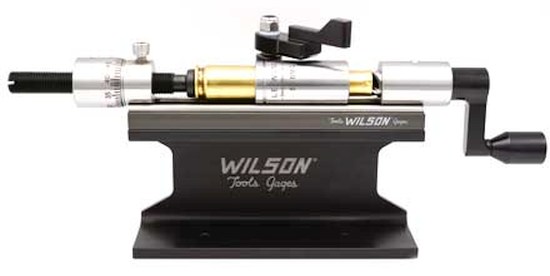


 I began doing leatherwork as a kid, 12 or 13, and the first piece I made was a pair of shoes. Got a job in a leather shop in the late ’60s and made purses and belts, wallets and sandals — many pairs of sandals. I opened a small retail shop in Estes Park, CO and made even more of the same, adding vests, halter tops, hats, mountain man gear of all sorts from skunk hats to goat fur high-top moccasins.


 For today’s Sunday GunDay story we offer a short history of the legendary .50 BMG cartridge, tips on loading, and some fun photos from FCSA matches in the Western USA.


 Alliant’s Powder for 50-Caliber Applications


