Our latest Forum sponsor, DoghouseOutdoors.com, is a new online retailer specializing in fine optics. Based in Salt Lake City, Utah, Doghouse has a modern, easy-to-navigate website with a wide selection of products, all illustrated with high-quality photos.
Current Mfg. Rebates in Doghouse’s Rebate Central
On DoghouseOutdoors.com you’ll find a very cool feature: Rebate Central. Here manufacturers’ current optics rebates are all collected in one place. This helps buyers take advantage of all available money-saving promotions on rifle scopes, binoculars, rangefinders and other products.
Here’s the way it works: DoghouseOutdoors.com searches out all applicable rebates and then highlights them on the DogHouse home page in the “Rebate Central” area. As you move from one featured rebate to the next, if you find a rebate that suits you, just click on the rebate notice and you’ll be taken to the relevant products. Each product listing contains high-resolution photos along with a detailed description.
FREE Shipping on Rebated Products
As an added incentive for AccurateShooter.com readers, DoghouseOutdoors.com will provide free shipping on all rebate-qualified products. This currently includes products from Burris, Bushnell, Eotech, Leupold, and Sightron. (Shipping policy subject to change.)
Zeiss Instant Rebates
In related news, Zeiss just announced a Winter Specials Promotion providing instant rebates on Zeiss scopes and binoculars. If you purchase a set of Victory RF Binoculars between November 15, 2010 and January 31, 2011 you get a $200 instant rebate at check out. You can also get a $100 instant rebate if you purchase any other Zeiss Victory FL Binoculars or Zeiss Victory riflescope (except DiaRange LRF scope).
Field Days Mail-In Rebate
Also, under the Zeiss Field Days Promo (which continues through December 31, 2010), you can get a $100 mail-in rebate with the purchase of a ZeissVictory 8×26 T* PRF Laser Rangefinder or any of the Victory Compact Binoculars. We have field-tested the Zeiss 8×26 T* PRF Rangefinder and we recommend it highly. It is easy to hold and aim, optics are sharp and bright, and ranging performance is excellent.
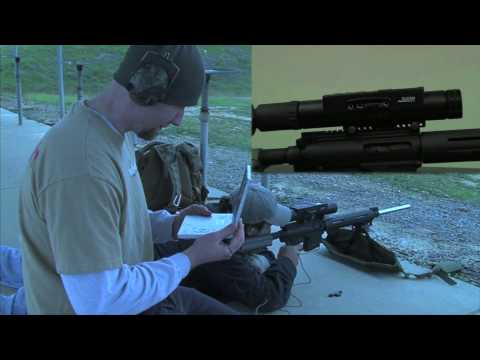
Elcan ushers in the age of digitally-enhanced scopes with its amazing Digital Hunter. It’s about time digital features were added to consumer rifle scopes. In many respects a $150.00 point and shoot camera is much more sophisticated than a $2600.00 Schmidt & Bender. Adding a digital image sensor and digital “crosshairs” to a telescopic lens system unlocks an amazing realm of possibilities. First, you can eliminate moving parts, including the reticle itself, avoiding the possibility of reticle movement that could alter your zero. With digital crosshairs “informed” by a ballistics calculator, the reticle’s aimpoint can automatically display the correct hold-over at any target distance. For low-light shooting, you can boost the brightness and contrast of the image. You can even hook up the scope to a remote monitor so an instructor or spotter can see exactly what the shooter is seeing. Last but not least, everything viewed through the scope can be digitally recorded for later playback and analysis. This way a hunter can record, for posterity, the moment he bagged a trophy buck. Or, a military sniper can record a complete target engagement, for later review by his commander and fellow marksmen.
The $1199.00 Elcan Digital Hunter offers a 2.5-16.5X digital zoom, four field-selectable reticles, and built-in video capture. Reticles can be changed ‘on the fly’ and you can output the video to an external monitor, or simply pop out the SD flash memory card to play back video files on your computer.
Electronic Zoom with No Moving Parts
There are no moving parts in the Digital Hunter except for the diopter adjustment. Magnification is accomplished electronically, and the aiming point does not change at all during magnification. The electronic magnification is parallax-free and the exit pupil remains constant, allowing easy target acquisition, even at high power. Elcan claims that resolution does not change significantly from wide field of view to narrow field of view.
Electronic Ballistic Compensation
One of the most useful features of the Digital Hunter is electronic ballistic compensation. Here’s how that works. The scope has a USB port to connect with a computer. Using Elcan-provided PC ballistics software, you input Bullet BC, Muzzle Velocity, and even wind speed and angle. The scope’s processor automatically calculates drift and drop for various distances and then positions the digital aim point for the correct holdover, based on the target distance you select. All the critical calculations are handled automatically. Watch the video below to see how this all works.
Day-Night Digital Hunter In addition to the standard Elcan Digital Hunter, Elcan offers a version for low-light shooting. The Day/Night Digital Hunter, priced at $1399.00, can be combined with IR (infrared) “flash-lights” to provide full night-hunting capability. Low Light mode displays all the available visible light and the near infrared light (that can be “seen” by the scope’s image sensor, but not by the human eye). Utilizing the near infrared means more light energy is available to the scope for better, brighter imaging. After dark, active night vision enables covert surveillance and varmint hunting (where legal). The effective range of the active night vision depends on the power of the IR Flashlight(s).
Remote Viewing Capability Helps Disabled Shooters
When the Elcan Digital Hunter was first introduced a couple years ago, Outdoors writer Ray Sasser of the Dallas Morning News field-tested it with Ray Mauldin, Elcan Products Manager. Sasser wrote: “There’s a new rifle scope technology on the horizon, a spin-off from military developments made by the Raytheon Company [parent company of Elcan]. The software calculated bullet drop… and the information was stored in a computer chip inside the scope. The only two drawbacks I could find were price and weight. The digital scope weighs 26 ounces, nearly seven ounces heavier than Leupold’s LPS 3.5-14x50mm, my personal favorite traditional scope. Mauldin said physically challenged hunters are particularly excited about the Digital Hunter. It can be used with a video monitoring screen so the rifle can be sighted without your eye to the scope. That’s a huge advantage for a quadriplegic, one-armed or no-armed shooter.”
Digital Enhancements for Target Scopes?
Traditionalists may scoff at digital scope technology, thinking that something like the digital Elcan could never be used in a match because it is too big and heavy. But consider this — all you really need on top of the rifle is the lens system with light sensor. All the other controls and the display could be moved off the rifle and built into a benchtop display/control/processing unit (which could be wireless). In fact, the control functions and display could even performed by an iPod or smartphone. With the iPod you could select the reticle, input ballistics data (Velocity, Bullet BC, Wind direction), and select the magnification level. (Fitting longer focal-length lenses would allow higher magnification than the Digital Hunters’ 2.5-16.5X.) And with a finger-tap on the screen you can record the entire match you are shooting. When mass-produced, such a unit could be sold for considerably less than the $1199.00 price of the Elcan Digital Hunter, as the iPod does the processing and replaces most of the hardware.
MidwayUSA has teamed up with Burris Optics to produce a new scope that should be ideal for Multi-Gun competition. The new Burris Fullfield TAC30, sold exclusively thorugh MidwayUSA, features 1X to 4X adjustable magnification and a 24mm objective. The illuminated Ballistic CQ reticle provides hold-over points for the longer stages. The scope body is sealed and nitrogen-purged. Sean Doke, MidwayUSA’s Optics Manager noted: “We listened to our Customers and partnered with Burris to create a unique scope that met our customers’ requirements. The new Burris Fullfield TAC30 allows for rapid engagement of close quarters targets while also providing holdover points out to 600 yards.”
The scope, finished in Burris’s popular Dark Earth Color, is constructed with quality, multi-coated lenses. The new TAC30 retails at MidwayUSA for $339.99, and is covered by the Burris Forever Warranty which states: “If [this product] is ever found to have defects in materials or workmanship, Burris will, at our option, repair or replace it at no charge, even if you are not the original owner.”
Stephen Ivey has engineered a set of gimbaled scope rings allowing up to 150 Minutes of Angle (MOA) of elevation. These rings have precision hinge pins front and rear allowing the entire scope to be tilted by a micrometer-controlled cam in the rear. This allows the scope to tilt upwards (in the rear) with the front ring as the axis while both rings remain parallel to prevent scope binding. The rear ring tilts to match the front while a cam pushes it up. Ivey also makes tilting +150 MOA Picatinny riser rails.
Ivey offers two scope-mounting products. First is the RT-150 Ring set (above). This has two, polished 30mm or 34mm 6061-T6 aluminum rings with bases to fit a Picatinny profile or mil-spec 1913 rail with standard 5mm cross slots at 10mm spacing. (Weaver installation requires extra cross-slots to be cut.) Total elevation is +150 MOA. The micrometer adjuster is graduated in true 1 MOA intervals, with 5 MOA of elevation change per rotation. This product costs $525.00 and requires at least 5-1/2″ length mounting base.
The newest product is the MSRR-150MOA Riser Rail, a pivoting 5.75″-long Picatinny-style rail that accepts Weaver-style clamping scope rings. This Adjusts from Zero to +150 MOA and raises the scope 1.45″ from the top of the action. The extra height provides clearance for large objectives when the unit is tilted for a full +150 MOA elevation. Cross slots are 5mm wide at 10mm (.394″) spacing. The $525.00 riser rail is made of 6061 T6 Aluminum hard-anodized black. Clamps are heat-treated steel. The micrometer thimble is marked for 1 MOA gradations, and provides 20 MOA per revolution.
The Ivey products are expensive, to be sure, but they are beautifully machined, and they offer unique capabilities for ultra-long-range shooters. With the +150 MOA units you have enough elevation to shoot at 2000+ yards! We like the idea of using the micrometer to dial within 1 MOA and then just using the scope turrets for fine-tuning. To learn more, visit the Ivey Shooting website, or call Stephen Ivey at (615) 896-9366, or email him at sales [at] iveyshooting.com .
The new Zeiss Victory DiaScope 85mm spotting scope from Carl Zeiss has won Field & Stream magazine’s prestigious Best of the Best Award for 2010. This annual awards program recognizes the most innovative and best-designed products in the hunting industry. In the September issue of Field & Stream, the magazine’s reviewer wrote: “The DiaScope is superior in sharpness, focus, zoom and armored construction. When I tested for waterproofness, it floated. I could judge buck antelope miles away with it on a cloudy day. The cost can be made up in saved boot leather. – T.M.”
Zeiss 85mm Diascope Also Earned Outdoor Life and Hunting Magazine Honors
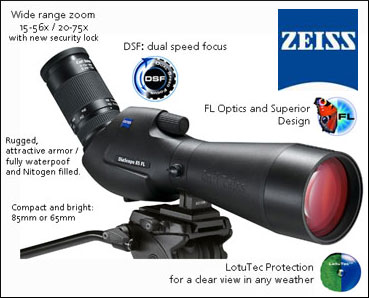
This marks the third major industry award for the ZEISS DiaScope this year. The 85mm DiaScope also won the 2010 Outdoor Life Editor’s Choice Award and Petersen’s Hunting magazine’s Editor’s Choice Award. The DiaScope is available in 65mm or 85mm models, straight or angled, and newly-designed eyepieces include the Vario D 20-75X, one of the most powerful and versatile eyepieces on the market today. All DiaScope eyepieces boast Zeiss’ LotuTec® water-repellant coating and a new bayonet locking system that securely locks the eyepieces yet still allows quick eyepiece changing.
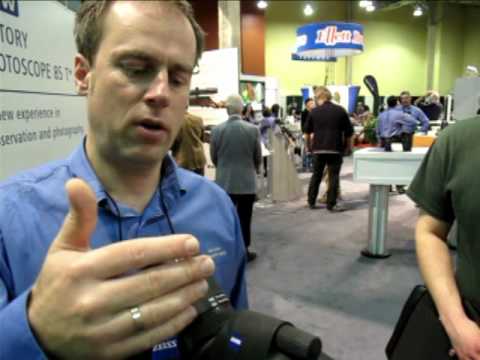
At the 2010 SHOT Show, this Editor had a chance to interview Stephan Albrecht, Project Engineer for the impressive new 85mm Diascope. In the video below, Stephan explains the important new features of the award-winning spotting scope, including the dual-speed focus system and the new, high-power 20-75X eyepiece.
Leupold has launched a dedicated website to educate hunters and shooters about the Custom Dial System (CDS™) feature for VX-3® riflescopes. The innovative CDS system is darn clever. Basically what Leupold has done is create calibrated elevation knobs that allow hunters and varminters to simply dial the yardage to their targets, rather than input a specific number of clicks. For example, to shoot a buck at 300 yards, you simply rotate the elevation turret to “3” on the scale. CDS helps hunters and shooters get on target at any range, with any load, by matching their scopes to the ballistics of their ammunition.
Leupold’s CDS system is a user-friendly invention that can really simplify shooting at multiple yardages. The big single-digit Arabic numerals on the elevation dial correspond to 100-yard intervals, while the smaller numbers show 50-yard intervals. (Click values are otherwise 1/4-MOA.) No longer do you have to remember specific come-ups for particular distances. For the CDS system to work correctly however, your load’s ballistics must match a set of master loads that Leupold uses to calibrate the dial scales. Hunters using most common cartridges should find a calibrated load that matches their muzzle velocity and bullet BC. CDS turrets are available on these scopes: VX-3 3.5-10x40mm, VX-3 3.5-10x50mm, VX-3 4.5-14x40mm, VX-3L 3.5-10x50mm and VX-3L 4.5-14x50mm.
Free CDS Calibrated Dials with Purchase of VX-3 Scopes
Leupold’s CDS system is explained at www.leupold.com/VX-3CDS. Visitors to the VX-3 CDS webpage will find an educational video and graphics, an overview of how the system works and its advantages, and details on a special offer. With the purchase of any VX-3 CDS riflescope, shooters receive two customized, ballistically-matched adjustment dials ($100 retail value) at no extra cost. This offer ends December 31, 2010. Click the image below to learn more (turn down your speakers before clicking as a loud video will auto-play).
The new Zeiss Victory DiaScope 85mm T* FL spotting scope from Carl Zeiss has been named Editor’s Choice by Petersen’s Hunting magazine. The 2010 Spotting Scope Review, featured in the magazine’s September issue, compared spotting scopes from many manufacturers and the new ZEISS DiaScope, with its revolutionary Dual Speed Focus (DSF) system, came out on top. Petersen’s editors wrote: “The innovative Dual Speed Focus (DSF) system is something you almost have to try to believe. It automatically transfers from macro-adjustment to fine-tuning like no other scope. This is our pick of the litter, price be damned. $2,999.00.”
straight or angled bodies both boasting a rubber-armored exterior for protection. Eyepieces are available as variable 20-60x, 20-75x, or fixed 40x. A 65mm version of the new Diascope is also available, but we feel that, if you’re going to spend this kind of money ($3000.00 for 85mm with 20-60X eyepiece), you should go with the 85mm. The 20-75X eyepiece only delivers 15-56X when used with the smaller 65mm Diascope.
New DiaScope Wins Other Awards
The new Zeiss Victory DiaScope 85 T* FL Spotting Scope has earned two other prestigious awards. First the new 85mm DiaScope won the coveted Red Dot Design Award. “All products honored with the red dot design award had to impress an international jury. These products [must] demonstrate their quality in one of the toughest design competitions in the world,” says Professor Dr. Peter Zec, speaking on behalf of Design Zentrum Nordrhein Westfalen which issues the Red Dot Design Awards.
At the NRA Annual Meeting on May 14, the Zeiss 85mm DiaScope was named an “Editor’s Choice” by Outdoor Life Magazine. Outdoor Life’s editors praised its “optically superior [flourite] glass in a surprisingly lightweight chassis”. The ZEISS DiaScope won the low-light test, had a top resolution score and “the two-speed focus and wide-angle eyepiece sparkled”, according to the test team.
To compete with the vaunted Leica Geovids, Steiner Optik has released its new 10×50 porro-prism binoculars equipped with a built-in Laser Rangefinder. Steiner’s new model 398 10×50 LRF Military Rangefinder Binoculars feature a handy two-button interface and a powerful Class 1 laser rangefinder with claimed maximum ranging distance of 1,600 yards. That meets or beats the range of any other commercial laser rangefinder on the market. Beam divergence on the Steiner LRF binocular is impressively narrow. This allows ranging at very long distances. Steiner claims: “With sunshine and good visibility, the unit’s accuracy is within one yard at ranges up to 380 yards, within two yards to 763 yards, and within approximately 0.5% to 1,600 yards.”
Yes, There is a Mounting Slot for Tripods and Monopods
We were pleased to see that Steiner’s LRF binoculars incorporate a 1/4-20 tripod adapter mount. We think all “serious” laser rangefinders should have mounts for tripods and/or monopods. You simply can’t make use of the full ranging capability of these devices unless you can hold them rock steady when aiming at far-away objects. Steiner’s “easy-on” two-button control also helps you aim precisely. With some LRFs, such as the Swarovski LaserGuide, you must press down quite hard to activate the “on button”. This can upset your aim.
New LRF Binoculars are Built Tough Inside and Out
The new Steiner LRF binoculars are built to withstand tough use, even though, at 46 ounces, they are still fairly lightweight. The chassis is made with Makrolon®, a fiber-reinforced polycarbonate material that is very impact resistant. The exterior is fully armored with Nitrile Butadiene Rubber (NBR) for protection. The interior is pressurized with dry nitrogen fill and is waterproof to 16 feet. All alloy components are anodized, and external metal parts are enamel-finished to prevent corrosion.
Lowest Web Price is Under $2100.00
Though Steiner’s 10×50 LRF binos have “Military” in the product name, this unit can be purchased by the public. Current “street price” at most online optics dealers is $2,499.00. However a few dealers are now undercutting MAP pricing, so if you shop around, you may find the model 398 Steiner 10×50 Military LRF binoculars for under $2,100.00. DigitalFoto.com is listing the unit at $2079.48. For comparison, DigitalFoto.com sells the 8×56 Leica Geovid rangefinder binoculars for $2699.00.
Webyshops, one of our sponsors, is offering an exclusive July Sale for AccurateShooter.com readers and Forum members. Because of MAP pricing rules, we can’t reveal the exact amount of the discount, but we can say it applies to all items on Webyshops’ riflescopes webstore, and the discount is significant. Webyshops carries a large, brand-name inventory of scopes, spotting scopes, laser rangefinders, binoculars, flashlights, and trail cameras. The promo pricing is effective through July 31th, 2010. Not applicable in conjunction with other coupons/specials.
NOTE: To qualify for the July Sale discounts you must click on the link below, and then provide a name and email address to “get in the door”.
We know some of you guys do not want to supply your email for privacy reasons. That’s fine — we respect your concerns and nobody is forced to participate. But WebyShops has set up this extra layer of security so that these discount prices are limited to our members.
Replacing retiring Leupold executive Tom Fruechtel, Calvin Johnston has been appointed as Leupold & Stevens’ President and CEO effective July 19, 2010. Johnston has very limited, if any, experience in the optics industry or in hunting/shooting-related businesses. Johnston’s primary expertise is in the apparel sector. Since 2007, Johnston has served as President of Aramark’s Galls Division. Galls specializes in direct sales of police and public safety uniforms and gear. Presumably, Leupold’s Board of Directors hopes that if Johnston can sell uniforms and gear to law enforcement buyers, he can expand Leupold’s LEO optics business.
Prior to running Galls, Johnston served from 2005-2007 as group president/CEO of Russell Athletic, which manufacturers sports clothing. Before that, Johnston, who earned a Marketing MBA from Northwestern Univ., held a series of sales and marketing positions, including a two-year stint as Director of International Marketing for Rollerblade.
What Does the Future Hold for Leupold & Stevens?
Johnston succeeds Tom Fruechtel, who will retire from Leupold at the end of 2010. Fruechtel served as CEO of Leupold & Stevens for 12 years. During that period Leupold sales and profits grew considerably. However, Leupold’s reputation in the market for high-end premium optics has suffered in the past decade. Companies such as Nightforce Optics, Schmidt & Bender, and Zeiss are well-established in the top end of the market, while, in the medium-priced scope segment, smaller optics companies such as Sightron and Vortex have taken market share from Leupold by offering more bang for the buck. In the laser-rangefinder market, Leupold needs to make major improvements in order to compete with the latest products from Leica, Swarovski, and Zeiss.


 Our latest Forum sponsor, DoghouseOutdoors.com, is a new online retailer specializing in fine optics. Based in Salt Lake City, Utah, Doghouse has a modern, easy-to-navigate website with a wide selection of products, all illustrated with high-quality photos.
 Zeiss Instant Rebates


 In addition to the standard Elcan Digital Hunter, Elcan offers a version for low-light shooting. The



 Leupold’s CDS system is a user-friendly invention that can really simplify shooting at multiple yardages. The big single-digit Arabic numerals on the elevation dial correspond to 100-yard intervals, while the smaller numbers show 50-yard intervals. (Click values are otherwise 1/4-MOA.) No longer do you have to remember specific come-ups for particular distances. For the CDS system to work correctly however, your load’s ballistics must match a set of master loads that Leupold uses to calibrate the dial scales. Hunters using most common cartridges should find a calibrated load that matches their muzzle velocity and bullet BC. CDS turrets are available on these scopes: VX-3 3.5-10x40mm, VX-3 3.5-10x50mm, VX-3 4.5-14x40mm, VX-3L 3.5-10x50mm and VX-3L 4.5-14x50mm.
 New DiaScope Wins Other Awards

 Webyshops, one of our sponsors, is offering an exclusive July Sale for AccurateShooter.com readers and Forum members. Because of MAP pricing rules, we can’t reveal the exact amount of the discount, but we can say it applies to all items on Webyshops’ riflescopes webstore, and the discount is significant. Webyshops carries a large, brand-name inventory of scopes, spotting scopes, laser rangefinders, binoculars, flashlights, and trail cameras. The promo pricing is effective through July 31th, 2010. Not applicable in conjunction with other coupons/specials.
 Replacing retiring Leupold executive Tom Fruechtel, Calvin Johnston has been appointed as


