|
|
November 25th, 2011
 As a last-minute “surprise”, MidwayUSA has added a selection of Leupold VX-I and VX-II riflescopes to its list of Black Friday Bargain items. You can now save from $50.00 to $100.00 off the normal price of these popular, lifetime-guaranteed hunting scopes. Here are some of the Leupold scopes on sale today through 11/28/2011: As a last-minute “surprise”, MidwayUSA has added a selection of Leupold VX-I and VX-II riflescopes to its list of Black Friday Bargain items. You can now save from $50.00 to $100.00 off the normal price of these popular, lifetime-guaranteed hunting scopes. Here are some of the Leupold scopes on sale today through 11/28/2011:
Leupold VX-I Rifle Scope 3-9x50mm LR Duplex
Was $319.99, now $249.99 – Save $70.00
Leupold VX-I Rifle Scope 3-9x40mm Duplex
Was $229.99, now $179.99 – Save $50.00
Leupold VX-II Ultralight Scope 3-9x33mm LR Dplx
Was $379.99, now $279.99 – Save $100.00
Leupold VX-II Rifle Scope 6-18x40mm Adj. Obj. LRV Duplex
Was $529.99, now $449.99 – Save $80.00
November 2nd, 2011
Amazon.com just listed 15 more Pentax PF-80ED Angled spotting scopes at $684.95 with FREE Shipping. While this price does NOT include eyepiece (20-60X zoom costs another $320.00 or so), this is a great deal on a high-quality 80mm spotting scope with great glass. You need to spend $2000.00 or more for a spotting scope that will significantly out-perform the Pentax PF-80ED. Also the Pentax eyepieces (purchase separately) are outstanding. READ MORE here.
Disclosure: AccurateShooter.com has an affiliate relationship with Amazon.com.
September 2nd, 2011
By Dr. Jim Clary
 One cannot discuss one of the most useful tools for long range shooters, The Slope Doper, without saying something about its inventor, David Rolls. David was a bold man, bigger than life, who dedicated his life to the service of others. Yet, he was full of fun and a little mischief. He had little tolerance of fools (a man after my own heart), but had great respect for those who deserved respect. It was a loss to all when he passed away in August 2008 at the young age of 61. That being said let me tell you of how he lived and what he accomplished with The Slope Doper. One cannot discuss one of the most useful tools for long range shooters, The Slope Doper, without saying something about its inventor, David Rolls. David was a bold man, bigger than life, who dedicated his life to the service of others. Yet, he was full of fun and a little mischief. He had little tolerance of fools (a man after my own heart), but had great respect for those who deserved respect. It was a loss to all when he passed away in August 2008 at the young age of 61. That being said let me tell you of how he lived and what he accomplished with The Slope Doper.
David Rolls’ Background
David worked for years with the Baltimore City Fire Department as a firefighter and paramedic, retiring at 45. Not being content to sit around, he applied for a job with the Sheriff’s Department of Mineral County, West Virginia and graduated from the state police academy. No small feat for a man of any age, let alone one in his forties. David rose to the rank of Sergeant and held that rank until his passing. As a firefighter, paramedic and police officer, he was the kind of man you would want if you were in a tight spot. He never backed down when it came to helping others. Throughout his life he was active in the Boy Scouts and community activities. He was a lifetime member of the NRA holding the status of Golden Eagle and Certified Firearms Instructor.
As a shooter, David was intensely interested in tactical competitions and was a member of the American Sniper Association. Long distance tactical shooters are frequently faced with the problem of making adjustments when shooting uphill or downhill, as well as windage and normal bullet drop. Chucks Hawks provided a superb discussion of the effects of uphill/downhill shooting for the hunter. I strongly urge every reader to look up Chuck’s article to better understand the problem.
Even knowing that we will be shooting over our target (or at best higher than our aiming point), most hunters do not know how to make the required adjustments in the field. Something had to be devised that could be used quickly in the field by the average hunter. Enter David P. Rolls!
Slope Doper Debuts in 1998 at Storm Mountain
After a great deal of thought, David showed up at the Carlos N. Hathcock II Charity Sniper Competition at the Storm Mountain Training Center in 1998 with a prototype of his Slope Doper. It was somewhat crude by comparison to the current day production model, consisting of a laminated paper protractor with a weight and string, but it worked. It allowed a shooter to determine the impact point of his bullet when shooting at any angle. David had succeeded in combining the science of mathematics with the practicality required for field use. It should be noted that military shooters have used protractors for years, but they had to subtract numbers to arrive at the correct angle. Dave’s invention placed the zero degree point at the top of the arc, virtually eliminating the possibility of error. Ever the perfectionist, with an eye to the future, he asked his best friend, Fred Fischer to design a “professional” version with AutoCad, which Fred gladly did. Fred also had contacts with a manufacturer who happened to be a shooter and they were off. Fred still chuckles when he remembers all of the last minute changes that Dave came up with, but at least they had the basic artwork locked into the AutoCad program to go into production. The rest is history.

The Quantico marine sniper instructor who was the first military member to see a production version of the Slope Doper (and incidentally a member of the two-man team who won the Carlos Hathcock Sniper Competition) was impressed enough by it to remove his personal protractor from his data book and replace it with the Slope Doper David gave him. The Slope Doper is now standard issue with the Marine Corp sniper weapon system; The Slope Doper is packed with each rifle and its accessories. The pointer is easily replaceable with string and a weight if it is lost and the printing on both sides is actually fire resistant. It is mil spec and made to withstand combat conditions. It is aluminum rather than plastic, so that it will not break in cold conditions.
To understand how the Slope Doper works, it is best for me to let David tell you in his own words:
To begin with, you must understand that when you shoot up or downhill, gravity has a diminished effect on your projectile such that if you do not make any adjustment for angle, you will likely shoot over your target. This applies at long distances (greater than 300 yards) at slight angles and at severe angles (greater than 30 degrees) at lesser distances. With slight angles at short distances the adjustment may not be enough to worry about. The Slope Doper is a photo etched, anodized, aluminum plate that has two scales inscribed along an arc. The first scale tells you the angle in degrees, the inner scale gives you the cosine of the angle (what I call the “Slope Angle Factor”) at 10 degree intervals.
To use the Slope Doper, you must first know the range to your target. Next you have your partner (guide) hold the Slope Doper along side the bore centerline of your rifle while you take aim and read the Slope Angle Factor. If you are alone, you can sight your target along the top edge of the Slope Doper and capture the pointer with your thumb and then read the Slope Angle Factor. If you are not at an exact Slope Angle Factor, it is easy to interpolate. Now take the known distance and multiply that by the Slope Angle Factor. The answer you get is the effective range. You should now shoot as if the actual distance is the lesser distance (at 30 degrees, a Slope Angle Factor of 0.87, 500 yards becomes 435 yards). All other environmental factors, like wind, are still in effect at the actual distance (500 yards of wind is still 500 yards of wind).
To make my life easier, I attached some Velcro to the back of my Slope Doper and on the forend of my rifle. After using my rangefinder for distance, I simply point my rifle at the target, capture the pointer with my thumb, read the Slope Angle Factor, make a quick mental calculation and shoot. If you are an experienced shooter with a scope that has a mil dot reticule, the back of the slope doper has your ranging formulas. The Slope Doper is a must-have for every person who hunts in mountainous country, from the Appalachians to the Rockies. It will help prevent you from missing your quarry. It is a bargain when compared to the $300 – $500 we pay for our rangefinders and binoculars. You can purchase the Slope Doper directly from the Slope Doper Website for $24.95 plus $5.00 shipping (PayPal or mail-order). U.S. Tactical Supply also sells the Slope Doper for $24.95.
A final note: I was watching the Outdoor Channel last week and watched a hunter on a ridge shoot over a 6×6 bull elk in the valley below. The elk disappeared, and the show ended with the hunter and guide talking about the thrill of the chase, even though they missed the elk. Good for public relations, but not so good for the freezer. They should have had The Slope Doper!
July 15th, 2011
 Bryan Litz, Ballistician for Berger Bullets and author of Applied Ballistics for Long Range Shooting, has tested the latest version of the Shooter Ballistics Calculator for Android™ OS Smartphones and portable devices. This is a very sophisticated, full featured App that incorporates the latest bullet databases with Litz G7 BCs as well as a wealth of other information. It provides extremely reliable ballistics solutions at all ranges, and in all atmospheric conditions. Bryan Litz, Ballistician for Berger Bullets and author of Applied Ballistics for Long Range Shooting, has tested the latest version of the Shooter Ballistics Calculator for Android™ OS Smartphones and portable devices. This is a very sophisticated, full featured App that incorporates the latest bullet databases with Litz G7 BCs as well as a wealth of other information. It provides extremely reliable ballistics solutions at all ranges, and in all atmospheric conditions.
 Bryan tells us: “The Shooter App has been improving steadily since it was first released and there are many new capabilities now. One of the cool new features is a wireless Bluetooth link to Kestrel Weather Trackers. This can automatically provide the exact atmospherics at your location.” Bryan tells us: “The Shooter App has been improving steadily since it was first released and there are many new capabilities now. One of the cool new features is a wireless Bluetooth link to Kestrel Weather Trackers. This can automatically provide the exact atmospherics at your location.”
Bryan used the Shooter App on a trip to Wyoming: “I shot a Sako TRG42 in .338 Lapua Mag to 2400 yards with Berger’s new 300gr hybrids. The dope from the Shooter App was spot on up to 103 MOA of drop using the G7 BC of .419 for that bullet! At 2400 yards, even at 6,000 ft+ elevation, the bullet is subsonic but remained stable and tracked perfectly with the predicted trajectory from Shooter. I don’t know if the same bullet would be stable at sea level when fired at that range or not but it worked well at 6,500 feet.”

Litz Says Shooter App Offers Very Sophisticated Ballistics Solutions
Bryan thinks the Shooter App is extremely accurate: “I consulted on the solver development for Shooter so I can personally vouch for the accuracy of this program. You can set up profiles for rifles and ammo types including calibration factors for scope adjustments, temperature affects on powder burn rate / muzzle velocity, and of course G1 and G7 referenced BCs (you can define a ‘stepped’ BC for both as well). You can set preferences for units, atmospherics, station pressure or altitude, and more. It can calculate spin drift and Coriolis effect, or those features can be disabled. If your smartphone has GPS, the program can automatically populate the latitude for Coriolis calculations.”

Shooter App is just $9.99 — A Bargain Given Its Capabilities
The full-featured Shooter App sells for $9.99 in the Android Apps Marketplace. Visit the Shooter App Website to preview the program’s functions and see how the entry screens work. The App is easy to install and run. There is a also a ‘Lite’ version of SHOOTER that you can download for free.
CLICK HERE for SHOOTER Android OS Ballistics Program.
CLICK HERE for SHOOTER LITE Android OS Ballistics Program.
June 8th, 2011
Kowa TSN-884 Spotting Scope Review
by Danny Reever
It has been a couple of years since I wrote the review of high-end spotting scopes for AccurateShooter.com. In that time there have been some advances in technology and unfortunately some hefty price hikes to go along with that technology. Not too long ago, few top-end scopes exceeded $2300.00 with eyepiece. Now some premium spotting scopes top the $4000.00 mark with eyepiece! My Pentax PF100-ED, once a top-of-the-line product (but now discontinued by Pentax) would now be considered a mid-price spotting scope, given the current pricing of premium spotting scopes from Kowa, Leica, Zeiss, Swarovski and other top brands. “Street Price” for the Kowa TSN-884 reviewed here, is roughly $2800.00 with eyepiece. That’s a serious investment by any standards.
“The Kowa Prominar (TSN 88X series) is quite simply the best spotting scope I’ve ever looked through. In all instances the Kowa out-performed everything I was able to compare it to. The Kowa had unrivaled clarity, and I could resolve 6mm bullet holes at 500m with it better than with my 100mm Pentax. After testing the Kowa, I sold my Pentax PF100-ED, and I’m planning to purchase a Kowa TSN-884.”
 Being like many shooters out there I’m always looking for that better mousetrap in regard to seeing 6mm bullet holes at extended yardages. That’s how I ended up with the Pentax PF100-ED. Recently I had been hearing rumblings here and there from other shooters and on various websites raving about the Kowa TSN 883/884 spotting scopes. In fact right here on AccurateShooter.com’s Daily Bulletin it was reported that the Kowa Prominar was rated number one by the Cornell Ornithology lab in their 2008 Scope Quest — a detailed review of 36 spotting scopes. However, they did not compare all spotting scopes that were available at that time. The super expensive Leica 82mm Televid APO HD was missing, along with my Pentax PF100-ED. The Cornell test also was geared more toward birders than shooters, but it was enough to pique my interest in regard to the Kowa, which features an 88mm objective with Pure Flourite Crystal (PFC) main lens elements. Being like many shooters out there I’m always looking for that better mousetrap in regard to seeing 6mm bullet holes at extended yardages. That’s how I ended up with the Pentax PF100-ED. Recently I had been hearing rumblings here and there from other shooters and on various websites raving about the Kowa TSN 883/884 spotting scopes. In fact right here on AccurateShooter.com’s Daily Bulletin it was reported that the Kowa Prominar was rated number one by the Cornell Ornithology lab in their 2008 Scope Quest — a detailed review of 36 spotting scopes. However, they did not compare all spotting scopes that were available at that time. The super expensive Leica 82mm Televid APO HD was missing, along with my Pentax PF100-ED. The Cornell test also was geared more toward birders than shooters, but it was enough to pique my interest in regard to the Kowa, which features an 88mm objective with Pure Flourite Crystal (PFC) main lens elements.
I had to find a Kowa 883/884 to review and compare to what shooters were currently using out there. I contacted Kowa USA, which graciously agreed to furnish me one to review for Accurate Shooter. I requested the Kowa TSN-884 straight body along with the 20-60X zoom eyepiece that Kowa had redesigned for the 77-88mm spotting scopes. I chose the straight body over the TSN-883 angled version. With a straight spotter you can easily monitor flags and conditions downrange without moving your head very much. I admit the TSN-883 angled model may be more user-friendly for some applications, such as prone and F-Class shooting. With an angled body you can also set the scope slightly lower on your tripod. Straight or Angled — you need to choose what works best for you in your particular application.

Kowa TSN-884 Highlights
Even though the Kowa has a large 88mm objective I was struck by the compactness of this scope. With a length of a little over thirteen inches without eyepiece it is compact indeed. Weight (without eyepiece) is a trim 53.6 ounces due to the use of Magnesium alloy for the scope body. With the 20-60X eyepiece installed, length is 16 3/8 inches, and weight is 65.1 ounces. Compare this to my monster-sized Pentax PF100-ED which is 23 ¾ inches long and weighs 111.1 ounces (6.94 pounds!) with eyepiece. The Kowa is 7 3/8″ shorter overall, and the Kowa is an amazing three and a half pounds (56 ounces) lighter in weight! The smaller size and weight of the Kowa allows you to use a much lighter and more compact tripod for this scope if you so desire. (Note: You might think the Pentax’s weight might actually stabilize the unit. However, the problem is that much of the weight of the Pentax is way out front, where it is cantilevered far forward of the mounting bracket. We’ve found that just a light touch on the front end of the Pentax will cause it to shake and wobble. Because so much weight is cantilevered way out front, the Pentax can wobble easily even on a massive tripod.)

The most impressive quality of the Kowa 883/884 is its bright, ultra-sharp image. This super-sharp, distortion-free image comes from superior glass. The objective lens of the TSN 884 incorporates Pure Fluorite Crystal (PFC). Kowa claims 99% or higher light transmission and after looking through the scope I have no reason to doubt that claim. One focuses the Kowa via a system of two focus controls along one axis. The larger-diameter knob provides course adjustment to rapidly bring the subject into focus. The smaller-diameter control fine-tunes the focus for the sharpest image. This system works well in practice and one adapts quickly to the dual controls.
Like most high-end spotting scopes, the Kowa 883/884 is designed to function in all weather conditions. The nitrogen-purged body is fully sealed, and Kowa claims the “housing” is waterproof — but no you don’t want to dunk your scope in a river. Note: Even though this scope is robustly constructed, I must point out that the Kowa does not have any rubber armor coating. This does keep the weight down, but if you are tough on scopes, you may prefer a different design, such as the new Zeiss Diascope which boasts full rubber armor over the entire scope body. Kowa does offer a padded cover for an additional $125.00 which would help protect the scope. Given the high cost of the TSN 883/884, the padded cover is probably a smart investment.
Kowa TSN-884 Field Test Results
Initially I set up the Kowa and my Pentax PF100-ED on separate tripods side by side on my front deck. I was immediately impressed with the optical clarity of the Kowa, especially at the lower powers. I aimed both scopes at my neighbor’s log house, perhaps 150 yards away, focusing on a particular log end cut. With both scopes set at 60-power I could easily count the growth rings on the log with both scopes. However, the Kowa, without question, was clearer. How much clearer? I can best describe it this way. Imagine looking through a car window with the window up. Now imagine rolling the window down and looking again. With the Kowa, it was like having the window rolled down — contrast was a bit better, colors were a bit more vibrant, things seemed slightly sharper — as if a thin haze had been removed.
Using the Kowa TSN-884 at the Range
I have taken the Kowa to the range on numerous occasions over the past few weeks. I’ve used it in many different environmental conditions, comparing it to as many different spotting scopes as were available. In all instances the Kowa out-performed everything I was able to compare it to. Sometimes (but not always) the difference was startling.

One of my tests included a Snellen Eye Chart, just like the one at your optometrist office. Instead of it hanging on a wall, I placed the Snellen Chart at 500 meters along with some previously-shot paper Ground Hog targets. Conditions were hazy and humid with moderate mirage. My Nightforce 12-42x56mm Benchrest riflescope set at 42X could read line 6 on the chart and I could distinguish only a few of the 6mm bullet holes. My Pentax PF100-ED set at 60X (to match the Kowa’s maximum power) was better. With the Pentax I could read line 7 on the chart and see more of the bullet holes. With the Kowa set at 60X, I could read line 8 on the chart and see all of the bullet holes on the white parts of the targets.. FYI, line 8 on the Snellen Chart defines 20-20 vision at 20 feet. Reading that at 500 meters (1641 feet) is pretty impressive!
I could make out perhaps one-third of the bullet holes in the black parts of the targets with the Kowa. That’s not that great, but the Kowa did better than the Pentax or the Nightforce. Rodney Smith, another Shippensburg shooter, had his own Pentax PF100-ED on site. Comparing his PF100-ED with the Kowa, Rodney agreed that the Kowa TSN-884 was markedly better. (It is interesting to note that both Rodney’s Pentax and mine were optically identical in every respect when compared side by side. And the Kowa out-performed them both.) Another shooter, Bob Chamberlin, had the smaller Pentax PF80-ED on site so we could compare the smaller Pentax with the Kowa as well.

Since then I’ve tested the Kowa in some really severe mirage. When the mirage is really running it’s a hard test for any optic. When the mirage is building, I’ll say that the Kowa can perhaps give you a longer timespan or “viewing window” — starting when you start to lose sight of 6mm bullet holes until you lose them all together. How much is the “viewing window” extended? That depends on the environmental conditions, your eyesight, and your age. My son Logan, who is fourteen with eyes like a hawk, can see 22/6mm bullet holes when I can’t see a thing. Youth and 20/20 vision trumps old eyes every time.
Kowa TSN-884 Performs Great in Ground Hog Match
I used the Kowa at the Shippensburg, Pennsylvania Ground Hog Match on May 28, 2011. At that match, I managed to set a new course record for the 200/300/500 meter distance. Here’s the important fact — using the Kowa I could easily see my 6mm bullet holes at all yardages. That sure helped my shooting and contributed to setting the course record. But then, “Even a blind squirrel finds a nut now and then.”
Overall Assessment — Superior Performance, and a Hefty Price
The Kowa is a truly outstanding spotting scope. I’ll go on record and say it’s the best I’ve ever looked through. However, this level of optical performance does come with a hefty cost — “street price” is about $2800.00 with eyepiece. Is the Kowa TSN-883/884 worth almost $1000 more than a Pentax PF100-ED (if you can find one)? Is the Kowa worth $1700.00 more than the excellent Pentax PF80-ED (a ‘best buy’) which costs around $1100.00 with 20-60 zoom eyepiece? Only you can decide that.
In my situation, I decided that the Kowa was worth the price. After testing the Kowa TSN-884 and using it successfully at a match, I decided to purchase one. I have sold my Pentax PF100-ED, and I’m shopping right now for a Kowa TSN-884. So far, the best price I’ve found is on Amazon.com — $2100.00 for the TSN-884 body only.
Three Eyepiece Options Available
Kowa offers three new eyepieces designed for its 77-88mm family of scopes: a 25X long eye relief; a 30X wide angle; and a 20-60X zoom. These current eyepieces are held securely within the body by means of a locking button on the scope body that needs to be pressed while un-mounting an eyepiece, so accidental removal is prevented. (Older Kowa eyepieces may be used with the purchase of an adapter for those upgrading their scope bodies.) The new generation 20-60X zoom eyepiece will be of most interest to shooters. This has a field of view (at 1000 yards) of 115 feet at 20 power and 55 feet at 60 power. Minimum eye relief is 16.5mm — that’s pretty good for a spotter with 60X magnification. Exit pupil size ranges from 4.4mm to 1.5mm. The shortest distance at which the TSN-884 can focus is 16.5 feet — so, yes, you can use this for handgun spotting duties.
The eyepiece features a twist-up eyecup with four detents. One possible annoyance is the eyecup can come unscrewed when you are trying to adjust it due to the fact that the digiscoping adaptor is designed to fit in the place occupied by the eyecup. I didn’t really find this a problem but it is worth mentioning in cases where multiple users are constantly adjusting the eyecup. If I had to suggest anything to Kowa to make the TSN-884 better it would be to increase the magnification to 75X for those times when you could use the extra power. Rumor has it that Kowa just might have a higher 70- or 75-power eyepiece on the drawing board. That would make the TSN-883/884 an even more impressive product.
Disclosure: Kowa provided Danny Reever with a temporary “loaner” TSN-884 (with eyepiece) for testing and evaluation. Kowa provided no compensation to the reviewer.
February 20th, 2011
Natchez Shooters Supplies is currently running a major promotion on Swarovski optics. If you are looking for an extremely high quality hunting scope or target scope, you should check out the deals at Natchez. Here are some examples:


 Swarovski Spotting Scopes Swarovski Spotting Scopes
Swarovski Spotting Scopes and eyepieces are also on sale. The outstanding Swaro 80mm STM HD is marked down from $3,110.00 to $2,520.00, while the compact Swaro 65mm STM 65 (Straight Body) spotter is discounted from $1,521.11 to $1,240.00. The Swarovski Optik 20-60XS Oculars Eyepiece is also discounted from $665.56 to $539.00, a 19% savings.
NOTE: Sale inventories are limited, and prices are subject to change.
Story sourced by Edlongrange.
February 2nd, 2011
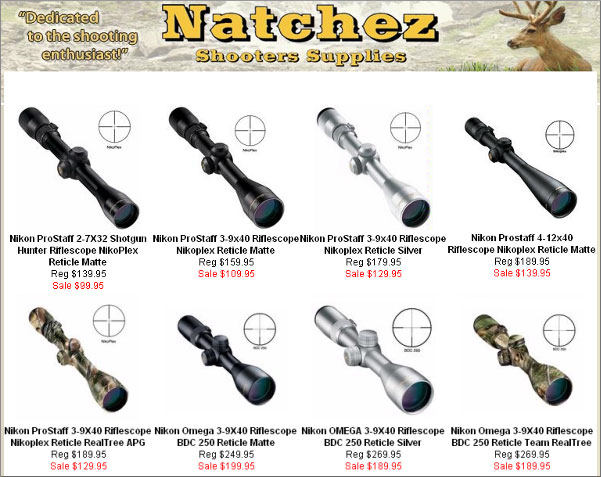
If you need a good, basic, reliable 3-9X40 hunting scope, Natchez Shooting Supplies is offering great deals right now on Nikon ProStaff and Omega riflescopes. You can select among a variety of reticles, including medium plex (NikoPlex) and bullet-drop compensation (BDC). Sale scopes are offered in Matte Black, Silver, or Real-Tree Camo finishes. While discounts vary, prices on many of these scopes have been slashed 30% below normal levels. For example the Nikon ProStaff 3-9×40 Matte is now just $109.95, marked down from $159.95, a 31% savings. Nikon binoculars are also on sale.
CLICK HERE for Natchez NIKON Optics Sale
Story Sourced by Edlongrange.
January 28th, 2011
Schmidt & Bender has a very impressive new tactical scope in the PMII (Police and Marksman) line, the 3-20x50mm PM II/LP/MTC/LT. A first-focal-plane design, the new 3-20X PMII features very bright glass, and a double-turn, locking elevation turret. The scope can be ordered with a variety of reticles, and either 1/4-MOA clicks or one-tenth milrad clicks, with MTC turrets.
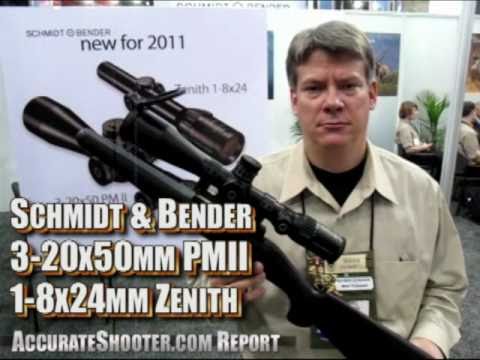
First delivered in late 2010, this unit has already drawn praise from the tactical community. JR, posting on SnipersHide.com Forum, declared: “I had the opportunity yesterday while at the Modern Day Marine show in Quantico to take a look at the new 3-20×50 PM II and to say that it impressed would be an understatement. The overall size was right between the 3-12 and the 4-16 and the 50mm objective is perfectly proportioned to this optic. Locking MTC turrets are very user friendly and it’s nice to have the option to leave them in the unlocked position when needed. Having a parallax range of 25 metres to infinity can also be very beneficial in many circumstances. Overall I was very impressed with the newest PM II … this scope will most definitely be sitting on one of my rifles before the year is over.” Another observer, writing in the Optics Talk Forum states: “If money is no object, consider the Hensoldt. But I think the scope that will be hardest to beat in the high-end tactical market will be the Schmidt & Bender 3-20.” That’s probably an intelligent call. However, at $3100.00+ per unit, we wonder how many shooters can actually afford the new 3-20x50mm PMII.


New Illuminated 1-8×24 Hunting and Multi-Gun Scope
At about $1899.00, Schmidt & Bender’s new 1-8x24mm Zenith scope is considerably less expensive. This scope is designed for short to medium-range tactical use, multi-gun competition, and hunting. One nice feature is that the scope has a “pure 1-power” setting that is 100% parallax-free. There will also be an illuminated version offered for $2149.00 US.

January 24th, 2011
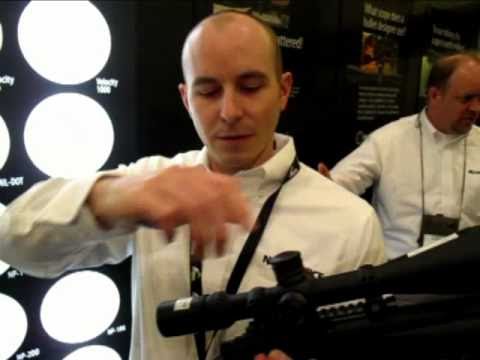
The big news at the Nightforce Optics booth this year involved Nightforce’s “High-Speed” turret design. First introduced on select models in 2010, now the “high-speed” turrets will be installed as standard equipment on Nightforce’s full line of NXS riflescopes (except compacts). The “High-Speed” turrets basically double the amount of elevation (or windage) travel you get with one full revolution of the turret. Previously, a Nightforce elevation turret delivered 10 MOA of elevation adjustment with one 360° turret rotation. Now, with the “High-Speed” turrets, Nightforce scopes will yield twenty (20) MOA of elevation travel with one full revolution. The “High-Speed” windage knobs will now give 10 MOA of travel in each direction. For mil-based turrets, the amount of elevation travel (per revolution) has been increased from 5 mils (per 360° spin) to 10 mils.
The doubling of adjustment travel (per revolution) really is an important upgrade that should make Nightforce scopes more user-friendly and fool-proof. For most popular cartridges, you should be able to go from 100 to 1000 yards within one 360° spin of the elevation turret. This means you no longer have to worry about which revolution you’re on. There are highly visible index numbers on the turret, so you should be able to just dial an index number (e.g. 9, 12, 18) to zero at any distance from 100 to 1000.
New Velocity 600 and Velocity 1000 Ballistic Compensating Reticles
Nightforce will also introduce two new “Velocity” reticles in the summer of 2011, one for 600 yards max, and the other for 1000 yards max range. These will initially be available for the 3.5-15X and 5.5-22X scopes only. Both NF “Velocity” reticles are basically Bullet Drop Compensating reticles that provide hold-over lines for particular yardages. But, you might ask, “How does Nightforce know the ballistic drops for my particular cartridge?” Here’s how it works — the customer sends in his bullet type, bullet BC, and muzzle velocity. Then Nightforce picks one of five (5) calibrated “Velocity” reticles, selecting the hold-over reticle design that most closely matches the actual trajectory of your loads. For most hunters using a common cartridge, one of the five Nightforce “Velocity” reticles should provide a good fit to your load’s ballistics. This isn’t revolutionary — Burris, Leupold, and Zeiss all offer something similar, but it’s good to see Nightforce add this reticle option to its lineup.

December 22nd, 2010
 If you’ve been shopping for Burris riflescopes or binoculars, visit SWFA.com. Texas-based SWFA is running a special liquidation sale on Burris optics with some items marked way down “below distributor cost”. Supplies are limited. Here are some examples of the savings: If you’ve been shopping for Burris riflescopes or binoculars, visit SWFA.com. Texas-based SWFA is running a special liquidation sale on Burris optics with some items marked way down “below distributor cost”. Supplies are limited. Here are some examples of the savings:
Burris 3-12x50mm Xtreme Tactical XTR 30mm SideFocus with Mildot Reticle.
Price: $599.99, regularly $789.95. Stock #201914.
Burris 3-12x50mm 30mm Euro Diamond with Ballistic Plex Reticle.
Price: $349.95, regularly $619.95. Stock #200916.
Burris 6.5-20x50mm Fullfield II, Adj. Objective Front with Fine Plex Reticle.
Price: $249.95, regularly $419.95. Stock #200191.
Burris 3-9x40mm Fullfield II with Electro-Dot/Duplex Reticle.
Price: $199.95, regularly $329.95. Stock #200156.
Burris 8x56mm Signature Select Binoculars, multi-coated lenses, black body.
Price: $199.95, regularly $524.95. Stock #300284.
Below you can see a small sample of the many items on sale (CLICK HERE for full list). Visit SWFA.com or call (972) 726-7348. SWFA offers a price guarantee and SWFA claims it “will beat any price”.

|


