|
|
February 15th, 2009
Unfortunately, we still see too many scopes sold to the public with canted reticles. The problem of canted reticles is a serious issue that some manufacturers (both domestic and foreign) have failed to address. (Note: here we are talking about an INTERNAL scope assembly problem that results in reticles being off-axis relative to the turrets. Don’t confuse this with the canting which occurs if you don’t level your rifle. A canted reticle is a scope production defect requiring factory repair.)
One degree of scope reticle cant is noticeable. Three degrees is “slap in the face” obvious and, frankly, pretty unpleasant to work with. Unfortunately, three degrees happens to be one major domestic scope-maker’s production tolerance. And sure enough, you can find this company’s scopes in retail outlets with the reticles located a full three degrees off-axis.
We believe that badly canted reticles are unacceptable in a high-dollar scope, one costing more than $450.00. Optics-makers — it’s high time to improve your quality control.
 
Three degrees may not sound like much–after all it is less than 1% of a 360-degree circle. Nonetheless, as the diagrams show, three degrees of cant is VERY noticeable in a scope. In fact, most people will be bothered by a reticle that is just one degree off-axis. Canted reticles are not just annoying to look at, but off-axis reticles cause a number of problems with sighting and accuracy. For example, if you set up your rifle so the vertical cross-hair is straight up and down, your turrets will be slightly tilted. This means that when you click elevation you will change windage slightly, and vice-versa. If, on the other hand, you cant (or tilt) the whole rifle to make the turrets square, this throws off the bullet trajectory–causing bullet impact that is low and displaced horizontally*.
Now, all manufacturers can have a production flaw now and then. Yet we’ve never heard a complaint about canted reticles in Nightforce, U.S. Optics, or Schmidt & Bender scopes. So, it IS possible for the better manufacturers to get it right. Our point here is that it is time for the major scope-makers to address this problem and improve their quality control. That will happen sooner if consumers pay greater attention to reticle alignment during the purchasing process. If you have a scope with a canted reticle, send it back to the maker and ask for the problem to be fixed. If enough shooters do that, we expect the scope-makers will take notice and improve their products.
*CLICK HERE to read a very thorough technical article that explains the effect of rifle canting on bullet trajectory. CLICK HERE to see targets shot with canted rifles showing bullet displacement. The diagram below shows how this occurs.

Illustration courtesy Long Shot Products, Ltd.
August 28th, 2008
The new-generation Leica Ultravid 10×42 HD Binocular has been named “Best of the Best” by Field & Stream magazine. Field & Stream’s “Best of the Best” award selects winners based on design, dependability, and value. The Ultravid 10×42 is offered in both basic and HD (“high definition”) versions. The premium HD model features Fluorite-Ion Lenses for reduced chromatic aberration and enhanced color rendition plus state-of-the-art lens/prism coatings that transmit 3% more light. External lenses have an “AquaDura” hydrophobic coating that sheds moisture.
The Leica Ultravid HD binocular was introduced in 2007. The new Ultravid HD offers a marked increase in depth of field, contrast, and light gathering while retaining a compact size. Leica Ultravid HD binoculars are offered in a variety of models: 8×32, 10×32, 7×42, 8×42, 10×42, 8×50, 10×50, and 12×50. The Award-winning Ultravid 10×42 HD is available from SWFA.com (item 40294) for $2295.00. The “regular” (non-HD) 10×42 Ultravid (item 40262) is considerably less expensive at $1,479.95.

10000Birds.com Review:
“Optically [the Ultravids] are without doubt the best binoculars I’ve ever used — clear, sharp, and with no fringing at all. Thanks to the use of lightweight materials like magnesium for the housing and titanium for the central hinge shaft I no longer feel like I’m carrying a boulder around my neck after a day in the field, and the neck-strap is as comfortable as expected. I’ve used them on five continents already, at high-altitude, in strong sunlight and at dusk, in light rain and strong winds, and they have performed exceptionally well every time. They don’t fog-up, they don’t let in dust and — as the manufacturers booklet suggests — you can clean them by running them under a tap!”
Birdwatching.com Review:
“Because of its superb optical resolution and contrast, the Ultravid belongs in any list of the top binoculars of the world. Look through a Leica Ultravid, and you’re immediately struck with how bright and clear the image is from the center of the generous field of view to the outer edges, and how true and free from bias are the colors.”
Great Optics but Just Too Expensive?
The Washingon Times had an interesting take on Field & Stream’s “Best of the Best Awards”: “If you just hit the lottery and money is no object, the best top-of-the-line binoculars, say the experts at Field & Stream, are the German Leica Ultravid 10x42mm HD at $2,095. The best mid-priced binocs were Leupold’s Mojave 10x42mm at $480. Okay, so [the Ultravids] are the best, but I’ll never throw away my 20-year-old Bushnell binoculars I paid a little over $100 for. I love ’em. Seriously now [despite what F&S says] … we’re idiots if we buy the most expensive item when another performed just as well.”
August 23rd, 2008
Sinclair International, a leading vendor for precision reloaders and competitive shooters, has added Nightforce Optics to its inventory of products. Nightforce scopes remain the first choice of most top long-range shooters, including F-Class National Champions. The Benchrest and NXS models offer high magnification (up to 42 power), clear, sharp optics, and very reliable and repeatable windage and elevation adjustments. Nightforce also offers a large variety of reticles. How good is the glass? With a 12-42 Nightforce BR or NXS, in ideal conditions, you can see 6mm bullet holes “in the white” at 600 yards (not razor sharp mind you — but enough to see shot placement on a white background). We just confirmed this ourselves this past weekend. Of course, viewing conditions truly have to be absolutely “perfect” (no mirage) to see 6mm holes at 600 and such conditions are normally short-lived, but the resolving capability is there with the high-magnification Nightforces.

Sinclair’s pricing is competitive with other authorized Nightforce vendors. For example, the
12-42x56mm Nightforce BR scope (item 72-1040/45) is $1306.00 while the 8-32×56 Benchrest model (item 72-1030) is $1211.00.

Shown above are some of the most popular reticles, but others are offered. CLICK HERE to view Nightforce’s complete selection of reticles.
July 24th, 2008
Sightron just delivered to Jason Baney an SIII 6-24×50 Mildot, the latest in the new SIII line-up of side-focus, 30mm Sightron scopes. This follows on the hot-selling 8-32×56, which was the subject of our recent Scope Test. Jason will be testing the scope’s optical qualities soon and using it in an upcoming tactical match.
The new 6-24×50 scope is also offered with a fine cross-hair with target dot reticle. Both mildot and FCH versions are 14.96″ overall with a near-constant 3.6-3.8 inches of eye relief. Clicks are 1/4 MOA (15 MOA per revolution), and total elevation (and windage) adjustment is listed as 100 MOA (50 MOA on either side of center). That’s a class-leading amount of elevation which should make the new 6-24×50 popular with long-range shooters.

Shown above and below is the Sightron 6-24×50 Mildot, flanked by a Leupold 8-25×50 LRT and the Sightron 8-32×56. The controls on the 6-24 Sightron are identical to those of its big brother, but it is shorter, with a smaller objective. The shorter length and 50mm front objective allow a 2.8 ounce weight savings over the larger model (21.9 oz. vs. 24.7 oz.).


Below are reticle specs for Fine Cross-Hair + Target Dot Version

May 15th, 2008
Creedmoor Sports has a new promotion for scope buyers. If you purchase a Nightforce NXS or Benchrest Model scope at regular price, Creedmoor will give you a $75.00 gift cerficate that can be applied to other Creedmoor Sports merchandise. (Note: The certificate can NOT be applied to the original scope sale, or the purchase of another Nightforce product.)

May 14th, 2008
Just this week, Sightron sent us one of the new Sightron SIII 8-32×56 LR D rifle scopes for evaluation. This new optic features a 30mm main tube and weighs 24.7 ounces. Clicks are set in 1/4-MOA increments. The reticle is a fine cross hair with 1/4-MOA dot. The scope comes with a 3″ sunshade, turret covers, and rubber-connected, see-thru lens caps. Jason Baney had a chance to test the scope and give his initial impressions of its optical qualities. We will follow this “First Look” report with more extensive testing of the scope’s mechanical tracking and long-range resolution.

Overall, Jason was extremely impressed with the new scope. It was very bright, with excellent color rendition and contrast. The image remained bright and sharp out all the way out to the edges, with no shadowing or distortion. Compared to a Nightforce 12-42×56 BR scope set at 32-power, Jason thought the Sightron had better contrast and more vivid colors. Jason concluded: “At this point, the new Sightron seems like a good value, and compares well with the Nightforce BR model.”
Parallax and Focus
Importantly, the Sightron’s parallax control worked perfectly. There was no lash issue and Jason was able to attain minimal parallax with the target at maximum sharpness. With some other scopes, if you set the scope to have the target in best focus, you’ll still have too much parallax.

Elevation and Windage
This is a scope you can use to 1000 yards. Jason ran the adjustments top to bottom and recorded 75 MOA of both Elevation and Windage, based on the stated 1/4-MOA click Value. (That’s 75 total MOA available from one extreme to the other.) The target knobs have 15 MOA per turn and operate VERY smoothly and positively. Jason said the clicks “feel similar to Nightforce NXS clicks, but the Sightron clicks engage with a slightly softer feel, with less resistance.”
 Resolution Tests Resolution Tests
Jason used two resolution charts, the USAF 1951 Optical Chart, and a line-width/text size chart. To judge resolution, Jason did a comparison test of the new Sightron 8-32×56 and a Nightforce 12-42×56 BR, with both scopes set at 32x with their sunshade attached. Jason looked through both scopes at the resolution test targets at 100 yards, and then at target frames, grass, and flowers at 300 yards. Viewing was done late in the day, with some shadows on the range. Keep in mind these were less than ideal conditions for viewing.
The test charts have incrementally smaller focus lines and text. Both scopes were able to resolve down to the same line/text level on the two resolution charts. The new Sightron showed comparable, but VERY slightly less resolution than the NF. Both could identify the same size of text, but the NF saw it just a bit more crisply. Jason reports: “I could go to the same resolution level with both scopes, but the last line was just a touch more crisp with the Nightforce. Still, the Sightron is very close in resolution.”
Contrast and Color Fidelity
The Sightron was the winner in this category. In fading light, the Sightron delivered better contrast. Green, yellow, red, and white colors showed more differentiation and all the colors were more vivid. Weathered target backer boards also showed more contrast through the Sightron. Jason checked this several times nearing dusk, and the Sightron always seemed more vivid and showed more contrast looking at a patch of grass and colored vegetation. In terms of color temp, the Nightforce has a more whitish tone, whereas the Sightron seemed “warmer” with more vivid colors.
Brightness/Light Transmission
Along with its superior color and contrast, the Sightron seemed to be consistently brighter through the fading light. We note, however, that manufacturers’ published light transmission factors are nearly identical for the Sightron 8-32 and the Nightforce 12-42. The greater brightness of the Sightron is Jason’s subjective perception, but he said “the Sightron definitely seemed brighter.”
View to Edge
With many zoom scopes, at high magnification, the center of the “circle of light” is bright and sharp, but the edges are faded or shadowy. The brightness attenuates (fades out) on the edges. In addition, you sometimes see some image distortion or focus loss at the edges. The Sightron showed none of these issues. At SHOT show, this editor looked through a prototype 8-32 Sightron and it was bright and sharp all the way out to the edges. Jason observed the same thing: “The Sightron was noticeably clear edge to edge, where the Nightforce showed some fading or darkening at the edges. This point was quite surprising to me.” Jason also noted that the Sightron had about a 3-4″ wider field of view at 100 yards.

Fringe Effect with Highly Reflective Subjects
With the Sightron, when looking at extremely bright, reflective objects, such as a car’s chrome trim, Jason did observe some minor fringing–what he called a “thin halo”. This also appeared around the edge of a white target paper viewed in bright light. A through-the-lens photo appeared to show edging colors (purple fringe), so this may be Chromatic Aberration*. It wasn’t a major issue and it did not affect the sharpness or contrast of the viewed object itself. This was visible only on the periphery of very bright objects.
Conclusion–Impressive Optics for $825.00
We only were able to comparison-test one sample of each scope, Sightron vs. Nightforce. As noted, the performance was very close, and it is possible that different samples might perform slightly better or worse in each optical category. In this test the Nightforce had a very slight edge in resolution, while the Sightron was brighter. We plan to do more testing, with bullet-hole targets set at long ranges. That should give us a better sense of how the Sightron can resolve bullet holes and target lines out past 300 yards. Jason will also do a box-test to check the tracking and repeatability of the Sightron. Based on what we’ve seen so far, however, the Sightron, with a “street price” of about $825.00, is a very good value. Jason concludes: “Given the 8-32 Sightron’s price point, I’d say most people will feel it is a great scope for the money.”
*Chromatic aberration occurs in a riflescope when white light, bent by the objective lens, separates into different colors (wavelengths), each color bending at a slightly different angle. When that occurs, the colors don’t focus at the same point. This most often appears as a deep blue/purple or yellow edge on the image, particularly straight black and white edges.
May 8th, 2008
Newcon Optik, based in Toronto, Ontario, Canada, produces many optics products for the Canadian military including laser rangefinders, image stabilizers, and night-vision gear. Newcon Optik also sells a line of laser rangefinders for consumers. Newcon claims that its rangefinders offer performance comparable to Leica, but at a much lower cost. The Newcon Optik LRM2000 Pro is designed to function out to 2000 meters, with a “reliable, all-conditions range” of at least 1500 yards. The LRM2000 Pro sells for $499.95 at SWFA.com, making it considerably cheaper than comparable models from Leica and Swarovski.

AccurateShooter.com has not been able to field test the LRM2000 Pro ourselves. For that reason it was not included in our Review of Laser Rangefinders done in 2007. However, we’ve handled the unit at SHOT Show and there are many features we like. First, it has a selectable reticle, offering a choice between a small rectangle and a cross-hair. By contrast, the $890.00 Swarovski Laser-Guide only offers a rather large aiming circle. Some hunters have complained the Swaro’s reticle is just too big for deer-sized animals out past 600 yards or so.

FEATURES
1 – Measurement result
2 – Units of measurement (Yards, Meters, Mils, Degrees)
3 – Low battery indicator
4 – Over 100m indicator (LRM 2500, LRM 2500CI Models only)
5 – Laser active indicator
6 – Target quality indicator (optional)
7 – Reticle (cross or rectangular selectable)
We also like the Newcon Optik’s shape and ergonomics. Sized 4.72″ x 4.8″ x 2.36″, the Newcon is flat and easy to hold, with non-slip rubber grip sections on both left and right sides. You can hold the brick shape securely with two hands, horizontally, like using binoculars.
 By contrast, Leica went to an ultra-compact, vertical design for its latest CRF1200 rangefinder. The CRF’s small size makes the Leica easy to carry, but it is more difficult to hold the Leica stable when precise aiming is needed. With the Newcon Optik, you can set it flat on top of a case or rucksack and it’s easier to maintain a solid grip. The LRM2000 Pro also offers a built-in digital compass, a nice feature for anyone in the outdoors. By contrast, Leica went to an ultra-compact, vertical design for its latest CRF1200 rangefinder. The CRF’s small size makes the Leica easy to carry, but it is more difficult to hold the Leica stable when precise aiming is needed. With the Newcon Optik, you can set it flat on top of a case or rucksack and it’s easier to maintain a solid grip. The LRM2000 Pro also offers a built-in digital compass, a nice feature for anyone in the outdoors.
In the video below, Alex Rudi of Newcon Optik explains the features of the LRM2000 Pro model:

CLICK HERE to watch NEWCON OPTIK VIDEO
How do the Newcon Optik rangefinders perform in the field? Do they live up to the claims of Leica-class performance? We invite our readers who own or use Newcon Optik rangefinders to add their comments.
CLICK HERE for LRM2000 PRO SPECS SHEET (.pdf file)
March 13th, 2008
Currently, Natchez Shooters Supply has the highly regarded Steiner 8×32 Predator binoculars on sale for $199.00, marked down from $249.00. The versatile, rubber-armored Predator 8×30 is small enough to carry easily and fit into a coat pocket, while offering both power and brightness. The Steiner 8x30s provide 20mm of eye relief and a 390-foot-wide field of vision at 1,000 yards. Weight is 18 ounces. The waterproof Predator 8x30s come with Auto-Focus System, wrap-around eye cups that fold down, objective lens covers, binocular case and strap. Steiner offers a 10-year warranty on this model.

This is a very good deal. We did a quick price search on the web. Cabela’s.com has the same 8×30 Steiners for $260.94, while OpticsPlanet.com is charging $249.00.
CLICK HERE to read Steiner Binocular reviews from Cabela’s Customers.
February 20th, 2008
Consumers who purchase any Sightron scope (excluding S1 models) will receive a free one-year NRA membership. Current NRA members will receive a one-year renewal with purchase. “With 2008 being a critical election year, all of us here at Sightron are concerned about attacks against our right to bear arms. We want to ensure that future generations have the same rights we have enjoyed”, said Sightron’s President, Scott Helmer. “We are proud to do our part ot help the NRA defend our Second Amendment rights.”

To qualify for the FREE NRA membership, a $25.00 value, just purchase a Sightron SIIISS, SII Big Sky or SII Series riflescope before December 31st, 2008. (The impressive, new Sightron SIII 8-32×56, shown above, also qualifies.) Purchaser must submit Sightron Coupon with original sales receipt by March 31st, 2009.
CLICK HERE for More Info and SIGHTRON COUPON

February 19th, 2008
German optics-maker Schmidt & Bender has recently released comprehensive information on the new 12.5-60×56 PMII scope. The spec sheets are found on S&B’s German-language website. (The USA website has not been updated yet.) We’ve handled this new scope at SHOT Show and it is very impressive to say the least. While our auto-translation from the German isn’t perfect, (and some of the published info appears to be incorrect), here are key specs we’ve discerned:

Weight: 21.52 ounces (610 grams) HOWEVER 1100 grams may be more accurate*
Overall Length: 16.38″ (416.5 mm)
Main Tube: 34mm
Click Value: 1 cm per click OR 1/4 MOA (two versions)
Reticle: P3 (Others may be available later)
CLICK HERE for Schmidt & Bender 12.5-50 Scope INFO
Note: S&B also lists an exit pupil size range of 13.3 to 3.3 mm. The smaller number doesn’t seem right, unless S&B has achieved a major breakthrough in optics design. At max 50X power, with a 56mm front objective, we calculate the minimum exit pupil as 1.12 mm.
*We also question the stated weight of 610 grams. The 12.5-50X56 S&B Field Target Scope, which is similar in size and features, is listed at 1150 grams or 40.56 ounces.
The scope description states: “The sight is alternatively available with foreseeing in the 1st plane or 2nd plane.” By this we think it means BOTH first-focal-plane reticle and second-focal-plane reticle versions will be offered. On a variable power scope, a first-focal-plane reticle increases or decreases with the power setting, so the reticle always appears the same size relative to the target. When the reticle is in the second focal plane, the reticle stays a constant size as the image increases or decreases in size with the power setting.


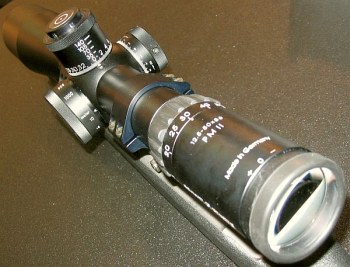
We still have no concrete information on scope price or availability in the USA. We’ve heard the figures $2700-2900 tossed around, but S&B representatives won’t give out hard numbers. Keep in mind that the 12.5-50 is NOT illuminated so it could actually be a little cheaper than the 5-25×56 PMII with illuminated reticle.
|


