|
|
September 6th, 2010
 Applied Ballistics, run by top Palma shooter Bryan Litz, now offers extremely high-quality loaded match ammunition for .308 Fullbore (Palma) shooters. The new Applied Ballistics “FULLBORE” ammo, priced at $38.00/box, is unlike anything on the market. It features the best available components, with individually-weighed charges. Independent testing shows this ammo offers extremely low ES and SD with accuracy comparable to precision hand-loaded cartridges. Applied Ballistics, run by top Palma shooter Bryan Litz, now offers extremely high-quality loaded match ammunition for .308 Fullbore (Palma) shooters. The new Applied Ballistics “FULLBORE” ammo, priced at $38.00/box, is unlike anything on the market. It features the best available components, with individually-weighed charges. Independent testing shows this ammo offers extremely low ES and SD with accuracy comparable to precision hand-loaded cartridges.
Bryan Litz tells us: “Applied Ballistics’ FULLBORE ammunition is not just another ‘factory ammo’ option. This ammo is loaded specifically for the rifles and chambers commonly used in international-style Palma and Fullbore shooting.” Bryan cited the important qualities which make his FULLBORE ammo unique:
- AB FULLBORE is the only .308 Win Ammo with Individually-Weighed Charges.
- AB FULLBORE is the only .308 Win Ammo with Berger Bullets AND Lapua Brass.
- AB FULLBORE is the only .308 Win Ammo Optimized for Int’l Fullbore Competition.
- AB FULLBORE is the only .308 Win Ammo with Independently-Verified Single-Digit SD.

What Makes Applied Ballistics’ FULLBORE Ammo Special
Unlike most factory ammo, AB FULLBORE powder charges are carefully weighed, not metered, which helps to minimize muzzle velocity variation. Velocity averages over 3000 fps from 30″ barrels with Standard Deviation (SD) typically under 10 fps. Components are the best available, according to Bryan: “The ammo is loaded with Berger 155.5 grain bullets and Lapua brass. These are the same components I’ve had success with for years. The brass preparation, loading techniques, and QC steps that I’ve implemented for larger-scale production insure this ammo is good enough to win at the highest levels.”

Applied Ballistics FULLBORE Ammo Already Proven in Competition
Can this pre-loaded FULLBORE ammo really rival handloads in competition? Yes it can, according to Bryan: “I’ve been prototyping and testing ammo this past year and have had very good results. One notable achievement was a 150-15X fired at 900 yards during a coached team match in Lodi, WI during the Midwest Palma Tournament.”
Brian adds: “This ammo is the perfect option for someone who doesn’t enjoy handloading but still wants the accuracy, consistency and performance of handloaded ammunition. It’s also a good option for beginners who haven’t learned how to reload and/or don’t yet have the equipment but want to train and compete with quality ammunition.”
Tierney Tests New FULLBORE Ammo and Rates It Highly
Jerry Tierney, past NBRSA 600-yard and 1000-yard Champion and skilled Palma shooter, has tested the new ammo extensively. In comparison tests with Jerry’s own .308 Win handloads, the Applied Ballistics FULLBORE ammo shot great. Jerry concluded: “The Applied Ballistics 155.5 grain FULLBORE loads matched the best I can do hand loading. They fit the new 2011 fullbore chamber very well. I would not hesitate to use this FULLBORE ammo in any match anywhere.”
Notably, the Applied Ballistics ammo had a lower ES and SD than Jerry’s handloads. One five-shot group of the FULLBORE ammo had an ES of 7 fps and SD of 2 fps — that’s remarkably low. Four groups shot with Tierney’s handloads at 300 yards averaged 0.449 MOA, vs. 0.498 MOA for two groups of the Applied Ballistics ammo, so the accuracy is very close to the best precision handloads.
Click Here for complete Jerry Tierney Applied Ballistics Ammo Test Results (PDF file).
Coming Next — Applied Ballistics Tactical .308 Win and .338 Lapua Magnum Ammo
Applied Ballistics plans to release more types of high-quality loaded ammo in the months ahead. Bryan reports: “Future plans include a .308 load optimized for tactical applications. This will be a magazine-length round probably with a 175 grain bullet with favorable transonic stability. Eventually I’d like to offer a .338 Lapua Magnum tactical/hunting round loaded with Berger’s 300 grain Hybrid bullet.”
Bryan explains that he is developing .308 Win tactical ammo, because the FULLBORE product is made specifically for Palma work: “The fact that the FULLBORE ammo is optimized for the target application means it’s not necessarily ideal for other uses. For example, the rounds are too long to feed through standard-length magazines so they’re not of much use for tactical shooters. Also the seating depth is optimized for the chambers typically used in custom target rifles so it’s not the best option for factory (SAAMI) chambers.”
To order Applied Ballistics’ .308 Win FULLBORE ammo, visit Bryan’s AppliedBallisticsLLC.com website, which features secure online ordering. Currently, .308 Win FULLBORE ammo is priced at $38.00 per 20-round box (shipping extra).
August 20th, 2010
Savage’s Fullbore (Palma) rifle team performed well in recent competitions. The four-man team (Darrell Buell of Damascus, OR, John Weil of Welches, OR, Monte Milanuk of Wenatchee WA, and Stan Pate of Milwaukie, OR) wrapped up the season with two internationally-sanctioned matches. The first was the Canadian International Fullbore Championships in Chilliwack, B.C. and and the second was the Pacific International Fullbore Championships held just outside of Portland, OR. At both matches, elite shooters from around the world competed at 800, 900 and 1,000 yards. The two matches combined constitute a “Super Aggregate”, or Continental Title.

Team members (L to R): John Weil, Darrell Buell, Monte Milanuk and Stan Pate. (File Photo 2009).
Team Savage loaded up on the hardware at both matches, winning multiple medals at the various distances. Savage’s four shooters captured the team gold at the Canadian match and Gold and Silver in the individual Super Aggregate.
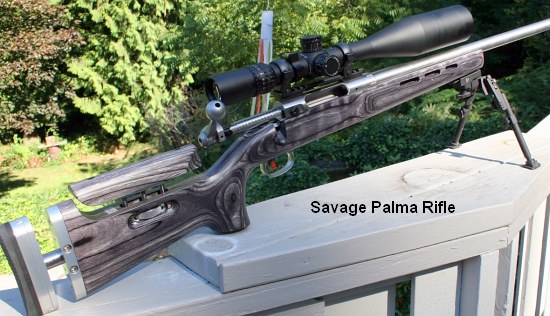
At the Pacific Int’l match in Oregon, local knowledge helped Team Savage rack up the medals. This competition was held on Weil and Pate’s home range at the Douglass Ridge Rifle Club. With John Weil leading the way, Team Savage put on a clinic: Weil won all seven gold medals available, while teammate Pate won six silvers. Milanuk added three bronzes. Weil also shot an impressive 148-4X at 1000 yards. In the video below, Team Captain Stan Pate demonstrates the accuracy of the Savage Palma (Fullbore) rifle, nailing a steel target at 1169 yards.

August 19th, 2010
 John Whidden of Whidden Gunworks used a collection of .243 Winchester and .308 Win rifles to win his third NRA National Long-Range Championship this week at Camp Perry. We had a chance to discuss Whidden’s winning guns during a long telephone conversation with John yesterday, as he motored back to Nashville, Georgia. John revealed some interesting facts about his long-range arsenal. John Whidden of Whidden Gunworks used a collection of .243 Winchester and .308 Win rifles to win his third NRA National Long-Range Championship this week at Camp Perry. We had a chance to discuss Whidden’s winning guns during a long telephone conversation with John yesterday, as he motored back to Nashville, Georgia. John revealed some interesting facts about his long-range arsenal.
For the “Any sights, Any Rifle” and “Iron Sights, Any Rifle” stages of the Long-Range Championship, John used three different .243 Win rifles. He shoots the same load in all his .243s: Berger 105gr VLD bullets (moly-coated) with N160 powder and PMC (Russian) primers. The bullets are seated very long, with about .001″ neck tension, so the bullets “soft-seat” themselves into the rifling as he closes the bolt. This way he can use the same ammo in different guns and the bullets always find the same seating depth relative to the rifling. John uses a very stout load of N160 that drives his Berger 105s at about 3,300 fps. No that is not a misprint. John launches thin-jacket 105s at 3,300 fps and he doesn’t have an issue with bullet blow-ups. Moly helps keep the heat down, but John’s Broughton 5C (canted land) barrels are key. These are gentler on the jackets than barrels which have very tall or sharp lands.
 John shoots the Berger 6mm 105gr VLDs because they are a proven commodity that seem to work in a variety of barrels and cartridges: “We need something that is very reliable from an accuracy standpoint, match in and match out. The 105s are more reliably accurate over a range of different cartridges, barrels, and conditions. I’ve considered using the 115s, but I’ve heard mixed results. Across the whole range of variables, the 105s and 107s always seem to work for people but I’ve heard a lot of mixed results with the 115s.” John shoots the Berger 6mm 105gr VLDs because they are a proven commodity that seem to work in a variety of barrels and cartridges: “We need something that is very reliable from an accuracy standpoint, match in and match out. The 105s are more reliably accurate over a range of different cartridges, barrels, and conditions. I’ve considered using the 115s, but I’ve heard mixed results. Across the whole range of variables, the 105s and 107s always seem to work for people but I’ve heard a lot of mixed results with the 115s.”
At 3,300 fps, the 105s deliver ballistics that are hard to beat, according to John: “My .243 shoots inside a 6.5-284 with 142s. Nothing out there is really ahead of [the .243], in 1000-yard ballistics unless you get into the short magnums or .284s and those carry a very significant recoil penalty. In the past I did shoot the 6.5-284. I went to the .243 because it had similar ballistics but had much less recoil. It doesn’t beat me up as much and is not as fatiguing.
With the .243… there’s no tensing-up, no anticipating. With the reduced recoil, I can break and shoot very good quality shots. I find I just shoot better shots with the .243 than I ever did with the 6.5-284.”
John’s primary “Any Sights” .243 is built on a Winchester m70 action, it has a Broughton 32″, 1:8″ twist 5C (canted land) barrel. This gun shot very well, but he did have a firing pin issue during the Remington Band of Brothers match on Day 1 of the Long-Range competition, so he was forced to bring out his back-up “Any Sights” gun. This features a Stolle Panda action, and Broughton 30″, 1:8″ twist 5C barrel. Both guns employ a Nightforce 8-32x56mm Benchrest Scope. John joked: “I’ve done a lot of hauling back-up guns across the country for no reason in the past, but this time it mattered a lot.”
For the “Iron Sights, Any Rifle” stages Whidden uses a .243 Win with a Gilkes-Ross action, Warner Rear Sight, and CG front sight with +0.5 diopter. As with John’s scoped .243s, this gun has an 8-twist, light Palma contour, Broughton 5C barrel. This is the same gun and 32″ barrel John used to set the Leech Cup record in 2008. It has about 650 rounds through the barrel. The chambering, as with his other “Any Rifle” guns, is a “plain vanilla .243 Win”.
.308 Palma Rifle Shooting 185gr VLDs with N140
Whidden’s .308 Winchester Palma Rifle is the same rifle we featured as our Gun of the Week Number 59 (photo below). It’s the same gun with the same barrel, a 32″ Broughton 10-twist with 5C rifling, light Palma contour. Round-count on this barrel is over 3000! John’s current .308 Win load is a very stout charge of N140 power, PMC primers, and 185gr Berger moly-coated VLDs. The brass is Lapua .308 Win with the standard large primer pocket/large flash holes. He turns his case-necks for a .333″ loaded round in a .343″-necked chamber, which was cut with the popular “95 Palma” reamer. As with his .243s, John loads his .308 ammo long and “soft-seats” his bullets with bolt closure.


Barrel Selection is Key to Running 6mm VLDs at Very High Velocities
Given John’s success with the .243 Winchester at Camp Perry, we asked him why more competitors weren’t using this cartridge at Perry. The combination of great ballistics and moderate recoil seems hard to beat. John explained: “There were several other .243s on the line. Lamar Jones, my travel partner, shot a .243, and there were a couple other guys out there. But there are more 6.5s I think. If there were an equipment list, I would be pretty certain that the 6.5-284 would be the majority in the ‘Any Rifle’ category.”
Importantly, John explained that it takes the right hardware to run the heavy 6mm bullets at high velocities. Bullet blow-up is a risk. John told us: “At the velocities I’m running the 105gr VLDs in the 243s, barrel brand selection is really important. You absolutely have to shoot a barrel that is easy on bullets to run these velocities. To avoid bullet blow-ups at these speeds, you can’t shoot barrels that have the tallest and sharpest rifling, such as you find with some cut-rifled barrels. I’m still shooting the thin-jacket Berger VLDs. I haven’t even switched to the thick-jacket bullets. To do this you need a rifling solution that is kinder to the bullet. The point I’m trying to drive home is that barrel selection is a very important factor. If my barrels didn’t work we would have smoked a lot of bullets. But that’s not the case with the Broughtons. I haven’t blown up a .243 bullet through a Broughton barrel.”
August 19th, 2010
A new NRA record in the team Palma event was set yesterday at Camp Perry by the Litz-Gallagher team. The new record of 1796-119X was set by Brian Litz (Captain and Shooter), Michelle Gallagher (Coach and shooter), Nancy Tompkins (Coach and shooter), Bob Gustin (shooter). Shooting the Palma course of fire at 800, 900, and 1000 yards, these four beat the 1796-112X mark set in July at Raton, NM by an all-female ‘dream team’ of shooters coached by Steve Conico. (Both Michelle Gallagher and her mother Nancy Tompkins were member of the Raton ‘Dream Team’). Bryan Litz reports: “At Perry, Michelle and Nancy did an outstanding job shooting, and coaching Bob and myself to very high scores especially at the 1000-yard-line where the conditions were extremely difficult.”

Team member Bob Gustin also won the Individual Palma match with a 450-33X, not dropping a point. That’s remarkable considering Bob shoots right-handed while sighting with his left eye through off-set rear and front sights. Congrats to Bob and all the team members. Bryan Litz won’t take any time off after his team’s record-breaking performance. Bryan reports: “I’m on my way to Canada now for the America Match this Sunday — a bi-annual international fullbore match.” Good luck Bryan.
July 29th, 2010
 Kelly Bachand, the youngest competitor on the Top Shot TV series, is a regular contributor to AccurateShooter.com. Currently an electrical engineering major at the Univ. of Washington, Kelly is a talented Palma rifle shooter who has managed to hold his own in other shooting disciplines. Kelly is the real deal — a genuine marksman, and we know many readers have been pulling for him through the grueling Top Shot elimination process. Kelly Bachand, the youngest competitor on the Top Shot TV series, is a regular contributor to AccurateShooter.com. Currently an electrical engineering major at the Univ. of Washington, Kelly is a talented Palma rifle shooter who has managed to hold his own in other shooting disciplines. Kelly is the real deal — a genuine marksman, and we know many readers have been pulling for him through the grueling Top Shot elimination process.
There’s a fascinating full-page interview with Kelly in the Cheaper Than Dirt Blog. The first half of the interview covers Kelly’s background and marksmanship training. In the second half, Kelly discusses his Top Shot experience, revealing secrets about the show and the inter-personal rivalries which have become such a staple of the series. Kelly also explains how he managed to survive three elimination rounds.
| Q: During the first elimination challenge you shot rifles and sent Mike Seeklander home. That was a pretty stunning defeat and seemed to surprise everybody. It does seem like your mental attitude has really helped you through all of the elimination challenges you’ve been through.
Kelly: I do have a certain mental ability that I’ve kind of picked up and practiced and begun to get better at over the last year, year and a half, to kind of shut other things out while I’m actually shooting. I’ll be extremely nervous up until the point I’m actually shooting, extremely nervous.
At the Beretta Xtrema [shotgun] challenge I got up to the line, and I’m way outside of my comfort zone holding this Beretta. I’ve fired it all of about 20 times now, and I got up there, I focused on what I need to do, and I make the shot. It all kind of goes away. What I do is I just repeat a mantra in my head. I just ask myself, “OK, what do I need to do to make this a perfect shot?”. Then I tell myself over and over what I need to do. If I continually force feed myself good thoughts — positive thoughts about what I need to do to make it perfect — I typically make very good shots. That’s right out of Lanny R. Bassham’s book With Winning in Mind. |
Whether you love the Top Shot show (for the shooting) or hate it (for the Hollywood reality-show nonsense), we recommend reading Kelly Bachand’s interview. Kelly has managed to adapt and learn quickly and that’s why he’s still “in the running” while other, more experienced competitors have been eliminated. Kelly offers many insights that can help any competitive shooter.
July 22nd, 2010
A “Dream Team” composed of four of America’s top lady shooters set a new national long-range Palma record at the Rocky Mountain Palma Championships at Raton, NM last week. The four-woman squad of Trudie Fay (Captain), Michelle Gallagher, Noma Mayo, and Nancy Tompkins shot brilliantly to establish a new National Palma record of 1796-112X, breaking the existing 1791-102X record held by the USAMU (Praslick) team.
Officially listed as “The U.S. National Team”, but dubbed “Team Estrogen” by one of the gals, this squad of four female High Masters was coached by Steve Conico, a veteran long range shooter from New Mexico. Michelle told us that Coach Conico did a great job calling the wind, and all the team members performed well: “Our strategy was simple: lay down, shoot, let Steve think for everybody. Steve’s a fantastic coach. We all just had a good day. All four trigger-pullers were on top of our game. The combination of good conditions (for Raton), great coaching, and good shooting allowed a memorable team performance. That combination is rare. It’s not going to happen again any time soon.”
SCORES: T. Fay: 448-39X | M. Gallagher: 450-35X | N. Mayo: 449-26X | N. Tompkins: 449-22X

For Michelle, competing in this match with a team of female all-stars (who are all close friends) was a dream come true: “We’ve been planning to have a womens’ team for 10 years and it finally happened. It’s fun getting everyone together. We’re all delighted it worked out so well. And I loved being able to shoot with my mom.” Michelle shot a perfect 450 in the match, not dropping a single point.
 Record-Setting Equipment Record-Setting Equipment
All four Dream-Teamers were shooting conventional single-shot .308 Winchester Palma rifles — no tube-guns in this arsenal. Nancy Tompkins’ rifle featured a wood stock, Stolle Panda action, and 30″ Krieger barrel. Michelle’s rifle was similarly configured but she used a fiberglass McMillan stock. Nancy and Michelle shot ammo loaded with Hodgdon Varget powder, Wolf (Russian) primers, and the 155.5gr Berger Palma bullet. The other two team members, Noma and Trudie, may have been using Sierra #2156 155gr Palma bullets but that’s not confirmed.
Loading for the 155.5gr Berger Palma Bullet
Michelle observed that the 155.5gr Berger Palma bullet doesn’t require any special tuning: “With the 155.5, it’s pretty easy to swap out any load you’ve used successfully with any of the other 155s. The 155.5 doesn’t require a lot of extra load development. As far as seating depth goes, some people are successful jumping them, some people are successful jammin’ them in. Personally I’ve always soft seated. I haven’t found them to be very finicky.” Editor’s note: “Soft Seating” refers to deliberately loading the bullets long, with fairly light neck tension, and then allowing the bullet to find it’s position as one closes the bolt. The potential benefit is that the bullet ogive is always in the same position relative to the start of the rifling.
Good Conditions Aid Record-Setting Team Performance
During the July 10 team match, the weather gods smiled, providing good conditions (by Raton standards) for the female Dream Team’s record-setting performance. Michelle observed: “Have you ever shot at Raton? It can be the devil. Raton can be really nasty, but it was a pretty benign day by Raton standards. The wind was switchy but not what I’d call ‘blow you off the paper’ wind. We were all able to concentrate on the mechanics — just ‘lay down and squeeze’. Steve did all the work.”
March 15th, 2010
We have a “Palma/Tactical” project gun in the works built with an Eliseo chassis, Borden action, and one of Krieger’s very first 5R barrels. Initial load testing with Hodgdon Varget showed excellent accuracy potential, but we weren’t achieving the velocity we hoped to get from the 30″ medium-Palma-contour barrel. With Lapua brass and Varget we ran short of case capacity when seating bullets to mag-length, and the best accuracy came at about 2860 fps, well under competitive Palma velocities.
Mark LaFevers with .308 Win Eliseo Tubegun on SEB NEO front coaxial rest. Mark made the wood front bag-rider.

Chris Hodgdon kindly shipped us some H4895 and some of the new IMR 8208 XBR powder, lot #1022510-4798. In beautiful 70° conditions yesterday, we did a quick pressure work-up with both powders to determine “practical max” loads with the Berger 155.5gr Fullbore bullets (#30416). The 155.5s were loaded in once-fired Lapua brass with CCI BR2 primers, to a COAL of 2.860″, which is about .010″ short of land contact.
Varget-beating Speeds from Both IMR 8208 XBR and H4895
We loaded up two rounds at each charge weight, starting with the Hodgdon’s recommended starter load for a 155gr Sierra HPBT, as found in Hodgdon’s online Reloading Data Center. (There was no load listed for the 155.5gr Berger). It’s good that we started low because we saw immediately that both the 8208 XBR and the H4895 were yielding much more velocity, grain for grain, than Varget. Though we were not shooting for groups, the 8208 XBR also seemed to have a very large accuracy load window. Moreover, the velocity spreads for each two-round 8208 charge (above 43.0 grains) were remarkably low — none were more than 6 fps, and the velocities on our two 44.0-grain shots were exactly the same — 2992 fps. (This was NOT an error — the chron registered both shots #7 and #8.)

Of course, you can’t conclude much about ES/SD from just two shots, but the speed consistency in the 8208 was notable as you can see from the chart above. By contrast, each pair of H4895 shots varied in speed much more. For example, the two-shot ES for 43.0 grains of H4895 was 14 fps, while the two-shot 8208 XBR spread (for 43.0 grains) was 4 fps. It will be interesting to see if further testing confirms the low ES/SD potential of IMR 8208 XBR in the .308 Winchester.
We dispensed charges with an RCBS ChargeMaster calibrated and leveled on a granite bed. The 8208 XBR has smaller kernels than either Varget or H4895 and, as we expected, 8208 XBR dispensed very easily. The H4895, with longer kernels, dispensed fine in the ChargeMaster, but it took the machine more time to trickle the H4895.
As noted, we didn’t shoot for groups, but the IMR 8208 looked like it would shoot really well at anywhere from 43.0 to 44.0 grains. The H4895 proved accurate as well, at least in the high pressure ranges. We need to do 5-shot testing, over flags, before drawing any real conclusions. But right now we can say that, if you’re shooting a .308 with 150-155 grain bullets, you should definitely try the IMR 8208 XBR. It looks like a near-perfect match for the Palma-class bullets. The velocity is great, it appears the ES will be very low, and 8208 XBR packs more densely than Varget so you won’t have to run compressed loads.

Our most important discovery was that both 8208 XBR and H4895 offered significant velocity gains over Varget, at least in this rifle. It looks like 8208 XBR can run 2990 fps in this gun without pressure issues, while H4895 may top 3000 fps. Varget struggled to get much past 2900 fps.
IMPORTANT WARNING: The stated max load for IMR 8208 XBR with a Sierra 155gr HPBT was 45.3 grains, while the stated max load for H4895 (same bullet) was 46.0 grains. Note that, in this rifle, which has a tight 0.298″ Palma bore, we hit pressure limits well before reaching Hodgdon’s “book max.” Read that again carefully folks. Our 44.0 grain “practical max” for 8208 XBR was a FULL GRAIN less than the stated max load with a Sierra 155-grainer. Likewise we started getting stiff bolt lift at 44.3 grains of H4895 — a long way from the 46.0 grain stated max. So, the combination of a different bullet, and a tighter-than-normal bore made a significant difference in pressures. This is why, if you change ANY component in a load recipe you MUST start low for safety. And never assume that a factory “Max Load” is safe or “conservative”.
March 9th, 2010
Gary Eliseo of Competition Shooting Stuff (CSS) builds great TubeGun rifle kits and he’s a superb shooter to boot. This past weekend Gary won the California State Palma Championship in Coalinga, California. Gary was shooting his CSS BN1 tubegun with a Barnard action, Krieger 1:13″ twist barrel, and Berger 155.5gr bullets.

Gary reports: “Conditions went from super easy to pretty vicious. The scores haven’t been published yet but mine was 889, and I think the next three were: Lane Buxton 886, Martin Tardif 883, and Jim O’Connell 881. I was using one of my B1 rifles, Barnard P action, Krieger 13 twist barrel, Berger 155.5s. My load was N150 with Winchester .308 brass weight-sorted to 1%. This was the same rig I used at Phoenix (AZ) but I wasn’t completely happy with the performance at 1000 yards. Then, in German Salazar’s Rifleman’s Journal Blog, I read that Mid Tompkins was ‘soft-seating’ the same bullet in his Palma gun. So, I gave that a try for Coalinga and the results were much better. Elevation at 1000 was excellent — the gun holds X-Ring elevation with ease.
The way soft-seating works is that I load long with pretty light neck tension. The bullet moves back about .010-.012 as the bolt is closed. If I extract the round I can barely see any engraving mark on the bullet. But be careful when extracting a soft-seated round because it is possible for the bullet to stick in the rifling. Anyway, the results with soft-seated bullets were much better. So this is a method which works with the .308 case and the Berger 155.5s and my well-worn throat. I don’t necessarily recommend this with other bullets, calibers and throat configurations. And if your discipline often requires you to extract loaded rounds, soft-seating is not advised.”

Top Row: Gary Eliseo (far left), MartinTardiff, unknown, John Giles | Bottom row: Randy Tesseidre, Marco Rojas, Allan Morita. Note that nearly all the rifles are CSS (Eliseo) tubeguns.
To learn more about shooting with Eliseo’s innovative CSS stocks, read German Salazar’s article: Adjusting the TubeGun Stock.
February 14th, 2010
 Bryan Litz, Ballistician for Berger Bullets, is the author of the book Applied Ballistics for Long-Range Shooting. Before joining Berger, Bryan was a missile design engineer working with the U.S. Air Force. An NRA High Master, Bryan also happens to be one of the country’s top long-range shooters. Bryan (aka “bsl135″ in our Forum) has written many ballistics programs and technical papers dealing with long-range flight dynamics of projectiles. Bryan has recorded some very impressive match performances recently. At the 2008 NRA National Championships at Camp Perry, Bryan beat 258 other competitors to win the Palma Individual Trophy Match. Bryan shot a remarkable 450/26x, not dropping a single point. Bryan Litz, Ballistician for Berger Bullets, is the author of the book Applied Ballistics for Long-Range Shooting. Before joining Berger, Bryan was a missile design engineer working with the U.S. Air Force. An NRA High Master, Bryan also happens to be one of the country’s top long-range shooters. Bryan (aka “bsl135″ in our Forum) has written many ballistics programs and technical papers dealing with long-range flight dynamics of projectiles. Bryan has recorded some very impressive match performances recently. At the 2008 NRA National Championships at Camp Perry, Bryan beat 258 other competitors to win the Palma Individual Trophy Match. Bryan shot a remarkable 450/26x, not dropping a single point.
Palma Match — Caught on Video
Bryan has crafted a cool video that puts the viewer “in the driver’s seat” as Bryan shoots an 800-yard match with his .308 Winchester, iron-sights Palma rifle. Watch as each shot is marked and scored. Bryan explains: “The inset target at upper right displays each shot location in sequence. The score card shows the windage used for each shot, as well as the windage that was ‘Required’ for that shot to be centered. Wind wasn’t very challenging in this string, only requiring between 2 and 3 MOA right. This particular match is the 800-yard phase of a Palma course fired in the summer of 2008 at Camp Atterbury, IN. NOTE: I’ve had to cut out some ‘pauses’, and speed up the film in order to meet YouTube’s size requirements, so that’s why we sound like chipmunks.”
CLICK SCREEN to WATCH VIDEO. Click Menu Button for High Quality (HQ) Option
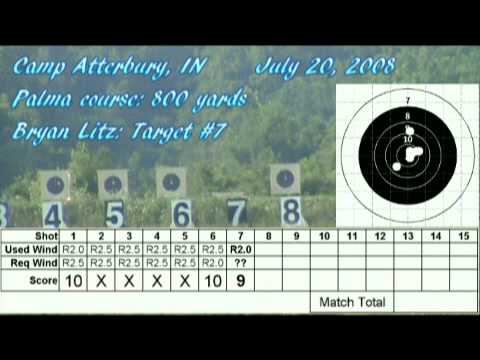
Bryan also has his own website with a number of authoritative articles. Topics include: Bullet Design, Meplat Trimming, Gyroscopic and Coreolis Drift, Palma Bullet Analysis, How Ballistics Programs Work, and Ballistic Coefficient Testing. CLICK HERE to visit BRYAN LITZ Website.
February 7th, 2010
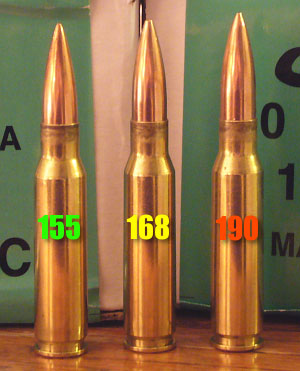 In December, we published the rules controlling choice of caliber and bullet weight for Palma competition. (CLICK HERE to Read.) In the USA, some events are still limited to 156gr or lighter bullets for .308-caliber shooters. But where such restrictions don’t exist, many shooters are using heavy 175-190gr bullets in their .308s. Is the heavier bullet always better? What considerations favor the lighter 155gr-class bullets in Palma competition? Top Palma shooter Kelly Bachand addresses these questions in today’s commentary. In December, we published the rules controlling choice of caliber and bullet weight for Palma competition. (CLICK HERE to Read.) In the USA, some events are still limited to 156gr or lighter bullets for .308-caliber shooters. But where such restrictions don’t exist, many shooters are using heavy 175-190gr bullets in their .308s. Is the heavier bullet always better? What considerations favor the lighter 155gr-class bullets in Palma competition? Top Palma shooter Kelly Bachand addresses these questions in today’s commentary.
Factors That Favor the 155s
by Kelly Bachand
It is clear that 155gr bullets are adequate. In the Palma game, more matches have been won and more 450 scores have been shot with 155gr bullets than with any other weight projectile. With the NRA allowing heavier bullets in Palma matches, many shooters prefer to shoot the longer, heavier bullets when possible. With their higher BCs, the longer bullets would seem to offer a ballistic advantage. There may be an edge, but in my opinion, it comes at a high cost.
Shooting a heavier bullet adds complications. You’ll probably need a different powder and new load development will have to be done. New zeroes must be calculated and confirmed on the range. An expensive new barrel with a faster twist rate may be needed to stabilize the heavier bullets. And unless you’re lucky, there’s a chance that the new barrel is less accurate than your existing barrel. (If you’ve got a “hummer” barrel for the 155s, what are the odds of getting another one as good for the 190s?) For a shooter who only competes domestically and who has plenty of time and money, this does not pose much of a problem, as he can work up multiple loads and acquire multiple barrels, or even build up a second complete rifle. But shooting BOTH the 155s and the heavy bullets (which may require a new barrel) certainly adds to the cost of competing, and the time required to work up loads. One who also competes internationally has much more to worry about, since you’ll likely be switching between the heavy bullets for most domestic matches and the 155s for most international matches.

Consider the challenges you’ll encounter switching between a heavy-bullet domestic load and a 155gr international load. Will changing between two different loads (with very different recoil levels) alter your gun-handling and follow-through? Will having two loads (with different ballistics) create confusion when making wind calls? And if you DO shoot both 155s and 190s, should you have two different barrels, or should you stick to one barrel which is adequate for both bullet weights, but perhaps not optimal for either? The heavier bullets typically have a better BC which means they should be less bothered by the wind. At the same time the heavier bullets travel at a much slower velocity. Does this negate the ballistic advantage? You need to check the ballistic tables carefully, looking at BOTH BC and velocity.
As a person who prefers to keep things simple and stick with what works, it’s no surprise I continue to shoot 155gr bullets exclusively in Palma competitions. But I understand this is just one viewpoint. A Palma shooter reading this should survey competitors who are consistently putting themselves in the winner’s circle. Talk to top shooters and then make your own rational, informed decision about which bullets to use. Good luck and keep them in the center.
|


