Craters may look interesting on the moon, but you don’t want to see them on your primers. Certain mechanical issues that cause primer craters can also cause primer piercing — a serious safety problem that needs to be addressed. If you have a gun that is cratering primers (even at moderate pressure levels), there is a solution that works with many rifles — send your bolt to Greg Tannel to have the firing pin hole bushed.
Shooters who convert factory actions to run 6BRs, 6PPCs or other high-pressure cartridges should consider having the firing pin bushed. These modern cartridges like to run at high pressures. When running stout loads, you can get cratering caused by primer flow around the firing pin hole in the bolt face. The reason is a little complicated, but basically the larger the hole, the less hydraulic pressure is required to crater the primer. A limited amount of cratering is normally not a big issue, but you can reduce the problem significantly by having a smith fit a bushing in the firing pin hole. In addition to reduced cratering, bushing the firing pin often produces more consistent ignition.
This is a highly recommended procedure that our editors have had done to their own rifles. Greg Tannel (Gre-Tan Rifles) is an expert at this procedure, and he does excellent work on a wide variety of bolts. Current price for a bushing job, which includes turning the firing pin to .062″, is $80.00, or $88.00 with USPS Priority Mail return shipping.
If you have a factory rifle, a bushed firing pin is the way to go if you are shooting the high-pressure cartridges such as 6PPC, 6BR, 6-6.5×47 and 6.5×47. This is one of the most cost-effective and beneficial upgrades you can do to your factory rifle. For more info on the Firing Pin Bushing process, visit GreTanRifles.com, or email greg [at] gretanrifles.com. (After clicking the link for GreTanRifles.com, Click on “Services” > “Shop Services” > “Bolt Work”, and you’ll see a listing for “Bush Firing Pin Hole & Turn Pin”. Select “View Details”.)
Firing Pin Hole Bushing by Greg Tannel
Work Done: Bush firing pin hole and turn pin.
Functions: Fixes your cratering and piercing problems.
Price: $80.00 + $8.00 return shipping Total Price: $88.00
Actions for which Bushing is Offered: Remington, Winchester, Savage multi-piece pin, Sako, Kimber, Nesika, Stiller, BAT Machine, Kelbly, Lawton, Surgeon, Borden, Wichita, Hall, Ruger, Howa, Weatherby, Dakota, Pacific Tool, Phoenix, and Defiant bolt action rifle or pistol.
Actions for which Bushing is NOT Available: Case hardened receivers, ARs, Accuracy International (AI), Barnard, Big Horn, Cooper, Desert Tactical Arms, Kimber, Rosenthal, New Savage single piece pin, Rim fires, Falling block, Break open, Lever, Pump rifles, 1903-A3, CZ, Mauser.
How to send your bolt in to be bushed:
You can send your bolt snail mail, priority mail, or UPS (Please do not use FEDEX as it sometimes has delivery delays). Pack your bolt carefully and ship to: Gre’-Tan Rifles, 24005 Hwy. 13, Rifle CO 81650. Please include your name, phone number, and return shipping address.
Due to the high volume of work, turn around is 5 to 8 weeks on bushing a bolt. Three or more bolts will be sent back to you UPS and we will have to calculate shipping. We can overnight them at your expense. You can pay by check, money order, or credit card. For more information visit GretanRifles.com.
.009″ — The Record That Stood for 40 Years.
In 1973 Mac McMillan shot an amazing 100-yard, .009″ five-shot group in a benchrest match. The .009″ group was measured with a 60x microscope for verification. Mac McMillan shot the group using a handbuilt prototype McMillan rifle with an early McMillan stock.
Mac’s .009″ group was the “Holy Grail” of rifle accuracy. This .009″ record was considered by many to be unbreakable, a record that would “stand for all time”. Well, it took 40 years, but someone finally broke Mac’s record with an even smaller group. In 2013, Mike Stinnett shot a .0077″ five-shot group using a 30 Stewart, a .30 caliber wildcat based on the 6.5 Grendel. Stinnett’s .0077″ group now stands as the smallest 100-yard group ever shot in registered benchrest competition.* Read About .0077″ group HERE.
Stinnett’s success doesn’t diminish the significance of Mac McMillan’s .009″ group in the history of benchrest competition. For four decades Mac’s group stood as the ultimate standard of rifle accuracy*. For those of you who have never seen Mac McMillan’s .009″ group, here it is, along with the NBRSA World Record certificate. The target now hangs in the McMillan Family Museum.
*Somebody else might claim a smaller group, but unless moving backers or electronic targets were used, it cannot be verified. Moving target backers are used at registered benchrest matches to ensure that five (5) shots are actually fired in each group. That eliminates any doubt.
Butch Lambert of ShadeTree Engineering provided this tip. Butch notes that many 6 PPC benchrest group shooters also enjoy shooting in score matches. But to be really competitive in the BR for score game, that means shooting a 30BR, which has a wider, .308-class rim (0.4728″ diameter). Likewise, if you want to compete in 600-yard registered BR events or in varmint matches, you probably want to run a bigger case, such as the 6BR, 6mm Dasher, or 6-6.5×47. Those cartridges also have the larger 0.4728″ rims.
To convert a PPC-boltface action to shoot the bigger cases you can spend a ton of money and buy a new bolt. That can cost hundreds of dollars. The simpler solution is to turn down the diameter of the larger cases on a lathe. Butch explains: “We’ve seen plenty of interest in rebating case rims. This lets you shoot a 30BR in score matches using your PPC action. All you need is a new barrel. This saves buying another bolt, receiver, or rifle if you have a PPC boltface. Anyone who has access to a lathe can do this job pretty easily. Yesterday I turned 150 case in about an hour.” Below are photos of a rebated 6BR case, along with the lathe form tool Butch uses to rebate the case rims.
AccurateShooter.com Forum members often ask: “Is there a reasonably-priced ammo box that fits PPC and BR cases just right?” The answer is yes — check out the 50-round Frankford Arsenal model 512 ammo box. It is offered in transparent blue or smoke gray for $3.49 per box at MidwayUSA (or $3.99 per box at Amazon.com).
The cartridge slots are just the right size for 22BR, 6mmBR, 30BR, 220 Russian, 6 PPC, 6.8 Rem SPC, 6.5 Grendel, and 7.62×39 cartridge cases. Cells are 1.687″ high x 0.392″ square, with a divider height of 0.94″. That will hold BR-type cases securely, and fired brass won’t get jumbled if you tip-over the box.
Here’s an example of world-class benchrest shooting. Charles Huckeba of Texas was the top individual shooter at the 2013 World Benchrest Championships (WBC) held near Sydney Australia in October 2013. In this video, 2013 WBC Two-Gun Overall winner Charles shoots a 1/8th MOA group at 200 yards — “a little bitty dot” as a fellow Team USA shooter observes. That’s impressive. If you can describe Huckeba’s style in a nutshell it would be “smooth, consistent, and rapid but not hurried”.
Charles also employed some unusual hardware. In the video, take a close look at the joystick on the Farley Coaxial front rest. There’s no knob at the end. In its place is a small, wood ammo caddy. Charles removed the standard knob from the handle of his Farley rest and replaced it with a home-made wood block that holds cartridges for the record target. The 10.5-lb Light Varmint rifle is chambered in 6PPC with a BAT Machine Action and a composite wood and carbon-fiber stock.
Watch Charles Huckeba Shoot 1/8 MOA, 200-yard group at World Benchrest Championships
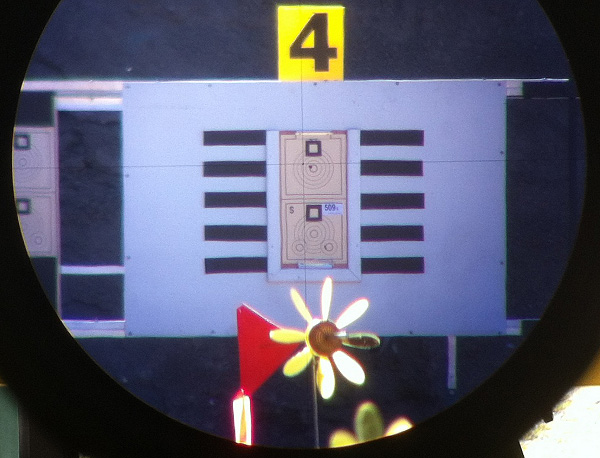
Here is the actual 200-yard, 5-shot group Charles shot in the video. Photo (by Stuart Elliot) taken through the lens of Huckeba’s 50X March scope (reticle has 1/16th MOA Dot).
Analyzing the Fine Points — What Makes Huckeba So Good
Short-range benchrest shooter Boyd Allen saw some interesting things in Huckeba’s WBC performance, as captured on video. Boyd noticed Huckeba’s smooth gun-handling and efficient loading. But Boyd also spied some interesting equipment, including an innovative joystick “handle-caddy”.
1. Low Friction Bags — When Huckeba slid his rifle, there was very little apparent friction. The front bag features the new 3M material (ScotchLite) on the sliding surfaces. The rear Protektor bag has ears of the same low-friction material.
2. Pause Before Chambering — While he was watching the flags and deciding when to start firing, Charles kept his first round in the action, but out of the barrel’s chamber, probably so as not to heat the cartridge and change the round’s point of impact.
3. Ammo Caddy on Joystick Arm – Charles shoots a Right Bolt/Left Port action, so he pulls his rounds with his left hand. Note that Huckeba’s record rounds rest in a small, wood ammo caddy attached to the end of the joystick shaft. Look carefully, you’ll see the wood ammo block in place of the normal black ball at the end of the joystick. That allows Charles to pull shots with the absolute minimum of hand movement. Ingenious! Huckeba is very fast, with a great economy of motion. I believe that because his ammo was literally at hand, Charles was better able to keep his focus on aiming and the flags.
4. Smooth-Cycling BAT Action — Note how smoothly Huckeba’s action operates. When Charles lifts the bolt handle (to extract a round and cock the firing pin), this does not disturb the rifle. Likewise, as he closes the bolt, the gun doesn’t wobble. The smooth action allows Charles to hold point of aim even when shooting relatively quickly. Huckeba’s BAT action is chrome-moly steel. Some shooters believe this metal makes for a smoother action than stainless steel or aluminum.
5. Long-Wheelbase Stock — The wood and carbon fiber stock is light, long, and stiff. Yet, importantly, the stock is also well-damped. The longer-than-average stock length (with extended forearm) seems to help the gun track well without jumping or rocking. The longer forearm allows a longer “wheelbase”, effectively shifting the weight distribution rearward (less weight on the front, more weight on the rear). This places a greater share of the gun’s weight on the rear bag, as compared to a more conventional benchrest stock. Huckeba’s stock, built by Bob Scoville, is at the cutting edge of short-range benchrest design. Its light-weight balsa wood and carbon fiber construction provides a combination of stiffness and vibration damping that allows its relatively long fore-end to be fully utilized to increase the weight on the rear bag (always an issue with 10.5-pound rifles).
To learn more about this benchrest stock design, read the comments by stock-builder Bob Scoville in our PPC with Pedigree story in our Gun of the Week Archives. Bob observed:
“There is a lot more to the structure of the stocks than meets the eye. The carbon fiber skin with which I cover the stocks creates a light, tough exterior surface. However, this contributes very little to the overall performance of the stocks. The real strength and stiffness is the result of an internal beam utilizing balsa core/carbon fiber technology.
This type construction can be found in aircraft, race cars, powerboats, and sailboats. It is interesting to note, balsa has the highest strength to weight ratio of all woods and carbon fiber is one of the lowest stretch (modulus of elasticity) relative to weight of all materials. The marriage of these two materials is common in the high-performance world. Additionally, balsa is used commercially for vibration dampening and sound reduction.”
Video find by Boyd Allen. Video by Stuart Elliot of BRT Shooters Supply, Brisbane, Australia.
Farley Manufacturing has just introduced a new gravity-fed cartridge caddy that puts your rounds right next to your rifle’s loading port. Farley’s new G-Feed Cartridge Elevator has a unique switchback-type feed path that provides high capacity in a compact unit. This unit is handy and fast to use. Farley says that, with a little practice, a skilled benchrest shooter can run five shots in less than 18 seconds. We believe that — provided a shooter has quality rests, a stock that tracks well, and good technique.
The G-Feed Elevator is held up by a 3/4″-diameter spring steel gooseneck (similar to 50s-style lamp support arm). You can easily adjust the gooseneck to the exact height and angle you want. (But Farley recommends at least 10 degrees of “tilt” to ensure proper feeding.)
Made from machined 6061 aluminum, the G-Feed Caddy ranges in price from $125.00 to $160.00 depending on cartridge size. Currently three sizes are offered: PPC, BR/PPC, and .284 Winchester. The BR/PPC model holds 22 rounds of BR cases or 23 rounds of PPC cases. The larger .284 Win model has a 25-cartridge capacity.
Product Tip from EdLongrange. We welcome reader submissions.
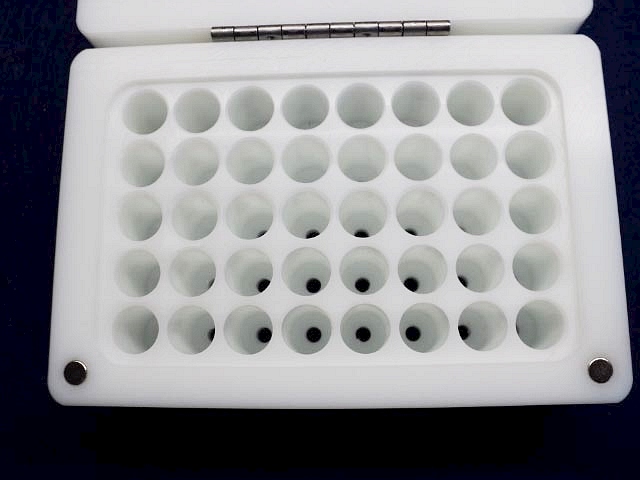
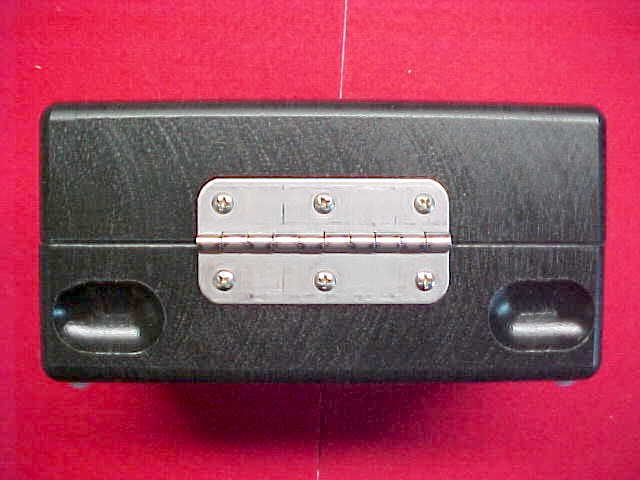
Up in Wisconsin, a gentleman named Joe Maisto crafts some exceptionally nice competition cartridge boxes. Each box is hand-machined (no molds, no CNC), with the holes precisely fitted to the cartridge you shoot. Joe has been building his boxes since 1996, first from wood, and now from more durable (and easier-to-clean) polymers. Joe started with a hinge-top 25-round box (with magnetic latch) for short-range benchresters. He still makes that box, but now he also offers 40-round boxes, high-top boxes (for bigger, taller cartridges), open top cartridge blocks, and combo blocks with holes for cases and a built-in tray. Our buddies in the short-range benchrest game say the Maisto boxes are perfect for carrying rounds from the loading bench to the firing line. GO TO Joseph Maisto website.
25-Round Cartridge Boxes
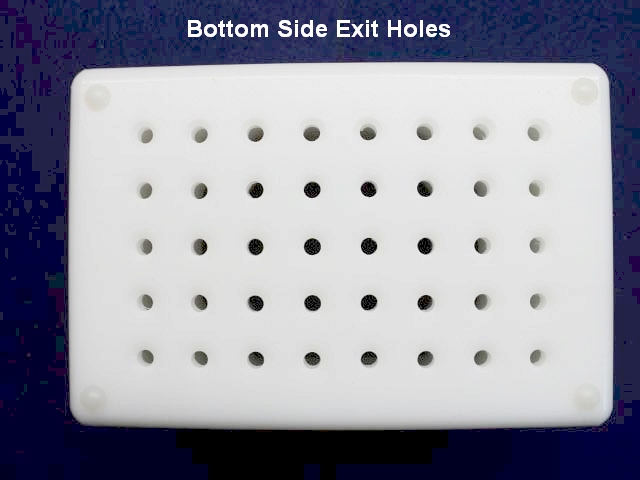
These units were designed in 1996. The originals were machined of Walnut, Cherry, or Birch. They were lovely, laborious, and expensive. To make the price more affordable, the wood units have since been retired in favor of high density polyethylene (HDPE). The front holes are separated for “record rounds”. Holes are bored with a minimum of clearance, and up to the shoulder. Additionally, each cartridge slot has a smaller hole in the bottom to allow debris to exist. These $60.00 boxes feature a quality stainless steel hinge with small but strong magnets that provide secure closure. While these were originally crafted for PPC cases, Joe offers various hole diameters for different-sized small cartridges.
40-Round Cartridge Boxes
For those who want more capacity (for longer strings of fire), Joe offers 40-round cartridge boxes. These allow shooters to change loads on the line, or simply have more rounds in a single box. With finger grooves front and back, the 40-rd boxes work for both left and right handers. Just like the 25-rd boxes, the 40s have a stainless hinge and magnetic closure. Price is $130.00.
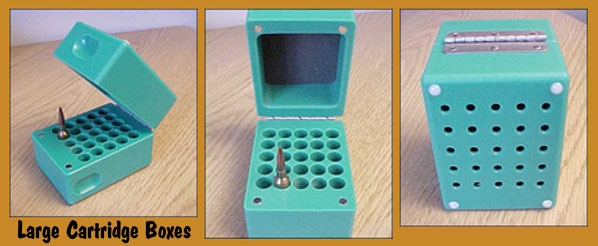
Large Cartridge Box
Joe’s Large Cartridge Boxes are taller to accommodate the bigger cartridges used for long-range shooting. These feature magnetic latching and and bottom exit holes, just like the Joe’s original PPC boxes. Joe notes that, for some cartridges, the Large Boxes “have 20 holes instead of 25 because of the larger cartridge head size”. When ordering the Large Boxes, you need to specify cartridge dimensions and cartridge overall loaded length (COAL). Price is $65.00 per box.
Cartridge Blocks
These cartridge “blocks” are made from the same material as Joe’s cartridge boxes. Each has finger grooves and exit holes. Joe says: “The size of the block is perfect for manipulating primed cases under a powder measure where space is a factor.” The 20-round block costs $19.00. Joe also offers a version with a recess on one side for empties. These have either 10 or 14 holes and cost $28.00.
Joseph A. Maisto www.benchrest.com/maisto
3647 Debby Lane
Franksville, Wl 53126
PH: (262) 886-1610
Email: jmaisto [at] wi.rr.com
Want to invest in a gun-making milestone, with authentic “PPC Provenance”? Here is a rare opportunity to acquire a set of guns that forged new frontiers for rifle accuracy. Dave Kiff, founder of Pacific Tool & Gauge, is selling a consecutive built and numbered set of four (4) benchrest rifles which belonged to Ferris Pindell, one of the fathers of the PPC cartridge. These four game-changing guns were custom-crafted by Pindell with help from his friend and fellow PPC inventor Lou ‘Doc’ Palmisano.
Dave Kiff tells us: “These are the four rifles that June Pindell had sold me a while back. I have #1, #2, #3 and #4 of Ferris Pindell’s original custom-made Benchrest rifles. These are consecutive builds. I am selling all four at cost! Several collectors (and one museum) have offered a generous amount of money for only one or two of them, but I would hate to split them up. I would much rather sell all four of them complete for $6,900.00 and keep them all together. There are two PPCs and two BRs from what his wife told me. June told me these are the rifles that Ferris and ‘Doc’ Palmisano built when they created the PPC cartridge. This would be a great addition to any collection or a great start for anyone interested in shooting competition, as the rifles look very usable.”
For more information, call Yvette of PT&G at (541) 826-5808, or send email to yvette [at] pacifictoolandgauge.com .
Sale tip by Boyd Allen. We welcome reader submissions.
Editor’s Note: Sometimes proven old designs are just as good as the latest technology. In the capable hands of Robert Vadasz, the scratched and well-used 11-year-old Smith & Wesson revolver shown below has won three PPC National Championships and the 2011 National Police Shooting Championship (multiple guns used). Here’s a profile of a great shooter and his trusty old wheelgun.
Story by Lars Dalseide, for The NRA Blog
When I first approached U.S. Border Patrol Agent Robert Vadasz about profiling the guns he used to win the 2011 National Police Shooting Championship — his third in four years — he had just completed the final stage of the Revolver 1500 Match. A match that he won with a score of 1490-117X. A match in which he used his Bob Jones PPC revolver.
“It’s a .38 Special Smith & Wesson,” said Vadasz. “My Bob Jones PPC revolver. The very first competition gun that I ever had built … probably back in 2000″. Fitted with Hogue Monogrip, the .38 hasn’t been tinkered with since the day it arrived. “Exact same gun,” said Vadasz. “It’s never been worked on. It’s never been changed. I won all three of my PPC National Championships with this gun. It’s real special to me.”
In a 2001 NRA Law Enforcement Division Newsletter, gunsmith Bob Jones talked about his work on PPC pistols: “I started working on pistols in the Navy, and it kind of stuck — it was something I really enjoyed doing,” said Bob, thinking back to his days as a Naval armorer who tinkered with .45s.
Bob’s typical modifications to a Smith & Wesson revolver include fitting a Shilen barrel, bobbing the hammer (cutting off the cocking spur), adding an Aristocrat Sight Rib, tuning and smoothing the trigger, and installing a trigger stop. The Shilen barrel increases accuracy, adds some additional weight for stability, and its increased size (and surface area) helps with heat dissipation.
Get ready for a major new technology that could change the benchrest game. Carlos (Carlito) Gonzales, a benchrest shooter (and Professor of Engineering) from Argentina, has perfected a horizontal, external “floating” cartridge loader that can reliably feed PPC cartridges as fast as you can work the bolt.
We have received a report that Gonzales’s fast-feeding device has been approved by the NBRSA for use in benchrest matches. Pascal Fischbach told us: “I had an email September 17th from Gene Bukys, [stating] that the board of directors of the NBRSA approved the use of the ‘[Gonzales] manual cartridge feeder’ for use in NBRSA competitions.” [Editor’s note: We don’t yet know if the device is approved for all NBRSA benchrest matches, or just short-range matches.] Pascal added: “The device was presented at the delegates meeting of the WBC11 in France and approved for use during the World Championships. The next step for Carlito will be to market it. He is also willing to license the concept, plans, and methods to a machinist capable of manufacturing it in the USA.” See Discussion Thread.
External Horizontal Cartridge-Feeder
The Gonzales loading device is an open-ended, covered metal tray situated on the left side of the action (but it does not touch the gun — it is supported by an arm attached to the front rest). This feeds into the left-side loading port. The cases are gravity-fed, but the shooter has positive control over feeding. A cable with a push-button control runs from the magazine down to the rear foot of the pedestal rest. You just push the button to drop one cartridge from the magazine. We don’t know exactly how the cartridge is released in the magazine itself, but in the video below you can see how the push-button works.
You push the button as soon as a spent cartridge ejects (watch Carlito’s left hand in the video above). It is a clever set-up that works very, very fast. The video shows Carlos running five cartridges through his action in just 9 seconds (time marker 00:31 – 00:40). That’s fast! On a repeat viewing focus on Carlito’s left hand to see how he works the push-button cartridge dispensing control.
Credit to Pascale Fischbach for sourcing this story and video link.


 Craters may look interesting on the moon, but you don’t want to see them on your primers. Certain mechanical issues that cause primer craters can also cause primer piercing — a serious safety problem that needs to be addressed. If you have a gun that is cratering primers (even at moderate pressure levels), there is a solution that works with many rifles — send your bolt to Greg Tannel to have the firing pin hole bushed.
Firing Pin Hole Bushing by Greg Tannel
 .009″ — The Record That Stood for 40 Years.


 AccurateShooter.com Forum members often ask: “Is there a reasonably-priced ammo box that fits PPC and BR cases just right?” The answer is yes — check out the

 3. Ammo Caddy on Joystick Arm – Charles shoots a Right Bolt/Left Port action, so he pulls his rounds with his left hand. Note that Huckeba’s record rounds rest in a small, wood ammo caddy attached to the end of the joystick shaft. Look carefully, you’ll see the wood ammo block in place of the normal black ball at the end of the joystick. That allows Charles to pull shots with the absolute minimum of hand movement. Ingenious! Huckeba is very fast, with a great economy of motion. I believe that because his ammo was literally at hand, Charles was better able to keep his focus on aiming and the flags.






 Want to invest in a gun-making milestone, with authentic “PPC Provenance”? Here is a rare opportunity to acquire a set of guns that forged new frontiers for rifle accuracy. Dave Kiff, founder of


 Story by Lars Dalseide, for


