This Gun Digest book has become a “go-to” resource for NRL22 and PRS Rimfire (RF) shooters. Key topics included in this 2021 Edition full-color Gun Digest book include: rimfire semi-autos and how they work; bolt-action accuracy; match shooting skills; DIY precision gunsmithing; hunting with rimfires; and the future of the rimfire market.
With the growth of rimfire tactical competition, the .22-Caliber rimfire rifle is more popular than ever. Every major gun manufacturer has brought at least one new .22 LR rimfire rifle to the market in the last two years. Gun Digest’s Rimfire Revolution has extensive coverage of new models from major manufacturers.
The .22 Long Rifle (.22 LR) is the planet’s most popular ammunition type and firearm chambering. The .22 LR is used in the Olympics by 3P marksmen, but it also serves benchrest competitors, NRL22 shooters, backyard plinkers, small-game hunters, and tactical trainers. With the expansion of NRL22 matches (and the PRS equivalent), the humble .22 LR is undergoing a major resurgence in the USA. And with centerfire reloading components being so costly and difficult to find, many folks are shooting less centerfire, but way more rimfire.
This 272-page book also covers .17-caliber rimfire cartridges: 17 HM2 (Mach 2), 17 HMR, and 17 WSM. These are all excellent varmint rounds, with the 17 WSM effective out to 250 yards. The 17 HM2 will run in a normal .22 LR action and feed from standard .22 LR magazines. So, for most rifles, all you need to do a .22 LR to 17 HM2 conversion is a barrel switch. That gives your rimfire rig twice the versatility. Shoot .22s and .17s with the same gun.
NRL22 — Challenging Practical Competition with .22 LR Rifles
The USA has seen a big growth in rimfire tactical matches over the last five years. Right now there are probably ten times as many rimfire tactical matches as sanctioned PRS and NRL centerfire matches. The reason is simple — rimfire ammo is much less costly, and clubs can run challenging rimfire tactical matches at nearly any outdoor gun range that allows shooting out to 200+ yards.
NRL22 Competition — Tactical Rimfire Matches
The NRL22 match format is a great shooting discipline. NRL22 offers a high fun factor at relatively low cost. You don’t have to reload match ammo. A couple of 50-round boxes of .22 LR ammo will get you through the match. While some people bring lots of gear to matches, that’s by choice and not by necessity. You can keep it simple and still be competitive (and win).
Tips for NRL22 Competitors by Jonathan Ocab
I am a match director at my gun club and run our local NRL22 matches. People often ask me for tips for competing in NRL22. First, I recommend getting the course of fire for the month in advance and practicing those stages at the range. Here are other specific tips that should help NRL22 competitors improve their gun-handling and match results.
1. Dry Fire Practice — If you are not able to do live fire practice at the range, I encourage shooters to practice their shooting positions at home via dry fire. Setup props or barricades with pasters or other faux targets on a wall in the garage or inside the house and run through each stage.
2. Scope Magnification Level — The most common issue I see with newer shooters in NRL22 is the tendency to maximize their scope magnification. The timer will start, and the shooter gets into position on a target, but the scope is set to 15x or higher and the shooter can’t find the target. The shooter lowers the magnification, locates the target, and then increases the magnification again, takes the shot, transitions to another target, and repeats the process of decreasing magnification, locating target, etc. Novice NRL22 shooters should try using the mid-range magnification. Try shooting 7x-12x and learn to balance field of view and target image.
Many guys getting started in long range shooting are confused about what kind of scope they should buy — specifically whether it should have MIL-based clicks or MOA-based clicks. Before you can make that decision, you need to understand the terminology. This article, with a video by Bryan Litz, explains MILS and MOA so you can choose the right type of scope for your intended application.
You probably know that MOA stands for “Minute of Angle” (or more precisely “minute of arc”), but could you define the terms “Milrad” or “MIL”? In a helpful video, Bryan Litz of Applied Ballitics explains MOA and MILs (short for “milliradians”). Bryan defines those terms and explains how they are used. One MOA is an angular measurement (1/60th of one degree) that subtends 1.047″ at 100 yards. One MIL (i.e. one milliradian) subtends 1/10th meter at 100 meters; that means that 0.1 Mil is one centimeter (1 cm) at 100 meters. Is one angular measurement system better than another? Not necessarily… Bryan explains that Mildot scopes may be handy for ranging, but scopes with MOA-based clicks work just fine for precision work at known distances. Also because one MOA is almost exactly one inch at 100 yards, the MOA system is convenient for expressing a rifle’s accuracy. By common parlance, a “half-MOA” rifle can shoot groups that are 1/2-inch (or smaller) at 100 yards.
What is a “Minute” of Angle?
When talking about angular degrees, a “minute” is simply 1/60th. So a “Minute of Angle” is simply 1/60th of one degree of a central angle, measured either up and down (for elevation) or side to side (for windage). At 100 yards, 1 MOA equals 1.047″ on the target. This is often rounded to one inch for simplicity. Say, for example, you click up 1 MOA (four clicks on a 1/4-MOA scope). That is roughly 1 inch at 100 yards, or roughly 4 inches at 400 yards, since the target area measured by an MOA subtension increases with the distance.
MIL vs. MOA for Target Ranging
MIL or MOA — which angular measuring system is better for target ranging (and hold-offs)? In a recent article on his PrecisionRifleBlog.com website, Cal Zant tackles that question. Analyzing the pros and cons of each, Zant concludes that both systems work well, provided you have compatible click values on your scope. Zant does note that a 1/4 MOA division is “slightly more precise” than 1/10th mil, but that’s really not a big deal: “Technically, 1/4 MOA clicks provide a little finer adjustments than 1/10 MIL. This difference is very slight… it only equates to 0.1″ difference in adjustments at 100 yards or 1″ at 1,000 yards[.]” Zant adds that, in practical terms, both 1/4-MOA clicks and 1/10th-MIL clicks work well in the field: “Most shooters agree that 1/4 MOA or 1/10 MIL are both right around that sweet spot.”
Rifleshooter.com does some great original research — providing “hard data” you can’t find anywhere else. Here are the eye-opening results of Rifleshooter.com’s 6.5 Creedmoor barrel cut-down test. You may be surprised at the results. Read on…
What do you get when you cut a 6.5 Creedmoor-chambered barrel down to just over 16 inches? A lot more velocity than you might think. Our friends at Rifleshooter.com conducted a remarkable barrel cut-down test with 6.5 Creedmoor test rifle, shortening the barrel from 27 to 16.1 inches in one-inch increments. Surprisingly, with a 142gr Sierra MK, the total velocity loss (as measured with a Magnetospeed) was just 158 FPS, an average of 14.4 FPS per inch of barrel length. With the lighter 120gr A-Max bullet, the total velocity loss was 233 FPS, or 21.8 FPS average loss per inch of barrel.
Test Procedure
Five (5) rounds of each type of cartridge were fired at each barrel length and the velocity data was recorded with a MagnetoSpeed V3 barrel-mounted chronograph. The rifle was then cleared and the barrel was cut back one inch at a time from 27″ to just over 16″. NOTE: During this winter test, the air temperature was a very chilly 23° F. One would expect higher velocities across the board had the outside temperature been higher.
The photo below shows how the barrel was cut down, inch-by-inch, using a rotary saw. The barrel was pre-scored at inch intervals. As the main purpose of the test was to measure velocity (not accuracy) the testers did not attempt to create perfect crowns.
6.5 Creedmoor vs. Other Mid-Sized 6.5mm Cartridges
The 6.5 Creedmoor is a very popular cartridge with the tactical and PRS crowd. This mid-size cartridge offers good ballistics, with less recoil than a .308 Winchester. There’s an excellent selection of 6.5mm bullets, and many good powder choices for this cartridge. When compared to the very accurate 6.5×47 Lapua cartridge, the 6.5 Creedmoor offers similar performance with less expensive brass. For a tactical shooter who must sometimes leave brass on the ground, brass cost is a factor to consider. Here’s a selection of various 6.5mm mid-sized cartridges. Left to right are: 6.5 Grendel, 6.5×47 Lapua, 6.5 Creedmoor with 120gr A-Max, 6.5 Creedmoor with 142gr Sierra MK, and .260 Remington.
When asked to compare the 6.5 Creedmoor to the 6.5×47 Lapua, Rifleshooter.com’s editor stated: “If you don’t hand load, or are new to precision rifle shooting, get a 6.5 Creedmoor. If you shoot a lot, reload, have more disposable income, and like more esoteric cartridges, get a 6.5×47 Lapua. I am a big fan of the 6.5×47 Lapua. In my personal experience, the 6.5×47 Lapua seems to be slightly more accurate than the 6.5 Creedmoor. I attribute this to the quality of Lapua brass.” Now that Lapua offers 6.5 Creedmoor brass with small primer pockets, the 6.5 Creedmoor is even more attractive.
The creator of Rifleshooter.com also operates a Custom Rifle Building enterprise and gun shop in Long Island, New York: 782 Custom Guns Ltd.. He tells us: “We offer an unparalleled level of gunsmith machine shop services in the Long Island region. From precision rifles (USMC M40A3/A5/A6 XM3 clones) to customized Remington 870 and Mossberg 590 shotguns, and customized 1911s, chances are if you can dream it, we can build it!”
Looking for a match-worthy PRS/NRL rig for under $2050.00? Check out Savage’s Model 110 Elite Precision, now with a $200 rebate, lowering your net cost to $1849.99 (some calibers higher price). With the purchase of a Savage m110 Elite Precision, m110 Precision, or Impulse Elite Precision rifle you qualify for a $200 mail-in rebate from Savage. CLICK HERE for rebate info.
GunsAmerica Digest completed a very thorough test of the 110 Elite Precision, declaring that this modern Savage is “Competition-Ready Out of the Box.”
The 110 Elite Precision has many notable features:
1. Modular Driven Technologies (MDT) Adjustable Core Competition (ACC) Chassis
2. Trigger adjusts from 1.5-4.0 pounds
3. Barrel comes with timed muzzle brake from factory
4. MDT Stocks easily accepts Weights and Accessories
5. Takes AICS-compatible Magazines
6. Titanium Nitride coated bolt body
This rifle boasts an excellent MDT ACC modular chassis. GunsAmerica stated: “Combined with the excellent trigger, an AR-compatible vertical grip, flared magazine well, and AICS mag system (along with a host of additional features), the 110 Elite Precision comes with everything you need [for PRS/NRL matches].” The stock has ARCA rails on the fore-end and M-LOK mounting points for accessories and/or weights. You can add an additional 9 pounds of steel to customize the balance/mass of the rifle to improve stability and minimize recoil.
The Cheekpiece and Buttpad are adjustable, along with Length of Pull (LOP).
Another reviewer noted that the 110 Elite Precision has important accurizing tweaks from the factory: “Key upgrades include a blueprinted action … Savage squared the receiver face and cleaned up the receiver threads to ensure they’re concentric with the barrel’s bore. This combination goes a long way in eliminating the occasional flyer that can ruin a good group or cause a miss in a match.” Source: GunsandAmmo.com.
Decent Accuracy with Factory Ammo
What kind of accuracy can you expect? Decent for a factory barrel and factory ammo. With Hornady 6.5 Creedmoor ammo, shooting off a sled, the test rifle delivered 1.1-MOA average groups. We would expect considerably better accuracy using a proper front rest with a bag-rider fitted to the fore-end. Likewise, the gun would almost certainly shoot better with handloads with Lapua brass and Berger bullets. Handling was good: “The Elite Precision is about as shootable as it gets. The 12.6-pound rifle produces very little recoil with the 6.5 Creedmoor cartridge, and … the ACC chassis can be weighted to control recoil even further.”
Actual owners have been impressed with the 110 Elite Precision. One buyer posted: “You couldn’t build a complete PRS rifle that is this good of a platform for even close to the price!” GunsAmerica tester Jordan Michaels concurred that this rig is a great choice for PRS/NRL factory-class: “If you’re in the market for a rifle to compete in a long-range competition, the Savage 110 Elite Precision is an excellent choice.”
This Gun Digest book has become a “go-to” resource for NRL22 and PRS Rimfire shooters. Key topics included in this 2021 Edition full-color Gun Digest book include: rimfire semi-autos and how they work; bolt-action accuracy; match shooting skills; DIY precision gunsmithing; hunting with rimfires; and the future of the rimfire market.
With the growth of rimfire tactical competition, the .22-Caliber rimfire rifle is more popular than ever. Every major gun manufacturer has brought at least one new .22 LR rimfire rifle to the market in the last two years. Gun Digest’s Rimfire Revolution has extensive coverage of new models from major manufacturers.
The .22 Long Rifle (.22 LR) is the planet’s most popular ammunition type and firearm chambering. The .22 LR is used in the Olympics by 3P marksmen, but it also serves benchrest competitors, NRL22 shooters, backyard plinkers, small-game hunters, and tactical trainers. With the expansion of NRL22 matches (and the PRS equivalent), the humble .22 LR is undergoing a major resurgence in the USA. And with centerfire reloading components being so costly and difficult to find, many folks are shooting less centerfire, but way more rimfire.
This 272-page book also covers .17-caliber rimfire cartridges: 17 HM2 (Mach 2), 17 HMR, and 17 WSM. These are all excellent varmint rounds, with the 17 WSM effective out to 250 yards. The 17 HM2 will run in a normal .22 LR action and feed from standard .22 LR magazines. So, for most rifles, all you need to do a .22 LR to 17 HM2 conversion is a barrel switch. That gives your rimfire rig twice the versatility. Shoot .22s and .17s with the same gun.
NRL22 — Challenging Practical Competition with .22 LR Rifles
The USA has seen a big growth in rimfire tactical matches over the last five years. Right now there are probably ten times as many rimfire tactical matches as sanctioned PRS and NRL centerfire matches. The reason is simple — rimfire ammo is much less costly, and clubs can run challenging rimfire tactical matches at nearly any outdoor gun range that allows shooting out to 200+ yards.
NRL22 Competition — Tactical Rimfire Matches
The NRL22 match format is a great shooting discipline. NRL22 offers a high fun factor at relatively low cost. You don’t have to reload match ammo. A couple of 50-round boxes of .22 LR ammo will get you through the match. While some people bring lots of gear to matches, that’s by choice and not by necessity. You can keep it simple and still be competitive (and win).
Tips for NRL22 Competitors by Jonathan Ocab
I am a match director at my gun club and run our local NRL22 matches. People often ask me for tips for competing in NRL22. First, I recommend getting the course of fire for the month in advance and practicing those stages at the range. Here are other specific tips that should help NRL22 competitors improve their gun-handling and match results.
1. Dry Fire Practice — If you are not able to do live fire practice at the range, I encourage shooters to practice their shooting positions at home via dry fire. Setup props or barricades with pasters or other faux targets on a wall in the garage or inside the house and run through each stage.
2. Scope Magnification Level — The most common issue I see with newer shooters in NRL22 is the tendency to maximize their scope magnification. The timer will start, and the shooter gets into position on a target, but the scope is set to 15x or higher and the shooter can’t find the target. The shooter lowers the magnification, locates the target, and then increases the magnification again, takes the shot, transitions to another target, and repeats the process of decreasing magnification, locating target, etc. Novice NRL22 shooters should try using the mid-range magnification. Try shooting 7x-12x and learn to balance field of view and target image.
Photo by Forum member GAT. Chambered in 6-6.5×47 Lapua, this rifle features a Stiller TAC30 action, Krieger barrel, Harrells brake, Konohawk Stock, and Sightron SIII 6-24x50mm scope.
Ryan Cleckner has created many good shooting videos for the NSSF, such as his excellent Understanding MOA Video. Ryan is noted for his ability to explain complex topics in an easy-to-comprehend manner. This video, covering the fundamentals of shooting, has been viewed over 3.7 million times! It’s worth watching, particularly for guys getting started in PRS/practical competitions.
In this video, Ryan Cleckner reviews proper technique for rifle shooters. A stable platform, sight alignment, sight picture, and trigger control are key fundamentals to shooting properly. This is basic stuff, but Cleckner presents it in a clear, logical fashion. This is a good video for novice shooters.
Tip on Viewing Your Reticle:
Cleckner: “Sometimes it can be difficult to focus between the target and the reticle, even with the parallax adjusted properly. I recommend you focus only on the reticle. Just like the front sight on a rifle or a handgun, that reticle is what you can control, and it’s what matters. Focus on a crisp, clear reticle, in a stable platform, and all that’s left is trigger control.”
Tip on Trigger Control:
Cleckner: “Trigger control is pretty straightforward, as long as you think about it as a continuous process, and not just one thing that happens. I like to think about it as drawing a line in the dirt. I like to think about this constant pressure that I’m adding as I draw this line straight back, and then… continuing to draw that line even as the rifle goes off. That’s the good follow-through you’ll need.”
Long Range Shooting Handbook — A Good Resource
Cleckner has authored a book, the Long Range Shooting Handbook, which expands on the topics covered in the above video. You can view Sample Chapters from Ryan’s Book on Amazon.com.
Ryan Cleckner’s LR Shooting Handbook is designed as an intro to important fundamental concepts such as MOA vs. Mils, External Ballistics, and Environmental Effects. Included are personal tips and advice based on Cleckner’s years of experience as a sniper instructor and special operations sniper.
The Long Range Shooting Handbook is divided into three main categories: What It Is/How It Works, Fundamentals, and How to Use It. “What It Is/How It Works” covers equipment, terminology, and basic principles. “Fundamentals” covers the theory of long range shooting. “How to Use It” gives practical advice on implementing what you’ve learned, so you can progress as a skilled, long range shooter.
As a long-range shooting expert, Ryan Cleckner has impressive credentials. Cleckner was a special operations sniper (1/75 RGR) with multiple combat deployments, and he has served a U.S. Army sniper instructor. Currently he works as a firearms industry executive and attorney.
Our friends, Ed Mobley and Steve Lawrence, aka the “6.5 Guys”, have written an excellent article on getting started in practical/tactical competition. If you are new to the game, these tips can help you save money, progress faster, and have more fun. Here are article highlights, but we recommend you read the full story,5 Tips for Attending Your First Precision Rifle Match, onwww.65guys.com.
We often meet people who are new to long range precision shooting, and want to improve their knowledge and skill level. However, they aren’t sure if they are ready to sign up to compete in a match. They often ask, “What knowledge or skills are necessary to compete in a match?” Others may state, “I need to purchase this gear or that gear before I can attend a match”. For those guys who have a strong interest in precision rifle shooting, and who wish to chec out a precision rifle match, below are Five Tips to make it a positive experience.
TIP ONE: Make Plans and Commit to Go
First you need to start by finding a match to attend. This may entail a little bit of research and investigative work on your part to find what matches are scheduled in the next few months. We recommend starting with any match that may be within a reasonable driving distance. This may likely be a local “club” match, many of which are held on a regular basis. These make great venues because it will provide an opportunity to meet some of the regular attendees as well as shooters that are from your geographic area. Additionally, most of the smaller matches are a little more relaxed in terms of level of competitiveness.
Once you decide on the match you want to attend, do your homework. This means finding out if you need to pre-register or pre-pay the match fee. Commit to going by registering for the match and putting it on your schedule. Be sure to find other useful information for questions such as:
— What time should I arrive?
— Is there a mandatory safety briefing for new shooters at that venue?
— What is the travel time required to get to the match site?
— How many stages will there be?
— Is there a description of the stages available before the match?
— How many rounds should you bring?
— Are there special equipment requirements? (E.g. do you need chamber flags, is there a pistol stage?)
TIP TWO: Bring What You Have
(Don’t Spend a Fortune at the Start)
Some new shooters often assume they need a custom match rifle or all of the miscellaneous shooting gear associated with long range precision shooting to compete in match. While having a Kestrel weather meter and a high quality laser range finder and other shooting accoutrements are invaluable kit, you will find other shooters at your first match that will provide you with the information and coaching you need to get on target.
In fact, the only gear you really need to bring is a scoped rifle with a bipod and ammo capable of consistently shooting within one MOA. Also, be sure to know the ballistic drops or have a ballistic drop table prepared for your rifle/ammo to dial the correct DOPE on your scope for different target ranges. Many of the other participants at the match will be willing to let you borrow a support bag, bipod, tripod or other gear if you need one — just ask. Don’t use the excuse of not having the right gear to delay getting out to a match!
One reason not to make a big initial investment in a new rifle and assorted gear before competing, is we’ve seen a number of people come into the sport and try it for a year and then make the decision to move on to something else.
TIP THREE: Be Prepared to Learn
As a new shooter at a match, there is no better opportunity to learn. We often look to our local club matches as a group ‘training’ session to prepare for the bigger matches. You will find competitors at all levels of skill and many of your fellow shooters will enthusiastically provide helpful advice once they learn you are new to the sport. Take advantage of the opportunity to ask questions if you would like ideas for how to engage a stage, but also be sure to do more listening than talking as you receive guidance and tips from more experienced competitors.
Watch and observe other shooters and how they approach and ‘game’ a specific stage or course of fire. You’ll begin to recognize which shooting positions work best for different scenarios, and maybe even come up with some new ones that no one has thought of before.
Seeing what the better shooters do is an invaluable instructional tool. You can use your smart phone’s video camera to record other shooters (with their permission). When you’re ready to shoot, ask another shooter to record your performance. Watching yourself will point out needed areas of improvement.
After each match conduct an informal after action review and summarize for yourself the things that went well and what you should continue to do. You should also identify the specific shooting skills you should develop and make a plan to integrate the appropriate practice drills into your practice sessions. Finally, if you maintain a shooter’s data book or journal you’ll want to note things such as:
After Action Review – How you did, what went well, things you need to work on in practice. Stage Observations – Successful methods used for specific courses of fire. Note barricades, positions used, specific gear used for stages. Gear Observations – How your rifle/gear performed, what new items you should add to your “buy list”.
TIP FOUR: Be Safe and Have Fun
You’ve all heard a parent or teacher say, “It’s all fun and games until someone loses an eye.” The same can be said of the shooting sports. Safe handling of firearms is the number one rule at any match, and comes before the FUN part in terms of importance.
Before all matches start there will always be some form of a mandatory safety briefing. Make sure you know, understand, and follow any unique safety protocols for the match you attend. Some matches require all rifles have chamber flags inserted and are stowed in bags/cases while not on the firing line — other matches may not. If you run afoul of any safety rules, you risk the chance of being disqualified from a stage or worse, the entire match.
The second rule is simply have fun. This starts with having a good attitude throughout the day. Keep in mind that as a new competitor you should think of a match as a solid day of practice and training. If you blow a stage, use it as an opportunity to diagnose what you could have done differently or what you need to improve on — then smile and drive on.
Any day at the range or shooting is a good day. A match is an opportunity to hang out with like-minded people who are passionate about shooting and impacting targets far-far away. Life is great when you are doing what you enjoy!
TIP FIVE: Make Friends
There is no better way to meet lots of precision rifle shooters and make friends than at a match. The people that attend the tactical precision matches on a regular basis are those that have ‘fallen into the deep end of the pool’ and are really into the sport. As a result, they have become part of the local precision shooting community. As you strike up conversations at the match, find out if your new-found friends visit specific forum boards or social media outlets, or if there are other matches they attend.
Precision shooters tend to congregate and share information in different corners of the Internet. It will serve you well to meet some of the guys in person at matches and be able to connect a face to a screen name. As you develop your friendships and develop a level of trust, you will find opportunities become available to shoot with others in your local area, or get ‘read-in’ on a secret honey-hole of a spot to shoot long distance. Additionally, the local shooting community will often find it more convenient to sell or trade gear and equipment locally than deal with buyers/sellers that are out of state.
Getting Started in PRS/NRL — One Man’s Story
My name is Jeff Cosgrove. I have shot for 20+ years but I found my interest in shooting was dwindling over time. I got somewhat bored with shooting paper at 100 yards or plinking cans out in the desert. About 3 years ago I decided I wanted to shoot long range. I picked up a used MPA in .300 Win Mag and started shooting long range with a new buddy. That day I fell in love with guns all over again.
With that new .300 WM I found my reloads were not up to my expectations (high ES/SD), so I purchased all new reloading hardware. One of my purchases was a used Benchsource Annealer. The guy I bought that from asked if I had ever tried PRS and he invited me to check out a match. So I went to a local PRS event as a spectator. I looked at many rigs and took notes. By the end of the day I knew this was something I really wanted to do. I then acquired a used chassis rifle that I thought would work well for PRS.
After working with that first PRS rifle, a 6.5 CM with Stiller Tac30 action, MDT chassis, and Proof Carbon-wrapped barrel, I quickly learned that gun did not handle and balance the way I hoped. It was too light in the front, the ergos were poor, and scope eye relief was not optimal. So I decided to build my own GEN 2 PRS rifle, a switch-barrel rig that I now use in competition. READ FULL Story HERE.
Load Development Using 6.5 Guys Custom Spreadsheet
To hold and analyze his load development data, Jeff uses the spreadsheet from 65Guys.com. this can really help identifying your best load. The Excel spreadsheet is detailed, yet makes it simple to analyze your data. You can even copy and paste your chronograph data if your chrono logs on to a SD card.
In this 6.5 Guys video Steve provides an overview and tutorial for using the Excel load development analysis model that he has developed. The Excel Load Development Analysis Spreadsheet version 2.0 is FREE. Download from the 6.5 Guys Load Development Page using this LINK for XLSM spreadsheet.
NOTE: If that direct link does not work, CLICK HERE to go to the 6.5 Guys website page, then look for the “Load Development Analysis Model Version 2.0″ link in the second paragraph.
In this video Steve explains some key statistical concepts for performing load data analysis. He also provides tips and guidance for determining the optimal load for your rifle as you analyze the load data you’ve collected.
Good Resource for PRS/NRL Newbies — Practical Shooter’s Guide
Marcus Blanchard, $19.98 Paperback, $9.99 Kindle
Thinking of getting started in the Practical/Tactical shooting game? Looking for ways to be more stable when shooting from unconventional positions? Then you may want to read Marcus Blanchard’s Practical Shooter’s Guide (A How-To Approach for Unconventional Firing Positions and Training). Unlike almost every “how to shoot” book on the market, Blanchard’s work focuses on the shooting skills and positions you need to succeed in PRS matches and similar tactical competitions. Blanchard provides clear advice on shooting from barricades, from roof-tops, from steep angles. Blanchard says you need to train for these types of challenges: “I believe the largest factor in the improvement of the average shooter isn’t necessarily the gear; it’s the way the shooter approaches obstacles and how they properly train for them.”
This impressive 15-round group was shot by Jim See of Elite Accuracy.
Different Shooting Disciplines Demand Different Levels of Precision/Accuracy
In the rapid-fire 3-Gun game, you could probably “clean” most stages with a 2-MOA rifle. By contrast, in the short-range group benchrest game, to compete with the best, you’ll need a rifle that shoots in the “ones” (i.e. 0.1-0.19 MOA) in perfect conditions. In 1000-yard F-Class competition, the top shooters want a rifle that will hold one-third-MOA of vertical at that distance.
What is your standard of accuracy? How good is “good enough”. Jim See, a skilled gunsmith and successful PRS competitor, recently answered that question for his tactical discipline. For the kind of matches Jim shoots, he likes to have a rifle that will hold half-MOA for five (5) shots, 3/4-MOA for 15 shots, and 1 MOA for twenty shots. Remarkably, Jim’s rifle can do that with factory ammo. Above is an impressive 15-shot group shot with .260 Remington Federal Premium Ammo.
“I say it all the time, my loads need to print 5 under 1/2″, 10 under 3/4″, and 20 under 1″. It’s simple, if a hot barrel will keep 20 rounds fired in succession under my standard it will be a good barrel and load for Precision Match Shooting. Federal Premium Gold Metal Match .260 with Sierra bullets made the cut for me today. 15 consecutive shots under 3/4 MOA.” –Jim See
It’s said that you “can never have too much accuracy”, but there are acceptable standards for each discipline, and they’re not the same. A 100/200 yard Benchrest shooter will be sorely disappointed with a rifle/ammo set-up that can only deliver half-MOA. On the other hand, a PRS competitor like Jim See can achieve great success with a lesser degree of precision. This means you can save time and money. You can run your barrels longer between cleanings, and you don’t have to go “full OCD” when loading your ammo. The PRS shooter does not need to weigh-sort primers, or load powder to single-kernel standards. Proof is the performance. Jim See recently took third place at the Spearpoint Shootout, and he has been a podium finisher at other events. Learn more about Jim’s gunsmithing and training operations at EliteAccuracy.com.
Download This Load Development Target
Jim’s target seemed a bit familiar. AccurateShooter.com created this Diamond and Dot Target a few years back. On each aiming point, there are high-contrast black horizontal and vertical lines for aligning your cross-hairs. The gray circle lets you see the bullet impacts above, without obliterating the red diamond, which is quite useful for precise aiming (we put fine cross-hairs on the points of the diamond). This target sheet includes data entry tables below each of the three aim points. There are many other free targets out there, but this format is very popular. We’re pleased to see Jim using it. You can download this and dozens of other FREE Targets from the AccurateShooter.com Target Page.
Are sound suppressors useful in competition shooting? In some disciplines, and in venues where sound “moderators” are permitted, the answer is “yes”. In a past edition of Shooting Sports USA eZine, you’ll find an interesting article about the use of sound suppressors (aka “cans”). The article explores the use of suppressors in Europe and in tactical matches in North America. You’ll also find an explanation of the rules and regulations governing suppressor ownership and use in the United States.
Shooting Sports Editor Chip Lohman tests three rifles from the bench and found that sound suppressors did not harm accuracy. In fact, all three test rifles (one each in .223 Rem, .308 Win, and .338 Lapua Magnum), shot slightly better 5-shot groups at 200 yards when a suppressor was fitted to the barrel. However, the suppressors did alter point of impact. Interestingly, velocity standard deviation (SD) values were lower with suppressors in place for all three test rifles. This observation calls for further study.*
So the use of suppressors in competition could be a good thing. However, in the United States, current NRA rules prohibit the use of sound suppressors. NRA Rule 3.16.1 subsection (a) states: “Sound Suppressors are not authorized for use in High Power competition.” In addition, there are some practical problems with suppressors — the heat rising off of a naked suppressor can create mirage problems (that’s why some shooters wrap their cans with a cover).
Despite such issues, now commonly see suppressors on rifles used in tactical matches and PRS/NRL events. For example, many competitors in the Steel Safari field challenge match use suppressors. The photo below shows our friend Zak Smith competing in the Steel Safari with his suppressed Accuracy International rifle.
Commentary — What Can We Conclude?
Obviously, this three-rifle SSUSA test was not definitive. One well might observe different results with different types of suppressors, fitted to different kinds of rifles. Mounting a suppressor to any barrel will certainly affect harmonics and “tune”. But this SSUSA study does suggest that tactical shooters, who are allowed to use suppressors in competition, may find that the benefits of suppressors (significantly reduced recoil and less noise) outweigh any meaningful accuracy loss, at least in PRS-type matches.
NOTE: The article cautions that one should not extrapolate too much from the SD numbers, given the low number of test shots. Chronograph-maker Ken Oehler, when asked to comment on the SD values stated: “[You should] report the observed SDs, but draw no conclusions until… you can do more testing with larger sample sizes.”
Qualifications to Obtain a Suppressor
To legally obtain a suppressor, you must fill out Federal Forms and pay a $200 fee to the ATF. You must also pass BATFE background checks and otherwise comply with Federal and state laws. States can regulate suppressor ownership or use, so be sure to check the laws in your area. On the federal level, the process to acquire a suppressor is regulated under the National Firearms Act of 1934.
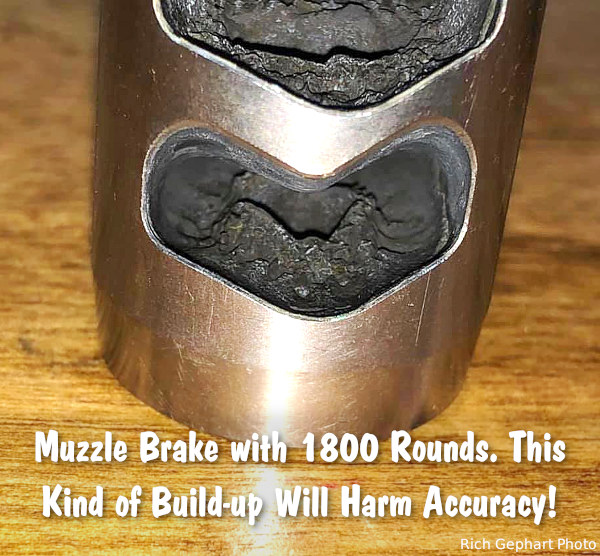
Many hunters and precision rifle competitors use muzzle brakes because these ported devices reduce felt recoil significantly. That makes a real difference getting back on target for quick follow-up shots. While many rifle owners appreciate the benefits of muzzle brakes, they may also neglect their brakes, allowing hard carbon and powder residue to build up. Not good. You should regularly clean your muzzle brake to remove fouling and carbon build-up.
As Mark Edgreen posted: “Carbon build up on the crown and in the brake is a recipe for poor accuracy.” And another gunsmith reported that customers complained about guns that “shot out way too early” but they only needed to have the brakes cleaned.
Gunsmith and PRS/NRL competitor Jim See recently reminded his Facebook Fans about the importance of cleaning muzzle brakes: “How many times do I have to say it? You need to maintain your rifles. Clean your muzzle brakes people!”. Jim, who runs Elite Accuracy LLC, notes that hard carbon build-up in brakes can definitely harm accuracy. Look at this example:
Muzzle Brake Cleaning Methods
There are various methods for cleaning a brake, we list a variety of techniques, but we would start with NON-corrosive ultrasound. You’ll want to remove the muzzle device before doing these tasks.
1. Use Ultrasonic Cleaning Machine with cleaning solution. This may be the most efficient method: “I place my brake in the ultrasonic cleaner. Shiney as new.” (Jim Moseley).
2. Spray with commercial Carb Cleaner and brush. Then apply anti-corrosion coating.
3. Soak in half hydrogen peroxide and half vinegar. Suggestion: “Let sit over night and carbon melts off. Brush remaining carbon off, rinse and put the brake back on.” Apply anti-corrosive before mounting.
4. Soak in 50/50 solution of water and white vinegar and brush. (Be sure to apply anti-corrosion coating, such as Eezox, after soaking).
5. Tumble in liquid solution with stainless pins. Comment: “Comes out slightly faded, but perfectly clean on stainless, non-painted brakes though.” Warning — do NOT do this with threaded brakes — tumbling could affect threads of screw-on brakes. Also, tumbling can harm painted or Cerakote finishes.
Gunsmithing Tip: By fitting the muzzle brake so that the barrel crown is slightly forward, it is easier to wipe carbon fouling off the end of the barrel. See photo: