|
|
April 27th, 2009
 We’ve learned that many first-time visitors to AccurateShooter.com may come in via a link to the Daily Bulletin rather than through our home page. As a result, they may not be aware that there is a wealth of other content available to our readers. Our Shooters’ Forum, with nearly 8,000 registered members, is one of the best places on the web to discuss precision shooting and advanced reloading. We also offer FREE Forum Classifieds. On the editorial side, AccurateShooter.com offers hundreds of pages of content, with thousands of photos. Our Cartridge Guides are considered definitive sources of tech info for popular match calibers, and our Guns of the Week articles provide in-depth reports on outstanding custom rifles, most of which have competition pedigrees. In addition, we offer videos, gear reviews, book reviews, an event calendar, and even FREE downloadable targets. We’ve learned that many first-time visitors to AccurateShooter.com may come in via a link to the Daily Bulletin rather than through our home page. As a result, they may not be aware that there is a wealth of other content available to our readers. Our Shooters’ Forum, with nearly 8,000 registered members, is one of the best places on the web to discuss precision shooting and advanced reloading. We also offer FREE Forum Classifieds. On the editorial side, AccurateShooter.com offers hundreds of pages of content, with thousands of photos. Our Cartridge Guides are considered definitive sources of tech info for popular match calibers, and our Guns of the Week articles provide in-depth reports on outstanding custom rifles, most of which have competition pedigrees. In addition, we offer videos, gear reviews, book reviews, an event calendar, and even FREE downloadable targets.
If you’re a new visitor to AccurateShooter.com, you should check out all that we have to offer. There are hundreds of informative articles to read … and they’re all free.
 AccurateShooter.com Features: AccurateShooter.com Features:
 Shooter’s FORUM Shooter’s FORUM
FREE Classified Ads
ARTICLES Archive
CARTRIDGE Guides
FREE Targets
GUNS of the Week
TECH Articles
Gun VIDEOS
Gear Reviews
Book Reviews
Event CALENDAR
COMPETITION Resources
April 5th, 2009
Sinclair International recently launched its enhanced and upgraded website. The revamped site is faster to navigate, and you’ll find it much easier to find new products and bargain specials. Congrats to Bill Gravatt and the folks at Sinclair Int’l for a job well done.

One great feature newly integrated into Sinclair’s website is The Reloading Press, a regularly-updated Blog with product info and authoritative technical articles on reloading and precision shooting. Here are some of the valuable “how-to” articles you’ll find on Sinclair’s Blog:
Determining Bullet Seating Depth
Setting Up a Full-Length Sizing Die
Shooting Non-Benchrest Rifles from the Bench
Basics of Reloading for the AR15
Methods and Benefits of Sorting Cases by Weight

The Reloading Press is a valuable addition to the online resources available to precision shooters. We commend Sinclair for investing the time and effort to provide this material at no cost to Sinclair’s customers. Click one of the links above and check it out yourself.
March 14th, 2009
 The folks at Berger Bullets have just released an interesting technical bulletin that describes methods for optimizing bullet seating depths with Berger VLDs. The document explains how to find the OAL “sweet spot” for VLDs in your rifle. Interestingly, while VLDs commonly work best seated into the rifling .010″ or more, Berger’s research indicates that, in some rifles, VLDs perform well jumped .040″ or more. This is a significant finding, one that’s backed-up by real-world testing by many shooters. The folks at Berger Bullets have just released an interesting technical bulletin that describes methods for optimizing bullet seating depths with Berger VLDs. The document explains how to find the OAL “sweet spot” for VLDs in your rifle. Interestingly, while VLDs commonly work best seated into the rifling .010″ or more, Berger’s research indicates that, in some rifles, VLDs perform well jumped .040″ or more. This is a significant finding, one that’s backed-up by real-world testing by many shooters.
The key point in Berger’s report is that: “VLD bullets shoot best when loaded to a Cartridge Overall Length (COAL) that puts the bullet in a ‘sweet spot’. This sweet spot is a band .030″ to .040″ wide and is located anywhere between jamming the bullets into the lands and .150″ jump off the lands.”
CLICK HERE to download Berger VLD Tuning Tips
Writing in the report, Berger’s Eric Stecker observes: “Many reloaders feel (and I tend to agree) that meaningful COAL adjustments are .002 to .005. Every once in a while I might adjust the COAL by .010 but this seems like I am moving the bullet the length of a football field. The only way a shooter will be able to benefit from this situation is to let go of this opinion that more than .010 change is too much (me included).”
For target competition shooters (for whom it is practical to seat into the lands), Berger recommends the following test to find your rifle’s VLD sweet spot.
Load 24 rounds at the following COAL:
1. .010″ into (touching) the lands (jam) 6 rounds
2. .040″ off the lands (jump) 6 rounds
3. .080″ off the lands (jump) 6 rounds
4. .120″ off the lands (jump) 6 rounds
Berger predicts that: “One of these 4 COALs will outperform the other three by a considerable margin. Once you know which one of these 4 COAL shoots best then you can tweak the COAL +/- .002 or .005.”
OBSERVATION and WARNING
Berger may definitely be on to something here, and we applaud Berger’s testers for testing a very broad range of seating depths. However, we want to issue a STRONG WARNING to reloaders who may be inclined to try the 4-step method listed above.
Be aware that, as you load your cartridge progressively shorter, putting the bullet deeper into the case, you will be reducing the effective case capacity dramatically. With smaller cases, such as the .223 Rem and 6mmBR, moving from .010″ into the lands to .080″ and .120″ off the lands can CAUSE a dramatic pressure rise. So, a load .010″ into the lands that may be safe can be WAY OVERPRESSURE with the bullet seated .120″ off the lands (i.e. .130″ deeper in the case, the difference between .010″ in and .120″ out).
To illustrate, using a QuickLOAD simulation for the 6mmBR cartridge, moving the bullet 0.130″ deeper into the case can raise pressures dramatically. With the Berger 105 VLD seated .010″ in the lands (with 0.220 of bearing surface in the neck), and a charge of 30.0 grains of Varget, QuickLOAD predicts 60,887 psi. (This is using ADI 2208 data, and a 5500 psi start initiation value). If we move the bullet back 0.130″ further into the case, QuickLOAD predicts 64,420 psi (even after we drop start initiation pressure to the “default” non-jammed 3625 psi value). The 64,420 psi level is way higher!
| Cartridge & Load |
COAL |
Jam/Jump* |
Start Pressure |
Max Pressure |
6mmBR, 30.0 Varget
Berger 105 VLD |
2.354″ |
+0.010″ in lands |
5500 psi |
60,887 psi |
6mmBR, 30.0 Varget
Berger 105 VLD |
2.324″ |
-0.20″ JUMP |
3625 psi |
59,645 psi |
6mmBR, 30.0 Varget
Berger 105 VLD |
2.264″ |
-0.80″ JUMP |
3625 psi |
62,413 psi |
6mmBR, 30.0 Varget
Berger 105 VLD |
2.224″ |
-0.120″ JUMP |
3625 psi |
64,420 psi |
* As used here, this is the variance in OAL from a load length where the bullet ogive just touches the lands (first jacket to barrel contact). Loading bullets to an OAL beyond that point is “jamming” (seating bullet into lands), while loading to an OAL shorter than that is “jumping” (seating bullet away from lands).
NOTE: This is only a software simulation, and the real pressures you encounter may be different. But, the point is that moving the bullet 0.130″ further down in a 6mmBR case can raise pressures more than 3,000 psi! Therefore, you must employ EXTREME CAUTION when moving your bullets that much in a relatively small case. Remember that going from .010″ jam to a very long jump will probably increase pressures in your cartridge so you MUST adjust your load accordingly.
February 22nd, 2009
 The TECH TIPS shared in this Daily Bulletin are very popular. We know there are many clever folks out there who have developed interesting tricks and procedures to load better ammo or shoot tighter groups. To share some of these “bright ideas” with our readers, we’ve decided to run a contest, rewarding the best reader-submitted Daily Bulletin TECH TIPS. The TECH TIPS shared in this Daily Bulletin are very popular. We know there are many clever folks out there who have developed interesting tricks and procedures to load better ammo or shoot tighter groups. To share some of these “bright ideas” with our readers, we’ve decided to run a contest, rewarding the best reader-submitted Daily Bulletin TECH TIPS.
Bulletin TECH TIPS Contest
We are soliciting TECH TIPS from our readers. These can include reloading advice, ways to optimize the use of tools, pointers on how to maintain/repair rifles, or even advice on how to set up your rifle better on the bags. You might also explain how to craft a simple, inexpensive tool or gadget to assist with reloading. One popular TECH TIP was from a reader who built a portable reloading bench using a Black & Decker Workmate as a base. Another guy crafted a custom jig to control cut depth with a neck chamferer. One popular reader-supplied TECH TIP explained how to fit a mirror and magnifying glass to make it easier to use a balance-beam scale. There are all kinds of good ideas… so come on and share your best tips with us.
 Contest Rules Contest Rules
To enter the contest, you must have an original idea (no copies from somebody else’s post or article), and original photos. You must submit at least 400 words explaining your TECH TIP, and provide at least three (3) good, sharp digital photos (or technical diagrams). The photos should be 640×400 or more pixels. 1024×768 is ideal. Any TECH TIP without photos/diagrams will be ineligible for prizes.
Entrants MUST supply their name, address, email address, and phone number. We must have that information for fact-checking purposes and to notify the winners.
We will select the top TECH TIPS in late April. All submissions (text and photos) become the property of 6mmBR.com | AccurateShooter.com. We will run the best TECH TIPS in the Daily Bulletin over the next few months.
Contest Prizes
The writers of the Best Four (4) TECH TIPS will each receive a prize. First Prize is an RCBS CaseMaster ($100.00 value), Second Prize is a 100-ct box of Berger Bullets (.204, .224, 6mm, 6.5mm calibers), Third and Fourth Prizes will be AccurateShooter.com T-Shirts (Large or X-Large only).
Contest Deadline
To be considered in the Contest, you must submitted your TECH TIP (500 or more words plus at least 3 photos), no later than April 10, 2009. While 500 words + 3 photos is the minimum, you can submit longer articles and more photos. It is OK to submit multiple entries.
September 1st, 2008
As a cartridge case is reloaded multiple times, burnt powder residue and carbon builds up on the inside of the case. Unless the case interior is cleaned in some fashion, eventually you’ll see a reduction in case capacity. One of our Forum members from Australia wonders about the effects of reduced case capacity: “If the capacity of the case decreases as the crud builds up, then it effectively reduces the chamber size. Wouldn’t that change the pressure produced from that of an equivalent clean case?”
Ultrasonic Cleaning Example:
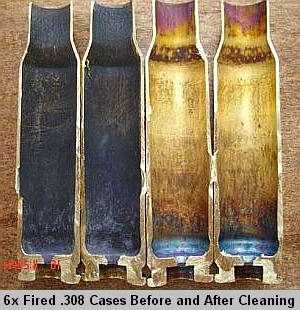
Interesting Test of Case Capacity Changes
Forum member Fred Bohl has actual test results that can help answer the above question. Fred proved that, over a 20-reload cycle, the case capacity of uncleaned cases did, indeed, decline a small amount. However, surprisingly, this did not seem to affect the actual chronographed velocity of the load. ES did increase, but Fred believes the higher ES was due to changes in case-neck tension, rather than due to the slight reduction in case capacity.
Fred reports: “Back when beginning to use ultrasonic case cleaning, part of the motivation was to get the inside clean based on the assumption that allowing burnt residue to build up inside cases would affect capacity, and, ultimately, performance. An experiment was done to test this hypothesis. The load used, 30.5 grains of RL15 behind 107gr SMKs in a 6mmBR, was selected for best group and lowest ES in prior load development. It turned out to be 92% of initial case capacity and neither “full” or compressed. (I would suspect that different powders, load weight, and total case capacity might produce very different results.)
We took 30 cases of identical initial capacity and tracked three lots of 10 each:
LOT 1: No Internal cleaning
LOT 2: Cleaned with media in tumbler
LOT 3: Cleaned with Ultrasound machine
Each case (in each lot) was shot and reloaded 20 times. The simplified results after 20 reloads of each lot were as follows:
Lot 1 (not cleaned) – 0.3 to 0.4 gr. loss of capacity, 5 to 8 fps greater ES.
Lot 2 (tumble cleaned) – 0.1 to 0.3 gr. loss of capacity, 4 to 6 fps greater ES.
Lot 1 (ultrasonic cleaned) – no loss of capacity, no detectable change in ES.
FINDINGS
There was no detectable correlation of velocity change to the lots. An oddity was that on very hot days Lot 1 velocities were, occasionally, slightly higher. [Editor’s note: That does suggest that the carbon build-up inside the uncleaned cases might cause a slight increase in pressure that shows up on hot days. Fred has posted that “A local shooter reported doing the 20 reload, no clean test on a .308 that gave a loss of capacity of 2.0 grains, doubled ES and signficant velocity changes. However, I don’t have any details on his load weight or powder.”]
NOTE: From results of another ongoing test, I believe the above differences in ES are probably due more to variance in bullet grip tension than case capacity. The ultrasound cleaned cases (LOT 3) did maintain the lowest ES, but we are not 100% sure of the reasons why. More consistent bullet seating might be the reason.
[Editor’s comment: Jason found that with his ultrasonically-cleaned cases, the inside of the necks got so “squeaky clean” that he needed to use dry lube in the necks. Jason uses the $10.95 dry lube kit from Neconos.com. This applies ultra-fine Moly powder to the neck using small carbon steel balls]

August 19th, 2008
Alliant Powder, a division of ATK, has issued the following safety notice concerning Alliant Blue Dot powder, a popular propellant for handgun loading:

Alliant offers a FREE detailed, 43-page Reloader’s Guide with recipes for shotgun, pistol, and rifle cartridges. This guide includes important safety instructions, plus reloading data for most popular cartridges. Unfortunately the guide does not yet include Alliant’s new Reloder 17 and the listed loads for centerfire rifles only include Speer bullets.

CLICK HERE to download ALLIANT RELOADER’S GUIDE (.pdf format).
August 1st, 2008
With the relentless pursuit of more velocity and the “next higher node” by many reloaders, it is important to pause and think about safety. And one has to remember that most brass will not hold up to high pressure the way Lapua or RWS does. Many readers have asked us: “How does one detect excess pressure?”. Well first, one can obviously monitor the primer pockets and measure the diameter of the case near the web. Excessive stretch or pocket loosening is a sure sign you’re running too hot. There are also many visible signs of over-pressure which you can see. Reader ScottyS provided this comparison photo of cases, showing the tell-tale signs of over-pressure.

Scotty tells us: “These samples were from a lot of Federal soft-point hunting ammunition that were fired in a custom .308 with a chamber on the tight side (although still allowing a .308 Winchester GO gauge). Among the pressure symptoms were heavy recoil, sticky bolt lift, and the left case had to be manually removed from the boltface. This demonstrates why: 1) you should never assume that all lots of factory ammo are the same (and safe); and 2) you should ALWAYS wear eye protection. This also shows how high pressure can spike once you approach maximum load levels.”
Scotty noted that there was a big pressure difference between the left case and the right case, although both were fired sequentially, and both were from the same lot of ammo. So take heed–always take precautions when testing new ammo, even if it is factory-loaded.
July 21st, 2008
The PACT XP Chronograph is now on sale at MidwayUSA for $206.99, $23.00 off the regular price. (Sale ends July 31, 2008.) This unit contains many advanced features, is fairly easy to set up, and has a handy control unit with built-in printer. An enhanced “Glint Guard” bullet detection system provide greater sensitivity in a wide range of light conditions.

The PACT XP chronograph can also be upgraded with infrared screens. We highly recommend the infrared option, a $49.95 upgrade from PACT. You can also purchase the PACT Pro XP with infrared kit directly from PACT for $269.95.

The PACT Pro XP includes improved “Mark 6″ Skyscreens, mounting bracket, storage case, and a 9-volt battery. With software available from the PACT website, you can transfer your data to a laptop or home computer. The PACT Pro XP also features a built-in ballistics calculator that uses your actual chronograph and bullet data and corrects for windage, elevation, and temperature. PACT provides a bullet database with the Ballistic Coefficient (BC) of nearly all bullet designs from popular bullet-makers.
July 9th, 2008
Even in today’s digital age, many reloaders prefer the simplicity and reliabilty of a balance scale for weighing powder charges. In this Bulletin, we reported that our own PACT digital scale suffers from fluctuating read-outs. The weight reading drifted up to 0.3 grains in less than an hour. (PACT Story). LTRDavid has come up with a clever upgrade to an O’Haus-type scale that makes the weighing process easier for those of us with old eyeballs. He simply mounts a magnifying glass in front of the balance marker, using two clamps.
Pretty ingenious wouldn’t you say? We wonder why the scale-makers didn’t offer a small magnifier as a factory option long ago. For more smart reloading tips, check out David’s website, LTRDavid.net.
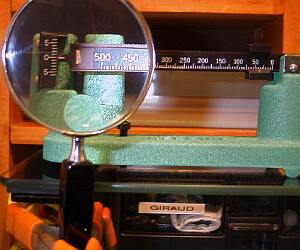
When working with balance beam scales, be sure you have the device leveled. Even a small amount of tilt will throw off the measurement. We’ve seen folks who keep their scale on a shelf or storage area, and then take it out for use. That’s fine, but remember than your loading bench may not be uniformly level on all sections. Unless you put the scale in exactly the same place on the bench every time (at the same angle), you may have to re-set the level. Likewise, if you take the scale to a range, be sure to re-level it to your new working surface. And remember that is it just as important to level the scale front to back as left to right. Most scales have a leveling adjustment, but that will only level the scale left to right. If your bench has a bad front to back slant, you may have to build a corrective base for your scale.
July 8th, 2008
 The RCBS ChargeMaster 1500 has been our top-rated electronic powder dispenser. It is very popular with precision centerfire rifle reloaders who benefit from weighing every charge. It’s a very versatile tool that can make your reloading much more efficient. The RCBS ChargeMaster 1500 has been our top-rated electronic powder dispenser. It is very popular with precision centerfire rifle reloaders who benefit from weighing every charge. It’s a very versatile tool that can make your reloading much more efficient.
MidwayUSA has slashed the price on the RCBS ChargeMaster 1500 Powder Scale and Dispenser Combo, item 772151. The selling price is now just $272.46, marked down from $309.99. That’s a $38 savings.
Is the Unit Worth Buying?
Most RCBS ChargeMaster 1500 owners have been very happy with the devices. If you click the “Reviews” Tab on MidwayUSA’s ChargeMaster Page, you can read 87 reviews. The vast majority of the reviews are five stars. However, as with all electronic products, a small number of ChargeMasters have required repair or replacement. We do think RCBS now has most of the bugs worked out, and they are generally quite reliable (provided incoming voltage is uniform and the device is leveled properly.)
The units we tested showed excellent dispensing accuracy, delivering the desired charge within + or – 0.1 grain, 48 out of 50 times with H4350. (Weights were confirmed with a high-end digital laboratory scale.) The ChargeMaster works especially well for long, extruded powders, which are favored by long-range shooters. You can also speed the dispensing process by starting out with a scoop of powder on the pan (below your desired weight), and letting the ChargeMaster “top off” the charge.
ChargeMaster VIDEO
CLICK HERE to watch an excellent short video demonstrating the RCBS ChargeMaster 1500 in action. It shows how to calibrate the machine, how to weigh powder, and how to remove powder when you’re done.

|


