This gun production chart appears in the July 2018 issue of Shooting Industry magazine. Factoid: U.S. total firearms production has more than tripled since we launched this website in 2004.
Move over Ruger, Remington, Savage … Smith & Wesson is the new Big Kid on the Block. According to 2016 firearms industry production reports from Shooting Industry magazine, S&W has taken over as the number one firearms producer in the United States. That’s good news for S&W, but bad news for Ruger, which had been number one for the past eight years.
Smith & Wesson was the top overall U.S. firearms manufacturer in 2016 with 2,120,910 firearms produced, a stunning 44% increase over the previous year. Ruger was second in 2016 with 1,981,590 firearms, an 18.8% gain over 2015. The last time S&W was ranked number one was way back in 2007. While S&W is generally seen as a handgun maker, it also produces a wide variety of rifles both under the S&W banner and its subsidiary Thompson/Center Arms. Last year the historic Smith & Wesson enterprise was officially renamed American Outdoor Brands Corp. (NASDAQ: AOBC) in part to reflect the fact that it is more than just a handgun maker.
Key Industry Production Numbers in 2016
There were some other interesting facts revealed in the Shooting Industry magazine report:
1. For only the second time ever, U.S. gun-makers produced over 10 million firearms (rifles, pistols, and shotguns) in 2016. The 10,664,318 total was nearly 20% more than in 2015.
2. For the first time ever, in 2016 American gun-makers produced over 4 million rifles. The 4,239,335 rifle output set a new high mark, that was 6.5% more than the previous record year, 2013 (3,979,570).
3. A record number of handguns were also produced in 2016. The 5,576,366 pistols produced in 2016 marked a 7.9% increase from 2013, the previous record-holding year (5,167,008).
4. Gun sales increased dramatically in 2016, influenced by fears over the election: “NICS background checks achieved record-setting levels in 2016 — with 15,700,471 background checks (NSSF-Adjusted), an increase of 10.2 percent over 2015 (14,244,240 [NSSF-Adjusted]).”
Top Overall U.S. Firearms Manufacturers in 2016
(Percentage change over 2015)
• Smith & Wesson: 2,120,910 (+44.0%)
• Ruger: 1,981,590 (+18.8%)
• Remington: 1,240,665 (+8.5%)
• SIG Sauer: 633,533 (+27.4%)
• O.F. Mossberg: 508,466 (+0.8%)
Top U.S. Rifle Makers:
(Percentage change over 2015)
• Remington: 769,942 (-0.5%)
• Ruger: 701,992 (+6%)
• Anderson Mfg.: 453,763 (+51.1%)
• Smith & Wesson: 396,710 (+89.7%)
• Savage Arms: 311,878 (-18.3%)
Top U.S. Handgun Makers:
(Percentage change over 2015)
• Smith & Wesson: 1,724,131 (+36.4%)
• Ruger: 1,279,415 (+27.4%)
• SIG Sauer: 581,807 (+26.6%)
• Glock: 368,140 (+70%)
• Kimber: 223,785 (+69.6%)
Current Outlook for American Firearms Industry
So far, 2018 has been a fairly tough year for the gun industry: “The U.S. firearms industry finds itself at a crossroads in 2018. Facing attacks from state governments, financial institutions, tech companies and students (all while experiencing sluggish demand) it’s currently in a challenging position.” However, there are many indicators that the gun industry is still strong. Kimber and Tauras have both opened new factories in the U.S. Southeast, and Remington has emerged from Chapter 11 Bankruptcy with creditors exchanging debt for equity: “It is morning in Remington country — We are excited about the future…” said Anthony Acitelli, Remington CEO.
For more insights, read the full version of the U.S. Firearms Industry 2018 Report. There are many more detailed charts and tables breaking down production, imports, and exports. This appears in the July 2018 issue of Shooting Industry Magazine.
For this chart, HowMuch.net analyzed data from the NSSF’s 2017 Firearms and Ammunition Industry Economic Impact Report to estimate gun industry output and jobs in each state.
The firearms industry is an important element of our nation’s economy. Manufacturing products for shooting, hunting, and LEO/military applications employs hundreds of thousands of workers and contributes billions of dollars to America’s GNP. The mainstream media demonizes firearms and attempts to ridicule gun-owners, but the fact remains that guns and ammo are an important part of American culture and a key element of our economy.
Guns America recently published an article showing the economic impact of the firearms industry on a state-by-state basis. This features a “money map” of the USA created by HowMuch.net based on data from the National Shooting Sports Foundation. The number one state is Texas, with $3.83 Billion of economic impact and 23,070 jobs. That may not surprise you, as many quality companies such as Shilen are based in the Lone Star state. However, you may be surprised by the number two state, California, given that jurisdiction’s liberal legislature, and anti-gun policies. But there are still plenty of guns, shooting accessories, and ammo produced in California, generating $3.64 Billion in firearms industry economic activity and over 20,000 jobs. Given that job number, perhaps California’s politicians should think twice before they enact more misguided anti-gun laws.
Weatherby is relocating from California to Wyoming, citing California’s high corporate taxes and hostile business regulations.
Here are Top Ten States, ranked in order:
1. Texas: $3.83B and 23,070 jobs
2. California: $3.64B and 20,610 jobs
3. Minnesota: $2.43B and 11,650 jobs
4. Florida: $2.39B and 14,850 jobs
5. Illinois: $2.18B and 10,681 jobs
6. North Carolina: $1.98B and 11,427 jobs
7. Pennsylvania: $1.94B and 12,436 jobs
8. Massachusetts: $1.86B and 7,116 jobs
9. New York: $1.84B and 8020 jobs
10. Ohio: $1.61B and 11,772 jobs
Ranking third overall is Michigan with $2.43 Billion in economic activity, followed by Florida close behind in fourth place with $2.39 Billion. The NSSF’s data reveals some surprising trends, notes Guns America: “While pro-gun states like Texas ($8.83B) boast a large firearms industry that employs thousands of people, states with stricter firearms regulations like California ($3.64B), Minnesota ($2.43B), Illinois ($2.18B), and Massachusetts ($1.86B) also incorporate relatively large gun industries.”
Looking at that list, it is noteworthy that, along with California, another anti-gun state, New York, has made the Top Ten. New York’s Governor Andrew Cuomo has attacked the firearms industry and the NRA, and the N.Y. State Department of Financial Services has pressured Banks and Insurance companies to stop doing business with gun industry firms. One wonders if Governor Cuomo and his minions have considered the full consequences of their anti-gun activism. Guns America observes: “it is notable that gun makers can survive at all in states like New York, California, and Massachusetts. Attacking firearm makers and sellers is one of the most common anti-gun tactics, but some companies still manage to scrape by despite increasing regulations and public hostility.”
Though it has moved much of its production to Alabama, Remington retains production facilities in New York state. The Remington enterprise was founded in 1816 by Eliphalet Remington in Ilion, New York, as E. Remington and Sons. Remington is America’s oldest gun maker and is still the largest U.S. producer of shotguns and rifles.
Good news for fans of Big Green — Remington remains a going concern…
On 5/17/2018, Remington Outdoor Company (“Remington”) announced that it has emerged from Chapter 11 after successfully implementing the reorganization plan recently approved by the Delaware Bankruptcy Court. Basically, the bankruptcy proceeding has converted debt into equity allowing Remington to move forward with significantly reduced debt load and associated interest costs.
“The Plan provides a comprehensive balance sheet restructuring of the Company and converts over $775 million of the Company’s debt into equity,” stated the Remington press release.
“In addition, the Plan provides the Company with a new Asset Based Loan (“ABL”) facility of $193 million, the proceeds of which will refinance its prior ABL facility in full, a new $55 million First-In, Last-Out Term Loan and a new $100 million Term Loan.” The Plan received support from over 97% of the voting Term Loan Lenders and all of the voting Third Lien Noteholders.
“It is morning in Remington country,” said Anthony Acitelli, Chief Executive Officer of Remington. Mr. Acitelli continued, “We are excited about the future — producing quality products, serving our customers, and providing good jobs for our employees.”
Old Shared Cancelled, New Shares Issued to Previous Lenders
The bankruptcy essentially extinguished old Remington stock shares and replaced them with new shares: “As provided in the Plan, all shares of Remington’s common stock issued prior to the commencement of Remington’s bankruptcy proceeding were cancelled upon emergence, and Remington has issued new shares of common stock and, in some cases, warrants, to the holders of its previously outstanding funded debt in return for their allowed claims against Remington.”
Remington Has a Storied History
Founded in 1816 by Eliphalet Remington in New York, Remington is the oldest continuously-operating gun manufacturer in the United States. Even with its present difficulties, Remington still sells more sporting rifles and shotguns than any other American company. Remington has developed more cartridges than any other U.S. company. And it is the only American company that sells firearms AND ammunition under its own name.
Magpul has released a new modular chassis that should generate interest in tactical and PRS circles. Priced at $999.95, the Magpul Pro 700 Chassis is expensive — you can buy a complete Ruger Precision Rifle for less than that. But it looks like it has some impressive features that may justify the cost. The buttstock section features fast, ambidextrous controls for LOP and cheek-piece height. The Pro 700 features a strong, internal aluminum sub-chassis, with an universal bedding block section that works with both right-hand and left-hand actions.
Video Shows Key Features of Magpul Pro 700 Tactical Rifle Chassis:
Q: So what do you guys think — Is this thing worth a grand ($1000)?
Magpul Pro 700 Chassis Features
— Anodized machined 6061-T6 billet aluminum V-bedding block, body, adjustment knobs and fore-end with high-strength, injection molded polymer body covers.
— Ambidextrous bedding block for left-hand or right-hand actions.
— Folding stock with push-button hinge has left- or right-folding capability.
— Stock won’t interfere with bolt handle when folded.
— Fixed Stock adapter for non-folding use.
— Overall LOP adjustment range is 13.25” – 15.125”
— Butt pad adjusts up 1.33″ and down .90″ and 5° left or right.
— Comb height adjustment has a 1” range with locking knob for cheek piece.
— Cheek riser features a 3-position fore/aft adjustment.
— Polymer grip with 5° forward edge sweep, with 3/4” fore/aft trigger-reach adjustment.
— M-LOK® slots on fore-end for accessory mounting.
— Integrated AICS-pattern mag well for AICS-pattern short action magazines.
— Large trigger guard allows use with gloves and aftermarket triggers.
— Low-profile, anti-snag ambidextrous magazine release.
Product find by EdLongrange. We welcome reader submissions.
If you watch just one episode of Shooting USA TV this year, it should probably be this week’s hour-long SHOT Show Special. Tonight, March 14, 2017, enjoy a full hour of SHOT Show coverage. Jim Scoutten’s team of gun journalists work hard every January, bringing you highlights from the gun industry’s largest trade show. Jim, son John Scoutten, and other staffers prowled the 12 miles of aisles in the Sands Convention Center in Las Vegas, visiting many of the 1,600+ exhibitors. This episode provides a “first look” at the new guns, optics, and gear introduced for 2018. Click HERE to learn more about this week’s 2018 SHOT Show episode.
2018 SHOT Show Highlights: Ruger Precision Rimfire, Sig P365, M1A in 6.5 Creedmoor, MR-10 Bolt Action Comp Rifle, Colt Competition 1911, and a whole lot more.
Shooting USA Hour AIR TIMES
Shooting USA’s SHOT Show Special will air for a full hour on Wednesday, March 14, 2016 on the Outdoor Channel. Here are the air times, but you should check your local schedule. Look for Shooting USA TV on the Outdoor Channel.
Wednesday Night Schedule:
Eastern Time – 9:00 PM
Central Time – 8:00 PM
Mountain Time – Check Listings
Pacific Time – 9:00 PM
Here are some of the 50+ new products featured on the SHOT Show Special:
Remington Outdoor Company Inc. (Remington) will file for Bankruptcy in the Delaware Federal Court. The North Carolina-based company is pursuing Chapter 11 Bankruptcy to reduce its $950,000,000 in debt. According to Reuters, Remington hopes to work out an agreement with its creditors to write off about $700 million in debt obligations. That would permit Remington to sustain manufacturing operations and retain most of its work-force. In announcing the Bankruptcy filing, Remington executives stated that the company will continue to operate as usual during the bankruptcy proceedings.
(Reuters) – Remington Outdoor Company Inc., one of the largest U.S. makers of firearms, said on Monday it had reached a deal with its creditors to file for Chapter 11 bankruptcy to slash its $950 million debtload. Remington said it will receive $145 million in bankruptcy financing to fund the company through the Chapter 11 process.
Cerberus Will Yield Control of Remington to Creditors
If the pending deal with creditors goes through as planned, Cerberus, the private equity group that currently controls Remington, will lose ownership of the company. Through the bankruptcy, according to Reuters: “the company’s creditors, which include Franklin Templeton Investments and J.P. Morgan Asset Management, will exchange their debt holdings for equity in the company.”
Two months ago, AccurateShooter.com noted that Remington was considering Bankruptcy. Our report noted that an earnings decline left Remington few options. In early December, Fox News reported: ““The rifle and shotgun manufacturer’s third-quarter sales plunged 41% as demand for firearms dried up. That led Remington to report adjusted earnings before interest, taxes, depreciation, and amortization that were 78% lower year over year. Over the first nine months of 2017, the company has produced a $60.5 million net loss, compared to a $19.1 million gain in the prior-year period. And with its credit rating in the trash bin, the future is bleak for ‘America’s oldest gunmaker’. Today, debt on the company’s books has ballooned to almost $1 billion[.]”
Remington Has a Storied History
Founded in 1816 by Eliphalet Remington in New York, Remington is the oldest continuously-operating gun manufacturer in the United States. Even with its present difficulties, Remington still sells more sporting rifles and shotguns than any other American company. Remington has developed more cartridges than any other U.S. company. And it is the only American company that sells firearms AND ammunition under its own name.
SHOT Business, an NSSF publication, has just revealed a host of new-for-2018 rifles. These new rigs will all be on display at SHOT Show in Las Vegas next month. These new rifles run the gamut — from muzzle-loaders to modern-day Tommy Guns. As you’d expect, there are AR-platform rifles, and modular PRS-type rigs. There is also an interesting new rifle from Savage that looks very Tikka-esque.
SHOT Business reports: “For what seems like a long time now, new rifle introductions at the SHOT Show have been dominated by variations on the AR15/AR10 platform. But times are changing, to paraphrase one of Bob Dylan’s most famous lines. For 2018, we continue to see line extensions to accommodate the 6.5 Creedmoor, but we’re also seeing the emergence of a new trend—dedicated long-range precision sport and hunting rifles. Yes, there are still a few new MSRs that will draw intense interest, but for the first time in a decade, the new rifles at SHOT are a balanced lot.”
Among the many new rifles to debut at SHOT Show 2018, here are three that caught our eye. Savage has upgraded its hunting rifle offerings with adjustable, internal-chassis stocks, Bergara continues to build a good reputation, and Mossberg has rolled out a new modular rifle that could provide stiff competition to Ruger’s popular RPR.
Savage — New Stocks for 110 Series
We are impressed with the New Savage 110 line-up featuring higher-quality, user-adjustable stocks. The all-new AccuFit system/stock allows shooters to customize length of pull and comb height. The new AccuStock features a rigid chassis embedded in the stock. Savage has a full line of revamped 110s with these enhanced stocks. For example, the Savage 110 Storm shown here features a detachable-box magazine, a stainless-steel barrel, and a gray synthetic stock. It is available in many chamberings from .223 Remington to .338 Winchester Magnum. MSRP: $849. Visit SavageArms.com.
Bergara — Upgrades to HMR
The HMR Pro is an upgraded version of the HMR, introduced in 2017. The new-for-2018 HMR Pro includes a Cerakoted stainless action and barrel with a threaded muzzle plus a upgraded TriggerTech trigger. All HMR Pros ship with a “proof of accuracy” sub-MOA target. Available chamberings are: .223 Remington ( 1:8″-twist), .22/250 Remington (1:9″-twist), 6mm and 6.5mm Creedmoor (both 1:8 twist, and .308 Winchester with a 1:10 twist. Weight range: 9.2 to 10.10 pounds. MSRP: $1,695. Visit BergaraUSA.com.
Mossberg T&T — Tactical and Traditional
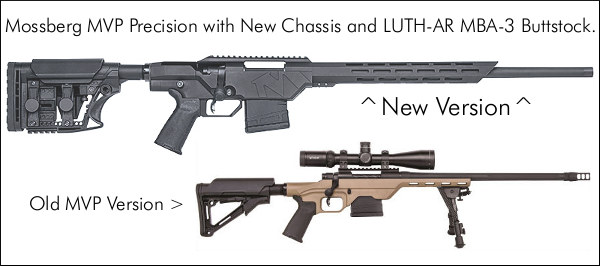
The MVP Precision looks good. It has all-new chassis with a longer fore-end up front and a fully-adjustable LUTH-AR MBA-3 stock in the back. Every rifle comes with an LBA trigger, and 20″ or 24″ threaded and free-floated medium bull barrels are standard. The action features an oversize bolt handle with a Picatinny rail on top. Available chamberings include the 6.5 Creedmoor (no surprise) and 7.62×51 (.308 Win). Mossberg will also offer combo packages fitted with Vortex Viper HS-T riflescope. Visit Mossberg.com.
For fans of traditional wood-stocked rifles, Mossberg has added the 6.5 Creedmoor chambering to the top-of-the-line Revere model. This rifle features a high-grade European walnut stock with rosewood fore-end tip and grip cap. As you can see in the video above, the Mossberg Revere offers a lot of style and performance for the $823 MSRP.
New Rifles tip from EdLongrange. We welcome reader submissions.
There are tough times ahead for Remington. Fox News reports that: “Privately-held Remington Outdoor is now at risk of declaring bankruptcy after a collapse in sales and profits. Saddled with debt, the historic gun manufacturer is short on avenues for escape.” (LINK). Fox News adds:
“The rifle and shotgun manufacturer’s third-quarter sales plunged 41% as demand for firearms dried up. That led Remington to report adjusted earnings before interest, taxes, depreciation, and amortization that were 78% lower year over year. Over the first nine months of 2017, the company has produced a $60.5 million net loss, compared to a $19.1 million gain in the prior-year period.
And with its credit rating in the trash bin, the future is bleak for ‘America’s oldest gunmaker’. Today, debt on the company’s books has ballooned to almost $1 billion[.]”
Financial analysts report that Remington’s earnings decline will further harm the company’s already poor corporate credit rating. That means Remington must pay even higher interest rates to borrow money, further bleeding cash and decreasing profitability. This, in turn, accelerates the momentum towards filing bankruptcy. Fox explains: “With the firearms and ammunition manufacturer burning through cash as a result of falling sales, S&P expects it will undertake a restructuring within the next year.”
Other large American gun industry companies have seen their stock value drop dramatically this year. Vista Outdoor (Savage, RCBS, CCI etc.) is down 62% since December 9, 2016, while American Outdoor Brands (Smith & Wesson) has dropped 36%.
Remington Has a Storied History
Founded in 1816, Remington is the oldest continuously-operating gun manufacturer in the United States, and remains one of the USA’s oldest commercial enterprises. Even with its present difficulties, Remington still sells more sporting rifles and shotguns than any other American company. Remington has developed more cartridges than any other U.S. company. And it is the only American company that sells firearms AND ammunition under its own name.
The Remington enterprise was founded in 1816 by Eliphalet Remington in Ilion, New York, as E. Remington and Sons. In 2016 Remington celebrated 200 years of history. American Rifleman TV explored the history of Remington Arms Company in a TV special which focuses on many of the company’s most noted firearms. Here is a preview:
The science behind annealing during the manufacture of new cases is well-established. What happens after that, when we repeatedly reload and anneal those same cases, has always been somewhat of a “dark art”. To help separate scientific fact from fiction, the creators of the Annealing Made Perfect (AMP) Annealer machine have conducted detailed studies of cartridge brass. The AMP Team’s studies offer some remarkable insights, while disproving a number of myths about annealing. Will annealing tighten your groups? The evidence of these studies shows it could.
The test results are fascinating. The team compared brands of brass, sectioning brass to examine both alloy composition and thickness from case mouth to case-head (bottom). They also examined how carbon build-up affects next tension. And they determined how brass changes over multiple loading cycles. They even did a series of bullet-pull tests to analyze factors affecting neck tension. Here are some of the key subjects in the reports:
Brand by Brand Analysis — How the cartridge brass alloy varies among different manufacturers. Bullet Release and Neck Tension — Tensile Bullet-Pull tests show factors affecting neck tension. Neck Tension and Carbon — How carbon build-up inside the neck affects “neck tension”. SS Tumbling and Hardness – How tumbling with stainless media affects brass hardness. Case Cleaning (Ultrasound and Tumbling) — How case cleaning affects annealing. Multiple Loadings — How brass performs when annealed every reload over 10+ cycles.
You really should read the reports — there are some fascinating revelations. The AMP team made longitudinal sections of various cases to show different case wall thicknesses and head geometry. These examples also show how the hardness of the case varies from the case mouth to the case-head. Both virgin and used, annealed cases were examined.
Bullet-Pull Tests — Using advanced tensile test equipment, AMP experimented with different combinations of dies, reloading sequences, and neck hardness to ascertain the best practice.
Carbon Inside Your Case-Necks May Be a GOOD Thing
AMP’s testers found carbon in necks can be beneficial: “Even with identical interference fit and neck hardness, as the carbon layer increased (microscopically), the force to draw the bullet decreased. It would appear the carbon acted as a lubricant. Interestingly, the [pull force] standard deviation also improved, i.e. the case to case variation in the force required to draw the bullets decreased.”*
Read the Full Test Reports
The AMP team’s objectives were to clarify some misconceptions on just what annealing does and does not do, and also to establish the best practices for consistent results. They have consulted with three independent certified metallurgy laboratories to produce some definitive information. So far, the Stage 1 and Stage 2 reports have been released. The studies include a report on the general physical properties of cartridge brass, including grain structures, hardness scales, time/temperature annealing information, and what can cause de-zincification.
The FULL REPORTS, including comprehensive appendices, are found here:
Examining Different Brands of Brass — What the Tests Revealed
Is Lapua brass harder than Norma? Is Lake City better than Remington? You’ll find answers to these and other questions in AMP’s annealing studies. One of the key findings in Stage 2 of Amp’s research is that brass from different manufacturers does vary in the distribution of material in the walls of the case.
Stage Two Conclusions:
— Different brands of the same cartridge cases can require different annealing power settings due to differing case wall thickness in the neck and shoulder region. The greater the mass of brass to be annealed, the greater the power requirement. Lot to lot variation within the same brand can occur for the same reason.
— The bushing die used in this set of tensile bullet pull tests gave significantly more consistent results than the standard neck die with expander ball.
— Cases should be annealed every reload in order to get the best repeatability.
Case Variations: Brand to Brand, and Lot to Lot
Here is a sample from AMP’s test report:
Analyzing Different Brands of Brass
In our Stage One report, we demonstrated that there is insufficient variation in alloy composition between brands to account for the variations we experience when annealing different brands of the same cartridge case. We therefore sought to confirm that it is the mass of brass to be annealed which accounts for the difference. Below are sectioned samples of four different brands of .223 Remington cases.
Both the Lapua and Norma neck walls are 314* microns (0.01236”) at the mouth. The Lapua neck wall thickens to 348 microns at the junction of the neck and shoulder, and the Norma neck thickens to 325 microns. Through the shoulder, however, the walls of both cases thicken to 370 – 380 microns. Once past the shoulder, they both taper back to 314 microns, before starting to thicken again, moving towards the case head.
The Lapua case requires AMP Program 47 to anneal correctly. It is the heaviest of the four cases tested through the shoulder region. The Norma case, which is only slightly lighter through the same region, needs Program 43.
The Remington case is very similar to the Lapua and Norma cases in the neck region, but it actually thins fractionally through the shoulder and front section of the body. The AMP program setting for Remington 223R is P32.
The Lake City case is the thinnest throughout of all four samples. It only requires Program 28.
The above samples clearly demonstrate that the mass of brass to be annealed is critical to the power requirement for correct annealing.
To see how the AMP Induction Annealing Machine works, watch this video:
* However, in Stage Two of AMP testing, the testers experimented with clean, carbon-free necks with dry lube. There was some indication of greater tensile pull consistency with dry-lube, but AMP plans to do more testing.
A while back, RifleShooter online magazine published a list of the purported Ten Best Bolt-Action Rifles of All Time. Ten classic rifle designs (including the Remington 700 and Winchester Model 70) were featured with a paragraph or two explaining their notable features.
“Best” Lists Stir Controversy…
These Top 10 lists are always controversial. While most readers might approve of half the entries, there are always some items on the Top 10 list that some readers would challenge. Here is RifleShooter’s Top 10 list. What do you think? Are there some other bolt-actions that are more deserving?
1. Springfield M1903
2. Mauser 98
3. Winchester Model 70
4. Remington Model 700
5. Weatherby V
6. Sako L61/AV
7. Savage Model 110
8. Ruger M77
9. Tikka T3
10. Mannlicher-Schonauer


 Top Overall U.S. Firearms Manufacturers in 2016