|
|
August 1st, 2009
The Smallbore Prone Championship matches have concluded at Camp Perry, and we have a new National Champion, Spc. Joseph Hine from the U.S. Army.

As the Smallbore prone champ and winner of the Critchfield Trophy, Specialist Joseph Hein was awarded the Critchfield trophy plaque, a gold tone national champion, a medallion, a Chiappa blackpowder muzzleloading rifle, and a $500 Visa gift card. Here are the top finishers and their final scores.
1. SPC Joseph Hein – 4790×354 | National Champion
2. Richard Fowke – 4790×355 | Civilian Champion
3. Reya Kempley – 4789×374 | Woman Champion
Runner-up Richard Fowke was crowned the Civilian Champion. Fowke actually outscored Hein by one “X”. But as a British citizen, Fowke wasn’t eligible for the U.S. National Championship. Third-Place finisher Reya Kempley also received an award as Top Female Shooter. Reya also shoots a 6mmBR centerfire rifle in international 300m competition.

This story was provided by the NRA Blog. You’ll find many more photos of the Camp Perry Smallbore competition and awards ceremonies on the NRA Media Relations Public Gallery. On that page, click on any thumbnail to view a slideshow of related photos.
July 25th, 2009
The NRA Blog provides daily updates from the NRA National Rifle Championships in Camp Perry. Over the past couple of days the Smallbore three-position (3P) events have been held, and the NRA Blog has syndicated videos of the competition. Linked below are Thre videos of the Smallbore 3P “optical” division. The first video shows the prone phase, while the second shows the standing event. Note that, even in the difficult standing position, the shooters can hold their rifles very steady. That takes years of disciplined training.
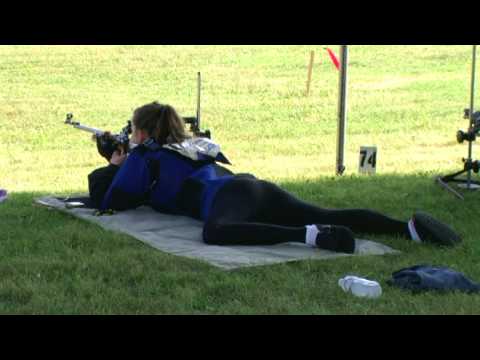

CLICK HERE to watch full-width HD versions on YouTube.com.
July 23rd, 2009
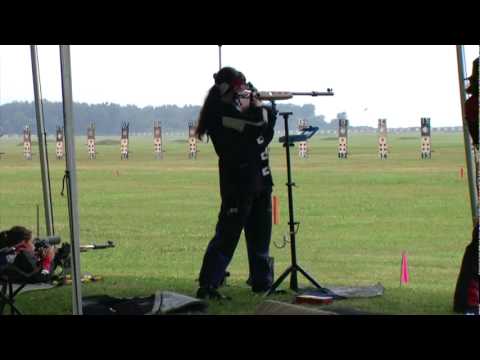
 July 22nd was smallbore practice day at Camp Perry, Ohio, site of the NRA National Championships. In this video, provided by the NRA Blog, junior three-position competitors practice their prone, standing, and kneeling positions, even as rain fell on the range. NRA correspondent Lars Dalseide reports that: “unless there’s lightening in the air, rain does little to stop things at Camp Perry.” The NRA Smallbore Championships begin with the three-position events (July 23-25), followed by a variety of prone matches running July 26-30. The CMP Rimfire sporter match is scheduled for the 26th also. July 22nd was smallbore practice day at Camp Perry, Ohio, site of the NRA National Championships. In this video, provided by the NRA Blog, junior three-position competitors practice their prone, standing, and kneeling positions, even as rain fell on the range. NRA correspondent Lars Dalseide reports that: “unless there’s lightening in the air, rain does little to stop things at Camp Perry.” The NRA Smallbore Championships begin with the three-position events (July 23-25), followed by a variety of prone matches running July 26-30. The CMP Rimfire sporter match is scheduled for the 26th also.
CLICK HERE for NRA National Championships Information and complete Match Schedule.
June 15th, 2009
Here is an interesting tool that lets rimfire shooters re-shape and uniform the tips of their 22 rimfire lead bullets. Paco Kelly’s Acu’Rzr comes in two versions, the “Phase III Nasti-Nose” and the “Phase IV Baby Scorp’n”. The Phase III tool produces a deep-dished hollowpoint (like an ash-tray) that opens quickly and efficiently. There is also a Phase III insert that creates a flatter, open dish HP for target shooting. The Phase IV Scorpion tool creates a deep hollow point with a central post in the middle. The internal post in the middle helps achieve deeper penetration in game. The designer claims that ammo modified with either tool is more accurate because the bullet diameter “comes out the same every time”.

Why re-shape lead rimfire bullets? The first reason is accuracy. The tool’s designer, Paco Kelly, claims you can improve the accuracy of budget-priced ammo by using the dish nose rod with the Phase III tool: “The dish nose forming rod is for accuracy and paper targets. It makes very sharp and clean cut holes in paper. And the consistency of the [re-shaped] bullet diameter pulls the group together.”

The main reason to use Paco Acu’Rzr tools is to improve perfomance on small game such as squirrels, prairie dogs, and jack-rabbits. Kelly says: “Unlike most commercial 22 rimfire ammo with small holes and negligible HP expansion, the Nasti-Nose will open even with standard velocity ammo. Yet it will NOT explode on contact like the hyper-velocity ammo. For small eating game, such as squirrels, the Hyper ammo is too much and the medium-velocity, hollow-pointed commercial ammo often fails to open. But not so with the Nasti-Nose.” The idea, Kelly suggests, is that you get reliable expansion with medium-velocity ammo, without destroying the game the way more expensive, hyper-velocity ammo does.
The Phase III tool costs $65.00, while the Phase IV tool costs $75.00. Both tools can be customized for target rifles or European chambers. To order, contact Paco Kelly, P.O. Box 1170, Cortaro, AZ 85652 or use this ORDER FORM.
EDITOR’s NOTE: Do NOT use this tool with premium-grade rimfire target ammo. It won’t help. Use it with the cheaper bulk-pack ammo. Also, we have not tested the reformed ammo on live targets, so you have to draw your own conclusions as to its benefits on small critters.
June 9th, 2009
Capitalizing on the strong consumer interest in AR15-style rifles, Remington Arms recently introduced its 597-VTR, a semi-automatic 22LR with AR-style ergonomics. Inside the matte black, slab-sided “upper” is the venerable Remington 597 receiver, updated with a nickel-Teflon® plated bolt, hammer and sear. On the outside, the 597-VTR features a AR-15 pistol grip, and AR collapsible stock, and a round AR-style float tube/handguard. On top of the receiver is a 1913 Picatinny-spec scope rail. Street price for the new rifle is about $450.00, complete with compact 10-round magazine. A standard Remington 597, without the tactical goodies and black paint, costs under $200.00.

Good for 3-Gun Cross-Training and Tactical Rimfire
While we snicker a bit at an older rimfire design tarted up in new tactical clothing, the 597-VTR makes sense for some users. Three-gun competitors should like this rifle. Most multi-gun match shooters use ARs for the rifle stages. With the 597-VTR, they can cross-train using inexpensive 22LR ammo, while maintaining the same basic ergonomics. For 3-gun shooters, who engage targets from a wide variety of shooting positions (often behind barriers), the collapsible stock has utility. It will allow the shooter to make his rifle more compact when practicing CQB or house-clearing stages.

With mods, the 597-VTR should also work well for the tactical rimfire discipline. The Picatinny rail makes it easy to swap over good optics from your centerfire gun. The tubular forearm should provide a strong mount for a bipod. However, for the tactical rimfire game, which is shot mostly prone, we don’t like the collapsible stock at all. Junk it. The LOP is too short, the bottom of the stock is terrible with sandbags, and the cheek weld is wrong. Tactical rimfire shooters would be wise to replace the collapsible stock with an upgraded design with longer length of pull and a proper cheekpiece. (The 597-VTR will accept most AR15 stocks). And, in reality, with a bedding job, a basic 597 in a laminated stock (see below) would probably work just as well.

June 4th, 2009
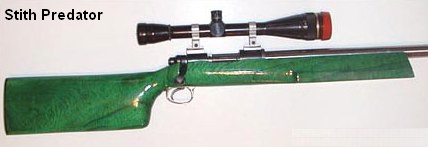
We often hear the question: “Where can I get a quality bench stock, with a wide, flat fore-end, for a rimfire action?” First, McMillan can inlet their popular Edge and Hunter benchrest stocks for rimfire actions such as the Hall, Rem 40X, and Turbo. Second, if you’re looking for a nice wood stock, contact Don Stith in Troutville, Virginia. Don’s St. Louis Plains Rifle Co. offers match-proven wide fore-end designs, inletted for most of the popular rimfire target actions: Anschutz 54, Hall, Remington 37, Remington 40X, Remington 540 or 580, Sako Finnfire, Suhl, Turbo, Ultralight, and Winchester 52. Stith also sells a rimfire sporter stock with a narrower fore-end. This is designed to meet the regulations of IR50/50 Sporter Class
Stith offers a variety of fancy woods, as well as colored laminates. Stock weight depends on your choice of wood. Butternut, Catalpa, and Sassafrass will weigh 1.5 to 1.75 pounds. Walnut and Curly Maple are 1.75 to 2.25 pounds and the laminates are approximately 2.5 pounds.

Stith “Class BR” rimfire stocks start at $220 for laminates, and $200 for solid wood, but fancy or highly figured woods can cost quite a bit more. Call Don for a quote. The popular “Predator” design (known for its great tracking) starts at $250.00. Don’s rimfire benchrest stocks are fully shaped, sanded to 120 grit, and inletted but no finish is done and they are shipped without buttplates.
May 30th, 2009
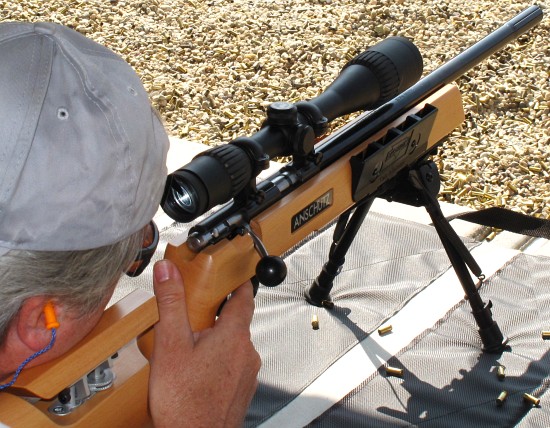
 We’ve had an Anschütz model 64-R Biathlon to play with since the first of the year, thanks to Anschütz. This is a very impressive rifle. Accuracy has exceeded our expectations. Even with relatively inexpensive Wolf Match Extra and Eley Club Xtra, the gun has shot many 1/4″ groups at 50 yards from bipod. Our ace rimfire triggerman, Joe Friedrich, has shot some 50-yard groups with 4 out of 5 shots virtually through one hole, and the fifth maybe half a bullet width further out. We’ve had an Anschütz model 64-R Biathlon to play with since the first of the year, thanks to Anschütz. This is a very impressive rifle. Accuracy has exceeded our expectations. Even with relatively inexpensive Wolf Match Extra and Eley Club Xtra, the gun has shot many 1/4″ groups at 50 yards from bipod. Our ace rimfire triggerman, Joe Friedrich, has shot some 50-yard groups with 4 out of 5 shots virtually through one hole, and the fifth maybe half a bullet width further out.
Originally, the gun came with a 2.2-lb (one kilo) two-stage trigger, suited for biathlon and silhouette. That trigger was nice, and certainly shootable, as we could get the second stage down to about 9 ounces. But Anschütz recently provided its 500 gram match trigger assembly, and that has made the gun even sweeter to shoot. The 500 gram trigger installed easily, and by adjusting two screws we got the total pull weight down to 1.13 pounds, with the second stage about 5 ounces. (Note: in the video, I said the trigger pull was about “one and a half pounds”; we later adjusted it down to 1.13 pounds, or 512 grams.)
Please enable Javascript and Flash to view this VideoPress video.
The cheekpiece adjusts for height and cant angle. Length of pull can be adjusted by means of plastic spacers. With the spacers provided by Anschütz, the LOP is about 13.3 inches. That’s still a bit short for this Editor, but the gun was still very comfortable to shoot in all positions: prone, sitting, and standing. The near-vertical grip is very comfortable in prone and, with the scope positioned well forward, you can easily get your head in the right position for scoped shooting. With its built-in accessory rail, and a $6.00 track adapter, a Harris bipod attaches easily, and you can move the bipod position fore and aft.

With its excellent ergonomics and stellar accuracy, we think the Anschütz 64R Biathlon is a superb choice for tactical rimfire matches. Plus, it’s dead-nuts reliable. By contrast, at the rimfire tactical matches we’ve covered, we’ve seen a variety of misfeeds and/or mag failures with other brands of rifles. With the Anschütz 64R, mag feeding and function has been flawless. We’ve shot over 700 rounds without a single problem.

Does the rifle have flaws? Yes, a few. First, as noted, the LOP is short for someone with long arms, even with 3 spacers installed. Second, the barreled action and bolt are prone to develop rust if you don’t keep them well-oiled. We wish Anschütz offered a more durable, corrosion-resistent finish so we didn’t have to baby the blueing after each shooting session. While the magazines fed flawlessly, the mag well is recessed and the mag release is small. This caused some fumbling when we tried to do “speed reloads.” That’s it — the complaint list is pretty small, and you could easily apply a baked-on resin finish if you wanted.
Subjectively, this gun is a hoot to shoot, and I can honestly say I’ve had more fun with this rifle than any other rimfire I’ve tested. No, it won’t rival a tuned ARA rimfire Benchrest rig, but it is still exceedingly accurate, and the gun is truly versatile. It’s ideal for tactical matches, club fun shoots, and if you lock the cheekpiece in place and use the 2.2-lb trigger, most clubs should let you use it for silhouette. The gun currently retails for about $1200.00 IF you can find one. Anschütz isn’t building many 64Rs these days, and only a handful made their way to the USA. Hopefully, our report will spur interest in the rifle and Anschütz will decide to ship more across the Atlantic.
May 1st, 2009
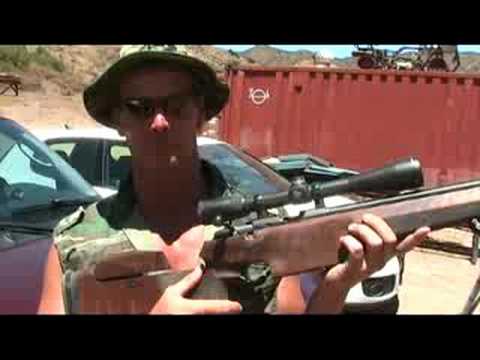
Forum Member Mark E. (Shooter65) is the proud owner of a handsome, very accurate SAKO Finnfire ‘Range’ 22LR rimfire. Fitted with a full-size stock that replicates Tikka’s Master Sporter stocks, SAKO’s Range model has the look and feel of a centerfire gun. The size and ergonomics of the Finnfire Range makes this an excellent cross-training rifle. If you want to train with inexpensive rimfire ammo with a rifle that duplicates the feel of a centerfire, the Finnfire Range is hard to beat. Mark has competed successfully with this rifle in Southern California Rimfire Tactical matches.


Mark recently replaced the factory tube with a hand-lapped Lilja barrel. The Lilja barrel has demonstrated superb accuracy. Below is a 10-shot group at 50 yards (left), and a “dot-drill” tactical target shot at 100 yards (right).
In the video below, Mark explains the features of his SAKO Finnfire ‘Range’. This video was produced before the addition of the Lilja barrel, but the gun still shot extremely well. Unfortunately, as Mark notes, SAKO has halted production of the Finnfire Range. As a result, prices are rising for this highly desirable rimfire — guns that sold for $850 two years ago are now fetching $1100.00 or more.
April 28th, 2009
 Ever wondered how and where rimfire ammo is produced? The CCI plant in Lewiston, Idaho is the main production facility for CCI and Federal rimfire cartridges. This plant also produces Hornady-brand 17 Mach 2 and 17 HMR ammo. This week, ShootingUSA visits CCI’s Idaho ammo factory during the TV show’s “Sighting In” segment. ShootingUSA’s camera crew meets with production engineers and explores the many options available among .22 rimfire ammo. CCI’s Lewiston, Idaho plant produces four million rounds every day in a wide variety of velocities and bullet designs and weights. Ever wondered how and where rimfire ammo is produced? The CCI plant in Lewiston, Idaho is the main production facility for CCI and Federal rimfire cartridges. This plant also produces Hornady-brand 17 Mach 2 and 17 HMR ammo. This week, ShootingUSA visits CCI’s Idaho ammo factory during the TV show’s “Sighting In” segment. ShootingUSA’s camera crew meets with production engineers and explores the many options available among .22 rimfire ammo. CCI’s Lewiston, Idaho plant produces four million rounds every day in a wide variety of velocities and bullet designs and weights.
 |
 |
Rick Stoeckel, CCI Ammunition Brand Manager, explains the many options offered in rimfire ammo: “The rimfire shooters today — they’re hunters, they’re plinkers, they’re target shooters. And varmint shooting is a big deal today.” CCI offers a variety of different options, Stoekel says, so “you can basically hunt, shoot targets, [do] everything with a rimfire gun.” Working with the ammo experts at CCI, during this week’s show, ShootingUSA tests various choices of .22 ammo for both accuracy and performance on game.
CLICK HERE For BALLISTICS INFO for all CCI Rimfire Ammunition.
(Once on this page, select “View Details” for the particular ammo type.)
Cowboy Action World Championships Coverage
During the same April 29th episode this week, ShootingUSA covers the 2008 “SASS End of Trail” — the World Championship of Cowboy Action Shooting held at Founders Ranch outside Albuquerque, New Mexico. End of Trail has become a significant tourist event, drawing thousands of visitors from across the United States.
CLICK HERE to visit Single Action Shooting Society Website.
Photos courtesy ShootingUSA, © 2008, TIER ONE MEDIA, LLC. All Rights Reserved
March 30th, 2009
The Browning T-Bolt straight-pull rimfire rifle is an American classic, first produced from 1965 through 1975. In 2006 Browning wisely resumed production of the fast-cycling T-Bolt. We were pleased to see the re-introduction of the T-Bolt, as the unique action is smooth and quick to use. This makes the rifle well-suited for both varminting and the new “Rimfire Tactical” discipline. With enhanced materials and improved manufacturing methods, the new-generation T-Bolt is more reliable and smoother-operating than ever.
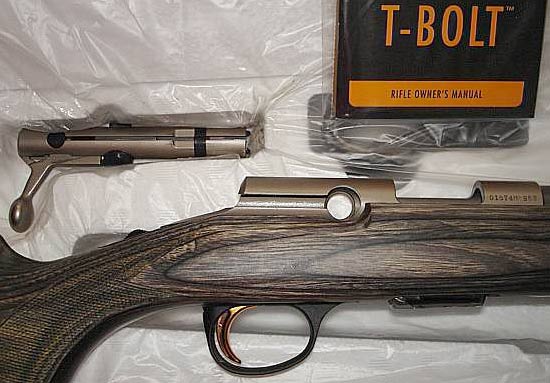
Browning Launches Left-Handed T-Bolts
Browning has added twelve new offerings to their T-Bolt rimfire rifle line for left-handed shooters. All the new models incorporate the basic design of the T-Bolt rifle but with the bolt on the left side. There are four new left-hand models in each caliber: .22 long rifle, .22 Winchester Magnum and .17 HMR.

On all T-Bolts (both right- and left-handed), receivers are drilled and tapped for scope mounts. Barrels are free-floated and have recessed crowns. T-Bolts feature a 3-lever, short-travel trigger design. Trigger pull weight is adjustable with an external screw and there is a convenient, thumb-operated tang safety.
Among the new T-Bolt models, we like the heavy-barreled Target/Varmint model. This has a satin finish checkered walnut stock with a Monte Carlo comb and wider fore-end. Suggested retail price for the .22 LR Target/Varmint is $719.00 and $729.00 for the .22 WinMag and .17 HMR guns. There is also a less expensive Sporter Model with a lighter-contour barrel.

|


