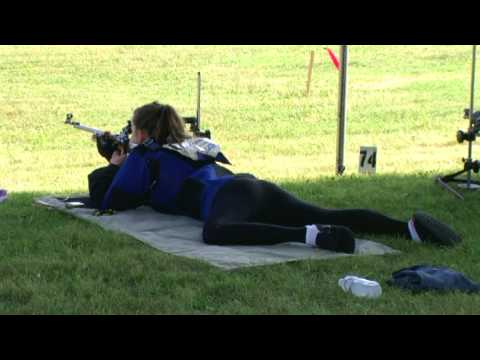
Shooting an impressive 4790-355X, SSG Shane Barnhart earned the title of National Smallbore Rifle Prone Champion, while competing this week at Camp Perry, Ohio. Finishing second and third, respectively, were 1LT Christopher Abalo, and Charles Kemp. Abalo and Kemp had identical 4786 scores, but 1LT Abalo had the higher X count. Abalo scored 344X compared to Kemp’s 338X.
Army Shooters Top the Field Story by Danielle Sturgis, The NRA Blog
SSG Shane Barnhart has been to Camp Perry since 1992, minus two years. This year is his best smallbore rifle performance. Did he come expecting to win? “I was hoping (to place in top 3),” he said. “I knew going into Any Sight that I had Abalo and Kemp, both very fine shooters, to keep up with.” What was the biggest challenge of the week? “Battling the wind,” Shane said. When asked if he had any advice for young people thinking about shooting competitively, Barnhart responded: “You can get a free ride to college,” he said.
First Lieutenant Christopher Abalo practiced for the national smallbore prone championships for just one month, yet still managed a strong second-place finish. “I took a two-year break from competitive shooting, so this feels good,” he said. “I feels great, actually. I expected to shoot well, and I would say I met my expectations.” Below are photos from the 2010 Smallbore Prone Championships.
Gunny Zins Wins his 10th Pistol Championship
In related news, retired Gunnery Sergeant Brian Zins of Poland, Ohio, was named national champion at the NRA National Pistol Championships held July 13-17 at Camp Perry. This was Zins’ 10th National Championship. Zins shot consistently high scores throughout the event, winning the .22 Caliber Championship and placing in the top three for both the Center Fire and .45 Caliber Championships. Zins’ Aggregate score of 2650-134X placed Brian at the top of the leader board for the tenth time in his shooting career — a record number of National Pistol Championships. CLICK HERE to learn more about Zins and other pistol competitors.
The NRA Metric Smallbore Championships were held in Bristol, Indiana from July 17-20th. Team Lapua shooters performed well in this prestigious match. Team Lapua member Kevin Nevius shot superbly, earning the title of 2010 Metric National Champion. Nevius also won the Metallic Sight Aggregate Trophy, the Metallic Sight Team Trophy with Eitan Barazani, and the Overall Metric National team title with Barazani. Both Nevius and Barazani shot Lapua ammo.
Team Lapua member Nancy Tompkins, shooting Lapua Midas+ ammo, was the 1st Master and Top Woman competitor. The First-place Junior competitor, Elijah Ellis, also shot Lapua ammunition. Most of these top competitors are now competing in the 2010 NRA Smallbore Prone National Championships held at Camp Perry, Ohio, this week, July 25-28th.
At the Metric Championships, conditions were mild and partly cloudy both days. Day 2 (any sights day) saw slightly higher wind velocities. Both days saw winds from the south (from behind the firing line) that would switch quickly from left to right.
Nevius’ Championship Rifle and Winning Ammo
Kevin Nevius used Lapua X-ACT and Midas+ ammunition in the Walther-based prone rifle he built last winter specifically for Lapua ammunition. The gun features a Walther KK300 action (won at the 2008 National Matches) and a 1:17″-twist Hart barrel. NOTE:The above photo, taken at the 2008 National Championships, show Nevius with a different rifle.
With the firing of a cannon, the 2010 Smallbore Position Championship commenced on July 22, 2010. Today, the 22nd, competitors will shoot the Metallic Championship, on the 23rd the Any Sight Championship will be held, and the team matches will run on Saturday the 24th. Over 300 shooters will compete for the Frank Parsons Memorial Trophy. In years past, juniors have comprised around 70% of the total competitors. This year junior shooters make up 85% of the competitors. That’s a good sign for the future of the sport.
This report came from the NRA Blog which will provide scores, photos, and videos in the days ahead. Above is a video from the 2009 Smallbore 3P competition at Camp Perry.
We recently tested some interesting “club benchrest” rifles created by MT Guns. Recognizing the demand for highly accurate “club-level” smallbore BR guns, Mac Tilton and his crew at MT Guns have started producing two new types of affordable rimfire benchrest rifles. One line of rifles employs Anschütz actions refitted with modern SS barrels and benchrest stocks. As its second line of rimfire BR guns, MT Guns is offering highly-modified BSA Martinis, tricked out with bag-riders and premium barrels fitted with tuners. With the hot-rod Anschütz running about $2000.00 and the modified BSA costing about $1500.00, these guns should provide an affordable alternative for club-level rimfire benchrest shooters. Plus you won’t have to wait months or years to get a “big-name” smith to build you a rifle.
Anschütz Modified for Serious Accuracy
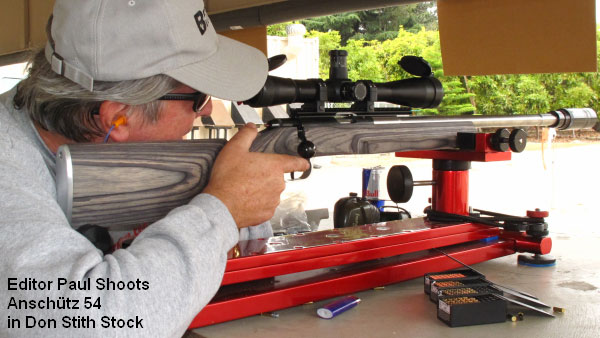
For Anschütz fans, MT Guns has fitted high grade Benchmark barrels to the legendary Model 54-type action. These re-barreled Anschütz actions are placed in Don Stith laminated benchrest stocks. With a modern low-profile, wide-forearm stock, MT Gun’s Anschütz BR guns track beautifully. So far, MT Guns has created two of these Anschütz-based bench guns, both built from model 19XX donor rifles — which also provided superb 5018 triggers. Barrels on both guns are Benchmark — one a 2-groove, the other a 3-groove. In the Stith stocks, complete with aluminum butt plates and weighted tuners, both rifles tip the scales at about 10 pounds. Price for the Anschütz bench guns is $1995.00 with unfinished Stith stock. A fitted Hoehn barrel tuner adds $200 to the price, while a Picatinny rail is a $125.00 option.
BSA Martini — Classic Design with 21st Century Upgrades
If you want to get noticed at your club’s next smallbore rimfire match, then a modified BSA Martini may be the gun for you. These rifles, originally built for prone target shooting, earned a well-deserved reputation for accuracy. MT Guns has done some basic modifications allowing the unique BSA Martinis to be surprisingly competitive in the benchrest game. The factory barrels were “retired” in favor of a 2-groove or 3-groove reverse taper Benchmark barrel — the type of tube that has won big matches and set records. To improve the rifle’s “bench manners” MT Guns fits a custom-made low-friction polymer sled in the front. Fitted with this 3″-wide bag-rider, the gun is extremely stable. An optional Hoehn tuner allows you to tune barrel harmonics for maximum accuracy.
Speaking of which, readers may be asking “How accurate can this BSA Frankengun really be?” Amazingly accurate. Watch the slide show below. In the last frame you’ll see two very impressive 5-shot groups shot by the BSA Martini Int’l Mark III at 50 yards. The ammo was Lapua X-Act.
In the video below, Bruce Duncan of MT Guns explains the distinctive mechanical design of the lever-activated, tilting-block BSA Martini. Bruce also discusses the history of the BSA Martini marque, reviewing the many BSA Martini models produced in the last century. The BSA Martini International MK III is perhaps the most desirable in the long evolution of target Martinis built by BSA from the Great War era to the early 80s. These MK IIIs, dating from the 1960s, feature Benchmark 28 3/4″ reverse-taper barrels, Hoehn barrel tuners, and special bolt-on Picatinny rails fabricated by MT Guns. Bruce noted: “The MT Guns bag rider attaches to the rifle’s fore-end rail. During testing, we noted that the fore-and-aft position of the bag rider on the rail affected the rifle’s tune.” For more info, visit MTGuns.com or call the shop at (805) 720-7720.
Since it was first released in 1965, Cartridges of the World by Frank Barnes, has been considered the definitive print resource on firearm cartridges. The current 12th Edition, edited by Holt Bodinson, was released late last year. The 568-page 12th Edition now describes over 1500 cartridges (from 0.1 inch to 0.95 inch caliber). This edition has interesting new articles on cartridge design and performance. The book includes dimensions, illustrations, a short history, and sample loading data for over 1500 different cartridges, including virtually every significant cartridge introduced since the early 1870s, with separate chapters on rimfires, shotgun shells, sporting rifle cartridges from the United States and Canada, Britain, and Europe, plus handgun cartridges, military cartridges, and limited production “wildcat” and “proprietary” cartridges. You won’t find all the narrow-focus or obscure wildcats, but the book is still a useful resource, well worth owning. It’s a “must-have” item for any serious cartridge collector.
Frank C. Barnes (1918-1992) began collecting information on handgun cartridges at the early age of 12, thanks to his father, a police officer. Frank Barnes was an innovative cartridge designer, who invented the original 308 x 1.5″ Barnes, predecessor of the 30BR case. Before Frank began a law enforcement career, he was a college professor. Frank was also a pilot, and a race-car driver.
Cartridges of the World was first published in 1965. It’s lived through 12 editions and can be found on many reloaders’ bookshelves today. Suggested retail for the book is $32.99, but MidwayUSA currently sells the 12th Edition for $19.99 plus shipping (Midway item 242319). Amazon.com offers the book for $21.77 with free shipping on combined orders over $25.00.
Here is an interesting tool that lets shooters re-shape and uniform the tips of their .22 rimfire lead bullets. Paco Kelly’s Acu’Rzr comes in two basic versions, the “Phase III Nasti-Nose” and the “Phase IV Baby Scorp’n”. The Phase III tool produces a deep-dished hollowpoint (like an ash-tray) that opens quickly and efficiently. There is also a Phase III insert that creates a flatter, open dish HP for target shooting. The Phase IV Scorpion tool creates a deep hollow point with a central post. The internal post in the middle helps achieve deeper penetration in game. The designer claims that ammo modified with either tool is more accurate because the bullet diameter “comes out the same every time”. In addition to the Phase III & IV tools, which reform one round at a time, Paco offers a Maxi series for bulk production. These let you process either three rounds at once (Maxi 3) or four rounds at once (Maxi 4).
Why re-shape lead rimfire bullets? The first reason is accuracy. The tool’s designer, Paco Kelly, claims you can improve the accuracy of budget-priced ammo by using the dish nose rod with the Phase III tool: “The dish nose forming rod is for accuracy and paper targets. It makes very sharp and clean cut holes in paper. And the consistency of the [re-shaped] bullet diameter pulls the group together.”
The main reason to use Paco Acu’Rzr tools is to improve perfomance on small game such as squirrels, prairie dogs, and jack-rabbits. Kelly says: “Unlike most commercial 22 rimfire ammo with small holes and negligible HP expansion, the Nasti-Nose will open even with standard velocity ammo. Yet it will NOT explode on contact like the hyper-velocity ammo. For small eating game, such as squirrels, the Hyper ammo is too much and the medium-velocity, hollow-pointed commercial ammo often fails to open. But not so with the Nasti-Nose.” The idea, Kelly suggests, is that you get reliable expansion with medium-velocity ammo, without destroying the game the way hyper-velocity ammo does.
The Phase III tool costs $65.00, while the Phase IV tool costs $75.00. The Maxi 3 which does three (3) rounds at once, costs $100.00, and the four-round Maxi 4 is $128.00. All tools can be customized for target rifles or European chambers. To order, contact Paco Kelly, P.O. Box 1170, Cortaro, AZ 85652 or use this ORDER FORM.
EDITOR’s NOTE: Do NOT use this tool with premium-grade rimfire target ammo. It won’t help. Use it with the cheaper bulk-pack ammo. Also, we have not tested the reformed ammo on live targets, so you have to draw your own conclusions as to its benefits on small critters.
A reliable 22LR conversion kit for an AR-platform rifle lets you train with inexpensive ammo. That’s a big advantage for 3-gun competitors who must engage multiple targets rapidly, often at relatively short distances. Multi-gun competition is a speed game, requiring plenty of practice to “run with the big dogs”. It’s not unusual for elite 3-gun shooters to put hundreds of rifle rounds down range every week. Service Rifle shooters can also benefit from cross-training with an AR equipped to shoot .22LR rimfire rounds. With a good .22LR conversion kit, Service Rifle shooters can practice their positions and gun-handling at minimal expense. In the winter, if you have a .22LR conversion for your AR, you can train at the many indoor ranges that allow rimfire rifles, but not centerfire rifles.
Complete Conversion Kit for $189.99 from CDNN
CDNN Investments in Texas is offering a good deal on the CMMG .22lr Stainless Conversion Kit for AR15-type rifles. This includes a stainless bolt and bolt carrier assembly and two (2) 25-round magazines or two (2) 10-round mags. The CMMG Kit uses your existing fire control (trigger) group and requires no internal gunsmithing. Just drop it in and shoot. While supplies last, the CMMG Conversion Kit with magazine(s) is priced at $189.99. NOTE: CDNN is offering 2 mags with this package as a “limited time offer”. (MidwayUSA also has this Kit, with one mag, for $199.99.)
CMMG .22LR Kit Is Reliable and Affordable
The CMMG conversion is widely used and has proved quite reliable, both with the 10-round and 25-round magazines. It is recommended by Brownells, though some Brownells customers have said the kits required some minor fitting or polishing. (This may be more of an issue with “off-brand” uppers — Colt AR owners reported no issues.) In the video below you see an AR15 being fired with the CMMG .22LR conversion in place. Then the CMMG bolt is exchanged for the original .223 Rem bolt assembly and the gun is shot in centerfire mode.
In the second video below you’ll see the CMMG conversion shot with two full (or nearly full) 25-round magazines, in rapid fire. There are no malfunctions.
The 2010 Winter Olympics are coming up soon, so we asked Uwe Anschütz to show us the Fortner-Action rimfire biathlon rifle that will be used by the vast majority of top competitors. This high-tech 22LR rifle features a straight-pull action that can be cycled nearly as quickly as a semiautomatic. The rifle is designed to be carried on the back while skiing, then quickly deployed at the shooting stages, where competitors engage banks of targets either prone or standing. Note the slots on the forearm for storing up to four extra 5-round magazines.
Olympic Medal-Winning Air Rifles on Display
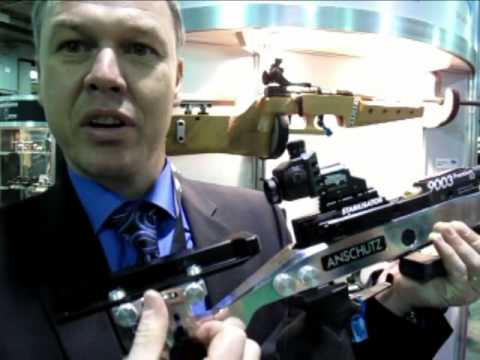
In addition to the Biathlon Rifle, Uwe Anschütz showed us the model 9003 S2 Premium Air Rifle, which features a 9003 S2 action in the Precise aluminum stock. This state-of-the-art airgun earned medals at the 2008 Olympics in China, and it is a favorite of top compeitors worldwide. The model 9002 S2 features a very sophisticated buttstock assembly which with great adjustability. With this metal stock, you can adjust every point at which the rifle contacts the shooter’s body, from shoulder to cheek to hand. Even the angle and fore/aft position of the trigger shoe can be adjusted.
If you recently purchased a Remington 40X rimfire rifle from the CMP, and the bolt is old, worn out, or missing altogether, take heart, Dave Kiff of Pacfic Tool & Gauge (PTG) has a solution.
For a $199.00 “locked-in price” for AccurateShooter.com readers, PT&G offers a complete Remington 40X replacement bolt for CMP Rem 40X rifles. Even if your original factory 40X bolt functions, the replacement bolt should fit better (with less slop) and provide more consistent ignition, shot after shot. We won’t promise improved accuracy, but we predict that you get fewer unexplained flyers with the Kiff replacement bolt. Below, the charming Ashley Kiff explains the $199.00 special offer for our readers.
Savage Arms was well represented today at the SHOT Show’s “Media Day as the Range.” We saw and shot several new offerings from Savage (including a tactical rifle in 338 Lapua Magnum and a hunting weight 6.5-284). We’ll cover these centerfire Savages later this week. One of the new Savages we really liked was the model 93R17 TR, a slick little 17 HMR. It looks and feels like a full-sized centerfire tactical bolt-gun, it comes with an excellent stock and nice trigger, and it is both affordable and very accurate. (NOTE:v Savage is also offering 22LRs rimfires in the same stock, the MK II TR and TRR.)
This rifle features an all-new, texture-painted wood stock with a very sound “tactical” design. It is well thought out, with good ergonomics, and offers options and design details that most rimfires do not. The stock features a moderate beavertail fore-end, a fairly vertical grip and a shallow butt-hook at the rear for support using the non-shooting hand. The black textured paint is very similar to the black painted finish on McMillan stocks (notice the texture in the photo).
The “look and feel” of the model 93 TR is similar to the popular Rem 700 PSS, and that’s good news for tactical shooters. With the new m93 TR, you feel like you are shooting a full-size tactical rifle. It feels solid and comfortable. And this rifle features with an optional factory-installed picatinny rail — a very nice feature on a rimfire rifle. You can easily move your scope back and forth between the model 93 and a Picatinny equipped centerfire bolt-gun. The model 93 should prove very popular with shooters who want to train with an economical rimfire that has very similar ergonomics to a centerfire bolt gun. For training duties only you may prefer the 22LR version. But the 17 HMR would be our pick for a “working” varmint rifle.
With CCI hollowpoint 17 HMR ammo, the m93 proved very accurate — we hit everything we shot at with ease, even in rainy, gusty conditions. Targets were mostly clay pigeons at 50-100 yards; we could break a clay, then easily hit the smaller pieces. Clearly this gun can be a very effective short-range varminter.
Overall, we really liked the feel and ergonomics of this rifle. It is a good choice for those seeking a rimfire trainer that handles like an “adult-sized” centerfire rifle. We are confident this will make a great varmint rifle as well as a economical tactical trainer. Your Editor expects that this rifle will be a hot seller for Savage.
Savage m93 17 TR Specs: Cal 17HMR; barrel 21″; overall-length 40″; weight about 7.5 lbs.


 Shooting an impressive 4790-355X, SSG Shane Barnhart earned the title of National Smallbore Rifle Prone Champion, while competing this week at Camp Perry, Ohio. Finishing second and third, respectively, were 1LT Christopher Abalo, and Charles Kemp. Abalo and Kemp had identical 4786 scores, but 1LT Abalo had the higher X count. Abalo scored 344X compared to Kemp’s 338X.
 The NRA Metric Smallbore Championships were held in Bristol, Indiana from July 17-20th. Team Lapua shooters performed well in this prestigious match. Team Lapua member Kevin Nevius shot superbly, earning the title of 2010 Metric National Champion. Nevius also won the Metallic Sight Aggregate Trophy, the Metallic Sight Team Trophy with Eitan Barazani, and the Overall Metric National team title with Barazani. Both Nevius and Barazani shot Lapua ammo.


 BSA Martini — Classic Design with 21st Century Upgrades
 Since it was first released in 1965,




 This rifle features an all-new, texture-painted wood stock with a very sound “tactical” design. It is well thought out, with good ergonomics, and offers options and design details that most rimfires do not. The stock features a moderate beavertail fore-end, a fairly vertical grip and a shallow butt-hook at the rear for support using the non-shooting hand. The black textured paint is very similar to the black painted finish on McMillan stocks (notice the texture in the photo).


