Hunting season is coming soon. For hunters that means many hours may be spent searching for animals through spotting scopes and binoculars — “glassing” for game. And when the hunter does find a good buck or doe, he’ll need to know the animal’s precise distance, so that demands a good laser rangefinder. Being carried in the field, the scopes on hunting rifles need to be tough and durable, and every hunting scope should have excellent low-light performance. And when the hunter finally takes his shot, his scope better be properly zeroed. Today’s Saturday showcase spotlights Hunting Optics. We offer eight great videos that help you select the right riflescope, spotting scope, rangefinder, and binoculars for your next hunt.
Here’s a good video by an avid hunter who treks in remote, mountainous zones. The host has learned what works… and what’s worth the weight to carry: “I’ve found that the combination of 10×42 binoculars and a 27–60x80mm spotting scope is the sweet spot for mountain hunting. This pairing balances weight with reach, allowing me to keep moving but also reach out and see well-hidden animals. In some cases, I will make use of an 18×56 binocular, but this is reserved for non-backpack hunts. With 25 years of mountain hunting experience, I can whole-heartedly recommend my preferred binocular pair as a fantastic and versatile set-up for northern mountain hunts at the very least.”
Ultimate Spotter Test — 19 Spotting Scopes Reviewed
The producers of this remarkable 19-product spotting scope comparison state: “If you are looking at choosing the best spotting scope for hunting… you are in the right place! We tested these 19 spotting scopes to find the best compact spotting scope, best 65mm spotting scope, and best 85mm spotting scope out there. We also wanted to find the best values on the market, and I think we definitely did that. While we certainly couldn’t test them ALL, we were able to put together this incredible lineup of some of the best spotting scopes out there to help you find what is going to work for your specific needs.”
First Focal Plane vs. Second Focal Plane Scopes
For the last century, Second Focal Plane (SFP) scopes have been most common on hunting rifles. Now there are an increasing number of First Focal Plane (FFP) optics favored by hunters. The main reason is that the reticle mark values (in Mils or MOA) are constant relative to the target size at all magnification levels. That is handy for hold-offs and hold-overs. On the other hand, a SFP scope maintains a constant reticle size and line thickness at all zoom values. For most hunting shots, taken inside 300 yards, that really should be fine. Many hunters feel they can spot their prey more easily without a busy reticle that obscures small details at higher magnification. This video explains the pros and cons of both reticle types. The final decision is up to you — much will depend on the terrain you hunt and the distances you shoot.
The Complete Optics Selection for For Deer Hunting
In this video, Vortex optics techs explain the optics package deer hunters will want to take into the field. Along with a good medium-power zoom riflescope, you’ll want binoculars and (probably) a spotting scope. You’ll also want a Laser Rangefinder (LRF) or laser-equipped binoculars. As the team points out, the LRF is not just to range your prey right before you take a shot. A top-quality LRF can range a reflective object as far as 1500 yards away. That helps you decide whether you want to hike a mile to reach that buck you see way out on the next ridge.
MOA vs. MIL — What You Need to Know
These days, scope manufacturers offer a wide selection of both MIL (Milliradian) and MOA (Minute-of-Angle) based optics. We do think that MOA is still predominant in the lighter-weight, lower-cost (sub-$500) scopes marketed for hunters. There are pros and cons for both angular measurement systems. One MIL is 3.6″ at 100 yards, while one MOA is 1.047″ at 100 yards. If you grew up thinking in inches, a 1/4-MOA click-value hunting scope might work best. If you shoot PRS or have other MIL scopes you may prefer a MIL-value optic for your hunting rifle. Both choices will do the job.
Comparison of Eight Laser Rangefinders
The Backfire team purchased eight rangefinders and tested them in the field. Most of the products are under $500. This is a good review if you are looking for a compact LRF at a moderate price. Looking at performance for the price, for the hunting market, the reviewers favored the Leupold RX-1600 and the waterproof Vortex Ranger 1800. COMMENTARY: If you can afford it, we recommend that serious hunters consider top-end laser rangefinder-equipped binoculars such as the ZEISS Victory RF and Leica Geovid.
How to Zero Your Hunting Rifle Efficiently
Last but not least, here’s a great video from Vortex that shows you how to quickly and efficiently sight-in and zero your hunting rifle before heading out into the field. This video explains a simple procedure that lets you get a solid zero in just three shots. Of course you probably want to fire a few more rounds to confirm your zero before you head off to your hunting grounds, but this will let you get on-target with a minimum amount of time and ammo expended. This helpful video has over 3 million views on YouTube!
Fouling Shots and Cold Bore Condition
If you recently cleaned your rifle, you may want to fire two or three fouling shots before you start this procedure. But keep in mind that you want to duplicate the typical cold bore conditions that you’ll experience during the hunt. If you set your zero after three fouling shots, then make sure the bore is in a similar condition when you actually go out hunting.
If you will be flying with firearms this summer, here are six videos you should watch before you travel. You need to familiarize yourself with current Federal Regulations on gun transport before you get anywhere near an airport. Thankfully, the Transportation Security Administration (TSA) has an official INFO page that states the important requirements for airline passengers traveling with firearms and/or ammunition.
You’ll want to visit the TSA Firearms and Ammunition webpage, and read it start to finish. In addition, before your trip, you should check the regulations of the airline(s) with which you will fly. Some airlines have special requirements, such as weight restrictions.
We have two other key tips: 1) WEIGH Your Guns and ammo (as packed) BEFORE you get to the airport — so you comply with all airline flight limits without being surcharged; 2) Carry a printed copy of TSA and airline baggage regulations pertaining to firearms — this can help when dealing with airline personnel.
TSA offers this general advice: “You may transport unloaded firearms in a locked, hard-sided container as checked baggage only. Declare the firearm and/or ammunition to the airline when checking your bag at the ticket counter. The container must completely secure the firearm from being accessed. Locked cases that can be easily opened are not permitted. Be aware that the container the firearm was in when purchased may not adequately secure the firearm when it is transported in checked baggage.”
Traveling by Air with Firearms — Advice from Legal Expert
This is a good video by a very knowledgeable attorney. Washington Gun Law President William Kirk goes over everything you need to know in order to fly safely, and legally, with a firearm if you travel domestically. Kirk states: “While many believe this is a complicated formula of various state laws, in actuality TSA regulations govern all travel domestically with a firearm. There are very specific rules which must be followed in order to do this correctly.”
Colion Noir — Air Travel with Packed Firearms
Popular YouTube host and lawyer Colion Noir has created a good video that shares important points about traveling with firearms. Colion says: “Don’t risk making costly mistakes — get informed and ensure your firearm journey is hassle-free and lawful.” In this video, Colion covers these key points:
1. Bag Check: Learn the crucial pre-flight checklist to avoid any unwanted surprises at the TSA checkpoint.
2. Airline Check: Discover the differences in airline policies and ensure a smooth journey by reviewing your chosen carrier’s firearm guidelines.
3. Law Check: Stay on the right side of the law by understanding the gun regulations in every state you’ll visit during your trip.
4. The Gun Case: Explore the essential details about the TSA-required hard-sided lockable case and find out which one is my top choice.
5. Ammo Transport: Learn the correct way to transport ammunition separately from your firearm, all while staying within the weight limit.
Step-By-Step Guide to Gun Transport — Good Tips
This 18-minute Spiritus Systems video provides some very valuable practical tips for gun owners traveling by air. The host explains what to look for in a rifle case and locking system. He also explains how to pack the rifle and gear efficiently and how to label and track your gun/ammo cases. If you’re new to airline travel with guns, this video is worth watching start to finish. Here are highlights are listed by video times:
00:01 Introduction and Regulations
00:51 Storage Container Options
2:50 Type of Lock You Should Use
6:25 Tape Tip
7:16 Contact Information, and Labeling Your Bag
8:07 Firearm Considerations / Configuration
10:03 Documents
12:30 Tracking Your Bag
13:20 Packing Your Ammo
16:00 Prepping Your Magazines
How to Efficiently Pack Your Rifles and Gear
Our friend F-Class John often travels by air to major F-Class matches (most recently to the V2 Finale in Texas). John has learned how to transport valuable match rifles and optics most efficiently and economically. In these two videos F-Class John shows how to pack your rifles and equipment, and how to employ carry-on bags to secure optics and other non-regulated equipment.
TSA Video about Airline Travel with Guns and/or Ammo
This is the latest official TSA video covering gun/ammo transport via airlines. When packing for a flight be sure to start with an empty bag (make sure there are no forgotten gun parts or ammo inside before you pack). If you’re planning to travel with a firearm, follow the tips in this video and remember that you may NEVER bring a firearm in your carry-on bag. Also make sure you are not “packing” when entering the airport even if you have a CCW permit. TSA.gov Firearms/Ammo Transport INFO Page.
Official TSA Guidelines for Airline Travel with Firearms and Ammo
When traveling, comply with the laws concerning possession of firearms as they vary by local, state, and international governments.* Declare each firearm each time you present it for transport as checked baggage. Ask your airline about limitations or fees that may apply.
Firearms must be unloaded and locked in a hard-sided container and transported as checked baggage only. As defined by 49 CFR 1540.5 a loaded firearm has a live round of ammunition, or any component thereof, in the chamber or cylinder or in a magazine inserted in the firearm. For civil enforcement purposes, TSA also considers a firearm to be loaded when both the firearm and ammunition are accessible to the passenger.
Only the passenger should retain the key or combination to the lock unless TSA personnel request the key to open the firearm container to ensure compliance with TSA regulations. You may use any brand or type of lock to secure your firearm case, including TSA-recognized locks.
Bringing an unloaded firearm with accessible ammunition to the security checkpoint carries the same civil penalty/fine as bringing a loaded firearm to the checkpoint. You may find information on civil penalties at the Civil Enforcement page.
Firearm parts, including magazines, clips, bolts and firing pins, are prohibited in carry-on baggage, but may be transported in checked baggage. Replica firearms, including firearm replicas that are toys, may be transported in checked baggage only.
Rifle scopes are permitted in carry-on and checked baggage.
TSA Guidelines for Transporting Ammunition on Flights
Ammunition is prohibited in carry-on baggage, but may be transported in checked baggage. NOTE: Check with your airline for quantity limits for ammunition.
Firearm magazines and ammunition clips, whether loaded or empty, must be securely boxed or included within a hard-sided case containing an unloaded firearm. Read the requirements governing the transport of ammunition in checked baggage as defined by 49 CFR 175.10 (a)(8).
Small arms ammunition (up to .75 caliber and shotgun shells of any gauge) must be packaged in a fiber (such as cardboard), wood, plastic, or metal box specifically designed to carry ammunition and declared to your airline.
Ammunition may be transported in the same hard-sided, locked case as a firearm if it has been packed as described above. You cannot use firearm magazines or clips for packing ammunition unless they completely enclose the ammunition. Firearm magazines and ammunition clips, whether loaded or empty, must be boxed or included within a hard-sided, locked case.
*INTERNATIONAL: If you are traveling internationally with a firearm in checked baggage, please check the U.S. Customs and Border Protection website for information and requirements prior to travel.
We enjoy shooting steel targets with rifle, pistols, and shotguns. Hitting a steel target provides instant gratification with a loud “ping” and possible movement. You can shoot small, low-cost reactive steel targets with rimfire guns at short range. Or get the stronger high-grade AR500 steel targets for centerfire shooting at 50 yards and beyond. We’ve enjoyed varmint matches with steel targets placed at 100-yard intervals from 200 to 700 yards.
Action pistol and rifle matches are typically conducted with steel targets, some that spin, and others that may even be set on moving tracks. Dueling trees are another popular type of steel targets. These have multiple plates that swing horizontally from side to side. For long-range rifles, self-resetting targets are popular. These typically have a tombstone-style steel plate set with a spring-loaded base. When hit, the target goes down, but then pops back up again after a few seconds.
Dustin Ellermann’s Steel Target Playground
In this video, popular Top Shot champion Dustin Ellerman shows his entire Steel Target facility with dozens of targets. This range has one of the most diverse collections of steel targets in any single location.
Know Your Limits Portable Steel Targets
Know Your Limits (KYL) target sets typically provide a series of swinging targets of multiple sizes, running from larger to smaller. This provides increasing challenge with each shot. This Guns and Guitars Channel video showcases two portable KYL target sets you can easily transport in your car/truck. The host states: “I love how portable and easy to set up it is, I love how many targets you get… and most importantly, I love that Shooting Targets 7 offer the best price for AR500 steel targets on the internet.”
Best Steel Targets for a Home Range
This video covers steel targets from Shooting Targets USA and MGM Targets. The video explains how to choose targets for your home range — covering the key factors to “consider when buying steel targets.” Interestingly, this Tactical Rifleman channel also has a video about building a range on your own property. The host notes: “There is so much more to it than just pushing up a berm and buying some steel targets. Med plan, legal restrictions, drainage, targetry, and 50 other things should be planned out BEFORE you start digging. CLICK HERE for “How to Build Make Your Own Shooting Range” video.
Do-It-Yourself REBAR Target Stands — Very Low Cost
This Guns and Guitars Channel Video shows how to make making the CHEAP and sturdy target stands from REBAR. The host says: “These things are basically bullet-proof and would probably stand up against a charging rhino. You can build these stands using a 10-foot length of 1/2″ rebar from your local hardware store. Bending it is not super easy, but it can be done without a rebar bender, just watch the video!”
Steel Target Arrangements for Action Shooting Matches
This video from Tactical Hyve shows a variety of steel targets used in action shooting scenarios. The host is a knowledgeable gear analyst and a very good shooter. If you are looking to get started in action pistol disciplines this is a good video to watch.
Steel Target and Target Stand Varieties
This video reviews the key features and functions of a variety of steel targets — from large torso silhouettes to reactive dueling trees. The video also reviews various target stands and supports. This is worth watching if you are considering buying steel targets for your shooting club or home range.
Shooting Steel Targets Safely — Tips from Hickok45
In this video, YouTube host Hickok45 offers valuable safety tips on shooting steel targets, based on his 30+ years of steel shooting experience. This guy knows his stuff — as proven by the fact that he now has over 7.6 million subscribers to his Hickok45 YouTube channel.
TOP SHOT: The steel targets in the top photo are part of the extensive facility operated by Big Daddy Hoffman 1911. See more on his popular YouTube Channel, now with 314,000 subscribers.
UltimateReloader.com offers some of the most thorough firearms and reloading tool tests on the internet. And UltimateReloader’s YouTube Channel has over 1040 great videos that showcase reloading tools, accurate firearms, precision optics, gunsmithing methods, and top-tier reloading components. For today’s Saturday at the Movies feature, we showcase five videos recently created by Gavin Gear and his UltimateReloader team. These videos highlight a superb Long-Range Target Camera, the remarkable AMP Press, the new Hornady PRC cartridges, and other interesting topics.
Since starting his channel in 2007, Gavin has released over 1040 videos showcasing reloading products, gunsmithing, and gun testing. Thanks to Gavin’s movie-making skills and hard work, his YouTube Channel now has 335,000+ subscribers. And over the years Gavin’s videos have received over 73.8 million views. Gavin’s videos have benefited shooting enthusiasts and hand-loaders around the globe.
Multiple Muzzle Brake Performance with .224 Bullets
This video includes some serious testing of muzzle brakes in three bore sizes. One each designed for .224 caliber, 6.5mm caliber, and .308 caliber. The goal of the project was to see how brake bore affected recoil reduction, and accuracy. Gavin’s team uses two rifles, one AR and one 22-250 bolt action. Gavin’s testing equipment allows him to plot recoil force with great precision. What did they find: “With optimized clearance [.224 brake] we got the lowest recoil”.
New LongShot Ranger and Ranger Plus Target Cameras
Longshot offers superb, reliable, high-resolution target cameras favored by top shooters around the world. Now LongShot is introducing a new Ranger series of target cameras starting at just $199.00 for the basic Ranger which runs at 100 yards. For those who regularly shot at longer distances, the new Ranger Plus reaches out to 1000 yards. Right now you can get the impressive Ranger Plus for a $299.00 “Pre-Order” sale price. The features of these two systems are compared in the graphic below:
Bergara Premier Competition Rifle in 6GT
The 6GT is a popular new cartridge originally developed for the PRS/NRL discipline. It has a case capacity and case length between the 6 Dasher and the 6mm Creedmoor. This allows it to rival the accuracy of the 6 Dasher with less recoil than a 6mm Creedmoor, and potentially longer barrel life because less powder is burned with each shot. In this video Gavin tests the new Bergara factory precision rifle chambered in 6 GT. This rifle is based around the Bergara Premier action with a stainless No. 7 taper 1:7.5″-twist barrel, set in an MPA BA chassis. CLICK HERE for full test article on UltimateReloader.com.
AMP Mark II DB and RAMP Bipod at SHOT Show 2024
Top Benchrest, F-Class, Palma, ELR, Silhouette, and PRS/NRL shooters use AMP annealers. These impressive, computer-controlled annealing machines allow you to get optimal, consistent neck tension. In addition, regular AMP annealing can significantly extend the life of cartridge brass. With good brass now running $130-$160 per 100 cases, you definitely want your brass to last as long as possible.
Shown above is the innovative RAMP Bipod from the New Zealand team that created the revolutionary AMP Annealing machine. This new RAMP Bipod allows easy yet secure elevation changes with the front bipod.
Caldwell Flash Bang Target Impact Indicators
We like reactive targets for the instant gratification that comes with a hit. When shooting steel it’s great to get that rewarding “ping” on impact. But sometimes it’s hard to hear, especially when the targets are far away. Caldwell’s Flash Bang target hit indicators solve this problem, providing visual feedback for the shooter, spotter, and spectators. Gavin notes that: “These small units will mount to any steel target and are incredibly affordable. At $37, replacing them if they are accidentally shot is not a huge loss. In fact, Caldwell is the first company to bring a hit indicator to market that doesn’t eat a hole in your wallet.”
Anschutz .22 LR rifle set up for F-Class competition. Photo courtesy Sportschieben Blog.
Here’s a fun new discipline that will grow in years ahead — Smallbore F-Class with .22 LR rimfire rifles. Rest-supported prone rimfire matches have been held around the world for quite some time, but only a few years ago was the discipline officially codified in the NRA Smallbore Rulebook. And the first-ever Smallbore F-Class National Championship was held in July 2018 in conjunction with the Smallbore Nationals at Camp Wa-Ke’-De in Bristol, Indiana. The Nationals involved multiple days of prone shooting at 50 meters and 100 yards. For more information read Hap Rocketto’s Shooting Sports USA Smallbore F-Class Report.
Smallbore F-Class competitors may shoot F-TR style with a bipod, or use a front rest. In the above photo from the inaugural NRA National Championship you can see a shooter with SEB Coaxial Rest at top, with a competitor using a low-profile bipod at bottom. Note the extended handle used to adjust bipod elevation. This is not a coaxial joystick, but rather a long handle attached to the mariner wheel.
Smallbore F-Class — The Future Looks Bright
With the high cost of centerfire ammunition, and the limited number of 1000-yard (or even 600-yard) ranges, we can envision that Rimfire F-Class will become a popular event at ranges across the country. Clubs don’t even need benches — just a 100-yard target bay and flat ground for the shooters. You can start with an inexpensive rimfire rig and Harris bipod. Then work up from there. Here is a custom rimfire F-TR style rig that belongs to F-Class ace and past centerfire F-TR National Champion James Crofts.
Rimfire F-Class and Fun Prone Matches with Front Rest or Bipods
Rimfire F-Class offers the fun of centerfire shooting at a much lower cost. Shooting is done prone with either a front rest or a bipod. You can shoot a relatively inexpensive rifle such as a CZ 457 MTR, or a custom build that has the same design features, weight, and ergonomics as a full-size F-TR or F-Open rifle. The choice is yours. We like shooting smallbore F-Class, because you can find decent .22 LR ammo for just $0.20 per round. By contrast, you’ll probably spend at least $1.20 per round for F-Class centerfire ammo (counting bullet, powder, primer, and part of the brass cost).
Top-Tier Vudoo V22-S Target Rifle for Rimfire F-Class
Vudoo Gun Works now offers an impressive .22 LR Single Shot Target Rifle that should prove ideal for rimfire F-Class (Open division). It features the new V22-S single-shot action, McMillan stock, and Flavio Fare BR-VS trigger.
Rimfire F-Class in the Canary Islands
This video comes from the Canary Islands, part of Spain. The voice-over is in Spanish but there are English sub-titles. The host explains: “In this video we summarize the main characteristics of this [shooting sport] that is practiced at 50 meters, 100 meters, and 200 meters with your .22 LR. Learn how to prepare your rimfire carbine and learn how to score your own targets by following our simple explanations. In another video we will delve into shooting techniques, shooting accessories and field accessories.”
Here is another rimfire F-Class video from the Canary Islands. This shows how the sport can be done with a variety of rimfire rifle types, even including a .22 LR AR clone. Some shooters are using a wide-base bipod, others are using normal Harris-type bipods, while others are using a large, benchrest-style front rest.
Rimfire F-Class-Style Local Fun Match in Oregon
In this video, F-Class John shoots an F-Class-style local fun match in Oregon. He is using a .22 LR rimfire rifle that has a full-size stock very similar to his custom F-Open centerfire rifles. This allows him to easily switch from centerfire F-Class to rimfire prone shooting with front rest and rear bag. The local fun match rules are a little different than an official F-Class match, but the shooting skills required are the same. Shooting this kind of local rimfire match allows John to keep his F-Class skills at a high level at a fraction of the cost of shooting centerfire F-Open.
Rimfire F-Class in Russia
NOTE: This video was filmed in Russia. The dialog is in Russian (without English subtitles), but it is still interesting to watch. Shooting F-Class with .22 LR ammo has become popular in Russia and other parts of Europe. You can have fun on a relatively short (200m) range with low-cost ammo.
Smallbore F-Class Course of Fire
The Smallbore F-Class Nationals was completed on paper targets at 50 yards and 100 yards. According to Shooting Sports USA: “The tournament ran during the any sight and metric phases of the 2018 NRA National Smallbore Rifle Championships, featuring a daily course of fire which mirrored the sling shooters, 40 shots at 50 meters on the A-50 target, a Metric Dewar, followed by 40 shots at 100 yards on the A-33 target. Although the international targets were shot throughout, the first two days were titled ‘conventional’ and the last two ‘metric’.”
The specifics of the match such as rifle requirements, rests, and sights may be found in the Provisional Smallbore Rifle F-Class Rules (Section 23), found on page 65 of the current NRA Smallbore Rifle rulebook. Any rules not covered in Section 23 will [reference] the normal rules of Sections 1 through 22.
For most larger centerfire cartridges, increased barrel length augments muzzle velocity. That’s why you see F-Open rifles with 30″ and even 32″ barrels. But there is a limit — at some point, increased barrel length may not yield any additional velocity. And in the case of rimfire, too much barrel length can reduce MV. Today’s showcase explores how barrel length affects muzzle velocity, both in centerfire and rimfire rifles.
In the photo above you can see a test rifle fitted with what may currently be the longest barrel fitted to a conventional rifle. This was created by the team at MDT (Modular Driven Technologies) to test how velocity varies with barrel length.
You can see the results of testing with this one-of-a-kind rifle in the MDT video below, the first in our Saturday video showcase. This is followed with an MDT rimfire barrel length/velocity test, and additional tests for the .308 Winchester, 6.5 Creedmoor, and .223 Rem cartridge types.
World’s Longest Rifle Barrel Cut to Determine Velocity Change
This may be the most interesting velocity by barrel length test ever put on video. The MDT (Modular Driven Technologies) team started with a 69″-long barrel, chambered for .308 Winchester. The ammo was Federal Gold Medal match with 175gr Sierra HPBT Bullets (Video 3:30). This barrel had actually been fabricated from multiple sections, a challenge in itself.
Velocity was measured in one-inch increments starting at 69″ and going down to 19″. The speed at 69″ was 2778 FPS while the final speed, at 19″ barrel length, was 2567 FPS. “That is a difference of 211 FPS from the longest point to the shortest point”, observed MDT’s tester. Note that, the velocity did show fairly constant change per inch from 19″ to 45″. So going beyond 36″ inches can actually increase velocity. However, from 45″ to 61″ inches the velocity actually declined a bit. SEE VIDEO at 6:55 time-mark, and check out the chart below.
Ultra-Long .22 LR Rimfire Barrel Cut-Down Velocity Test
This video features Part 2 of MDT’s “Cutting the World’s Longest Rifle” test. This time the team shoots the diminutive .22 LR cartridge from an ultra-long barrel. The results may surprise you: “Get ready to have your assumptions shattered as the MDT team chopped a .22 LR rimfire barrel away inch by inch, recording velocities at each barrel length. In this test, the MDT team looked to determine the optimal length for a .22 LR barrel, from the standpoint of velocity. How long is too long? How short is too short? Does shorter always mean faster? Does longer always mean slower?”
In fact, MDT’s testers determined that, with standard rimfire ammunition, the velocity started to decline after 16″ length. That surprised some of the testers. So with the small .22 LR cartridge, more barrel length can actually reduce muzzle velocity from increased in-barrel friction.
6.5 Creedmoor Barrel Length Test (24″ to 16″)
For this video, testers for Western Powders took a standard test barrel chambered for 6.5 Creedmoor and cut it down one inch at a time. The velocity for five rounds at each length was then measured with a chronograph to determine velocity loss per inch of barrel reduction. Overall the recorded velocity loss from 24″ to 16″ was 197 FPS, almost exactly 25 FPS per inch of length. The velocity loss rate was fairly constant inch by inch, as you can see from the graph displayed at the 4:00-minute mark in the video.
.223 Rem (5.56×45) Velocity Tests (9 Guns, 7.5″ to 20″ Barrels)
In this video, the team from Classic Firearms tests a variety of firearms chambered for .223 Rem (5.56×45). This starts with an Springfield Saint Victor AR-type pistol with a very short 7.5″ barrel. This yielded a 2183 FPS average. Then the team tested eight more guns with increasingly long barrel lengths, adding barrel length with each gun in sequence. The test concluded with a Colt XM16E1 rig with 20″ barrel. That Colt AR averaged 3052 FPS. The guns used (and barrel lengths) are listed below.
The overall results are discussed at the 13:45 Time-Mark.
Test Lengths at Video Time — 7.5″ to 20″
2:11 — 7.5″ Springfield St.V. AR Pistol, 2183 FPS
3:23 — 10.3″ DD MK18 SBR, 2513 FPS
4:34 — 11.8″ PWS MK111 AR Pistol, 2644 FPS
5:35 — 12.5″ IWI Zion AR Pistol, 2789 FPS
.308 Winchester — 16″ Barrel vs. 24″ Barrel Velocity
With the .308 Win cartridge, many hunters prefer a shorter barrel for lighter carry weight. In this video, Gavin Gear of UltimateReloader.com compares .308 Win velocities with a 16″ barrel and a 24″ barrel, shooting the same ammo. Gavin notes: “We asked for input on our .308 build. Overwhelmingly, you all wanted a 16″ barrel, so ‘Shorty’ was born! Looking to compare velocities, I brought out my match .308 Win with a 24″ barrel to compare the results with some Hodgdon data.” CLICK HERE to read full report on UltimateReloader.com.
RifleShooter.com Barrel Cut-Down Testing
Along with these videos, our friends at RifleShooter.com have conducted a number of barrel cut-down tests, starting with fairly long barrels. Velocities were measured with each inch reduction
Most of us own a .223 Rem rifle. Now, thanks to our friends at Rifleshooter.com we can assess exactly how velocity changes with barrel length for this popular cartridge.
Rifleshooter.com performed an interesting test, cutting the barrel of a .223 Rem rifle from 26″ all the way down to 16.5″. The cuts were made in one-inch intervals with a rotary saw. At each cut length, velocity was measured with a Magnetospeed chronograph. To make the test even more interesting, four different types of .223 Rem/5.56 ammo were chron’d at each barrel length. The Rifleshooter.com team that conducts these tests has a full-service gun shop, 782 Custom Gunworks — visit 782guns.com.
Test Barrel Lost 25.34 FPS Per Inch (.223 Rem Chambering)
How much velocity do you think was lost, on average, for each 1″ reduction in barrel length? The answer may surprise you. The average speed loss of the four types of .223/5.56 ammo, with a 9.5″ shortening of barrel length, was 240.75 fps total (from start to finish). That works out to an average loss of 25.34 fps per inch.
5.56/.223 Barrel Cut-Down Speed Test 26″ to 16.5″
Start FPS at 26″
End FPS at 16.5″
Total Loss
Average Loss Per Inch
UMC .223 55gr
3182*
2968
214
22.5 FPS
Federal M193 55gr
3431
3187
244
25.7 FPS
Win m855 62gr
3280
2992
288
30.3 FPS
Blk Hills .223 68gr
2849
2632
217
22.8 FPS
*There may have been an error. The 25″ velocity was higher at 3221 fps.
Rifleshooter.com observed: “Cutting the barrel from 26″ to 16.5″ resulted in a velocity reduction of 214 ft/sec with the UMC 223 55-grain cartridge, 244 ft/sec with the Federal M-193 cartridge, 288 ft/sec with the Winchester M855 cartridge and 217 ft/sec with the Back Hills 223 68-grain match cartridge.”
How the Test Was Done
The testers described their procedure as follows: “Ballistic data was gathered using a Magnetospeed barrel-mounted ballistic chronograph. At each barrel length, the rifle was fired from a front rest with rear bags, with five rounds of each type of ammunition. Average velocity and standard deviation were logged for each round. Once data was gathered for each cartridge at a given barrel length, the rifle was cleared and the bolt was removed. The barrel was cut off using a cold saw. The test protocol was repeated for the next length. Temperature was 45.7° F.”
See More Barrel Cut-Down Tests on Rifleshooter.com
Rifleshooter.com has performed barrel cut-down tests for many other calibers/chamberings including 6mm Creedmoor, .308 Winchester, and .338 Lapua Magnum. See these test results at Rifleshooter.com.
Hunting season is starting soon around the country. For hunters that means many hours may be spent searching for animals through spotting scopes and binoculars — “glassing” for game. And when the hunter does find a good buck or doe, he’ll need to know the animal’s precise distance, so that demands a good laser rangefinder. Being carried in the field, the scopes on hunting rifles need to be tough and durable, and every hunting scope should have good low-light performance. And when the hunter finally takes his shot, his scope better be properly zeroed. Today’s Saturday at the Movies showcase is all about Hunting Optics. We offer nine great videos that help you select the right riflescope, spotting scope, rangefinder, and binoculars for your next hunt.
Comparison of Seven Popular Deer Hunting Scopes
This is summary review of seven (7) popular hunting scopes, as available in 2020 (there may be newer variants). This video consist mostly of manufacturer-created marketing content with a few minutes of independent reviews. Consider this video a place to start when shopping for a new hunting optic. You’ll want to check independent reviews when you select a particular model. The seven riflescopes featured in the video are: Athlon Optics Argos BTR, Leupold VX-3i 3.5-10x50mm, Leupold VX-R 4-12x40mm, NightForce SHV 5-20x56mm, Nikon Buckmasters II, Vortex Crossfire II, Vortex Viper HS SFP.
Optics Selections for Mountain Hunts
Here’s a good video by an avid hunter who treks in remote, mountainous zones. The host has learned what works… and what’s worth the weight to carry: “I’ve found that the combination of 10×42 binoculars and a 27–60x80mm spotting scope is the sweet spot for mountain hunting. This pairing balances weight with reach, allowing me to keep moving but also reach out and see well-hidden animals. In some cases, I will make use of an 18×56 binocular, but this is reserved for non-backpack hunts. With 25 years of mountain hunting experience, I can whole-heartedly recommend my preferred binocular pair as a fantastic and versatile set-up for northern mountain hunts at the very least.”
Ultimate Spotter Test — 19 Spotting Scopes Reviewed
The producers of this remarkable 19-product spotting scope comparison state: “If you are looking at choosing the best spotting scope for hunting… you are in the right place! We tested these 19 spotting scopes to find the best compact spotting scope, best 65mm spotting scope, and best 85mm spotting scope out there. We also wanted to find the best values on the market, and I think we definitely did that. While we certainly couldn’t test them ALL, we were able to put together this incredible lineup of some of the best spotting scopes out there to help you find what is going to work for your specific needs.”
First Focal Plane vs. Second Focal Plane Scopes
For the last century, Second Focal Plane (SFP) scopes have been most common on hunting rifles. Now there are an increasing number of First Focal Plane (FFP) optics favored by hunters. The main reason is that the reticle mark values (in Mils or MOA) are constant relative to the target size at all magnification levels. That is handy for hold-offs and hold-overs. On the other hand, a SFP scope maintains a constant reticle size and line thickness at all zoom values. For most hunting shots, taken inside 300 yards, that really should be fine. Many hunters feel they can spot their prey more easily without a busy reticle that obscures small details at higher magnification. This video explains the pros and cons of both reticle types. The final decision is up to you — much will depend on the terrain you hunt and the distances you shoot.
Field Evaluation of Nine Binoculars under $500
Here is another multi-product optics comparison test. Backwoods Pursuit tested nine binoculars under $500. The testers evaluated each of the nine binoculars performed, considering optics (glass) quality, sharpness, low-light performance, focus control, weight, and ergonomics. Listed in the order they appear in the video, here are the nine binocular types tested:
1:27 Maven C.1
2:16 Athlon Midas
3:15 Zeiss Terra ED
4:30 Kowa BD II XD
5:34 Bushnell Forge
7:29 Vortex Viper HD
The Complete Optics Selection for For Deer Hunting
In this video, Vortex optics techs explain the optics package deer hunters will want to take into the field. Along with a good medium-power zoom riflescope, you’ll want binoculars and (probably) a spotting scope. You’ll also want a Laser Rangefinder (LRF) or laser-equipped binoculars. As the team points out, the LRF is not just to range your prey right before you take a shot. A top-quality LRF can range a reflective object as far as 1500 yards away. That helps you decide whether you want to hike a mile to reach that buck you see way out on the next ridge.
Comparison of Eight Laser Rangefinders
The Backfire team purchased eight rangefinders and tested them in the field. Most of the products are under $500. This is a good review if you are looking for a compact LRF at a moderate price. Looking at performance for the price, for the hunting market, the reviewers favored the Leupold RX-1600 and the waterproof Vortex Ranger 1800. COMMENTARY: If you can afford it, we recommend that serious hunters consider top-end laser rangefinder-equipped binoculars such as the ZEISS Victory RF and Leica Geovid.
MOA vs. MIL — What you Need to Know
These days, scope manufacturers offer a wide selection of both MIL (Milliradian) and MOA (Minute-of-Angle) based optics. We do think that MOA is still predominant in the lighter-weight, lower-cost (sub-$500) scopes marketed for hunters. There are pros and cons for both angular measurement systems. One MIL is 3.6″ at 100 yards, while one MOA is 1.047″ at 100 yards. If you grew up thinking in inches, a 1/4-MOA click-value hunting scope might work best. If you shoot PRS or have other MIL scopes you may prefer a MIL-value optic for your hunting rifle. Both choices will do the job.
How to Zero Your Hunting Rifle Efficiently
Last but not least, here’s a great video from Vortex that shows you how to quickly and efficiently sight-in and zero your hunting rifle before heading out into the field. This video explains a simple procedure that lets you get a solid zero in just three shots. Of course you probably want to fire a few more rounds to confirm your zero before you head off to your hunting grounds, but this will let you get on-target with a minimum amount of time and ammo expended. This helpful video has over 3 million views on YouTube!
Fouling Shots and Cold Bore Condition
If you recently cleaned your rifle, you may want to fire two or three fouling shots before you start this procedure. But keep in mind that you want to duplicate the typical cold bore conditions that you’ll experience during the hunt. If you set your zero after three fouling shots, then make sure the bore is in a similar condition when you actually go out hunting.
If you need a good hunting rifle, consider a Tikka. The latest generation Tikka T3x rifles are very popular with hunters around the globe — for good reason. These rifles offer smooth-running actions, easy sub-MOA accuracy with good ammo, crisp triggers, and reliable detachable box magazines. The Tupperware stocks aren’t super-rigid, but they are comfortable and easy to handle. The Tikka T3 and T3X models are smart choices for hunters, offering good performance for the price (starting at $749.00 for the T3X Lite version). The T3x series is offered in a wide selection of chamberings, from .204 Ruger up to the large magnums.
Testing the T3x Series on the Range — Fun in Finland
This video was produced at a range in Finland. Tikka product manager Taneli Pokkinen shoots three Tikka rifles — the first two prone, off bipod, and the third standing (as a hunter might shoot). You can see the recoil of various chamberings, plus the accuracy at 100m, which is pretty impressive. Rifles tested are: 1) Tikka T3x Varmint Hunter; 2) Tikka T3x Super Varmint (with suppressor); 3) Tikka T3x Roughtech Ember. NOTE: At 4:30 there is a 5-shot group from the Super Varmint as shot by a gunsmith. All shots are touching — very impressive!
These two short videos explain two key features of modern Tikka rifles — the smooth running bolt and the precise, crisp, and relatively light trigger. We recommend you check out both of these tech videos if you’ve never handled a Tikka rifle before. Tikkas really do have very good factory triggers, with bolt smoothness that rivals some custom actions.
Tikka Rifles — Five Recent Models Reviewed
If you are considering a Tikka for PRS/NRL, check the first segment of this video covering the Tikka T3x TAC A1. In order, here are the five (5) Tikka rifle reviewed, with video start times (if you want to skip around): 1. Tikka T3x Super Varmint (00:40, video only); 2. Tikka T3x TAC A1 (01:13); 3. Tikka T3x Super Varmint (02:34); 4. Tikka T3x Lite Roughtech Ember (05:12); 5. Tikka T3x Varmint Hunter (wood) (07:31). Note: The review sections are done by a knowledgeable Tikka product manager Taneli Pokkinen. CLICK HERE for 40+ Tikka factory videos.
Tikka T3X — Hickok45 Shows Function and Shoots at Steel Plates
Popular YouTube gun reviewer Hickok45 reviews the Tikka T3x Tactical Compact Rifle in 6.5 Creedmoor. There are good explanations of the operation of the action and magazine. In addition Hickok45 shoots the rifle offhand (05:10 and 13:44 time-marks), evaluating the ergonomics of the stock and the trigger feel. Hickok45 now has 7.27 million subscribers to his YouTube Channel.
Tikka T3x Compact Lite Roughtech Ember
The Tikka Compact Lite Roughtech Ember has a handsome brown polymer stock with subtle camo. This nicely-finished 6.8-pound $1299.00 rifle comes with a stainless fluted barrel fitted with factory muzzle brake. The stock has interchangeable pistol grips for various shooting positions. The fore-grip has attachment points, allowing forearm width to be increased. In this video, at the 8:40 time-mark, the trigger is adjusted to crisp 2.5 pounds, as verified with a trigger gauge. That is excellent for a factory trigger.
Why the TIKKa T3x Is Great for Hunting
With 650,000+ subscribers, the Backfire Channel is one of the most popular gun channels on YouTube. You can trust Backfire reviewers because they pay their own money for all the products they review. This video reviews current generation Tikka rifles. Backfire had high praise for Tikka T3x rifles: “The Tikka T3x SL is an incredibly lightweight mountain rifle that should be in every hunter’s safe. We like it for its lightweight build, stainless steel barrel, superb trigger, and surprisingly accurate shooting. Overall, this is the hunting rifle we recommend more frequently than any other.”
TIKKA T3x TAC A1
Along with the hunting rifle models, Tikka also produces quality, metal chassis tactical-style rifles. The Tikka T3x TAC A1 has earned considerable praise and is PRS/NRL competition-ready right out of the box. The T3x TAC A1 is offered in multiple calibers/chamberings, barrel lengths, and chassis colors. The impressive T3x TAC A1 retails for $2199.00 – $2299.00 at EuroOptic.com.
BONUS: TIKKA T3x vs. Ruger American
This comparison video compares the Tikka T3x with the Ruger American rifle. The reviewers explain the key differences and the pros and cons of each type. The video examines the receivers, barrels, triggers, and stocks of the Tikka and the Ruger. What’s the bottom line? Well the Ruger has a price advantage, but the Tikka T3x has a better trigger, nicer action, better magazines, and probably better 5-shot accuracy.
To optimize your loads and to generate precise ballistics tables, you need a quality chronograph. Having precise readings of bullet muzzle velocities lets you calculate ES and SD to determine the most repeatable load with least vertical dispersion. Very accurate velocity data is also essential to created a precise drop table for long range and to predict the effect of winds. There are many good chronographs on the market, ranging in price from around $100 to $1000, not counting tripods.
Today’s Saturday Movie showcase features a variety of modern chronographs. We include comparison tests, as well as video reviews of the new, small-format Bulletseeker Mach 4 and AndiScan Micro A2 Doppler Radar chronographs. If you are in the market for a new chronograph and have the resources, you should definitely consider one of these new small chronos, which are easy to set-up and can be mounted directly to your rifle. For those with a limited budget, MagnetoSpeeds still offer great performance for the price. However, you may have to conduct load tuning separately with the MagnetoSpeed removed.
Triple Chronograph Comparison Test
LabRadar, MagnetoSpeed, and Shooting Chrony Alpha Master
This video has an interesting comparison test with three chronograph devices operating at the same time. A Shooting Chrony Alpha Master unit was set up downrange, while a modern LabRadar was placed to the right side of the rifle. On the barrel of the rifle a MagnetoSpeed chrono was attached. This allowed the tester to compare shot velocity values from all three chrono systems at the same time. The video creator explained: “I was curious to see if my old [Shooting Chrony] chronograph could still give me useful velocity information compared to using the newer MagnetoSpeed and LabRadar.”
Chronograph Functions and Features — Vortex Nation Podcast
In this 78-minute video, experts from Vortex explaining how modern chronographs work. The discussion covers the technical features of various chronographs. Multi-time F-Class National Champion Ian Klemm and former sniper Tony Palzkill examine different chronograph types, explaining how they operate. Ian discusses the pros and cons of different chronograph designs, and provides many good tips for chronograph owners. This 78-minute discussion covers multiple chronograph designs, including LabRadar, MagnetoSpeed, and Caldwell Ballistic Precision. There is also extensive discussion of ballistics in the first 20 minutes.
MagnetoSpeed vs. Caldwell Ballistic Precision Chronograph
In this video the host compares a MagnetoSpeed with an older, first generation Caldwell Ballistic Precision Chronograph, mounted a few yards downrange on a tripod. The tester favored the Magnetospeed saying it was “incredibly accurate” while being much easier to set up and transport. He also says the MagnetoSpeed App was very “user-friendly”.
NOTE: Skip Forward to 5:40 to see the Bulletseeker field-tested as mounted on rifle and on tripods.
The Bulletseeker Mach 4 is a new radar chronograph that mounts directly to your rifle. The advanced Bulletseeker features 120 Ghz radar with a beam-forming lens. Developed in Europe, with made-in-Germany core components, this unit is sold in the USA for $999.00 by Longshot, trusted maker of long-range target cameras. We think this is a game-changer. You get advanced radar ON YOUR GUN, with no need to haul around a bulky LabRadar.
Comparison test with the Bulletseeker Mach 4 and LabRadar
Another Bulletseeker tester was very impressed: “Based on my experiences with the device it seems like a good product that does everything it advertises. All the benefits of a LabRadar without the drawbacks.” (SEE Product review HERE.)
In this video, our friend F-Class John tests the innovative, ultra-compact AndiScan Micro A2 Doppler radar chronograph. This unit is small enough that it can be fitted to your rifle, or attached to a front rest or mini tripod. John tested an early pre-production model. The production model is now available for 800 Euros on the SQI-AndiX eShop. The manufacturer notes: “The next large 2023 production series is expected to be ready by the end of February.”
Product Description: “The AndiScan Micro A2 is an advanced ballistic velocity Doppler radar for measuring muzzle velocity of projectiles. It operates in 24GHz frequency band. It is a highly integrated and extremely small form-factor device that is intended to be directly mounted on the rifle. This frees the user from a complicated setup alignment and it also allows to perform measurements under dynamic conditions. It is the first device [with] this form-factor on the public market.”
JKL Inertial Trigger for LabRadar
The JKL Inertial Trigger for the LabRadar is an easy-to-use, inertial-driven trigger that activates simply from the recoil of your gun. Rather than activate by sound or Doppler reading, the JKL Trigger works from the rifle’s instantaneous recoil pulse when a shot is fired. The unit consists of a small rectangular pad attached to a long audio cable. All you do is plug in the audio cable, attach the pad to your gun with the provided hook and loop (Velcro) material. Then (important), you must change the LabRadar trigger settings from “Doppler” to “Trigger”. The unit works great and is easy to set up.
The text in this article is Copyright 2023 AccurateShooter.com. No site shall reproduce this article without express authorization.
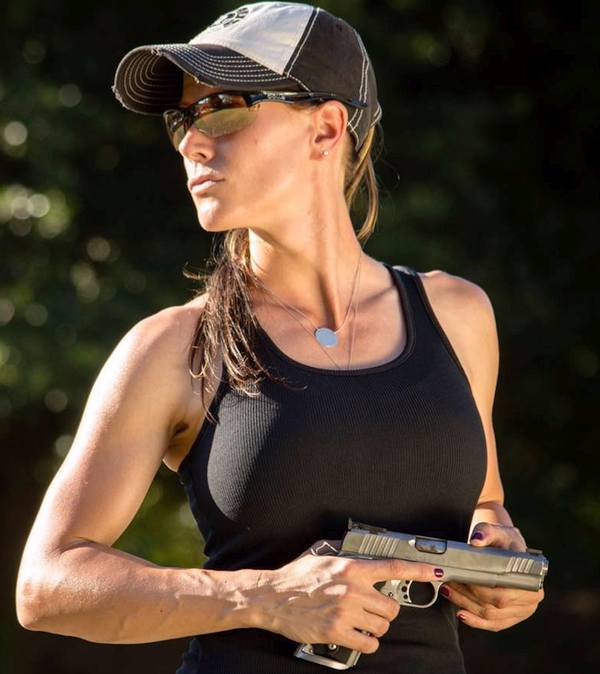
Jessie Harrison is arguably the best female action pistol shooter in history. No other lady has amassed as many championships or set so many speed-shooting records. Over the past two decades Jessie Harrison (who has also competed with with married names Jessie Duff and Jessie Abbate) has earned dozens of major titles including twenty-two U.S. Practical Shooting Association (USPSA) Ladies Championships. Jessie won her 22nd USPSA title at the USPSA Race Gun Nationals in October 22–24, 2021 at the Talledega Marksmanship Park in Alabama.
This Saturday at the Movies feature showcases Jessie Harrison shooting in competition as well as Jessie offering shooting and firearms safety tips. You can see dozens more action pistol videos featuring Jessie on the Jessie Harrison YouTube Channel.
Jessie with Team USA at 2022 IPSC World Shoot
American shooter Jessie Harrison was part of a victorious USA Team and took second in the Ladies Open Division at the IPSC Handgun World Shoot held in November, 2022 in Pattaya, Thailand. The IPSC World Shoot is considered by many to be the most prestigious action pistol competition in the world. “The IPSC Handgun World Championships are our equivalent to the Olympics, the pinnacle of matches,” said Harrison.
Blast From the Past — Young Jessie in Cowboy Action Mode
Early in her shooting career, Jessie enjoyed Cowboy Action Shooting. She honed her skills shooting revolvers and lever guns “on the clock” with steel targets. For this Single Action Shooting Society (SASS) sport, all competitors use an official “alias” at matches. Jessie’s SASS alias was “Jasmine Jessie”. Watch this video from 2009 to see a young Jessie in action with a slick shotgun-loading trick.
Jessie Harrison, Successful Huntress
Jessie also enjoys hunting. Back in 2019, the chance to bag a Muley buck drew action-shooting ace Jessie Harrison out to Wyoming’s Bighorn Mountains region. Jessie, who is probably the best lady action pistol shooter on the planet, had a successful hunt with Big Horn Outfitters. Jessie, Shooting Team Captain for Taurus USA, really enjoyed getting out into the Wyoming wilderness. And she got her buck!