This Saturday Movie showcase features four handguns chambered for the modern, high-velocity 5.7x28mm cartridge. In a 5″-6″ barreled pistol, the 5.7x28mm round can achieve very high velocities compared to a 9x19mm (9mm Luger) or .40 SW. The bottle-necked 5.7×28mm cartridge weighs roughly two-thirds as much as a typical 9mm Luger cartridge, allowing more rounds to be carried for the same weight. The cartridge can produce considerable muzzle flash when fired from a pistol, but it has roughly 30% less recoil than the 9mm Luger cartridge, improving controllability. Thanks to its high velocity, the 5.7×28mm has a flatter trajectory than most pistol ammo types.
Today we showcase videos of four different 5.7x28mm pistols — the new S&W M&P 5.7, the PSA 5.7 Rock, the Ruger-5.7, and the FN Five-SeveN Mk3 MRD. If you are looking for the best deal on a 5.7 pistol, check out the the PSA 5.7 Rock. You can buy one today for $599.99 including Holosun Red Dot Sight.
Smith & Wesson M&P 5.7 with 22-Rd Magazine
Chambered for the high-velocity, flat-shooting 5.7x28mm, the Smith & Wesson M&P 5.7 features S&W’s new TEMPO barrel system. This is a two-part, lock-breech barrel with a proprietary gas system for improved cycling and extraction. The new M&P 5.7 includes a 1/2×28 threaded barrel to mount a muzzle device or suppressor, optics-cut slide, flat-face trigger, and forward, frame rail for mounting accessories.
PSA 5.7 Rock — Best Value in a 5.7x28mm Handgun
The Palmetto State Armory (PSA) 5.7 Rock is the best value in a 5.7x28mm pistol. Right now PSA offers it complete with a mounted Holosun Red Dot sight for just $599.99 with two 23-rd mags. A full-sized, polymer-framed pistol, the PSA 5.7 Rock has threaded carbon steel fluted barrel and 416 stainless steel slide with QPQ finish for corrosion protection. Chambered in 5.7x28mm, the PSA 5.7 Rock is fed from a 23-round magazine and operated by a smooth, single-action, striker-fired trigger mechanism. While sold with a Holosun 407k optic, the 5.7 Rock slide accepts other Shield footprint optics.
Ruger-5.7 Pistol Review by Hickok45
In the video above, popular YouTube host Hickok45 reviews the Ruger-5.7, which was introduced in late 2019. This gun has proven reliable and when it hit the market it was much less expensive than its main competitor made by FN. Ruger’s 5.7x28mm pistol is blow-back operated with an internal hammer and ambidextrous thumb safety. The pistol is offered with a 20+1 capacity magazine and an adjustable rear sight paired with a fiber-optic front. Current MSRP is $899.00. If you’re interested in the Ruger-5.7, read the On-Target Magazine Full Review.
FN Five-SeveN Mk3 MRD Review
In this episode of TFBTV, James Reeves reviews the new FN Five-SeveN Mk3 MRD. At $1,449.00 MSRP, this is the most expensive 5.7x28mm pistol on the market, but might it also be the best? James takes the new Five-seveN Mk3 MRD to the range and to the table to tell you if FN’ lastest, high-tech 5.7x28mm pistol is worth the spend.
Ruger-5.7 vs. PSA 5.7 Rock
Ruger-5.7 vs. FN 5.7
Comparison Between 5.7x28mm and 9x19mm
In this video James Reeves compares the performance of the 5.7x28mm round with the 9mm Luger. The 5.7x28mm round certainly offers higher velocity and greater penetration than the legendary 9mm round. Plus common 5.7 magazines hold over 20 rounds. James discusses the advantages of this modern 5.7x28mm cartridge, as well as a few of its shortcomings — such as high cost per round. There is another insightful comparison between the two ammo types on the Ammo-to-Go website. Editor John Lewis notes: “5.7×28 is lighter and faster than 9mm ammo” while the 9mm had a “slight advantage in energy [and was] much better in gel”.
5.7x28mm vs 9mm Penetration Test
In this video the tester shot both 9mm and a 5.7x28mm bullets into horizontal stacks of paper plates. The smaller-diameter 5.7mm bullet penetrated about 40% more paper plates than the 9mm bullet (See video at 3:10-3:35). The 5.7mm bullet basically retained its dimensions in this test, while the hollow-point 9mm spread out slightly. Just mere horizontal penetration can’t tell you the actual effectiveness of the round based in a defensive situation. In a different test using Ballistic Gel, both rounds penetrated adequately but the 9mm created a bigger wound channel. SEE: AmmotoGo.com 5.7x28mm Test.
Short History of 5.7x28mm Guns and Ammo
The FN 5.7×28mm (designated as the 5.7×28 by the C.I.P. and FN 5.7x28mm NATO) is a small-caliber, high-velocity, rebated rim, bottle-necked centerfire cartridge designed for handgun and personal defense weapon uses. It is similar in length to the .22 WMR and somewhat similar to the .22 Hornet or .22 K-Hornet. Unlike many new cartridges, it has no parent case — it was developed from scratch by FN.
The 5.7×28mm was developed in conjunction with the FN P90 PDW and FN Five-Seven pistol in response to NATO requests for a replacement for the 9×19mm Parabellum cartridge (9mm Luger). In 2002 and 2003, NATO conducted a series of tests with the intention of standardizing a PDW cartridge as a replacement for the 9×19mm. The tests compared the relative merits of the 5.7×28mm cartridge and the 4.6×30mm cartridge, which was created by Heckler & Koch.
By 2006, FN’s 5.7×28mm firearms — the P90 PDW and Five-Seven pistol — were in service with military and police forces in over 40 nations worldwide. In the USA, 5.7×28mm firearms are currently used by many law enforcement agencies, including the U.S. Secret Service.
Along with use in military and law enforcement firearms, in recent years the 5.7×28mm cartridge has become popular for handguns in the USA. In December 2019 Ruger unveiled the Ruger-5.7 semi-automatic pistol chambered in this cartridge. In January 2021 Kel-Tec introduced its P50 handgun, which uses horizontal 50-round FN P90 magazines. In January 2021 Palmetto State Armory (PSA) introduced its Rock 5.7 pistol. And this year, Smith & Wesson has released its new M&P 5.7, featured above.
The 5.7×28mm cartridge itself is produced by multiple ammunition makers including Federal, Fiocchi, FN, and Speer. 5.7x28mm ammunition is PRICEY — the cheapest 5.7x28mm ammo we found with a quick search was 40gr Federal American Eagle at $0.77 round. By comparison, you can currently find bulk CCI 9mm Luger ammo for $0.30/round.
Some still images and text shared from Wikipedia: CC BY-SA 3.0
Anschutz .22 LR rifle set up for F-Class competition. Photo courtesy Sportschieben Blog.
Here’s a fun new discipline that will grow in years ahead — Smallbore F-Class with .22 LR rimfire rifles. Rest-supported prone rimfire matches have been held around the world for quite some time, but only a few years ago was the discipline officially codified in the NRA Smallbore Rulebook. And the first-ever Smallbore F-Class National Championship was held in July 2018 in conjunction with the Smallbore Nationals at Camp Wa-Ke’-De in Bristol, Indiana. The Nationals involved multiple days of prone shooting at 50 meters and 100 yards. For more information read Hap Rocketto’s Shooting Sports USA Smallbore F-Class Report.
Smallbore F-Class competitors may shoot F-TR style with a bipod, or use a front rest. In the above photo from the inaugural NRA National Championship you can see a shooter with SEB Coaxial Rest at top, with a competitor using a low-profile bipod at bottom. Note the extended handle used to adjust bipod elevation. This is not a coaxial joystick, but rather a long handle attached to the mariner wheel.
Smallbore F-Class — The Future Looks Bright
With the high cost of centerfire ammunition, and the limited number of 1000-yard (or even 600-yard) ranges, we can envision that Rimfire F-Class will become a popular event at ranges across the country. Clubs don’t even need benches — just a 100-yard target bay and flat ground for the shooters. You can start with an inexpensive rimfire rig and Harris bipod. Then work up from there. Here is a custom rimfire F-TR style rig that belongs to F-Class ace and past centerfire F-TR National Champion James Crofts.
Rimfire F-Class and Fun Prone Matches with Front Rest or Bipods
Rimfire F-Class offers the fun of centerfire shooting at a much lower cost. Shooting is done prone with either a front rest or a bipod. You can shoot a relatively inexpensive rifle such as a CZ 457 MTR, or a custom build that has the same design features, weight, and ergonomics as a full-size F-TR or F-Open rifle. The choice is yours. We like shooting smallbore F-Class, because you can find decent .22 LR ammo for just $0.20 per round. By contrast, you’ll probably spend at least $1.20 per round for F-Class centerfire ammo (counting bullet, powder, primer, and part of the brass cost).
Top-Tier Vudoo V22-S Target Rifle for Rimfire F-Class
Vudoo Gun Works now offers an impressive .22 LR Single Shot Target Rifle that should prove ideal for rimfire F-Class (Open division). It features the new V22-S single-shot action, McMillan stock, and Flavio Fare BR-VS trigger.
Rimfire F-Class in the Canary Islands
This video comes from the Canary Islands, part of Spain. The voice-over is in Spanish but there are English sub-titles. The host explains: “In this video we summarize the main characteristics of this [shooting sport] that is practiced at 50 meters, 100 meters, and 200 meters with your .22 LR. Learn how to prepare your rimfire carbine and learn how to score your own targets by following our simple explanations. In another video we will delve into shooting techniques, shooting accessories and field accessories.”
Here is another rimfire F-Class video from the Canary Islands. This shows how the sport can be done with a variety of rimfire rifle types, even including a .22 LR AR clone. Some shooters are using a wide-base bipod, others are using normal Harris-type bipods, while others are using a large, benchrest-style front rest.
Rimfire F-Class-Style Local Fun Match in Oregon
In this video, F-Class John shoots an F-Class-style local fun match in Oregon. He is using a .22 LR rimfire rifle that has a full-size stock very similar to his custom F-Open centerfire rifles. This allows him to easily switch from centerfire F-Class to rimfire prone shooting with front rest and rear bag. The local fun match rules are a little different than an official F-Class match, but the shooting skills required are the same. Shooting this kind of local rimfire match allows John to keep his F-Class skills at a high level at a fraction of the cost of shooting centerfire F-Open.
Rimfire F-Class in Russia
NOTE: This video was filmed in Russia. The dialog is in Russian (without English subtitles), but it is still interesting to watch. Shooting F-Class with .22 LR ammo has become popular in Russia and other parts of Europe. You can have fun on a relatively short (200m) range with low-cost ammo.
Smallbore F-Class Course of Fire
The Smallbore F-Class Nationals was completed on paper targets at 50 yards and 100 yards. According to Shooting Sports USA: “The tournament ran during the any sight and metric phases of the 2018 NRA National Smallbore Rifle Championships, featuring a daily course of fire which mirrored the sling shooters, 40 shots at 50 meters on the A-50 target, a Metric Dewar, followed by 40 shots at 100 yards on the A-33 target. Although the international targets were shot throughout, the first two days were titled ‘conventional’ and the last two ‘metric’.”
The specifics of the match such as rifle requirements, rests, and sights may be found in the Provisional Smallbore Rifle F-Class Rules (Section 23), found on page 65 of the current NRA Smallbore Rifle rulebook. Any rules not covered in Section 23 will [reference] the normal rules of Sections 1 through 22.
SHOT Show 2023 is right around the corner, with the annual NSSF Gun Industry convention opening its doors to dealers and media on Tuesday, January 17, 2023. Thousands of new products will be unveiled for the first time at SHOT Show 2023, including hundreds of new rifles. Today’s Saturday Movie showcase features a number of new (or nearly-new) rifles that will be on display at SHOT Show 2023 in Las Vegas. This showcase gives our readers a chance to preview some of the newest hunting, precision, and tactical rifles on the market even before retail buyers get to handle them at SHOT Show display booths.
Five Best New Generation Precision and Sniper Rifles for 2023
This Survival Gear video showcases five newer model precision/tactical rifles offered in 2022 and some new offerings for 2023. The models are: 1. SIG Sauer Cross PRS (1:01 time-mark); Scopes Poweryz (2:25); Tikka T3X Tac A1 (3:18); Kelbly’s Nanook MG (4:48, shown below); and IWI US DAN (6:05).
The video hosts based his choice on function, reliability, and accuracy: “When pulling together this list of the best precision rifles and sniper rifles, I considered a few different criteria. The list highlights modern rifles with proven track records that are currently in use. It includes some new precision rifles that are coming online right now.”
Three Impressive Modern Rifles — Including a Cool Ultralight
This 10-minute Central Gear video covers three fairly interesting rifles. PRS/NRL fans will like the Daniel Defense Delta 5 Pro Precision Rifle, a modern mag-fed chassis rig for PRS/NRL competition. Hunters should check out the impressive Gunwerks Skunkwerks Lite SabR rifle. Designed for easy field carry by hunters, the limited-edition Lite Sabr features an ultra-light magnesium metal chassis and a folding buttstock. The third rifle, also from Gunwerks, is a modern muzzleloader for hunters.
Fierce Arms 5.8-Pound Mountain Reaper Ultralight
This video covers just one rifle, the Fierce Arms Mountain Reaper. But we think this new ultralight rig will definitely appeal to hunters who need a light rifle. With an 18″ barrel, the Mountain Reaper weighs just 5.8 pounds! The Mountain Reaper features an ultra-light magnesium chassis, carbon-wrapped barrel, and carbon M-Lok forearm. It also boasts a quick-deploying, push-button-lock folding stock and premium Bix ‘N Andy trigger. Seven chamberings are offered starting at $3399.00 MSRP.
Three New Bergara Rifles for 2023
With over 620,000 subscribers, the Backfire YouTube Channel is very popular. It has earned a strong following for its multi-product comparison tests and straight-talk “No BS” reviews. In this video, Backfire reviews three new rifles from Bergara: The Bergara B14 Squared Crest, The Bergara Wilderness Ridge Carbon, and the Bergara HMR Carbon. All three products are well suited for hunting and varminting.
Five New Rifles for 2023 — Wide Variety of Platforms
The five rifles featured in this video have just hit the market. Most of these were first revealed at the NASGW (Nat’l Assn. Sporting Goods Wholesalers) EXPO a few months ago. Many will also be showcased soon at SHOT Show 2023 next week. The five featured rifles are: 1) Traditions Shed Horn .50 Cal Muzzleloader (1:02 time-mark); 2) Rock River Arms LAR22 (3:19); Mossberg Patriot Predator (5:47); Live Free Armory Challenger (8:28); and Pioneer Arms 556 (11:05). Two of these five choices are AR-type rifles, and one is an AK variant underfolder. The reviewer notes: “Here are five of the best new rifles introduced at NASGW 2022 … to keep an eye out for in 2023.”
Top AR-Platform Rifles for 2023
AR-platform “Modern Sporting Rifles” continue to be top sellers because of their affordability and versatility. An AR rifle can be used for Service Rifle competition, 3-Gun games, varmint hunting, and of course, home defense. This video features 15 modern-generation AR-platform rifles. Most of these rifles will be on display at SHOT Show in Las Vegas starting Tuesday January 17, 2023.
The model 1911 pistol, designed by John Moses Browning, is an American classic. Originally manufactured as .45 ACP military pistols, modern 1911s have evolved to be superb competition pistols, and carry pistols. With a Single-Action-Only (SAO) configuration, the 1911 design is different than most modern pistols. You must have the hammer cocked to fire a 1911 — like a single-action revolver. But the positive side of the Single-Action design is than modern 1911 pistols enjoy superb triggers with very positive release and fast reset. There is a reason the 1911 design is the basis for so many modern competition pistols.
In today’s Saturday at the Movies feature, we showcase videos that cover the history, design, and function of 1911-type pistols. We also include videos that explain how to field-strip a 1911 and how to accessorize/upgrade 1911 pistols.
Operation of 1911 Pistol with 3D Animations
Here are two excellent videos that show how a classic 1911-type pistol functions. 3D computer graphics animation offers a X-Ray view inside the pistol, showing how cartridges feed and how the slide cycles during the firing process.
How to Field-Strip and Re-Assemble a 1911 Pistol
There are a few tricks to field-stripping a 1911-type pistols, and it helps to have a couple specialized tools. This helpful TFB-TV (The Firearm Blog) video shows the process of disassembling a 1911 pistol from start to finish, and notes components that require lubrication or special attention.
History of the Classic Model 1911 Pistol
The model of 1911 pistol is an American classic with a long and illustrious history. These two videos cover the interesting origins of the 1911 pistol, and explain how J.M. Browning designed the remarkable 1911 pistol which became the iconic American sidearm of the U.S. Military, the longest-serving pistol in American military history.
A fascinating article by Rock Island Armory covers the complete evolution of the 1911 pistol, including its earlier prototype variants, starting with the model of 1905. SEE: Road to the 1911 Article (with Model 1905, 1907, 1909, and 1910 prototypes).
Over time the 1911 design has evolved into many variants, including the modern “race gun” used in rapid-fire pistol competitions. Here is an STI DVC Open model fitted with a C-More sight, and front compensator.
Pistol Shooting Skills Demonstrated with 1911
How to Grip a 1911 Handgun Properly
World Champion pistol ace (and 18-time Bianchi Cup winner) Doug Koenig demonstrates how to grip a handgun. While the fundamentals are demonstrated on a 1911 pistol they are effective for establishing a proper grip on any handgun.
Trigger Press and Trigger Control
In this video Champion shooter Doug Koenig talks about key techniques that apply to all pistol marksmanship — not just speed shooting “on the clock”. With any handgun, Doug explains, you should focus on consistent trigger control. You want to avoid yanking the trigger or anticipating recoil.
How to Accessorize Your 1911
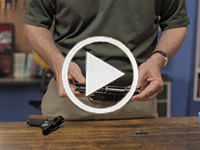
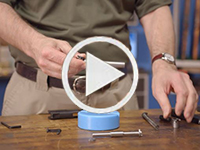
This six-part series by Brownells provides step-by-step instruction on how to accessorize your 1911. The videos cover changing out the mainspring housing, magazine release, slide release, hammer, guide rod, and installing a group gripper. If you want to upgrade your 1911, these videos are worth watching.
Hunting season is here. For hunters that means many hours may be spent searching for animals through spotting scopes and binoculars — “glassing” for game. And when the hunter does find a good buck or doe, he’ll need to know the animal’s precise distance, so that demands a good laser rangefinder. Being carried in the field, the scopes on hunting rifles need to be tough and durable, and every hunting scope should have good low-light performance. And when the hunter finally takes his shot, his scope better be properly zeroed. Today’s Saturday at the Movies showcase is all about Hunting Optics. We offer eight great videos that help you select the right riflescope, spotting scope, rangefinder, and binoculars for your next hunt.
Comparison of Seven Popular Deer Hunting Scopes
This is summary review of seven (7) popular hunting scopes, as available in 2020 (there may be newer variants). This video consist mostly of manufacturer-created marketing content with a few minutes of independent reviews. Consider this video a place to start when shopping for a new hunting optic. You’ll want to check independent reviews when you select a particular model. The seven riflescopes featured in the video are: Athlon Optics Argos BTR, Leupold VX-3i 3.5-10x50mm, Leupold VX-R 4-12x40mm, NightForce SHV 5-20x56mm, Nikon Buckmasters II, Vortex Crossfire II, Vortex Viper HS SFP.
Optics Selections for Mountain Hunts
Here’s a good video by an avid hunter who treks in remote, mountainous zones. The host has learned what works… and what’s worth the weight to carry: “I’ve found that the combination of 10×42 binoculars and a 27–60x80mm spotting scope is the sweet spot for mountain hunting. This pairing balances weight with reach, allowing me to keep moving but also reach out and see well-hidden animals. In some cases, I will make use of an 18×56 binocular, but this is reserved for non-backpack hunts. With 25 years of mountain hunting experience, I can whole-heartedly recommend my preferred binocular pair as a fantastic and versatile set-up for northern mountain hunts at the very least.”
Ultimate Spotter Test — 19 Spotting Scopes Reviewed
The producers of this remarkable 19-product spotting scope comparison state: “If you are looking at choosing the best spotting scope for hunting… you are in the right place! We tested these 19 spotting scopes to find the best compact spotting scope, best 65mm spotting scope, and best 85mm spotting scope out there. We also wanted to find the best values on the market, and I think we definitely did that. While we certainly couldn’t test them ALL, we were able to put together this incredible lineup of some of the best spotting scopes out there to help you find what is going to work for your specific needs.”
First Focal Plane vs. Second Focal Plane Scopes
For the last century, Second Focal Plane (SFP) scopes have been most common on hunting rifles. Now there are an increasing number of First Focal Plane (FFP) optics favored by hunters. The main reason is that the reticle mark values (in Mils or MOA) are constant relative to the target size at all magnification levels. That is handy for hold-offs and hold-overs. On the other hand, a SFP scope maintains a constant reticle size and line thickness at all zoom values. For most hunting shots, taken inside 300 yards, that really should be fine. Many hunters feel they can spot their prey more easily without a busy reticle that obscures small details at higher magnification. This video explains the pros and cons of both reticle types. The final decision is up to you — much will depend on the terrain you hunt and the distances you shoot.
The Complete Optics Selection for For Deer Hunting
In this video, Vortex optics techs explain the optics package deer hunters will want to take into the field. Along with a good medium-power zoom riflescope, you’ll want binoculars and (probably) a spotting scope. You’ll also want a Laser Rangefinder (LRF) or laser-equipped binoculars. As the team points out, the LRF is not just to range your prey right before you take a shot. A top-quality LRF can range a reflective object as far as 1500 yards away. That helps you decide whether you want to hike a mile to reach that buck you see way out on the next ridge.
MOA vs. MIL — What you Need to Know
These days, scope manufacturers offer a wide selection of both MIL (Milliradian) and MOA (Minute-of-Angle) based optics. We do think that MOA is still predominant in the lighter-weight, lower-cost (sub-$500) scopes marketed for hunters. There are pros and cons for both angular measurement systems. One MIL is 3.6″ at 100 yards, while one MOA is 1.047″ at 100 yards. If you grew up thinking in inches, a 1/4-MOA click-value hunting scope might work best. If you shoot PRS or have other MIL scopes you may prefer a MIL-value optic for your hunting rifle. Both choices will do the job.
Comparison of Eight Laser Rangefinders
The Backfire team purchased eight rangefinders and tested them in the field. Most of the products are under $500. This is a good review if you are looking for a compact LRF at a moderate price. Looking at performance for the price, for the hunting market, the reviewers favored the Leupold RX-1600 and the waterproof Vortex Ranger 1800. COMMENTARY: If you can afford it, we recommend that serious hunters consider top-end laser rangefinder-equipped binoculars such as the ZEISS Victory RF and Leica Geovid.
How to Zero Your Hunting Rifle Efficiently
Last but not least, here’s a great video from Vortex that shows you how to quickly and efficiently sight-in and zero your hunting rifle before heading out into the field. This video explains a simple procedure that lets you get a solid zero in just three shots. Of course you probably want to fire a few more rounds to confirm your zero before you head off to your hunting grounds, but this will let you get on-target with a minimum amount of time and ammo expended. This helpful video has over 3 million views on YouTube!
Fouling Shots and Cold Bore Condition
If you recently cleaned your rifle, you may want to fire two or three fouling shots before you start this procedure. But keep in mind that you want to duplicate the typical cold bore conditions that you’ll experience during the hunt. If you set your zero after three fouling shots, then make sure the bore is in a similar condition when you actually go out hunting.
For today’s Saturday at the Movies feature, we spotlight seven product comparison videos from a variety of skilled sources. Gun buyers should check out the comparisons of Affordable Hunting Rifles, AR Platform Rifles, and .22 LR Handguns. Hunters will appreciate the detailed, comparison review of Hunting Scopes. We also feature informative comparison tests of Suppressors and Muzzle Brakes. And any handloader should check out Gavin Gear’s remarkable review of 14 different single-stage presses.
Hunting season is right around the corner. If you need a quality riflescope but have a limited budget, this video from the popular Backfire Channel can direct you to some of the best current hunting scope values. The reviewer looks at models starting at $200, examining the magnification levels, reticle types, and glass quality. He finds that it IS possible to get a very good scope at an affordable price. The video also explains First Focal Plane vs. Second Focal Plane considerations. NOTE: Backfire also recently released a video featuring scopes all under $500.00.
14 Single-Stage Reloading Presses Compared
Gavin Gear’s 14-Press comparison test for UltimateReloader.com is legendary. This detailed 41-minute video is the most comprehensive guide to single-stage reloading presses ever created. This remarkable 14-press review is the best place to start if you are in the market for a new press. Gavin notes the pros and cons of each press type, and explains which may be best suited for pistol loading vs. large rifle cartridges
Nine .30-Cal Muzzle Brakes Reviewed with Recoil Force Data
Here’s another great comparison test from Gavin Gear of UltimateReloader.com. Gavin measures the effectiveness of nine (9) different muzzle brakes. Using sophisticated electronic equipment, Gavin measures the recoil reduction of each brake. His equipment calculates the “peak force” as well as the recoil pulse (10:10 time-mark), with a chart of the total recoil impulse (10:40). Finally Gavin charts the total percentage reduction in recoil force (11:42). That last chart may be the best “quick reference” to decide which brake does the best job of reducing the load on your shoulder.
Affordable Hunting Rifles — Best Choices under $750.00
Here’s another good Backfire Channel video for hunters looking for a new rig. With hunting season starting soon, this video can save you time and help you get the most bang for your buck. The Backfire team review eight affordable under-$750 rifles: Bergara B-14, Howa 1500 Hogue, Kimber Hunter, Remington 700, Ruger American, Savage 110 Switchback, Tikka T3X Superlite, and Weatherby Vanguard. The Backfire reviewers tested all 8 rifles for function and accuracy (4-shot groups). These 8 rifles were chose for review based on input from Backfire channel viewers.
Best .22 LR Rimfire Handguns
We think every gun owner should have a .22 LR rimfire handgun. In this informative 25-minute video, a team from the Backfire Channel tests eight .22 LR handguns — seven semi-autos and one wheelgun (revolver). The guns tested are: Browning Buck Mark, Glock 44, Heritage Rough Rider 16″ revolver, Keltec CP33, Ruger MKIV Lite, Smith & Wesson SW22 Victory, Taurus TX22, and Walther PPQ. The test does a good job of showing feed reliablity and rapid-fire performance. Editor’s Comment: We have shot rimfire pistols for five decades for fun and in competition. We recommend the Smith & Wesson Model 617 revolver, and the Browning Buck Mark semi-auto.
Top Five AR-15 Platform Rifles
The donkey party politicians in Washington are up to no good again. The Democrats are seeking to ban and/or restrict mag-fed, semi-automatic rifles including popular AR-platform rifles. Because more gun bans may be coming out of Washington soon, you may want to get your own “Modern Sporting Rifle” while you can. This helpful Survival Channel video showcases five quality AR-15 type rifles: Daniel Defense DDM4V7, Daniel Defense DDM4V11, Ruger AR-556 MPR, Sig Sauer SIGM400 Tread, and Smith & Wesson M&P15T. In addition, the video reviews the Springfield Armory Saint Edge AR-15 Pistol.
Suppressors (Silencers) — How to Choose the Best Option
Suppressors are becoming increasingly popular with PRS/NRL shooters, pistol shooters, and hunters. Thankfully companies such as SilencerCo.com and Silencer Central are making it easier to comply with Federal rules on silencer acquisition. These vendors have made it much easier to prepare the paperwork needed to get the requisite ATF Tax Stamp and, if desired, set up a suppressor ownership trust.
There are many tactical-style video producers on YouTube. Many of these guys, to be honest, aren’t very knowledgeable about firearms, nor are they particularly good shooters. By contrast, videos hosted by Tactical Hyve regularly feature top Action Pistol, PRS and 3-gun competitors as well as military SPECOPS veterans. The vets include SEAL team members who really know their stuff. The Tactical Hyve YouTube channel currently hosts over 560 videos! Here are seven of our favorite Tactical Hyve videos featuring highly-skilled instructors.
1. How to Aim a Pistol with Iron Sights or Red Dot
We recommend this video for persons training for a CCW permit, or who are getting started in pistol shooting competition. The video shows proper technique for using iron sights. In addition, it offers some important advice for shooting with Red Dots. Shooting with Red Dot sights can be easier than with iron sights because you only have to put the dot on the target, rather than align front blade with rear notch. But it does take some familiarization to get things right. And persons with astigmatism can have challenges with Red Dot sights.
2. Five Most Common Pistol Shooting Mistakes
In this video, Myles, the founder of Tactical Hyve, talks about the five most common pistol shooting mistakes he sees in classes and how to correct them. Many folks begin pistol shooting without a qualified instructor. Or they try to imitate what they see on TV. This can lead to new pistol shooters forming bad habits. This video helps handgunners correct those bad habits. This popular video has 1.9 million views.
3. Dry-Fire Techniques with Pistol Master Champion J.J. Ricaza
Released on 8/4/22, this is the latest video from the Tactical Hyve YouTube channel. The featured shooter, J.J. Ricaza, a multi-time Steel Challenge champion, is one of the top 10 action pistol shooters in the country. Racaza show how to dry fire like a grandmaster in this video. Dry-firing lets you polish your technique at home, and improve your skills without the cost of live ammunition.
4. Reticle Types Reviewed — MOA and MilRAD
In this video, Billy Leahy, former USCG Precision Marksmanship Instructor, talks about the common optics reticles you’ll encounter. This is a good video to watch if you are shopping for a new scope and are considering a variety of reticle types, both MilRAD (Milliradian) and MOA, SFP and FFP. In this video, Leahy covers the following reticles:
Standard Mil Dot
Leupold TMR
Nightforce Mil-XT
Horus Tremor3
Vortex EBR-7C (MRAD)
Vortex EBR-2C (MRAD)
Vortex EBR-4 (MOA)
5. Use of Tripods for Precision Rifle Competitions
In this video, retired Green Beret and nationally-ranked precision rifle shooter, Scott Satterlee, shares precision rifle tripod shooting tips. This is a “must-watch” video for PRS/NRL shooters who may use tripods in competition. This video can also benefit hunters who might use a tripod in the field.
6. Pistol and Rifle Methods for CROSS-Dominant Shooters
What is “Cross Dominance” and how do you adjust for it? Those questions are answered in this video. If your dominant eye is opposite your dominant hand, then you are cross-dominant. For example, this Editor is right-handed but my LEFT eye is dominant. So I am cross-dominant. This video starts with a simple exercise to determine your dominant eye. Then the video shows how to hold a pistol correctly if you are cross-dominant. Finally, the video shows techniques that benefit cross-dominant rifle shooters.
7. Setting Up an AR-15 for Home Defense
In this video, retired Navy SEAL Mark “Coch” Cochiolo shares how his primary AR for home defense is set up. Coch reviews various optics choices and he also explains how to mount a lamp on your home defense rifle(s). The AR-15 set-ups of ten other tactical experts are revealed in a Tactical Hyve web article. See:
Sako, and its subsidiary Tikka, make some of the finest hunting rifles you can buy. These offer smooth actions, and very good out-of-the-box accuracy for factory rifles. In addition, Sako and Tikka now offer high-tech carbon fiber stocks, along with Sako’s handsome wood stocks. With the three videos showcased today, you get a virtual tour of the Sako/Tikka production facilities in Finland.
Tour of Finland SAKO/Tikka Factory — 22-Minute Video
In this informative video, the Canada in the Rough team tours the Sako/Tikka factory in Riihimäki, Finland. All aspects of the production process are covered — crafting actions, barrel-making, stock fitting and more. It was interesting to see the hammer-forging process for barrels, and the exacting measurements that are performed on the actions and bolt assemblies. If you have an interest in rifle production and the type of modern, computer-controlled machinery now being used, definitely watch this video.
Visit to SAKO/Tikka Carbon Fiber Stock Factory
This Sako-produced video shows how the company’s modern carbon-fiber stocks are produced. The stock production process is highly automated, to ensure that the finished stocks have very precise dimensions. These carbon Sakos are some of the nicest carbon-fiber stocks we’ve ever seen.
SAKO Factory Tour in Riihimäki, Finland
In this segment, huntress and outdoor video host Mia Anstine tours the Sako manufacturing facility in Riihimäki, Finland. This video covers both firearms production and ammunition manufacturing. In a follow-up video posted below, Mia tests Sako rifles and Sako ammunition at a Finland range. Mia also reported on her Sako factory tour in the Beretta Blog. She notes: “Sako built its original manufacturing facility during World War I. To this day they still utilize the original buildings but have also grown over the years to include larger production areas and updated equipment.”
Canada in the Rough Video Tip from Boyd Allen — we welcome reader submissions
Today we showcase five YouTube videos that explain basic reloading processes. This article primarily focuses on the .45 ACP cartridge because this a very good choice for hand-loaders getting started. The .45 ACP is one of the easier cartridges to reload, because it has a large case diameter and large primer pocket, and because it operates at relatively low pressures (compared to rifle rounds).
We recommend that new reloaders consider starting with the .45 ACP cartridge. There are many reasons why the .45 ACP is a good choice for those just getting started in hand-loading:
1. The case is fairly short but has a relatively large diameter (and minimal taper), so it is easy to see inside the case. That helps you quickly check powder levels.
2. Many good powders (for the .45 ACP) will fill the case over 60%, so you will have an obvious overflow if you double-charge by accident.
3. The .45 ACP round runs at relatively low pressures, but delivers excellent accuracy.
4. Good .45 ACP brass lasts a long time, is easy to size, and is good for many reloads.
5. Along with 1911s, there are fine .45 ACP revolvers that shoot the round with moon clips.
6. The vast majority of .45 ACP brass uses large pistol primers (although there ARE some small primer pocket varieties*). We find that large primers are easier to pick up and handle if you are using a single primer tool.
The .45 ACP (Automatic Colt Pistol) cartridge is a rimless straight-walled handgun cartridge originally developed in 1904 by John Moses Browning for use in his prototype Colt semi-automatic pistol. After successful military trials, it was adopted as the standard chambering for Colt’s M1911 pistol.
For reloading, there are many good powder choices. We recommend Vihtavuori N320. This is very accurate and burns cleaner than some otherwise good powders, such as Accurate (AA) No. 5 and Unique.
Basic Reloading for the .45 ACP Cartridge
This is the most-viewed .45 ACP reloading video on YouTube. It is directed primarily for the novice or prospective reloader. It covers the basic processes: case inspection, cleaning, trimming, sizing, priming, powder filling, bullet seating, and crimping. The video creator notes: “Trimming pistol/revolver brass is optional and usually not necessary. it was included because that is what I did when I first began reloading, before I found out that handgun brass does not stretch as much as bottleneck rifle brass.”
How To Reload .45 ACP Start to Finish — Tutorial for Newer Reloaders
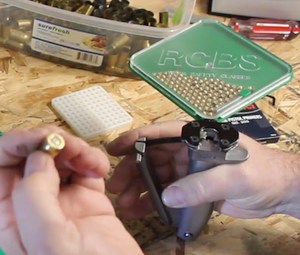
This is a detailed 20-minute video that shows the reloading process start to finish. The video shows how to clean the cases, deprime, and check them before loading.
In this video the cases are sized and bullets seated using a single-stage RCBS press. The cases are primed using an RCBS hand-priming tool which keeps multiple primers in a tray (see 8:55 time-mark). For efficiency, we recommend seating with a hand tool (or bench-mounted tool) vs. seating primers using the priming system on the press itself. The hand seating tool also gives you a better “feel” for setting the primers.
Safety First When Loading All Cartridges
Along with the first two instructional videos above, we include two important videos focused on reloading safety. In the first video, UltimateReloader’s Gavin Gear explains how to check your cartridge during the loading process to eliminate squib loads and other defects. In the second video, Starline Brass tech Hunter Pilant explains how to avoid double charges.
Load .45 ACP Safely — Avoid Squib Loads and Overcharges
You need to check the powder level of EVERY round you load. Do this visually BEFORE seating a bullet. (Or, with a progressive press, use a lock-out die that monitors powder levels). This is very important because a squib load (with little or no powder) can leave a bullet lodged in the barrel. A subsequent full, live round can cause a Kaboom with dire consequences.
Preventing Double Charges — Use a Case-filling Powder with .45 ACP
IMPORTANT TIP: Use a bulky powder that fills your case more than half way with a correct charge. “This will over-fill the case if it is double-charged, making it impossible to load. This is one safeguard that can keep you from making a big [mistake]” (Hunter Pilant, Starline). A bulky powder with high fill level will also be easier to see inside the case.
The Progressive Option — Loading .45 ACP on the Dillon 550B
Once you have mastered the basics of reloading for the .45 ACP, if you require large quantities of ammo, you may want to consider getting a progressive press. Progressive presses can significantly increase your ammo output, but there are also important safety considerations. You need to be careful about powder levels and priming. In this video, Gavin Gear explains how to reload safely with a Dillon 550B progressive press. The equivalent current model is the Dillon 550C.
.45 ACP Ammunition Loading Guide — Nosler Data
If you “roll your own” .45 ACP cartridges, there are many good powder choices. Our favorites are Vihtavuori N320, AA No. 5, and Hodgdon TiteGroup, but there are many other good choices. You’ll find these three recommended powders (plus many others) in the .45 ACP Load Data Charts from Nosler. Shown below are the Nosler Guides for 185gr bullets and 230gr bullets. Right-click each image below to access/download printable PDF files.
Click for PDF File
Click for PDF File
* However, be aware that CCI and other companies are now manufacturing .45 ACP brass with SMALL PRIMER POCKETS. Whenever you get new brass, be sure so check ALL the cases for primer size, and segregate large and small in two groups. Attempting to push a large primer into a small primer hole can lead to jams, or worse, dangerous detonation. Be CAREFUL!


 This Saturday Movie showcase features four handguns chambered for the modern, high-velocity 5.7x28mm cartridge. In a 5″-6″ barreled pistol, the 5.7x28mm round can achieve very high velocities compared to a 9x19mm (9mm Luger) or .40 SW. The bottle-necked 5.7×28mm cartridge weighs roughly two-thirds as much as a typical 9mm Luger cartridge, allowing more rounds to be carried for the same weight. The cartridge can produce considerable muzzle flash when fired from a pistol, but it has roughly 30% less recoil than the 9mm Luger cartridge, improving controllability. Thanks to its high velocity, the 5.7×28mm has a flatter trajectory than most pistol ammo types.






 This is a detailed 20-minute video that shows the reloading process start to finish. The video shows how to clean the cases, deprime, and check them before loading.


