|
|
June 13th, 2008
Put the same load in a variety of barrels (with the same length and chamberings) and you’ll see a wide variance in muzzle velocity. In fact, it’s not unusual to see up to 100 fps difference from one barrel to the next. We demonstrated this with a comparison test of Lapua factory ammo.
Chron Testing Lapua Factory Ammo
We recently chronographed Lapua 105gr 6mmBR factory ammo in three different 8-twist barrels of similar length. The results were fascinating. Lapua specs this ammo at 2790 fps, based on Lapua’s testing with its own 26″ test barrel. We observed a speed variance of 67 fps based on tests with three aftermarket barrels.

Brand ‘S’ and Brand ‘PN’ were pre-fit barrels shot on Savage actions. Brand ‘K’ was fitted to a custom action. All test barrels were throated for the 100-108 grain bullets, though there may have been some slight variances in barrel freebore. With a COAL of 2.330″, the rounds were “jumping” to the rifling in all barrels. Among the four barrels, Brand ‘PN’ was the fastest at 2824 fps average — 67 fps faster than the slowest barrel. Roughly 10 fps can be attributed to the slightly longer length (27″ vs. 26″), but otherwise this particular barrel was simply faster than the rest.
Results Are Barrel-Specific, Not Brand-Specific
These tests demonstrate that the exact same load can perform very differently in different barrels. We aren’t publishing the barrel-makers’ names, because it would be wrong to assume that ‘Brand X’ is always going to be faster than ‘Brand Y’ based on test results from a single barrel. In fact, velocities can vary up to 100 fps with two identical-spec barrels from the SAME manufacturer. That’s right, you can have two 8-twist, 26″ barrels, with the same land-groove configuration and contour, from the same manufacturer, and one can be much faster than another.
Don’t Demand More Than Your Barrel Can Deliver
We often hear guys lament, “I don’t get it… how can you guys get 2900 fps with your 6BRs and I can only get 2840?” The answer may simply be that the barrel is slower than average. If you have a slow barrel, you can try using more powder, but there is a good chance it may never run as fast as an inherently fast barrel. You shouldn’t knock yourself out (and over-stress your brass) trying to duplicate the velocities someone else may be getting. You need to work within the limits of your barrel.
 Factory Ammo Provides a Benchmark Factory Ammo Provides a Benchmark
If you have a .223 Rem, 6BR, .243 Win, 6.5×47 Lapua, 6.5×55, .308 Win, 30-06, or 300 WM Rifle, we recommend you buy a box of Lapua factory-loaded ammo. This stuff will shoot great (typically around half-MOA), and it can give you a baseline to determine how your barrel stacks up speedwise. When you complete a new 6BR rifle, it’s wise to get a box of the factory ammo and chronograph it. That will immediately give you a good idea whether you have a slow, average, or fast barrel. Then you can set your velocity goals accordingly. For example, if the factory 6BR ammo runs about 2780-2790 fps in your gun, it has an average barrel. If it runs 2820+ in a 26″ barrel (or 2835 fps in a 28″), you’ve got a fast tube.

June 9th, 2008
 Successful marksmanship is the product of a complex system, part biological (the shooter), and part mechanical (the rifle). Too often, in our fascination with things mechanical, we forget the human, physical side of the sport. The March edition of the CMP’s “The Mark” newsletter features an excellent article by Amber Darland on physical training for shooters. Darland, a certified Personal Trainer, is also a top-level competitive shooter. A U.S. Olympic Team alternate, she was on the American World Championship Team in 2002, and was a member of the Univ. of Alaska NCAA Rifle Team, which won four National Championships while she was there. Successful marksmanship is the product of a complex system, part biological (the shooter), and part mechanical (the rifle). Too often, in our fascination with things mechanical, we forget the human, physical side of the sport. The March edition of the CMP’s “The Mark” newsletter features an excellent article by Amber Darland on physical training for shooters. Darland, a certified Personal Trainer, is also a top-level competitive shooter. A U.S. Olympic Team alternate, she was on the American World Championship Team in 2002, and was a member of the Univ. of Alaska NCAA Rifle Team, which won four National Championships while she was there.
Garland says shooters should be involved in three kinds of exercise to improve their physical conditioning: 1) Aerobic Exercise to strengthen the cardiovascular system; 2) Anaerobic Exercise (such as weight lifting) to build muscle strength and stamina; and 3) Flexibility exercises.
 Strength Training Strength Training
Garland notes that strength training helps in many ways: “Weight training also increases your kinesthetic connections and awareness (your ability to notice internal changes in muscle position and
tension). The more you utilize your brain-to-muscle connections, the more you will be able to tap into them to correct positional errors and normal, day-to-day changes in muscle tension.”
Improving Flexibility is Key
Garland stresses that flexibility training can be very helpful, even for older, F-Class or Benchrest shooters: “Of all aspects of fitness, [flexibility] is probably the most utilized by shooting athletes, though not consistently in most cases. Flexibility is important for several reasons including injury prevention and positional consistency. The more pliable and flexible your joint capsules, the more readily they will handle unanticipated stress. An athlete who performs flexibility work on a regular basis will have pliable, supple, relaxed muscles that are not bound by constant tensions and immobility.”
CLICK HERE to Read Full Article (.pdf Download, p. 17)
May 28th, 2008
 Increasing the numbers of women involved in the shooting sports is vital. We need to bring in more women shooters to grow our gun clubs’ membership rolls and expand the consumer base for firearms products. From a political standpoint, getting women involved in shooting strengthens the gun rights movement, and helps counter efforts to close gun ranges and shooting facilities. Anti-gun advocacy groups and “liberal” politicians bank on the fact that most women are either opposed to firearms or are apathetic about gun rights. As more females get involved with shooting, it becomes more difficult for gun opponents to claim support from the “silent majority” of Americans. Also, women are important decision-makers at the family level. Wives often decide if there will be a gun in the house and if children in the family are allowed to participate in shooting sports. Increasing the numbers of women involved in the shooting sports is vital. We need to bring in more women shooters to grow our gun clubs’ membership rolls and expand the consumer base for firearms products. From a political standpoint, getting women involved in shooting strengthens the gun rights movement, and helps counter efforts to close gun ranges and shooting facilities. Anti-gun advocacy groups and “liberal” politicians bank on the fact that most women are either opposed to firearms or are apathetic about gun rights. As more females get involved with shooting, it becomes more difficult for gun opponents to claim support from the “silent majority” of Americans. Also, women are important decision-makers at the family level. Wives often decide if there will be a gun in the house and if children in the family are allowed to participate in shooting sports.

This week’s ShootingUSA television episode features the NRA’s Women On Target program. This unique program offers firearms training and hunting excursions exclusively for women. The Women On Target program offers new lady shooters the chance to receive handgun, rifle, and shotgun instruction by other women, in a low-stress situation.

CLICK HERE to Find a Women on Target Instructional Clinic
The popular Women-Only Hunt Program allows women to enjoy the outdoors with experienced outfitters guiding all female clients. A wide variety of hunts are offered in the second half of 2008 including duck/goose hunts, pheasant hunts, turkey hunts, whitetail deer hunts, and even a Rocky Mountain Elk hunt. This program has been operating successfully since 1999.

CLICK HERE for Hunt Dates and Outfitter List
Photos courtesy National Rifle Assn., All Rights Reserved.
May 1st, 2008
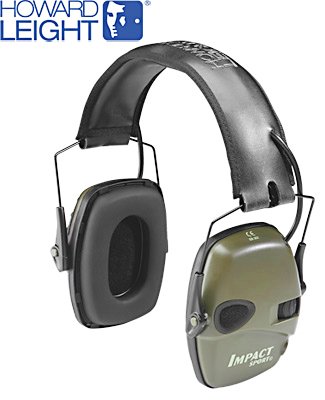
Now through May 31, 2008, MidwayUSA has the Howard Leight Impact Sport Earmuffs on sale for $49.99, $10.00 off the regular price. That’s a heck of a deal. These electronic muffs (item 671923) perform as well as some other noise-cancelling muffs that cost two or three times the price.
Because the Howard Leight Impact Sport muffs only carry a Noise Reduction Rating (NRR) of 22 db, we recommend you use these OVER foam ear plugs. When you do that, the electronic noise circuit still allows you to hear range commands. Forum member Danny Reever has a pair of the Leight Impacts. He reports: “Off the firing line, while others are shooting, you can easily carry on a conversation while the electronics cancel out the gunfire. Amplification is crisp and clear even at the highest setting. On the firing line, the slim profile of the muffs does not interfere with cheek weld and are comfortable.
The 22-decibel noise reduction rating (NRR) is a bit low for my liking, but I have found using 29-db plugs coupled with a slight gain in the electronics allows me to get maximum protection and still hear range commands. In fact, by increasing the volume further I could still hear conversations up and down the firing line.”
Assistant Editor Jason Baney also has a pair of the Howard Leight electronic muffs. He says: “They are comfortable and work great if you wear plugs underneath. You can even plug an iPod into them.”
Both Cabela’s buyers and MidwayUSA customers have praised these units:
“I am a firearms instructor/SWAT instructor, active on two SWAT teams. [I] have burned through too many pairs of Peltors due to their poor battery set up. These are cheaper price-wise, but [have] better controls and battery storage. Amazing sound quality. In reality to beat the performance you need to spend four to five times the money. If I could give ten stars I would…” ZM, Cabelas customer.
“I have a set of Peltors that I paid triple the price for and they aren’t half as good. These [Leights] have nice smooth attenuation unlike the Peltor that snap on and off in a very annoying fashion. These fit tight, have good noise reduction and good sound quality. The low profile works well with rifles and shotguns. Don’t bother spending more, these are great!” Paul D., MidwayUSA Customer.
April 29th, 2008
Forum member Ron Tilley finished fourth overall at the recent NBRSA 600-Yard Nationals. This was an impressive performance for a relative newcomer to the 600-yard game without “local knowledge” of the Sacramento range. The top 3 finishers, Jerry Tierney, Peter White, and Craig St. Claire, all have extensive experience shooting at Sacramento.

While many of the top shooters were using a 6mm in Light Gun (such as a 6 Dasher or 6-6.5×47), Ron campaigned a 260 Ackley Improved. This is based on a 260 Rem case, with the shoulder blown forward to 40 degrees. Improving the 260 Rem case adds just enough extra capacity to get the 140gr-class bullets into the 2900+ fps velocity window where they seem to perform best.
Ron starts with Lapua 243 cases, necked up to 6.5 mm. He was shooting 140gr Berger VLD bullets, pushed by Hodgdon H4831sc powder and Russian primers. Ron says this combination has been “very accurate right out of the gate.” Ron’s 2920 fps load delivers 5-shot groups in the high teens and low twos, with very low ES and SD. In the video interview below, Ron explains the merits of the 260 AI cartridge, and offers tips on case prep and loading for accuracy.

CLICK HERE to WATCH TILLEY VIDEO
Ron was shooting an eye-catching rifle. It featured a carbon fiber and wood Terry Leonard stock, BAT Action, and Nightforce scope. With all-premium components, Terry’s 260AI is a beautiful rig that shoots as good as it looks.


March 12th, 2008
 “What trigger would you like us to build next?” That’s the question Timney Triggers is asking shooters. Timney wants customer input on what type(s) of new triggers it should develop, and the reasons why. Just log on to the Timney Triggers website, and share your ideas on the Trigger Survey Page. “What trigger would you like us to build next?” That’s the question Timney Triggers is asking shooters. Timney wants customer input on what type(s) of new triggers it should develop, and the reasons why. Just log on to the Timney Triggers website, and share your ideas on the Trigger Survey Page.
Timney tells us: “Since its inception in 1946, Timney has always looked for ways to improve their products by listening to the customer. After all who knows better about the product than the end user? Timney would like to pose the question to all shooters and hunters. What trigger would you like us to build next? Perhaps a new bolt action, semi-auto pistol, shotgun, or tactical rifle? The sky is the limit so be creative.”
Arizona-based Timney Triggers currently offers a line of 75 replacement triggers, including a popular set of drop-in, modular AR-15 triggers. For more info, call 866-484-6639 or visit TimneyTriggers.com.

March 7th, 2008
Now through March 31, 2008, MidwayUSA has Ramshot X-Terminator powder on sale for just $10.49 per pound, marked WAY down from the $20.49 regular price. X-Terminator is a double-based, high-energy ball powder that is designed for the varmint hunters who demand a clean burning powder. X-Terminator’s small, spherical kernels meter easily and precisely, so this is a good choice if you plan to load a large quantity of ammo on a progressive press. X-Terminator has a burn rate similar to Accurate 2230, Hodgdon H322, and Win 748. X-Terminator is well-suited for the 222 Remington, 223 Remington and 22 BR cartridges.

Note, the sale price does NOT includes a $20.00 hazmat charges and $9.99 special handling fee. You may want to combine your order with fellow shooters to “amortize” the hazmat fee over a larger quantity of powder.
Powder Burn Rate Chart from The Reload Bench.
February 26th, 2008
Recent visitors to the AccurateShooter.com site may not know that we have an entire set of FREE TARGETS. There are sight-in targets, load development targets, Benchrest Targets, NRA Highpower targets, Scope Testing Targets, even a special set of Fun Targets.
Most of the targets come bundled in .zip archives, so you can easily download multiple targets with one click. The targets are saved in .pdf format, so they are easy to print and the scale is correct no matter what your screen resolution.
Here Forum member FireMedic shows some fine shootin’ with our basic Accuracy Target. With small, red diamonds and extended black lines, this target allows very precise aiming at 100 and 200 yards. The gray dot on top provides a reference point for a 200-yard zero. FireMedic reports: “My 30″, 12 twist, 3 groove does pretty good for an old Savage chambered in .308 Win.” With an average group size of 0.208 inches we’d have to agree. Great Shootin’ FireMedic!

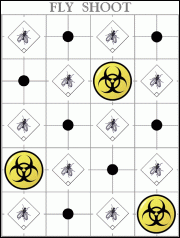
Here are two fun targets you might enjoy. The Atomic Target was originally created as a contest for our readers. The design is by Michael Forester of Auckland, New Zealand. Hit the bigger green and red neutrons, then try your luck with the smaller electrons. In the center, go for true “bug-holes” with our Fly Shoot Target. Watch out for the bio-hazard rings!
December 26th, 2007
This summer, Carl Bernosky became the first shooter to win the NRA High Power competition at Camp Perry using an AR-platform, semi-automatic rifle. Since that accomplishment, many folks have asked about the fire-control system in Carl’s gun. Carl used a John Holliger-built upper fitted with a Match Rifle Trigger from Geissele Automatics. Priced at $279.00, the Geissele (pronounced “Guys-lee”) Match Rifle Trigger features a 1.3 to 3 pound First Stage (2-lb nominal), with a 4 to 14 ounce Second Stage. This allows a very crisp, light final trigger release. The Geissele trigger, with its low-mass, hi-speed hammer, has a fast lock-time, and also delivers enhanced kinetic energy to the firing pin.

The Geissele Match Trigger boasts Wire EDM-cut sear surfaces for a crisp and consistent release with minimal drag. Overtravel is adjustable, and there are separate, independent adjustments for Second Stage pull weight and sear engagement.

In addition to the Match Trigger, Geissele Automatics offers a Service Rifle Trigger set up for the 4.5-lb minimum pull weight. Minimum pull weight for Service Rifle competition is 4.5 lbs, and the Geissele provides a 3.2 to 5 pounds First Stage, with a 0.5 to 1.5 pound Second Stage. The Geissele Service Rifle trigger employs an exclusive 5-coil trigger spring for a nominal 4-lb First Stage, allowing allow a light 0.5-lb (8-ounce) Second Stage with crisp, light break similar to the Match Rifle Trigger.
December 12th, 2007
Here’s a product that should interest all F-Class shooters. It is a new bipod that offers unrivaled stability from an ultra-wide footprint. Nick-named the “Ski Bipod”, this impressive unit is custom-crafted by Canadian Henry Rempel, who also conceived the design. The height of the bipod is adjustable as is the distance between the runners or “skis” that contact the ground. And there is a cant adjustment allowing the rifle to be leveled on uneven ground. The reason Henry used ski-like runners rather than flat pads is that this allows the rifle to slide slightly reward during recoil. That eliminates much of the hop and rotation associated with conventional bipods.

Forum member Keith Skjerdal reports: “A lot of F-CLass guys in Canada are using the Ski Bipod made by Henry Remple out of Calgary. It is very well made and steady as a conventional pedestal rest. Even some guys in the USA and Britain have them now. If you want the best, this is it, in my opinion. This makes the trip to the mound easier than with a big pedestal rest. Downside? Well, since the Ski Bipod attaches to your rifle, it counts in your total weight under the rules. The Ski Bipod adds roughly 3.5 pounds to your gun’s weight. The cost is around $400-420 Cdn (this basically covers the cost of materials and all that milling work.)
To get one, contact Henry Rempel from Calgary. He does not have a web site. His home phone number (after 7 pm) is 1-403-272-8416. I think his email is henry.rempel [at] hotmail.com.”


Photos Copyright © Richard Dreger, used by permission.
|