Scores of manufacturers showcase their products at the SHOT Media Day event, held each year in Boulder City, Nevada. This year we saw some legendary names (such as Colt and Winchester), as well as new, 21st-century gun-makers (such as Tracking Point). Savage and Kimber had some surprising new offerings, and we saw impressive new optics from Zeiss and Minox. There were some interesting trends. Many firearms were equipped with “factory” suppressors. Ruger, much to our surprise, showcased a Ruger 10/22 takedown rifle fitted with a Ruger-branded suppressor. It was extremely quiet. Many of the handgun manufacturers, including Ruger and Walther, supplied ammunition with composite polymer matrix bullets. These bullets are significantly lighter than conventional pistol bullets of the same caliber (the reduced bullet mass did lessen felt recoil with 9mm and 45 acp pistols). The polymer bullets are lead-free, and they don’t ricochet, so they are both more “eco-friendly” and safer when used on steel targets.
New Savage 110 BA Stealth Rifle
Savage unveiled a modern, “monolithic” metal-chassis tactical rifle. Designed to compete with the Ruger Precision Rifle (RPR), the new Savage 110 BA Stealth has an AR-type hand grip, skeletal buttstock, and a low-profile vented forearm. This rifle will be offered in .308 Winchester and 6.5 Creedmoor while a slightly bigger model will be offered in .300 Win Mag and .338 Lapua Magnum. Savage says that all the 110 BA Stealth models will feature “factory blue-printed actions” for improved accuracy. MSRP varies from $1200 to $1600 depending on caliber and configuration. It should be available starting next month.
The model on display, chambered in .308 Winchester, proved accurate in the hands of Ed M. of 65guys.com. Ed liked the trigger and the fact that the rifle uses PMags. The stock, based on a design by Drake Associates, is very light but also very rigid. Ed thought this stock would work well on barricades in tactical matches. Steve L. of 65guys.com said there is “pent-up demand” for a rifle like this, and he predicts the 110 BA Stealth will be a big seller for Savage.
New K6 Revolver from Kimber
Kimber, known for its 1911-type semi-auto pistols, has introduced an all-new K6 .357 magnum carry revolver. Kimber’s hammerless wheelgun was very nicely crafted and had one of the smoothest double-action pulls we’ve tried. The trigger pull was long, but very consistent and smooth. With the Kimber, you don’t feel a series of “stages” or transitions as you do with most other double-action revolvers. The other impressive thing about the new revolver is the finish — the stainless is very smooth and shiny, the result of “much hand polishing” according to Kimber engineers.
Ruger 10/22 Takedown with Factory Suppressor
The most fun we had all day was at the Ruger booth. There we got to test a Ruger 10/22 Takedown fitted with a Ruger-branded factory-made suppressor. This little rifle was a hoot to shoot, and with the suppressor in place it was amazingly quiet. We really liked this set-up and the take-down system worked brilliantly — just pull one lever, then twist and the barrel section comes off. For those states where you can own a suppressor, we strongly recommend this configuration. The “can” is sold separately and buyer must still comply with all applicable state and Federal laws.
Zeiss Victory V8 4.8-35x60mm Rifle Scope
Zeiss showed off its impressive Victory V8 line of riflescopes. These offer an 8X zoom ratio, with handy BDC turrets — just dial the yardage indicated on the turret (you can custom-order BDC rings calibrated for your favorite load). The new V8 scopes offer many impressive features. We shot a rifle fitted with the new 4.8-35x60mm V8, which features a very beefy 36mm main tube. The glass was bright and ultra-sharp. Zeiss claims 92% light transmission. Fiber optic technology provides a very precise red dot in the center of the reticle. This was visible even in bright sunlight. Zeiss will offer three other V8 models: 1-8x30mm, 1.8-14x50mm, and 2.8-20x56mm.
APO .338 Lapua Magnum
Bigger is apparently better when it comes to serious tactical rifles. There were quite a few rifles chambered for the powerful .338 Lapua Magnum Cartridge. We tried out a .338 LM from Ashbury Precision Ordnance. With some help from a laser rangefinders, we were able to put rounds on a large steel plate at 960 yards. The trigger was nice and the suppressor reduced felt recoil. This was a nice rifle, with a comfortable cheek-piece and ergonomic grip.
Minox MD 88 Spotting Scope
We noticed a BIG front objective on a brand-new Minox spotting scope — one of only two in the country. This new spotter features low-dispersion glass and dual focusing rings — a large “fast focus” ring and a second smaller, fine focus ring. The price, including 20-60X eyepiece, will be around $1750.00. Jason Baney, who works for EuroOptics, says this new Minox spotting scope compares well with other spotters that cost considerably more.
Blaser R8 Professional Thumbhole Fancy Wood
If there was one rifle I wanted to take home with me, it was this nice Blaser R8 “Professional Success” model with a fancy wood new thumbhole stock. This rifle was very comfortable in all shooting positions. The gun balanced well and the straight-pull Blaser action is fun to use. It can be cycled rapidly without disturbing your position on the rifle.
This is always something new and unusual on display at Media Day at the range. This tracked one-man rig provides all-terrain mobility so disabled persons can enjoy hunting and wilderness recreation.
SHOT Show in Las Vegas is just two weeks away. Here are some of the interesting new products that will debut at SHOT Show. You can find these items and hundreds more new-for-2016 products at the SHOW Show New Product Center.
The Newcon Optik Spotter LRF is a combined spotting scope and laser rangefinder — the first of its kind. This unique piece of equipment integrates a Newcon Optik Laser Rangefinder with a 15-45X Spotting Scope with etched mil-dot reticle. Newcon Optik claims a 5500m maximum range for the LRF. The integrated scope/LRF is housed in a rugged yet light-weight MIL-SPEC housing. We like the idea of a combined Spotter/LRF. Will other companies try to copy Newcon Optik’s innovative design?
Mason Target Systems — AR500 Steel Target With Shot Sensor
The MTS Target System “Pescadero” unit combines a rugged AR500 steel target with a durable electronics and sensor package that allows shooters to view their shots on a mobile App. With on-board power and wireless communication technology, the system will display shot location to the shooter positioned hundreds of yards away. So you can hear the “ding” of steel and then see your exact shot location on your smart phone or tablet. To aid aiming, the Pescadero target can mount self-healing polymer targets to the AR500 steel plate. Visit MasonTargetSystems.com for more information.
Schweitzer Optics — First-Ever Double FOV Scope
Here is a very innovative new hunting scope that actually displays a 3.5 X view AND and 1.0 X view simultaneously. Schweitzer claims this is the first and only double Field of View (FOV) sports optic in the world. This innovative optical technology doesn’t come cheap — Schweitzer’s Eagle Eye 3.5 dual POV scope retails for $2500.00.
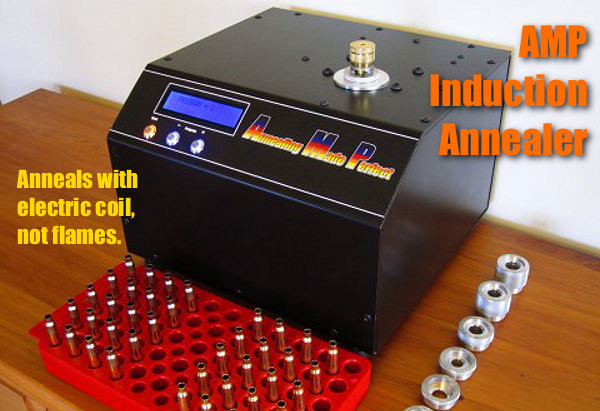
Annealing Made Perfect — Induction Annealing Machine
No more flaming torches (and burned fingers). The AMP Annealing system anneals through electrical induction. This micro-processor controlled, precision-calibrated induction annealer provides exact and repeatable neck hardness. With the various AMP-made pilot inserts, the machine will handle popular cartridge types from .17 Caliber all the way up to 460 Weatherby. Anneal times are pre-programmed for optimal results.
Accu-Tac — SR-5 Tactical Bipod
The Accu-Tac SR-5 Bipod is crafted from high-quality billet aluminum. The SR-5 mounts quickly and securely to a 1913 Picatinny rail. The bipod’s wide stance provides good stability. Ratcheted leg extensions adjust to five different heights, and then retract quickly with a one-button retraction lever. Legs can be deployed in a conventional 90-degree orientation, or at a 45-degree angle either forwards or rearwards.
Lyman Products — Cyclone Rotary (Wet) Tumbler
Lyman is introducing a new Rotary Tumbler for 2016. Designed for use with stainless (pin-type media) and liquid, this Cyclone Tumbler gets brass thoroughly clean inside and out. The large capacity drum holds up to 1000 pieces of .223 Rem brass and features a rubber lining to protect brass and greatly reduce operating noise. The included two-piece sifter pans make separating cases and pins easy.
Swiss+Tech Products — Tac20 Firearms Multi-Tool
This new multi-function gun tool contains 4 driver bits, 2 Torx drivers, 2 Allen drivers, gun pin punch, sight wrench, castle nut wrench, flat screwdriver, bottle opener, knife, and LED flashlight. It even contains a fitting with a male thread connection for attaching cleaning rods. That’s clever. All totaled, the Tac20 multi-tool offers 20 features — that’s a lot of functionality in a small, compact package from Swiss+Tech Products.
The R-F Cam Cradle is a smart new product that lets you securely mount a Laser Rangefinder (LRF), digital camera, and spotting scope all on a single tripod. The “game-changing” feature of the R-F Cam Cradle is that it allows you to colimmate (i.e. precisely align) all your optics on the same spot. This way you can simultaneously aim all three devices at a long range target by simply moving the tripod head. A tactical shooter can easily range his target while watching the wind though his spotting scope. And the long-range hunter can range and film his prey as he watches it through the spotter. This unit costs $179.95 from DefensiveEdge.net.
You’ll find a detailed product evaluation of the R-F Cam Cradle on the LongRangeOnly.com website. Reviewer Sam Millard uses the R-F Cam Cradle in the field with a variety of optics and rangefinders. Millard explains how the R-F Cam Cradle conveniently allows combined use of spotting scope, LRF, and compact video camera.
Millard was very impressed with the system: “I field-tested the R-F Cam Cradle in the mountains of northern Idaho and the wide open spaces of eastern Wyoming. I believe the most effective way to use the cradle is in a long range ambush; get the spotting scope, camera, and LRF aligned on a landmark, then lock it down. The LRF and spotter won’t be aligned perfectly, but they’ll be well within the field of view of each other, requiring only a gentle tilt of the tripod to center the beam of the LRF on the target. At ELR distances, a well-supported LRF is crucial to obtaining an accurate range. This mount makes it easy, and doesn’t require displacing your spotting scope to get it done.”
See R-F Cam Cradle Demonstrated in the Field:
Having a video camera mounted in alignment with spotting scope is great for Long Range applications notes Millard: “The camera mount is my favorite feature of the R-F Cam Cradle. It allows co-witnessing the video camera to the spotting scope, then aiming the field of view of both with one movement of the tripod head. This is a great improvement to the normal way of recording the shot and spotting at the same time, which previously required two tripods or a clamp-on head for the camera, both of which required separate aiming of the camera and spotting scope.”
R-F Cam-Cradle Product Details
Manufacturer: RLC Customs
Vendor: Defensive Edge, Inc.
Rathdrum, ID DefensiveEdge.net
Order Phone: (208) 687-2659
Material: 3/16” 53 Series aluminum
Finish: Powder-coated Matte Black
Total Weight: 16.5 ounces
Mount: ¼-20 Threaded Standard Camera Mount
Retail price: $179.95
Shawn Carlock of Defensive Edge explains: “The R-F Cam Cradle is a way for one person to run everything. Otherwise it’s really difficult to run the spotting scope, run the video camera, run the rangefinder, get dope — do all those different things. So RLC Customs has come up with the idea to put everything together in one platform, where you can sync it together and use it effectively, as a cluster.”
Product Find by Boyd Allen. We welcome reader submissions
Nightforce is bringing out a new 20-60X 80mm spotting scope that is significantly less expensive than its 82mm big brother, the 20-70X TS-82. The new TS-80 Hi-Def spotter is priced at $1595.00 MSRP compared to $2653.00 for the TS-82 (MAP “street price”). Yes, you heard that right, the new TS-80 is more than $1000.00 less expensive than its 82mm big brother. That’s a lot of hard-earned cash saved in return for the loss of just 10X magnification on the upper end. Both spotting scopes feature high-definition glass and easy-to-use, full-diameter focusing controls.
At its $1595.00 price point, the Nightforce TS-80 looks like a winner. It shares features we liked in the more expensive TS-82: Extra-low-Dispersion (ED) glass, easy-to-use zoom ring, built-in sunshade, and rubber armor on the entire body. However, on the TS-80 the eyepiece is NON-removable. That means you cannot swap in a different eyepiece (such as a fixed power 25X for greater field of view).
The TS-80 offers a lot of performance for the $1595.00 price. Most other current-production spotting scopes with comparable features and ED glass cost a lot more. Weight is 68 ounces (4 lbs., 4 oz.) — that’s fairly hefty. The TS-80 will focus from 20 feet to infinity, making it suitable for all shooting chores, even close-range pistol work. The mounting foot fits many quick-release tripods and accepts standard 1/4″ tripod screws. The TS-80 includes an integral, retractable sunshade for the front objective. Optional accessories include a protective sleeve and a fitted carrying case, shown below.
Product Tip from EdLongrange. We welcome reader submissions.
For many spotting chores, this small $260.00 Minox MD50 16-30x50mm may be all you really need.
Many readers have asked: “Can you recommend an affordable, quality, very compact spotting scope for viewing mirage or hunting?” These folks want a handy, general purpose optic — they aren’t trying to resolve 6mm bullet holes at 600 yards and beyond. For that kind of long-range viewing, you’ll need a premium ($2000+) high-magnification spotting scope (or better yet, a target cam system). However, for other tasks (such as viewing mirage, wind flags, or game animals), you can save your pennies and go with something smaller, lighter, and WAY less expensive — such as the Minox MD 50.
If you are looking for an ultra-small, medium-magnification spotting scope that is light, bright, affordable, and easy to use, we recommend the Minox MD 50 16-30x50mm spotter. To be honest, this is a steal. We don’t know of any pint-sized spotting scope that offers better performance at anywhere near the price (currently $259.00 on Amazon.com).
This small optic is easy to mount (even on very small tripods). It has a reasonably wide field of view, and is surprisingly bright and sharp considering the sub-$300.00 price. We prefer the angled model (for viewing mirage and flags while shooting prone), but there is also a straight (non-angled) version for the same price (currently $259.00 on Amazon.com).
Mind you, this little Minox MD 50 will certainly NOT replace a high-end Kowa or Swarovski spotting scope, but it may be all you need to see mirage, wind flags, and shot markers. Moreover, this little unit is ideal for use with pistols or airguns inside 50 meters. In fact this is the spotter we use when shooting pistols because it’s compact enough to fit inside a small range bag.
We’re not alone in our praise for the little Minox MD 50. The OpticsThoughts Blog reviewed five (5) different ultra-compact spotters from Leupold, Minox, Nikon, and Vortex, which ranged in price from $300 to $700.* Though the little Minox was the least expensive optic in the test, the reviewer concluded it was the best value by far:
MD50 16-30×50mm (OpticsThoughts.com Review)
This is easily the champ in the “bang for the buck” contest. Form factor-wise, it looks like a scaled-down, full-size spotter with a proper “foot” for a tripod mount. It has a very solid feel, owing to it being short and moderately heavy.
Optically, the spotter is very good for what it costs. It is a bit cheaper than the Leupold and outperforms it in most ways, while being more compact: FOV is wider, low light performance is better and overall image quality is better from 15X up to 22X or so. At higher magnifications, eye-relief gets a little short and Leupold is easier to use. However, the FOV advantage carries over across all magnifications. The focus ring is on the body of the spotter and the large diameter offers a fair amount of adjustment precision. [T]he focusing mechanism … is quite good.
The Swarovski Optik website features a blog with interesting technical articles. In the “On Target” series of blog stories, Swarovski has provided a handy explanation of how optics systems work, with exploded diagrams of rifle scopes, spotting scopes, and binoculars. CLICK HERE for Swarovski Optics Blog.
Scope Terminology Focusing Lens
The focusing lens is an adjustable lens inside the optical system for focusing the image at different distances…. In the case of rifle scopes, apart from focusing, the focusing lens also facilitates parallax compensation.
Diopter Adjustment
For rifle scopes, the reticle can be focused using the diopter adjustment on the eyepiece, thereby correcting any visual impairment. [Editor’s Note: Movable eyepiece diopter adjustment is not offered on all rifle scopes. It is a useful feature on Swarovski and other premium scopes. This allows shooters who need eyeglasses to get a sharply focus image even without wearing corrective lenses. Of course shooters should always wear ANSI-certified eye protection. With the diopter, folks who need correction can use inexpensive, non-Rx safety eyewear instead of expensive prescription safety glasses.]
Reversal System
The purpose of the reversal system is to reverse the image by means of prisms in binoculars and telescopes, and lenses in rifle scopes….The lens reversal system is needed in rifle scopes to control the variable magnification and move the exit pupil[.]
Resource tip by EdLongRange. We welcome reader submissions.
If you’re thinking of spending thousands of dollars on a new rifle scope or spotting scope, do your homework first. You need to understand key design features, such as first focal plane vs. second focal plane, and turret click values. You should learn about light transmission, resolution, and other factors that distinguish a great optic from a not-so-great one. You also need to analyze your specific requirements before making a buying decision: How much magnification do you really need? Is illumination important? How much scope weight can you reasonably tolerate?
Sport Optics, a new book by Alan Hale, helps you answer all these important questions. Hale, former CEO of Celestron Optics, has more than 50 years of experience in the optics industry. His book, Sport Optics, is an up-to-date, comprehensive guide to Riflescopes, Spotting Scopes, and Binoculars. Hale surveys products from dozens of domestic and foreign manufacturers. Hale explains, in easy-to-understand terms, the technical jargon used by optics-makers. This helps buyers make informed decisions.
The new book is full of good, sound advice. Respected gun writer Chuck Hawks says: “Alan Hale has impeccable credentials in the optics industry. Sport Optics is written for the layman in a clear, understandable and interesting manner.” Bill Thompson, co-publisher of Bird Watcher’s Digest adds: “Alan Hale is one of the Zen masters of sport optics[.] He knows more about how optics work, how and where they are made, and how to put them to their highest possible use than most outdoor sport optics writers. Read this book before you make any optics purchase[.]”
FREE Book Preview at Amazon.com
The Sports Optics book is offered at Amazon.com for $21.95. To preview the book, go to the Amazon web page for Sports Optics, and click the cover photo that says “Look Inside”. This lets you see front and back covers, complete table of contents, and many sample pages (such as those shown below):
Swarovski has a new STR 80 spotting scope with an illuminated reticle. That’s right, this new STR 80 spotter has a ranging reticle like a riflescope, with adjustable brightness levels. This 80mm spotting scope can be used for estimating range to targets, using MIL-based or MOA-based stadia lines on the cross-hairs. This allows you to range targets optically, as you could with a ranging reticle in a riflescope.
Revolutionary Reticle “ON”, Reticle “OFF” Technology
The STR 80’s illuminated ranging reticle makes the new STR 80 a fairly unique product among high-end, imported spotting scopes. Thanks to a new technology, Swarovski is the first manufacturer to successfully project a reticle directly in a spotting scope. The reticle (MOA or MRAD) can be activated or deactivated as required. Notably, because the reticle appears via electro-illumination, it can be “turned off” for un-obstructed viewing. So you can have a totally clear field of view when desired, OR a ranging reticle when that functionality is desired. Having the ability to turn OFF the reticle is great — that’s a very intelligent feature.
When viewing targets, the STR 80’s sharp HD (high-definition) lenses will resolve bullet holes at long range. Current Swaro 20-60X and 25-50X (wide) eyepieces can be used with the new STR 80 spotter. Optional accessories include Picatinny mounting rail, digiscoping attachment, and a winged eye cup.
How to Range with STR 80 Reticles
The new STR 80 scope offers a choice of either MOA or MRAD reticles with 15 brightness levels, 10 day levels, and 5 night levels. For convenient ranging, set the magnification level so that the MOA reticle displays ¼ MOA divisions, while the MRAD Reticle displays 0.1 MIL divisions. (NOTE: the reticle will change in size relative to the target at different magnifcation levels. Therefore ranging is normally done at one standard magnification level).
Dustin Woods, Sales Director for Swarovski Optik NA said: “Long range shooters asked for a premium spotting scope with integrated reticle and we have listened. With our new STR spotting scope we now have MOA and Mil-Radian reticle models. Because the reticle is illuminated, the user can have the reticle turned on when they are judging hits and misses but also turn it completely off for an unobstructed view during observation. This product is a real game changer in the precision shooting segment.”
While attending the CA Long Range Championship a while back, we had the opportunity to test the performance of a high-magnification (63X) spotting scope in near-ideal conditions (maybe the best I’ve ever witnessed). On the event’s last day we arrived at 5:45 am, literally as the sun was cresting the horizon. I quickly deployed our Pentax PF-100ED spotting scope, fitted with a Pentax SMC-XW 10mm fixed-power eyepiece. When used with the 100mm Pentax scope, this 10mm eyepiece yields 63X magnification. Befitting its $359.00 price, this eyepiece is extremely clear and sharp.
At the crack of dawn, viewing conditions were ideal. No mist, no mirage, no wind. The first thing this Editor noticed was that I could see metal nail heads on the target boards. That was astonishing. As soon as the first practice targets went up, to my surprise, I could see 6.5mm, 7mm, and 30-caliber bullet holes in the white at 1000 yards.
That’s right, I could see bullet holes at 1000. I know many of you folks may not believe that, but there was no mistaking when I saw a 7mm bullet cut the white line separating the Nine Ring and Eight Ring on the target in view. (I was watching that target as the shot was fired and saw the shot-hole form). And when I looked at the 30-cal targets, the bullet holes in the white were quite visible. In these perfect conditions I could also make out 3/8″ bolt heads on the target frames.
The Human Factor
When viewing the bullet holes, I was using my left naked eye (no safety glasses or magnification). I also had a contact lens in my right eye (needed for distance vision). To my surprise, while I could see the bullet holes without much difficulty with my left eye, things were fuzzier and slightly more blurry with the right eye, even when I re-focused the scope.
Then I invited 3 or 4 shooters to look through the scope. One younger guy, with good eyes, said immediately: “Yeah, I can see the holes — right there at 4 o’clock and seven o’clock. Wow.” Some older guys, who were wearing glasses, could not see the holes at all, no matter what we did to the scope’s main focus and diopter adjustment.
The lesson here — if you have to wear glasses or corrective contact lenses, just that extra bit of optical interference may make a difference in what you can see through the scope. Basically anything that goes between the scope eyepiece and your eyeball can degrade the image somewhat. So… you may be better off removing your glasses if you can still obtain good focus sharpness using the diopter adjustment and focus ring. I did the left vs. right eye test a half dozen times, and I could definitely see small features at 1000 yards with my naked eye that I could not see with my right eye fitted with a contact lens. (I did have to re-focus the scope for each eye, since one had a corrective lens while the other did not.)
Mirage Degrades Image Sharpness and Resolution
The “magic light” prevailed for only an hour or so, and then we started to get some mirage. As soon as the mirage appeared I was no longer able to see raw bullet holes, though I could still easily see black pasters on the black bulls. When the mirage started, the sharpness of the visible image degraded a huge amount. Where I could see bullet holes at dawn, by mid-morning I could barely read the numbers on the scoring rings. Lesson: If you want to test the ulimate resolution of your optics, you need perfect conditions.
Chromatic Aberration Revealed
As the light got brighter and the mirage increased I started to see blue and red fringing at the edges of the spotting disk and the large numerals. This was quite noticeable. On one side of the bright, white spotting disc you could see a dark red edge, while on the other side there was a blue edge (harder to see but still present).
The photo below was taken through the Pentax spotter lens using a point and shoot camera held up to the eyepiece. The sharpness of the Pentax was actually much better than this photo shows, but the through-the-lens image does clearly reveal the red and blue fringing. This fringing is caused by chromatic aberration — the failure of a lens to focus all colors to the same point. Chromatic aberration, most visible at high magnification, causes different wavelengths of light to have differing focal lengths (see diagram). Chromatic aberration manifests itself as “fringes” of color along boundaries that separate dark and bright parts of the image, because each color in the optical spectrum cannot be focused at a single common point on the optical axis. Keep in mind that the Pentax does have “ED” or low-dispersion glass, so the effect would be even more dramatic with a cheaper spotting scope.
If you wonder why top-of-the-line spotting scopes (such as the $3900 Leica APO-Televid 82) cost so much, the answer is that they will deliver even LESS chromatic aberration at long range and high magnification. With their exotic apochromatic (APO), ultra-low-dispersion glass, a few ultra-high-end spotting scopes can deliver an image without the color edging you see in the photo above.
The Pentax PF-100ED is a heck of a spotting scope. Any scope that can resolve bullet holes at 1000 yards is impressive. But if you want the ultimate in optical performance, with minimal chromatic aberration, you may need to step up to something like the 88mm Kowa Prominar TSN-883 with Flourite Crystal lenses ($2450.00 body only), or the 82mm Leica APO ($3899.00 with 25-50X eyepiece).
EDITOR’s NOTE: The purpose of this report is to show what is possible… in IDEAL conditions. With this Pentax 100mm, as well as a Swarovski 80mm, we have often been able to resolve 6mm bullet holes at 600 yards. But again, that performance requires really good viewing conditions. By 10:00 am at my range, even with the 100mm Pentax at 75 power, seeing 6mm bullet holes is “iffy” at best. So don’t go out and mortgage the house to buy a $4000 optic with the hope that you’ll be able to spot your shots at 1000 yards. If conditions are anything less than perfect, you’ll be lucky to see bullet holes at 500 yards. The real solution for very long-range spotting is to set up a remote target cam that broadcasts a video picture to a screen at your shooting station.
At long range, small bullet holes are much easier to see in the white than in the black. When you’re practicing at long range on high power targets, one way to enhance your ability to see your bullet holes is to print a “negative” version of the regulation bullseye target.
How do you create a “negative” of a target image? Many image programs, including the FREE Irfanview software, have a “Negative” function in the pull-down menu. If you don’t see a “Negative” menu option in your program, look for a “substitute colors” option. Many printers also have a “reverse colors” function. If you can’t find a solution with your computer or printer, just take a normal bullseye target to a copy shop, and the staff can easily print you a set of targets with white centers in black fields.
Forum member Watercam uses a Pentax PF-80ED spotting scope. With his 80mm Pentax he can see 6mm bullet holes in the white at 600 yards (in very good conditions), but holes in the black are only visible out to 400 yards or so. Accordingly, Watercam uses a modified “reversed” black-to-white target for 600-yard practice.
Watercam told us: “The view through the Pentax is very sharp and contrasty with great color. Eye relief with the Pentax 10-60 power zoom is 18-22mm (much more than the Kowa zoom), so I can use glasses with no problem. With my 6mm and limited mirage I’m seeing defined, 6mm holes in the white out to 600. In the black, I can see bullets holes at about 400 with my eyes. I am printing reverse-color targets for training without a pit partner at the 600-yard line.”
Brits Use New White-Field Target for F-Class
In the UK, ranges are now using a “reverse-style” target with a mostly white area. Laurie Holland says this allows shooters to see shots much more easily. Laurie reports: “Here’s a photo of the 500/600 yard F-Class match target we use in PSSA comps at Diggle Ranges with club members Chris Hull (L) and Terry Mann (R). We now use this target form at all ranges up to 1K for F-Class, and, yes you can often see your hits at 600 on the target before the markers pull it. Regards from England — Laurie”.
Day-Glo Stick-on Targets
If you’re not concerned with official scoring rings, you can use an all-white target with a bright, fluorescent target dot in the middle. A 2″- or 3″-diameter stick-on target dot is highly visible at 600 yards. With a high-quality scope, you can use the small black diamonds in the center for precise aiming. The Birchwood Casey Target Spots® assortment (item #33928-TSA) offers neon orange target dots in 1″, 2″, and 3″ diameters. This “value pack” includes 72-1″, 36-2″, and 24-3″ self-adhesive circles.




 If you’re thinking of spending thousands of dollars on a new rifle scope or spotting scope, do your homework first. You need to understand key design features, such as first focal plane vs. second focal plane, and turret click values. You should learn about light transmission, resolution, and other factors that distinguish a great optic from a not-so-great one. You also need to analyze your specific requirements before making a buying decision: How much magnification do you really need? Is illumination important? How much scope weight can you reasonably tolerate?

 Swarovski has a new

 While attending the CA Long Range Championship a while back, we had the opportunity to test the performance of a high-magnification (63X) spotting scope in near-ideal conditions (maybe the best I’ve ever witnessed). On the event’s last day we arrived at 5:45 am, literally as the sun was cresting the horizon. I quickly deployed our Pentax PF-100ED spotting scope, fitted with a Pentax SMC-XW 10mm fixed-power eyepiece. When used with the 100mm Pentax scope, this 10mm eyepiece yields 63X magnification. Befitting its $359.00 price, this eyepiece is extremely clear and sharp.
 Then I invited 3 or 4 shooters to look through the scope. One younger guy, with good eyes, said immediately: “Yeah, I can see the holes — right there at 4 o’clock and seven o’clock. Wow.” Some older guys, who were wearing glasses, could not see the holes at all, no matter what we did to the scope’s main focus and diopter adjustment.
 Chromatic Aberration Revealed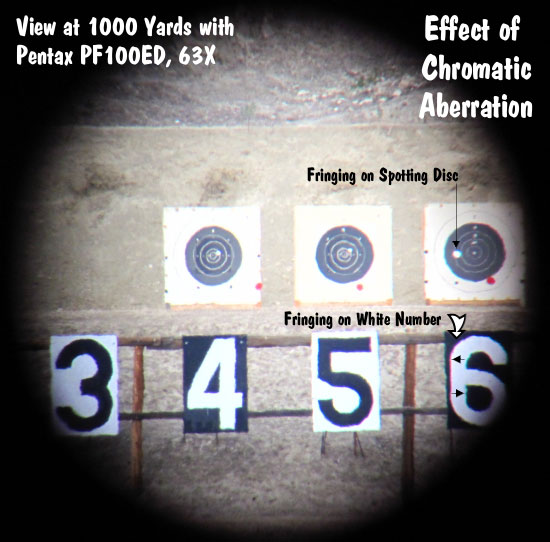

 At long range, small bullet holes are much easier to see in the white than in the black. When you’re practicing at long range on high power targets, one way to enhance your ability to see your bullet holes is to print a “negative” version of the regulation bullseye target.


