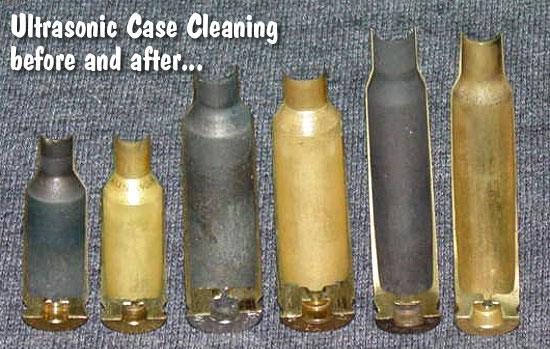
Shiny brass — it may not shoot more accurately, but it does make you feel better about your hand-loaded ammo. While it’s not necessary to get brass “bright and shiny” after every firing, it is a good idea to clean powder residue, grime, and grit off your brass before you run cases into sizing dies. There are many ways to clean cartridge cases. A quick wipe with solvent on a patch may suffice for recently-shot cases. Older brass with baked-on carbon may require lengthy tumbling. Ultrasonic cleaning is another popular option that gets your brass clean inside and out.
Sinclair International has a series of helpful videos on brass cleaning. These short “how-to” videos, hosted by Bill Gravatt, Sinclair’s past President, cover the various processes you can use — tumbling, ultrasonic cleaning, chemical cleaning, and cleaning by hand.
Video ONE — Cleaning Brass in Vibratory or Rotary Tumbler
TIP: Brass that has recently been shot will clean more easily than brass that has been sitting many days or weeks. If your tumbling media is fresh the job should be done in an hour or less. It’s your choice whether to tumble with primers removed or with primers still in the cases. If you choose to tumble with primers out, we suggest you deprime with a depriming die, rather that put dirty brass into your sizing die. Some people like to add a teaspoon of liquid polish to the media. This does work, cutting tumble time, and making your brass more shiny. However, if you add liquid polish, do that BEFORE you add the brass and let the tumbler run for a 15 minutes to get the polish completely mixed into the media. Otherwise you can else up with gooey gunk inside your cases — a very bad thing.
Video TWO — Ulstrasonic Case Cleaning
TIP: There are many different types of solutions you can use. Soapy water suffices for some folks, particularly if you add a little Lemi-Shine. The Hornady and Lyman solutions work well, and can be used multiple times, provided you strain the solution to remove dirt and grit after cleaning sessions. Many ultrasonic cleaning machines have timers. Experiment with dwell time to see how long you need to immerse your brass. A very small amount of Ballistol in the solution will help lubricate your necks on the inside. This can make bullet seating go more smoothly, with more consistent neck tension.
Video THREE — Chemical Cleaners (Soaking without Ultrasound)
TIP: After using chemical cleaners, such as the Iosso solution, you need to water-rinse your brass thoroughly. A kitchen strainer helps with this (see video at 0:20). Also, don’t forget your brass in the chemical solution — follow the manufacturers recommendations and don’t exceed the recommended dwell time. Chemical cleaners work surprisingly well to remove grease and grime, and the solution can be re-used multiple times. However, if you want your cases to look bright and shiny (like new brass), you will probably have to tumble.
Video FOUR — Manual Cleaning (By Hand)
TIP: Keep some oversize patches in your range kit. At the end of your shooting sessions, wipe off your fired brass with a patch dampened with a mild, non-corrosive solvent (once again Ballistol works well). Before the carbon sets up on your brass it is very easy to remove. For tougher jobs, you can use 0000 Steel Wool (as Bill recommends in the video). You may find that timely hand-cleaning lets you avoid tumbling altogether — or you may choose to tumble (or ultra-sound) your brass only after a half-dozen or so firings.
Sinclair International has a good article on Case Lubrication which shows the various products and application methods available. Part of Sinclair’s Step-By-Step Reloading series, the article shows how to apply Spray Lube, Die Wax, or conventional lube from a Pad. The story also explains how to use dry lube to slick up the inside of your case necks.
Spray Lubes
High-volume reloaders often turn to spray-on lubricants such as the RCBS Case Slick (#749-001-341) or the Hornady One Shot (#749-001-065) to quickly lubricate large numbers of cases at once. An indispensable piece of gear that helps make spray lubing easy is a lube rack (#749-011-550) – a polymer block that holds cases upright and arranged to maximize their exposure to the spray.
Editor’s Note: Ballistol Aerosol is other good spray product for regular full-length sizing (not heavy case forming). It goes on clear (no chalky residue), it is ultra-slippery, and it will remove the carbon from your case necks as you apply Ballistol with a patch. This is my primary spray lube — but many folks hate the distinctive Ballistol smell. Try before you buy.
Sizing Die Wax
Over the years, many benchrest shooters have come to trust Imperial Sizing Die Wax (#749-001-052) for their case lube needs. It offers high lubricity and easily wipes off with a paper towel. In fact, its lubricity makes it a popular choice for case forming, for those wildcat folks who need to form their own unique or obsolete cartridges. Unlike lube pads or spray lubes, sizing wax is applied more naturally. You just put a little on your fingers and transfer it to the cases by handling them. As simple and easy as Imperial Sizing Die Wax is to use, it’s probably best for low-volume applications.
Dry Lubricant
Redding’s Imperial Application Media (#749-001-166) is a dry neck lube used to lube the inside of the neck, whether you’re full-length sizing or neck-sizing only. It consists of ceramic spheres coated with a fine graphite-based powder. You simply dip the neck into the container for a second to pick up the right amount of lube. This lube enables the expander ball to work smoothly throughout the case neck –instead of “grabbing” or “chattering” — to minimize case neck stretching.
Editor’s Note: Dry Lube is also very useful if you ultrasonically clean your cases. After the ultrasound process, the inside of the case neck can be so “squeaky clean” that bullets don’t seat smoothly. A quick application of dry lube will help bullets slide into the neck easier and the neck “grip” on the bullets should be more consistent from round-to-round. Consistent neck tension is key to accuracy and uniform velocities.
Story Tip from EdLongrange. We welcome reader submissions.
Our IT guy, Jay (aka JayChris in the Forum), was having some issues with his .260 AI. A load with known accuracy had suddenly and mysteriously stopped shooting well. Jay couldn’t figure out what was going wrong. Then he remembered he had cleaned his brass using a powerful ultrasonic machine.
He inspected his brass carefully and saw that the ultrasonically-cleaned necks were so “squeaky clean” that he was actually scratching the jackets on his bullets when seating them. As well, Jay noticed that it took more force to seat the bullets and the seating force became less uniform case to case. Jay solved the problem by applying NECO Moly dry-lube inside the necks of his brass before seating the bullets.
The Perils of Ultrasonic Brass Cleaning by JayChris
I rotate my brass so that I can keep track of each firing, so I keep a “clean/ready to load” bin and a “fired” bin. I have 400 pieces of .260 AI brass. So, all of it was on its first firing (after doing a Cream of Wheat fire-forming) until I hit the 400-round mark. To my surprise, things went south at the 500-round mark. The first time I noticed it (according to my range log) was at a match last year, when I dropped several points and had some vertical stringing issues. After that match, I had 400 rounds through the barrel and all of my brass had a single firing on it. So, it was time to clean.
I have used an ultrasonic cleaner for a while now. I recently got a more powerful Ultrasonic cleaner, although I don’t know if that makes a difference. My brass comes out dry and squeaky. Emphasis on the “squeaky”.
I found that my new US machine may have been getting the necks TOO clean. After ultrasonically cleaning my brass, I had noticed that it required a little more force to seat the bullets, but I didn’t really think too much about it. But then, after going over my ordeal with a shooting buddy and going over my process in minutiae, we had an “AH HA” moment when it came to cleaning (he uses good ol’ vibratory cleaning).
So, I used some moly dry-lube to pre-lube the case necks and took some rounds out to test at 200 yards. I used my last known good load and sure enough, the vertical flyers disappeared! I shot two, 10-rounds groups with .335 and .353 MOA vertical dispersion, which is consistent with the results I was originally getting.
Other folks have suggested necks may get “too clean” after ultrasonic cleaning. It was pretty sobering to actually witness, first hand, what can happen when brass is “too clean”. I had read some discussions of issues with neck friction/bullet seating after ultrasonic cleaning, but, frankly, I dismissed the idea. Now I understand. The “too clean” effect doesn’t seem to affect my Dasher at all (perhaps because Dasher necks are very short), but on the bigger .260 AI, it definitely does.
Close-Up Photos of Case-Necks
Here are photos Jay took with a microscope. You can see the difference between tumbled brass and ultrasonically-cleaned brass. Jay says: “Here, in sequence, are the Ultrasound-squeaky-clean case neck, a case neck after treatment with NECO moly dry-lube (you can see the particles that will help coat the neck during seating), and, finally, the neck from a case cleaned with corncob media in a vibratory tumbler. You can clearly see how much smoother the inside of the tumbled neck is. Yes, it’s dirty, but it’s also very, very smooth.
Close-Up of Scratched Bullet
Here is a close-up of a bullet that was seated in an ultrasonically-cleaned (“squeaky clean”) neck, with no lubrication. You can clearly see the damage done to the jacket — in fact, in a couple spots you can see the lead core through the scratches! Jay also observed that quite a bit more seating force was required to seat the bullet in a “squeaky clean” neck.
NOTE: The bullet jacket is naked — NOT coated in any way. It looks a little dark because of the shadow from the microscope lens, and the high contrast.
With the price of premium brass topping $90/100 for many popular cartridges, it makes sense to consider annealing your brass to extend its useful life. Forum member Darrell Jones offers a full range of brass prep, brass forming, and brass restoration (annealing, ultra-sonic cleaning) at very affordable prices. Starting at just $15 per 100 cases ($20/100 for magnum cases), Darrell’s company, DJ’s Brass, will anneal your used brass using state-of-the-art Bench-Source annealing machines. Annealing plus ultrasonic cleaning starts at $25.00 per 100 cases ($30 for magnum cases larger than 0.473″ rim). If you just want your cases ultrasonically cleaned (no anneal), that costs $15 per 100 ($20/100 for magnum).
Custom Neck-Turning Services
Another great service DJ’s Brass provides is precision neck-turning. Darrell can neck-turn any size case to your specified neck-wall thickness. The price is $0.30 per case (normal size) or $0.40 (magnum size) with a $20.00 minimum order. And if you’ve got a bucket of brass to neck-turn, that’s fine with Darrell — he recently neck-turned 1500 pieces of brass for one customer!
DJ’s Brass can process everything from .17 Fireball all the way up to the big magnum cases. And the job gets done quickly. Darrell has a 10-day turn-around guarantee. For most jobs, Darrell tells us, he gets the processed brass to the Post Office within three business days. DJ’s Brass charges only actual shipping fees, using USPS flat-rate boxes. For more info, visit DJsBrass.com or call Darrell Jones at 205-461-4680. IMPORTANT: Contact Darrell for shipping instructions BEFORE sending any brass for processing. ALL BRASS MUST BE DE-PRIMED before you send it.
• Ultrasonic Cleaning + Annealing ($25.00/100 normal or $30/100 magnum)
• Ultrasonic Cleaning and Polishing ($15.00/100 normal or $20/100 magnum)
• Anneal Case Necks (after checking for splits) ($15.00/100 normal or $20/100 magnum)
• COAL Trim and Chamfer Case Mouths ($0.20 per case, $20.00 minimum order)
• Uniform, Square, and Chamfer Primer Pockets ($0.15 per case, $20.00 minimum order)
• Expand Case Necks and Anneal brass (Call for Price)
• Create False Shoulder for Fire-Forming (Call for Price)
DJ’s Brass Offers Specialized Custom Services
Darrell tells us: “At DJ’s Brass, we can handle all your brass refurbishing needs. From ultrasonic cleaning to custom annealing for specific wildcat cartridges. We can expand your necks from .22 caliber to .30 caliber and anneal shoulders for consistent bump-back. We can turn your case-necks and trim the brass to your specs. For some cartridge types, I can pre-form cases to assist in fire-forming a wildcat cartridge. We also remove the carbon build-up in muzzle brakes. Don’t lose your accuracy by having carbon build up and close off the clearance required for the most accurate bullet release through a muzzle brake.” Note: Extra charges apply for neck-turning and neck expansion operations, or specialized cartridge-forming operations. Please call 205-461-4680 for special services pricing.
Darrell has cleaned and annealed cases for shooters from across the country. Here are testimonials (this Editor reviewed all the original emails so I can confirm these are real):
“Your services were good with a quick turn-around time. Quality of the case annealing looked great[.]” — Tom, in Alaska
“The [300 Win Ackley] batch you did for me came back looking great.” — Chuck, in Arizona
“Since I started using Lapua brass, I’ve gotten gotten enough reloads out of them to notice that the necks were no longer sealing as well as I’d like. A friend suggested annealing them. I remembered seeing DJ’s ad on AccurateShooter.com and thought I’d give him a try. Not only did my [.308 brass] come back sorted exactly as I had sent them out, all had been so thoroughly cleaned that I realized I had been leaving lube on them after forming. DJ had taken the time to enclose a note cautioning me to brush the inside case necks and do a full-length resize for the first loading. And all 200 cases were back in my hands in DAYS, not weeks! Great service, great price, great follow up.” — Jim, in Alabama
Lyman has introduced a number of new products for 2013 for gunsmiths and hand-loaders. An impressive new offering is the new, large-capacity Turbo® Sonic Power Pro Ultrasonic Cleaning machine. This new unit, one of the largest and most powerful on the market, can ultrasonically clean items up to 34″ in length. The Lyman Power Pro’s large, stainless-steel heated tank and ten transducers allow gunsmiths, armorers, and gun-owners to quickly clean a wide variety of metal items. Designed for high-volume cleaning or for larger-than-normal items, the new Turbo Sonic Power Pro’s 34.75″-long* heated stainless steel tank can easily handle most barreled actions, upper receivers, as well as multiple handguns. The Power Pro includes both a timer and adjustable heat control (you can select temps up to 175° F).
With an MSRP of $1395.00 and a 70-lb shipping weight, this is a big, heavy, and costly unit. But if you need a hard-working machine for big jobs, this may be worth the investment.
Ten Transducers Do the Job Fast
The Power Pro’s TEN high-output transducers aggressively clean and degrease items, both inside and out. In fact, the Power Pro is such an effective cleaner that Lyman recommends that cleaned parts immediately be treated with Lyman’s Turbo Sonic Gun Lube. Changing from cleaning to lubrication is easy with the built-in drain system. Lyman now offers both cleaning concentrate and parts lubricant in gallon containers.
(*Note: the tank is listed as 35.75″ in product photo, but Lyman’s spec sheet states 34.75″.)
How-To Video: Ultrasonic Brass Cleaning (Click Arrow in lower left to start video)
Video playback requires HTML5. This may not work with older browser versions.
Product tip from EdLongrange. We welcome reader submissions.


 Shiny brass — it may not shoot more accurately, but it does make you feel better about your hand-loaded ammo. While it’s not necessary to get brass “bright and shiny” after every firing, it is a good idea to clean powder residue, grime, and grit off your brass before you run cases into sizing dies. There are many ways to clean cartridge cases. A quick wipe with solvent on a patch may suffice for recently-shot cases. Older brass with baked-on carbon may require lengthy tumbling. Ultrasonic cleaning is another popular option that gets your brass clean inside and out.


 Our IT guy, Jay (aka JayChris in the Forum), was having some issues with his .260 AI. A load with known accuracy had suddenly and mysteriously stopped shooting well. Jay couldn’t figure out what was going wrong. Then he remembered he had cleaned his brass using a powerful ultrasonic machine.
 I have used an ultrasonic cleaner for a while now. I recently got a more powerful Ultrasonic cleaner, although I don’t know if that makes a difference. My brass comes out dry and squeaky. Emphasis on the “squeaky”.


 With the price of premium brass topping $90/100 for many popular cartridges, it makes sense to consider annealing your brass to extend its useful life. Forum member


 Ten Transducers Do the Job Fast


