IMR is bringing out a new series of advanced-formulation extruded powders. In 2015, IMR will introduce three (3) new Enduron powders: IMR 4166, IMR 4451, and IMR 7977. The new line of IMR Enduron powders feature small kernels for easy metering, plus a built-in copper fouling eliminator. IMR claims that Enduron powders are not sensitive to temperature changes. If this is true, these powders should prove popular, particularly IMR 4166 which seems to be in the Varget/Reloder 15 burn-rate range. With Varget so hard to find, if IMR 4166 proves accurate (and available) we might see many .308 Win shooters make the switch. IMR states that IMR 4166 is a “versatile, match grade propellant”. We’ve been quite pleased with IMR 8208 XBR as a Varget alternative. IMR 8208 XBR is accurate, clean-burning, and offers good velocity. Perhaps the new IMR 4166 will be as good or better.
When will Enduron powders appear on dealers’ shelves? Hodgdon Powder Co., distributors of Hodgdon, IMR, and Winchester powders, says that: “The new IMR Enduron™ Technology powders will be available at dealers in early 2015 in 1-pound and 8-pound containers.” For more information and Enduron LOAD DATA visit imrpowder.com or check the 2015 Hodgdon Annual Manual.
IMR’s press release provides these descriptions of the new Enduron propellants:
IMR 4166 is the first in the series of Enduron™ propellants. It’s a perfect burn speed for cartridges like the 308 Win/7.62mm NATO, 22-250 Remington, 257 Roberts and dozens more.
IMR 4451 Another new Enduron powder that gives top performance in the venerable .30-06, 270 Winchester, and 300 Winchester Short Magnum, to name just a few. This propellant is ideally suited for many mid-range burn speed cartridges.
IMR 7977 is the slowest burn rate Enduron Technology powder. It is a true magnum cartridge propellant with outstanding performance in such cartridges as the .300 Winchester Magnum, 7mm Remington Magnum, .338 Lapua and more.
Richard Schatz, the “Duke of Dashers”, has done it again. Just look at that group! Believe it or not, that is five shots at 600 yards. There are four shots in one ragged hole, with one a bit to the right. The group, initially measured at between 0.402″ and 0.410″, is very close to an IBS World Record. Assuming (on the high side) that that group measures 0.410″, that works out to 0.065 MOA. Wow.
Schatz, a past IBS 600-yard National Champion, shot this group in a Heavy Gun relay on May 18, 2014 at the Columbus Sportsman’s Association range in Columbus, Wisconsin. Richard was using his trusty 6mm Dasher, a 17-lb Light Gun that he has been shooting for years. His ultra-accurate load consisted of 103gr Spencer Bullets pushed by Varget and CCI 450 primers. The Lapua brass had recently been annealed and he batched his record rounds “by feel” based on the force needed to seat the bullets.
Richard said the group involved a good bit of luck, and perfect timing. The conditions were generally “switchy and difficult” at the match. However, in one Heavy Gun relay, Richard said “the wind flags just dropped straight down at the end of the sighter period. It’s like the range went dead.” Richard had windage on his scope so he just held off to correct for the calm. “I didn’t guess the hold-off correctly”, Richard admitted, “that’s why the shots ended up at the edge of the 9 Ring.”
Twenty Seconds of Near-Perfect Shooting
Richard got his five record rounds down range in about 20 seconds. He can shoot faster but, given the exceptional conditions, he took a little more time to aim: “Because the flags dropped and conditions stayed calm, I slowed down a little. I made more of a deliberate attempt to shoot a small group — a conscious effort to aim more precisely. Normally I’ll try to shoot the quickest I can get the dot close to the center of the X. I was trying to be a little more precise this time.”
Whatever Richard did, it sure worked. That’s a spectacular group — one of the smallest ever shot at 600 yards. Richard, a modest guy, credited the group to good conditions, and good luck: “Like I always say ‘the wind can blow ‘em in just as easy as it blows ‘em out’.” Richard says this rifle, with the current Krieger barrel, can typically put five shots in about two inches at 600 yards, in calm, stable conditions.
Very Close to an IBS Heavy Gun Record
The current IBS 600-yard, five-shot Heavy Gun group record is 0.404″, set by John Lewis in 2008. This recent group by Richard Schatz is very, very close to that mark. At Columbus, Wisconsin, four different measurers examined Richard’s group on May 18th. The four measurements were: 0.402″, 0.403″, 0.410″, and 0.409″ (see photo). Whether or not this is a new record will be determined by the IBS official measurement committee to which the target is being submitted. It’s worth mentioning that Richard Schatz currently holds the IBS 600-yard Heavy Gun score record, with a value of 50 points (and 0.634″ tie-breaker).
Rifle Specifications:
Nesika Action
Krieger 1:8″ twist barrel, 27″ length, 0.236″ bore
Chambered for 6mm Dasher with 0.272″ neck and 0.104″ Freebore
Shehane “Baby Tracker” stock
Nightforce 8-32x56mm NSX Scope
Load Specifications:
Clay Spencer 103gr bullets
Lapua 6mmBR brass (formed to Dasher)
Cases skim-turned for .0035 total clearance
Hodgdon Varget powder, 32.2 grains
CCI 450 primers
Muzzle Velocity 2980 FPS
Back in May, IBS shooter Rodney Wagner shot a 0.349″ (50-2X) 5-shot group that became the talk of the shooting community. This was the smallest 600-yard group shot in the history of recorded rifle competition. Rodney’s group cuts the existing IBS 600-yard record in half. Rodney put five shots under the size of a dime at the distance of six football fields. Just pause and think about that…
News of this amazing feat spread like wildfire via the internet. People were amazed at what Rodney accomplished. Here are some actual comments posted on various shooting forums:
308Nut: Simply Astounding.
Coues Sniper: That’s insanity.
PapaJohn: I strut around like a peacock if my rifles will shoot under a half-inch at 100 yards. His group was better than that at six times the distance… that’s just unfathomable. I don’t see anyone breaking that record for a loooooooooooong time!
Given the spectacular (and historic) nature of Rodney’s 600-yard group, many folks wanted to learn more about Rodney’s equipment and his shooting techniques. For that reason, we’ve compiled this follow-up report. Rodney was kind enough to provide a short video showing his equipment and shooting technique. In his video demonstration, Rodney runs off a 5-shot group in about 19 seconds. When he actually shot the 0.349″ group, Rodney estimates he got the five shots down-range in 12-15 seconds. (He slowed down a bit for the video!)
Watch Rodney Wagner Fire Five Shots in Under 20 Seconds
Rodney comments: “You’ll notice I hold the stock with my left hand while working the bolt to keep it from losing its ‘track’ (that slows me down a lot). I have just gotten into the habit of doing that because I feel tracking is one of the most important things not to take for granted. With this technique I don’t have to ‘saw’ the stock into the bags as much when I get on to the record target.”
Record-Setting Load: Varget Powder, CCI Primers, and Berger 108s Jumped
Rodney’s record 0.349″ group works out to 0.055 MOA at 600 yards. To shoot a “zero” group at 600 yards you need the finest components and insanely good reloading techniques (not to mention the grace of God.) As he does with all his 600-yard ammo, Rodney pre-loaded before the match. This particular ammo had been loaded 5-6 days before the match. Here are specs on Rodney’s load:
32.5 Grains of Hodgdon Varget Powder and CCI 450 Primers.
108gr Berger BT Match bullets seated 0.020″ away from the lands.
Lapua 6mmBR brass fire-formed to 6 Dasher and turned to 0.265″ loaded round for a 0.268″-neck chamber.
Neck-sized with a 0.262″ Redding bushing.
Note that Rodney was using Berger 108s, not the 105gr VLDs or Berger’s popular 105gr Hybrids. Rodney found his Brux barrel shot best with the 108s: “I’d get really nice 4-shot groups with the VLDs, but it seemed there would be four together and one out. The 108s seem to have less fliers.” Rodney experimented with seating depths before he settled on a .020″ jump: “I shot them for a long time 3 to 5 thousandths in the lands, just barely in the lands. But I knew Sam Hall had really good luck jumping. So I went to .020″ jump and it all came together. The 108s have shot good like that in three different Brux barrels (all chambered with the same reamer) so I just start at that setting now — twenty off the lands.”
Record-Setting Equipment
Rodney was shooting a 17-lb Light Gun. It features a BAT Machine ‘B’ action, and a 29″ Brux barrel chambered for the 6mm Dasher with a 0.268″ neck. The 0.236″-land, 4-groove barrel was fairly new when the record group was shot — it had about 300 rounds through it, and had shot 30 rounds since its last cleaning. Rodney chambered the barrel himself. The stock is a Shehane ST-1000 fiberglass tracker, inletted and bedded by Tom Meredith. A March 10-60x52mm scope is held in Burris Signature Zee rings on a +10 MOA rail. These rings are inexpensive, but they work just fine, notes Rodney: “With the inserts I can align the scope mechanically and keep the windage pretty much centered in its travel.”
Supporting his rifle, Rodney used a Farley co-axial rest up front (on Super-Feet) and a Protektor Doctor bag in the rear. The Farley features a Borden top carrying an Edgewood bag. Rodney notes: “In the front, I use the black diamond blasting sand, because it doesn’t pack as hard as regular sand. You can buy it at tractor supply stores in the welding section. It’s not as heavy as heavy sand.”
In the rear, Rodney runs a flat-top Protektor Doctor bag with Cordura ears. Rodney uses Sinclair heavy sand in his rear bag. He says “it’s got some squish — not much but just a little — call it a medium-hard fill”. Interestingly, Rodney sets up the bag so that the flat on the bottom of the stock rides on the stitches between the ears: “I like the stock to touch the top of the bag between the ears — I don’t like to see daylight.”
Conditions for the Record — You May Be Surprised
Many folks who have commented on Rodney’s 0.349″ group have wrongly assumed that the 0.349″ group was shot in “perfect” zero-wind conditions. Not so. There were switchy 5 mph winds with gusts to 10 mph. Rodney notes that on his second target of the day, he had to hold in three different places to manage a decent-sized group. So for those who think the group was shot in miraculous conditions, we have to say that wasn’t the case.
Creating Ultra-Accurate 6mm Dasher Ammunition
Rodney takes great care in loading his brass, and he employs a few tricks to get superior consistency.
Fire-Forming — To prepare his cases for fire-forming, Rodney starts by turning his Lapua brass to just past where the new neck-shoulder junction will be: “I just cut enough for the 6mm Dasher neck. A little bit of the cut shows on the shoulder after forming.” Then Rodney runs a .25-caliber K&M mandrel through the whole neck, expanding the neck diameter. After the entire neck is expanded, Rodney re-sizes the top section with a Wilson bushing, creating a false shoulder. Then, as further insurance that the case will be held firmly in place during fire-forming, Rodney seats his bullets long — hard into the lands. When fire-forming, Rodney uses a normal 6mmBR load of 29.8 grains of Varget: “I don’t like to stress my brass before it has been hardened. I load enough powder to form the shoulder 95%. Any more than that is just wasted.” Rodney adds: “When fire-forming, I don’t want to use a super-hard primer. I prefer to use a Federal 205, CCI 200, or Winchester — something soft.” Using a softer primer lessens the likelihood that the case will drive forward when hit by the firing pin, so this helps achieve more consistent “blow lengths”.
Ammo Loading — Rodney is fastidious with his brass and weighs his charges very precisely. Charges are first dispensed with an RFD manual powder measure, then Rodney trickles kernel by kernel using a highly-precise Sartorius GD-503 laboratory scale. He tries to maintain charge-weight consistency within half a tenth of a grain — about two kernels of Varget powder.
One important technique Rodney employs is sorting by bullet-seating force. Rodney batch-sorts his loaded rounds based on seating force indicated by the dial gauge on his K&M arbor press: “I use a K&M arbor press with dial indicator strain gauge. When I’m loading I pay lots of attention to seating effort and I try to batch five rounds that feel the same. For record rounds I try to make sure I get five of the same number (on the dial). When sorting based on the force-gauge readout, you need to go slow. If you go too fast the needle will spike up and down before you can see it.”
In practice, Rodney might select five rounds with a gauge value of 25, then another five with a gauge read-out of 30 and so on. He places the first five like-value rounds in one row of his ammo caddy. The next like-value set of five will go in the next row down. By this method, he ensures that all five cartridges in a five-round set for a record target will have bullets seated with very consistent seating force.
Unlike some top shooters, Rodney does not regularly anneal his cases. However, after every firing, he does tumble his Dasher brass in treated corncob media. After sizing his brass, before seating the bullets, he runs a nylon brush in the necks: “The last thing I do before firing is run a well-worn 30 caliber nylon brush in the necks, using a small 6-volt drill for power. This is a quick operation — just in and out the neck”. Sometimes, at the end of the season, he will anneal, but Rodney adds: “If I can get 10 firings out of the case I’ve done good.” He usually makes up new brass when he fits a new barrel: “If it is a good barrel (that I may shoot at the Nationals), I’ll usually go ahead and prepare 200 pieces of good brass.”
Shooting Techniques — Piloting a 600-yard Group into the Zeros Gun-handling and Rate of Fire — As you can see from the video, Rodney shoots with very minimal contact on the rifle. He normally shoots a string fast, but he remains calm and steady — almost machine-like. In the video he runs five shots in about 19 seconds, but he figures he shot the 0.349″ group in 12-15 seconds. Rodney says: “I’m not quite as fast as Sam Hall but I can usually run ‘em under fifteen seconds, sometimes closer to 10 on a good day. But when I shot the 0.349″ I couldn’t see the flags for the last shot so I dipped the joystick down between 4th and 5th shots, and that took a couple seconds. The flags had not changed, so I kept the same point of aim for 4th and 5th shot. I’d been watching that flag all morning, so to satisfy my curiosity I kind of dipped down for a second.”
Aiming for the Nine — To shoot ultra-small at long range, you must aim very, very precisely. When shooting at 600 yards, Rodney lines up his cross-hairs on the white number “9” in the blue field above the ten ring. This is visible through his rifle-scope at 600 yards, and it provides an aim point smaller than the center “X”.
Rodney explains: “I always aim for the number 9 up in the blue field. It provides for a smaller aim point. I noticed a difference when I started doing that. I learned that from some guys from South Dakota. It made sense so I’ve been doing it ever sense.”
Tips for 600-Yard Shooters New to the Game
In the course of our interview with Rodney, we asked if he had any tips for shooters who are getting started in the 600-yard Benchrest Game. Rodney offered some sensible advice:
1. Don’t try to go it alone. Find an old-timer to mentor you. As a novice, go to matches, watch and ask questions.
2. Go with a proven cartridge. If you are shooting 600 yards stick with a 6mmBR or one of the 6BR improveds (BRX or Dasher). Keep it simple. I tried some of the larger cartridges, the 6XC and 6-6.5×47 Lapua. I was trying to be different, but I was not successful. It wasn’t a disaster — I learned something. But I found the larger cases were not as accurate as a 6BR or Dasher. Those bigger cartridges are competitive for score but not for group.
3. You don’t have to spend a fortune to be competitive. Buy a used rifle from somebody and find out if you like the sport. You can save a lot with a used rifle, but do plan on buying a new barrel immediately.
4. Don’t waste weeks or months struggling with a barrel that isn’t shooting. My best barrels, including this record-setting Brux, started shooting exceptionally well right from the start.
Last month, shooting at the Piedmont Gun Club, Chad Jenkins put together a stunning 1.495″ Aggregate at 600 yards. Once certified, that will be a new IBS 4-target Light Gun record. Chad’s smallest group was a 1.033″. Chad’s 1.495″ Agg breaks the existing 1.6068″ record set by Sam Hall in 2011. Chad was shooting a no-turn-neck 6mmBR featuring a BAT action, Krieger barrel, and Shehane ST-1000 fiberglass stock. We had the chance to talk with Chad and learn more about his record-setting rifle, and the methods he uses to achieve superior accuracy. Chad was kind enough to tell us about his equipment and what he does to build very, very accurate ammo. For starters, Chad wanted to “say thanks to Lewis Winkler, James Coffey, Mike Davis, and Larry Isenhour” all of whom provided invaluable help and support over the years.
The Record-Setting Rig
Chad credits much of his success to an “fantastic Krieger barrel that shot great right out of the gate”. It’s a 1:8″ twist, HV contour, finished at 28″ — nothing unusual there. Mike Davis did the chambering, barrel-fitting, and barrel crowning. One reason the gun shoots so well is that Chad’s friend James Coffey did the stock work and bedding, and also added weight to the Shehane ST-1000. Chad says “James really knows what he’s doing”. For optics, Chad uses a Leupold 45X competition scope, with fine cross-hair (FCH). Chad says he can “aim at the ‘X’ at 600 yards more precisely with the cross-hairs than with a target dot.”
$200 Front Rest Good Enough to Set Record
You may be surprised that Chad set his record with an inexpensive Caldwell Fire Control Joystick rest, that sells for about $203.00 on Amazon.com. The Caldwell isn’t fancy, but it did the job. Chad says: “I have a family and a young boy. I don’t have the money to pour into equipment like some other people. I will continue to use my Caldwell, but I have recently modified the base. The record though was set with an unmodified unit, just as it appears in the photo.”
Chad Shoots a “Classic” 6BR Load, But He Jumps his Berger VLDs
Chad gets great accuracy with a pretty “standard” 6mmBR match load: 30.5 grains Varget, CCI 450 primers, Berger 105gr VLDs, in Lapua “Blue Box” brass. (Editor’s Note: That load can be too hot in some guns in summer conditions). Chad loads his ammo with a Redding bushing full-length sizing die with an 0.266″ bushing. Chad says: “That’s a good size for the ‘Blue Box’ Lapua brass (I tried a 0.268″ and I could pull the bullets out with my fingers). I seat my bullets about 0.020″ OFF the lands with a Redding Comp seater die.” The brass that shot the record Agg had about 10-11 firings on it, and Chad has NOT annealed the cases yet. While Chad is a very exacting reloader, he believes in the KISS principle — he doesn’t ream flash holes or uniform primer pockets. While he weighs every load with an RCBS Chargemaster, he normally does not double-check charges with a second balance. Chad tells us: “I just get the Chargemaster to where where it is going consistently and run with it.”
Knowing that gun-handling and barrel maintenance are key elements of accuracy, we asked Chad about his shooting style, rest set-up, and his cleaning regimen:
Shooting style: “I try not to touch the gun, except with my thumb on the back of the triggerguard, and my index finger on the trigger. I use just a slight amount of pressure as the finger pulls the trigger. I don’t have any pressure on my shoulder. The buttplate is just barely touching my shirt.”
Rest position: “I usually let the gun run out to the stop. But there’s not much overhang. It hangs over an inch and a half. That’s where I always shot it. In the rear the ears are pretty much centered on the underside of the buttstock.”
Cleaning: “I use Montana X-Treme with patches and bronze brushes, and I clean every 35-45 rounds. I don’t brush a lot — I kind of go on feel, anywhere from 4-10 strokes. The gun shoots so incredibly well, I want to baby it, so I try not to over-clean.”
View Chad Jenkins’ Four (4) Targets
Common Sense Tips for New Shooters
Chad offered some advice for shooters starting out in the 600-Yard Benchrest game:
Reloading — I don’t claim to be an expert. But I will say that consistency is all-important. I learned this first from my friend Lewis Winkler (who passed away), and then James Coffey. Lewis always told me that the main thing is that you must be consistent in everything — when you’re sizing, when you’re weighing, when you’re seating bullets. You can’t be deviating and expect your loads to shoot.
Mental Game — I don’t go to a match to beat anybody, or to compete against anyone in particular. I shoot the best I can shoot and let the chips fall where they may. Even in practice, I basically compete against myself and I try to do the same thing in a match.
Focus (when to have it and when to relax) — I do try to stay focused when I’m shooting. But I also try to get away from the pressure between relays. A lot of the guys spend 15-20 minutes looking at everybody’s targets. I just look at my own targets and go back and sit down and relax. I don’t try to overthink things. When I was a teenager I was a successful competitive golfer. And in those days, I didn’t think about it … I just stepped up to the ball and hit it. I think, with some competitive activities, “thinking too much” can probably mess you up more than it helps.
You don’t hear much about PacNor barrels in long-range competition, but FORUM member Wes J (aka P1ZombieKiller), proved that they can shoot “lights-out” in a rig assembled by a talented gunsmith. Wes tells us: “Since I restocked my 6BR more than a year ago, I have not had a chance to shoot it much since I have been playing the 100-200 game. Well, last week I decided to take it out and do some playing at 500 yards. I have to give some serious props to my buddy (and fellow FORUM member) ‘PREACHER’ who did the chambering and barrel work for me. He can certainly make a gun shoot good. The barrel is a PacNor 1:8″ twist. My load was 105gr Berger VLDs pushed by 29.6 grains of Varget.” The five-round, 500-yard group shot by Wes J with his 6BR, measured just 1.240″, as measured by OnTarget software. Now that’s one accurate rig!
This Editor knows something about the potential of a PacNor barrel. I have a 3-groove stainless PacNor SuperMatch on my trusty Savage-actioned 6BR. This barrel shoots quarter-MOA or better in calm conditions, and it cleans up super-easy. The interior finish is so good, I’ve never had to brush the bore or use abrasives, and after 750 rounds it shoots as well as ever. I attribute the easy cleaning to the fact the lands in a PacNor 3-groove are wide and flat, so they are gentle on bullet jackets. I think accuracy is helped by the fact that PacNors run on the tight side (0.236 land dimension) with a good amount of choke. That works well with the 105gr Lapua Scenars and 103gr Spencers I like to shoot. You can read more about my rifle, nick-named the “Poor Man’s Hammer”, in this Feature Article from our archives. In its last outing the Poor Mans’ Hammer put 3 shots in under 0.200″ (measured center to center) at TWO Hundred yards. If you get a good one, PacNor three-grooves can definitely shoot.
Target Measurement with OnTarget Software
We used OnTarget software to measure the 5-shot group in the target above. This easy to use software is very repeatable, once you get a feel for plotting the shots. The basic version 1.10 of OnTarget is FREE, while there’s a modest $11.99 registration fee for version 2.10. In addition to group size (in inches), OnTarget plots distance to aiming point, and the software automatically calculates the group’s vertical height, horizontal dispersion, average to center (ATC), and group size in MOA.
You can run a measurement on a scanned target or a photo of a target. You’ll need some known reference to set the scale correctly. The target above had a one-inch grid so it was easy to set the scale. Once you’ve set the scale and selected bullet diameter and target distance, you simply position the small circles over each bullet hole and the OnTarget software calculates everything automatically, displaying the data in a data box superimposed over the target image. To learn more about OnTarget Software, read AccurateShooter.com’s OnTarget Product Review. This article covers all the basics as well as some advanced “power user” tips.
Forum member Darrel Evans from the UK pulled off a remarkable feat recently. He set multiple 600-yard UK benchrest records shooting a true, military-type tactical rifle, an Accuracy International AW chambered in 6.5×47 Lapua. The gun had a custom 24″ fluted Border barrel, and bag-riding accessories, but other than that, Darrel’s gun was very much “as-issued” by the factory. Darrel pulled off this fine display of precision shooting at the December 27th 600-yard benchrest comp at England’s Diggle Ranges. (The Diggle, as you may know, is notorious for difficult conditions.)
Report by Darrel Evans
Just thought that you all might like to know how I have been getting on with my Accuracy International AW chambered in 6.5×47 Lapua. To make a long story short, I broke three UK records: smallest group of the day — 1.8″ at 600; smallest Agg for the day — 2.8″; and smallest Agg for the Light Gun class — 2.8″. All these records can be viewed on the UKBRA and TargetShooter websites.
To say that I was ‘over the moon’ would be an understatement. I was happy that all of my hard work had paid off. I was delighted to set records on the rifle’s first outing since [adding bag riders]. The 600-yard benchrest comps over here are run as a winter competition and the winds at the Diggle are not very forgiving. I knew that the group was small as the markers were over lapping each other when the target board came back up. But when they told me that it was 1.823″ I knew that I had got a record, as the last record of 2.225″ was set by myself in 2009 on the first Comp with the 6.5×47 barrel on, this was then broken with a 2.18″ on a calm day later that year. Later I received an email from Vince Bottomley telling me that I also had the best factory Agg record and the Agg record for Light Gun class.
About Darrel’s 6.5×47 Accuracy International
My Accuracy International AW (AI-AW), a military rifle system, started life as a .308 Winchester when I first bought it. But after a lot of reading I decided to buy a 6.5×47 Lapua barrel for it. As you know the AI-AW rifle system is a very good switch-barrel design, so after a phone call to Graeham Clark at Sporting Services I bought a Border Barrels 24″ fluted barrel in 6.5×47 Lapua. My .308 barrel is now in my gun safe. After seeing how the 6.5×47 barrel shoots, I doubt the .308 tube will ever go on again.
The rifle falls in the Factory Class for our 600-yard BR comps. This also qualifies in the Light Gun class. Most folks say that a factory rifle will never beat the custom lads in the Light Gun class…. Well, sometimes it’s nice to see this happen. To help the rifle’s bench manners, I made a plate for the front so that it would sit on my compact front rest with a Farley joystick top. I also made a bar to fit on the bottom of the buttstock for the rear sandbag.
Load Development and Accuracy Testing After a lot of testing with different powder and bullet combos, I settled on 38.2 grains of Hodgdon Varget, with 130gr JLK bullets and CCI 450m primers. Velocity is 2914 fps. Seems that this is where it likes to be. In the photo below, you can see the results of a few different powders, but all with the fantastic JLK 130gr bullets. The 38.3 Varget load had all four rounds in nearly one hole and I pulled the fifth, so this was pretty much the load that I went with for my 600-yard Comp. The JLKs are really good, consistent bullets, and I think that the next barrel that I buy will be set up for these bullets and no other — they are that good. I seat the bullets at 2.157″ OAL, just kissing the lands. I could not go any further out as the bearing surface is short.
Wrapping up his success story, Darrel added: “I hope that this is of some help to people who have a 6.5×47 or are thinking of building one. All the best for 2012.”
Alliant is introducing a new extruded powder, AR-Comp. AR-Comp is an advanced re-formulation of Reloder 15, a double-base Bofors powder. There are changes to internal and external chemistry to provide much better pressure/velocity stability across a wide range of temperatures. The main difference between AR-Comp and Reloder 15, is the AR-Comp has a slightly faster burn rate, and AR-Comp is much LESS Sensitive to temperature changes. AR-Comp is a small-kernel, double-base extruded powder like Reloder 15, so it will continue to meter just like Reloder 15. The load density should be the same as Reloder 15.
AR-Comp should be at Grafs.com in a Couple Weeks
Here’s the good news — Alliant will start shipping AR-Comp to Grafs.com later this week. Dick Quesenberry, Alliant Powder Product Manager, told us: “I just received the AR-Comp packaging labels and we hope to send off the first shipments to Grafs this week.” With transit time, expect the powder to be available from Grafs.com by the second week of June. You can go ahead and place advance orders for 1-lb and 8-lb containers of AR-Comp on the Grafs.com website.
AR-Comp Offers Uniform Velocities over a Wide Temp Range
Tests were done with .223 Rem and .308 Win ammo, loaded with AR-Comp and maintained at temps from -20° F to +160° F in a controlled test center. The ammo itself was heated or cooled to targeted temps before testing. Across that entire range of temperature, -20° F to +160° F, the ammo loaded with AR-Comp showed a variation of only 20 fps in muzzle velocity. The primary bullet type tested was a 77gr .224 bullet and the secondary was a 175gr .308 bullet.
Burn Rate Like Varget
Though this is a reformulation of Reloder 15, the burn rate of AR-Comp is slightly faster than Reloder 15. Alliant told us: “Reloder 15 is slightly slower, in burn rate, than Varget. The new AR-Comp, with the enhancements, ended up slightly faster than Reloder 15, so it is now very close to Varget in burn rate”. This is the result of the “tuning” of the powder to be much less temp-sensitive.
AR-Comp First in Series of New Alliant Temp-Stable Powders
AR-Comp will be the first in a series of “new generation” temp-stable powders from Alliant. Quesenberry noted: “Our goal was to provide a powder that offers stable pressures in all temperatures. Shooters want to be able to stay with the same load in winter and in summer, in cold or in hot conditions.” Quesenberry added: “We’ve been working on this quite a while. AR-Comp is the first example and we hope to extend this to other rifle powders. It’s a tough job. You have to balance the performance carefully. We worked very hard to do just that and we think shooters will be impressed with the results.”
Reloder 15 Will Stay in Production
Fans of Alliant’s Reloder 15 don’t need to worry. Alliant will keep Reloder 15 in production. “We don’t drop powder lines”, said Quesenberry.
Here’s the latest info on Alliant’s new AR-Comp powder. We had a chance to talk with Dick Quesenberry of Alliant, who revealed more details about this new propellant. First, Dick explained that AR-Comp is an advanced re-formulation of Reloder 15, a double-base Bofors powder. There are changes to internal and external chemistry to provide much better pressure/velocity stability across a wide range of temperatures.
AR-Comp Offers Uniform Velocities over a Wide Temp Range
Tests were done with .223 Rem and .308 Win ammo, loaded with AR-Comp and maintained at temps from -20° F to +160° F in a controlled test center. The ammo itself was heated or cooled to targeted temps before testing. Across that entire range of temperature, -20° F to +160° F, the ammo loaded with AR-Comp showed a variation of only 20 fps in muzzle velocity. The primary bullet type tested was a 77gr .224 bullet and the secondary was a 175gr .308 bullet.
Burn Rate Like Varget:Though this is a reformulation of Reloder 15, the burn rate of AR-Comp is slightly faster than Reloder 15. Alliant told us: “Reloder 15 is slightly slower, in burn rate, than Varget. The new AR-Comp, with the enhancements, ended up slightly faster than Reloder 15, so it is now very close to Varget in burn rate”. This is the result of the “tuning” of the powder to be much less temp-sensitive.
Meters Like Reloder 15:AR-Comp is a small-kernel, double-base extruded powder like Reloder 15, so it will continue to meter just like Reloder 15. The load density should be the same as Reloder 15.
Loaded Ammo:We asked if any manufacturer will be using AR-Comp in loaded ammo. Dick told us that he is “not allowed to release that information at this time”. Draw your own conclusions, but remember that Alliant is owned by ATK, which makes Federal rifle ammo.
Available in Summer 2011:Allliant hopes to ship AR-Comp in “June or July” of 2011, provided the DOT Classification process moves at a normal schedule. The powder is ready to go, Alliant is just waiting on the DOT to provide shipping authorization.
Reloder 15 Will Stay in Production:Fans of Alliant’s Reloder 15 don’t need to worry. Alliant will keep Reloder 15 in production. “We don’t drop powder lines”, said Quesenberry.
AR-Comp First in Series of New Alliant Temp-Stable Powders
Alliant has been working on AR-Comp for quite some time. This represents a major evolution for Alliant’s powder line. AR-Comp will be the first in a series of “new generation” temp-stable powders from Alliant. Quesenberry noted: “Our goal was to provide a powder that offers stable pressures in all temperatures. Shooters want to be able to stay with the same load in winter and in summer, in cold or in hot conditions.”
Quesenberry added: “We’ve been working on this quite a while. AR-Comp is the first example and we hope to extend this to other rifle powders. It’s a tough job. You have to balance the performance carefully. If you tweak it one way, say to improve the low temp performance, you lose something at the upper end. If you tweak it for the top end, you loose something at the bottom. You have to hit that balance. We worked very hard to do just that and we think shooters will be impressed with the results.”
Here’s important news for handloaders. Alliant Powder has introduced a new medium-burn-rate powder: AR-Comp™. This new powder was developed specifically for AR-style rifles. Alliant says that AR-Comp powder is “ideally suited for heavy .223 and .308 match bullets”. We presume, from that description, that the powder will have a burn rate similar to Varget. The AR-Comp powder, produced in Sweden by Bofors Nobel, is an enhanced temp-insensitive reformulation of Reloder 15. The burn rate is slightly faster than Reloder 15, according to Alliant.
Alliant Claims AR-Comp is NOT Temp-Sensitive
We have limited information about AR-Comp, and we have not yet been supplied with a test sample. We have confirmed is a double-base extruded powder, and is an upgraded version of the Reloder 15 formulation. Alliant claims the powder meters very well and delivers “consistent pressures and velocities across temperature extremes”. This new powder is supposed to be very uniform from lot to lot. That would be great — if it is true — but only time will tell.
We will try to get a sample of AR-Comp soon and test it in both .223 Rem and .308 Win rifles. We suspect, if AR-Comp suits both the .223 Rem and .308 Win, it should work well in the 6mmBR and 6.5×47 Lapua cartridges as well. Stay tuned — we hope to have more info next week. AR-Comp should be hitting the market in June or July, 2011, provided DOT Classification goes smoothly. It will be offered in both one-pound (#150664) and 8-lb (#150665) containers.
Powder Valley, a major vendor of powder, primers, brass, bullets, and loaded ammo, has received some large shipments of popular powders including Hodgdon Varget and IMR 8208 XBR. Powder Valley also has the hard-to-find Alliant Reloder 17 powder in stock, in both 1-lb and 5-lb containers.
Powder Valley Now Stocks Factory-Loaded Ammo
FYI, Powder Valley is now stocking quality factory-loaded ammo from Lapua, Hornady, Nosler, Prvi Partizan, and Wolf. If you’re looking for match-grade Lapua factory ammo or the Hornady .223 Rem, 6.5 Creedmoor, and .30-06 ammo, give Powder Valley a call at 800-227-4299.
Powder Valley Inventory Updates on Facebook
Powder Valley now posts recent product arrivals on Facebook. If you have a Facebook account you can link to the Powder Valley page to get the latest updates.
August 13
IMR 8208: Finished up the backorders on 8208 8#. We received in about 200 kegs from Hodgdon last week and have filled backorders that were placed prior to June 25.
August 12
Large shipments of primers received over the last couple days. Received 2 million Winchester, 1.2 million Federal, 1.5 million Rem and 6 million Tula. Also received large shipment of Winchester brass.
August 6
Varget 8-lb jugs have arrived. We won’t update the website until Monday. Facebookers go ahead and put your order in now and you will get first dibs.
August 2
Received in about 2 million Remington primers. Also, received a large shipment of backorders from Berger. We will be receiving about 125,000 Federal Small Pistol primers later this week and about 2-2.5 million in 3-4 weeks. We will begin listing these primers on the website August 3 so you can place an order if you would like.


 IMR is bringing out a new series of advanced-formulation extruded powders. In 2015, IMR will introduce three (3) new Enduron powders: IMR 4166, IMR 4451, and IMR 7977. The new line of IMR Enduron powders feature small kernels for easy metering, plus a built-in copper fouling eliminator. IMR claims that Enduron powders are not sensitive to temperature changes. If this is true, these powders should prove popular, particularly IMR 4166 which seems to be in the Varget/Reloder 15 burn-rate range. With Varget so hard to find, if IMR 4166 proves accurate (and available) we might see many .308 Win shooters make the switch. IMR states that IMR 4166 is a “versatile, match grade propellant”. We’ve been quite pleased with IMR 8208 XBR as a Varget alternative. IMR 8208 XBR is accurate, clean-burning, and offers good velocity. Perhaps the new IMR 4166 will be as good or better.


 Back in May, IBS shooter Rodney Wagner shot a 0.349″ (50-2X) 5-shot group that became the talk of the shooting community. This was the smallest 600-yard group shot in the history of recorded rifle competition. Rodney’s group cuts the existing IBS 600-yard record in half. Rodney put five shots under the size of a dime at the distance of six football fields. Just pause and think about that…


 One important technique Rodney employs is sorting by bullet-seating force. Rodney batch-sorts his loaded rounds based on seating force indicated by the dial gauge on his K&M arbor press: “I use a K&M arbor press with dial indicator strain gauge. When I’m loading I pay lots of attention to seating effort and I try to batch five rounds that feel the same. For record rounds I try to make sure I get five of the same number (on the dial). When sorting based on the force-gauge readout, you need to go slow. If you go too fast the needle will spike up and down before you can see it.”

 Aiming for the Nine — To shoot ultra-small at long range, you must aim very, very precisely. When shooting at 600 yards, Rodney lines up his cross-hairs on the white number “9” in the blue field above the ten ring. This is visible through his rifle-scope at 600 yards, and it provides an aim point smaller than the center “X”.


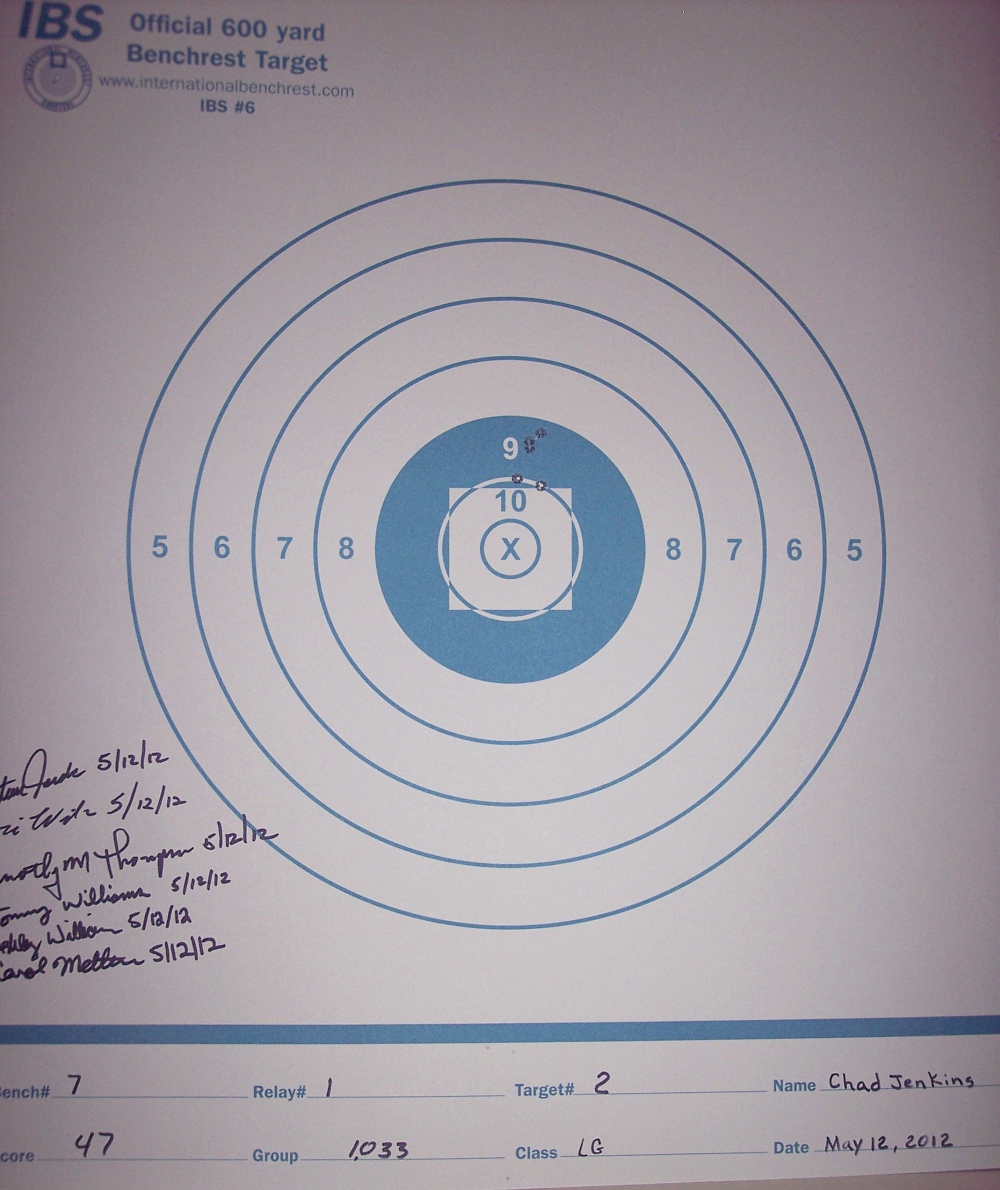
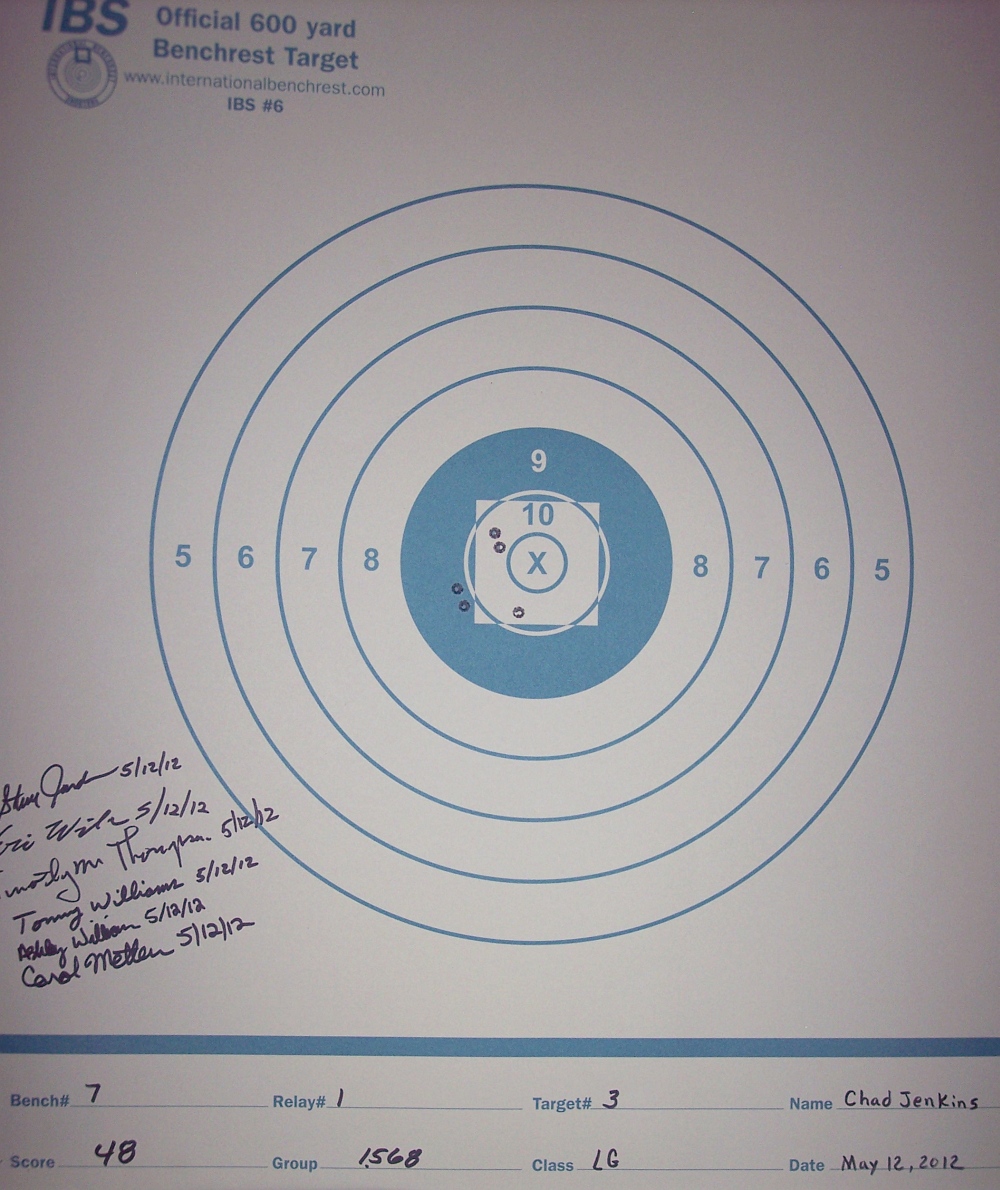
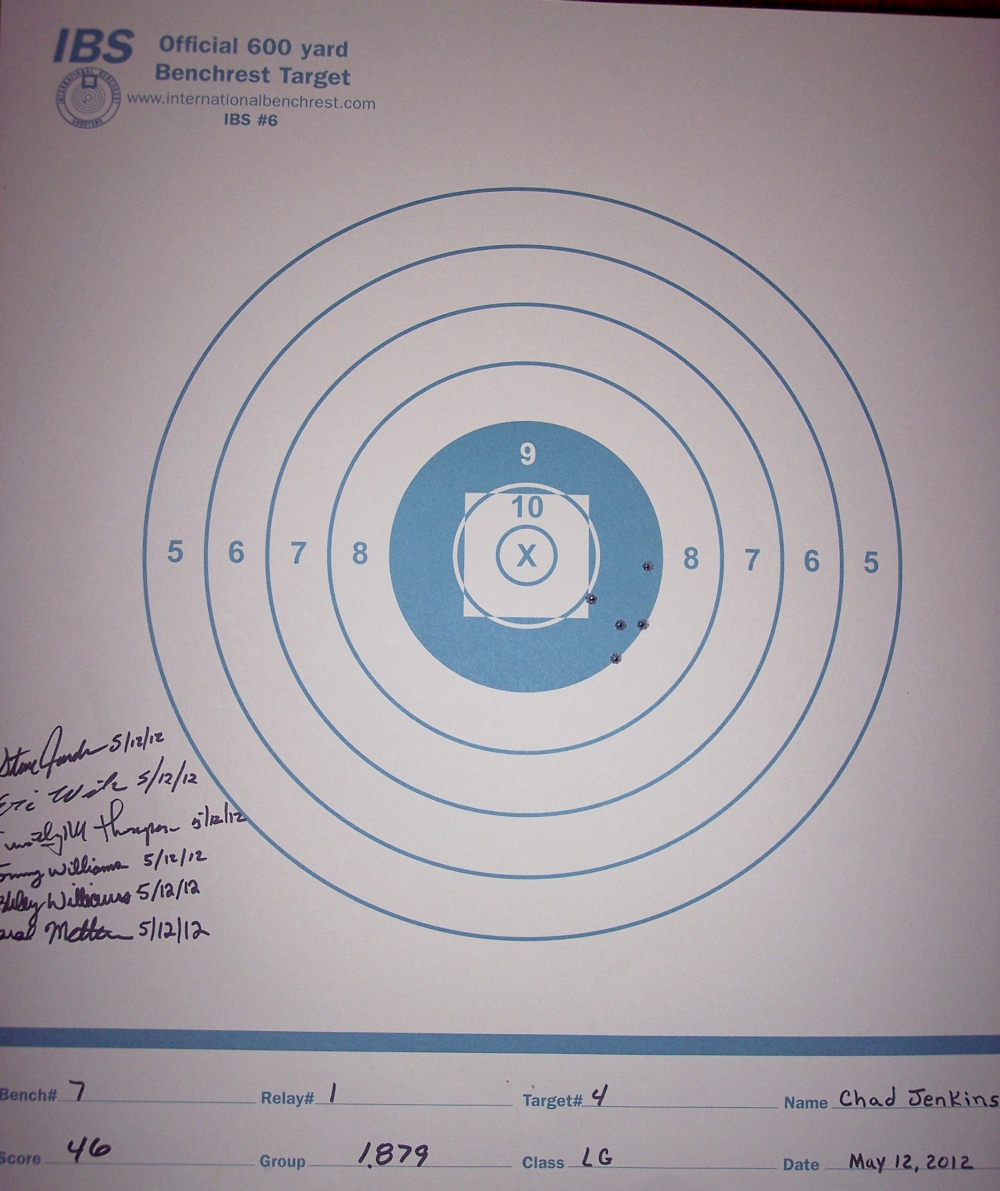


 Target Measurement with OnTarget Software


 After a lot of testing with different powder and bullet combos, I settled on 38.2 grains of Hodgdon Varget, with 130gr JLK bullets and CCI 450m primers. Velocity is 2914 fps. Seems that this is where it likes to be. In the photo below, you can see the results of a few different powders, but all with the fantastic JLK 130gr bullets. The 38.3 Varget load had all four rounds in nearly one hole and I pulled the fifth, so this was pretty much the load that I went with for my 600-yard Comp. The JLKs are really good, consistent bullets, and I think that the next barrel that I buy will be set up for these bullets and no other — they are that good. I seat the bullets at 2.157″ OAL, just kissing the lands. I could not go any further out as the bearing surface is short.

 Alliant is introducing a new extruded powder, AR-Comp. AR-Comp is an advanced re-formulation of Reloder 15, a double-base Bofors powder. There are changes to internal and external chemistry to provide much better pressure/velocity stability across a wide range of temperatures. The main difference between AR-Comp and Reloder 15, is the AR-Comp has a slightly faster burn rate, and AR-Comp is much LESS Sensitive to temperature changes. AR-Comp is a small-kernel, double-base extruded powder like Reloder 15, so it will continue to meter just like Reloder 15. The load density should be the same as Reloder 15.
 Powder Valley Now Stocks Factory-Loaded Ammo


