Keith Glasscock is one of America’s very finest F-Class shooters. This talented trigger-puller took second in F-Open division at the F-Class National Championships three years in a row. A smart engineer with aviation knowledge, Keith is a master wind reader, who has served as the wind coach for top F-Class teams. In fact Keith is in Arizona right now coaching a team at Ben Avery.
Keith shares his wind-reading expertise on his popular YouTube Channel — Winning in the Wind. This channel provides intelligent advice on multiple topics including reloading, load development, shooting strategies, and yes, reading the wind.
Keith has the credentials to back up the advice he offers in his video lessons. A High Master, Keith finished second overall at the 2021 NRA F-Class Long Range Championship in F-Open division. He also finished second at the 2020 Nationals, and he took second place at the 2019 Nationals. His consistency is unrivaled, which means he definitely knows the secrets of long-range wind calling and loading ultra-accurate ammo.
Today we feature two of Keith’s latest YouTube videos, both focused on wind reading.
Wind Direction vs. Wind Speed — Which is More Important
Most shooters find wind reading somewhat intimidating. That is understandable. The wind can change constantly during a match, with variations in both wind velocity and angles. Sometimes you think you have a cycle figured out, but then there can be an unexpected lull. Or you may start a string in what you think is a stable condition, but then a surprise shift changes everything. In addition, wind flows can be influenced by terrain features, such as berms, which have varying effects depending on wind angle (e.g. a tailwind hitting a berm will act differently than a 90-deg crosswind). That is why a good wind reader needs to identify both the wind speed AND the wind angle. In this video, Keith explains when to focus primarily on direction and when to pay most attention to velocity. With headwinds and tailwinds, Keith notes, you should monitor angle changes carefully. With crosswinds, speed is the key variable to watch.
KEY Points to Remember
— Small changes in wind direction changes alter POI drastically at long range
— During head or tailwinds, focus on wind direction
— During crosswinds, focus more on wind speed
— The wind is cyclic — always be aware of the pattern
Determining Wind Direction with Precision
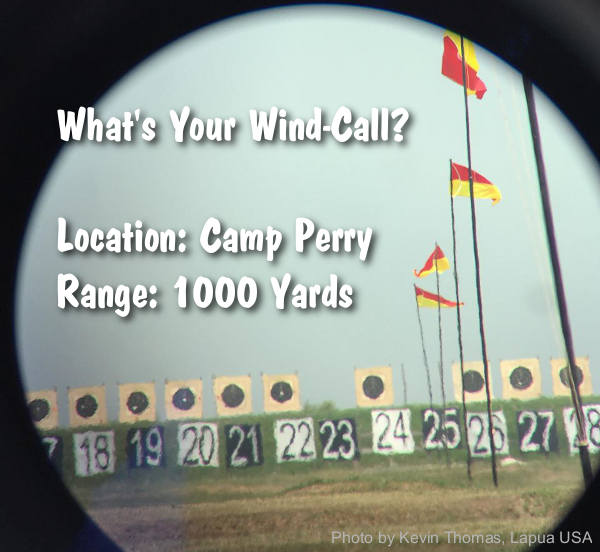
Many shooters try to read the wind merely using whatever wind flags might be aloft on the range. Flags are important of course, but there are other vital factors that a wise wind-watcher will monitor. You want to watch mirage, and the movement of grass and trees. In looking for angle changes, Keith says the spotting scope is a very important tool. His tripod is equipped with angle markings on the rotating tripod head. This allows him to ascertain wind angles with great precision.
In the video below, Keith shows how to use a spotting scope to read the wind. He explains how he uses his spotting scope in his role as a wind coach. But a spotting scope can also be used effectively by competitors shooting prone or from a bench. Many top shooters use their spotting scopes to watch mirage during their relays. Keith notes that smart competitors can also use their spotters BETWEEN relays to scout natural wind indicators (moving grass, trees etc.), check for boils, watch mirage, and estimate wind velocity cycles.
KEY Points to Remember
— Wind flags leave a lot to be desired in precision wind direction reading
— Precision wind direction can be obtained with a spotting scope
— There is a boil both directly upwind and directly downwind
— Angle indicator on your tripod helps with angular precision in wind readings
— Scouting with a spotting scope before your turn to shoot can be fruitful
Questions and Answers with Keith Glasscock
Q. How did you get started as a wind coach, and what were the most important stages in your progress in wind-reading?
Keith: I started coaching this team in 2017. I was looking for a team to shoot on, but they needed a wind coach. I’ve been a backseat driver ever since. I learned the most about reading the wind from shooting when the conditions are absolutely miserable – flags popping, wind switching, people missing the targets entirely, and there I was, having to make the big call. I learn from my own mistakes, and it shows. I still make mistakes, but try to limit them to ones I haven’t already made. In essence, I am in the most important stage now. Humbly looking at the wind knowing its power and mystery, while learning new things every day.
Q. What are the most common wind-reading mistakes you see people make at matches?
Keith: The most common, in a word, is UNDER-confidence. Most shooters can make that wind call with accuracy. But their fear prevents them from doing that, and prevents them from learning or taking advantage of smooth, solid conditions. The second common mistake is failure to anticipate changes. That comes from not gauging the wind pattern. It’s all about patterns in a sport where wind changes so small have such profound impacts on score.
Q. What’s more important — wind flags, or mirage (or maybe the unexpected horizontal that appears on the last shot recorded on target).
Keith: Both flags and mirage lie. The only thing that tells the truth is a bullet. Unfortunately, the wind can switch faster than you can shoot in most cases. I take a fluid approach. I look for what on the range right now tells me what the wind is doing.
Q. When are conditions so bad/unpredictable that it is necessary to just stop shooting and wait for things to get better?
Keith: This is situational, and comes down to what you are observing. I never like to shoot in the top of a gust condition, even when I know what the hold is. The drop off is what gets you that surprise 8.
Q: What type of wind meters do you recommend?
Keith: While Kestrels are inexpensive and quite serviceable, they are directional in nature. If I want absolute wind speed, an omnidirectional style unit is preferred.
Q. Are there ways to practice reading the wind (and judging wind speeds) when one is away from the range?
Keith: I really concentrate on seeing mirage any time I’m outside, without optics. I can, many times, see the boil of the mirage, and wind direction with the naked eye. My time in aviation has my eye tuned to see things like shear zones and venturis in the airflow. I take a moment, anytime the air is moving, to feel the air on my skin, see the trees and grass moving, and areas where the wind does funny things. Trees and grass tend to get too much credit as precision wind indicators. I use them as wind change indicators. It also gives me an opportunity to humble myself and realize how dependent I am on mirage and flags.
NRA publication Shooting Sports USA (SSUSA) has thousands of articles online, all free for the reading. Many of these stories have been written by top competitors, including National and Olympic Champions. You will find SSUSA articles spotlighted every week on the NRA Competitive Shooting Facebook page. We recommend you bookmark that page as a valuable resource. Here are four notable SSUSA articles that have been featured on Facebook this month. Go to SSUSA.org to see even more current articles, with new content every day.
Here is an insightful, fairly lengthy 1850-word article about the phenomenon we call mirage. The article explains how and why mirage appears, how it can best be monitored, and how mirage can indicate both wind velocity and direction. Top competitors follow the adage “Mirage is your friend”, because mirage can often be the most important indicator of wind variables — sometimes even more important than wind flags. “The mirage is more sensitive than the flags since it has less inertia and momentum”, wrote Desmond T. Burke, in his book, Canadian Bisley Shooting, an Art and a Science.
Well worth reading, this SSUSA article talks about the properties of mirage. Here is a sample:
“Mirage — can make all the difference between a shot landing squarely in the X-ring or being victimized by an undetected downrange breeze. The true power of mirage is found in its ability to betray the subtlest of breezes downrange. Its fluid movement… can not only provide wind direction, but speed as well.
Typically, the ability to detect mirage is maximized on warm, sunny and sultry days. Expect mirage to be most pronounced in mid-morning or early afternoon, although it ignores these rules with regularity[.]
Mirage is extremely powerful at identifying winds of less than 12 mph, particularly those gentle breezes subtle enough to not even bother moving the flags.
When there is no wind, or a gentle head or tail wind, mirage will appear to be ‘bubbling’ directly up from the ground. Many call this ‘boiling’, and it is probably the easiest of all to detect.
As a general rule of thumb, when wind speed increases, overall height of the waves produced by the mirage is reduced. Large peaks and valleys in the waves mean that particular mirage is being driven by a very slight breeze. Conversely, crest size is reduced with wind speed, making it harder and harder to detect, until the mirage disappears entirely at somewhere around 12 miles per hour. In other words, the taller mirage’s waves appear, the slower the breeze.”
Authored by the late Glen Zediker, this article covers barrel break-in procedures. It is particularly useful for dealing with factory barrels. We CAUTION readers — with outstanding, hand-lapped custom barrels from top barrel-makers, you may want to do very little break-in — clean sparingly and keep barrel heat low. Do NOT use abrasives aggressively. On our Krieger and Brux barrels, we simply wet-patched every 2-3 rounds for 20 rounds and the barrels shot superbly from the start with minimal fouling. But for factory barrels, a moderate break-in process may prove beneficial.
Zediker explains: “Lesser, lower-cost barrels are going to have more pronounced … imperfections within the bore[.] These imperfections are largely tool marks resulting from the drilling and rifling processes. And if it’s a semi-automatic, like an AR-15, there might be a burr where the gas port was drilled. The goal of break-in is to knock down these imperfections, thereby smoothing the interior surface.”
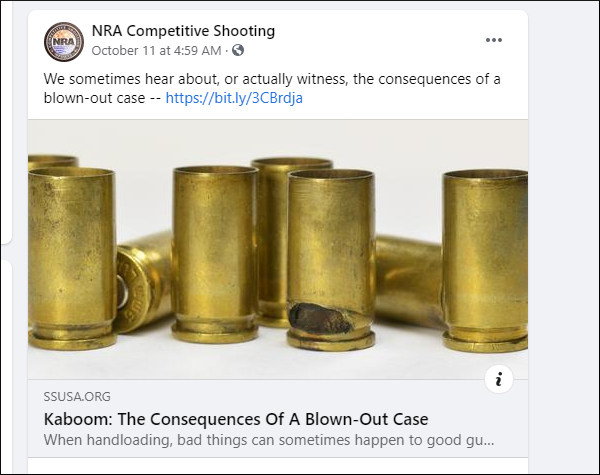
As one who has experienced a cartridge case-head blow-out with a 9mm pistol, this Editor is very conscious of the risks involved and the damage a blow-out can do to the pistol, to the magazine, and (worst of all) to the shooter. Even with new brass, the possibility of a case failure is always present. And even if the case remains intact, we’ve seen primer failures that create a dangerous jet back towards the pistol shooter. That’s why shooters should always employ protective eyewear whenever they shoot.
We love our wheelguns, but there’s no doubt that forcing cone damage can occur, particularly with hot loads and if your cylinder-to-barrel gap is excessive. This article explains how to inspect your revolvers, and how to mitigate the likelihood of forcing cone damage. The article also explains how to clean your revolvers properly. This is very important to avoid build-up of lead and powder residues.
September 25, 2021 is National Hunting and Fishing Day. Working on your wind reading skills can improve your odds of a successful hunt. Image from NHFDay.org.
Thomas Haugland, a Shooters’ Forum member from Norway, is a long-range target shooter and hunter. He has created an interesting video showing how to gauge wind velocities by watching trees, grass, and other natural vegetation. The video commentary is in English, but the units of wind speed (and distance) are metric. Haugland explains: “This is not a full tutorial, but rather a short heads-up to make you draw the lines between the dots yourself”. Here are some conversions that will help when watching the video:
.5 m/s = 1.1 mph | 1 m/s = 2.2 mph | 2 m/s = 4.5 mph
3 m/s = 6.7 mph | 4 m/s = 8.9 mph | 5 m/s =11.2 mph
How to Gauge Wind Speed and Hold Off Using Reticles
This field video shows how to observe natural indicators — trees and vegetation — to estimate wind velocity. Then it shows how to calculate hold-offs using the reticle hash-marks. Thomas shoots a fast-cycling Blaser R93 rifle with Norma 6XC ammunition.
Keith Glasscock is one of America’s greatest F-Class shooters, as well as a highly respected wind coach. A High Master, Keith finished second overall at the 2021 NRA F-Class Long Range Championship in F-Open division. He also finished second at the 2020 Nationals, tied with F-Open winner Pat Scully on points, but with fewer Xs. And he took second also at the 2019 Nationals. His consistency is unrivaled, which means he definitely knows the secrets of long range wind calling and loading ultra-accurate ammo.
Keith has a popular YouTube Channel with new content every week. On Keith’s Winning in the Wind channel, Keith offers 60+ informative videos on a wide range of topics including wind reading, reloading, component selection, load development, and training. For today’s Video Showcase, we offer four of our favorite Keith Glasscock videos. Each video has important points that can benefit any competitive rifle shooter, whether you shoot in local 100-yard fun matches or compete at the National Level in F-Class, LR Benchrest, Palma, or High Power.
How to Find (and Fine-Tune) Seating Depth
This is Keith’s most popular video. Keith definitely knows how to maximize accuracy by finding the optimal seating depth for each particular barrel. He is achieving groups in the high Ones for three shots. That would be good for a short-range benchrest cartridge, but Keith is achieving that with a .284 Winchester which has much more recoil. If you shoot F-TR or F-Open or even PRS, you should watch this video.
How to Lower your ES/SD and Reduce Vertical at Long Range
This is Keith’s first video in a series on how to improve long range groups, precision, and accuracy by reducing velocity Extreme Spread (ES) and Standard Deviation (SD). To achieve the lowest ES you need to look at multiple processes, including precision powder weighing, careful seating, brass annealing, and primer selection. Another factor is bullet selection. Not all bullets of the same nominal caliber and weight class have exactly the same bullet diameter or shape. Sometimes you can get better accuracy AND lower ES by trying a different brand of bullet. We have found bullet diameters, of the same stated caliber, can vary by up to .0008″ (eight ten-thousandths). Some barrels like the fatter bullets, while other barrels may favor the skinny bullets.
How to Find Bullet-to-Rifling Touch Point
Before you even start to load for a new rifle you need to know the point at which the bullet in a loaded round will first touch the rifling. (This will be a base to ogive measurement on your round). Beyond that point you are “in the lands”. If you load shorter than that base-to-ogive length you are “jumping” your bullets. Some cartridge/bullet combos typically shoot best in the lands, while with other bullets and cartridges, jumping is the way to go. Additionally, with some disciplines it is wise to jump your bullets since you may have to unload a chambered round while on the firing line. In this video Keith shows a number of methods to determine “length to lands” with repeatable precision.
Field Test and Review of SEB Mini-X Coaxial Front Rest
While gear reviews are not the primary focus of Keith’s YouTube Channel, Keith does talk about products he likes and uses. In this video. Keith reviews the SEB Mini-X, the newest coaxial tripod rest from SEB Rests. The Mini-X offers fast, precise windage and elevation adjustment with the joystick control. The unit is much easier to pack and transport than a large, heavy front rest such as a SEB NEO or Farley. The latest Mini-X also has upgraded foot controls that make it easier to level the rest on uneven ground. For more info, see our SEB Mini-X Report.
For those headed to the Nationals, we are sharing some smart tips from a past F-Class Champion who is both a great shooter AND a ballistics wizard. In 2015, Bryan Litz won the F-TR Mid-Range AND Long-Range National Championships hosted at Ben Avery. And at the 2014 Berger SW Nationals (SWN), Bryan took top honors among all sling shooters. If you only know Bryan Litz from his Applied Ballistics Books and DVDs, you may not realize that this guy is a also great marksman along with being an actual rocket scientist!
Given his impressive track record in both F-Class and Palma (Fullbore) out to 1000 yards, we asked Bryan if he had any advice for other long-range competitors.
First Bryan provided three tips concerning Ballistics, his special area of expertise. Next Bryan offered three more general tips about long-range competition — how to analyze your shooting, how to choose your ‘wind strategy’, and how to avoid the most costly mistakes, i.e. how to avoid the “train-wrecks”.
Bryan Litz won the 2015 F-TR Mid-Range and Long-Range Championships with this sleek rig:
Litz Ballistics Tips
Ballistics TIP ONE. If you’re having trouble getting your ballistic software to match actual drops, you need to look at a number of possible reasons. Here are some common issues that can cause problems.
Click Values Are Not Exact. Scopes and iron sights don’t always produce accurate adjustments. In other words, if your ballistics program predicts 30 MOA of drop, and you dial 30 MOA but hit low, it might be that your sight actually only moved 28 MOA (for example). To see if your sight is adjusting accurately, shoot a tall target at 100 yards and measure group separation when dialing your sight.
Barometric vs. Station Pressure. This is a commonly misunderstood input to ballistics programs. You can avoid this pitfall by remembering the following: station pressure is the actual measured pressure at your location, and you don’t need to tell the program your altitude when using station pressure. Barometric pressure is corrected for sea level. If you’re using barometric pressure, you also have to input your altitude.
Muzzle Velocity. Chronographs are not always as accurate as shooters think they are — your true MV may be off by 10-20 fps (or more). If your drop is different than predicted at long range, it might be because your muzzle velocity input is wrong.
Mixing Up BC (G1 vs. G7). Knowledgeable long range shooters know that the G7 standard is a more representative standard for modern LR bullets. However, using G7 BCs isn’t just a matter of clicking the ‘G7′ option in the program. The numeric value of the BC is different for G1 and G7. For example, the G1 BC of the Berger 155.5 grain Fullbore bullet is .464 but the G7 BC is .237. If you were to enter .464 but click on G7, the results would be way off.
Ballistics TIP TWO. A properly installed level is absolutely essential for long range shooting. Without a good level reference, your long range wind zero will be off due to minor canting of the rifle from side to side. You can verify that your level is installed correctly on a 100-yard ‘tall target’. Draw a plumb line straight up the target and verify that your groups track straight up this line as you go up in elevation.
Ballistics TIP THREE. If your long range ballistic predictions aren’t tracking, always come back and verify your 100-yard zero. Sometimes a simple zero shift can be misconstrued as errors in long range ballistics predictions.
Litz Competition Shooting Tips
Competition TIP ONE. Improving your scores in long range competition is a constant process of self-assessment. After each match, carefully analyze how you lost points and make a plan to improve. Beginning shooters will lose a lot of points to fundamental things like sight alignment and trigger control. Veteran shooters will lose far fewer points to a smaller list of mistakes. At every step along the way, always ask yourself why you’re losing points and address the issues. Sometimes the weak links that you need to work on aren’t your favorite thing to do, and success will take work in these areas as well.
Competition TIP TWO. Select your wind shooting strategy carefully. For beginners and veterans, most points are typically lost to wind. Successful shooters put a lot of thought into their approach to wind shooting. Sometimes it’s best to shoot fast and minimize the changes you’ll have to navigate. Other times it’s best to wait out a condition which may take several minutes. Develop a comfortable rest position so you have an easier time waiting when you should be waiting.
Competition TIP THREE. Actively avoid major train wrecks. Sounds obvious but it happens a lot. Select equipment that is reliable, get comfortable with it and have back-ups for important things. Don’t load on the verge of max pressure, don’t go to an important match with a barrel that’s near shot out, physically check tightness of all important screws prior to shooting each string. Observe what train wrecks you and others experience, and put measures in place to avoid them.
Berger’s Mil/LE Business Development Manager and “Wind Wizard”, Emil Praslick, will join Kestrel Ballistics to host a virtual Wind Reading class on Tuesday, May 25, 2021 at 3:00 PM EST. For more information on Kestrel Ballistics’ Virtual Classes and to sign up for the Wind Reading class with Emil Praslick, visit kestrelballistics.com/classes.
Kestrel Ballistics offers virtual classes to help shooters learn how to make the most of their Kestrel weather meters, maximize their time at the range, and advance their shooting capabilities to the next level. “I am really looking forward to this class and discussing how to best use the powerful capabilities of the Kestrel. There are a number of different strategies used to determine your wind and engage targets, and I’ll talk about how the Kestrel compliments those processes,” said commented Emil.
In addition to this upcoming Kestrel Ballistics’ Virtual Class on Wind Reading, Emil has hosted two wind-reading videos for Applied Ballistics and Berger Bullets.
WIND WISDOM: Determining the Direction of the Wind
Here Emil explains how to determine wind direction using spotting scope, riflescope, or binoculars. With the optic, look for the “Boil” — the condition in mirage when the light waves are rising straight up. The wind will generate that straight-up, vertical boil in your optics when it is blowing directly at you, or directly from your rear. To identify this, traverse your scope or optics until you see the boil running straight up. When you see that vertical boil, the direction your optic is pointing is aligned with the wind flow (either blowing towards you or from directly behind you).
WIND WISDOM: The No Wind Zero Setting
In this video, Emil defines the “No-Wind Zero”, and explains why competitive shooters must understand the no-wind zero and have their sights or optics set for a no-wind zero starting point before heading to a match. In order to hit your target, after determining wind speed and direction, says Emil, “you have to have your scope setting dialed to ‘no wind zero’ first.”
Coach of Champions — Emil Praslick III
SFC Emil Praslick III, (U.S. Army, retired) works with Berger Bullets and Applied Ballistics. Emil served as the Head Coach of the U.S. National Long Range Rifle Team and Head Coach of the USAMU for several years. Teams coached by Emil have won 33 Inter-Service Rifle Championships. On top of that, teams he coached set 18 National records and 2 World Records. Overall, in the role of coach, Praslick can be credited with the most team wins of any coach in U.S. Military history.
A lot of folks use a Kestrel Wind Meter every time at the range. That’s a good thing. However, many Kestrel owners may not be employing the Kestrel properly when seeking wind direction.
A Kestrel Wind Meter will record wind speed with its impeller wheel. However, to get the most accurate wind velocity reading, you need to have your Kestrel properly aligned with the wind direction. To find wind direction, first orient the Kestrel so that the impeller runs at minimal speed (or stops), and only then turn the BACK of the Kestrel into the wind direction. Do NOT simply rotate the Kestrel’s back panel looking for the highest wind speed reading — that’s not the correct method for finding wind direction. Rotate the side of the Kestrel into the wind first, aiming for minimal impeller movement. The correct procedure is explained below by the experts at Applied Ballistics.
How to Find the Wind Direction with a Kestrel Wind Meter
Here is the correct way to determine wind direction with a Kestrel wind meter when you have no environmental aids — no other tools than a Kestrel. (NOTE: To determine wind direction, a mounted Wind Vane is the most effective tool, but you can also look at flags, blowing grass, or even the lanyard on your Kestrel).
Step 1: Find the wind’s general direction.
Step 2: Rotate the Wind Meter 90 degrees, so that the wind is impacting the side (and not the back) of the wind meter, while still being able to see the impeller.
Step 3: Fine-tune the direction until the impeller drastically slows, or comes to a complete stop (a complete stop is preferred). If the impeller won’t come to a complete stop, find the direction which has the lowest impact on the impeller.
Step 4: Turn the BACK of the Kestrel towards the direction from which the wind is blowing. Then press the capture button, and record your wind speed.
Do NOT simply point the Kestrel’s back into the wind until you get the highest wind speed — that’s not the correct method.
Applied Ballistics Founder Bryan Litz and Former USAMU and Team USA coach Emil Praslick III share their wisdom in an informative Guns Magazine Podcast. Along with being a true ballistics guru, Bryan Litz is an outstanding competitive shooter, having won F-TR National Championships, and both Sling and F-TR divisions at the Berger SW Nationals, along with many other matches. Emil is considered one of the world’s great wind-readers and team coaches, having coached 20+ championship teams.
Guns Magazine podcast host Brent Wheat asks Bryan and Emil about multiple topics including: exterior ballistics, bullet design, wind reading, ballistic solvers, BC myths, and more.
Brent reports: “Together, Bryan and Emil understand what happens from the time a bullet leaves the muzzle until it impacts the target, including the atmospheric affects along the way. Grab a pencil, listen in, and get ready to take notes.”
This Long Range Grad School podcast features Berger’s Chief Ballistician, Bryan Litz, and Berger’s Emil Praslick. Both have extensive long range competitive shooting experience, with championship titles (as shooter and/or coach) in a multitude of long range disciplines. CLICK arrow below to start podcast audio:
Emil Praslick (left) confers with Bryan Litz (right) at King of 2 Miles ELR Event.
In this Video Emil Praslick explains his methods for determining wind direction.
Bryan Litz coaching Team USA in Canada using a WIND PLOT.
Bryan Litz at 2011 World Long Range (Palma) Championships in Brisbane, Australia
Note: This article was written by Glen Zediker. Sadly, Glen passed away in October of 2020. However, you can still order his books from Midsouth and read his articles in the Midsouth Blog.
Most good shooters use mirage as their leading indicator to spot changes in the wind. With well-designed stand, the scope can be set it up where you can see the wind with the left eye and see the sight with the right without anything more than a visual focus shift. That gets the shooter back on the trigger with the least chance of missing another change. In the photo below e you can see 11-time National High Power Champion David Tubb using a spotting scope set up for his left eye.
David Tubb sets up his spotting scope so he can easily see through it with his LEFT eye, without shifting his head and body position.
There are multiple resources that give clues or evidence of wind direction and strength: wind flags, observation of grass and trees, and mirage.
Almost always I use mirage as my leading indicator. Mirage (heat waves) is always present but you’ll need a scope to read it. For 600 yards I focus my scope about halfway to the target. Mirage flows just like water and the currents can be read with respect to wind speed as well, but it’s not clearly accurate beyond maybe a 15 mph speed. The thing is that mirage shows changes, increases or decreases, and also direction shifts, really well.
A couple more things about mirage flow: when mirage “boils,” that is appears to rise straight up, either there’s no wind or the scope is dead in-line with wind direction. And that’s a quick and accurate means to determine wind direction, by the way, move the scope until you see the boil and note the scope body angle. Here’s another tip — the boil can predict when a “fishtail” wind is about to change, a boil precedes a shift.
You don’t need to spend big bucks for an effective spotting scope to view mirage. You can get the Vortex 20-60x60mm Diamondback angled spotting scope for just $399.99 from Midsouth. That’s complete with 20-60X zoom eyepiece. Though inexpensive, the Vortex Diamondback is popular with many competitive shooters and hunters. No, it doesn’t offer the sharpness of an 80mm Kowa Prominar or Swarovski spotting scope, but you’ll pay $2400+ just for the body of those high-end optics.
Choice of EyePiece — Wide-Angle LERs Work Well
I use a long-eye-relief 20X to 25X wide-angle eyepiece. That setup shows the flow best. And pay attention to where the wind is coming from! See what’s headed your way, because what’s passed no longer matters. That’s true for any indicator. Right to left wind? Read off the right side of the range.
Once I get on target then all I am doing is watching for changes. It’s really uncommon to make a big adjustment between shots. The fewer condition changes you are enduring, the easier it is to keep everything on center. That’s why I shoot fast, and why I start at the low point in a wind cycle.
Making Corrections with Limited Sighters
Here’s a Tip for NRA High Power matches where only two sighters are allowed: “Make a full correction off the first sighting shot location! Even if there are minor changes afoot, that’s how to know how well you assessed condition influence pre-shot. Don’t second-guess. After the second sighter you should be on target and then simply watching for changes. Pay attention, correlate visible cues to the results of prior shots, and if in doubt, click into the wind.”
Information in this article was adapted from material in several books published by Glen Zediker and Zediker Publishing. Glen, who passed away in 2020, was an NRA High Master who earned that classification in NRA High Power Rifle using an AR15 Service Rifle. For more information and articles visitZedikerPublishing.com.
Want to improve your understanding of Ballistics, Bullet Design, Bullet Pointing, and other shooting-related tech topics? Well here’s a treasure trove of gun expertise. Applied Ballistics offers dozens of FREE tech articles on its website. Curious about Coriolis? — You’ll find answers. Want to understand the difference between G1 and G7 BC? — There’s an article about that.
“Doc” Beech, technical support specialist at Applied Ballistics says these articles can help shooters working with ballistics programs: “One of the biggest issues I have seen is the misunderstanding… about a bullet’s ballistic coefficient (BC) and what it really means. Several papers on ballistic coefficient are available for shooters to review on the website.”
Credit Shooting Sports USA Editor John Parker for finding this great resource. John writes: “Our friends at Applied Ballistics have a real gold mine of articles on the science of accurate shooting on their website. This is a fantastic source for precision shooting information[.] Topics presented are wide-ranging — from ballistic coefficients to bullet analysis.”
Here are six (6) of our favorite Applied Ballistics articles, available for FREE to read online. There are dozens more, all available on the Applied Ballistics Education Webpage. After Clicking link, select Plus (+) Symbol for “White Papers”, then find the article(s) you want in the list. For each selection, then click “Download” in the right column. This will send a PDF version to your device.






 The
The 


 Making Corrections with Limited Sighters


