|
|
April 25th, 2007
The big news at the recent NBRSA 600-yard Nationals was Don Nielson’s dominant performance, which included a new 1.776″ 10-shot NBRSA-record group. From a hardware perspective, however, the major story was the 40X ED March scope used by Lou Murdica. With this new, ultra-sharp scope with ED (low dispersion) glass, Lou was able to see his 6mm and 6.5mm bullet holes clearly most of the time, and that helped him aim his shots more precisely. Lou finished third overall, second in two-gun score, and posted the Light Gun high score, with a 50-3X, 1.745″ target.

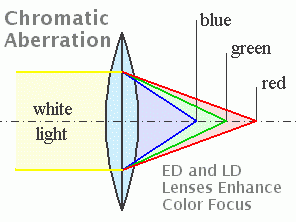
Until now, ED or low dispersion glass was only available in premium camera lenses or top of the line spotting scopes. This is a significant enhancement for benchrest scopes. “ED” or “LD” stands for low dispersion glass–this lessens chromatic aberration, which can cause an image to look fuzzy. All things being equal, low-dispersion lenses transmit a sharper image because different colors (wavelengths) don’t separate as they pass through the glass.
We have looked through various scopes at 6mm bullet holes at 600 yards. With a Leupold 8-25x LRT you can sometimes (in perfect conditions) see holes in the white but they are fuzzy and indistinct. With 36X Weavers or Sightrons, you have more magnification but most examples don’t have the sharpness to pick out 6mm holes consistently at 600. With a 12-42x Nightforce at max power you can see 6mm holes in the white when conditions are good, but it’s pretty difficult otherwise. With the March, Lou reports: “I could easily see 6mm bullet holes in the white or the blue in the mornings. At mid-day holes in the white were still really sharp, but shots in the blue were getting harder to see. At the end of the day when the mirage was bad, I could still see holes, but you needed to wait for the conditions to clear a bit.” Lou added: “On the March the image is bright and sharp all the way to the edge. It’s really noticeably better at the edges than other scopes.”
If all March 40X ED scopes perform as well as Lou’s, then this is a major advancement that may change the way the 600-yard game is played. If the March scope lets you see your bullet holes reliably, in all but the worst mirage conditions, then that really does give a “competitive advantage” over other scopes. We can expect some 600-yard competitors will trade in their Nightforces for March EDs. Lou tells us “many, many top short-range BR shooters are going with the March–Tony Boyer, Billy Stevens, Mike Ratigan–you name it.” But in short-range BR, it is not the resolving power that has driven sales of the March–it is the tracking reliability. Lou explained “In short-range BR, maintaining shot to shot Point of Impact (POI) is do or die. That’s why guys ‘lock up’ Sightrons and Leupolds. But with the March the POI stays constant. And when you do spin the knobs, you get totally repeatable tracking. I was clicking throughout the 600-yard match–even in the middle of a group. When I came back to my original zero it was always dead-on.” Lou noted: “Since I’ve been using the March, my shooting has improved dramatically. I’ve been up at the top and winning more than ever. Even at 300 yards the March makes a big difference. At the 300-yard Nationals Eric Stanton and I were the only two guys who used the scopes and we cleaned house with those things. I finished second overall and Eric finished first.”
The March scope, built by Koto Precision of Japan, is a 40-power, non-zoom, side-focus design, with 1/8-MOA clicks and 72 MOA of total elevation. Weighing 21.2 ounces, it has a 30mm tube, 52mm front objective, and a 1.3mm exit pupil. In the USA, March scopes are sold exclusively by Kelblys. Price is $2100.00 with a choice of four reticles. For more info, click HERE for the March data sheet.
April 25th, 2007
 Olympic-class shooters will be competing April 25-May 3, in Sydney, Australia as part of the ISSF World Cup series of shooting competitions. At World Cup events, hosted at various sites around the world, shooters can earn points towards Olympic elegibility for the next Olympic Games. In Sydney, air pistol and air rifle shooters, and small-bore (rimfire) rifle and pistol shooters will compete in individual and team competition at 10, 25, and 50 meters. To learn more about World Cup shooting, visit ISSF-Shooting.org, or log into the Australian Int’l Shooting Ltd. website. Olympic-class shooters will be competing April 25-May 3, in Sydney, Australia as part of the ISSF World Cup series of shooting competitions. At World Cup events, hosted at various sites around the world, shooters can earn points towards Olympic elegibility for the next Olympic Games. In Sydney, air pistol and air rifle shooters, and small-bore (rimfire) rifle and pistol shooters will compete in individual and team competition at 10, 25, and 50 meters. To learn more about World Cup shooting, visit ISSF-Shooting.org, or log into the Australian Int’l Shooting Ltd. website.
April 24th, 2007
 Written by a team of respected outdoor writers, the new 316-page Rifle Bullets for the Hunter is an impressive reference for any shooter interested in bullet performance. Eric Stecker of Berger Bullets reports: “Hunters finally have a book that thoroughly addresses the component used where the metal hits the meat. This book hits on a topic of importance that until now has been mistakenly assumed, addressed in passing or ignored altogether.” Illustrated with over 125 color photos, the book covers a wide range of topics including: Bullet Testing, Stopping Power, Deer Bullets, Varmint/Small Game Bullets, Big Game Bullets, Solids, and Cast Bullets. Contributing authors include “Leupold Writer of the Year” Award winners Craig Boddington, John Barness, and Ron Spomer, plus Shooting Illustrated Editor in Chief Dave Campbell. The book costs $34.95, direct from Ballistic Technologies. Written by a team of respected outdoor writers, the new 316-page Rifle Bullets for the Hunter is an impressive reference for any shooter interested in bullet performance. Eric Stecker of Berger Bullets reports: “Hunters finally have a book that thoroughly addresses the component used where the metal hits the meat. This book hits on a topic of importance that until now has been mistakenly assumed, addressed in passing or ignored altogether.” Illustrated with over 125 color photos, the book covers a wide range of topics including: Bullet Testing, Stopping Power, Deer Bullets, Varmint/Small Game Bullets, Big Game Bullets, Solids, and Cast Bullets. Contributing authors include “Leupold Writer of the Year” Award winners Craig Boddington, John Barness, and Ron Spomer, plus Shooting Illustrated Editor in Chief Dave Campbell. The book costs $34.95, direct from Ballistic Technologies.

April 24th, 2007
The 6.5 Grendel is derived from the 6PPC necked up to 6.5mm. Popularized by Alexander Arms, the 6.5 Grendel is optimized for the AR15 platform. Fired through a dedicated 6.5mm upper, the 6.5 Grendel lets AR shooters employ a heavier bullet with excellent ballistics and downrange energy. For quite some time, Alexander Arms has offered loaded 6.5 Grendel ammo built with premium Lapua brass and bullets. That is great stuff, but a bit pricey at $24.99 per box. Now Grendel shooters have an alternative. Alexander Arms now sells low-cost 6.5 Grendel Ammunition made by Wolf. Priced at just $9.97 per box of 20, the Wolf ammo is loaded with a 123gr softpoint bullet that packs enough punch for deer-hunters. The round, which runs about 2600 fps, is also well-suited for target and varmint use. Wolf 6.5 Grendel ammo is also available from MidwayUSA for $11.99 per box of 20, item 449268. To learn more about the 6.5 Grendel, read our 6.5 Grendel Cartridge Guide, or visit 65Grendel.com.

April 23rd, 2007
The NBRSA 600-Yard Nationals (Sloughhouse 600) wrapped up yesterday in Sacramento, CA. The top performers were Don Nielson (overall champion), Ron Tilley (Second Overall), and Lou Murdica (Third Overall). Conditions were fairly challenging during the match. On Friday the first relay started very calm, but then the winds picked up later in the day. It was windy Saturday and Sunday, and a big storm on Saturday night actually carried away the cover over the shooting benches. Don truly shot a great match, leading right from the start. After the first day he shot his 6.5×47 in both light and heavy classes. Don was worried about the increased winds on Sunday but “despite my fears, I shot 90s on Sunday which is what I needed to win.” In addition to winning the overall Championship, Don took top honors in Two-Gun Score, Two-Gun Group, Heavy Gun 3-Target Score, and Heavy Gun 3-Target Group. Don also posted the Heavy Gun single target High Score for the match (98-3X). That same target produced the Heavy Gun Small Group, 1.776″, which is a new NBRSA 10-shot record. During the match, Don established three other new score records for the new, smaller 600-yard target.
Ron Tilley ruled the Light Gun Class, finishing first in both Score (276-5X), and group (2.414″ Agg), and Ron had the best LG 3-target Group Agg. (2.023″). Ron was shooting a 6BR smithed by Stu Harvey. Bert Seltzer nailed the Light Gun Small Group, a 1.7″ (49-2X). Lou Murdica, shooting a 6BR with 95gr Bergers, shot the Light Gun High Score (50-3X) on a target which also produced an impressive 1.745″ group. (Lou shot a 6.5×55 in Heavy Gun.) In Heavy Gun class L. Dragoman Sr. shot well as did Billy Copelin.
 We spoke to Don Nielson this morning and he had some interesting observations. He started off the match shooting his 6.5×47 in Heavy Gun and 6-6.5×47 in Light Gun. Both rifles weigh 17 lbs. and use Panda actions in Kelbly 1M stocks. But, after his 6.5×47 produced the 1.776″ group on Day 1, he shot that Hart-barreled rifle in both classes for the rest of the match. On Sunday it was very windy and Don had two larger-caliber rifles in his truck, a 280 Rem Improved and a big 30. Don thinks “the 6.5×47 is the ideal cartridge for 600 yards, but when it really blows you may want something bigger.” Don attributed the accuracy of his rifle to careful brass prep: “If you don’t have perfect brass, you might as well go home.” Don reamed the 6.5×47 flash holes to .0625″ with a Ron Hoehn tool, and turned the necks to .010″ wall thickness using his Pumpkin neck-turning tool. In the 6.5×47 he shot a “moderate” load of RL15 with new JLK 130gr bullets from Swampworks.com. He uses Federal 205m primers and he says he has had absolutely no ignition problems. In the 6-6.5×47, Don used H4350 with original, Jimmy Knox produced 105gr JLKs. FYI, if you want some of those Swampworks’ 130s, you better get in line. Don just ordered another 3000. We spoke to Don Nielson this morning and he had some interesting observations. He started off the match shooting his 6.5×47 in Heavy Gun and 6-6.5×47 in Light Gun. Both rifles weigh 17 lbs. and use Panda actions in Kelbly 1M stocks. But, after his 6.5×47 produced the 1.776″ group on Day 1, he shot that Hart-barreled rifle in both classes for the rest of the match. On Sunday it was very windy and Don had two larger-caliber rifles in his truck, a 280 Rem Improved and a big 30. Don thinks “the 6.5×47 is the ideal cartridge for 600 yards, but when it really blows you may want something bigger.” Don attributed the accuracy of his rifle to careful brass prep: “If you don’t have perfect brass, you might as well go home.” Don reamed the 6.5×47 flash holes to .0625″ with a Ron Hoehn tool, and turned the necks to .010″ wall thickness using his Pumpkin neck-turning tool. In the 6.5×47 he shot a “moderate” load of RL15 with new JLK 130gr bullets from Swampworks.com. He uses Federal 205m primers and he says he has had absolutely no ignition problems. In the 6-6.5×47, Don used H4350 with original, Jimmy Knox produced 105gr JLKs. FYI, if you want some of those Swampworks’ 130s, you better get in line. Don just ordered another 3000.
We noted that Don and Lou Murdica are both veteran short-range benchrest shooters. We asked Don if his short-range experience gave him an edge in the 600-yard game. He replied: “Well both Lou and I are used to holding off as the conditions change. I never clicked once I had a group going–I held off as conditions dictated. I also tried to shoot sighters in all conditions that might occur during record fire, and noted how these impacted on the target. That way I felt I knew how to compensate with my hold no matter which way the conditions went.” Lou Murdica noted that his new March 40X ED scope made it easier to hold off: “Most of the time I had no trouble seeing 6mm bullet holes at 600 yards in both the white and blue areas of the target. Most of the other guys had trouble seeing their bullet holes with other scopes.”
Congratulations to all the competitors. We also credit Ed Eckhoff and his crew, who, as usual, did a great job running the match at the Sacramento Valley Shooting Center.
April 23rd, 2007
 The Bullet Test Tube (BTT), an innovative product from Ballistic Technology, allows hunters to test the terminal performance of hunting bullets. This $69.95 unit contains a re-usable wax-like compound that simulates how a bullet penetrates and expands when shot into a game animal. With the BTT, you can measure the wound channel volume (with water), then split the medium in half to measure the wound channel’s length and width. To re-use the BTT, simply melt the core material in a crock-pot or large pan and pour it into a new cardboard tube. Click the screenshot below to watch a QuickTime Video that demonstrates the whole process. The Bullet Test Tube (BTT), an innovative product from Ballistic Technology, allows hunters to test the terminal performance of hunting bullets. This $69.95 unit contains a re-usable wax-like compound that simulates how a bullet penetrates and expands when shot into a game animal. With the BTT, you can measure the wound channel volume (with water), then split the medium in half to measure the wound channel’s length and width. To re-use the BTT, simply melt the core material in a crock-pot or large pan and pour it into a new cardboard tube. Click the screenshot below to watch a QuickTime Video that demonstrates the whole process.

To learn more about the Bullet Test Tube, read this Product FAQ or this Test Tube Review from Handloader Magazine. The Bullet Test Tube has earned the NRA Publications 2007 Golden Bullseye Award and Field & Stream’s 2006 “Best of the Best” Accessories Award.
April 22nd, 2007
Regular readers of this website will know that we are big fans of Wipe-Out™ from SharpShoot-R™ Precision Products. Wipe-Out™ really works, and can save countless hours of cleaning, plus reduce wear and tear on your barrels. (Click HERE for related article.) The only shortcoming of Wipe-Out™ foam cleaner is that you’ll need to wait an hour or more to get the best cleaning results. This editor’s barrels like two applications of Wipe-Out with four hours total dwell time. Terry Paul, inventor of Wipe-Out™, has come up with a solution for shooters who want the benefits of Wipe-Out™ without the extended wait time.
 Terry’s new Patch-Out™ product is a non-petroleum-based liquid solvent that is effective on carbon and copper fouling. It does the job with just 15-25 minutes of soak time in the barrel. Unlike many other solvents, it does not leave a gummy residue in your barrel, and it doesn’t have to be “neutralized” after use. Terry’s new Patch-Out™ product is a non-petroleum-based liquid solvent that is effective on carbon and copper fouling. It does the job with just 15-25 minutes of soak time in the barrel. Unlike many other solvents, it does not leave a gummy residue in your barrel, and it doesn’t have to be “neutralized” after use.
Patch-Out™, as the name indicates, is applied with wet cotton patches. You can also use a brush, but you’ll probably find that you’ll get excellent results with only minimal brushing. After applying Patch-Out™, and letting it soak for 15-25 minutes, just use a dry patch. Because Patch-Out™ has a rust inhibitor, you don’t need to follow up with oil. Patch-Out™ is also safe to leave in your barrel overnight, just like Wipe-Out™. There is some evidence that, if you use a non-petroleum-based solvent such as Patch-Out™ and no oil, you can shoot more rounds through your barrel before a stubborn carbon ring will form just ahead of the throat. This is because that carbon ring is actually created, in part, from the “burn-off” of petroleum-based solvents and lubes. Patch-Out™ will be available from major suppliers including Brownells, MidwayUSA, and Midsouth Shooters Supply.
April 22nd, 2007
 Many readers have asked where they can find a high-quality, extremely light-weight hunting stock suitable for a “walk-around” varminter. One impressive option is Tom Manners’ Carbon Fiber MCS-UL (UltraLight). Weighing just 1.55 pounds, the Manners’ UltraLight is built to Benchrest standards. Despite its minimal weight, the stock is strong and very rigid–because it is basically a seamless shell. The only cuts in the shell are for the action pillars and bolt handle. Both the 1.75″-wide fore-arm and pistol grip area have a molded-in textured surface for better grip. Many readers have asked where they can find a high-quality, extremely light-weight hunting stock suitable for a “walk-around” varminter. One impressive option is Tom Manners’ Carbon Fiber MCS-UL (UltraLight). Weighing just 1.55 pounds, the Manners’ UltraLight is built to Benchrest standards. Despite its minimal weight, the stock is strong and very rigid–because it is basically a seamless shell. The only cuts in the shell are for the action pillars and bolt handle. Both the 1.75″-wide fore-arm and pistol grip area have a molded-in textured surface for better grip.

The MCS-UL is priced at $495 (before options), and is currently available only with a Rem 700 inlet. This will fit Rem 700 actions or clones such as the Lawton 7000 and Stiller Predator. Available finishes include clear-coat or polyurethane paint in black, gray, or olive. If you want to “show off” that handsome carbon shell, go with the clear-coat. For more details, contact Manners Composite Stocks, (816) 210-8108.
April 21st, 2007
 We’ve been waiting over a year for the new Norma URP (“Universal Rifle Powder”) to make it to America. This is an extruded powder with a burn rate similar to H4350. URP is available from Powder Valley and Grafs.com, and both companies have plenty in stock. We think this powder may be ideal for use in the 6XC and 6-6.5×47. We suspect it will also work very well for the .284 Winchester. Jason Baney recently received 2 lbs. of URP and he will be doing initial pressure/velocity workups this weekend. We’ve been waiting over a year for the new Norma URP (“Universal Rifle Powder”) to make it to America. This is an extruded powder with a burn rate similar to H4350. URP is available from Powder Valley and Grafs.com, and both companies have plenty in stock. We think this powder may be ideal for use in the 6XC and 6-6.5×47. We suspect it will also work very well for the .284 Winchester. Jason Baney recently received 2 lbs. of URP and he will be doing initial pressure/velocity workups this weekend.
April 20th, 2007
 Reader Richard H. just tested his new CED M2 Chronograph, one of the first units in the country. This is an all-new design with many upgrades over the previous CED Millenium model. Clock speed was boosted to 48 mHz, expanding the measurable velocity range to 7,000 fps. Memory storage has been expanded 500%. You can now have up to 500 speed readings per string (and as many as 500 strings). CED claims: “Expanded digital chip design now gives the CED M2 the ability of reading velocities at much lower light levels. On clear days, this means the ability to chronograph from early morning till almost sunset.” If this claim is true, the CED M2 would definitely out-perform rival PACT and Shooting Chrony designs in marginal light conditions. Reader Richard H. just tested his new CED M2 Chronograph, one of the first units in the country. This is an all-new design with many upgrades over the previous CED Millenium model. Clock speed was boosted to 48 mHz, expanding the measurable velocity range to 7,000 fps. Memory storage has been expanded 500%. You can now have up to 500 speed readings per string (and as many as 500 strings). CED claims: “Expanded digital chip design now gives the CED M2 the ability of reading velocities at much lower light levels. On clear days, this means the ability to chronograph from early morning till almost sunset.” If this claim is true, the CED M2 would definitely out-perform rival PACT and Shooting Chrony designs in marginal light conditions.
We’ve found that, with most chronographs, the biggest problems are confusing controls and keypad sequences that are hard to remember. CED has addressed that with the new machine. The $199.00 CED M2 Chronograph features single function string removal (something we wish the Shooting Chrony had), and the M2 offers “one touch” calculation of the average of the three highest velocities in a string. Another major (and much appreciated) improvement is the addition of a USB interface. That offers simple “plug and play” compatibility with laptops and home PCs. USB connectivity will make it much easier to download Chrono data into the updated CED Data Collector software. For more info, contact Competitive Edge Dynamics, CEDHK.com, (610) 366-9752. Right now the CED M2 is back-ordered, but a new shipment is arriving in 2 weeks and M2s should be available by mid-May at Brownells and MidwayUSA.com.

Richard tells us: “I’ve been frustrated for a long time with my inability to get my extreme spreads below 30-50 fps and have wondered if my bargain-basement Chrony F-1 might be part of the problem. Well, after I got my Denver Instruments MXX-123 last month, the powder scale was no longer a credible culprit, so I went shopping for a new chrono. This is what I found. Initial results (only three 5-shot groups so far) suggest that ES with the CED M2 is only half of what the Chrony measured. In the Chrony’s defense though, it is surprisely good for something that costs less than half as much (also more convenient and more portable).” If anyone in the Sacramento, CA area has an Oehler Chrono, Richard would like to do a 3-way comparision test with the CED, Oehler, and Shooting Chrony. We’d all be interested in the results. Contact Mailbox@6mmBR.com and we’ll put you in touch with Richard.
|


