|
|
June 12th, 2009
In the shooting sports, safety always has to be your number one priority. Even if you have a safe load, if the barrel is obstructed in any way, such as with mud in the barrel, a squib bullet, or a bore-sighting tool left in the barrel, the barrel can blow up, pealing back like a banana skin. Serious injury or even death can result. Below is an amazing video showing a catastrophic barrel failure caused, presumably, by a barrel obstruction — probably mud or dirt. You can see the barrel blow apart, starting at time mark 0:25 seconds.

The rifle is a Browning stainless A-Bolt, caliber unknown. We don’t know for sure, but the barrel probably became obstructed when the shooter allowed the gun to rest muzzle down on the ground, so some mud collected in the bore. Below, we’ve grabbed five frames from the key section of the video. You can see the barrel split into two segments. This shooter, who was NOT wearing eye protection, was uninjured. He is is lucky that the action held and no metal shards blew backwards.
June 12th, 2009
While conventional print gun magazines are having trouble maintaining readership, it seems like a new Firearms Blog (short for Web Log) launches every week. Our own AccurateShooter.com Daily Bulletin is one of the most popular rifle-oriented Blogs on the Internet, receiving over 14,000 page views every day.
Blogs represent the “new wave” of gun journalism. At the NRA Annual Meeting in Phoenix, on-site bloggers outnumbered “normal” print journalists for the first time. With the ability to provide late-breaking news, streaming video, and user comments, it’s no wonder Blogs are increasing in popularity compared to print journalism. For gun enthusiasts and supporters of the Second Amendment, you’ll find a wide variety of firearm blogs covering everything from antique arms to the latest high-tech military weapon systems.
50 Best Gun Blogs
The folks at Criminal Justice Degrees Guide recently released a list of the 50 Best Blogs for Gun Enthusiasts. Our Daily Bulletin made the Top 50 list, as did many of the Blogs we visit regulary. You may want to check out these firearms-related sites (listed in Alphabetical Order):
Gun Nut — Affiliated with Field & Stream magazine, this Blog is updated daily, and has nice photos and videos. It emphasizes shootgun sports and game hunting.
NFA Gun Trust Lawyer Blog — Edited by an Attorney, this blog covers legal issues facing gun owners.
Nigel Allen’s Airgun Blog — Well-written blog for air-gunners with nice photos. UK-based Allen founded the Bristish Airgun Shooters’ Association.
NRA Blog — This diverse blog features NRA activities, match reports, and gun rights news. NRA Blog staffers often travel to report first-hand from major events.
The Firearm Blog — Blogmaster Steve scours the net for interesting news and product intros. Updated daily, this blog has lots of photos and videos. Handguns and military-style rifles are featured heavily.

June 11th, 2009
 These days, shooters use all sorts of battery-powered accessories: chronographs, electronic ear-muffs, wind meters, timers, laser-rangefinders, even pulse-monitors. While AA or AAA batteries are easy to find and relatively inexpensive, many modern digital gadgets use smaller (yet more expensive) 1.5-volt batteries. These days, shooters use all sorts of battery-powered accessories: chronographs, electronic ear-muffs, wind meters, timers, laser-rangefinders, even pulse-monitors. While AA or AAA batteries are easy to find and relatively inexpensive, many modern digital gadgets use smaller (yet more expensive) 1.5-volt batteries.
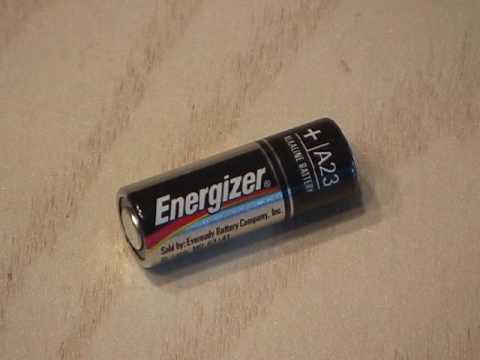
Here’s a simple “hack” that gives you eight (8) 1.5-volt button batteries for the price of a single A23 Energizer 12-volt battery (about $2.00 per pair). If you use the 1.5-volt batteries, this could save you quite a bit of cash. Just peel open the Energizer A23 with a screwdriver and you’ll find eight 1.5-volt batteries inside.
Note — this trick is known to work only with the Energizer A23, 12-volt battery. If you use another brand of A23, you might just end up with a ruined A23 and nothing else.
For more interesting, money-saving projects, visit KipKay Videos.
June 11th, 2009
Recent visitors to the AccurateShooter.com site may not know that we have an entire set of FREE TARGETS. There are sight-in targets, load development targets, Benchrest Targets, NRA Highpower targets, Scope Testing Targets, even a special set of Fun Targets.
Most of the targets come bundled in .zip archives, so you can easily download multiple targets with one click. The targets are saved in .pdf format, so they are easy to print and the scale is correct no matter what your screen resolution.
Here Forum member FireMedic shows some fine shootin’ with our basic Accuracy Target. With small, red diamonds and extended black lines, this target allows very precise aiming at 100 and 200 yards. The gray dot on top provides a reference point for a 200-yard zero. FireMedic reports: “My 30″, 12 twist, 3 groove does pretty good for an old Savage chambered in .308 Win.” With an average group size of 0.208 inches we’d have to agree. Great Shootin’ FireMedic!

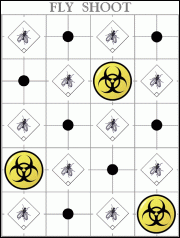
Here are two fun targets you might enjoy. The Atomic Target was originally created as a contest for our readers. The design is by Michael Forester of Auckland, New Zealand. Hit the bigger green and red neutrons, then try your luck with the smaller electrons. In the center, go for true “bug-holes” with our Fly Shoot Target. Watch out for the bio-hazard rings!
You’ll find other excellent, downloadable training targets on the U.S. Palma Team Website, www.uspalma.com. More than 50 free targets are offered, all in easy-printing .pdf format. Shown below is the “inside-out” fun target from the U.S. Palma Team site.

June 10th, 2009
What do you give “the man who has everything” for Father’s Day? How about a 7.62×39 ice-cube tray? This is no spoof. Shaped like an AK-47 magazine, this plastic “12-round” ice mold produces realistic 7.62×39 ice “cartridges” for use with your favorite beverages. This is just the thing for those summer lawn parties with your shooting buddies.
 
Each 8.5″ x 3″ tray produces ice cartridges measuring roughly 2.2″ x 1/2″, very close to the real size. The AK-47 ice tray costs about US $10.00 from FindMeAGift.com in the UK. Simply fill up one side of the tray with water, snap both sides together and freeze. Because water expands when it freezes, the ice will fill both sides, creating a 3D shape.
June 10th, 2009
Have a squirrel problem in your back yard, or maybe mice in the barn? Here’s an innovative, high-tech solution. Starting with a hand-cranked, pneumatic Gatling BB-Gun kit from BMIKarts, a talented machinist created a servo-activated, air-powered Gatling that can be “aimed” with a lap-top computer. A high-pressure air hose provides the energy to launch the BBs, while both traverse and elevation are handled by computer-controlled, electric servo-motors. Watch the video below, and you’ll notice some very nice machining on this mini-Gatling. Actual firing starts at the 24-second mark.

June 9th, 2009
Capitalizing on the strong consumer interest in AR15-style rifles, Remington Arms recently introduced its 597-VTR, a semi-automatic 22LR with AR-style ergonomics. Inside the matte black, slab-sided “upper” is the venerable Remington 597 receiver, updated with a nickel-Teflon® plated bolt, hammer and sear. On the outside, the 597-VTR features a AR-15 pistol grip, and AR collapsible stock, and a round AR-style float tube/handguard. On top of the receiver is a 1913 Picatinny-spec scope rail. Street price for the new rifle is about $450.00, complete with compact 10-round magazine. A standard Remington 597, without the tactical goodies and black paint, costs under $200.00.

Good for 3-Gun Cross-Training and Tactical Rimfire
While we snicker a bit at an older rimfire design tarted up in new tactical clothing, the 597-VTR makes sense for some users. Three-gun competitors should like this rifle. Most multi-gun match shooters use ARs for the rifle stages. With the 597-VTR, they can cross-train using inexpensive 22LR ammo, while maintaining the same basic ergonomics. For 3-gun shooters, who engage targets from a wide variety of shooting positions (often behind barriers), the collapsible stock has utility. It will allow the shooter to make his rifle more compact when practicing CQB or house-clearing stages.

With mods, the 597-VTR should also work well for the tactical rimfire discipline. The Picatinny rail makes it easy to swap over good optics from your centerfire gun. The tubular forearm should provide a strong mount for a bipod. However, for the tactical rimfire game, which is shot mostly prone, we don’t like the collapsible stock at all. Junk it. The LOP is too short, the bottom of the stock is terrible with sandbags, and the cheek weld is wrong. Tactical rimfire shooters would be wise to replace the collapsible stock with an upgraded design with longer length of pull and a proper cheekpiece. (The 597-VTR will accept most AR15 stocks). And, in reality, with a bedding job, a basic 597 in a laminated stock (see below) would probably work just as well.

June 9th, 2009
 You may have already heard this news, but we wanted to repeat it for our readers. Czech ammo-maker Sellier & Bellot was acquired in April by Companhia Brasileira de Cartuchos (CBC) a Brazilian enterprise. CBC produces civilian and military ammunition in calibers up to 30mm, and CBC sells a small line of sporting arms. CBC also owns U.S.-based MagTech Ammunition and Metallwerk Elisenhutte GmbH (MEN) of Germany. You may have already heard this news, but we wanted to repeat it for our readers. Czech ammo-maker Sellier & Bellot was acquired in April by Companhia Brasileira de Cartuchos (CBC) a Brazilian enterprise. CBC produces civilian and military ammunition in calibers up to 30mm, and CBC sells a small line of sporting arms. CBC also owns U.S.-based MagTech Ammunition and Metallwerk Elisenhutte GmbH (MEN) of Germany.
Founded in 1825, Sellier & Bellot has been a world leader in ammo production for over 180 years. It produces a very wide range of cartridge types, including pistol ammo, hunting ammo, and a large selection of both modern and “classic” military cartridges. CBC states that Sellier & Bellot will continue under current management, delivering Sellier & Bellot branded ammo through its current sales channels.
June 9th, 2009
Gary Anderson, Director of Civilian Marksmanship (DCM), has authored an excellent primer on the use of plug gauges to score targets. Anderson reviews the different types and sizes of gauges and explains the sometimes confusing rules for there use. CLICK HERE to read the whole article in the First Shot, the CMP Online Magazine.
 Anderson writes: “A frequently asked question at CMP concerns what are the correct gauges to use for scoring different targets and where can they be obtained. This is not a simple question to answer. There are inward gauges and outward gauges for most 10 meter and 50 foot targets and when each must be used varies from target to target. There are actually three different smallbore or .22 caliber inward gauges. And in High Power rifle matches governed by NRA Rules, the gauge used depends upon the caliber of the rifle being fired at each target. Moreover, ISSF and USA Shooting Rules give legal gauge dimensions in millimeters and NRA Rules use inches, while National Three-Position Air Rifle Council gives both. With so many rulebook variations, it is not difficult to understand why questions about scoring gauges are commonplace. Anderson writes: “A frequently asked question at CMP concerns what are the correct gauges to use for scoring different targets and where can they be obtained. This is not a simple question to answer. There are inward gauges and outward gauges for most 10 meter and 50 foot targets and when each must be used varies from target to target. There are actually three different smallbore or .22 caliber inward gauges. And in High Power rifle matches governed by NRA Rules, the gauge used depends upon the caliber of the rifle being fired at each target. Moreover, ISSF and USA Shooting Rules give legal gauge dimensions in millimeters and NRA Rules use inches, while National Three-Position Air Rifle Council gives both. With so many rulebook variations, it is not difficult to understand why questions about scoring gauges are commonplace.
Scoring Gauge
A scoring gauge is a precision metal instrument with a spindle sized to fit into the shot hole and a flange or “measuring diameter” turned to a precise size that is specified in a competition rulebook. The gauge, which is often called a “plug,” is inserted into a doubtful shot hole. The scorer then examines or “reads” the edge of the flange to determine whether the doubtful shot is “in” (receives the higher value) or “out” (receives the lower value). A magnifying glass is usually used to aid the scorer in accurately reading where the edge of the flange lies. Scoring gauges come with various types of handles that are used to gently hold the gauge while inserting it in a doubtful shot hole. Scoring gauges available in the USA vary in cost from $4.00 to $15.00.
 Inward or Outward Gauges Inward or Outward Gauges
A first step in sorting out this question requires an understanding of the difference between inward and outward gauges. An inward gauge is read on the inside or side of the gauge that is closest to the target center. An outward gauge is read on the outside or side of the gauge that is away from the target center.
Inward gauges give direct readings— does the inside edge of the flange touch or break the scoring ring in question? Outward gauges give indirect readings — does the outside edge of the flange remain inside the outer edge of a scoring ring that is usually two rings outside of the scoring ring value that is being evaluated? Some short-range targets and all targets used at distances of 25 yards or longer are scored with inward gauges. Outward gauges are used to score certain shots on 5-meter BB gun, 10-meter air rifle and pistol and some 50-foot smallbore rifle targets. Outward gauges typically are used on smaller rifle targets that have miniscule dots for 10-rings and scoring rings that are very close together because reading those gauges to the outside on larger scoring rings is more accurate.”

Official Gauge Specs and Sources
Anderson’s full article goes on to list the specific gauges (with dimensions) used for a variety of disciplines: 5-meter BB gun, 10-meter Air Rifle, 10-Meter Air Pistol, 50-Foot USAS 50 Smallbore Rifle, 50-Foot A-36 Smallbore Rifle, ISSF/USAS .22 Cal. Rifle & Pistol, NRA Smallbore Rifle & Pistol, CMP Rimfire Sporter (and Sporter rifle), CMP Games High Power Rifle, and CMP EIC and NRA Highpower Rifle. Anderson notes that NRA Smallbore Rifle and Pistol targets, as well as CMP Rimfire Sporter targets, must be scored with a .22 NRA Inward Gauge (.2225-.224”) for all rings. Anderson suggests using an Eagle Eye scoring device to detect and score double or multiple shot holes.
CLICK HERE for FULL ARTICLE with GAUGE SOURCES.
Text and photos © 2008 CMP, used with permission.
June 8th, 2009
 Remington Arms Company, Inc. through its fully owned subsidiary DA Acquisitions LLC, has entered into a purchase agreement to acquire certain assets of Dakota Arms, LLC including the Dakota, Nesika Bay Precision, Miller Arms, and Dan Walter brands. The transaction closed on June 5, 2009. Remington Arms Company, Inc. through its fully owned subsidiary DA Acquisitions LLC, has entered into a purchase agreement to acquire certain assets of Dakota Arms, LLC including the Dakota, Nesika Bay Precision, Miller Arms, and Dan Walter brands. The transaction closed on June 5, 2009.
This is the latest major acquisition by Remington Arms, which acquired Bushmaster Firearms, Marlin Firearms, and DPMS in 2007. Remington Arms is owned by Cerberus Capital Management, a private holding company. The acquisition of Dakota Arms is another example of the increasing consolidation of the American gun industry. Dakota Arms had suffered from over-ambitious growth plans and its revenues failed to meet investors’ expectations as Dakota never really developed a strong customer-base for its premium hunting rifles. Dakota tried to become the “Lexus/Mercedes” of the rifle market, but the plan didn’t work. Dakota’s rifles were much more expensive than Remington or Browning products, yet lacked the accuracy and craftsmanship of the high-grade, true custom rifles. “Factory rifles at custom rifle prices” was not a good business model.
Established in 1982 and headquartered in Sturgis, South Dakota, Dakota Arms manufacturers custom and semi-custom rifles for the sporting markets. The Dakota brands include Nesika, Miller Arms and Dan Walter. Nesika Bay Precision actions (at one time) were highly respected for their engineering and build quality; Miller Arms is known for the reliability and performance of its single-shot actions and custom rifles. Dakota Arms is based in the Black Hills of South Dakota and currently employs 35 people.
“I am pleased to announce that Dakota Arms is joining Remington and the Freedom Group of companies,” stated Ted Torbeck, CEO of Remington Arms Company, Inc. and Freedom Group Inc. “Dakota Arms is an icon within the industry and its fine products exemplify quality, craftsmanship and attention to detail. Dakota is the perfect compliment to our industry-leading family of brands. We look forward to continue to develop and expand the Dakota brand and thank all its employees for their continued dedication and success of Dakota Arms.”

|