Serious shooters dream of having a backyard range where they can practice, test loads, and shoot for fun with friends. For most of us, having even a 50-yard backyard range is impossible. And those lucky shooters who do have their own range can typically go out to 100 yards, but that’s it. It takes plenty of open land to set up even a 200-yard range, and then you still need the side of a mountain for a backstop, or many acres of additional clear land behind the berm, for safety reasons.
Mother of All Backyard Ranges
AccurateShooter Forum member J.R. (aka Huntinco) has put us all to shame. He is building the “mother of all backyard ranges” at a secret location in northern Utah. How long is J.R.’s range going to be? 500 yards? Nope — think WAY longer. J.R. has laid out a facility that is a full 1600 yards from firing line to the final target bay. Plus there are pits every 100 yards out to 1600 yards.
J.R.’s range is not just a strip of vacant land with a few target stands. The range will boast a full-featured shooting facility when it’s completed. J.R. is constructing a finished, covered “all-weather” shooting house with seven indoor shooting stations (and more benches outside). He explains: “I poured a 12×90 pad. I’m enclosing 45 feet and just putting a roof over the other 45 feet. On the enclosed part there are six, 6′-wide shooting stalls, with one on the end that’s 12′ wide. Shooting windows are 5′ wide and 4′ high. One small problem is that, the way the property lays out, only the 12′-wide stall can shoot 100 yards. All the rest will start at 200 yards.”
Interior Finishing Suggestions Are Welcome
J.R. hasn’t finished the interior of his shooting facility yet, so he is soliciting ideas as to how the inside should be laid out: “I need your input because I have never been to a range. I just shoot here on my place. Please help me with [your input] on the inside layout.”
Those of you who have suggestions for J.R., please place a comment here. And no, we won’t reveal where this beautiful range is being built. But we do give J.R. a hearty pat on the back for making his “dream range” a reality. CLICK HERE to view more photos.
UPDATE — Here are photos of the Shooting house, interior and exterior. Nice job J.R.!
New Name, Same Game
Jessie Harrison (who formerly competed as Jessie Abbate) stormed through the Steel Challenge last weekend, winning multiple titles (including her fourth women’s Overall Win) in a truly dominant display of speed and accuracy. This was a gutsy performance by Jessie, who has faced tough family issues lately*.
This year marked the 30th Anniversary of the Steel Challenge, one of the most prestigious action pistol events in the country. The match, held August 18-21, 2011 in Piru, California, attracts the top handgunners in the world, who compete against the clock in multiple stages. All targets are steel plates.
In a dominating “three-peat” performance, Jessie Harrison won the Women’s Division of the Steel Challenge. This is the third year in a row that Jessie won the Women’s Overall Title. Her 2011 win now gives her FOUR Steel Challenge Overall titles. This year, Jessie also won the Rimfire Title, the Women’s Limited Title, and the Steel Master Title. Jessie, who shoots for Team Smith & Wesson, proved convincingly that she is the woman to beat in the speed-shooting game.
B.J. Norris Blazes in Men’s Division
Jessie’s Team Smith & Wesson team-mate B.J. Norris rolled over the competition in the men’s Open division, demonstrating both blistering speed and consistency. Like Jessie, Norris won multiple titles: Open Division, Rimfire Open, and Steel Master. B.J. shot an impressive 81.18 score to secure the Open Division win.
Former Team Glock shooter Dave Sevigny won the men’s Limited Class (iron sights) with a cumulative time of 90.51. Dave obviously has not suffered too much from his move away from Team Glock, which has lost many top shooters lately. The men’s Production Class winner was Mike Seeklander with a 99.73 score. Living legend Jerry Miculek once again showed he is the world’s greatest wheelgunner, winning the OSR (revolver) class.
*Jessie’s 45-year-old husband, William L. Abbate, a professional shooter, was recently arrested and charged with improper conduct with a 15-year-old female shooter whom he coached. READ News Story.
The Tuff 1 Grip Cover is a simple new accessory that may benefit tubegun shooters, AR owners, and pistol enthusiasts. Tuff 1 Grip Covers are made from a proprietary, grippy rubberized material that can stretch up to 200%. This elasticity allows the covers to easily fit all revolvers, semi-autos, and rifle or shotgun pistol grips. As you’d expect, Tuff 1 grip covers give you a more secure hold. Importantly, the material also helps absorb recoil (though not as much as Hogue grips). When fitted over a standard, hard-plastic AR grip, the Tuff 1 sleeve definitely provides a more comfortable, “high-traction” feel in the hand. On semi-auto pistols, Tuff 1 grip covers give a secure hold without the rough feel you get with stick-on skateboard tape.
Boa or Bad-Ass
Three surface patterns and four colors (Black, Olive Drab, Desert Tan, Hot Pink) are offered. We prefer the raised button “Boa Snake” pattern, but there is also a grid pattern with raised lines, and a skull pattern, for those “bad-ass” types. The $16.95 MSRP is the same for all colors and surface patterns. You can order from major vendors or directly from the Tuff 1 Online Store.
The one-size-fits-all Tuff 1 grip covers are easy to install. Simply roll the rubberized grip up like a sock, place it on the grip, then unroll it. (Watch installation video below). The Tuff 1 covers can be just as easily removed without harming the rubber.
Useful Product — But Consider Other Options
If you sweat a lot or shoot in wet climates, Tuff 1 grip covers provide a simple, low-cost upgrade. A Tuff 1 grip sleeve does markedly enhance the standard plastic AR15 pistol grip, which is hard, and slippery when wet. But then, for not much more money, you can select among a half-dozen or more aftermarket AR grips which will probably fit your hand better AND provide more cushioning.
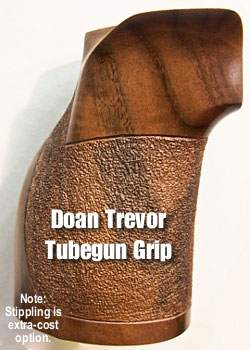
For wood-handled wheelguns, we like the Tuff 1 covers in Boa or ‘Double-Cross’ pattern. The Tuff 1 grip sleeves provide better “traction” and cushion the hand a bit without changing grip geometry or making the grip overly thick in your hand. For a tubegun, we prefer the feel and ergonomics of a wood grip, such as those crafted by Doan Trevor (photo at right). These cost $75.00 from DoanTrevor.com or CompetitionShootingStuff.com. For $175.00, Doan also offers fully customized stippled grips, fitted to the shooter’s hand, and finished in satin or gloss.
The centerfire World Benchrest Championship (WBC) is being hosted in Volmerange-Les-Mines, France this year. Matches commence on Tuesday, the 23rd of August. Practice has been underway since August 18. The official WBC website includes an event schedule plus a list of this year’s WBC competitors. It appears that the number of shooters is down slightly this year, compared to the 170 participants who attended the 2007 WBC in Austria. However, it looks like there will be a record number of countries represented at this year’s Championship event, with first-ever attendees from nations such as Colombia and Ukraine. The WBC has truly become a “world” competition, attracting the “best of the best” from around the globe. The match will be held at the modern Eurostand facility, one of Europe’s best-equipped indoor/outdoor shooting ranges.
The three American squads attending the 2011 WBC will include many Benchrest legends:
Team USA ‘A': Tony Boyer, Larry Costa, Gene Bukys, Chris Harris
Team USA ‘B': Mike Ratigan, Jack Neary, Andy Shifflett, Wayne Campbell
Team USA ‘C': Larry Baggett, Robert Hammack, Dave Coots, Tim Oltersdorf
Story tip by Fergus Bailey. Photos courtesy Association Bench Rest France.
Dennis DeMille, Gen. Manager of Creedmoor Sports, fired a rare 100-4X in the standing stage of the 2011 Springfield Rifle Match, winning the event and setting a new record in the process. DeMille’s 297-8X Aggregate score broke the previous record of 295-6X set by Douglas Armstrong last year. DeMille fired a 98-2X in slow-fire prone, and a 99-2X rapid-fire prone. DeMille then capped his record-setting match with his remarkable 100-4X in the final offhand stage. MSG Julia Watson, USMC, the only female competitor, placed second with a 293-4X Aggregate.
DeMille is Former National High Power Champion
A former U.S. Marine Rifle Team member, Dennis is no stranger to the podium at Camp Perry. Dennis won the NRA Nat’l High Power Championship in 2005 and the Service Rifle National Championship in 2003. This year Dennis proved this year that he still has what it takes. Congratulations to Dennis — Well done! After Dennis returned from Camp Perry, we asked him some questions about his 1903 Springfield rifle and his performance.
Interview with Dennis DeMille
Q: How does it feel to win an elite competition at age 46 compared to your other championships earlier in your career?
Dennis: Notwithstanding my freakish friend Carl Bernosky, as you get older, for a variety of reasons, winning becomes a little bit harder — in my case it’s poor vision. So of course each victory tastes a little sweeter and nothing is taken for granted.
Q: What were conditions like at the match this year?
Dennis: We had beautiful conditions that day — just a little warm.
Q. What ammo were you using?
Dennis: Hornady 168 grain .30-06, as issued at the Match.
Q: Was anything special done to accurize your rifle?
Dennis: No. This was the first match for this stock though. I think that might be why I shot two 9s in prone slow fire — it was still settling in. Nothing has been done to any part of the rifle to make it more accurate. The rifle is “as-is” from the CMP … complete with nasty trigger. Before I shoot it again though I am going to swap out the front sight blade for a fatter USMC type blade so I can see it [better].
Q. You nailed the standing, often considered the hardest stage. What advice can you give to shooters who want to improve their standing abilities?
Dennis: No secret there — snap-in, holding exercises, and a good mental program. In particular I recommend 20 one-minute holding exercises, with 30-second breaks in between each hold. That is the quickest and best way to identify a poor position (because it will be painful), and build a well-supported position.
Q: Does Creedmoor Sports have any specialty products for shooters of the 1903 Springfield or other vintage military rifles?
Dennis: We really don’t have many products specific to those rifles. But the beauty of those rifles and that course of fire is that there isn’t much you need to buy.
Photos Courtesy Civilian Marksmanship Program (CMP).
The 8th Western CMP Games and Creedmoor Cup Matches will be held at the Ben Avery Shooting Facility in Phoenix, Arizona, on 15-23 October 2011. The Western CMP Games run 15-18 October while the Creedmoor Cup Matches follow on 19-23 October. This event typical draws hundreds of shooters who compete with a wide variety of rifles — Match Rifles, Service Rifles, Vintage Military Rifles, and Rimfire Sporters. All interested shooters, whether new or experienced, recreation-oriented shooters or national championship contenders are invited to participate in these unique, national-level competitions. CLICK THIS LINK to register for the match. This event is co-sponsored by the Civilian Marksmanship Program and Creedmoor Sports.
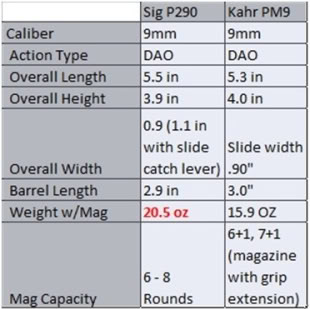
Small, light-weight carry pistols and revolvers are the hottest selling handguns on the market right now. Ruger’s .380 ACP and 9mm carry guns have been hugely successful, generating revenues that have helped push Ruger’s stock price up 500% since 2009. Now Sig-Sauer is getting on the bandwagon. We had a chance to look at Sig’s new-for-2011, P290 compact 9mm carry pistol. Overall, our reaction was generally favorable. The P290’s fit and finish are excellent — as you’d expect from Sig. Keltec’s PF-9 compact 9mm seems downright junky by comparison to the Sig P290. And the machining and fit of the slide and barrel on the Sig seem superior to the hot-selling Ruger LC9. In a nutshell, here’s how the new Sig P290 stacks up to the competition — it is better crafted and more reliable than the Keltec PF-9, it is more reliable than the Ruger LC9 (which has had recall issues), and, with its optional integrated laser, it is a more complete package than the Kahr CM9 and PM9.
However, the P290 is not without its flaws. We wish the grip was a little longer — and other reviewers agree. Also the trigger pull, listed at “9.0 lbs. average”, is just too heavy in our opinion. We know that Double-Action-Only (DAO) carry pistols like this need high pull weights to satisfy the lawyers, but the P290 pull weight is extreme. Most people will have trouble getting best accuracy out of the gun because of the heavy trigger, which one tester measured at 12.5 pounds.
Rich Grassi, Tactical Wire: “According to factory specifications, the trigger is supposed to average 9 pounds. The guns [we tested were] 1st Edition models and could have been underachievers. While some participants thought the triggers were a bit extreme, I found them manageable. The sample that arrived at headquarters on my return is an overachiever; my Timney scale ran out of weights at 10 pounds. Getting my old Brownells trigger pull gauge, I was able to get an average of around 12 ½ pounds(!) before bending the trigger hook! This is 12 ½ pounds to fire a gun that weighs just over a pound. You hold it still through a trigger stroke. I’ll watch.”
Paul Scarlata, PoliceMag: “The trigger pull was rather heavy with a definite staging about halfway through the stroke, although I assumed this would smooth out with use. My other concern was that the attenuated grip left the little finger of my shooting hand dangling in the air. Because of its short grip, frame recoil control was not what one would have hoped for and I actually found the pistol more comfortable to fire with an unsupported grip. [Sig informed me] that future plans call for the P290 to come with a spare eight-round magazine with a sleeve that approximates the external contour of the grip. Such magazines will provide a full, three-finger grip without compromising concealability[.]”
CONCLUSION: The Sig P290 is a well-designed, nicely-made pistol in the super-small 9mm carry pistol category. However, for this writer, I wouldn’t want to carry the gun unless the trigger pull could be reduced to a reasonable weight for a DAO application (the trigger pull on the Kahr PM9 is much better). I would also wait until the optional magazine with grip extension is available. In the meantime, when the situation calls for a very small, light carry gun, I’ll stick with my older S&W model 638 revolver. We do suspect that, despite its shortcomings, the P290 will attract many buyers based on Sig Sauer’s reputation for quality. But the P290 costs more than most other small, polymer-framed 9mms, and price may be the deciding factor for many buyers.
The National Matches at Camp Perry have wrapped up. That means it’s time to lay in a supply of practice targets so you can improve your skills during the off-season. Creedmoor Sports is now offering 20% off its inventory of targets and target pit supplies (spotters, spindles, and pasters). Creedmoor has a full line of official NRA High Power Targets, F-Class Targets, Smallbore Targets, Airgun Targets, and Pistol targets. You’ll find both full-size targets and replacement centers (which are much less expensive). To get your 20% discount on targets and target supplies, use Coupon Code TARGET11 during checkout.
IMPORTANT: The 20% off promo runs for a limited time — this offer is only good from August 19, 2011 through August 21, 2011, and the discounted prices apply to in-stock targets only (no discounted back-orders). So if you want to save 20%, order soon!
The Montana Northwest 1000-Yard Benchrest Association held its annual Championship match last weekend at the Deep Creek Range near Missoula, Montana. The match drew talent from across the nation. 57 shooters attended the two-day event, and many states were represented: California, Idaho, Missouri, Montana, North Dakota, Oregon, South Dakota, Washington — even Pennsylvania.
Dashers Dominate Two-Gun Results
Dashers ruled the roost for the most part, with four of the top five in the Two-Gun shooting 6mm Dashers. Leo Anderson (Dasher) finished first in Two-Gun, followed by Robert Hoppe (Dasher), Mike Thomas (Dasher), Richard Schatz (Dasher), and Don Nielson (6.5×47 Lapua). Leo Anderson also won the Heavy Gun Overall, followed by Dennis Peterson, and Robert Hoppe. Cody Finch topped the 17-pound class, ahead of runner-up Robert Hoppe, with Leo Anderson coming in third. Lonnie Anderson won the 11-Pound Sporter Class, ahead of Scott Nix and Kevin Watson.
Conditions Were Hot But Relatively Calm
Montana shooter Tom Mousel, who finished 6th in the two-gun overall, reports that: “It was a very calm, high pressure weekend, so much of the home field advantage wasn’t there. There was some mirage in the 90° heat, but mirage was really quite manageable. The stable conditions made for a very close match, with competitors from outside Montana giving the locals a run for their money.” As usual, the club had a rich prize table — there were over $27,000.00 worth of prizes and give-aways.
Highlights for the weekend included Barry Bluhm’s 3.624″/99 in Heavy Gun class on Saturday. Barry, who shots a 6-6.5×47 Lapua, proved you don’t have to run a Dasher to shoot small. Three perfect 100 scores were shot at the match. In Light Gun, Roger Hoppe fired a 100/5.947″ on Saturday, while Mike Thomas got his first perfect score with a 100/6.664″ on Sunday with his Light Gun. Deep Creek Ace Leo Anderson nailed a 100/5.432″ in the Heavy Gun class on Sunday.
Two-Gun Overall
1. Leo Anderson 15
2. Robert Hoppe 17
3. Mike Thomas 20
4. Richard Schatz 22
5. Don Nielson 23
6. Tom Mousel 26
7. Cody Finch 28
8. Bud Williams 28
9. Jack Peterson 30
10. Monte Foust 31
Heavy Gun Overall
1. Leo Anderson 6
2. Dennis Peterson 9 (5.876″)
3. Robert Hoppe 9 (8.3155″)
4. Mike Hern 9 (8.419″)
5. Tom Mousel 10 (7.083″)
6. Mike Thomas 10 (9.0685″)
7. Richard Schatz 10 (9.8235″)
8. Don Nielson 11
9. Vince Kruse 13
10. Lonnie Anderson 14
17-Pound Gun Overall
1. Cody Finch 7
2. Robert Hoppe 8
3. Leo Anderson 9
4. Mike Thomas 10 (7.1765″)
5. Bud Williams 10 (7.566″)
6. Jack Peterson 10 (7.609″)
7. Monte Foust 12 (8.690″)
8. Don Nielson 12 (8.787″)
9. Richard Schatz 12 (9.165″)
10. Ray Huffman 12 (9.294″)
11-Pound Sporter Class
1. Lonnie Anderson 6
2. Scott Nix 7
3. Kevin Watson 9
4. Cody Finch 10
5. Terry Hettich 13
6. Richard Schatz 13
7. Dirk Bluhm 15
8. Jack Peterson 17
9. Gary Christian 17
10. Bruce Bangeman 17
Leo Anderson Equipment:
Light Gun: 6mm Dasher, Stiller Viper drop port, Lawrence rifle barrel, Nightforce scope, Shehane stock, metal smithing by King Machine.
Heavy Gun: 6mm Dasher, Stiller Viper drop port, Lawrence rifle barrel, Nightforce scope, Bangeman stock, metal smithing by King Machine.
Dennis Peterson Equipment:
Light Gun + Heavy Gun (Dennis shoots one 17-pounder in both): 6mm Dasher, Defiance action, Lawrence rifle barrel, Nightforce scope, Shehane stock, smithing by Jeff Lawrence.
Match Sponsors Included: Bartlein Barrels, BAT Machine, Berger Bullets, Brownells, Burris, D&B Supply, Defiance, Dewey Mfg., Forster Products, Hodgdon Powder, Ron Hoehn, Lee Precision, Leica, Krieger Barrels, Lilja Barrels, Don Nielson, Nikon, Pacific Tool & Gauge, Pro-Shot, Sierra Bullets, Sure-Fire, Swarovski, Vortex Optics and Zeiss.
This fall, November 4-6, 2011, a new two-man tactical challenge match will be held at the Blue Steel Ranch in Logan, NM (site of the popular Steel Safari match). Sponsored by Competition Dynamics and Thunder Beast Arms, the 2011 Thunder Beast Team Challenge (TBTC) is a 3-day, 8-stage test of practical field rifle shooting and related skills. This will be a physically-demanding match! Two-man teams must navigate rugged desert terrain, recognize, locate, range, and engage multiple rifle targets from challenging shooting positions, and complete the 8-stage course under daily time constraints. Most targets will be steel plates, set at distances from 100 to 800 yards.
Skills used at the TBTC will include target recognition, range estimation, wind doping, trail skills, and marksmanship. The competition is designed to test a 2-man team’s skills shooting rifle and carbine to their effective ranges at practical targets in the natural terrain using what gear they can carry. One team member will use a precision bolt gun and while the other carries a tactical-style carbine. Targets for the carbine range from 20 to 400 yards, with some “move and shoot” assault-style stages. Bolt-gun targets are generally positioned at 150-800 yards
The TBTC is being run by Competition Dynamics, whose staff has a proven 10-year track record as practical field match organizers. Zak Smith is Match Director. The TBTC will be held at the Blue Steel Ranch, a private ranch near Logan, New Mexico. The Blue Steel Ranch, which also hosts the Steel Safari, offers some of the best geography for field shooting available anywhere.
The Thunder Beast Team Challenge costs $585.00 per team. To register, or to learn more about the match, visit the 2011 Team Challenge webpage. Or, email thunderbeastarms [at] gmail.com.


 New Name, Same Game
 B.J. Norris Blazes in Men’s Division
 Useful Product — But Consider Other Options


 Dennis DeMille, Gen. Manager of
 The 8th


 SIG P290 Online Reviews
 CONCLUSION: The Sig P290 is a well-designed, nicely-made pistol in the super-small 9mm carry pistol category. However, for this writer, I wouldn’t want to carry the gun unless the trigger pull could be reduced to a reasonable weight for a DAO application (the trigger pull on the Kahr PM9 is much better). I would also wait until the optional magazine with grip extension is available. In the meantime, when the situation calls for a very small, light carry gun, I’ll stick with my older S&W model 638 revolver. We do suspect that, despite its shortcomings, the P290 will attract many buyers based on Sig Sauer’s reputation for quality. But the P290 costs more than most other small, polymer-framed 9mms, and price may be the deciding factor for many buyers.


 The TBTC is being run by


